

In April 2026, ResumeTemplates.com surveyed 1,000 U.S. Gen Z workers ages 18 to 29 about workplace preparedness, career consequences, and the skills they say they were never taught growing up. The findings document where these workers have been disciplined, underpaid, and passed over, and where they are filling the gap today.
Study highlights:
- 2 in 3 (67%) Gen Z workers have been disciplined, underpaid because they didn’t negotiate, or passed over because of communication issues, and they attribute it to skills they were never taught growing up
- 6 in 10 (60%) say their parents shielded them from challenges more than they prepared them to face them
- 2 in 5 (40%) have earned less than they should have because they were never taught to negotiate
- 28% of Gen Z earning under $40,000 a year have been formally disciplined at work, compared with 15% of those earning $125,000 or more
- 4 in 5 (80%) turn to AI or social media at least once a month for workplace guidance
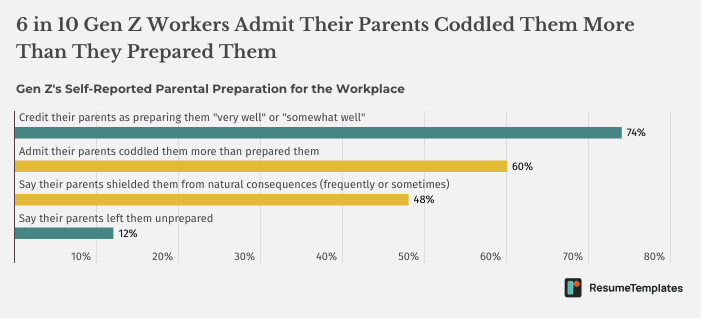
3 in 5 Gen Z Workers Admit Their Parents Coddled Them More Than They Prepared Them
Three in four Gen Z workers (74%) say their parents prepared them “very well” or “somewhat well” for workplace expectations and professional behavior, while 12% say they were left unprepared. Four in five (79%) feel “very prepared” or “somewhat prepared” to teach what their parents didn’t teach them to a younger sibling about to start a first job.
On overprotection, 60% say their parents “definitely” or “probably” protected them from challenges more than they prepared them to face challenges; 24% said “probably not” or “definitely not.”
Just under half (48%) say their parents shielded them frequently or sometimes from the natural consequences of their actions growing up, covering for missed assignments, smoothing over conflicts, or making excuses.
An earlier ResumeTemplates.com survey of Gen Z workers found 45% regularly have a parent talk to their current manager, and 73% have parents help complete their work assignments.
“Early-career employees tend to struggle most with workplace politics, because learning to read the room and being strategic in their communication aren’t common skills taught by parents or universities in many cases,” said Julia Toothacre, Chief Career Strategist at ResumeTemplates.com. “Similar to the negotiation skills they mentioned not being prepared for, managing politics becomes a new way of thinking and acting that doesn’t come naturally to most people. They’ll hold back in meetings, even when speaking up would benefit the situation and them. This gap falls on managers to recognize and address in their early-career hires.”
“When an early-career professional is frustrated about not feeling prepared at work, I want to get to the core issue,” Toothacre added. “Is this a skill issue and you need practical training, or is this a perception issue and you need a different perspective? Critical feedback doesn’t mean your manager hates you, which is how some perceive it. Understanding the root and reality of what you’re feeling helps you recognize what needs to be addressed.”
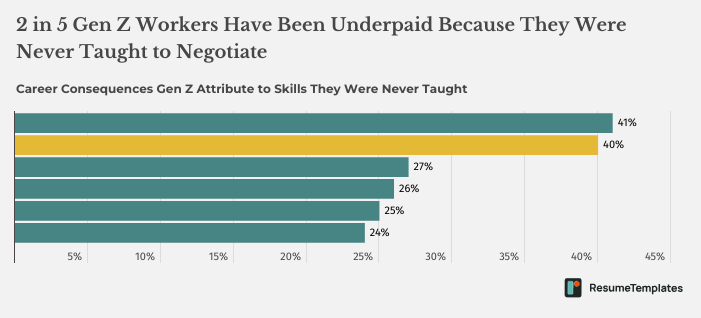
2 in 5 Gen Z Workers Have Been Underpaid Because They Were Never Taught to Negotiate
Two in five Gen Z workers (40%) say they have earned less than they should have because they did not negotiate, and they attribute that gap to skills they were never taught at home. An earlier ResumeTemplates.com survey of Gen Z workers documented parents joining job interviews and handling negotiations on their adult children’s behalf.
Across the same question, 41% say they have felt embarrassed in front of a boss or coworker, 27% have left a job within the first year because expectations were unclear, 26% have missed a promotion they felt they deserved, 25% have been passed over for a role because of communication issues, and 24% have received a formal warning or been disciplined. Each consequence was attributed to gaps from childhood.
Among Gen Z workers earning under $40,000 a year, 28% have been formally disciplined at work, compared with 15% of those earning $125,000 or more.
“Unfortunately, if you’ve left money on the table because of missed negotiation, it will be hard to recover in the same position, but not impossible,” Toothacre said. “If you’re excelling significantly in the position, it’s worth having a conversation with your manager about adjusting the pay to align with the level and quality of work you’re producing. Worst case scenario, they say no or tell you it’s in alignment with other team members. From there, you can decide if it’s worth staying longer or taking action to get a new job where you’ll be able to negotiate.”
“For a missed promotion, speak with your manager about what a promotion timeline looks like moving forward,” Toothacre added. “Express your desire to move up and come prepared to show evidence of why you deserve it.”
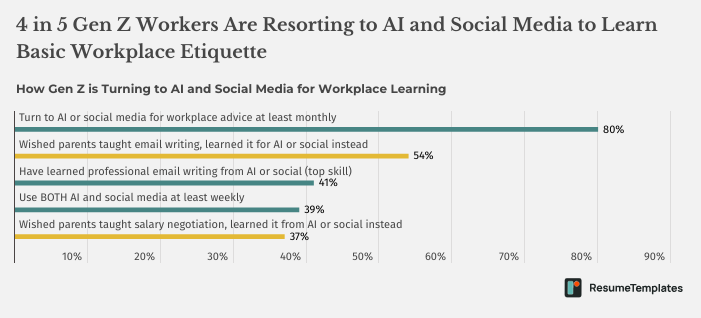
4 in 5 Gen Z Workers Are Resorting to AI and Social Media to Learn Basic Workplace Etiquette
Eighty percent of Gen Z workers turn to AI tools like ChatGPT or social media platforms like TikTok, Instagram, YouTube, or LinkedIn for workplace advice or career guidance at least once a month. Nearly 2 in 5 (39%) use both AI and social media at least weekly.
Professional email writing is the skill Gen Z has most successfully filled in from those sources: 41% say they learned it from AI or social media, the highest share of any workplace skill measured. That rises to 54% among Gen Z workers who specifically wished their parents had taught them to write professional emails.
For salary negotiation, 37% of Gen Z workers who wished their parents had taught them to negotiate have instead learned it from AI or social media.
“AI resources like ChatGPT are wonderful tools for early-career professionals to learn from when there is a gap in education,” Toothacre said. “If the gap is skill-based or practical, like writing an email, AI works well. Even in salary negotiation, there is a lot AI can provide to help you think through the process and ask the right questions. The times you want to have a conversation with someone are when you need to understand the context of a situation, the people involved, the politics, or when it’s a more complex situation that requires a human perspective.”
“When you’re trying to learn how to negotiate and manage conflict, you need feedback beyond words,” Toothacre added. “Both of those skills require your body language, facial expressions, and tone of voice to be considered. If you’re negotiating your salary and your voice isn’t confident on the phone, you need that feedback, which comes from a human, not a machine. AI can help you prepare significantly, but to really perfect these skills, human feedback will take you to the next level.”
Methodology: This survey was conducted via survey platform Pollfish in April 2026. In total, 1,000 U.S.-based Gen Z workers ages 18 to 29 were surveyed. Respondents were screened for current employment. Percentages reported are unweighted respondent percentages, and multi-select questions are calculated as the share of respondents who selected each option, not the share of total selections. The margin of error is approximately +/- 3 percentage points at the 95% confidence level. Responses were filtered using Pollfish’s fraud-detection tools and an in-survey attention check. Results are based on self-reported responses.
Resume Templates offers HR approved resume templates to help you create a professional resume in minutes. Choose from several template options and even pre-populate a resume from your profile.