Network Engineer Resume Examples and Templates for 2026



Engineering managers decide whether to forward a resume to the technical screen by the first job's bullets on page one; if shipped scale and stack ownership aren't visible by then, the resume loses to one that shows both.
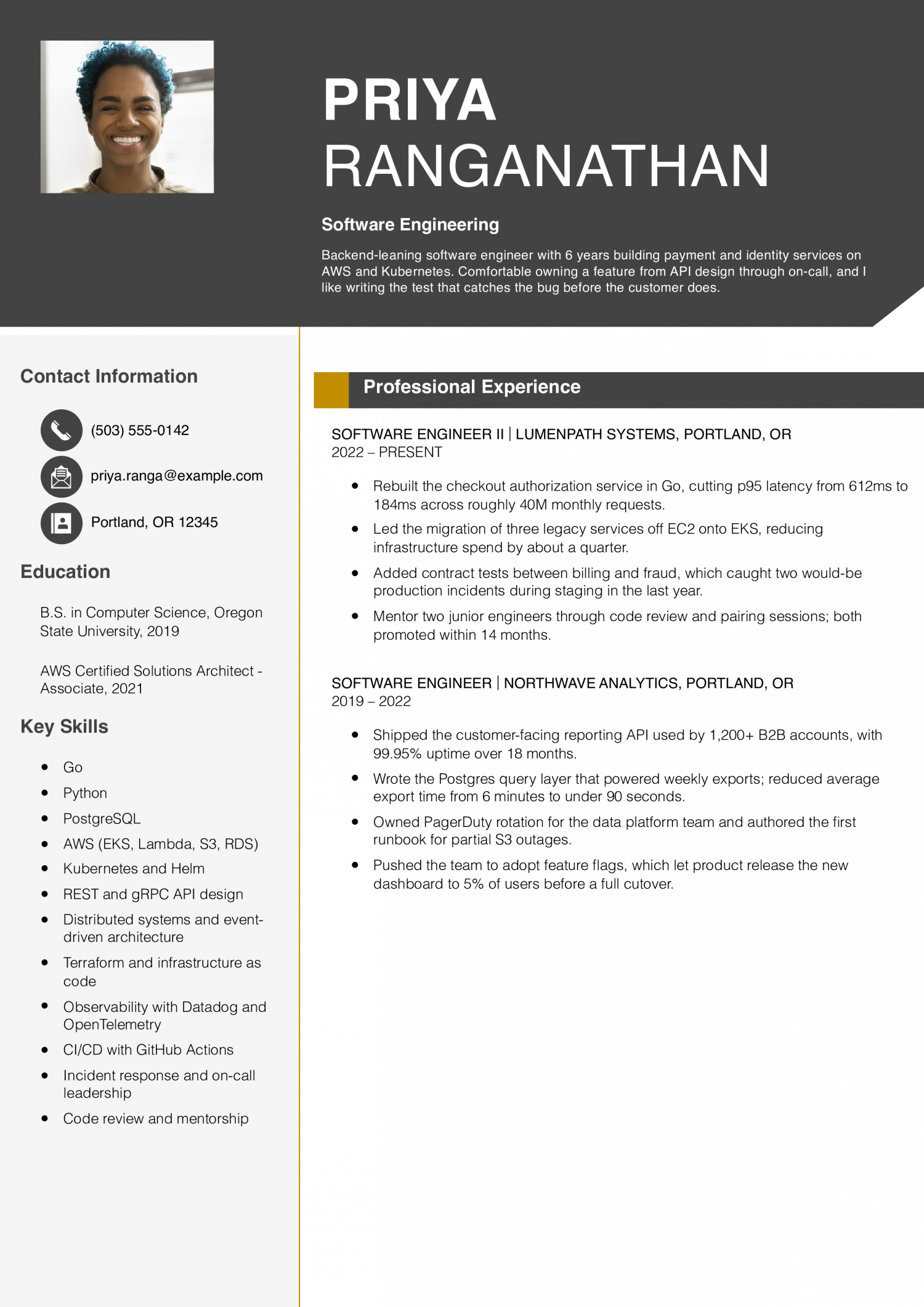
The junior engineer profile fits one to three years post-bootcamp, internship, or CS degree. This resume needs to prove you've shipped real features to production, not just completed coursework, and that you can navigate a codebase with code review feedback.
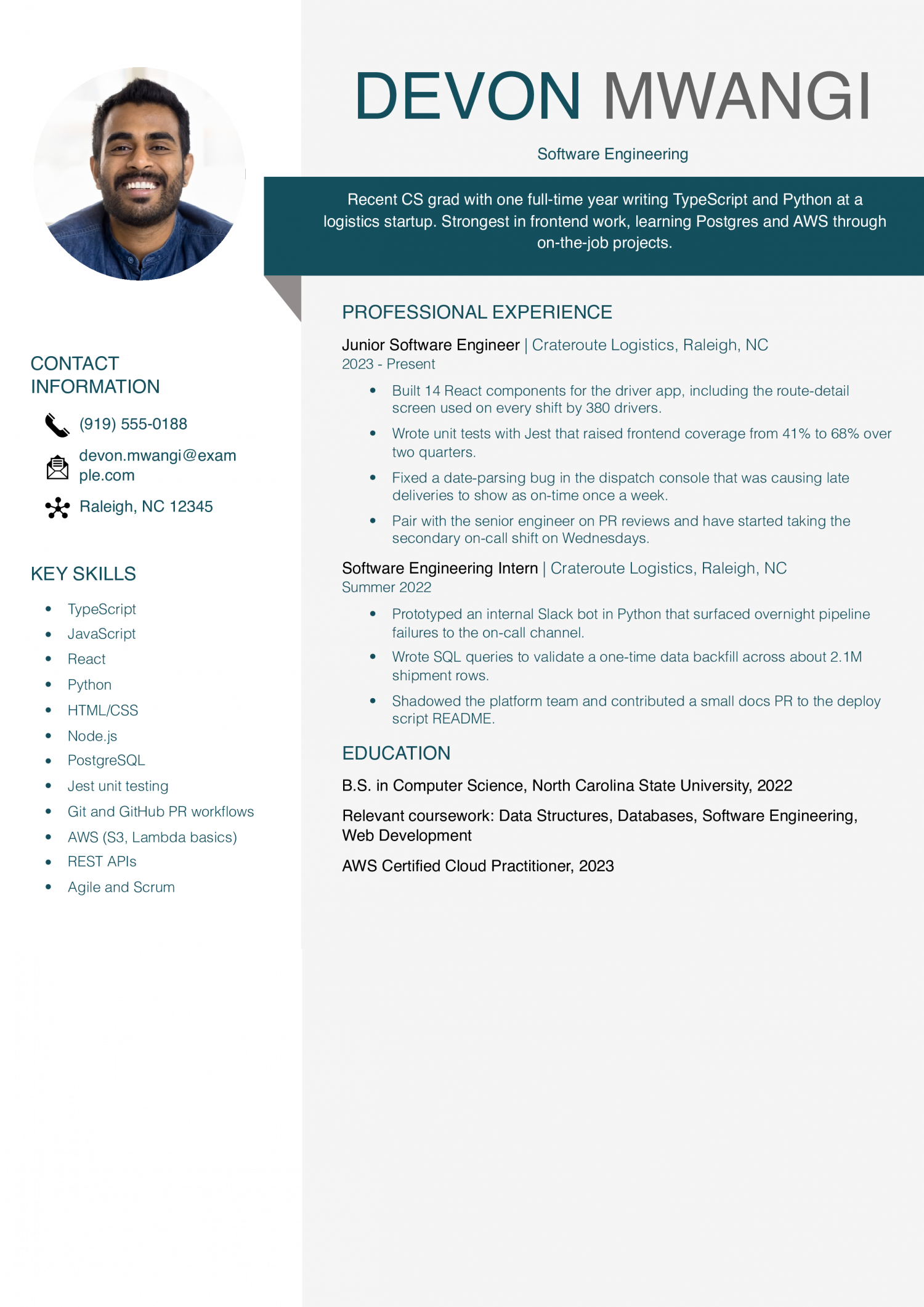
The senior engineer profile fits four to eight years owning features and services in production. This resume needs to prove system-level ownership: design docs you wrote, on-call rotations you carried, and the scale numbers behind the systems you shipped.
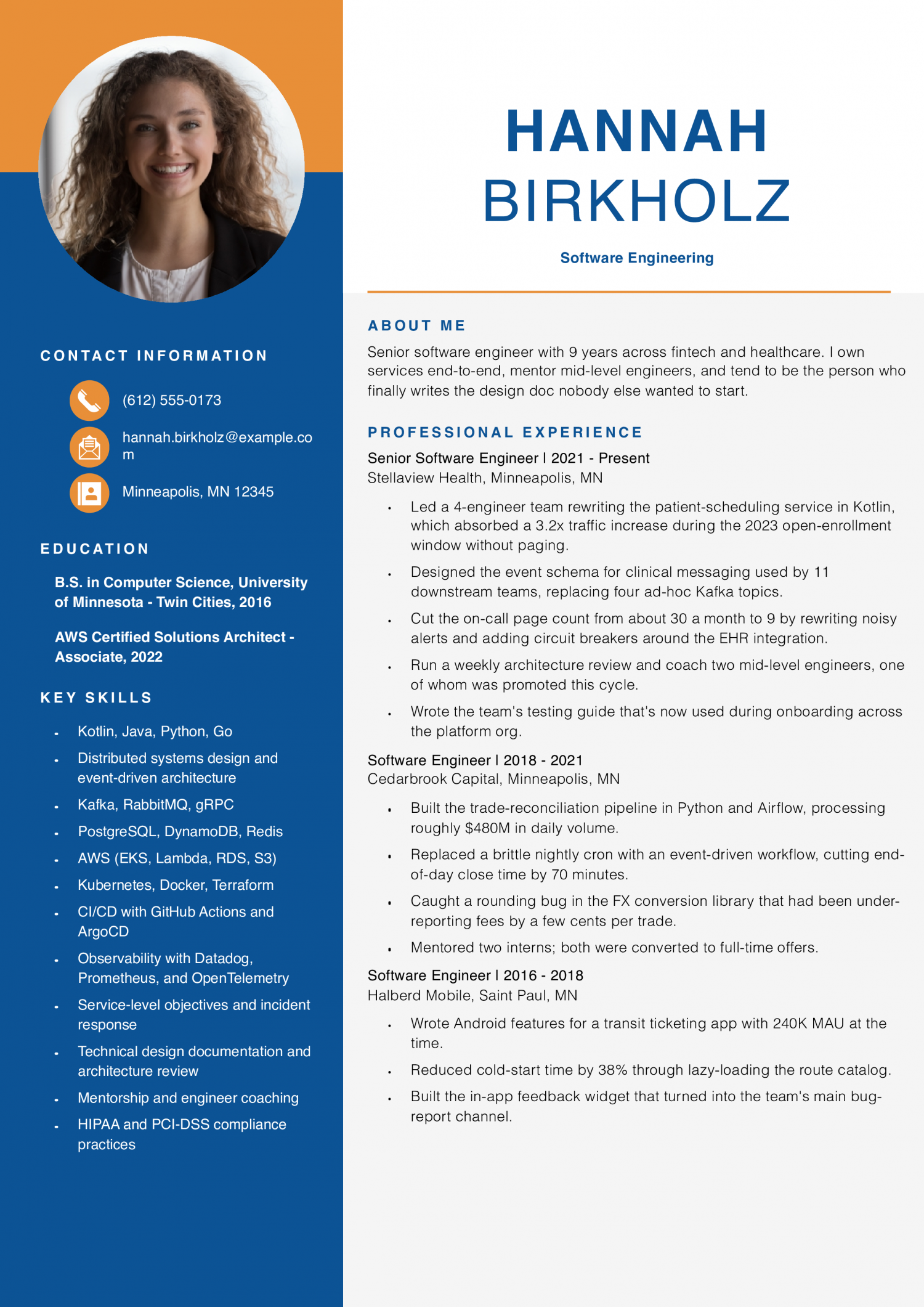
The staff engineer profile fits eight-plus years operating across teams on platform or architecture work. This resume needs to prove cross-team leverage: the migrations you led, the standards you set, and the engineers you mentored toward senior.
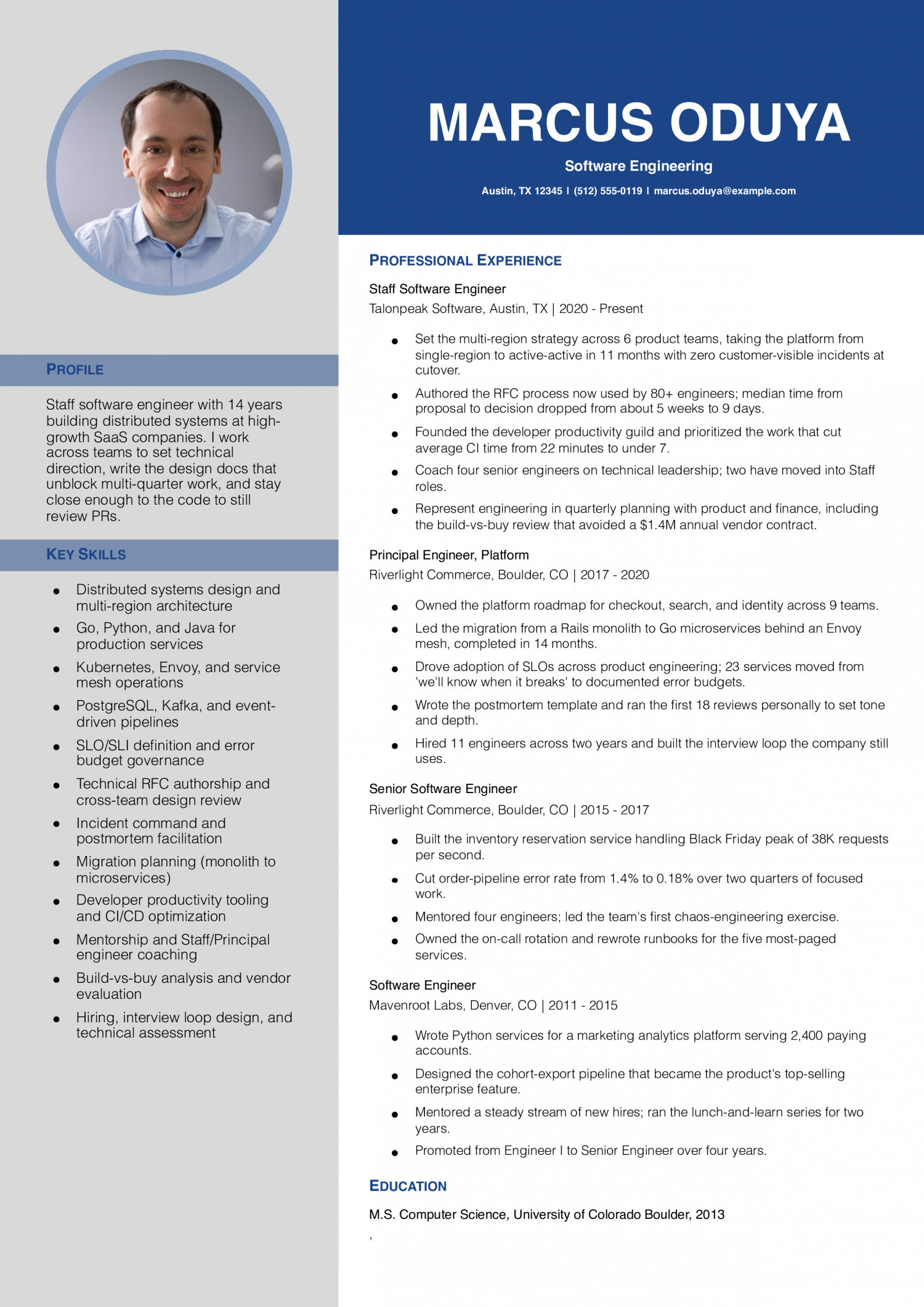
Elena Vasquez-Pratt
Seattle, WA | (206) 555-0164 | [email protected] | linkedin.com/in/elenavp
Software engineer with 8 years across backend, data, and developer tooling. I gravitate toward the messy seams between services: schema migrations, auth handoffs, the script nobody owns. Comfortable as the technical lead on a 3 to 5 person team and happy to do the boring documentation that keeps a project on schedule.
Senior Software Engineer
Northkettle Software | Seattle, WA | 2022-Present
Software Engineer
Glacierbyte Networks | Bellevue, WA | 2019-2022
Software Engineer
Coastpine Robotics | Tacoma, WA | 2017-2019
Software Developer
Heritage Mutual Insurance | Spokane, WA | 2015-2017
Software Engineering Intern
Heritage Mutual Insurance | Spokane, WA | Summer 2014
Your profile should state your years building production software, the systems you’ve owned (backend services, mobile clients, data pipelines, platform tooling), and the primary languages in your daily work.
Name the scale you’ve operated at: requests per second, users served, data volume, or team size. An engineering manager scanning page one wants to place you on the stack and the seniority ladder within fifteen seconds. A profile that reads “six years building Go and Python backend services for fintech APIs serving twelve million users” places you instantly.
A profile that reads “experienced software engineer with strong technical skills” sends the resume to the bottom of the pile.
Strong software engineering bullets carry numbers. Recruiters and engineering managers scan for three metric types first: scale, performance, and reliability.
Name request volume, p99 latency, error rates, deploy frequency, or cost reduction. Bullets without a number tend to read as duties, not contributions. Write “Cut checkout API p99 latency from 840ms to 210ms by replacing the ORM hot path with raw SQL” instead of “Improved API performance.” Write “Owned the pricing service handling 18k requests per second across three regions” instead of “Worked on backend services.” The bullets that advance further name the metric, the magnitude, and the technical lever you pulled.
Cluster your work into three to five categories that match how technical interviewers think: systems shipped, performance and reliability work, cross-team collaboration, and mentorship or hiring.
Under systems shipped, name the service, your role on it (sole owner, tech lead, contributor), the stack, and the production scale. Under performance and reliability, name incidents you led, on-call rotations you carried, and SLO improvements. Under collaboration, name the design docs you authored and the cross-team migrations you drove.
This grouping helps an engineering manager scan for the specific signal they need to fill the role, whether that’s distributed systems depth, frontend polish, or platform thinking.
Software engineering resumes need a dedicated technical skills block on page one, directly under the profile. Engineering managers and technical recruiters use it as an ATS pass and a fast eligibility check before reading bullets.
Group the block into languages (Go, Python, TypeScript, Rust), frameworks and runtimes (React, Node, Django, Spring), data and infrastructure (PostgreSQL, Kafka, Kubernetes, Terraform), and cloud (AWS, GCP, Azure). List AI tools you use in your workflow (Cursor, GitHub Copilot, Claude Code) honestly. Certifications like AWS Solutions Architect or CKA sit in a separate block at the bottom of page one, with the issuing body and year.
Senior and staff resumes lose credibility when they pad page two with bootcamp projects, college coursework, or every freelance gig from a decade ago. Cut anything that doesn’t prove production scale, ownership, or leverage.
Drop the “objective” line, the GPA if you have four-plus years of experience, and the generic “proficient in agile methodologies” filler. Trim early-career roles to two bullets each, keeping only the highest-scale shipped work. Replace a long projects section with two or three open-source contributions or technical talks.
The goal is a two-page resume where every bullet earns its line by naming a system, a number, or a decision.
Software engineering hiring is tight in 2026. Engineering teams are running leaner after the 2023-2024 corrections, and the bar to clear a screen is higher. The skills below come from our user-built software engineering resumes.
Hard skills like Python and Kubernetes get you through the ATS keyword parse. Soft skills like cross-team collaboration get weighed in the engineering manager loop. Match the hard skills against the posting’s stack, and treat soft skills as the lens for writing your bullets, not a list to copy.
| Soft Skills | % of resumes with this skill |
|---|---|
| Problem-solving | 79% |
| Communication skills | 62% |
| Adaptability and learning | 47% |
| Analytical thinking | 40% |
| Teamwork and collaboration | 31% |
And here are the top hard skills showing up most often.
| Hard Skills | % of resumes with this skill |
|---|---|
| Python programming | 77% |
| Object-oriented design | 70% |
| SQL databases | 47% |
| REST API development | 35% |
| System design | 25% |
Based on data from thousands of software engineers’ resumes built on ResumeTemplates.com, May 2026.
Before a software engineering resume gets a closer read, hiring teams check for a short list of essentials.
Engineering managers and technical recruiters expect the resume to mirror the posting’s stack and seniority language. Group these terms into the skills block and the profile so the ATS keyword parse catches them.
| Niche | Keywords ATS scans for |
|---|---|
| Backend and API engineering | backend engineer, REST API, microservices, distributed systems |
| Senior and staff signals | senior software engineer, staff engineer, technical lead, system design |
| Full-stack and frontend | full-stack developer, React, TypeScript, Next.js |
| Platform and infrastructure | Kubernetes, Terraform, AWS, CI/CD pipelines |
| Data and ML adjacent | data pipelines, Kafka, Spark, ML infrastructure |
What engineering managers expect on a software engineering resume has shifted: a resume that hides AI tooling now reads as out of touch, while an honest workflow naming Cursor or Copilot and the review steps you keep reads as current. The list below names what to add.
Boilerplate, test stubs, and obvious refactors now come from Copilot or Cursor; review judgment and system design stay human.
AI review bots catch style and obvious bugs first, so human reviewers focus on architecture, security, and edge cases.
Engineers draft architecture decision records and runbooks with LLM assistance, then edit for accuracy before merging.
On-call engineers paste stack traces and logs into AI tools for first-pass hypotheses, cutting time to root cause.
A software engineering portfolio isn’t a graphic-design site. Engineering managers want to see code they can read, projects that ran in production, and writing that shows how you think about systems.
Pin four to six repos with real READMEs, recent commits, and tests; this is the default link recruiters click.
A simple static site with two or three technical write-ups on systems you've built or incidents you've debugged.
Reputation score, conference talks, or recorded meetup presentations carry weight for senior and staff roles.
Merged PRs in well-known repositories signal you can navigate large unfamiliar codebases under real review.
Pin the right repos. Default GitHub pins a year-old tutorial follow-along. Override that. Pin the four projects that best match the role you want: a backend service if you’re applying for backend, a CLI tool if you’re applying to a platform team.
Write READMEs an engineering manager will read. A good README names what the project does, the stack, how to run it locally, and one paragraph on a design decision you made. Skip the badge wall.
Don’t pad with bootcamp projects. Once you have two-plus years of shipped work, drop tutorial-style projects from the portfolio. They drag the average quality down.
Engineering managers and technical recruiters scan the skills block before reading any bullets. Mirror the posting’s stack first, then add adjacent tools you’ve used in production.
Beyond a CS degree or bootcamp credential, the certifications below tell engineering managers which cloud and platform depth you bring to production work. List the issuing body and the year earned for each, in a dedicated block at the bottom of page one.
The 90th-percentile software engineer out-earns the median by a wide margin, which tells you the market rewards system scope and stack specialization more than years on the job. Generalist breadth gets you to the median; depth in distributed systems, machine learning infrastructure, or a hard platform gets you to the top decile. Lead the resume with the systems you’ve designed and the scale they ran at, not a chronological list of jobs.
The top of the band gets paid for ownership and architecture decisions, not tenure.
| # | State | Avg. Annual |
|---|---|---|
| 1 | California | $170,910 |
| 2 | Washington | $166,910 |
| 3 | Virgin Islands | $162,820 |
| 4 | New York | $161,260 |
| 5 | Massachusetts | $150,520 |
| 6 | Maryland | $137,890 |
| 7 | District of Columbia | $136,040 |
| 8 | Oregon | $135,260 |
| 9 | Delaware | $135,160 |
| 10 | Colorado | $134,540 |
| # | State | Workers | Median |
|---|---|---|---|
| 1 | California | 292,630 | $170,910 |
| 2 | Texas | 151,460 | $130,500 |
| 3 | New York | 104,130 | $161,260 |
| 4 | New York | 91,470 | $166,910 |
| 5 | Virginia | 83,290 | $134,470 |
Resume Templates offers HR approved resume templates to help you create a professional resume in minutes. Choose from several template options and even pre-populate a resume from your profile.
One page if you have less than five years of experience. Two pages if you're senior or staff with multiple systems to document.
Three pages reads as padding, even at the principal level. Trim early-career roles to two bullets each and cut the projects section once you have shipped production work to point to.
No, not for US or UK applications. Photos create bias-screening risk for the employer, and some ATS parsers strip them or fail to render the rest of the page cleanly.
In parts of continental Europe and Latin America, a professional headshot is conventional on a CV. Match the local norm for the country you're applying in.
Don't write "strong problem-solving skills" in a profile or skills block. Engineering managers discount that phrase on sight.
Show it in bullets instead. Name the problem, the constraint, the approach, and the result: "Cut nightly batch job from six hours to forty minutes by sharding the input set across worker pools and removing a redundant join."
Yes. List Cursor, GitHub Copilot, or Claude Code in your technical skills block, alongside your IDE and version control tools.
Engineering managers in 2026 expect AI-assisted workflows. What raises a flag is hiding it or, on the other side, writing slop like "leveraged AI to revolutionize development." Name the tool, name how you use it in code review or scaffolding, and move on.
For a software engineer, a tech template is the safest pick, because it keeps your stack, tools, and impact easy to scan. An ATS-friendly template is a solid alternative. Whichever you choose, keep the formatting clean and easy to parse: clear section headings, a standard font, and no graphics a parser can choke on.
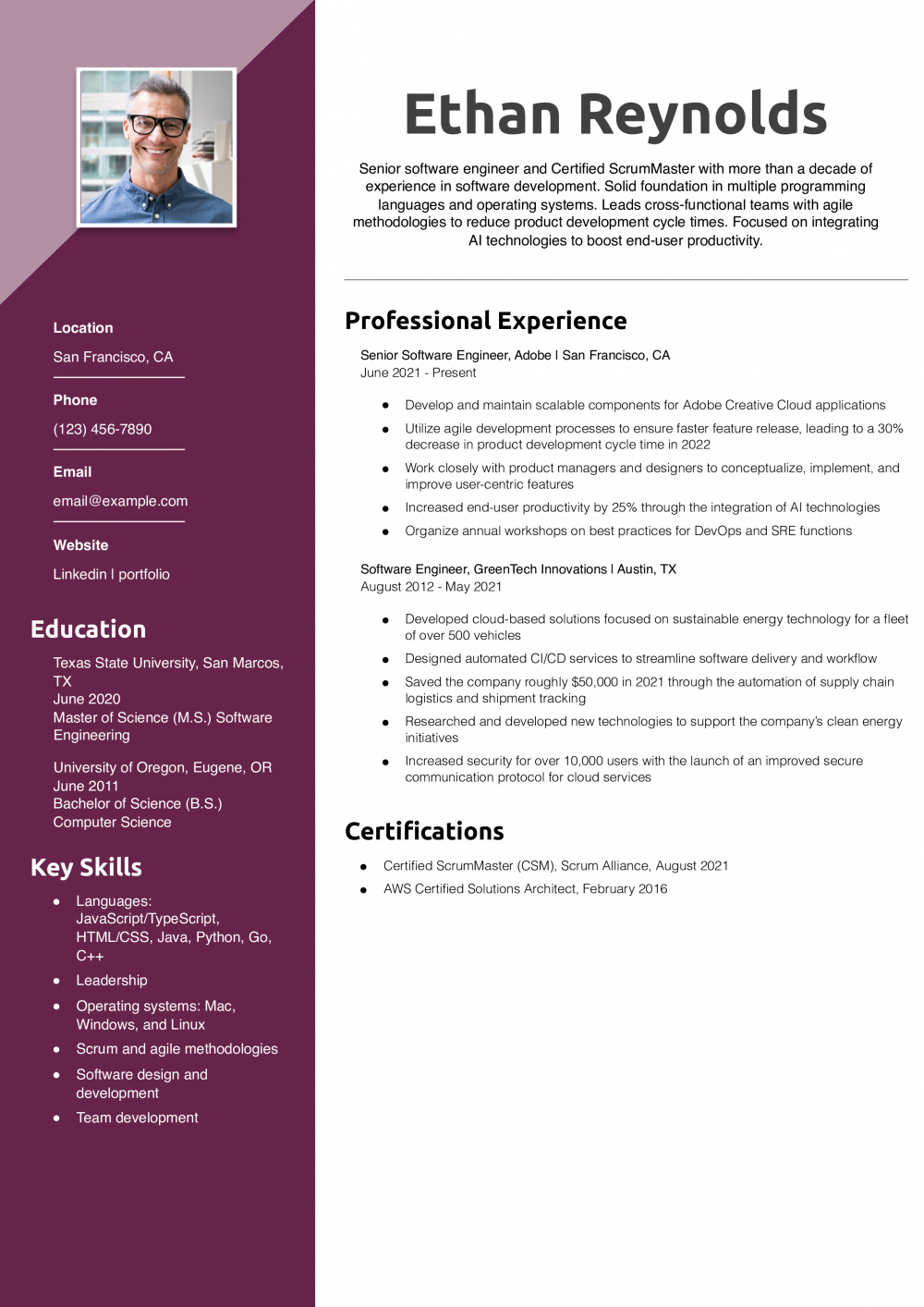
Customize this template in our builder in under 10 minutes.