Elementary Teacher Resume Examples and Templates for 2026



A visible license and endorsement line is what gets teacher resumes past the district portal screen; specific student-growth numbers are what make them readable enough for a principal to schedule a demo lesson.
The new teacher archetype is finishing a credential program, student teaching, or year one in the classroom. This resume needs to prove your endorsement area, cooperating teacher results, and the assessment tools you ran during placements.
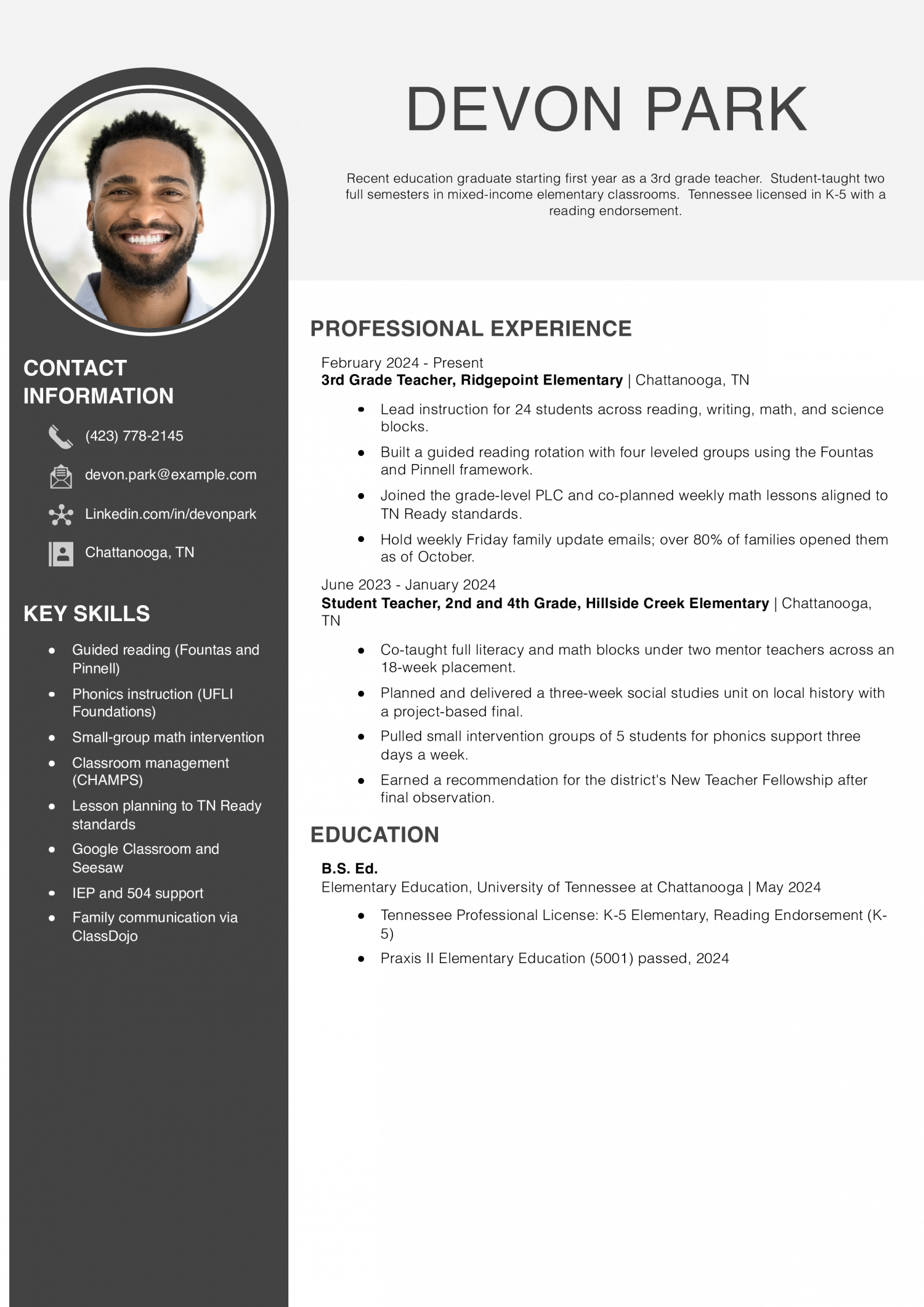
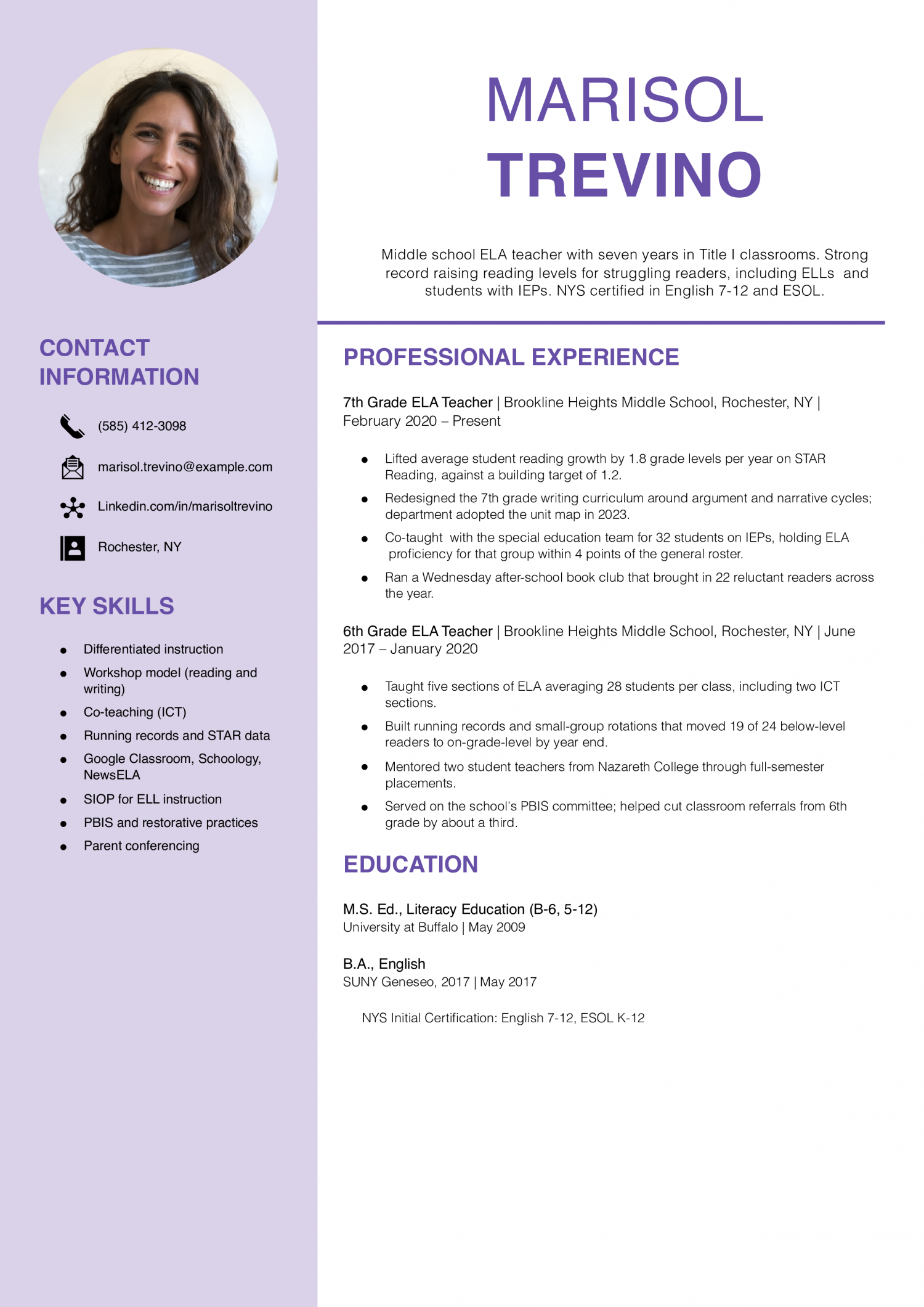
The experienced teacher archetype has three to ten years across a grade band or subject and a track record on state assessments. This resume needs to prove year-over-year proficiency gains, IEP or MLL caseload work, and the curricula you've delivered.
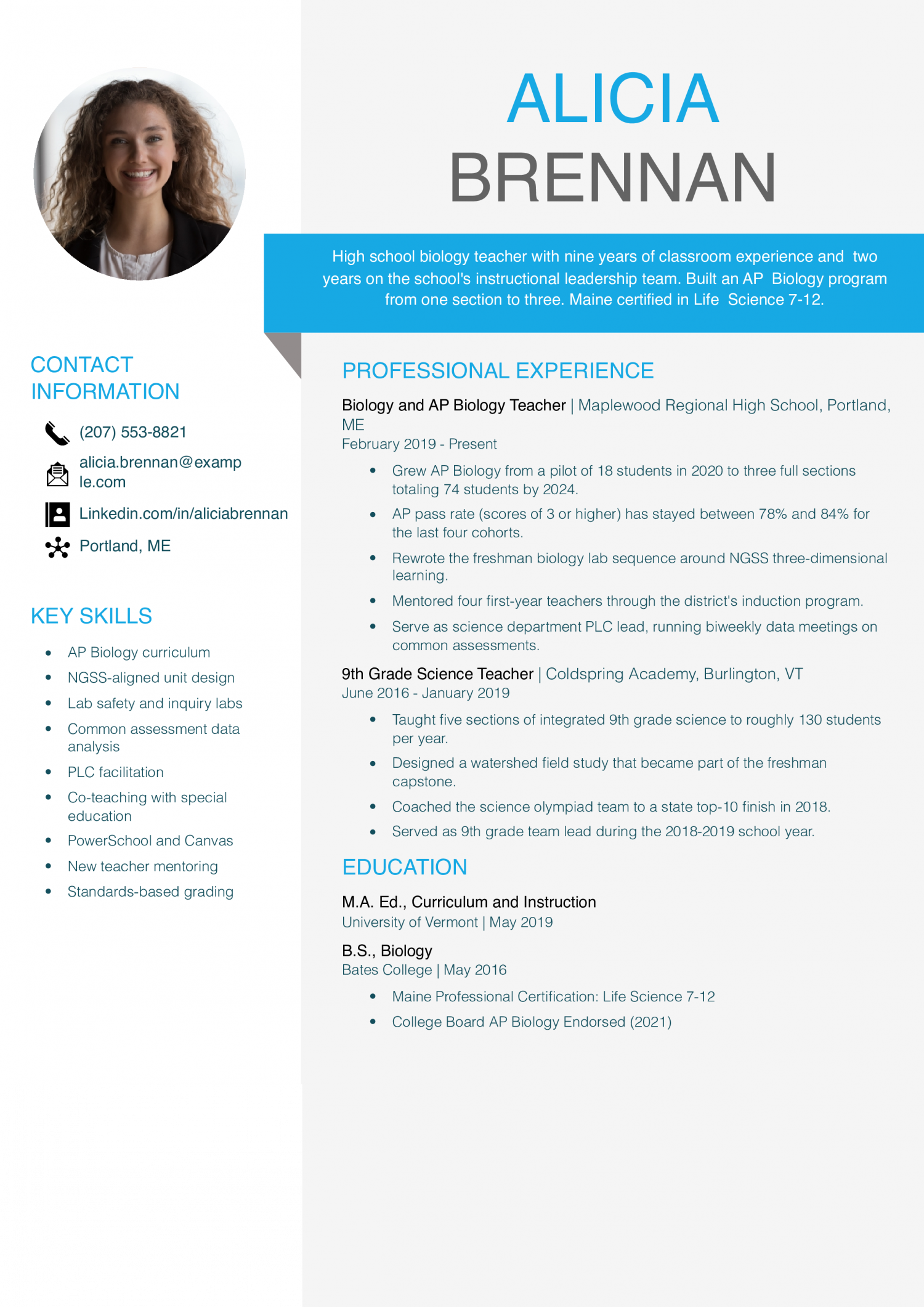
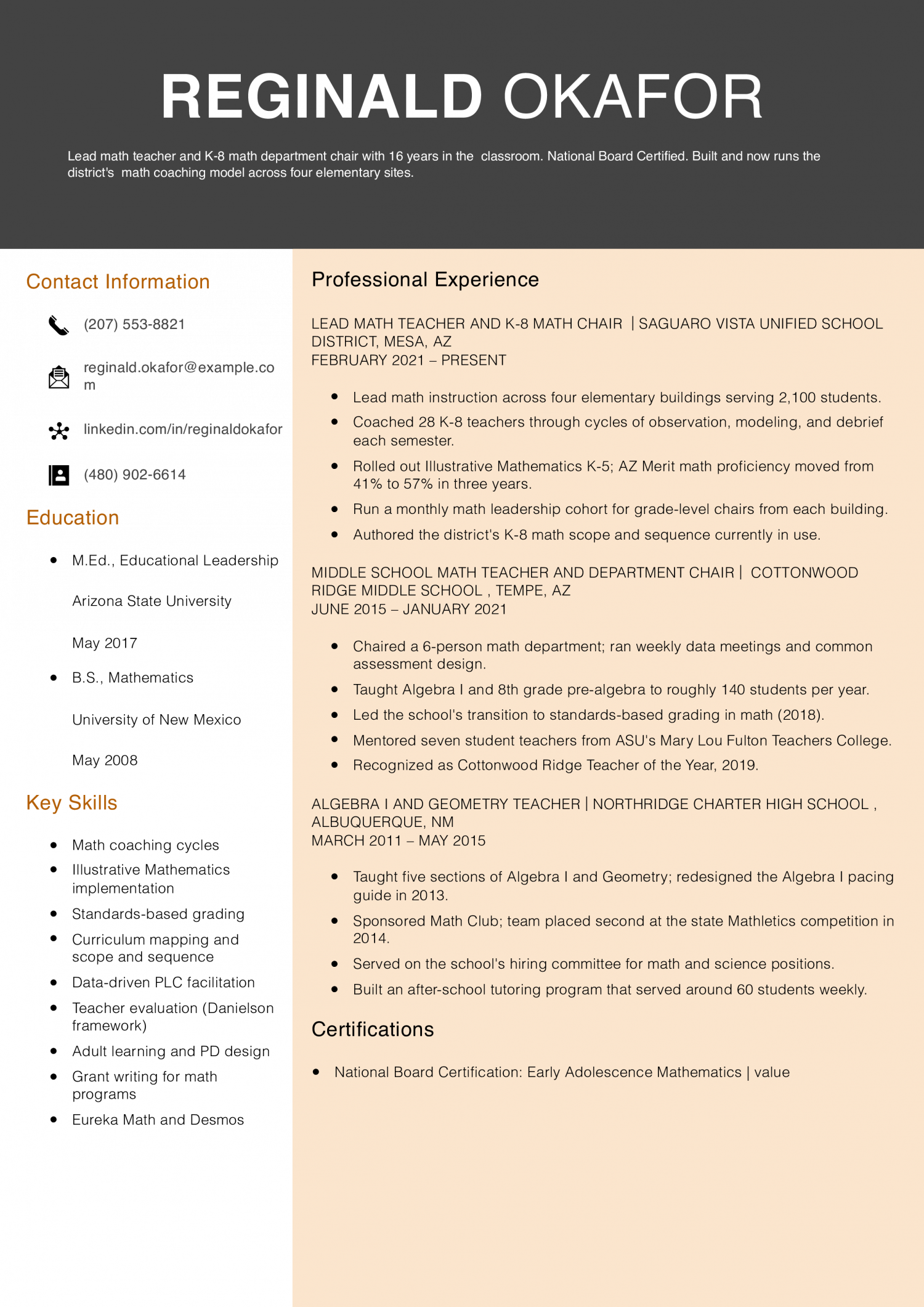
The lead teacher archetype anchors a grade-level team, PLC, or department and mentors newer staff. This resume needs to prove schoolwide initiatives you led, coaching cycles you ran, and the data routines that moved student growth across classrooms.
Yolanda Ferreira
Providence, RI | (401) 226-7740 | [email protected] | linkedin.com/in/yolandaferreira
Bilingual elementary teacher with 11 years of classroom experience across dual-language and general education settings. Rhode Island certified in Elementary 1-6 and Bilingual/Dual Language Education. Strong background in literacy intervention and family engagement in Spanish-speaking communities.
4th Grade Dual Language Teacher
Willow Creek Elementary | Providence, RI | 2021-Present
2nd Grade Teacher
Willow Creek Elementary | Providence, RI | 2018-2021
Bilingual 3rd Grade Teacher
Harborlight Academy | New Bedford, MA | 2015-2018
1st Grade Teacher
Harborlight Academy | New Bedford, MA | 2013-2015
Your profile should state your years in the classroom, the grade band or subject you teach, and the school setting you’ve worked in (Title I, charter, magnet, independent, or rural district).
Name your state license and endorsement areas in the same block. Add the student population you serve, such as MLL learners, inclusion classrooms, or IEP caseloads. Principals scan this block to see if your scope matches the opening before reading any bullets.
Keep it three to five lines. A second-grade teacher in a dual-language Title I school reads differently than an AP Chemistry teacher in a suburban high school, and your profile should make that distinction in the first two sentences.
Teacher bullets without a number tend to read as job description copy. Principals scan for proficiency gains, attendance, and behavior data first.
Lean on volume and scope language where exact percentages aren’t available. Strong bullets name the assessment (NWEA MAP, i-Ready, STAR, state assessment), the cohort size, and the movement.
Useful patterns include proficiency growth from one benchmark to the next, the percentage of students meeting their RIT growth target, attendance rates compared to the school average, and the number of IEP goals met during the year. Two or three quantified bullets per role beat eight duty statements.
Cluster bullets into three to four buckets so the resume reads as a teaching practice, not a task list. Useful categories include instruction and curriculum, assessment and data, student support and family engagement, and collaboration or leadership.
Under instruction, name the curriculum (Wit and Wisdom, Eureka, Amplify, CKLA, Illustrative Mathematics) and the differentiation moves you used. Under assessment, name the platforms and how you adjusted instruction from the data.
Under student support, name your IEP, 504, and MTSS work. Under collaboration, name PLCs, grade-level teams, or coaching cycles. This grouping mirrors how principals evaluate teachers during walkthroughs.
Districts screen for state license status before reading any bullets. Place a credentials block directly under your profile listing your state, license type, endorsement areas, and license status (active, in good standing).
Do not list your license number on the resume itself. State boards advise against publishing it; provide the number on application forms when asked.
Add Praxis II or edTPA pass, grade band and subject endorsements, and any reciprocity you hold across states. Include CPR or first aid if you teach early childhood or PE, and name your EdTech tools (Google Classroom, Canvas, Seesaw, PowerSchool, Schoology) in a tools line.
List your degree, institution, and graduation year, then your credential program if it was separate. Add your GPA if it’s above 3.5 and you’re within five years of graduation.
Below education, add a short professional development block. Name the institutes, conferences, or districts that hosted the training (Orton-Gillingham, Responsive Classroom, AVID, Teachers College Reading and Writing Project).
If you’re a career changer, place a short transferable-skills block above education naming the classroom-adjacent work from your prior career, such as training, curriculum design, or youth program management.
Five years ago, a teacher resume read like a list of subjects taught and grades covered. The skills below come from the resumes our users built in 2026. The mix has shifted toward assessment platforms, MTSS work, and named curricula.
Principals weigh hard skills as the floor: license, curriculum, and platforms must match the posting. Soft skills like classroom management read as evidence backing your bullets. Match the hard skills below against the job posting, and treat the soft skills as the behavior your bullets should prove.
| Soft Skills | % of resumes with this skill |
|---|---|
| Communication | 78% |
| Patience | 65% |
| Adaptability | 41% |
| Collaboration | 38% |
| Parent communication | 29% |
And here are the top hard skills showing up most often.
| Hard Skills | % of resumes with this skill |
|---|---|
| Classroom management | 67% |
| Lesson planning | 57% |
| Differentiated instruction | 50% |
| Student assessment | 36% |
| Educational technology | 31% |
Based on data from thousands of teachers’ resumes built on ResumeTemplates.com, May 2026.
Before a teacher resume gets a closer read, hiring teams verify a short list of licenses, tools, and compliance signals.
Districts screen for license status before any other section. Put this block directly under your profile so it loads on page one for both the portal and the principal.
List the issuing state, license name, endorsement areas, and current status. State boards advise against publishing the license number on a public resume, so leave it off and supply it on the application form when asked.
Name Praxis II or edTPA pass, any reciprocity you hold across states, and any pending license you’ve applied for. If you’re relocating, add a one-line note about reciprocity in progress.
Principals read this block to gauge how you’ll run a room and serve students on IEPs and 504 plans. Name the framework, the caseload, and the result.
Principals and district HR directors expect to see role-specific language that matches the posting. Cluster these keywords by where you’ve actually taught, and place them in the profile, skills, and bullet text.
| Niche | Keywords ATS scans for |
|---|---|
| Elementary classroom | elementary teacher resume, sample teacher resume, balanced literacy, small group instruction |
| Early childhood and pre-K | preschool teacher resume, early childhood educator, developmentally appropriate practice, Creative Curriculum |
| Paraprofessional and assistant | teacher assistant resume, paraprofessional, instructional aide, 1:1 support |
| Senior and lead BA | senior business analyst resume sample, cbap, safe popm, program backlog |
| Substitute and supply | supply teacher resume, substitute teacher, long-term sub, classroom coverage |
| Subject specialist and lead | teaching position resume, department chair, instructional coach, PLC lead |
Districts are split between schools piloting Khanmigo and MagicSchool AI for lesson planning and those banning generative tools in student-facing work. Name the tools you use, describe the workflow honestly, and don’t claim you build AI-personalized curricula if your actual practice is drafting and editing.
Teachers draft standards-aligned plans in MagicSchool or Khanmigo, then revise for their students' reading levels and IEP goals.
AI generates tiered reading passages, sentence frames for MLL learners, and scaffolds that used to take hours by hand.
Tools like Brisk Teaching draft rubric-aligned comments on writing, which the teacher edits before returning to students.
Translation and tone tools speed up parent emails and IEP meeting notes across home languages without losing accuracy.
Beyond your state teaching license and Praxis or edTPA pass, the certifications below tell principals and district HR directors which student populations you can serve and which interventions you can run on day one. List the certifying body and the issue or renewal year for each, and skip the license or certificate numbers.
Teacher is one of the larger occupations in BLS data, which means the median pulls in a long tail of part-time, substitute, and lower-cost-of-living variants. State pay floors and step-and-lane schedules also flatten the spread inside any one district.
To position above the median, lead your resume with your endorsement areas, the assessments you’ve moved, and the named curricula you’ve delivered, not your years in the classroom.
| # | State | Avg. Annual |
|---|---|---|
| 1 | Washington | $99,110 |
| 2 | California | $98,190 |
| 3 | District of Columbia | $94,730 |
| 4 | Rhode Island | $86,900 |
| 5 | Massachusetts | $83,260 |
| 6 | New York | $82,480 |
| 7 | Connecticut | $78,740 |
| 8 | New Jersey | $77,150 |
| 9 | Alaska | $76,290 |
| 10 | Oregon | $75,800 |
| # | State | Workers | Median |
|---|---|---|---|
| 1 | California | 141,650 | $98,190 |
| 2 | Texas | 124,430 | $61,380 |
| 3 | New York | 103,920 | $82,480 |
| 4 | Florida | 78,630 | $55,550 |
| 5 | Illinois | 61,000 | $64,160 |
State your license type, issuing state, endorsement areas, and status (active, in good standing). Skip the license number on the resume itself. State boards advise against publishing the number publicly. Provide it on the district application form when the portal asks for it. A clean line reads: Texas Standard Teaching Certificate, EC-6 Core Subjects with ESL Supplemental, active.
Place your credential program, student teaching placements, and any practicum hours directly under your profile. Principals want to see the classroom evidence first. Add a transferable-skills block above your work history. Translate prior roles using classroom verbs: trained, coached, assessed, differentiated, scaffolded. Name any youth-facing work: camp counselor, Sunday school, tutoring, coaching, or corporate training. This signals you've managed groups of learners before.
Elementary resumes should name the literacy and math curricula (CKLA, Wit and Wisdom, Eureka, Illustrative Mathematics) and your small-group rotation model. Add daily family communication tools (ClassDojo, Seesaw, Remind) and your behavior management approach. Principals at K-5 schools weigh these heavily. Secondary resumes should lead with subject mastery, course load, AP or honors sections taught, and any college and career readiness work.
Use cohort-level numbers: percent proficient, percent meeting NWEA growth targets, or average scale-score change across the class. Frame results against the school or district average where you can. A bullet like grew reading proficiency from 42% to 61% across two third-grade sections reads well. Never name students, share individual scores, or post identifying data. District communications offices and FERPA both flag that.
For a teacher, a professional template is the safest pick, because it signals the polish hiring managers in this field expect. An ATS-friendly template is a solid alternative. Whichever you choose, keep the formatting clean and easy to parse: clear section headings, a standard font, and no graphics a parser can choke on.
Executive Resume Writer and Career Coach
Andrew Stoner is an executive career coach and resume writer with 17 years of experience as a hiring manager and operations leader at two Fortune 500 Financial Services companies, and as the career services director at two major university business schools.
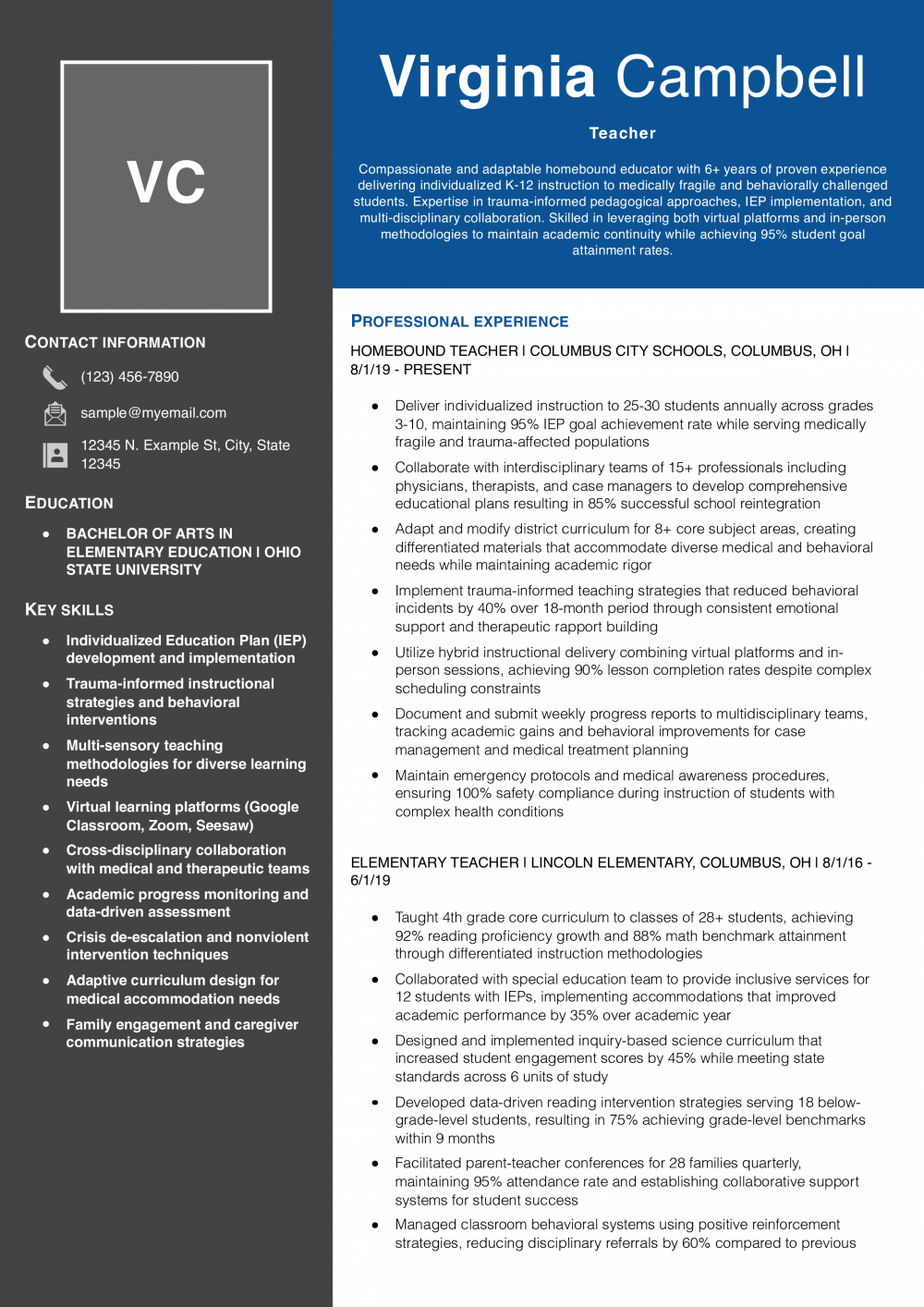
Customize this template in our builder in under 10 minutes.