20 Best Software Engineer Resume Examples and Templates for 2026



A stack match in the first six lines is what gets software developer resumes past the recruiter scan; a shipped-scale number on each role is what makes them readable enough to advance.
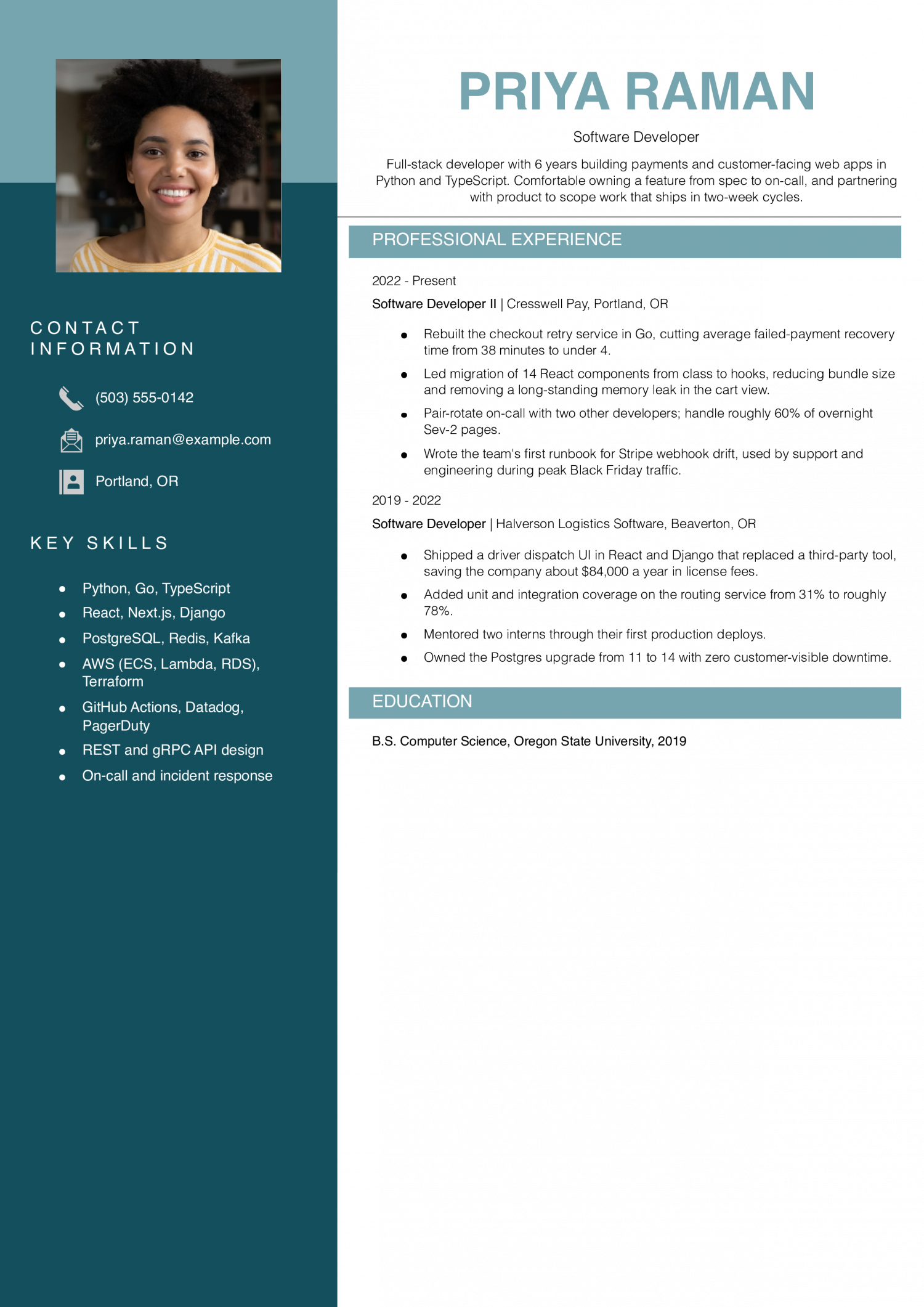
Junior developers are zero to three years in, often coming from a bootcamp, CS degree, or a first internship. The resume needs to prove you've shipped real code in production, not just coursework.
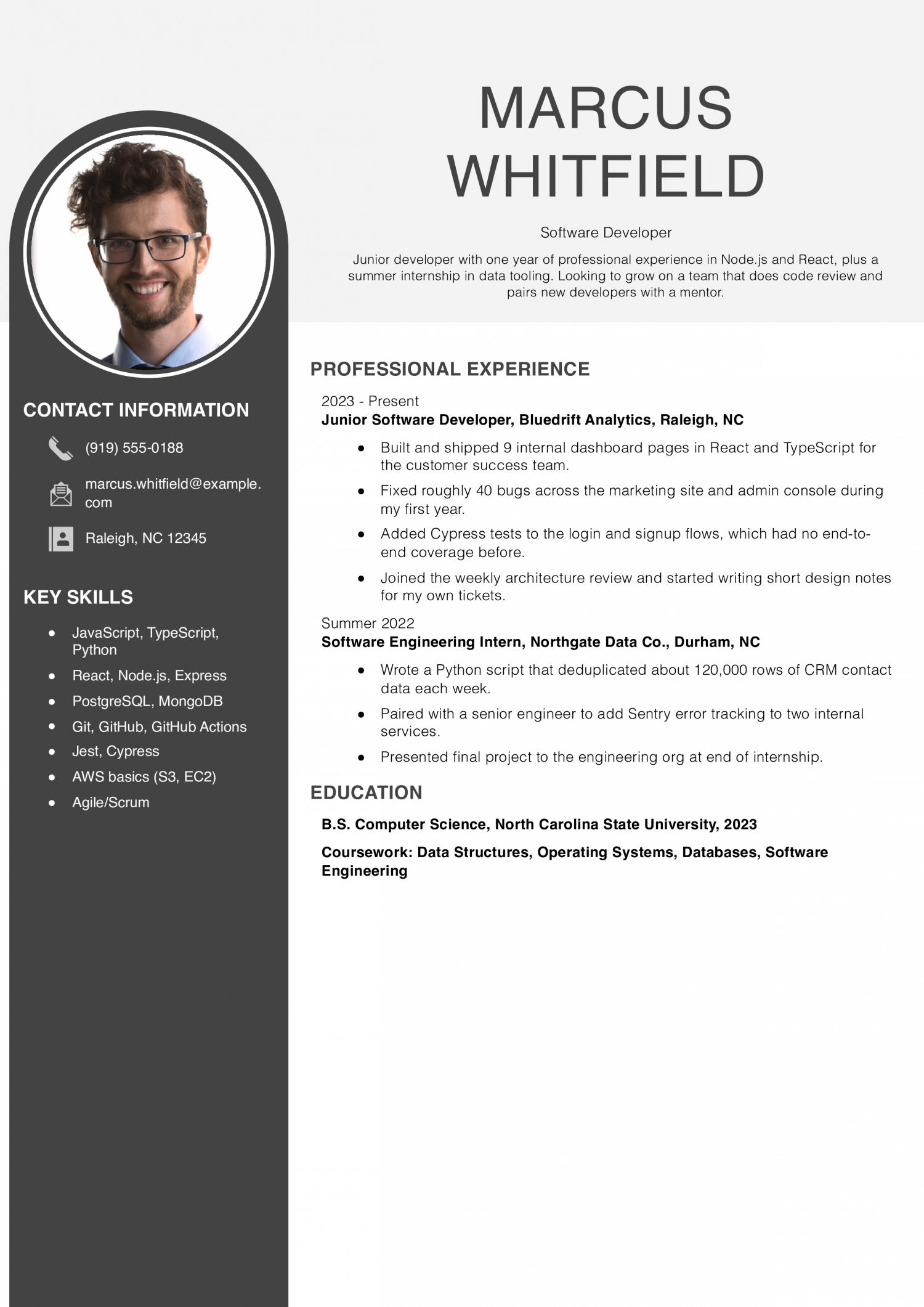
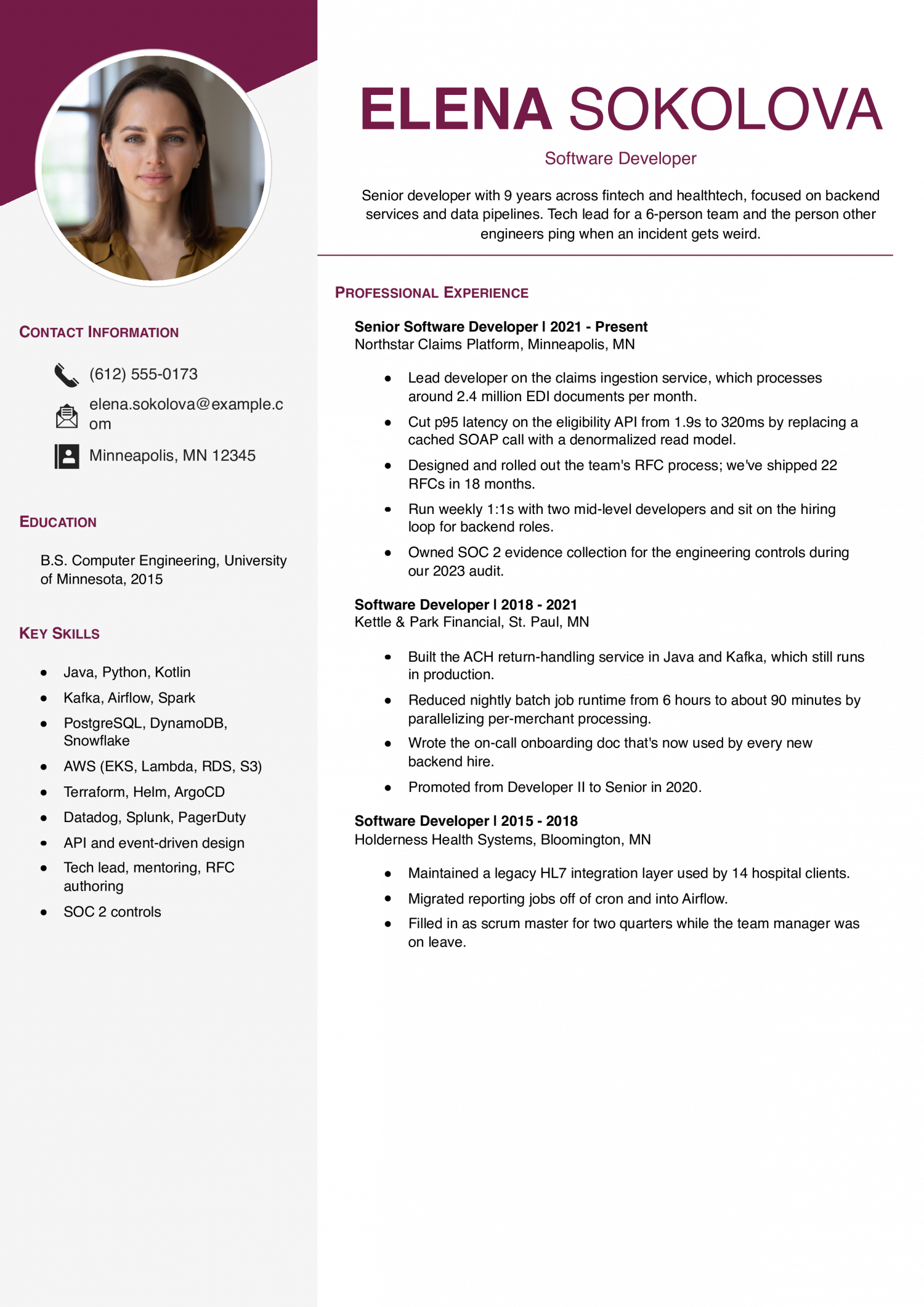
Senior developers own features end-to-end and carry on-call. The resume needs to prove system ownership, code review footprint, and measurable scale numbers on the services you maintain.
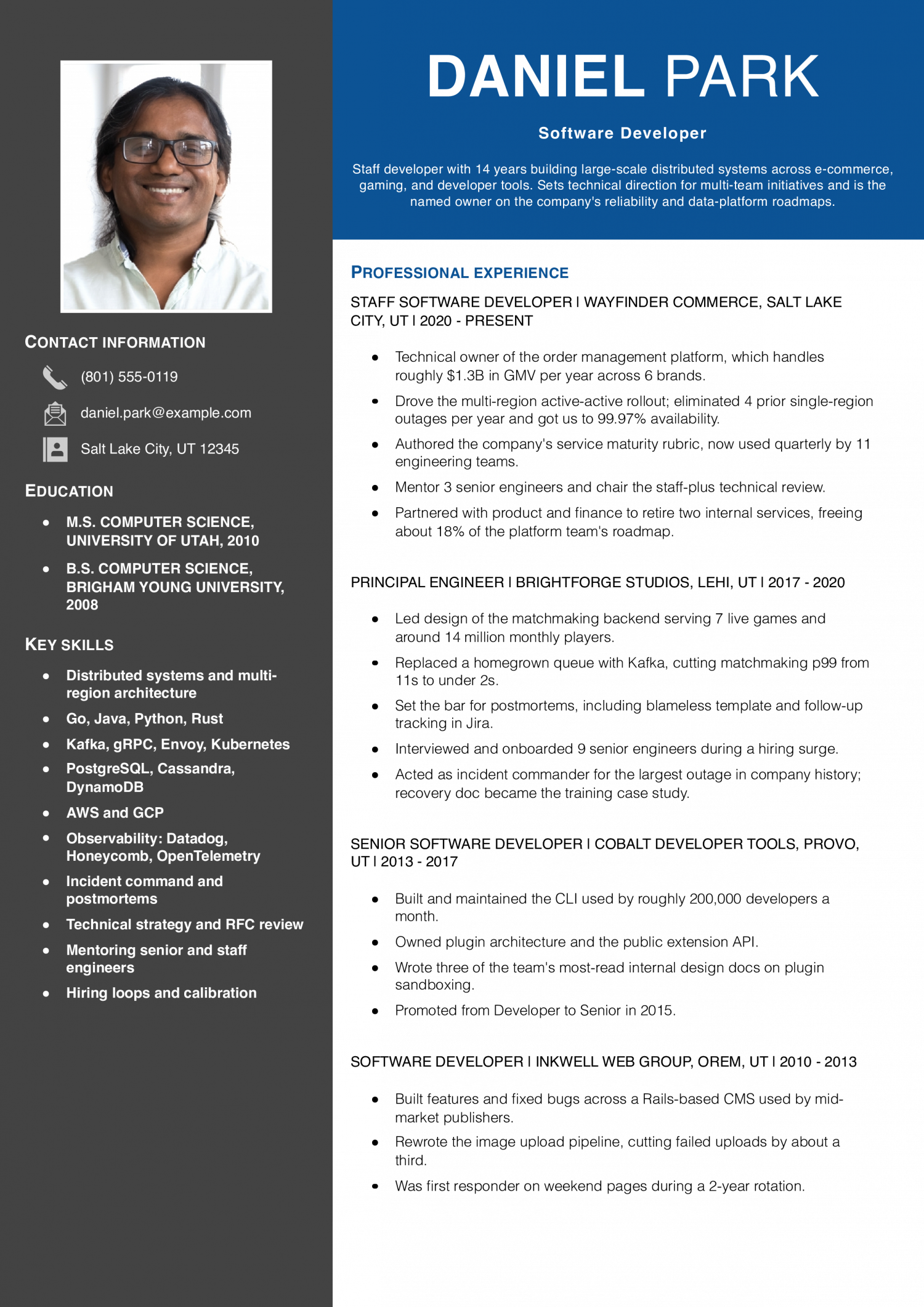
Staff developers set technical direction across teams. The resume needs to prove architecture decisions you authored, cross-team initiatives you led, and the engineers you mentored or hired.
Aisha Bensalem
Austin, TX | (512) 555-0164 | [email protected] | linkedin.com/in/aishabensalem
Software developer with 7 years across SaaS and ad-tech, focused on backend services and developer experience. Comfortable owning a service end to end, from on-call to capacity planning, and partnering with product on roadmap tradeoffs.
Senior Software Developer
Junction Mesh Software | Austin, TX | 2022-Present
Software Developer II
Tideglass Ad Platform | Round Rock, TX | 2020-2022
Software Developer
Pell & Vance SaaS | Austin, TX | 2018-2020
Junior Software Developer
Marlow & Reeve Web Studio | San Antonio, TX | 2017-2018
Software Engineering Intern
Heliotrope Robotics Lab | Austin, TX | Summer 2016
Add a single line a recruiter cannot find on your GitHub: the production scale you’ve shipped to, the on-call rotation you carry, or the regulated domain you work in.
Most software developer summaries read like every other one: language list, years of experience, vague impact. Replace that with a sharp anchor. Examples: “Backend engineer shipping Go services at 12k RPS,” or “Full-stack developer on a PCI-scoped payments team.” Recruiters and engineering managers scan the top inch for a stack and a context match.
Give them both in one line and the rest of your resume gets read.
Bullets without a number tend to read as duties. Engineering managers and tech leads want three kinds of numbers: scale, performance, and reliability.
Scale looks like requests per second, daily active users, rows processed, or services owned. Performance looks like p95 latency, build time, or query cost. Reliability looks like uptime, incident count, or MTTR.
A strong bullet pairs a verb with one of these. Example: “Cut p95 checkout latency from 480ms to 110ms by replacing the synchronous fraud call with a queue.” Two or three quantified bullets per role beats eight vague ones every time.
Cluster bullets under each role into three or four categories so a tech lead can scan for fit.
Useful groupings: services and APIs you own, infrastructure and tooling you set up, code review and mentorship footprint, and incidents you led. Name the language, framework, and datastore for each. Avoid the wall of acronyms; one strong sentence with React, TypeScript, and Postgres beats a 14-tag stack soup.
If you contributed to a migration, name the from-state and to-state. “Migrated 40 services from EC2 to EKS” tells a hiring team more than “led cloud transformation.”
Engineering managers and tech leads scan for stack match before they read a single bullet.
Place a Technical Skills block directly under your summary, grouped by category: Languages, Frameworks, Datastores, Infra/Cloud, Tooling. List what you’ve used in production, not what you read a tutorial on. Certifications like AWS Solutions Architect, CKA, or Google Professional Cloud Developer go in their own short block near the top if they’re current.
Skip the proficiency bars and the years-per-language matrix; recruiters ignore both. Keep this block under 10 lines so the experience section starts on page one.
Senior and staff resumes get longer by accident. Cut anything that isn’t load-bearing.
Drop: coursework, GPA after your third year out, internships older than your current title, generic phrases like “passionate about clean code,” and the eight-bullet description of a role you left in 2017. Keep: the architecture decisions you authored, the on-call rotations you carried, the hires you made, and the cross-team initiatives you led. A staff resume earns its second page with scope evidence, not with a longer history.
If a bullet wouldn’t survive a panel question, it doesn’t belong on the resume.
Five years ago, a software developer resume read like a language-and-framework tag dump. The skills below come from the resumes our users built in 2026. The mix has shifted toward cloud platforms, observability tooling, and named system-design work.
Engineering managers and tech leads weight hard skills heavily for the keyword screen, then read soft skills as evidence behind your bullets, not as standalone claims. Match the hard skills against the target posting’s language; treat the soft skills as a checklist your bullets must already prove.
| Soft Skills | % of resumes with this skill |
|---|---|
| Problem-solving | 78% |
| Communication | 70% |
| Teamwork | 49% |
| Adaptability | 35% |
| Time management | 34% |
And here are the top hard skills showing up most often.
| Hard Skills | % of resumes with this skill |
|---|---|
| Java | 69% |
| Python | 52% |
| JavaScript | 40% |
| SQLl | 35% |
| Git | 27% |
Based on data from thousands of software developers’ resumes built on ResumeTemplates.com, May 2026.
Before a software developer resume gets a closer read, hiring teams check for a short list of essentials.
Engineering managers and tech leads expect to see stack-specific terms grouped by the kind of work you do, not a flat tag cloud. Pick the rows that match your track and weave the keywords into your bullets and skills block.
| Niche | Keywords ATS scans for |
|---|---|
| Backend engineering | rest api design, microservices, postgresql, redis |
| Full-stack web | react, typescript, node.js, next.js |
| Platform and DevOps | kubernetes, terraform, ci/cd, observability |
| Cloud and distributed systems | aws lambda, eks, event-driven architecture, kafka |
| Senior and staff signals | system design, rfc authorship, on-call rotation, code review |
What engineering managers expect on a software developer resume has shifted: a clean “no AI tools” stance now reads as out of touch on most product teams; an honest description of how you use Copilot or Cursor with code review and test gates reads as current. The list below names what to add.
Copilot and Cursor are now baseline; teams want to see you review and test generated code, not paste it blind.
AI reviewers flag obvious issues first, so human review time goes to architecture and edge cases, not style nits.
Generating unit tests and mock data is now common; the skill is editing them to cover the right branches.
More postings name embeddings, vector stores, and prompt evaluation as required skills, not nice-to-haves.
A software developer portfolio is your GitHub plus one or two real projects a recruiter can run in under a minute. The goal is to give the technical screener evidence before the interview, not a personal-brand site.
Pin three to five repos with real READMEs, tests, and recent commits; this is the first place recruiters look.
One page with your bio, three project writeups, and links to the running app and the source.
A live URL beats a screenshot; one working deploy is worth five repos with no demo link.
Two or three deep posts on a debug, a migration, or a design decision signal staff-track thinking.
Pin the repos that match the target stack. If you’re applying to a Go shop, your top pinned repo should be Go, not the JavaScript side project you maintain for fun.
Write the README like a hiring manager will read it. Problem, stack, architecture diagram, how to run it locally, and one paragraph on the tradeoff you made. That single page changes how the rest of the repo gets read.
Group your stack by category so a tech lead can scan it in seconds. List only what you’ve shipped to production or used heavily in a real project.
Beyond a CS degree or bootcamp credential, the certifications below tell engineering managers and tech leads which cloud platforms you can operate in and which infrastructure you can own without supervision. List the issuing body and the year earned for each item.
Software developer is one of the larger occupations tracked by BLS, which means the median pulls in a long tail of entry-tier and lower-credentialed variants alongside senior engineers at FAANG-scale employers. The spread between the 10th and 90th percentile is wide, and most of that gap is explained by employer type, location, and the systems you can own end-to-end.
Lead your resume with the production scale and stack depth that the upper bands actually pay for.
| # | State | Avg. Annual |
|---|---|---|
| 1 | California | $170,910 |
| 2 | Washington | $166,910 |
| 3 | Virgin Islands | $162,820 |
| 4 | New York | $161,260 |
| 5 | Massachusetts | $150,520 |
| 6 | Maryland | $137,890 |
| 7 | District of Columbia | $136,040 |
| 8 | Oregon | $135,260 |
| 9 | Delaware | $135,160 |
| 10 | Colorado | $134,540 |
| # | State | Workers | Median |
|---|---|---|---|
| 1 | California | 292,630 | $170,910 |
| 2 | Texas | 151,460 | $130,500 |
| 3 | New York | 104,130 | $161,260 |
| 4 | Washington | 91,470 | $166,910 |
| 5 | Virginia | 83,290 | $134,470 |
Resume Templates offers HR approved resume templates to help you create a professional resume in minutes. Choose from several template options and even pre-populate a resume from your profile.
Two pages is the working ceiling for senior and staff developers. One page is fine through about five years of experience.
Past two pages, recruiters skim and stop reading. Cut roles older than 12 years to a one-line title and dates. Keep the architecture work, drop the early-career bullet detail.
Put both in the header on the same line as your email, as clickable URLs. Recruiters expect both, and a missing GitHub link reads as a flag.
Pin three to five repos on GitHub that show real code, not tutorial forks. If your GitHub is sparse, link a portfolio site or a writeup instead and skip the empty profile.
Reframe your QA experience around the code you wrote, not the tests you ran. Lead with test automation frameworks you built, CI pipeline work, and any production code or tooling you shipped.
Add a Projects section with two or three real applications using the target stack. Pair that with an open-source contribution or a take-home you can show, and apply to backend or platform roles where test infrastructure overlap is highest.
It depends on the stack. Cloud certs (AWS, GCP, Azure) and Kubernetes certs carry real weight; language certifications mostly do not.
If you're targeting a cloud-heavy shop and you don't have years of production experience on that platform, an associate-level cert helps you clear the keyword screen. Past mid-level, your shipped systems matter more than the certificate.
For a software developer, a tech template is the safest pick, because it keeps your stack, tools, and impact easy to scan. An ATS-friendly template is a solid alternative. Whichever you choose, keep the formatting clean and easy to parse: clear section headings, a standard font, and no graphics a parser can choke on.
Executive Resume Writer and Career Coach
Andrew Stoner is an executive career coach and resume writer with 17 years of experience as a hiring manager and operations leader at two Fortune 500 Financial Services companies, and as the career services director at two major university business schools.
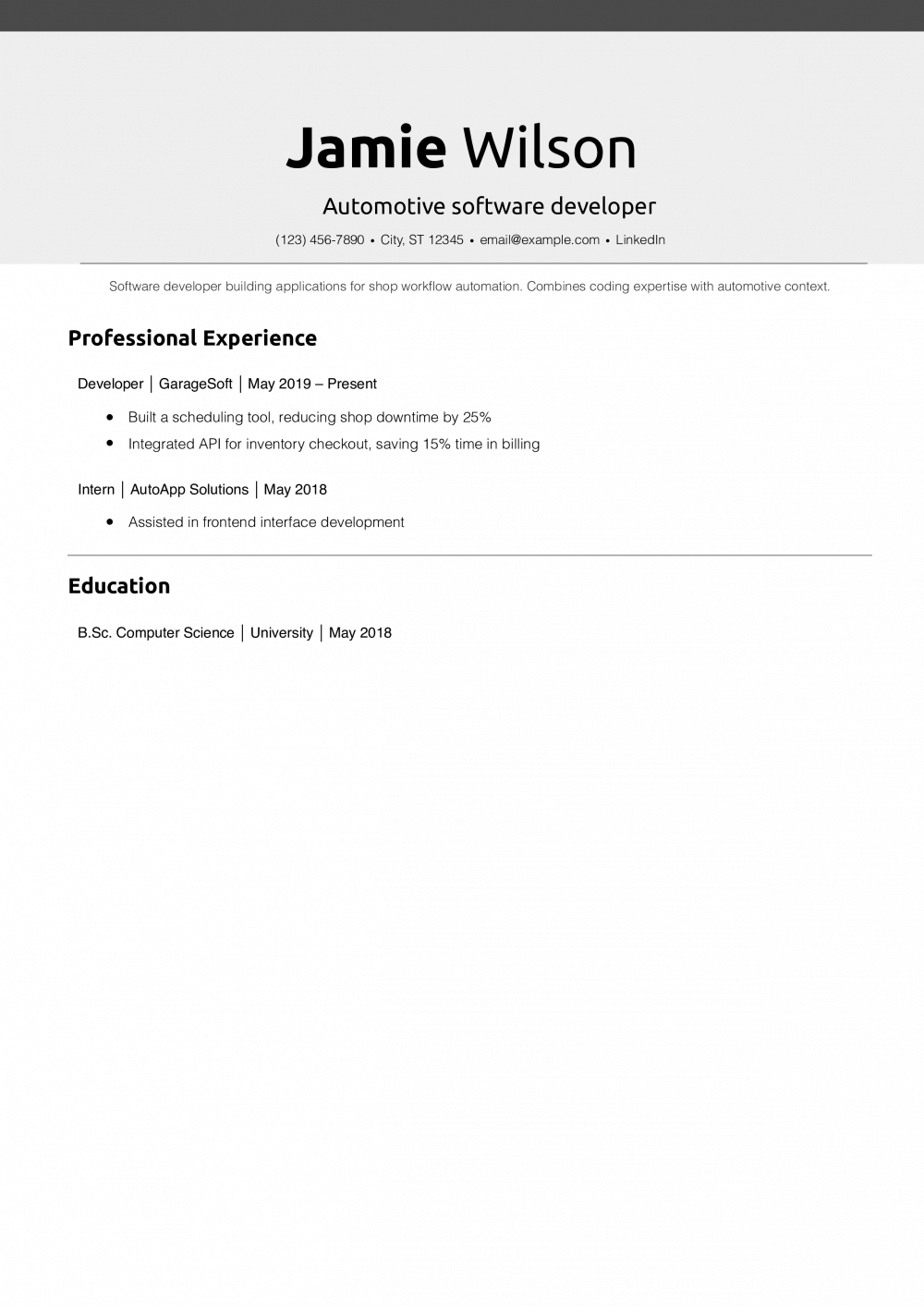
Customize this template in our builder in under 10 minutes.