

Artificial intelligence was supposed to make work easier, but a new survey from ResumeTemplates.com reveals that for many employees, it’s having the opposite effect.
As companies rush to integrate AI tools into daily operations, 31% of workers say their workload has actually increased since AI adoption, with some reporting they’re now expected to do twice, or even four times, as much work as before.
Study highlights:
- 31% of workers say their workload has increased since AI was introduced
- 1 in 5 workers say it would be difficult or impossible to keep up without AI
- 60% say managers or leadership expect or require them to use AI
- 59% say AI has increased pressure to perform at a higher level
- 37% are experiencing AI fatigue
- 4 in 10 workers fear AI could replace them in the next 5 years
1 in 5 Workers Say They Can’t Keep Up Without AI
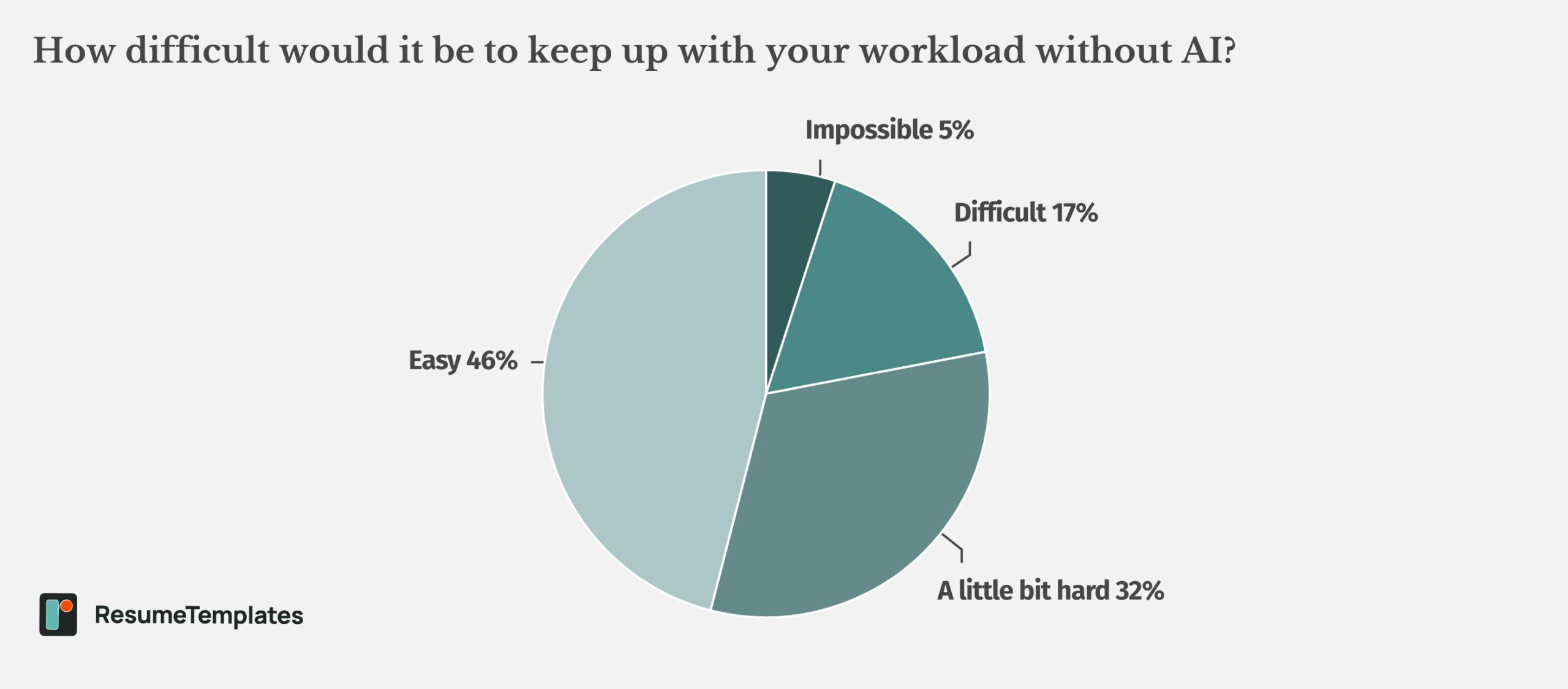
AI has quickly become a workplace necessity rather than a nice-to-have tool. The survey found that about 1 in 5 workers (22%) say it would be difficult (17%) or impossible (5%) to keep up with their current workload without AI assistance. An additional 32% say it would be at least somewhat challenging to manage without these tools, meaning less than half of workers (46%) feel confident they could maintain their current pace without AI support.
This dependency is reinforced through frequent daily use. Half of all workers (50%) now use AI at work at least once per day:
- 21% use AI many times per day
- 24% use AI a few times per day
- 6% use AI once per day
The frequent use suggests AI has become deeply embedded in how work gets done, transforming from an optional enhancement to a necessary component of meeting job expectations.
Workers Are Now Expected to Do Twice As Much Work
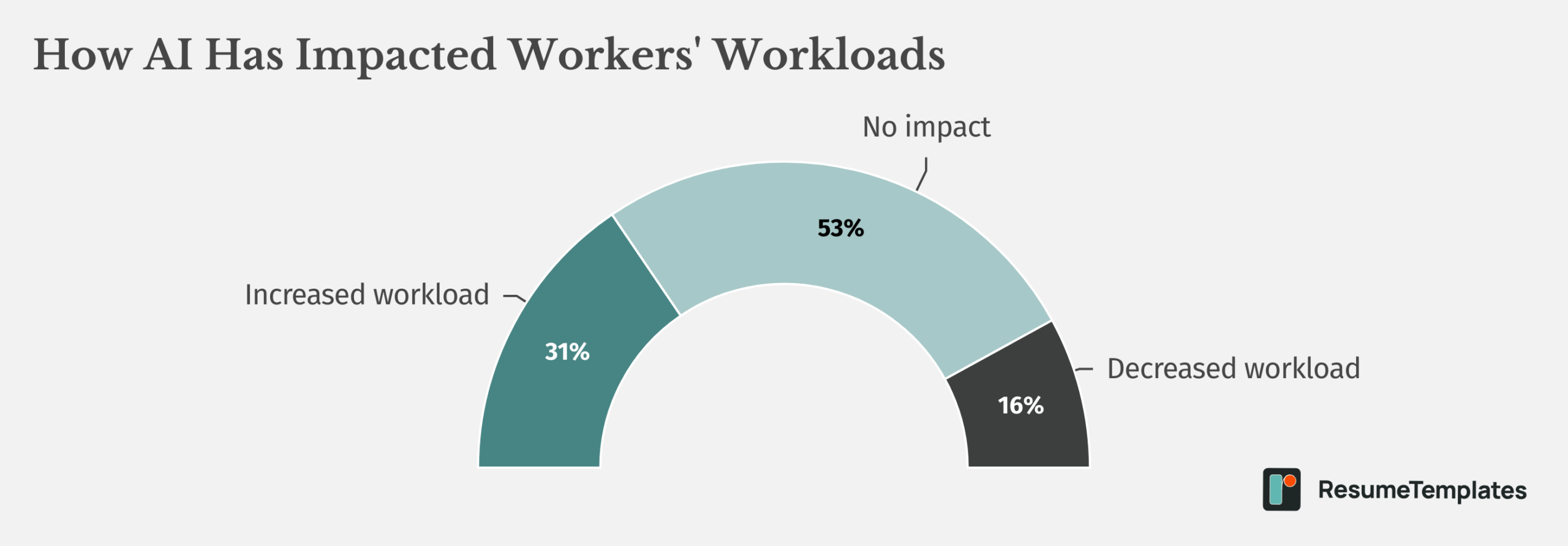
Despite promises of increased efficiency, AI adoption hasn’t lightened the load for most workers. Nearly half of all workers (48%) now describe their workload as very or extremely heavy, and 31% say their workload has increased since AI was introduced at their company. Only 16% of workers report their workload has actually decreased.
For workers whose workload has increased, the expectations have become demanding:
- 33% say they are expected to do twice as much work as before
- 6% say they are expected to do three times as much work
- 4% say they are expected to do at least four times as much work
- 57% say they are expected to do more work, but not double
“AI can cut down the busywork and help people focus on what really matters, but if professionals feel busier right now, it may be because they are,” says Julia Toothacre, Chief Career Strategist at ResumeTemplates. “After years of layoffs and reorganizations, many teams are operating with fewer people, so remaining employees are carrying more. AI can help manage that load, but employees should watch for workload creep, when managers assume AI means you can take on more without providing the resources to support it.”
60% of Workers Say Managers Expect AI Use and Have Higher Expectations
AI use isn’t just encouraged, it’s often expected or required. The survey found that 60% of workers say managers or leadership expect or require them to use AI, with 21% saying AI use is required and 39% saying it’s expected but not required.
The pressure to use AI is explicit in many workplaces. Nearly half of workers (45%) say managers explicitly reference using AI when assigning additional work, making it clear that productivity expectations have been adjusted upward with the assumption that AI tools will help employees meet them.

This has created measurable pressure. A majority of workers (59%) say AI has increased the pressure to perform at a higher level, with 17% saying pressure has increased a lot and 42% saying it has increased somewhat.
“Organizations need to provide proper training and clear expectations about how and when AI should be used,” says Toothacre. “Some employees will pick it up quickly and thrive, but others will take longer and may not like using the new tools. It’s important to start small and show how AI can improve day-to-day efficiency, then build up to more complex use cases over time. If you force employees to use something without introducing it appropriately, you risk eroding trust and hurting morale. It’s not worth it when there are better ways to roll it out.”
37% of Workers Are Experiencing AI Fatigue
The constant pressure to adopt and master AI tools is taking a toll. More than one-third of workers (37%) say they have experienced AI fatigue, a state of exhaustion and overwhelm related to the demands of learning and using AI in their daily work.
The anxiety around AI extends to job security as well. Four in 10 workers (40%) say they are worried AI could replace them within the next five years, adding another layer of stress to an already challenging situation.
The impact on job satisfaction is notable: 14% of workers say AI has decreased their job satisfaction. Attitudes toward AI are mixed overall, with 18% saying they dislike (12%) or hate (6%) AI, while 36% like it and 17% love it.
When asked how they plan to combat AI fatigue, workers shared a range of strategies focused on setting boundaries and finding balance:
- “I try to do mental exercises every day without using AI to combat any brain fog, difficulty finishing thoughts or sentences, or other symptoms I’ve been feeling lately that I believe are connected to increased AI usage,” one worker said.
- Another shared: “I plan to set strict boundaries around screen and AI usage.”
- “I really am aware of what I use AI for. I try to be very intentional and selective so I’m not going to it for every little task. A support but not everything,” one respondent explained.
- Others are creating clear separations between work and personal time: “Take an AI break at the end of the workday when I’m home and not use AI as much for personal reasons as I do for work related tasks.”
- One worker emphasized returning to human connection: “Getting out in the field and talking to people! You can’t replicate a physical conversation.”
“AI fatigue is about being expected to do more with these new tools and feeling like you can’t keep up,” says Toothacre. “The challenge is that the tools are constantly evolving, and employees are expected to learn how to use them well as they change. The signs of AI fatigue look a lot like burnout because it’s rooted in overwhelm. Like burnout, it can make you question whether the job is worth it, or worry you’ll get fired for not keeping up. In a lot of cases, it comes down to inadequate training and unclear expectations combined with mounting pressure.”
Methodology: ResumeTemplates.com surveyed 1,250 full-time U.S. workers in corporate jobs who spend a significant amount of time working on a computer. The survey was conducted in February 2026 using Pollfish’s online survey platform. Pollfish uses random device engagement (RDE) to reach respondents organically, ensuring a diverse and representative sample. The platform employs quality control measures including attention checks, response time monitoring, and duplicate detection to maintain data integrity. The margin of error is ±2.8% at a 95% confidence level.
Resume Templates offers HR approved resume templates to help you create a professional resume in minutes. Choose from several template options and even pre-populate a resume from your profile.