

Earlier this month, Microsoft’s CEO of AI Mustafa Suleyman made a striking prediction: most white-collar work will be fully automated by AI within the next 12 to 18 months.
To find out how business leaders actually feel about that claim, ResumeTemplates.com surveyed 933 executives and decision-makers, and the results suggest Suleyman may not be far off.
Study highlights:
- 60% of business leaders agree that most white-collar work will be fully automated by AI within the next 12 to 18 months
- 42% say AI is actively shrinking their workforce
- 41% say AI is the sole reason or primary driver behind their hiring reductions
- Many business leaders suggest switching from white-collar to blue-collar careers
- 83% say early-career employees should develop strong AI skills to remain competitive
3 in 5 Business Leaders Believe AI Will Replace White-Collar Jobs Within 18 Months
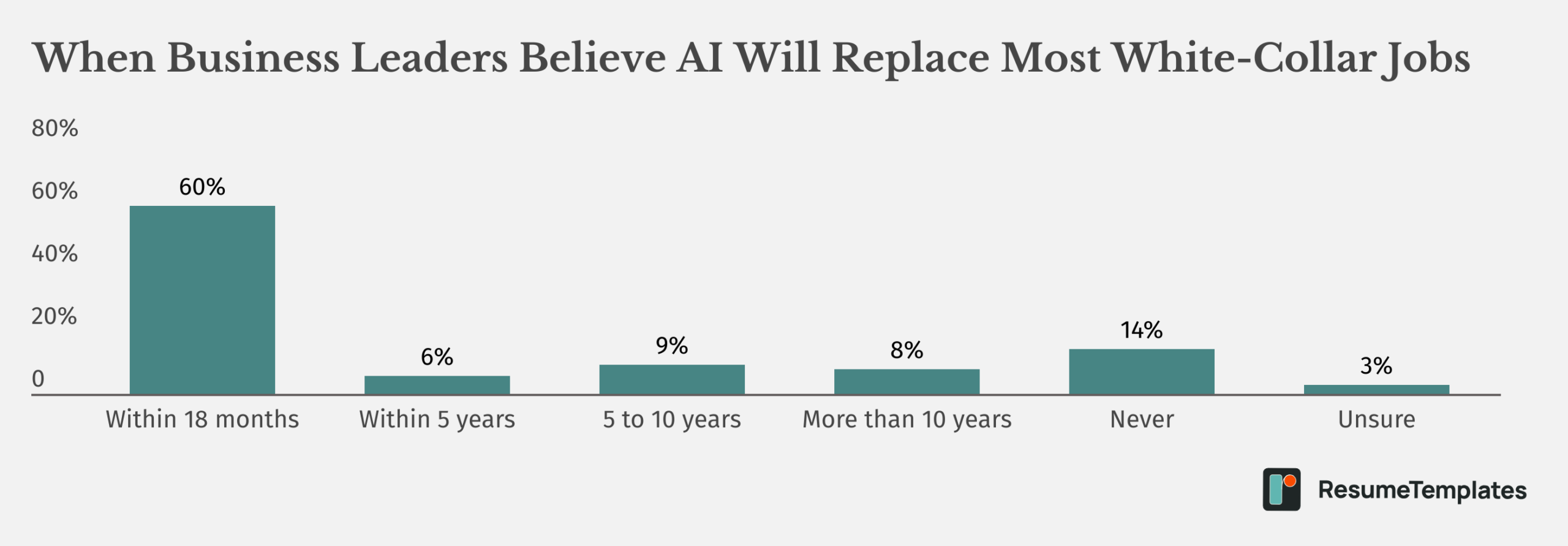
Sixty percent of business leaders believe AI will replace most white-collar jobs within the next 12 to 18 months, aligning with Suleyman’s prediction. Specifically, 31% strongly agree and 29% somewhat agree. Meanwhile, 32% disagree outright and 9% say they are unsure.
Among those who do not expect such rapid disruption, timelines vary. Eight percent believe widespread automation will happen within three years, while 9% estimate three to five years. Another 21% think it will take five to 10 years, and 19% say more than a decade. Notably, 34% say they do not believe most white-collar jobs will ever be fully automated.
4 in 10 Companies Have Already Replaced Workers With AI
Many business leaders (42%) say AI is already shrinking their workforce. When asked to choose the one option that best describes how AI is affecting their workforce size, 24% say they are actively eliminating roles because AI can replace the work.
Another 18% say they are consolidating roles or reducing backfills due to AI, and 10% report slowing or limiting hiring in certain areas. Meanwhile, 35% say they are using AI to support employees but not to reduce headcount, and 11% say AI is not affecting workforce size at all.
1 in 3 Business Leaders Suggest White-Collar Workers Pivot To Blue-Collar Careers
Roughly one in three business leaders say white-collar workers should consider pivoting to skilled trades or blue-collar roles instead of staying on a corporate path.
Specifically, 34% say early-career employees should consider making the switch. That rises to 37% for mid-career professionals, while 31% say even late-career workers should look at moving into the trades.
1 in 3 Suggest Traditional 4-Year College Is Dead
One in three business leaders say the traditional four-year college path is no longer a smart default.
Nearly half, 48%, say high school students should pursue skilled trades or blue-collar careers over white-collar jobs. That share climbs to 58% when asked about current college students.
Additionally, 33% say high school students should avoid a four-year college altogether, and 38% say the same for those already in college, suggesting that they consider dropping out.

For students who do pursue a degree, business leaders overwhelmingly say it should be practical and tech-focused. More than half, 55%, say high school students should choose a major with direct AI or tech applications. That figure rises to 69% for college students. In their view, a general degree is increasingly a poor bet.
Across the board, a majority say both high school and college students should prioritize developing strong AI skills.
“A four-year degree still makes sense for many career paths, including law, teaching, social work, and health care, and skilled trade workers will be in high demand over the next decade or more,” says ResumeTemplates’ Chief Career Strategist Julia Toothacre. “No path is perfect, so you need to consider what aligns best with your goals. Regardless of the path you choose, employers are looking for candidates who show initiative, communicate clearly, solve problems effectively, and embrace technological advancements like AI.”
8 in 10 Say Developing AI Skills Is Critical for Job Security
Developing AI skills is the most widely recommended strategy across every stage of education and career.
Seventy-five percent of business leaders say high school students should focus on building strong AI skills, and 72% say the same for college students. Additionally, 83% say early-career employees should prioritize AI skills, and 71% say mid-career professionals should as well.
Even late-career workers are not exempt. Sixty-seven percent of leaders say this group should focus on developing AI skills, making it clear that AI literacy is no longer optional at any stage.
“Those who can work alongside AI, using it to move faster, produce more, and take on higher-level work, have the strongest shot at long-term stability in corporate roles. Those who can’t are increasingly at risk,” says Toothacre.

Methodology: In February 2026, ResumeTemplates.com conducted an online survey of 933 U.S.-based business leaders. Respondents were screened prior to participation to ensure they were C-suite, VP, or Director-level professionals involved in hiring and workforce decisions. The survey targeted full-time employed adults ages 30 to 70 with annual income of $100,000 or more. Data quality procedures included completion checks and response-quality filters to remove low-quality or incomplete responses.
Resume Templates offers HR approved resume templates to help you create a professional resume in minutes. Choose from several template options and even pre-populate a resume from your profile.