

In January 2026, ResumeTemplates.com surveyed 1,000 Gen Z adults ages 18 to 23 who have searched for a job within the last two years. The survey aimed to understand the early-career job search and workplace behaviors of the youngest segment of the adult workforce.
The results:
- 75% of recent Gen Z job seekers say a parent submitted job applications for them
- 51% say their parent attended and sat in the room for multiple in-person interviews
- 65% say their parent completed at least one test assignment for them
- 2 in 3 employed Gen Zers admit a parent has communicated with their manager on multiple occasions, discussing their schedule, promotions, and workplace accommodations
- Gen Z men consistently report more repeat parental involvement than women, both during the job search and in the workplace
More than Half of Gen Z Recent Job Seekers Say a Parent Sat in on Multiple In-Person Interviews
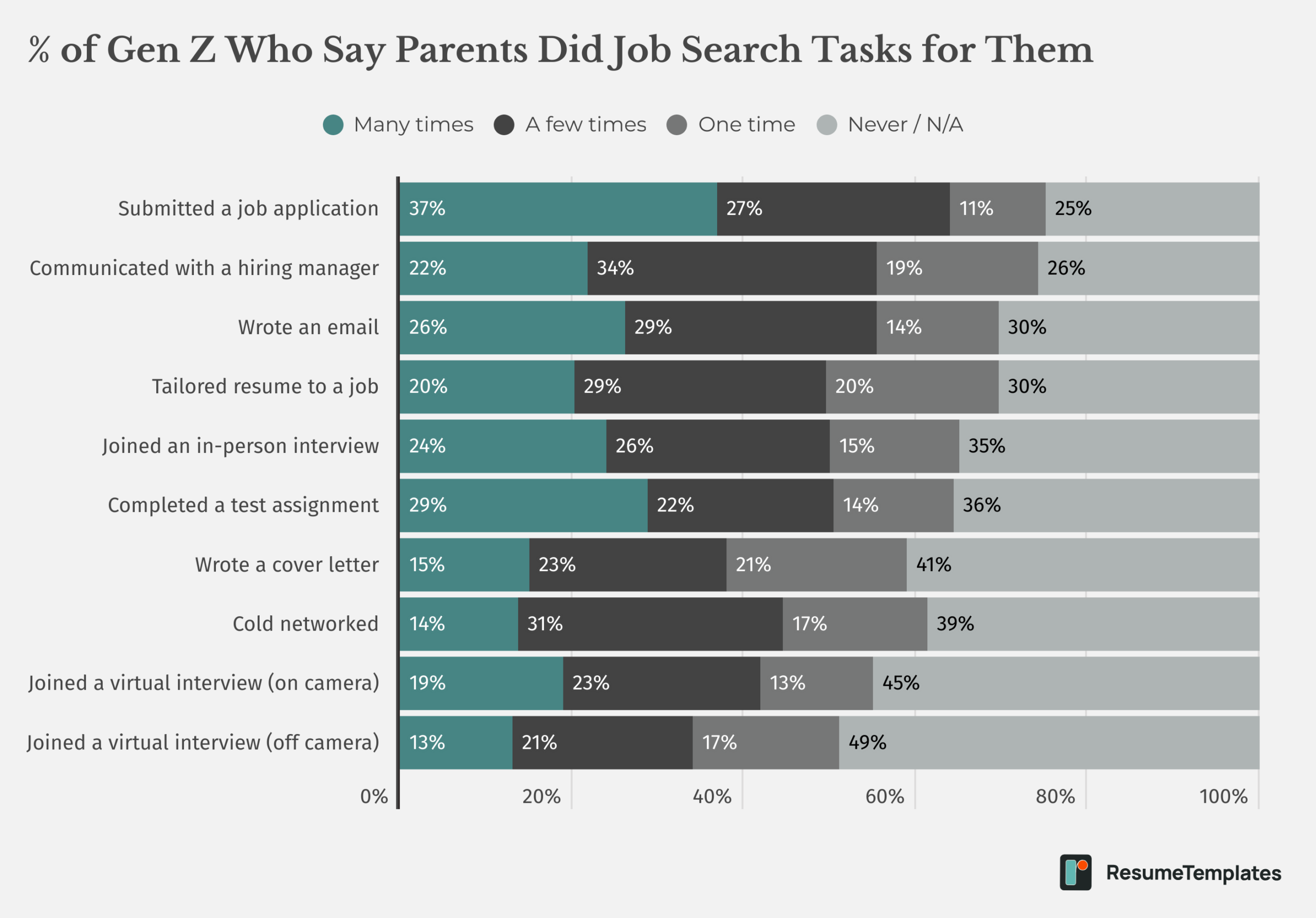
Young Gen Z job seekers report surprisingly high levels of parental involvement during their most recent job search. Across a number of tasks, more than half report a parent intervened at least once. Notably, however, involvement was typically not just occasional. More than half of Gen Zers surveyed say parents submitted applications (64%), communicated with hiring managers (56%), wrote emails on their behalf (56%), completed test assignments (51%), and sat in on in-person interviews (51%) multiple times.
Overall, a majority of Gen Zers say a parent did each of the following at least once during their most recent job search: submitted an application (75%), communicated with a hiring manager (74%), tailored their resume to a job (70%), wrote emails on their behalf (70%), sat in on an in-person interview (65%), completed a test assignment (65%), cold-networked for them (61%), wrote a cover letter (60%), appeared on camera during a virtual interview (55%), and attended a virtual interview off-screen (51%).
“Parental involvement in early-career job searches isn’t uncommon,” says ResumeTemplates.com Chief Career Strategist Julia Toothacre. “Most high schools don’t teach career readiness skills, and while colleges have career offices, those resources are often underused, especially in the early years. In that gap, parents often step in to provide support.”
“However, many parents are crossing the line from support into overinvolvement. It’s appropriate for parents to review resumes, explain how the job search works, or offer feedback on applications. Parents should advise and coach, but not take over or be present in the process. Many genuinely believe they’re helping their children navigate a system that feels unfamiliar, unpredictable, or stacked against them.”
Gen Z men are involving their parents more often than women
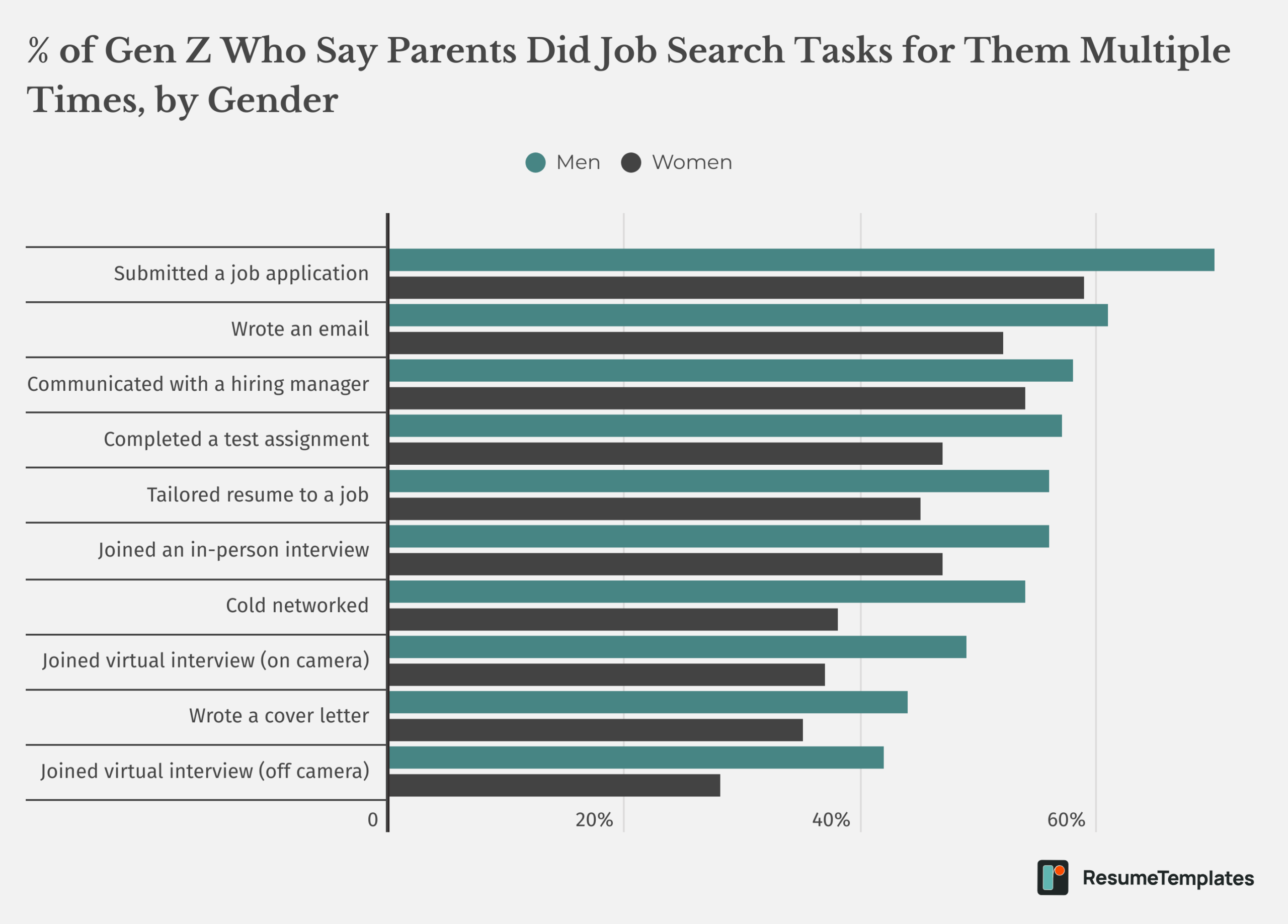
Across every job-search behavior, men are more likely than women to report parental involvement. Multiple times, 70% of Gen Z men had their parents submit job applications on their behalf (compared to 59% of women), write emails on their behalf (61% vs. 52%), and communicate with hiring managers (58% vs. 54%).
Nearly half of men (57%) had a parent join them in multiple in-person interviews, compared to 47% of women.
Toothacre explains that differences in how boys and girls are typically raised may help explain why more parents are involved in the early careers of Gen Z men. “In many families and cultures, girls are expected to take on responsibility at a younger age, whether it’s caring for siblings, helping around the home, or staying on top of school. In contrast, boys are more often encouraged to ‘just be kids,’ with fewer expectations early on. Boys are also more likely to be protected or defended, while girls are taught responsibility and self-management.”
More Than Half of Employed Gen Zers Say Their Parents Are Repeatedly Speaking With Their Manager and Doing Their Work
Among Gen Zers who are currently employed, many report that parents remain involved in their working lives. This involvement often extends beyond emotional support to direct participation in workplace responsibilities.
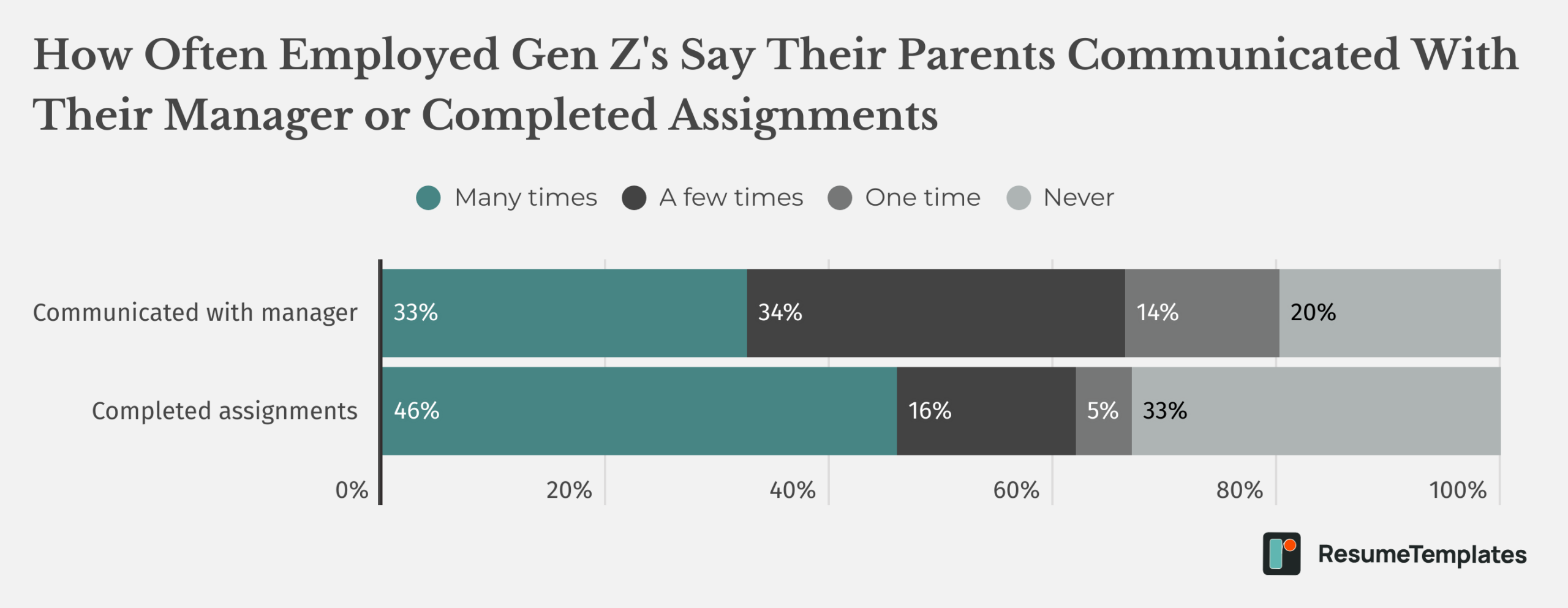
Eight in 10 employed Gen Zers say a parent has communicated with their manager at least once (80%), including 67% who report multiple instances.
Additionally, 62% say a parent has completed their work assignments multiple times, including 46% who report that this happens frequently.
Men are more likely to rely on parents for workplace support
Parental involvement at work is consistently higher among men than women. About 70% of men report that a parent has communicated directly with their manager at least a few times (35%) or many times (35%), compared to 65% of women (31% a few times, 34% many times).
Men are also more likely to report that their parents repeatedly complete their work assignments. Two-thirds of men (64%) say this happened multiple times, compared with 60% of women.
Among those whose parents have communicated with a manager, men are more likely than women to say it was primarily their idea (62% vs. 54%). Women are more likely to say the outreach was primarily the parents’ idea (36% vs. 27%).
When parents do communicate with managers, the most common topics for both groups are schedule or hours (58%), followed by workplace accommodations (38%). However, men again report higher rates of involvement across topics, including promotions (36% of men have a parent discuss this topic with managers vs. 27% of women), and concerns about workload or stress (34% vs. 30%).

“Some employers that regularly hire younger workers may tolerate a certain level of parental involvement. However, while there are exceptions, most managers expect employees to handle workplace interactions independently and professionally,” says Toothacre.
Parents Cite a Tough Job Market, Inexperience, and Anxiety as Reasons for Getting Involved
To better understand why parents step in, ResumeTemplates also surveyed parents who report significant involvement in at least one aspect of their 18 to 23-year-old child’s most recent job search.
In open-ended responses, many parents framed their involvement as a practical necessity in a difficult job market. One parent said it was “extremely hard for young people to get jobs nowadays, especially if they are under 25,” while another emphasized that they stepped in because they had professional expertise, noting, “I am a professional resume writer.” Others described involvement as a way to ensure their child was positioned to succeed, with one parent explaining they wanted to make sure their child “would be put in the best position to succeed.”
Some parents cited emotional or mental health-related reasons, including anxiety, explaining their child “has anxiety and is not a speaking to people type of person.” Several parents described stepping in to provide confidence and help with social aspects of the job search, including one who noted, “They needed help with getting into contact with people,” and another who said, “He was nervous for his first job, and they asked for my help.” A few were bluntly self-aware about the dynamic, with one parent admitting, “I am a helicopter parent and can’t relax otherwise.”
Parents overwhelmingly describe their involvement as requested rather than imposed. About 71% say their child asked them to be involved at the level they were, while 25% say they offered help and their child welcomed it. Only 4% say their child did not want their involvement.
Methodology: This survey was conducted in January 2026 by ResumeTemplates.com on the Pollfish platform. The survey consisted of 1,000 Gen Z adults aged 18 to 23 who have searched for a job within the past two years.
A subsequent survey was conducted among 181 parents who have a child between the ages of 18 and 23. Parents were asked whether they had taken specific actions to support their child during a recent job search. Parents who indicated that they had not participated in any of the listed job-search tasks were excluded from the study.
Pollfish employs multiple quality assurance procedures, including attention checks and respondent validation measures, to ensure the collection of high-quality survey data. Additional details on Pollfish’s sampling methods and quality controls are available on Pollfish’s website.
Percentages are rounded to the nearest whole number. As a result, totals may not equal 100%, and combined figures may differ slightly from the sum of rounded values.
Media inquiries can be directed to [email protected].
Resume Templates offers HR approved resume templates to help you create a professional resume in minutes. Choose from several template options and even pre-populate a resume from your profile.