Tip !

Category managers decide whether to keep reading by the first two bullets of your most recent role; if a sell-through percentage or named retail account isn't visible by then, the resume gets stacked under the ones that have both.

Andrew Stoner , Executive Resume Writer and Career Coach

Why this resume works

  • Numbers tied to the route: Specific visit counts, compliance rate, and store coverage show a hiring manager exactly what the candidate handles in a week.
  • Caught a costly shelf error: The shelf tag mismatch bullet shows the candidate protects client margin, not just hangs strips and signs.
  • Named the reporting tools: Listing Movista and Repsly by name passes resume screens for agencies that staff CPG field teams.

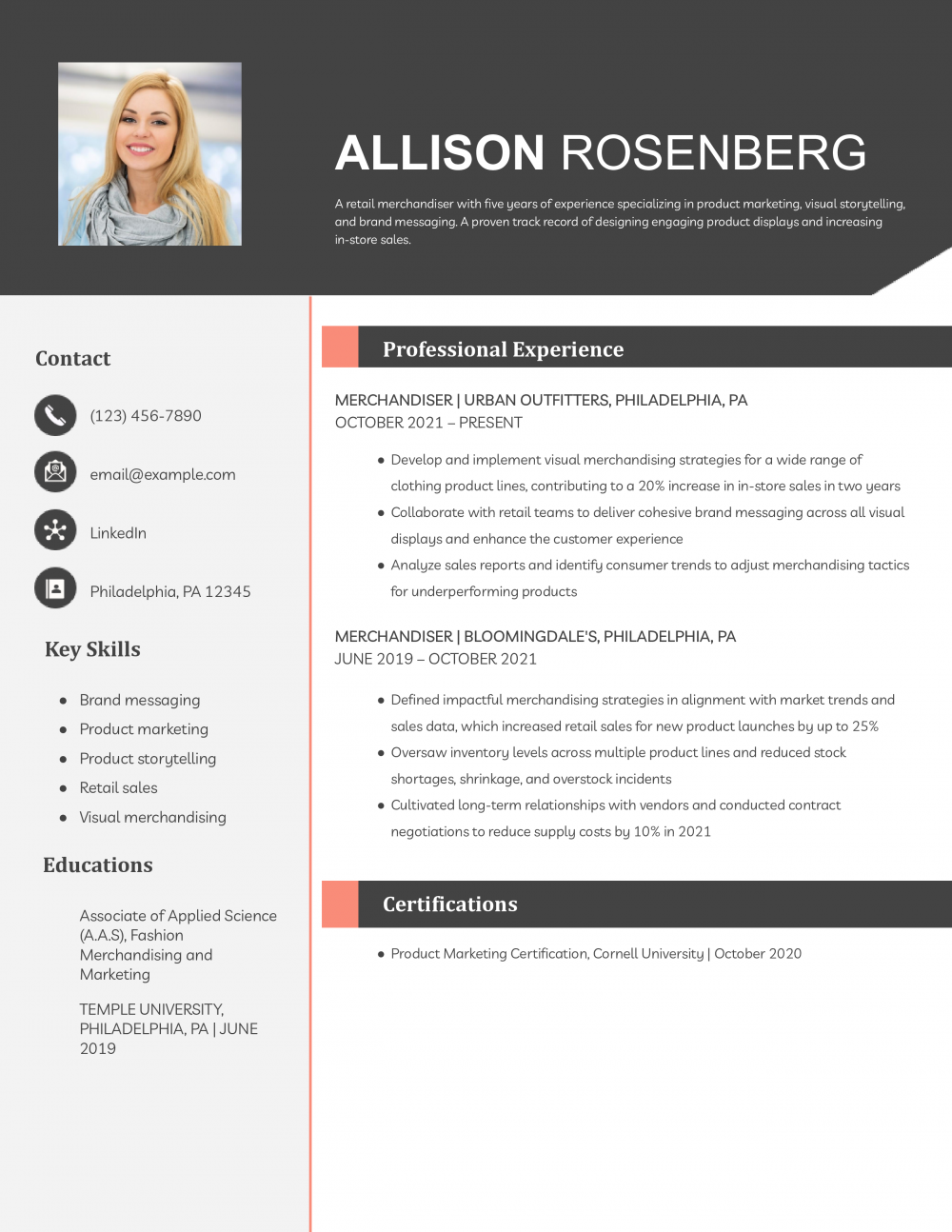
Entry Level Example

Entry level merchandisers are coming from retail floor, stocking, or visual display roles and need to show route reliability. The resume must prove planogram literacy, store coverage, and any sell-through or compliance data from prior shifts.

Why this resume works

  • Honest about experience level: The summary does not oversell a recent grad and instead points to two years of real shelf work.
  • Shows planogram exposure: Even at a junior level, the resume names planograms, FIFO, and price changes, which are the tasks merchandiser hiring managers screen for.
  • Lists schedule and transportation: Stating reliable transportation and morning availability answers two of the first questions any field recruiter asks.

Experienced Example

Experienced merchandisers run multi-store routes for a CPG brand or retailer and own category-level decisions. The resume must show account volume, sell-through lift, reset execution on schedule, and the retailer relationships you manage.

Why this resume works

  • Concrete route size: Naming an 11-store territory and 17 weekly visits tells the recruiter the candidate already runs the size of route most agencies are filling.
  • Beat a real deadline: Finishing the pet food reset 2 days early is the kind of detail account managers brag about to clients.
  • Reporting tools listed by name: AFS Retail and Repsly are the apps CPG field teams hire against, so this resume clears keyword filters.

Senior Example

Senior merchandisers and category leads own assortment strategy across a region or a national account. The resume must lead with revenue impact, team or territory scope, and the buyer relationships you've built at Walmart, Target, or comparable chains.

Why this resume works

  • Real team and territory size: Leading 9 merchandisers across 142 stores immediately places this candidate at the supervisor level a hiring manager is filling.
  • Cut turnover with a clear method: Pairing the 38% to 14% turnover drop with the actual program (onboarding rebuild and mentors) shows it was not luck.
  • Talks to clients, not just shelves: Running quarterly business reviews with national CPG brands signals this person can hold the client relationship a supervisor owns.

How to Write a Merchandiser Resume

01 Open with the one thing a category manager cannot find elsewhere

Lead with the signal a generic merchandiser resume won’t carry. Name the retailer accounts you service, the CPG brand you represent, or the reset team you lead.

If you’ve held a Walmart Retail Link badge, run Target POG resets, or covered a 40-store route across a metro, put it in the summary line. Visual merchandisers should name the apparel or home category and the store concept they built. That one specific opener tells a hiring buyer you’ve done the work they’re trying to staff.

02 Turn each bullet into a number a buyer recognizes

Merchandiser work has built-in metrics, so most strong bullets carry one. Pick from sell-through percentage, planogram compliance rate, stores covered per week, SKU count managed, or shrink reduction.

Write the action and the result on the same line: “Reset 32 Kroger stores across the Dallas market on a four-week cycle, lifting sell-through 18% in the snack category.” Bullets without a number tend to read as duties. Two or three quantified bullets per role move you ahead of resumes that list responsibilities.

03 Group your work into four merchandiser deliverables

Category managers scan for a predictable shape, so cluster bullets under the work they actually buy. Use planogram execution and resets, replenishment and inventory accuracy, sell-through and category performance, and account or vendor relationships.

Under planograms, name the POG software (JDA, Blue Yonder, Apollo) and the compliance rate. Under replenishment, name the handhelds and the cycle count cadence. Under category performance, tie a merchandising decision to a sales number.

Under accounts, name the retailers and the buyer-side contacts you coordinate with weekly.

04 Place tools and certifications where buyers look first

Put your tool stack and credentials in a page-one block beneath the summary, not buried at the bottom. List the planogram software, retailer portals (Retail Link, Partners Online), and any field reporting apps (Repsly, GoSpotCheck, Movista) you’ve used.

Add OSHA 10, forklift certification, and any retailer-specific training (Walmart vendor compliance, Target POG certification) on the same block. Category managers and field directors check tool fluency before deciding whether to call. Visible credentials shorten the screen and signal you can start a route without weeks of system training.

05 Close with education and route-specific assets

End with education, languages, and the practical assets that affect route assignment. A two-year or four-year degree in business, marketing, or visual merchandising goes here.

Add a clean driving record, reliable vehicle, and any geographic flexibility if the role is field-based. Bilingual ability matters in many markets, so name the language and proficiency. These line items resolve the logistical questions a recruiter asks before scheduling a screen, so keep them brief and visible above the fold of page two.

The merchandiser resumes that get callbacks share a specific skill mix. The lists below come from our user-built merchandiser resumes. Merchandising directors and category managers scan for these patterns first, not generic retail-floor framing.

Hard skills carry the keyword weight (planogram execution, sell-through analysis, JDA Space Planning). Soft skills back the bullets, so pair route reliability and account communication with the metrics that prove them. Match the lists against the job posting you’re targeting, and use the soft skills as evidence anchors inside your bullets rather than a standalone block.

Soft Skills % of resumes with this skill
Communication 73%
Attention to detail 52%
Creativity 44%
Organization 36%
Teamwork 30%

And here are the top hard skills showing up most often.

Hard Skills % of resumes with this skill
1. Visual merchandising 78%
2. Inventory management 70%
3. Planogram development 50%
4. Trend forecasting 35%
5. Product display design 29%

Based on data from thousands of merchandisers’ resumes built on ResumeTemplates.com, May 2026.

Must Have on a Merchandiser Resume

These are the must-haves hiring teams look for when scanning a merchandiser resume.

POS Systems Familiarity

Merchandiser tool fluency is a real screen, not a nice-to-have. Category managers and field directors check it before scheduling a call, so put a clean tools block on page one.

  • Planogram software: JDA Space Planning, Blue Yonder, Apollo, Spaceman
  • Retailer portals: Walmart Retail Link, Target Partners Online, Kroger Supplier Hub
  • Field reporting apps: Repsly, Movista, GoSpotCheck, Natural Insight
  • Handhelds and scanners: Zebra TC series, Telxon, in-house retailer devices
  • POS and inventory: NCR Counterpoint, Lightspeed Retail, Oracle Retail
  • Visual planning: Adobe Creative Suite, SketchUp, in-store concept decks

Route, Schedule, and Travel Availability

Merchandiser hiring runs on logistics, so route availability is part of the screen. Make it visible above the fold on page two or in a short callout under your contact line.

Route and Availability Snapshot

Resets happen overnight and weekends at most big-box accounts, and field routes start before stores open. Tell the recruiter what you can cover before they have to ask.

Note geographic radius, overnight reset availability, weekend coverage, and any blackout periods. A clean driving record and reliable vehicle line belong here too if the role is field-based.

  • Geographic radius you’ll cover (e.g., 60-mile radius of the Dallas metro)
  • Overnight and early-morning reset availability
  • Weekend and holiday coverage windows
  • Clean driving record and reliable personal vehicle
  • Travel percentage you accept for regional or multi-state routes
  • Bilingual coverage for markets that need it

Merchandising Credentials That Get You the Job

Beyond a clean driving record and basic retail experience, the certifications below tell category managers which retailer systems you’ve been trained on and how safely you handle a reset crew or warehouse floor. List each item with the issuing body and the year completed on a single line.

  • OSHA 10-Hour General Industry: Standard ask for any reset crew or warehouse-adjacent merchandiser role; signals you can work a back room safely.
  • Forklift Operator Certification: Required at many big-box and club-store accounts; name the issuing trainer and the lift class you're cleared on.
  • Certified Professional in Supply Management (CPSM): Carries weight for senior merchandisers moving into category or buying roles where assortment planning meets vendor negotiation.
  • Retailer Vendor Compliance Training: Walmart, Target, and Kroger run their own vendor training tracks; completion shortens onboarding and tells buyers you know their portal.

Latest BLS Statistics for Merchandisers

The top-paying states for merchandisers are clustered in high-cost coastal and Northeast markets where CPG brands compete hard for field coverage, not the Sunbelt metros where retail headcount is largest. The pay spread reflects account complexity: national-account merchandisers servicing Walmart or Target supercenters out-earn route merchandisers covering smaller convenience or drug formats.

If you’re geographically flexible, the resume should foreground the retailer accounts and category volume you’ve handled, since those are the levers that move you from a route rate to a category-management band.

$37,350 National median annual
$40,540 National mean annual
$30,050 Entry-tier floor (10th percentile)
$53,800 Top-decile ceiling (90th percentile)
192,480 Merchandisers in the U.S.
Where you stand

Entry tier

$30,050 to $37,350 At the entry tier, lead with route coverage, planogram literacy, and any sell-through or compliance numbers from retail or stocking roles.

Mid band

$37,350 to $53,800 At the mid band, your resume needs to show multi-store account volume, named retailers serviced, and quantified sell-through lift per category.

Top decile

$53,800+ At the top decile, lead with regional or national account ownership, team or territory scope, and revenue impact tied to assortment decisions.

Top-paying states

# State Avg. Annual
1 Washington $45,760
2 Alaska $44,410
3 Utah $43,260
4 California $42,530
5 District of Columbia $42,230
6 Connecticut $42,170
7 Massachusetts $42,010
8 Vermont $41,790
9 Colorado $41,660
10 New York $40,610

Highest-employment states

# State Workers Median
1 California 24,660 $42,530
2 Texas 17,010 $35,410
3 Florida 11,910 $36,050
4 New York 10,720 $40,610
5 Georgia 8,780 $34,160
Source: U.S. Bureau of Labor Statistics, OEWS 2024 release (SOC 27-1026).
Written by professional resume writers and loved by hiring managers

Resume Templates offers HR approved resume templates to help you create a professional resume in minutes. Choose from several template options and even pre-populate a resume from your profile.

Frequently Asked Questions

What counts as merchandising experience on a resume?

Merchandising experience is any work where you decided what product goes where, in what quantity, and how it's displayed.

That includes retail floor resets, planogram execution, visual display builds, replenishment routes, and category or buying assistant roles. Stocking shelves on its own does not count; the moment you owned the layout decision or the sell-through outcome, it does.

How do I write a visual merchandiser resume differently from a field merchandiser resume?

Visual merchandiser resumes lead with store concept, window builds, seasonal campaign execution, and the apparel or home category you styled. Name the store brand and the format (flagship, outlet, popup).

Field merchandiser resumes lead with stores per week, retailer accounts, planogram compliance rate, and sell-through lift. Name the CPG brand or agency and the retailers you serviced.

What format works best for a merchandiser resume?

Use reverse chronological with a page-one summary, a tool and certification block, and four to six quantified bullets per role.

Keep it to one page if you have under 10 years in the field. Move to two pages once you've run regional or national accounts and need room for the buyer relationships and category metrics.

Should I list the retailers and CPG brands I've worked with by name?

Yes. Named retailers like Walmart, Target, Kroger, and Home Depot and named CPG brands like PepsiCo, Unilever, and Nestle function as ATS keywords and signal account complexity.

Put them in your bullets next to the volume and sell-through numbers. A category manager scanning your resume wants to see scope (how many doors, what banner) before they read the metric.

What resume template should a merchandiser use?

For a merchandiser, a professional template is the safest pick, because it signals the polish hiring managers in this field expect. An ATS-friendly template is a solid alternative. Whichever you choose, keep the formatting clean and easy to parse: clear section headings, a standard font, and no graphics a parser can choke on.

Rate this article

Merchandiser Resume

Average Rating

4.2/5 stars with 132 reviews

You have given 0 Star(s)
4.2/5 stars with 132 reviews
Andrew Stoner

Executive Resume Writer and Career Coach

Andrew Stoner is an executive career coach and resume writer with 17 years of experience as a hiring manager and operations leader at two Fortune 500 Financial Services companies, and as the career services director at two major university business schools.