
1 in 4 Hiring Managers Will Cut 2026 College Grad Hiring This Year



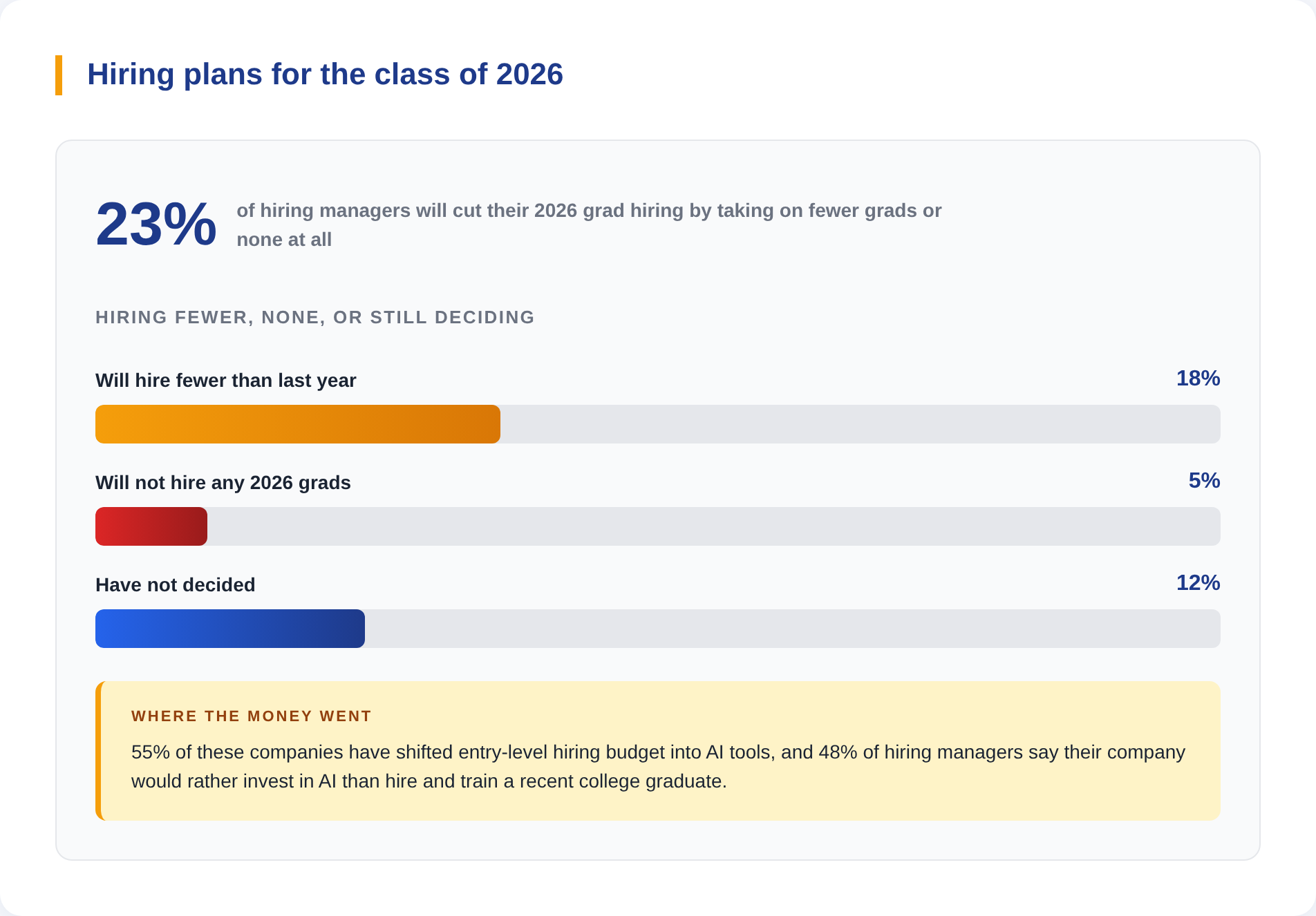
Graduation season is here, and the class of 2026 is walking into a colder reception than the class before it. In May 2026, ResumeTemplates.com surveyed 1,000 U.S. hiring managers at companies with 101 or more employees about their plans for this class. 23% of hiring managers will cut their 2026 college grad hiring, taking on fewer grads than last year or none at all. Already, 45% have restructured so one senior worker plus AI does the work of multiple grads. The survey’s findings run from character flaws to basic reading skills. Managers say grads act entitled, struggle to read a simple memo, and cannot be left alone with a customer.
Key findings:
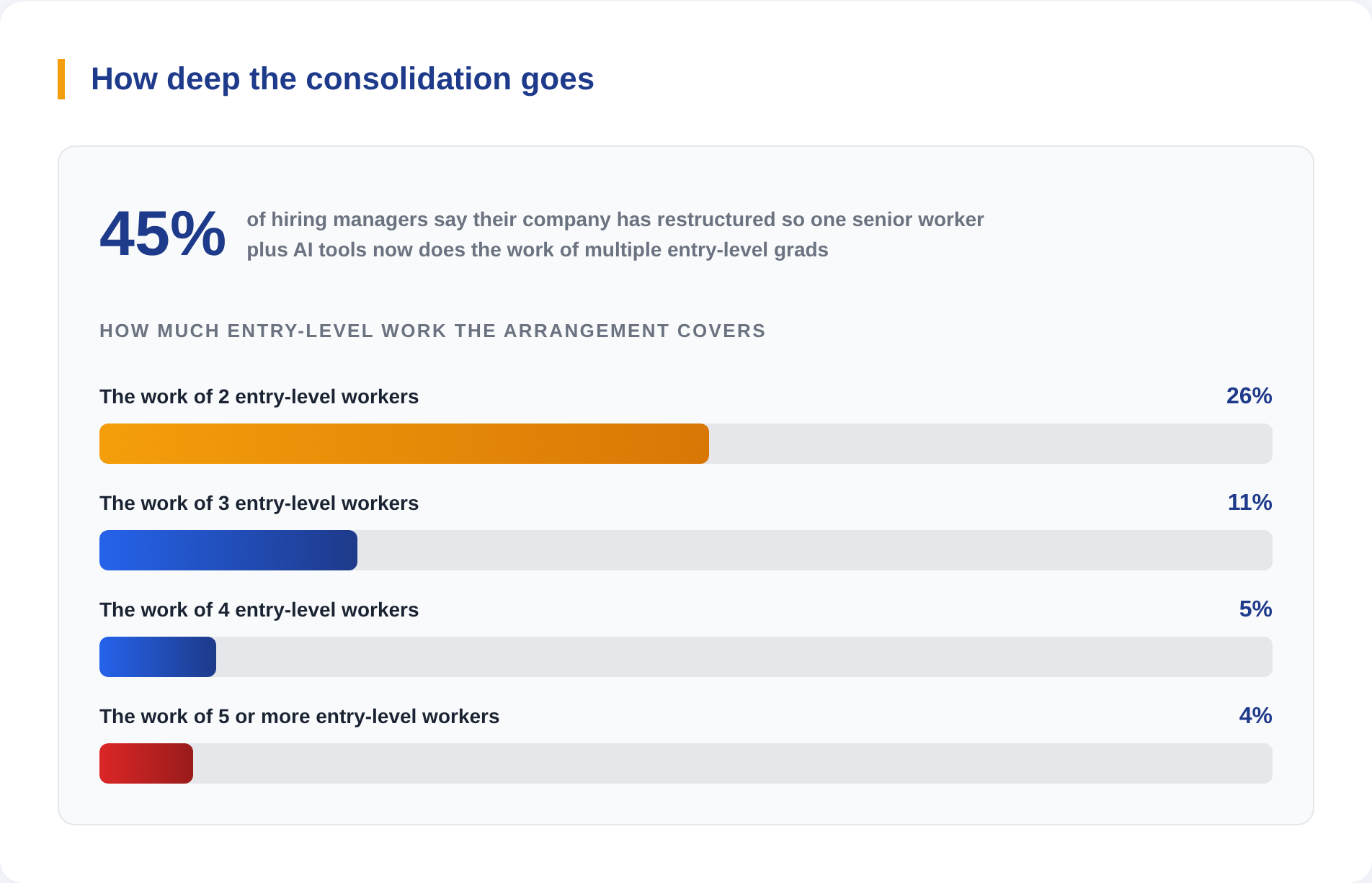
- Entry-level roles eliminated under AI: 1 in 5 companies now have one senior worker plus AI covering three or more entry-level roles
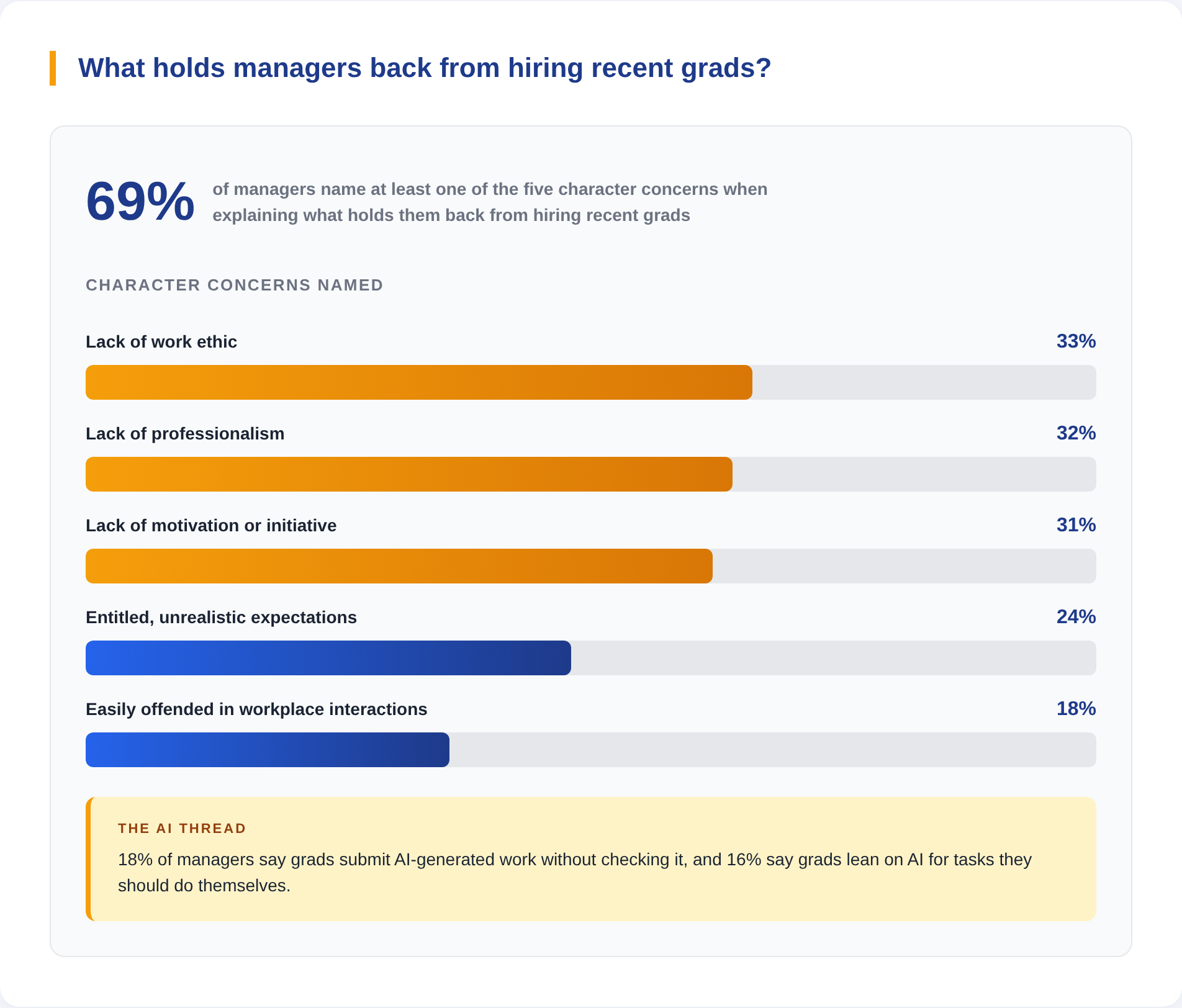
- Character flaws, the top deal-breaker: work ethic (33%), professionalism (32%), and motivation (31%) lead the complaints about grads
- Comprehension and critical thinking no longer taught: Three-quarters of managers say grads miss what work documents actually mean
- Basic skills lacking: 41% of managers say recent grads can’t write a professional email
- Liability in front of customers: 83% of managers don’t fully trust recent grads with customers
For some, the cut goes all the way to zero. 5% of hiring managers will not hire a single 2026 grad this year, and 18% will take on fewer than last year. Those two groups make up the 23% cut. Another 12% have not decided how many to hire.
1 in 2 Companies Consolidated Multiple Entry-Level Roles With One Senior Worker Plus AI
What replaced the entry-level positions is already in place. 45% of hiring managers say their company has restructured so that one senior worker plus AI tools now does the work of multiple entry-level grads. At 20% of companies, that arrangement covers three or more entry-level roles.
The money is moving the same direction. 55% report their company has shifted at least part of its entry-level hiring budget to AI tools, and 48% say their company would rather invest in AI than hire and train a recent college graduate. ResumeTemplates reported that AI finding in its companion report on AI and 2026 grads. For many grads, the competition this spring is not another applicant. It is AI.
That is the how. The why is the grads themselves, and it starts with their character.
2 in 3 Employers Reject 2026 Grads as Entitled, Unprofessional, and Lazy
When managers explain what holds them back, character comes up again and again. 69% name at least one character concern. A lack of work ethic (33%), professionalism (32%), and motivation (31%) top the list. Grads who come in entitled, with unrealistic expectations, follow at 24%. Another 18% say grads are too easily offended at work.
Beyond character, managers point to a lack of relevant work experience, the most-named single item at 45%, and a run of skill gaps: poor communication (28%), trouble handling feedback (26%), weak technical skills (26%), and poor time management (25%). Weak problem-solving lands at 22%.
Managers are not against AI. Their companies are paying for it. The complaint is what grads do with it: 18% say grads submit AI-generated work without checking it, and 16% say grads lean on AI for tasks they should do themselves. For managers, a grad who hands their work to AI is an argument for cutting out the middleman.
Asked what would change their mind about hiring a class of 2026 grad, a New York nonprofit manager spoke for those who doubt grads’ work ethic: “If the person could demonstrate an excellent work ethic by showing participation in groups and volunteer work during college.”
3 in 4 Managers Say Recent Grads Can’t Read a Simple Memo, Contract, or Budget Without Help
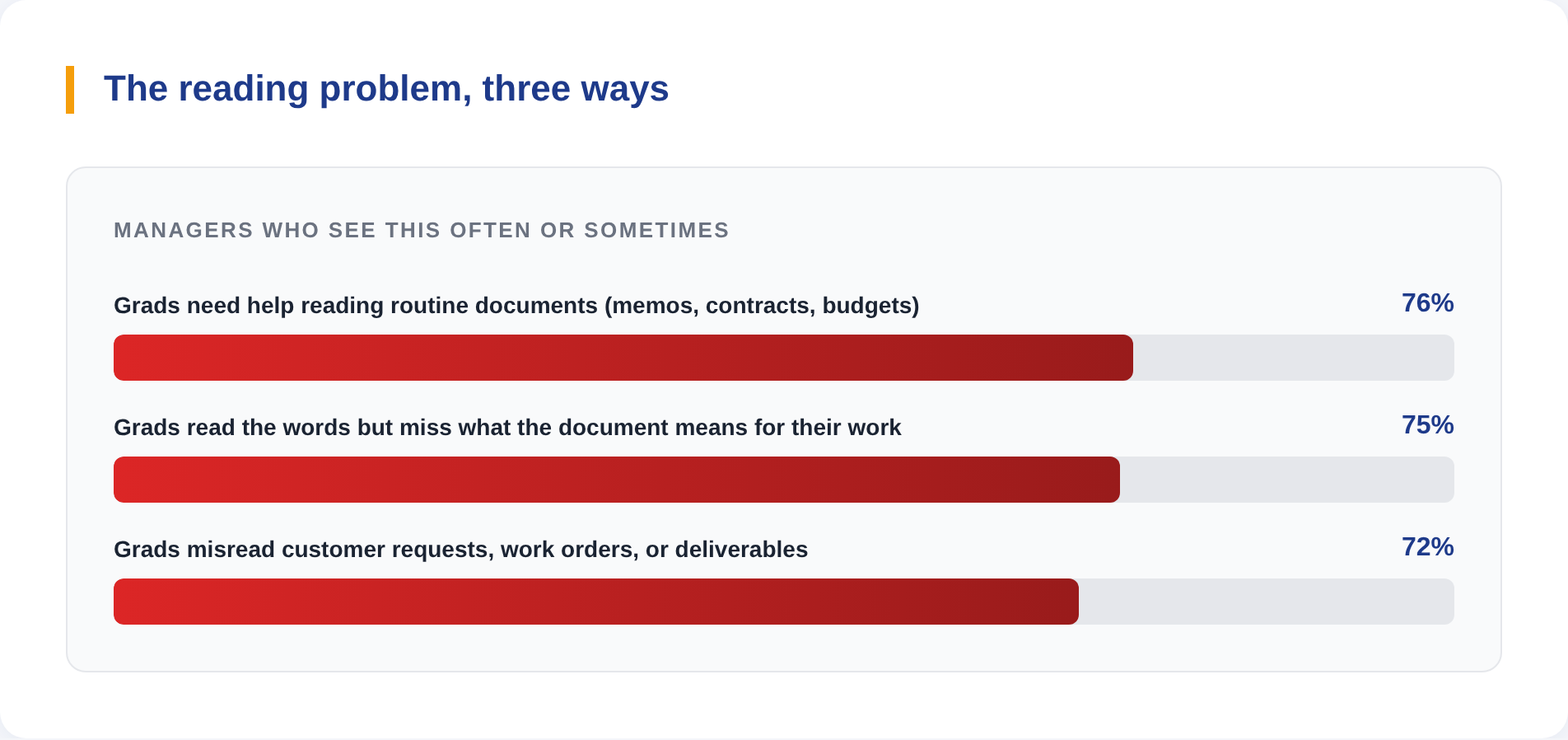
The complaints go past character and experience: managers also say grads cannot get through standard work documents. 76% of managers say recent grads need help reading routine documents like memos, contracts, or budgets. For 57% that comes up sometimes, and 19% say it happens often.
Reading is just the start. 75% say grads make sense of the words but still miss what the document means for their work. That happens sometimes for 57% and often for 18%.
The pattern reaches customers too: 72% say grads misread customer requests, work orders, or deliverables. 57% see it sometimes, and 15% see it often. The three numbers measure the same gap from three angles. A misread memo stays inside the company. A misread customer request does not.
“New grads can be prepared for this, especially in the interview process. They need to bring specific examples of how they have worked in the past,” says ResumeTemplates’ Chief Career Strategist Julia Toothacre. “Volunteer experience, student leadership, club involvement, or anything that requires them to work with complex documents or interact with people would be great examples to bring into an interview. Many recent grads tend to speak in generalizations and hypotheticals rather than specifics. When they get specific about what they have done, they demonstrate concrete knowledge to the hiring manager.”
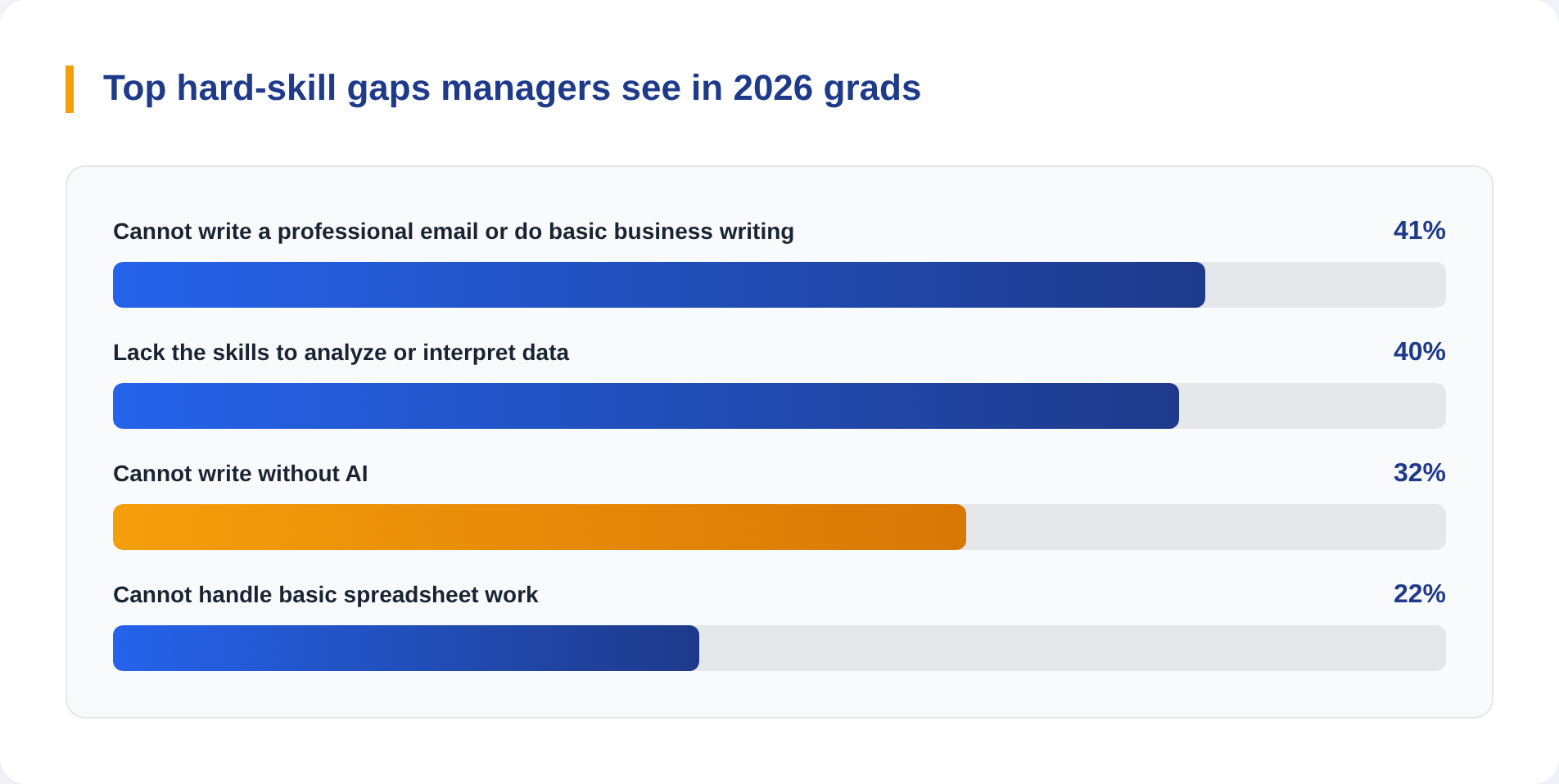
The writing gaps are just as basic. 41% of managers say recent grads cannot write a professional email or do basic business writing, and 32% say grads cannot write without AI.
2 in 5 Say Recent Grads Can’t Make Sense of Data
The second-most-named hard-skill gap is data analysis: 40% of managers say recent grads lack the skills to analyze or interpret data. Basic spreadsheet work is a problem too: 22% say grads cannot handle Excel or Google Sheets. That is not advanced modeling. It is rows and columns.
A Kentucky retail manager tied together two concerns that run through the survey: “I want people who can function without AI. Also, they need to carry themselves professionally in the workplace.”
3 in 10 Hiring Managers Don’t Trust Recent Grads with Customers
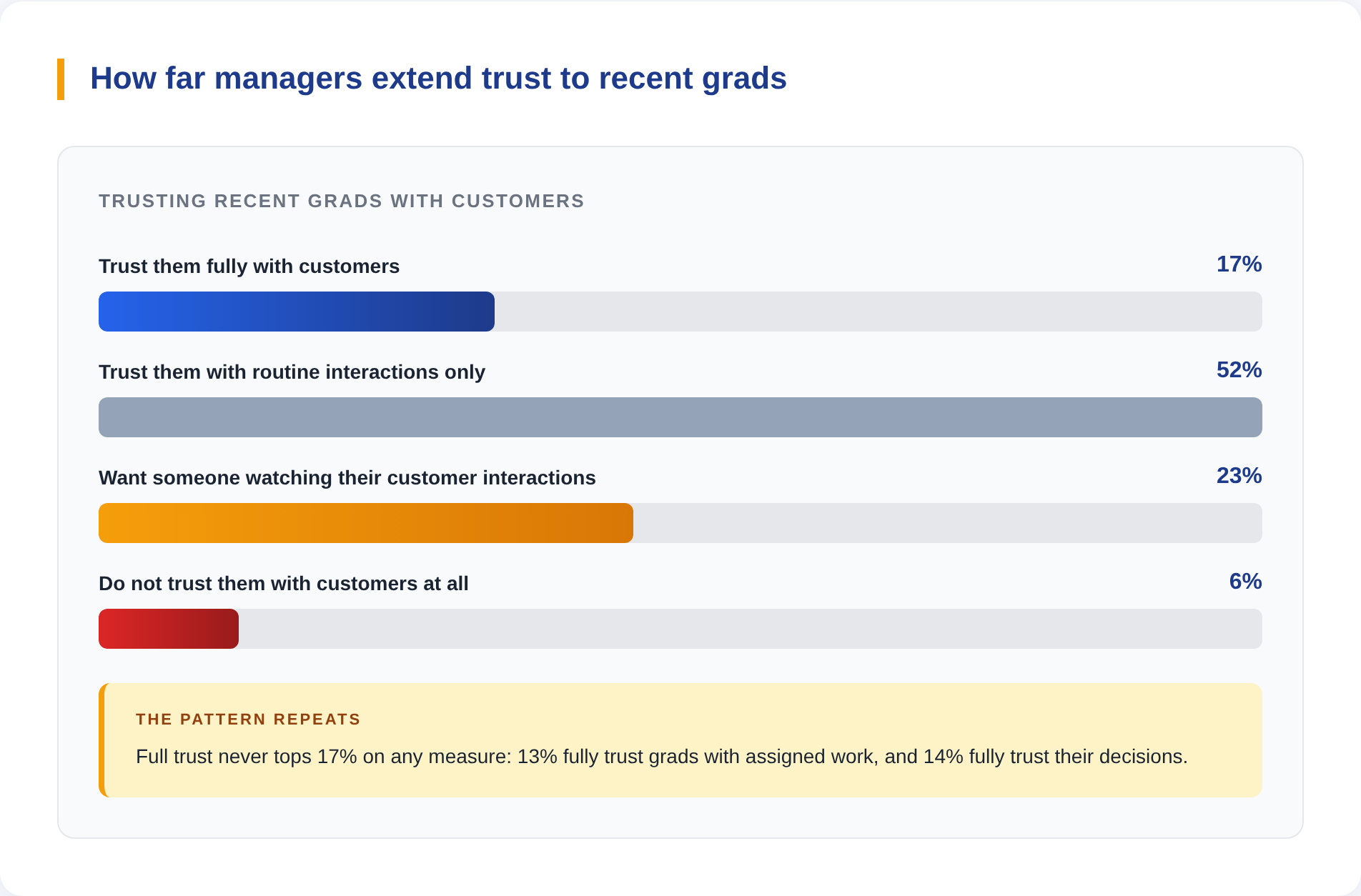
Managers draw lines around what recent grads can be trusted with. 29% do not trust recent grads on their own with customers: 23% want someone watching, and 6% do not trust them with customers at all. These are college graduates managers will not put in front of a customer alone. Another 52% trust them with routine interactions only. Just 17% extend full trust. The other 83% hold something back.
The same caution applies to grads’ own work. 13% fully trust recent grads to handle their assigned work without close supervision, and 64% trust them with routine work only. The pattern repeats on decisions, where 14% fully trust them to make good decisions on their own and 62% trust them with routine decisions only.
Full trust is rare across all three measures, never topping 17%. For the grads who do get hired, the numbers describe the job ahead: watched work, routine tasks, and trust that has to be earned.
For one Missouri hospitality manager, the limits come off on one condition: “If I could trust and feel confident that a class of 2026 grad was able to do things without supervision.”
“New grads need to be able to find their own answers and problem-solve,” says Toothacre. “For those still job searching, consider writing practice emails and getting them reviewed by a professional in your network, even a parent or family member. They can give you feedback on your writing style, tone, and professionalism. Most college students aren’t learning Excel in college unless it’s part of their major, so job seekers can take Excel courses to close that gap.”
Toothacre says all experience counts if it is framed the right way. “New grads can and should use a variety of experiences on their resume, such as volunteer work, student leadership, or involvement in sports. While employers like new hires to have real-world experience, that experience can be found in a variety of places. Focus on the skills you gained and the specific projects you worked on when you articulate your experience on your resume.”
Methodology: ResumeTemplates.com commissioned this survey, which was conducted via Pollfish in May 2026. A total of 1,000 U.S. hiring managers responsible for entry-level hiring at companies with 101 or more employees participated. Demographic and screening criteria ensured all respondents qualified. Pollfish reaches respondents in their natural digital environments through Random Device Engagement and applies quality controls to filter out inattentive or fraudulent responses. Pollfish reports a margin of error of plus or minus 3.1 percentage points at a 95% confidence level.
Resume Templates offers HR approved resume templates to help you create a professional resume in minutes. Choose from several template options and even pre-populate a resume from your profile.