Translator Resume Examples and Templates for 2026



Style guide fluency and a clean list of titles edited are what get editor resumes past the masthead's first read; the metrics tied to those titles are what make them readable enough to advance to a portfolio request.
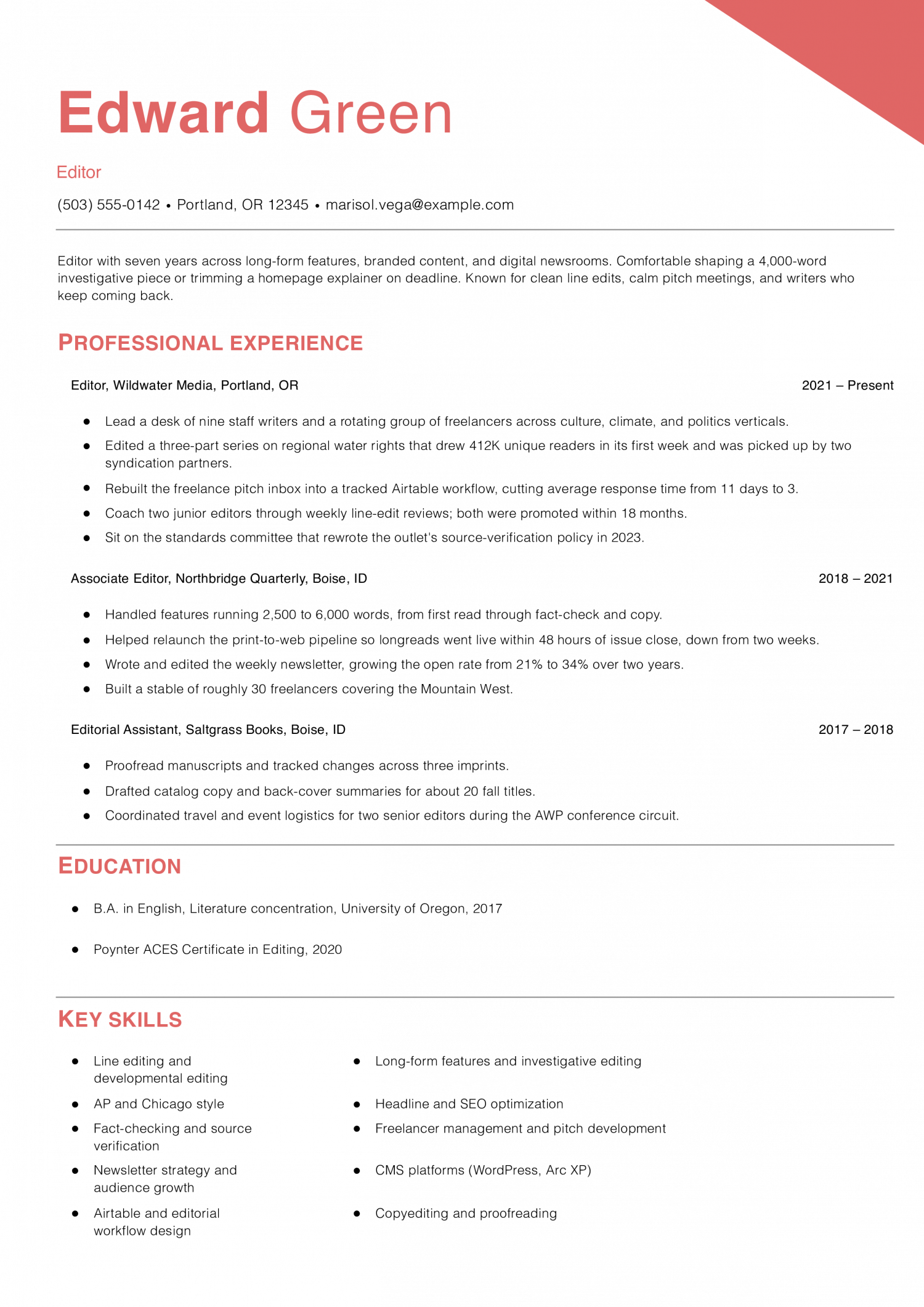
The assistant editor archetype is one to three years in, often promoted from editorial assistant or fellowship work. This resume needs to prove fact-checking volume, style guide fluency, and CMS production support on real titles or issues.
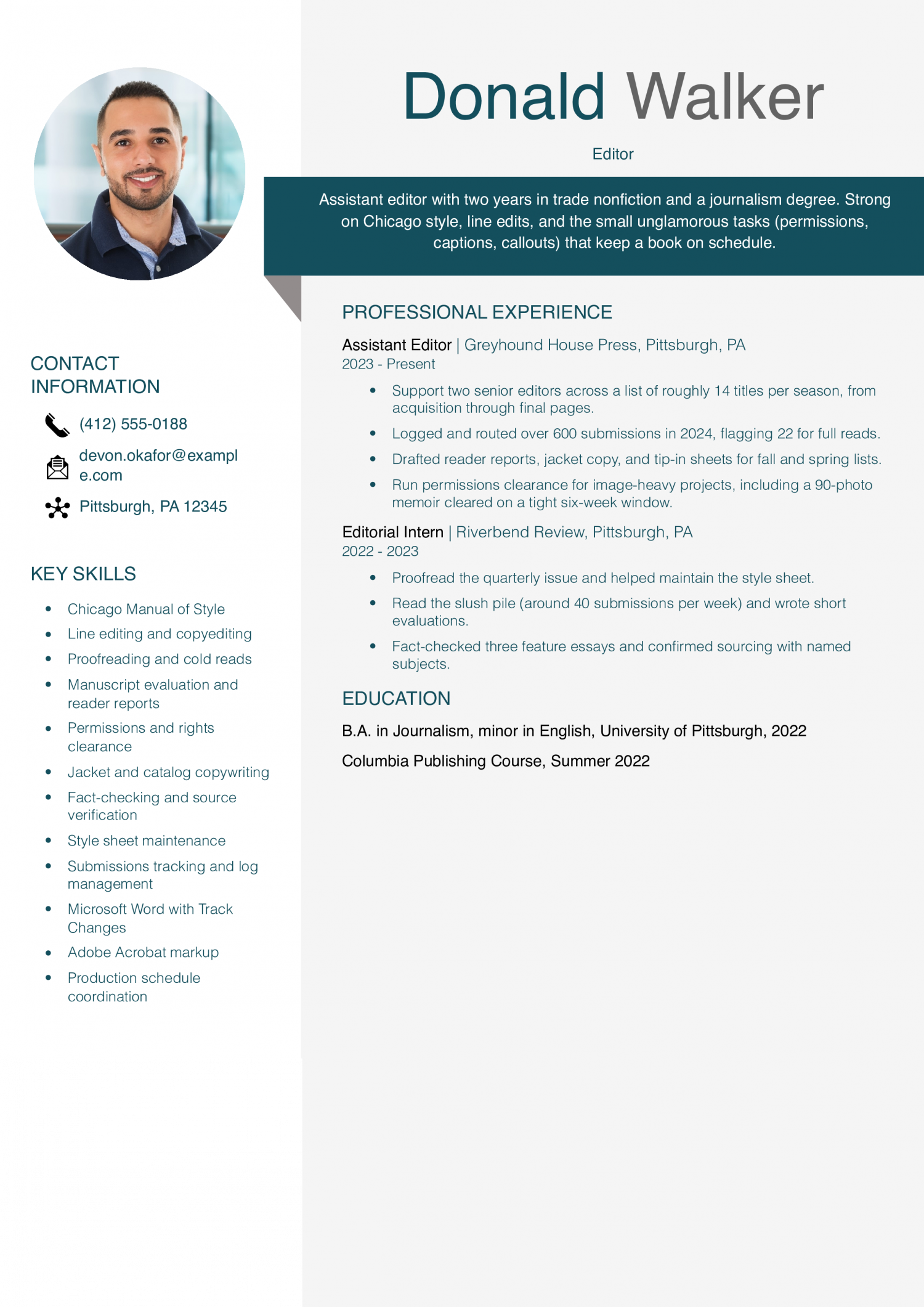
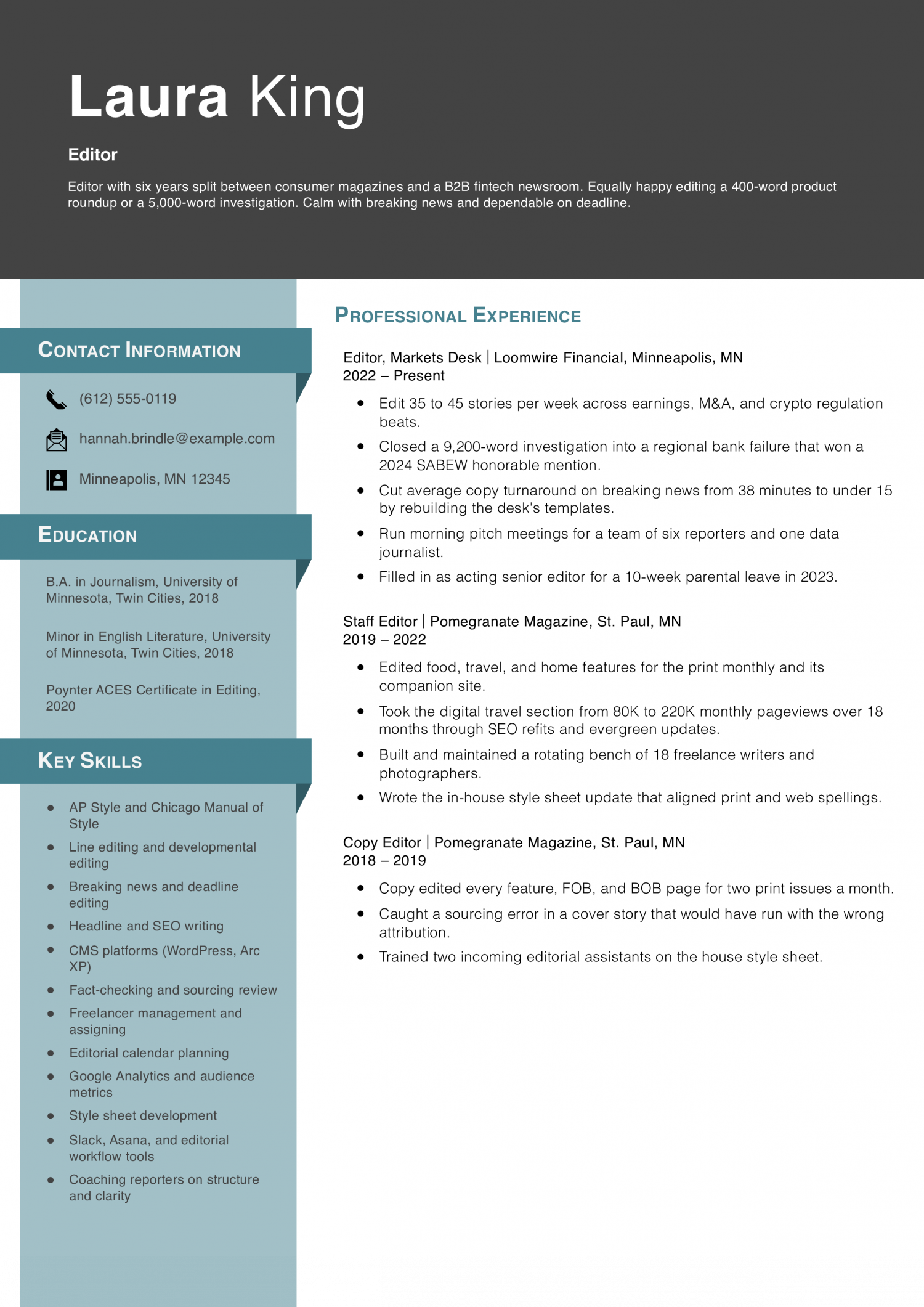
The editor archetype owns a section, vertical, or list and shapes the work from pitch through publication. This resume needs to prove story selection, writer management, and measurable lifts in traffic, accuracy, or on-time delivery.
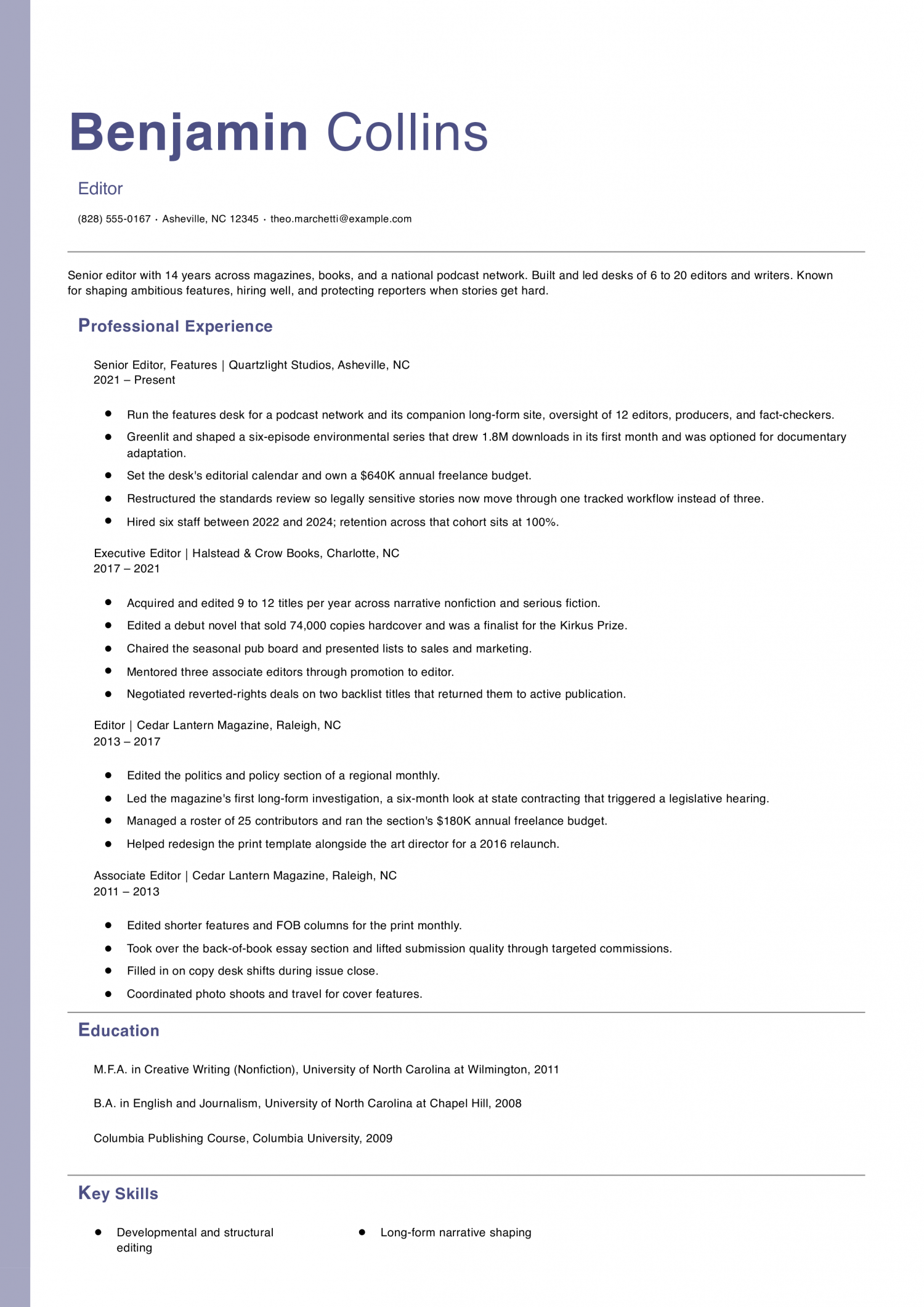
The senior editor archetype runs a team, a desk, or an imprint and signs off on the final read. This resume needs to prove hiring, budget, content strategy, and the audience or revenue numbers tied to the slate.
Editor with nine years spanning consumer tech publications, a university press, and a documentary production house. Strong at shaping voice in long-form features, calm under close-of-issue pressure, and patient with first-time writers. Comfortable owning a section, a budget, and a freelancer roster.
Your first line should name the editorial volume you’ve handled, not a scope statement.
Managing editors read the summary for output: articles or chapters per week, average word count, and the style guide you work in. A line like “Edited 14 to 18 longform features per month against AP style for a 2.1M-monthly-uniques food vertical” tells them you can hold the pace.
If you work in books, lead with titles per year and word count handled. If you work in brand or content, lead with assets shipped and the channels they ran on. If you also report and write your own stories, see our journalist resume examples for ways to present your output.
Strong editor bullets carry three kinds of numbers: volume, quality, and audience.
Volume looks like articles per week, books per year, or word counts cleared. Quality looks like error rates, on-time delivery against deadline, or fact-check pass rates. Audience looks like pageviews, time-on-page, or open rates on edited newsletters.
Bullets without a number tend to read as a list of duties. A bullet that says “Edited 22 longform pieces averaging 3,400 words, holding a 96% on-deadline rate” beats “Responsible for editing longform content.”
Sort your bullets under three or four real functions so an editor-in-chief can scan them.
The common buckets are story development (pitch review, outlining, writer coaching), line and copy editing (style guide application, fact-checking, libel review), production (CMS staging, image rights, SEO headlines), and team management (assigning, scheduling, mentoring).
Name the specific tools inside each bucket: WordPress, Adobe InCopy, Google Docs Suggesting Mode, Chicago Manual, AP Stylebook, Grammarly Business, or whatever the role actually used. Generic phrasing like “edited content” reads as junior.
Editors-in-chief and managing editors look for a credentials and tools block above the fold.
List your style guides (AP, Chicago, MLA, house style), your CMS platforms (WordPress, Adobe InCopy, Contentful, Drupal), and any SEO or analytics tools (Google Analytics 4, Semrush, Ahrefs). A short “Editorial Toolkit” line under your summary works well.
Certifications from Poynter, ACES, or the Editorial Freelancers Association sit near the bottom, but the everyday tools belong up top where a hiring editor scans first.
Senior editor resumes lose credibility when they read like an entry-level list.
Cut generic verbs like “proofread,” “edited,” and “reviewed” without a number behind them. Cut early bylines from a decade-plus ago unless they tie to your current beat. Cut every soft-skill claim that isn’t backed by a result.
Replace cut bullets with masthead context: team size you managed, budget you owned, slate of titles or verticals you ran, and the audience or revenue numbers attached. That’s what moves a senior editor resume from a long history to a clear leadership case.
ATS filters catch more editor resumes than ever in 2026. The skills below come from our user-built editor resumes. Style guide names and CMS tools clear the first cut, and writer-coaching language decides whether the resume advances.
Editors-in-chief weigh hard skills like AP style and WordPress as table stakes. Soft skills like writer development and editorial judgment carry weight only when bullets prove them. Match the list against your target posting, and use soft skills as evidence backing your bullets, not as standalone claims.
| Soft Skills | % of resumes with this skill |
|---|---|
| Attention to detail | 73% |
| Communication | 51% |
| Time management | 41% |
| Critical thinking | 38% |
| Team collaboration | 34% |
And here are the top hard skills showing up most often.
| Hard Skills | % of resumes with this skill |
|---|---|
| Copyediting and proofreading | 79% |
| Style guide knowledge | 70% |
| Fact-checking | 48% |
| Editorial software proficiency | 37% |
| SEO optimization | 25% |
Based on data from thousands of editors’ resumes built on ResumeTemplates.com, May 2026.
Before an editor resume gets a closer read, hiring teams check for a short list of essentials.
Editors-in-chief and managing editors expect a niche section that mirrors the publication category they hire for. Group your keywords by the editorial specialty you actually work in.
| Niche | Keywords ATS scans for |
|---|---|
| Content editing (digital) | content editor, SEO editing, WordPress CMS, editorial calendar |
| Book and manuscript editing | book editor, manuscript editing, developmental editing, Chicago Manual |
| Copy and line editing | copy editor, line editing, AP style, fact-checking |
| Writer-editor hybrid roles | writer editor, content writer, editorial production, story development |
| Editorial leadership | managing editor, senior editor, masthead, editorial strategy |
What editors-in-chief expect on an editor’s resume has shifted: a blanket “no AI” stance now reads as out of touch on most digital and B2B briefs, while an honest workflow naming where AI assists and where human judgment owns the final read reads as professional. The list below names what to add.
AI handles obvious typos and style consistency, freeing editors to focus on structure, voice, and fact-checking on the human pass.
Editors now review AI-suggested headlines for accuracy and tone instead of writing every variant from scratch.
AI flags claims worth verifying, but editors still own source vetting, libel review, and the final pre-publication call.
AI helps editors draft initial revision notes, which the editor then refines with the writer's voice and the title's goals.
Grammarly Business: Used for first-pass mechanical edits and house-style enforcement before the human line edit.
ChatGPT or Claude: Used for headline variants, summary drafts, and SEO research, with editor sign-off on every output.
A portfolio is the real gate for editor roles. Hiring editors read your clips before they read your resume, so the link at the top of your file matters more than the summary below it.
Auto-imports bylines and edited pieces from major sites and preserves them as the publisher's CMS changes.
Hosts an annotated list of titles edited, with cover images, word counts, and a short editorial note on each.
Built for content marketing portfolios and recognized by agency and brand-side hiring teams.
A curated case-study PDF you share on request, with permission-cleared excerpts and scope numbers.
Lead the portfolio with eight to twelve representative pieces, not your full archive. Curate by recency and by relevance to the job you’re targeting. If you’re applying to a food vertical, the first three clips should be food work, even if your strongest piece sits in a different beat.
Annotate each clip with a one-line editor’s note: what you owned, the style guide, and any traffic or award outcome. The note is what separates an editor’s portfolio from a writer’s portfolio, and it’s what an editor-in-chief reads before clicking through to the piece itself.
Editors-in-chief scan the tools line for fluency in the platforms the role uses every day. List the CMS, the style and reference tools, the workflow apps, and any analytics tools tied to the role’s audience targets.
CMS and production: WordPress, Adobe InCopy, Contentful, Drupal
Style and reference: AP Stylebook, Chicago Manual of Style, MLA Handbook, house style guides
Workflow and collaboration: Google Docs Suggesting Mode, Slack, Asana, Airtable
Quality and analytics: Grammarly Business, Google Analytics 4, Semrush, Parse.ly
Awards and masthead credits give an editor’s resume the third-party signal that bullets alone can’t. Place a short awards block near the bottom of the resume and a credits line under each relevant role.
Edited 2024 National Magazine Award finalist in Feature Writing (publication name)
Line edited New York Times bestseller (title, 2023) at imprint name
ASME Next Award nominee for editorial leadership, 2024
Edited three pieces selected for Best American Essays anthology series
Editors-in-chief and managing editors read this list as a map of where your editorial work is heading. The certifications below tell them which track (copy, content strategy, digital, scholarly) you’ve invested in. List the issuing body and the year of completion on a single line.
ACES Certificate in Editing: Signals serious copy editing skills and AP-style fluency, recognized by newsroom and trade hiring editors.
Poynter ACES Certificate in Editing: The deeper Poynter track, useful when you're targeting daily newsrooms or fact-heavy verticals.
Editorial Freelancers Association Course Completion: Works well for freelance editors and career-changers moving into book or brand editing from adjacent fields.
Google Analytics 4 Certification: Useful for digital editors who own SEO headlines, traffic targets, or newsletter performance on their slate.
For editors, the 10th-percentile floor reflects assistant and junior copy roles at smaller publications, while the top-decile ceiling reflects senior editors, editors-in-chief, and acquisitions leads at major imprints and national outlets. That spread tells you specialization, masthead tier, and the audience or revenue tied to your slate move you from floor to ceiling more than years of service do.
Lead your resume with the titles you’ve owned, the tier of publication, and the audience numbers your slate produced.
| # | State | Avg. Annual |
|---|---|---|
| 1 | New York | $98,620 |
| 2 | Delaware | $91,700 |
| 3 | California | $90,570 |
| 4 | Washington | $85,250 |
| 5 | Connecticut | $81,910 |
| 6 | District of Columbia | $81,580 |
| 7 | Virginia | $79,080 |
| 8 | Massachusetts | $78,720 |
| 9 | West Virginia | $76,760 |
| 10 | Colorado | $75,660 |
| # | State | Workers | Median |
|---|---|---|---|
| 1 | New York | 17,410 | $98,620 |
| 2 | California | 14,920 | $90,570 |
| 3 | Texas | 8,190 | $28,860 |
| 4 | Florida | 4,000 | $64,380 |
| 5 | Illinois | 3,680 | $68,050 |
Resume Templates offers HR approved resume templates to help you create a professional resume in minutes. Choose from several template options and even pre-populate a resume from your profile.
Treat freelance editing as a single ongoing role with a clear business name or "Freelance Editor" header, dated from your start year to present.
Under it, list three to five client engagements with the publication name, the work performed, and the volume or duration. "Copy edited 40 longform features for Trade Publication X (2023 to 2024)" reads cleaner than a wall of one-off projects.
If a client requires anonymity, describe the publication by category ("national B2B SaaS newsletter") instead of leaving it blank.
List it as a real editorial job with the section you ran, the publication frequency, and the writers you managed.
Name the bullets the same way you would for a paid role: pieces edited per week, style guide used, CMS, and any traffic or readership data the paper tracked.
A campus editor role with concrete numbers often beats a non-editorial internship for first newsroom jobs.
No. Published letters to the editor belong in a clips portfolio or personal site, not on the resume itself.
Use the resume's clips line or a portfolio URL for representative work. Reserve resume space for editorial roles where you shaped other writers' work, not for your own bylined opinion pieces.
Use scope language instead of titles. "Edited approximately 180 longform pieces averaging 2,800 words across a six-month contract for a major trade publisher" reads as credible without naming a confidential client.
For book work, name word counts and genre categories rather than titles or authors when an NDA applies. Editors-in-chief recognize the constraint and read the scope numbers as the real signal.
For an editor, a professional template is the safest pick, because it signals the polish hiring managers in this field expect. An ATS-friendly template is a solid alternative. Whichever you choose, keep the formatting clean and easy to parse: clear section headings, a standard font, and no graphics a parser can choke on.
Executive Resume Writer and Career Coach
Andrew Stoner is an executive career coach and resume writer with 17 years of experience as a hiring manager and operations leader at two Fortune 500 Financial Services companies, and as the career services director at two major university business schools.