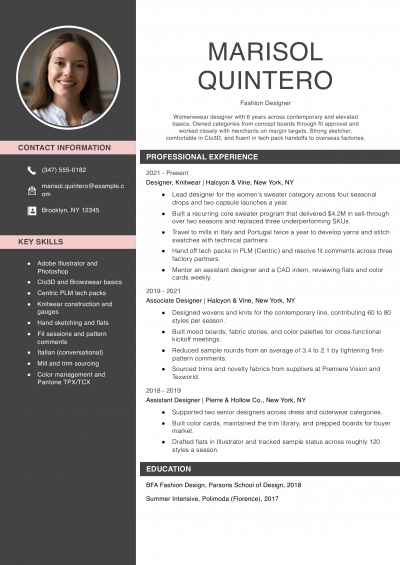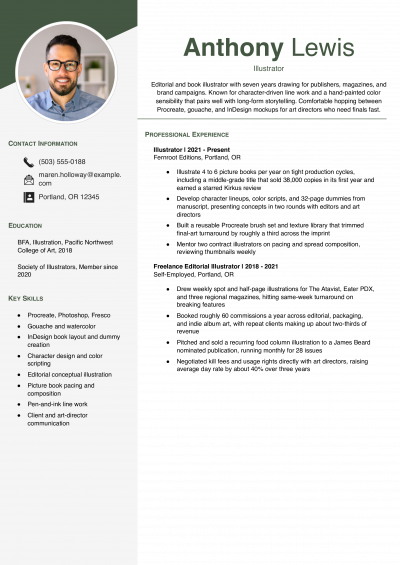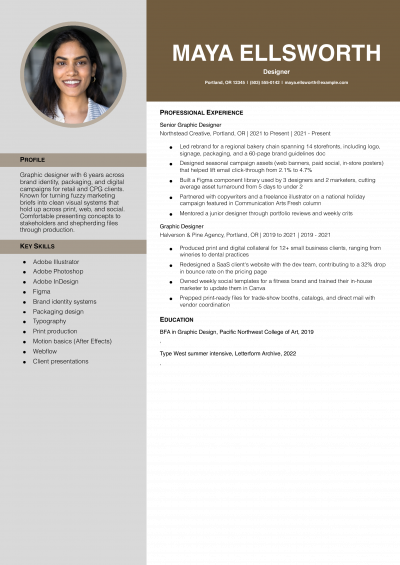
Designer Resume Examples and Templates for 2026




Design directors scan the first page for project types, square footage, and software stack, because those three signals tell them whether the designer can run a job or still needs a senior on every call.
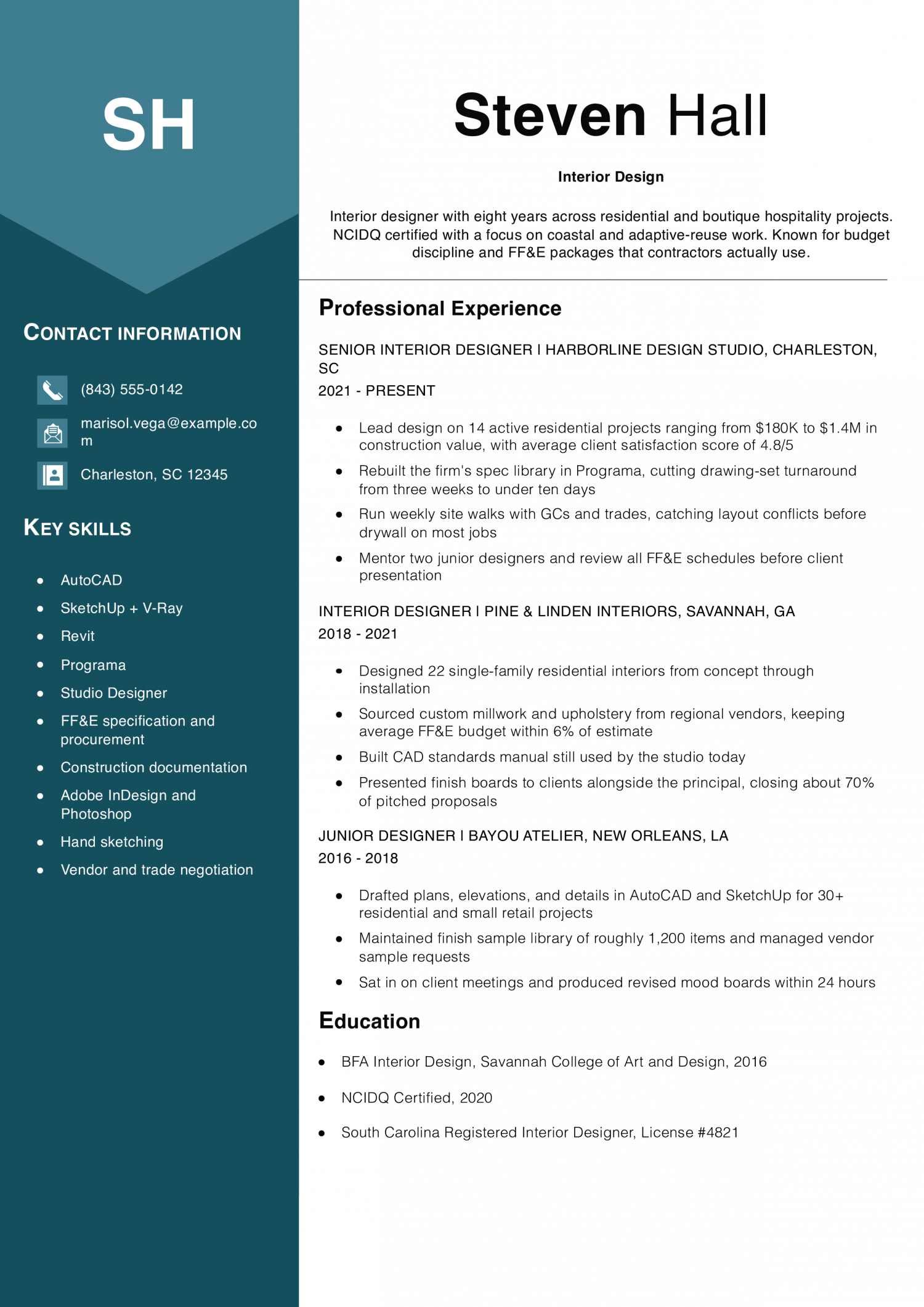
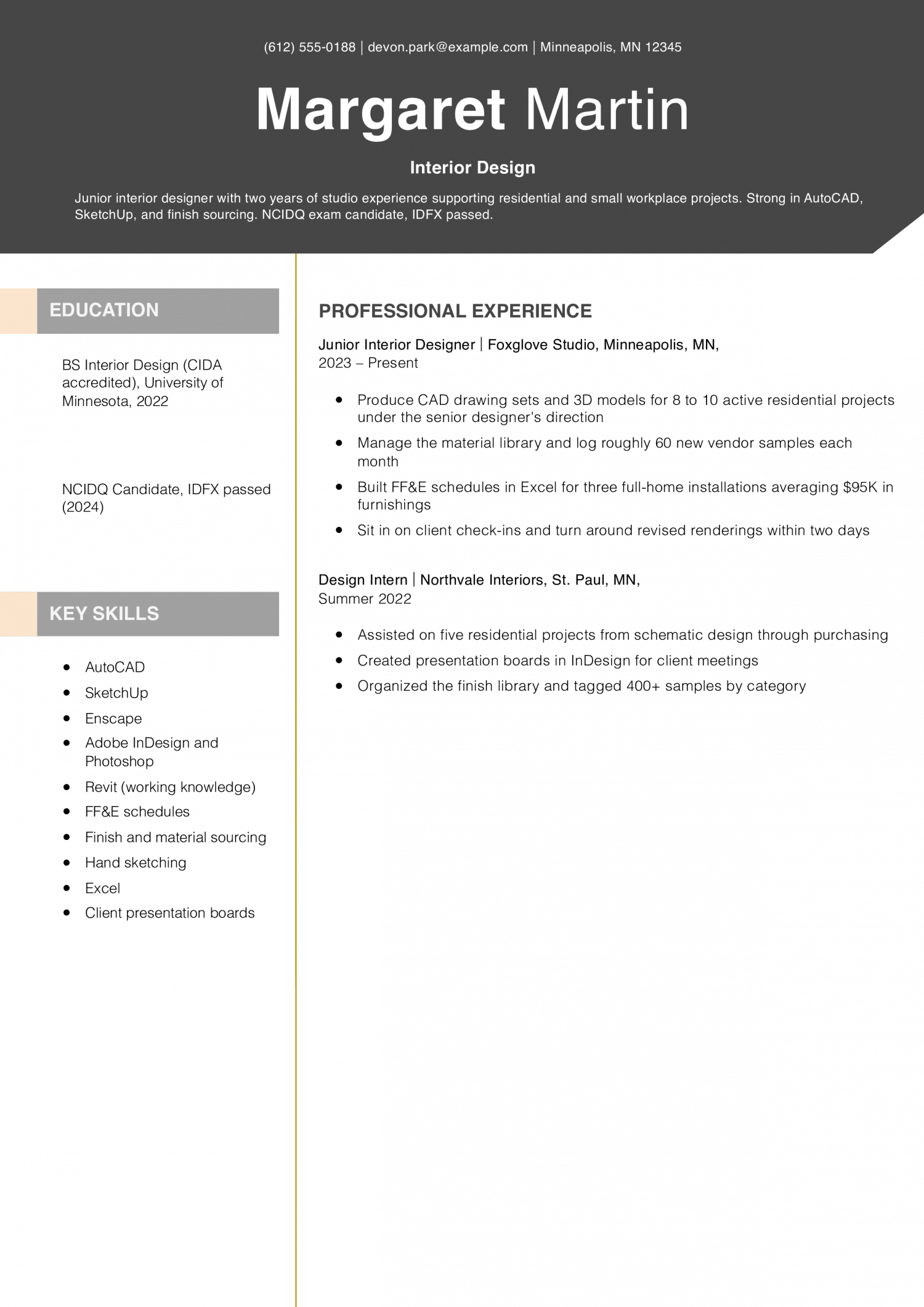
The junior designer with one to three years on a studio team, often supporting a senior on FF&E sourcing and CAD drafting. This resume needs to prove software fluency, project contributions, and a portfolio link with built or rendered work.
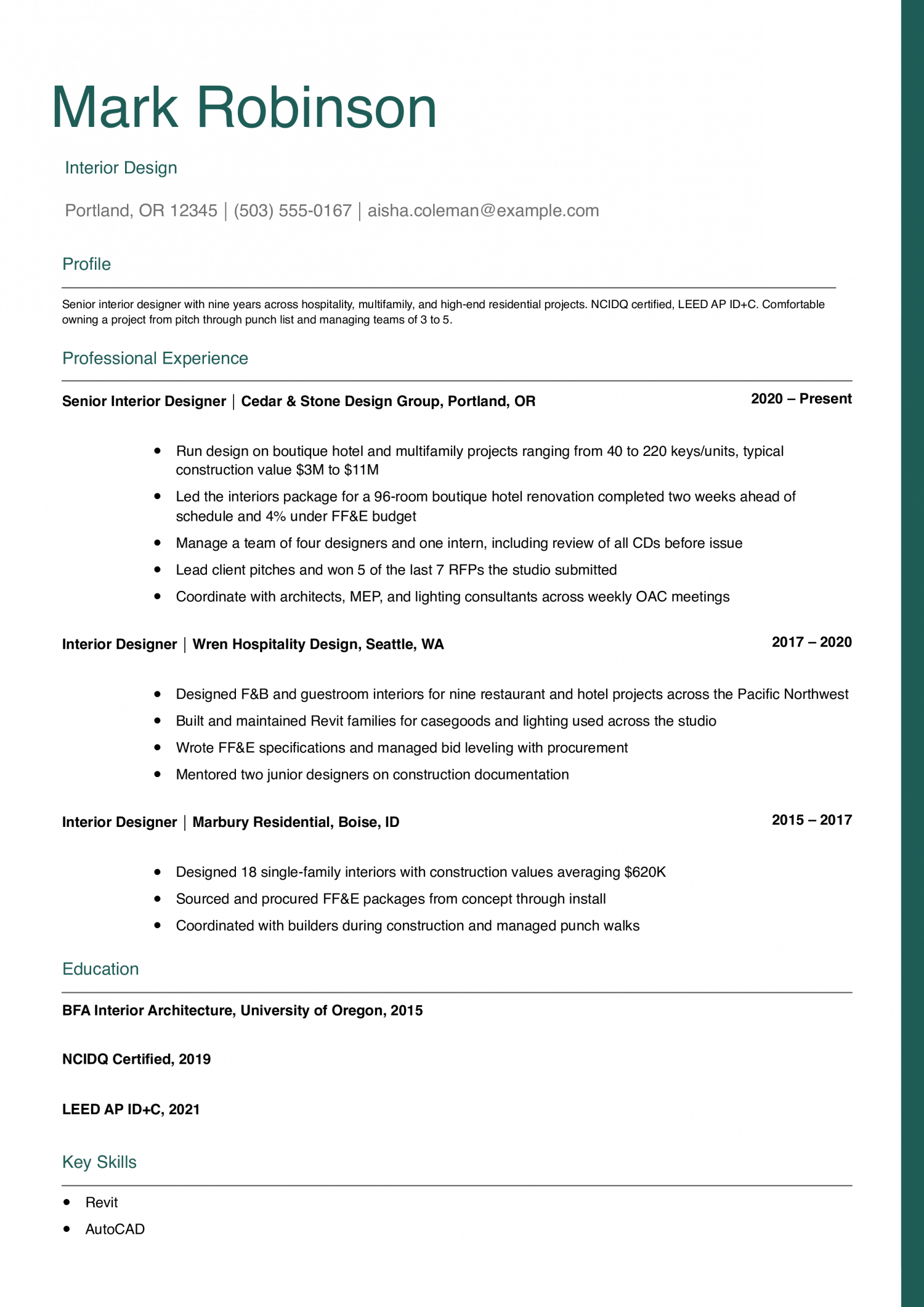
The senior designer running projects end-to-end, owning client presentations and trade coordination. This resume needs to prove project budgets owned, square footage delivered, and the design vocabulary that signals you can hold a client meeting alone.
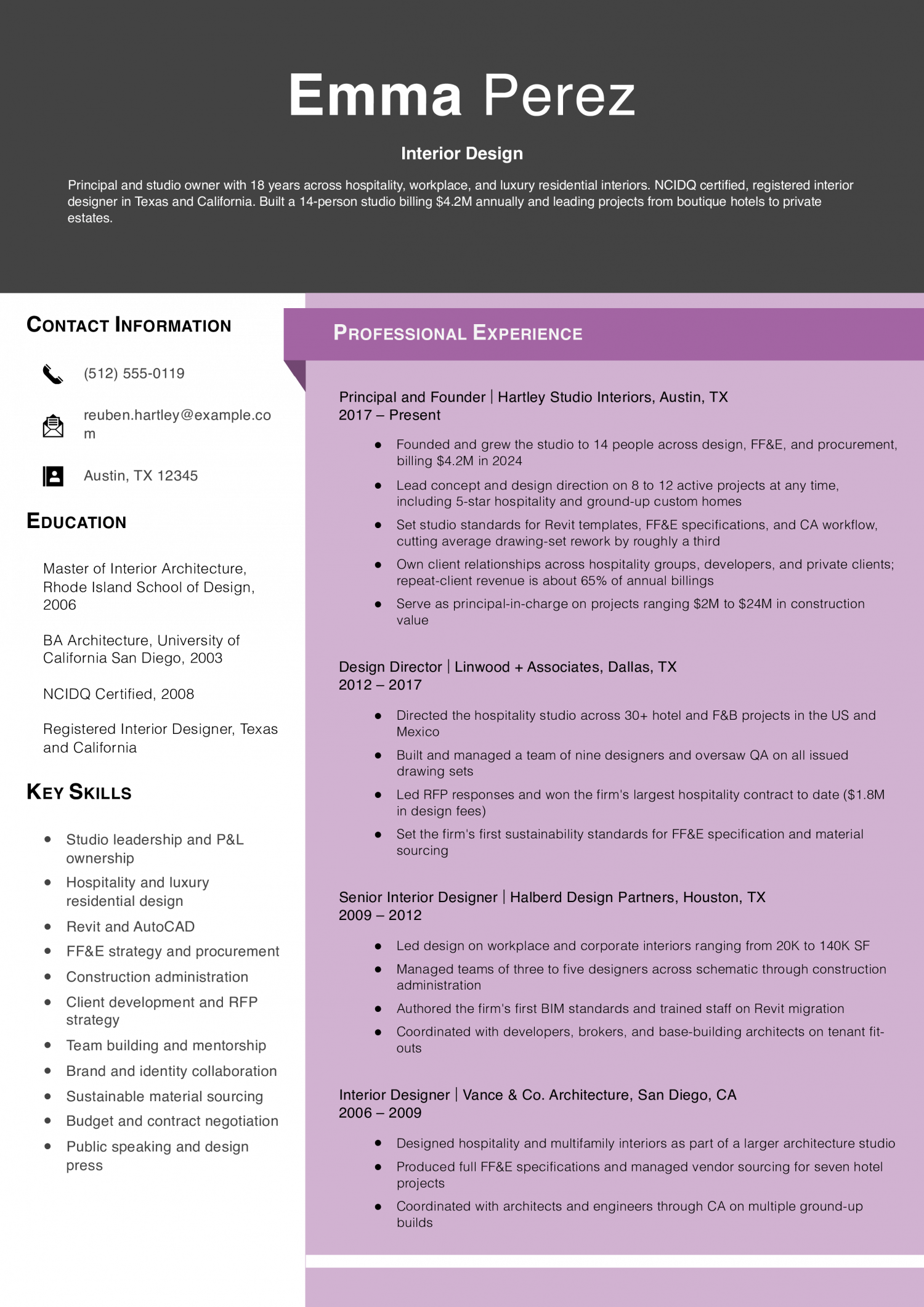
The principal or design director leading a studio book of business, mentoring staff, and shaping firm direction. This resume needs to prove revenue contribution, team size, signature projects, and the press or award credits that anchor your reputation.
Interior designer with 11 years across boutique hospitality, workplace, and high-end residential projects in New York and London. NCIDQ certified, WELL AP, and fluent in Revit-based studios. Known for tight FF&E budgets, calm CA management, and design that holds up after move-in day.
Your profile should state your years in practice, the project types you have shipped (residential, hospitality, commercial, healthcare, multifamily), and the price bands you have worked in.
Name the software you draft in and the deliverables you own. A principal reading the top of page one wants to know if you can run a kitchen renovation alone or only support one.
Skip the slogan opener. A scope statement beats a personality statement every time on a design resume.
Strong interior design bullets carry three kinds of numbers: square footage, project budget, and timeline. Add headcount when you led a team.
Write “Led FF&E specification for a 4,200 sq ft Tribeca duplex on a $680K furnishings budget, delivered four weeks ahead of installation date.” Bullets without a number tend to read as job duties.
If your work is residential and confidential, name the borough or city and the project type instead of the client.
Organize your bullets into three or four buckets: concept and schematic design, documentation and CAD, FF&E and sourcing, and project management.
Under each, name the deliverables: mood boards, finish schedules, construction documents, vendor RFQs, punch lists, trade coordination.
Spread out the software vocabulary. AutoCAD belongs in CAD bullets, SketchUp and Enscape near renderings, Studio Designer or Ivy near sourcing and procurement.
Put your portfolio URL in the header, right under your name and email. Design directors and firm principals click before they read.
List NCIDQ, LEED, or WELL credentials with your name and a credentials line beneath the profile. If you hold a state interior design registration, write “Registered Interior Designer, [State], in good standing” without the registration number.
Build a tools strip that names AutoCAD, Revit, SketchUp, Enscape, Adobe Creative Suite, and your procurement platform.
At the senior and principal level, drop college coursework, junior internships, and software you no longer touch. Page two should carry signature projects and press, not a list of every CAD class you took.
Trim duties that any designer would do. Keep the bullets that show budget ownership, team size, business development wins, and named press or award credits.
If a project predates 2015 and is not a signature, cut it.
ATS filters catch more interior design resumes than ever in 2026. The skills below come from our user-built interior design resumes. Software fluency and FF&E vocabulary clear the first cut.
Design directors and firm principals weigh hard skills first: AutoCAD, Revit, and project budget ownership are non-negotiable for senior roles. Soft skills then decide who advances, because client management and trade coordination are what break a project. Match the skills below against the posting you are targeting, and use the soft-skill words as evidence behind your bullets, not as a standalone list.
| Soft Skills | % of resumes with this skill |
|---|---|
| Client communication | 65% |
| Creativity | 63% |
| Project management | 48% |
| Attention to detail | 40% |
| Problem solving | 28% |
And here are the top hard skills showing up most often.
| Hard Skills | % of resumes with this skill |
|---|---|
| AutoCAD and SketchUp | 66% |
| Space planning | 61% |
| 3D rendering | 44% |
| Material and FF&E selection | 37% |
| Building codes compliance | 26% |
Based on data from thousands of interior designers’ resumes built on ResumeTemplates.com, May 2026.
Before an interior design resume gets a closer read, hiring teams check for a short list of essentials.
Design directors and firm principals expect to see niche vocabulary that maps to the studio’s book of work. Group your keywords by the specialization the posting names.
| Niche | Keywords ATS scans for |
|---|---|
| Residential design | high-end residential, FF&E specification, kitchen and bath, custom millwork |
| Commercial and workplace | tenant improvement, workplace strategy, space planning, construction documents |
| Hospitality | boutique hotel, restaurant design, guest room prototypes, hospitality FF&E |
| Software and rendering | AutoCAD, Revit, SketchUp, Enscape |
| Credentials and codes | NCIDQ, LEED AP ID+C, WELL AP, ADA compliance |
What design directors expect on an interior design resume has shifted. A silent stance on AI now reads as out of touch on most studio postings. An honest line naming generative tools and where human judgment takes over reads as current. The list below names what to add.
Midjourney and Firefly compress the mood-board cycle, so directors expect more concept directions in the first client review.
Enscape and Veras now turn SketchUp models into photoreal stills in minutes, raising the bar on early-stage visualizations.
AI drafts FF&E descriptions and finish schedules, which shifts the designer's job toward editing and verifying vendor specs.
Studios now expect designers to use AI for first-draft proposals, then layer in the studio's voice and project specifics.
Midjourney: Used for early concept exploration and mood-board generation before refining direction in Photoshop or InDesign.
Veras (or Enscape AI): Used to turn SketchUp or Revit models into rendered options at concept and schematic stages.
Your portfolio is the gate before the resume. Design directors click the link first, and only the work that earns a second look gets a resume read.
Signals a personal brand and gives full control over project sequencing and image quality.
Easy to build and well indexed by recruiters scanning for emerging designers.
Strong photo presentation templates favored by photographers and visual designers.
Bundled with Creative Cloud and supports private project pages for confidential residential clients.
Lead with five to seven projects, not twenty. Studios remember the first three. Sequence the work so your strongest project type sits at the top, then the project that shows range, then the work that backs your credentials.
Each project page needs the same scaffolding: a one-line brief, square footage and budget where you can share them, your role on the team, the deliverables you owned, and final photography or renderings. Process sketches and concept boards belong on a secondary scroll, not in the lead image.
Studios filter resumes on software first. Put the stack in the header strip and again in a tools line beneath your profile.
Drafting and modeling: AutoCAD, Revit, SketchUp, Rhino
Rendering: Enscape, V-Ray, Veras, Lumion
Presentation: Adobe InDesign, Photoshop, Illustrator, Morpholio Board
Procurement and project management: Studio Designer, Ivy, Mydoma, Asana
Press and awards do real work on a senior interior design resume. They tell a principal that other tastemakers have already vetted your eye.
Architectural Digest, "Tribeca Duplex Renovation," New York, 2024, Project Designer under Principal [Studio Name]
Interior Design magazine, Best of Year finalist (Hospitality, Boutique), 2023
Luxe Interiors + Design, Gold List, 2024
ASID Design Excellence Award, Residential under $1M, 2022
Beyond a state interior design registration where one applies, the certifications below tell design directors and firm principals which project types you can lead and which sustainability or codes vocabulary you bring to the table. List the credentialing body and current expiration date for each.
NCIDQ Certification: The benchmark commercial interior design credential. Required for many senior commercial roles and for state registration in most jurisdictions.
LEED AP ID+C: Signals you can lead sustainable interior projects and speak to credits, which matters for corporate and hospitality clients.
WELL AP: Tells healthcare, workplace, and multifamily clients you design for occupant health, air, light, and acoustics.
CAPS (Certified Aging-in-Place Specialist): Useful for residential designers serving older clients or working in healthcare adjacent residential renovation.
The 90th-percentile interior designer out-earns the median by a wide margin, which tells you the market rewards project type, client roster, and business development over years drafting. Studios pay for the designer who can win a hospitality account, run a $4M furnishings budget, or carry a press-worthy residential book. Lead the resume with the project types and budgets that map to the top band, not a chronological tour of every role.
Specialization is the lever; generalist breadth is not.
| # | State | Avg. Annual |
|---|---|---|
| 1 | Washington | $79,490 |
| 2 | District of Columbia | $79,060 |
| 3 | California | $77,360 |
| 4 | Massachusetts | $77,190 |
| 5 | Wyoming | $75,120 |
| 6 | New York | $73,630 |
| 7 | Colorado | $72,740 |
| 8 | Maryland | $70,810 |
| 9 | Nevada | $68,620 |
| 10 | New Jersey | $67,290 |
| # | State | Workers | Median |
|---|---|---|---|
| 1 | California | 8,360 | $77,360 |
| 2 | Florida | 7,090 | $60,200 |
| 3 | New York | 5,590 | $73,630 |
| 4 | Texas | 5,190 | $61,620 |
| 5 | Colorado | 2,800 | $72,740 |
Resume Templates offers HR approved resume templates to help you create a professional resume in minutes. Choose from several template options and even pre-populate a resume from your profile.
Use the exact terms studios post: AutoCAD, Revit, SketchUp, Enscape, construction documents, FF&E, space planning, and the project types you have shipped.
Add credentials by their acronym (NCIDQ, LEED AP, WELL AP) and name procurement platforms like Studio Designer or Ivy if you have used them.
Mirror the posting's project-type language. If it says "multifamily," do not write "apartment buildings."
Reverse chronological is the standard. Studios want to see your most recent project work first and verify you have worked on similar scope.
Skip heavy graphic treatments in the resume itself. Let the portfolio carry the visual story, and keep the resume readable for the ATS and a five-minute scan.
Put the portfolio URL right under your name, before your email. Design directors click before they read the bullets.
Make the link short and self-hosted when you can. A custom domain reads more polished than a long Squarespace or Behance URL.
Gate any confidential client work behind a password and add "password on request" next to the link.
Lead with a profile that names the design education or certificate you have completed, plus three or four portfolio projects (studio coursework counts if it is built or fully rendered).
Pull transferable bullets from your prior work: budget management, client presentations, vendor coordination, project timelines. Name them in design vocabulary.
List software fluency near the top so the parse maps you to junior designer roles.
For an interior designer, a modern template is the safest pick, because it shows visual polish while keeping your work the focus. A creative template is a solid alternative. Whichever you choose, keep the formatting clean and easy to parse: clear section headings, a standard font, and no graphics a parser can choke on.
Executive Resume Writer and Career Coach
Andrew Stoner is an executive career coach and resume writer with 17 years of experience as a hiring manager and operations leader at two Fortune 500 Financial Services companies, and as the career services director at two major university business schools.