Illustrator Resume Examples and Templates for 2026



Hiring art directors look for a portfolio link and named brand systems on the first page, because that signals whether a designer can ship cohesive work across formats without constant direction.
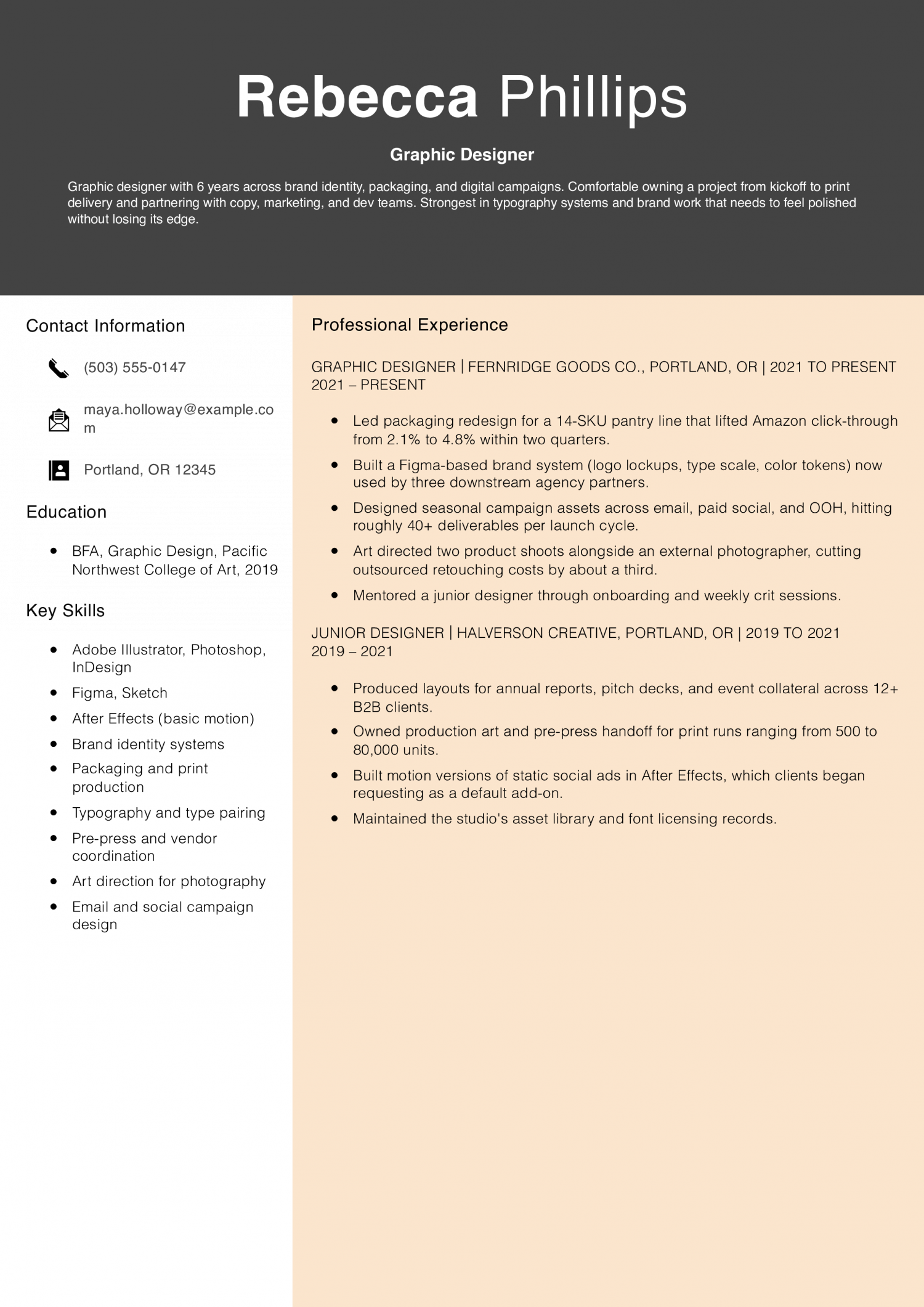
Junior graphic designers are zero to three years in, often coming off internships or a first agency seat. The resume needs to prove production-ready file skills, Adobe Creative Suite fluency, and a portfolio link with two or three full case studies.
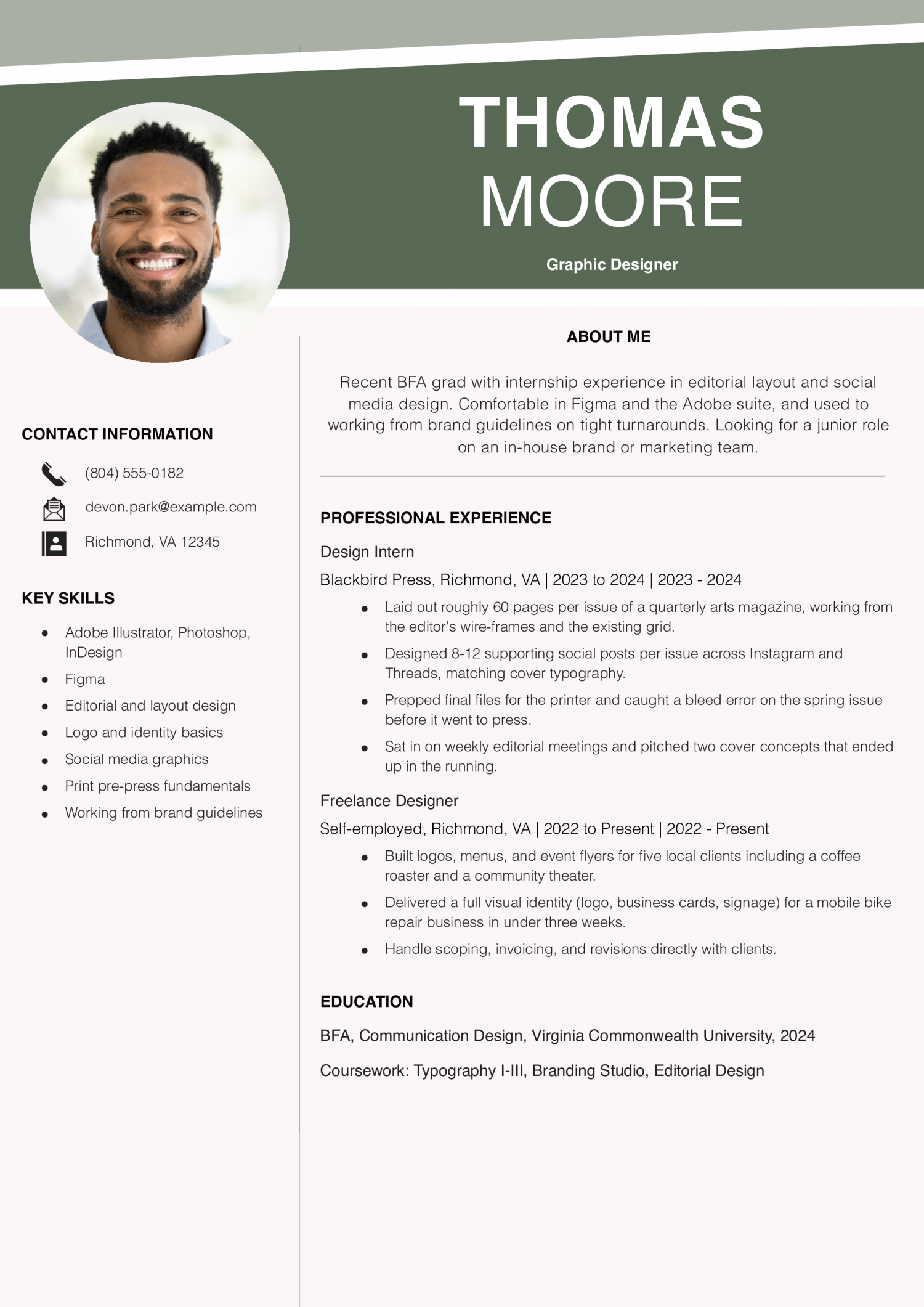
Senior graphic designers own projects end to end and mentor juniors on craft. The resume needs to prove a point of view on brand systems, typography decisions you defended, and measurable lift on campaigns or product surfaces.
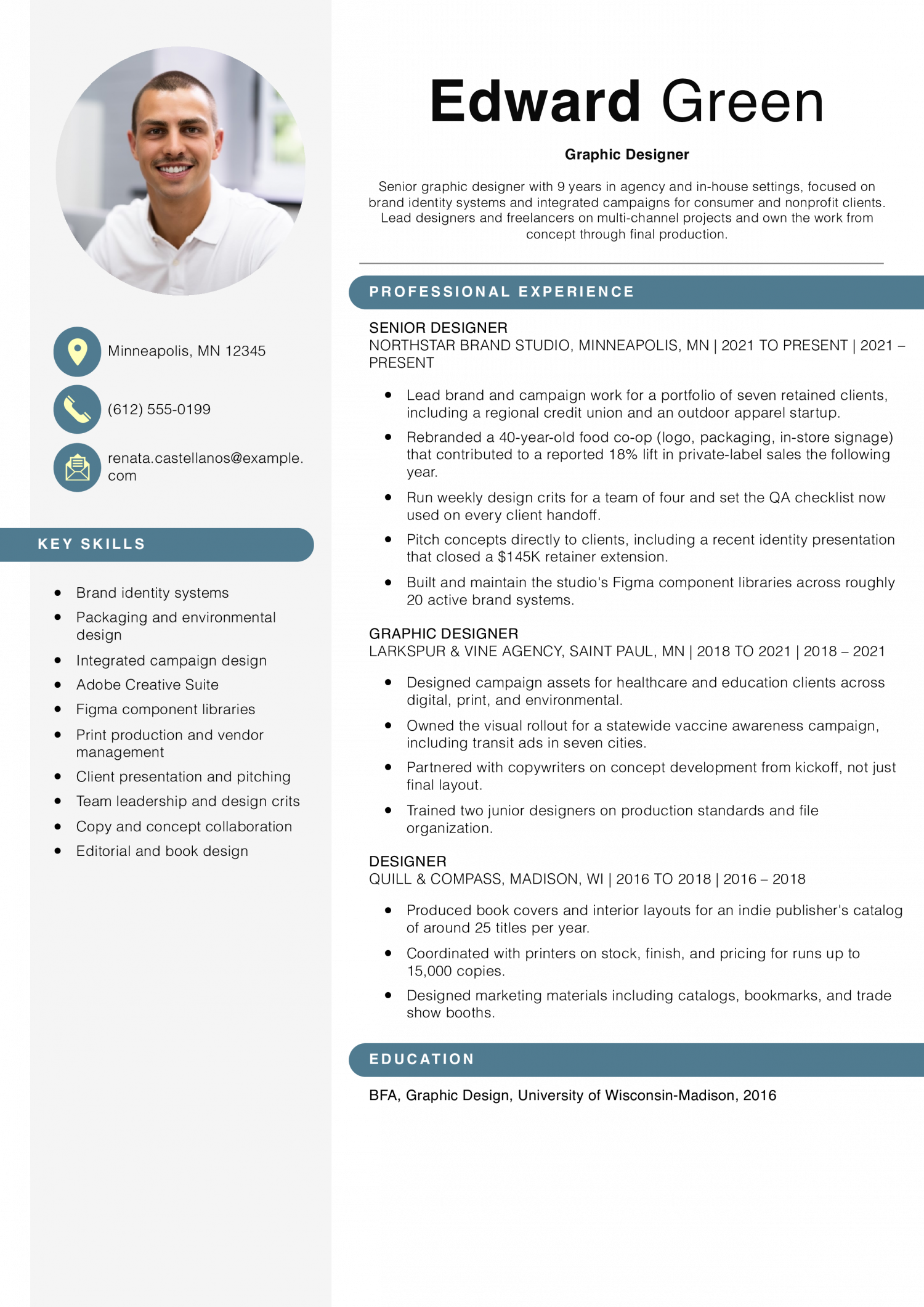
Art directors set the visual direction across multiple designers and external partners. The resume needs to prove team leadership, budget and vendor management, and brand work that moved business metrics across channels.

Graphic designer with 8 years across in-house brand teams and freelance work for early-stage startups. Strongest in brand identity, marketing site design, and the kind of campaign work that ties back to clear performance numbers. Comfortable leading projects end-to-end and partnering closely with marketing, product, and engineering.
Your portfolio shows the work. The header summary should name the signal an art director cannot read off a Behance grid in three seconds.
That might be a brand system you rolled out across 40 retail locations, a typeface you designed and licensed, motion fluency in After Effects, or a packaging specialty for regulated CPG categories. Pick one differentiator that maps to the job posting and lead with it. Skip the line about being a passionate visual storyteller.
Art directors filter that out before reading the next bullet.
Graphic designers undersell results because the craft feels qualitative. Translate it into numbers the hiring side reads.
Strong bullets name campaign reach, asset volume, conversion lift, or production-time saved. Try formats like ‘designed 60-plus social assets per sprint across three brand voices’ or ‘rebranded checkout flow that lifted add-to-cart by a measurable margin.’ Bullets without a number tend to read as duties. Where outcomes are confidential, use scope: number of SKUs, channels, markets, or designers you art-directed.
Walls of mixed bullets bury your range. Split the work into three to five categories an art director can scan.
Useful buckets for this role include brand identity systems, editorial and publication design, digital product and UI surfaces, packaging and print production, and motion or social campaign work. Under each, name the deliverable, the scale, and the stakeholders. A bullet that reads ‘led packaging refresh across 14 SKUs with the supply-chain team’ beats a generic ‘redesigned packaging’ every time.
Art directors and recruiters look for your software stack before the work history. Put it in a tools block under your summary, not buried on page two.
Name Adobe Illustrator, Photoshop, InDesign, and Figma with version fluency. Add After Effects, Adobe Firefly, Cinema 4D, or Sketch when relevant. List certifications like Adobe Certified Professional separately.
If you hold a BFA or design program credential that maps to the role, surface it near the top so credential filters catch it cleanly.
Once you cross five years, mocking up flyers and resizing banners works against you. Those bullets dilute the signal that you can lead.
Trim internship duties, software self-study lines, and any bullet that describes execution without scope. Replace them with brand-system ownership, designer mentorship, vendor and print-house management, and creative direction on cross-functional launches. The art director seat is about judgment and leverage, so the resume should read that way from the first bullet down.
Design hiring tightened through 2026. In-house brand teams and agencies are running leaner rosters, and the bar to clear a screen is higher than it was two years ago. The skills below come from our user-built graphic designer resumes.
Art directors weigh hard skills first because the tools and systems are non-negotiable, but soft skills decide who gets the offer once the portfolios are close. A bullet that names Figma plus stakeholder facilitation reads stronger than either alone. Match the lists below against your target job posting, and use the soft skills as evidence backing your bullets rather than as a standalone block.
| Soft Skills | % of resumes with this skill |
|---|---|
| Creativity | 66% |
| Communication | 52% |
| Attention to detail | 43% |
| Time management | 36% |
| Collaboration | 29% |
And here are the top hard skills showing up most often.
| Hard Skills | % of resumes with this skill |
|---|---|
| Adobe Creative Suite | 80% |
| Typography | 63% |
| Layout and composition | 42% |
| Color theory | 37% |
| Branding and logo design | 27% |
Based on data from thousands of graphic designers’ resumes built on ResumeTemplates.com, May 2026.
These are the must-haves hiring teams look for when scanning a graphic designer resume.
Art directors and creative leads expect the niche section to match the role’s actual specialty, not a generic design skills bucket. Group keywords by sub-discipline so a parser searching for one term catches the cluster.
| Niche | Keywords ATS scans for |
|---|---|
| Brand identity design | brand identity systems, logo design, visual identity, brand guidelines |
| Digital and UI design | figma, ui design, web design, design systems |
| Print and production | print production, prepress, packaging design, indesign layout |
| Motion and social | after effects, motion graphics, social media design, animated assets |
| Creative direction | art direction, creative direction, campaign concepting, design critique |
AI use on a graphic designer resume can go three ways: lead with ‘AI-powered visual storyteller’ (which art directors filter out on sight), leave it off entirely (which reads as evasive in 2026), or describe the workflow as it actually runs. The third is what art directors and creative leads can validate.
Mood boards and rough comps now run in minutes through Firefly and Midjourney, shifting designer hours toward selection and refinement.
Generative fill and content-aware tools handle the masking and retouching that used to fill junior production queues.
Design-system tooling in Figma plus AI variant generation makes maintaining cohesive systems across surfaces faster but easier to break.
Entry-tier candidates need stronger conceptual case studies because execution-only portfolios no longer differentiate against AI-assisted output.
Adobe Firefly: Cited in postings for first-pass concepting, generative variants, and brand-safe asset production inside the Adobe stack.
Midjourney: Named for mood boards, art direction exploration, and reference imagery in early creative-brief stages.
For graphic designers, the portfolio is the gate. Art directors click before they read, so structure the link target around two or three deep case studies rather than a wall of thumbnails.
Signals investment in your own brand and lets you control case-study depth, typography, and password-gated client work.
Designer-built site builders that ship clean templates without the Squarespace look, popular with editorial and brand designers.
Strong for recruiter discovery and entry-tier exposure, though art directors expect a deeper link by the second-round stage.
Necessary if you do any motion work, since stills cannot represent timing, easing, or transition decisions.
Lead the portfolio with two or three full case studies, not a grid of every project you’ve shipped. Each case study should name the client, the brief, your specific role on the team, the constraints, and the outcome. A grid of pretty thumbnails tells an art director you can execute. A case study tells them you can think.
Password-protect confidential client work and note ‘available on request’ in the portfolio. Most art directors expect this and will ask. Hiding strong work behind a generic NDA disclaimer loses you more than it protects.
Art directors scan your tool stack before your work history. Put it in a dedicated block on page one with versions and specialty tools called out.
Core design: Adobe Illustrator, Photoshop, InDesign, Figma
Motion and 3D: After Effects, Cinema 4D, Blender
Product and prototyping: Figma, Sketch, ProtoPie, Framer
Generative and AI: Adobe Firefly, Midjourney, Runway
Production and handoff: Adobe Acrobat, Zeplin, Adobe Bridge
Award credits read as third-party validation that an art director can’t get from your portfolio alone. They also surface in keyword searches inside ATS systems built for creative roles.
Awarding body, category, year, and the specific project credited
Editorial features in design publications with title and year
Speaking credits at design conferences like AIGA, Brand New Conference, or Adobe MAX
Juror or critique-panel roles for student design programs or industry awards
A strong portfolio and a design degree keep you eligible. The certifications below are what move a graphic designer resume from the qualified-but-typical stack into an art director’s shortlist. List the issuing body, certification level, and year earned on one line.
Adobe Certified Professional: Signals verified fluency in Photoshop, Illustrator, or InDesign and reassures hiring teams you can ship production-ready files without ramp-up time.
Adobe Certified Expert: Reads as senior-tier tool mastery and helps you stand out for roles that involve mentoring juniors or owning production standards.
Figma Professional Certification: Important for designers moving into digital product work, where Figma fluency and component-library hygiene are now baseline expectations.
Google UX Design Certificate: Useful for graphic designers pivoting into product or web roles, signaling structured UX vocabulary beyond visual craft alone.
Graphic designer is one of the larger creative occupations tracked by BLS, which means the median pulls in a long tail of entry-tier and generalist roles. The spread between the tenth and ninetieth percentile is wide, driven by industry (tech and advertising pay above print and nonprofit) and city cost of living.
To position above the median, lead the resume with the brand systems you’ve owned and the business metrics your work moved, not the software you’ve used.
| # | State | Avg. Annual |
|---|---|---|
| 1 | District of Columbia | $90,710 |
| 2 | California | $76,440 |
| 3 | Massachusetts | $76,370 |
| 4 | Washington | $76,010 |
| 5 | New York | $74,530 |
| 6 | Virginia | $70,060 |
| 7 | New Jersey | $66,600 |
| 8 | Colorado | $66,360 |
| 9 | Maryland | $66,290 |
| 10 | Connecticut | $65,360 |
| # | State | Workers | Median |
|---|---|---|---|
| 1 | California | 28,310 | $76,440 |
| 2 | Texas | 19,360 | $62,030 |
| 3 | New York | 16,730 | $74,530 |
| 4 | Florida | 14,010 | $57,900 |
| 5 | Pennsylvania | 8,280 | $52,990 |
Resume Templates offers HR approved resume templates to help you create a professional resume in minutes. Choose from several template options and even pre-populate a resume from your profile.
Keep the resume readable first and designed second. Art directors and recruiters open dozens of these, and a clever layout that hides the work history works against you.
Use restrained typography, clear hierarchy, and one accent color. Save the visual range for the portfolio link. ATS parsers also strip multi-column layouts, so a single-column structure tends to read more reliably.
Put a plain-text portfolio URL in the header next to your email and phone. ATS parsers strip styled hyperlinks, so a readable address like yourname.com beats a button or icon.
Inside specific bullets, you can also link to one case study that matches the role. Name the project and the outcome in the bullet, then point to the deeper write-up.
Lead with freelance clients, capstone projects, and volunteer brand work. Treat each one as a real engagement: name the client, the brief, the deliverable, and the outcome.
Two or three deeply documented case studies beat a long list of thin credits. Art directors care that you can run a project end to end, not whether the logo on the resume is recognizable.
Yes, name them, but tie each tool to a workflow. A bullet like 'used Adobe Firefly for first-pass mood boards, then finalized in Illustrator' reads stronger than listing Firefly in a skills block.
Art directors want to know your judgment around the tools, not that you have access to them. Honest workflow framing signals you can ship production-grade work, not slop.
For a graphic designer, a modern template is the safest pick, because it shows visual polish while keeping your work the focus. A creative template is a solid alternative. Whichever you choose, keep the formatting clean and easy to parse: clear section headings, a standard font, and no graphics a parser can choke on.
Executive Resume Writer and Career Coach
Andrew Stoner is an executive career coach and resume writer with 17 years of experience as a hiring manager and operations leader at two Fortune 500 Financial Services companies, and as the career services director at two major university business schools.