
Nearly Half of Hiring Managers Will Train AI Instead of Hiring 2026 College Grads



It has been widely reported that companies are using layoffs to fund AI investment. The class of 2026 is walking the graduation stage into that market. In May 2026, ResumeTemplates.com surveyed 1,000 U.S. hiring managers at companies with 101 or more employees to understand how the class of 2026 will be received. The findings show companies training the replacement: investing in AI tools instead of the class of 2026 college grads who would traditionally start in entry-level roles.
Key findings:
- Nearly half of hiring managers (48%) would rather invest in AI tools than hire and train a class of 2026 college graduates
- 55% of companies have already shifted entry-level hiring budget to AI tools
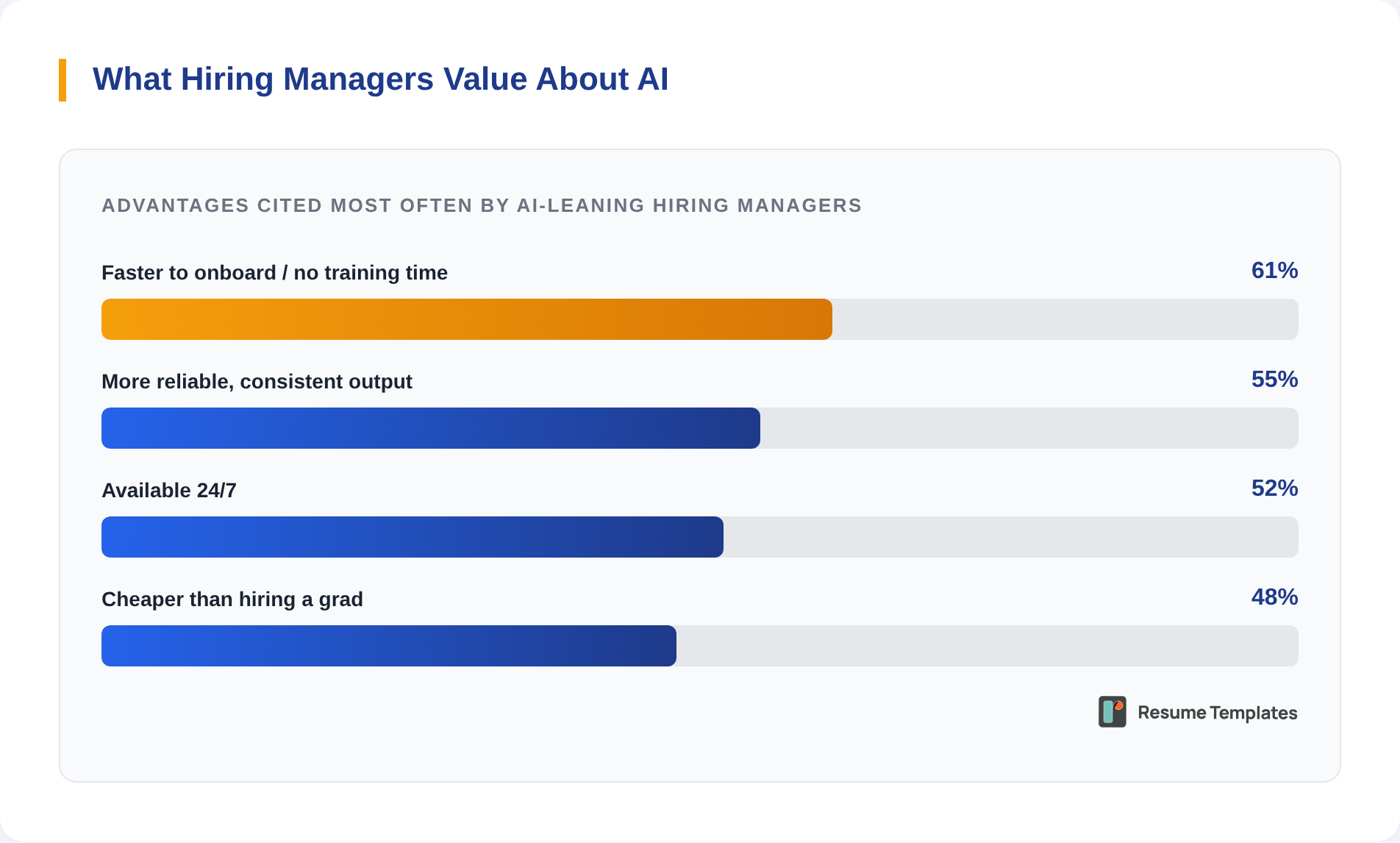
- Top AI advantages over college grads: faster onboarding (61%), more reliable output (55%), 24/7 availability (52%), and lower cost (48%)
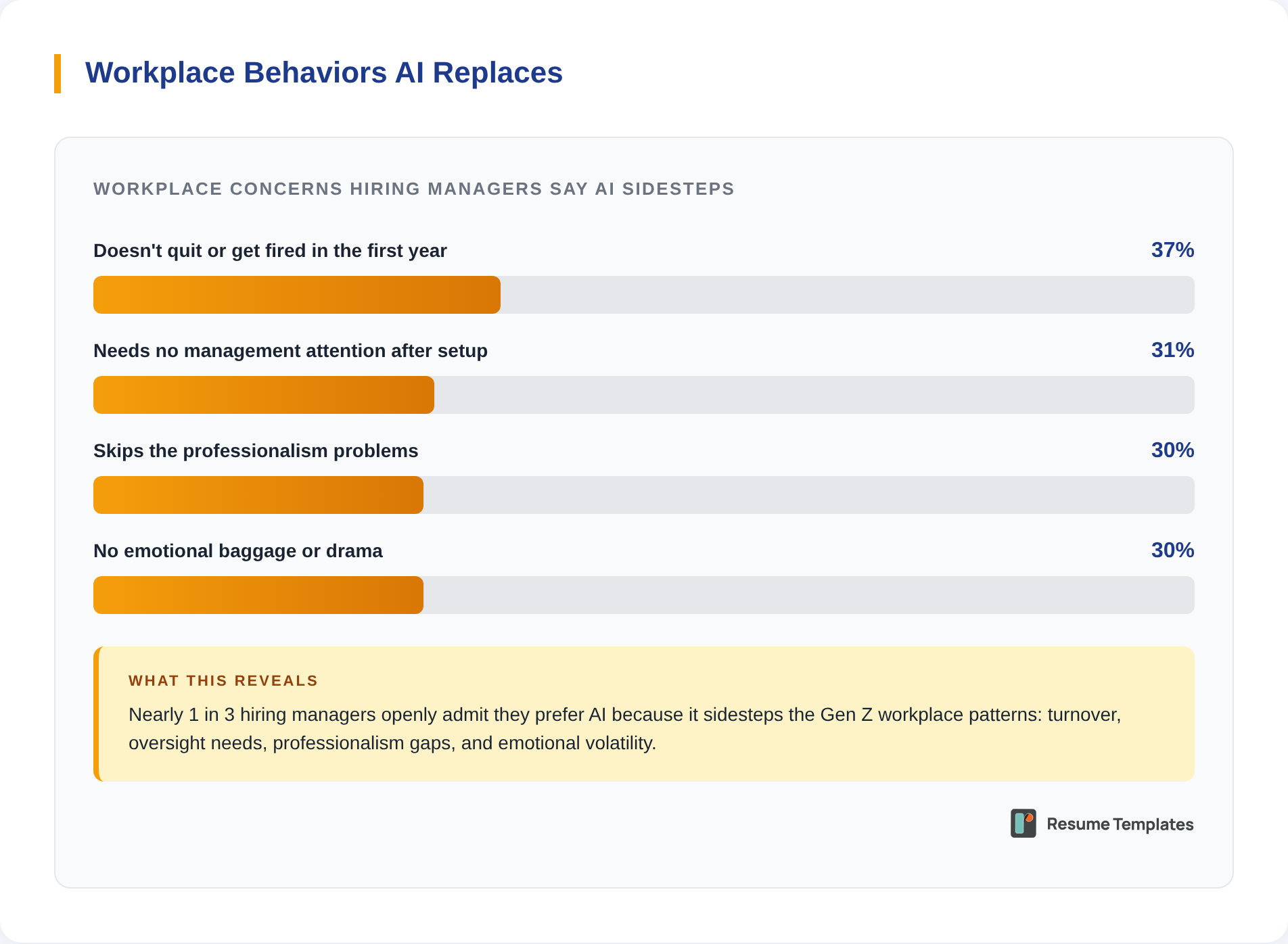
- AI also dodges Gen Z workplace challenges: no early quits (37%), no hand-holding required (31%), no professionalism issues (30%), no emotional drama (30%)
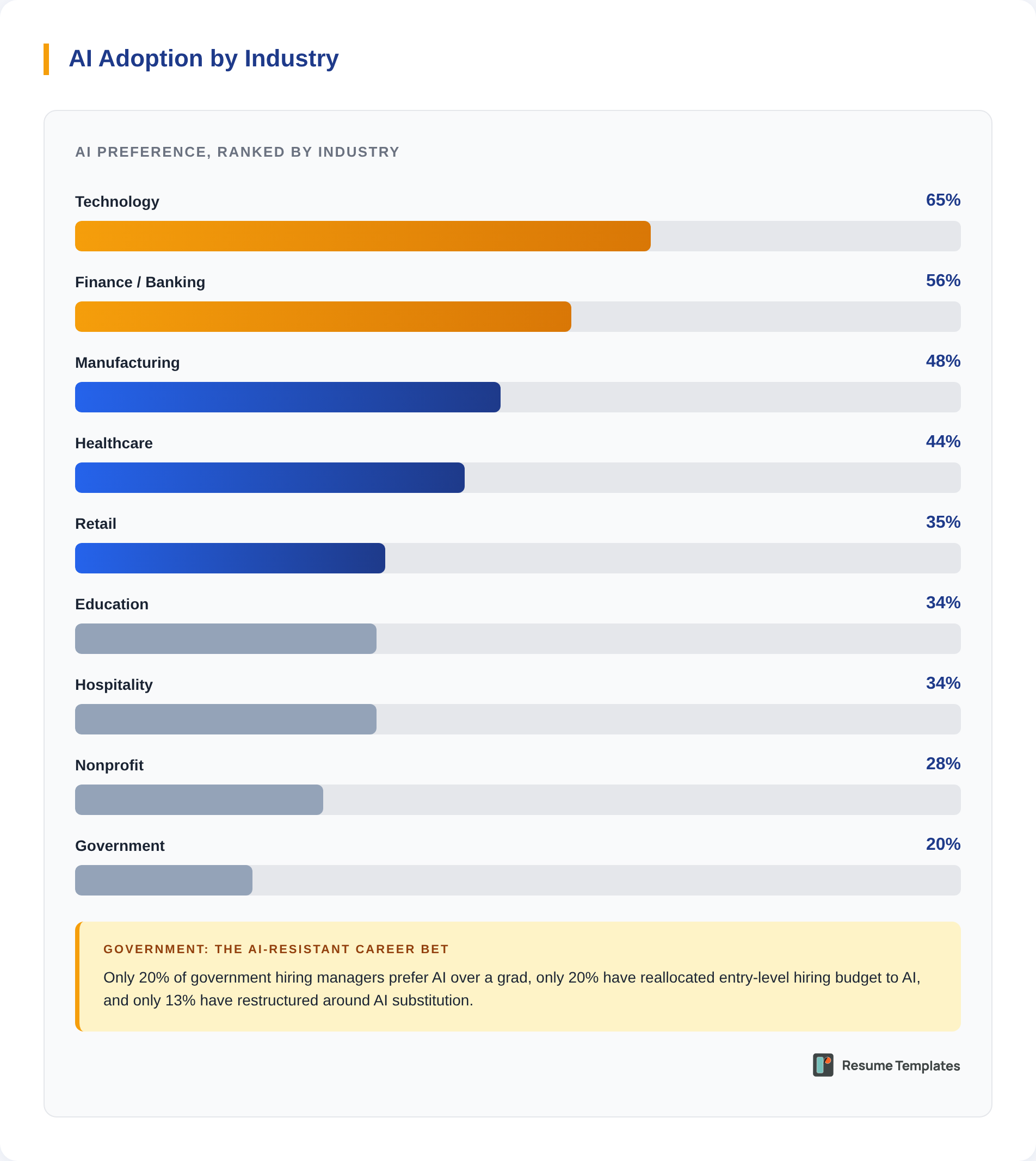
- The “training the replacement” shift runs hottest in tech (65%) and finance (56%), and coldest in government (20%)
- 1 in 3 hiring managers won’t hire a class of 2026 college grad this year
1 in 3 Hiring Managers Won’t Hire a Class of 2026 College Grad This Year
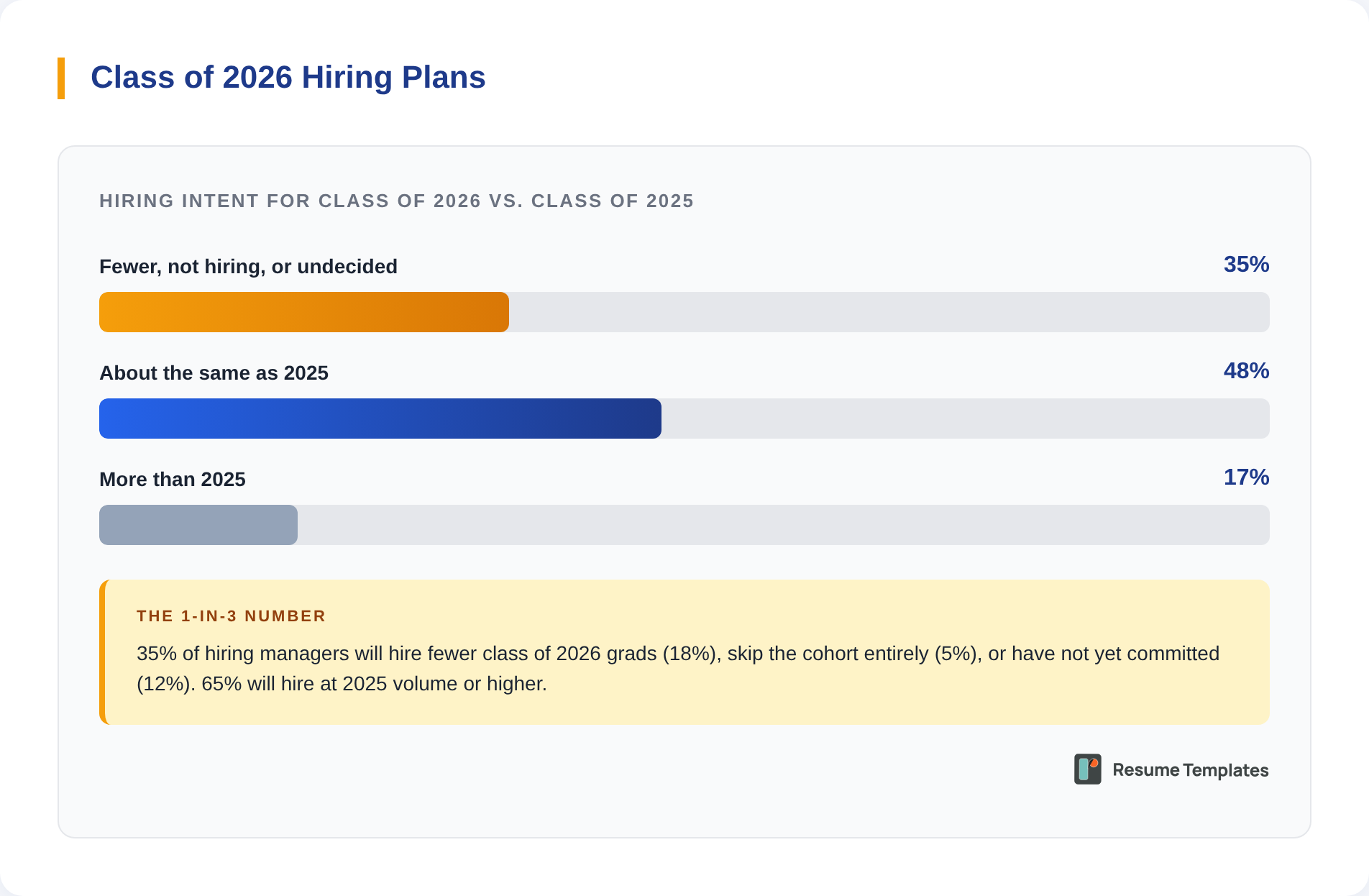
The clearest signal of the AI shift is who isn’t getting hired. One in three hiring managers (35%) report they will not hire a class of 2026 college graduate at the same volume as class of 2025. Nearly 1 in 5 hiring managers (18%) will hire fewer 2026 grads than they hired the previous year, 1 in 20 (5%) will not hire any 2026 grads, and more than 1 in 10 (12%) have not yet committed to whether they will hire 2026 grads this year.
The hiring pullback marks a meaningful tightening compared to prior years. While two-thirds of hiring managers (65%) will still hire 2026 grads at the same volume as class of 2025 or higher, the third who are stepping back, skipping the cohort, or not yet committing reshapes the entry-level market the class of 2026 is walking into.
48% of Companies Would Rather Invest in AI Than Hire a Class of 2026 Grad
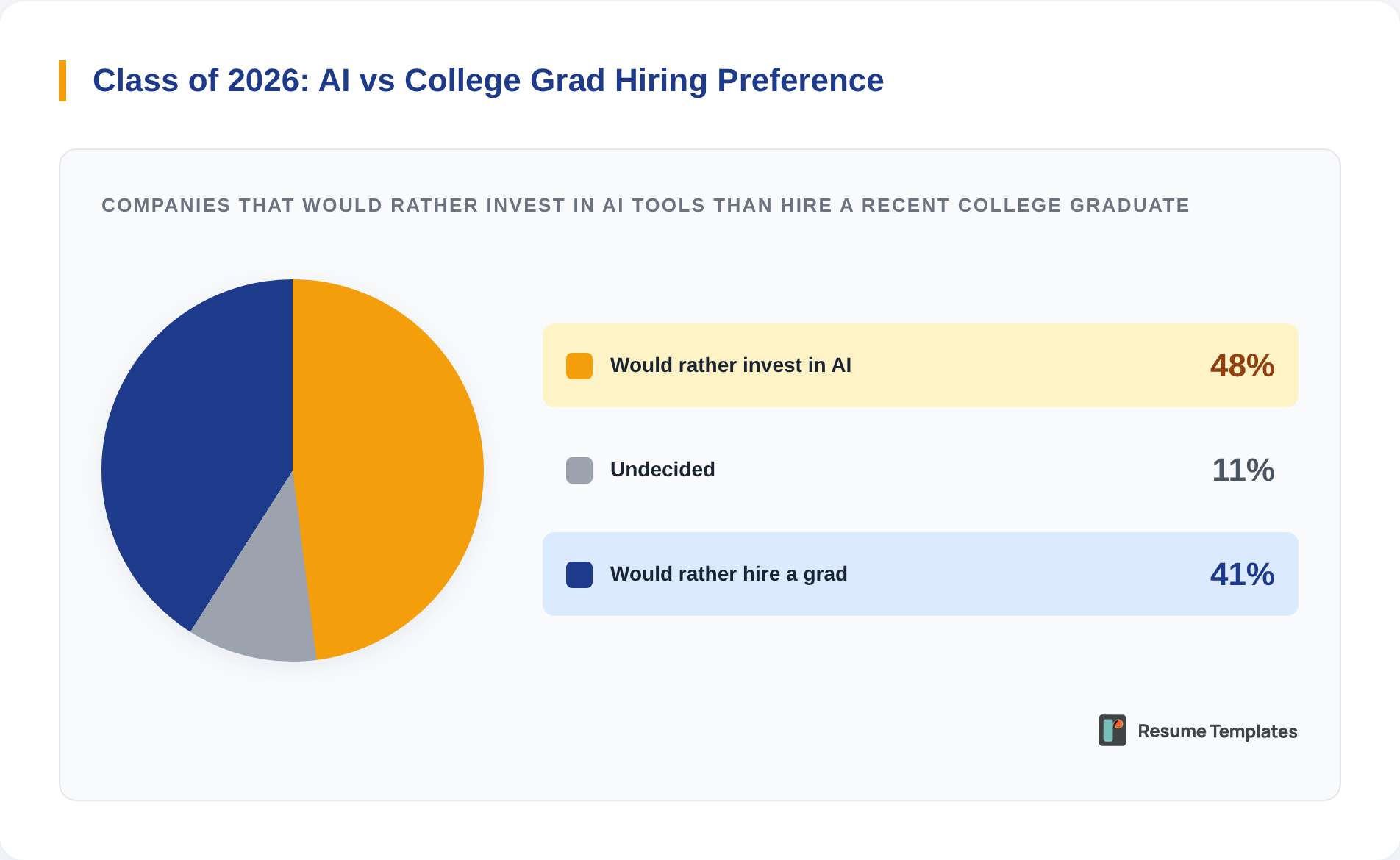
The hiring pullback runs alongside a clearer underlying preference. Nearly half of hiring managers (48%) say their company would rather invest in AI tools than hire and train a recent college graduate for entry-level work. Nearly 1 in 5 hiring managers (18%) say they would definitely choose AI, and another nearly 1 in 3 (30%) say they would probably choose AI.
Just over 4 in 10 hiring managers (41%) hold the opposite preference: 28% would probably choose a recent grad, and 14% would definitely choose one. The remaining 11% are undecided.
Hiring managers favoring AI investment explained their reasoning directly:
“I would rather invest in AI tools. It cost less, less training, peace of mind.”
— Hiring manager at a hospitality company in Texas
“If AI can do what I want it to do flawlessly, then I will go with AI.”
— Hiring manager at a finance company in Illinois
55% of Companies Have Shifted Entry-Level Hiring Budget to AI Tools
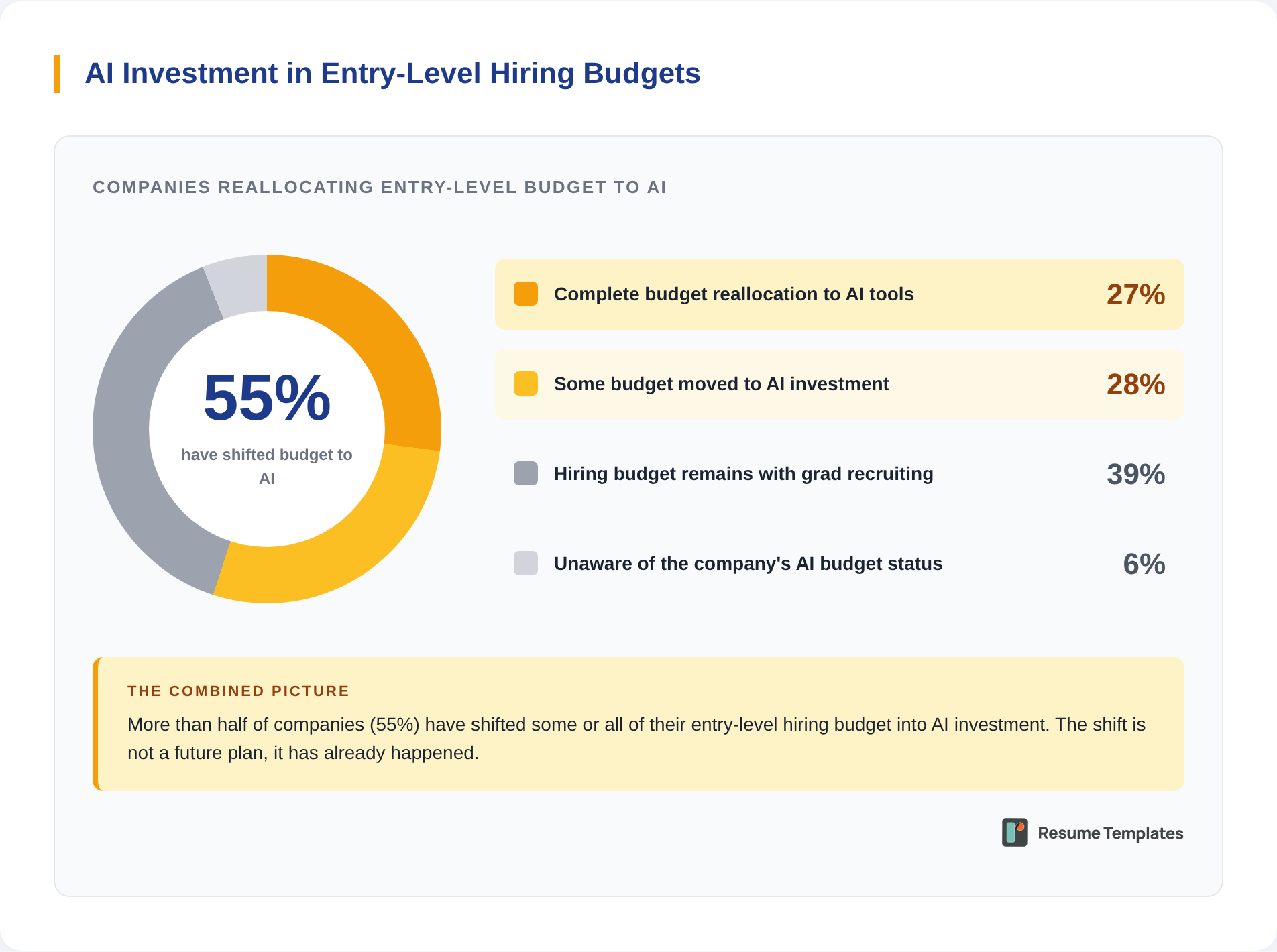
The hiring shift starts upstream, in how companies are allocating dollars. More than half of hiring managers (55%) report their company has already moved some or all of its entry-level hiring budget to AI tools. Within that group, more than 1 in 4 (27%) report the budget shift is complete and another more than 1 in 4 (28%) report it is partial.
The pace varies sharply by industry. Nearly 3 in 4 technology companies (74%) have reallocated entry-level hiring budget to AI. Finance follows closely at nearly 3 in 4 (73%), while more than half of healthcare (55%) and manufacturing (53%) companies have done the same. Retail (47%), education (35%), and government (20%) have shifted resources at a slower rate.
Among companies that have shifted budget, the reallocation is substantial. More than half (54%) have moved between 10% and 25% of their entry-level budget into AI investment. A quarter (25%) have moved between 26% and 50%, and 1 in 10 (10%) has moved more than half their entry-level budget into AI tools. Combined, more than 1 in 3 companies that have shifted budget (36%) have moved at least a quarter of their entry-level dollars into AI.
45% of Companies Have Restructured Entry-Level Work Around AI
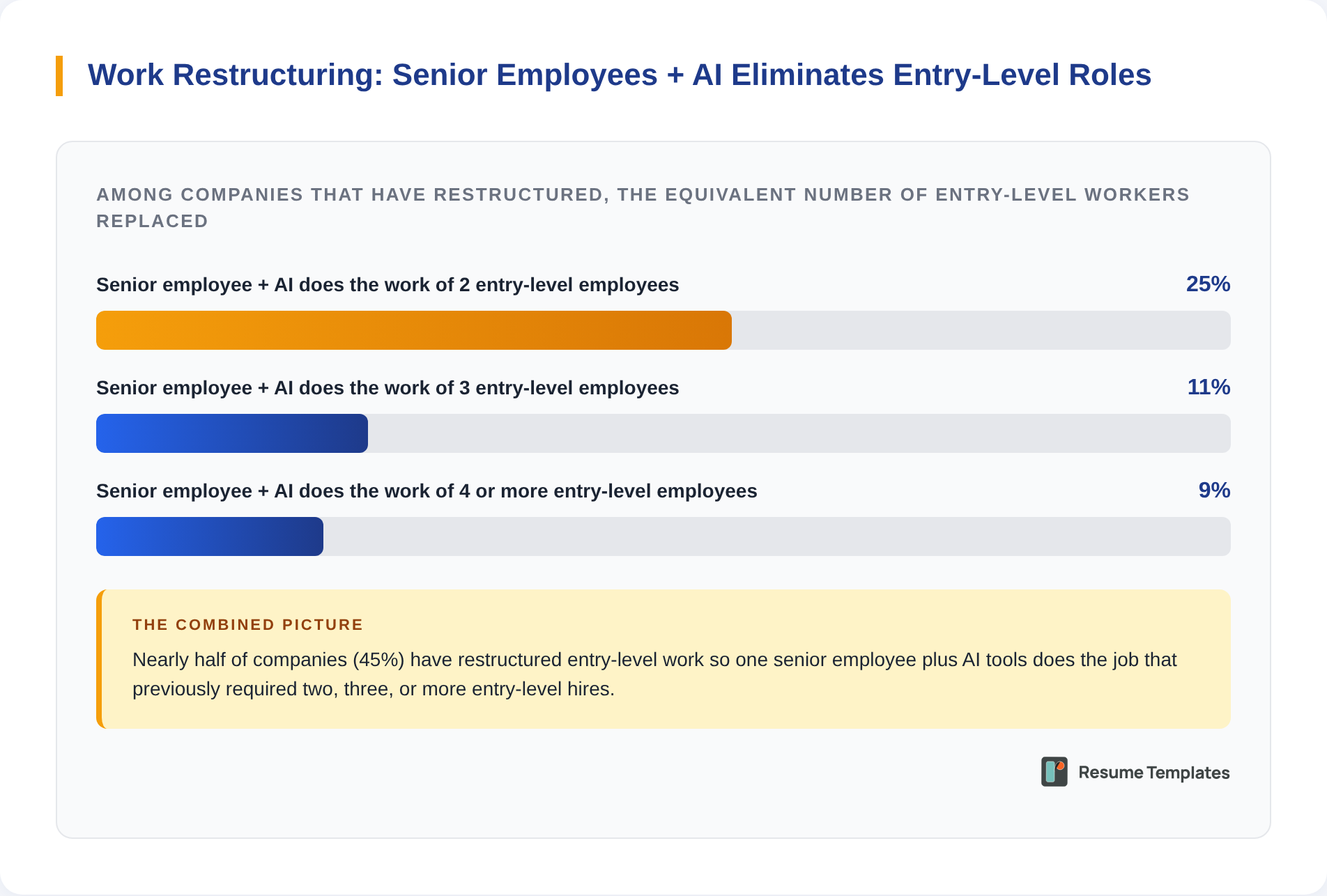
Beyond the budget reallocation, nearly half of companies (45%) have restructured how entry-level work itself gets done. One senior employee plus AI tools now performs work that previously required multiple entry-level hires. More than 1 in 4 companies (25%) report the senior plus AI does the equivalent of two entry-level workers, more than 1 in 10 (11%) report the equivalent of three, and another nearly 1 in 10 (9%) report the equivalent of four or more. Where this restructuring has happened, the work of multiple entry-level positions is now performed by a single senior role paired with AI tools.
“New grads can expect fewer opportunities in companies that are more AI-focused,” says Julia Toothacre, Chief Career Strategist at ResumeTemplates.com. “This is not an uncommon strategy when new technology is introduced. Companies are still figuring out how to implement AI, and its true impact on the work, which will vary by industry and business type. Aside from AI, the market is also inundated with talented professionals who have been laid off over the last few years. Unless a position is specifically designated for recent graduates, new grads should expect significant competition in the 2026 market.”
AI Beats Grads on Speed, Reliability, Availability, and Cost
When asked why they prefer AI to a recent grad, hiring managers cited a familiar set of practical reasons. Among hiring managers who lean toward AI investment, the advantages they cite over a college graduate concentrate on practical outcomes. Nearly 2 in 3 (61%) say AI is faster to onboard, and more than half (55%) say AI delivers more reliable, consistent output. More than half (52%) cite around-the-clock availability, and nearly half (48%) cite lower cost.
Cost ranks fourth on the list. Speed and reliability outpace it.
Three additional advantages reflect operational concerns: more than 1 in 3 hiring managers (37%) say AI is unlikely to quit or get fired in the first year, nearly 1 in 3 (31%) say AI does not need management attention after setup, and the schedule flexibility of AI tools eliminates time-zone constraints.
One hiring manager described the substitution this way:
“Don’t hire a human to do what an AI can do for $20 a month. Hire a human to do the things an AI will never be able to: care about the results, understand the ‘why,’ and innovate beyond the prompt.”
— Hiring manager at a tech company in New Hampshire
Hiring Managers Say AI Dodges the Gen Z Workplace Headaches
The advantages of AI over a college graduate go beyond practical performance. Among hiring managers who prefer AI, more than 1 in 3 (37%) say AI does not quit or get fired in the first year. Nearly 1 in 3 (31%) say AI does not need management attention after setup, nearly 1 in 3 (30%) say AI skips the professionalism issues hiring managers have raised about Gen Z workers, and nearly 1 in 3 (30%) say AI does not bring emotional baggage or workplace drama.
These responses mirror the workplace concerns hiring managers have raised about Gen Z employees over the past three years. The class of 2026 enters the market against that backdrop.
Hiring managers describing the cultural fatigue spoke bluntly:
“These new graduates are just not prepared to be in the workplace. They seem to be very entitled and lack a lot of these soft skills needed to work in a professional work environment.”
— Hiring manager at a hospitality company in Massachusetts
“The grad needs to make sure they are ready to put their phones down and have a good work ethic. They need to be willing to learn and be punctual.”
— Hiring manager at a hospitality company in Kentucky
“Hiring managers have been critical of Gen Z, but this critique is not uncommon for new professionals entering the workforce,” says Toothacre. “Similar critiques were made of Millennials years ago as well. Depending on the major, new grads come out of school with varying levels of experience and professionalism. The lack of internship opportunities over the years also contributes to this. While hiring managers continue to be critical of new grads, they also need to remember that entry-level positions still need training and management to be successful.”
“There are a few things new grads can do to appeal more to hiring managers who might doubt their abilities. First, they need to demonstrate a willingness and eagerness to learn. If you treat an opportunity as something that can be dismissed, the hiring manager won’t want to take a chance on you. Second, new grads have to be willing to accept feedback and demonstrate they have done so in the past. Entry-level positions are about learning through trial and error; new grads need to be ready for feedback and be able to implement it quickly. Finally, new grads need to show they can work through complex problems independently. While using professional experience examples is ideal, they can also use academic experiences to show how they think and implement solutions. Work ethic has been a common complaint about Gen Z, so being able to show concrete examples of your work ethic will go a long way with managers.”
AI Substitution Runs Hottest in Tech (65%), Coldest in Government (20%)
The AI substitution trend is not evenly distributed. In technology, nearly 2 in 3 hiring managers (65%) say they would rather invest in AI tools than hire and train a recent college graduate. Finance comes next at more than half (56%), followed by manufacturing (48%), healthcare (44%), retail (35%), and education (34%). Hospitality and nonprofit organizations land closer to the middle of the field.
Government sits at the bottom: 1 in 5 government hiring managers (20%) say they would rather invest in AI than hire a recent college graduate. Government has reallocated entry-level hiring budget to AI at the same rate (20%), the slowest pace of any sector surveyed.
Government Jobs Remain the AI-Resistant Career Bet
Government’s slow adoption is consistent across every question in the survey. 13% of government employers have restructured so that one senior employee plus AI tools now does the work of multiple entry-level employees, the lowest restructure rate of any industry. By contrast, more than 2 in 3 technology employers (67%) have restructured this way.
For the class of 2026 weighing where to send job applications, government remains what it has long been: the career path most insulated from the AI-driven substitution that is reshaping private sector hiring.
For grads heading into AI-forward sectors, the path forward requires engaging with AI directly rather than competing against it.
“While we don’t know the future of AI in the workplace yet, there are many things the class of 2026 can do to prepare for a workplace that is AI-driven,” says Toothacre. “First, you have to be willing to experiment with AI, even at a basic level. While I know some people are against it, it’s best to at least educate yourself on how it’s being used in your industry or function of choice. Second, look at professional associations related to your field of interest and start attending AI-related events. You’ll get to hear from professionals in the field about how they are using AI and their future plans. Some groups will also offer skill-building related to AI. Next, you want to consider building AI agents, either related to your field or something in your life. The experience of building and managing an agent is becoming more common in AI-forward companies, and they will want to see it on your resume. Finally, consider an AI certification, but be selective. Do your homework to ensure the certification has clear outcomes and skills that can be implemented in the workplace.”
Methodology: This survey was conducted in May 2026 via Pollfish. ResumeTemplates.com surveyed 1,000 U.S. hiring managers responsible for entry-level hiring decisions at companies with 101 or more employees. The margin of error for the full sample is approximately plus or minus 3.1 percentage points at a 95% confidence interval. Data quality procedures included an attention check and response-completion filters; 100% of the final sample passed the attention check. 45% of respondents identified as the primary decision-maker for entry-level hiring, 37% share decision-making authority, and 18% provide input on hiring decisions. All respondents are employed full-time and are aged 27 or older. Respondents hold a Manager-tier or higher job title. Industries represented include technology (24%), manufacturing (13%), retail (10%), professional services (10%), healthcare (10%), and more than 25 additional industry categories. Multi-select questions allow more than one response; percentages on multi-select questions do not sum to 100%. Where the survey reports the share of companies that have shifted entry-level hiring budget to AI tools (55%), this includes both full and partial budget shifts. Where the survey reports the share of hiring managers who would rather invest in AI than hire a class of 2026 college graduate (48%), this includes “Definitely AI tools” and “Probably AI tools” responses combined.
Resume Templates offers HR approved resume templates to help you create a professional resume in minutes. Choose from several template options and even pre-populate a resume from your profile.