

Employers are rethinking entry-level hiring for the class of 2026, and AI is the throughline. Hiring managers now have a credible alternative to a new graduate. That alternative is raising the bar a grad has to clear to be worth hiring and training. The survey captures both halves of the shift: how far AI has moved into entry-level work, and how high managers have set the bar for the grads they still hire.
ResumeTemplates.com surveyed 1,000 U.S. hiring managers responsible for entry-level hiring at companies with 101 or more employees. The survey covers hiring plans, the role of AI, the skills managers say grads lack, and how much responsibility managers will hand to a recent graduate.
This is not a market closing to new graduates. Most employers still plan to hire, and most will hold pay steady. But they are hiring more selectively, leaning on AI for work they once gave to juniors, and holding back trust until grads prove the basics.
Key findings
- 1 in 4 hiring managers will hire fewer class of 2026 grads than last year or none at all, while another 12% have not decided how many to hire.
- 48% of hiring managers would rather invest in AI tools than hire and train a recent college graduate, and 55% have shifted at least part of their entry-level budget to AI.
- 45% of companies have restructured so one senior worker plus AI does the work of multiple entry-level grads, including 20% where that covers three or more roles.
- 69% of hiring managers name at least one character concern about recent grads, led by a lack of work ethic (33%).
- 3 in 4 hiring managers say recent grads need help reading routine work documents like memos, contracts, or budgets.
- Just 17% of hiring managers fully trust recent grads to represent the company in front of customers.
Hiring outlook for 2026 college grads
Most companies still plan to hire from the class of 2026, but a sizable share is pulling back.
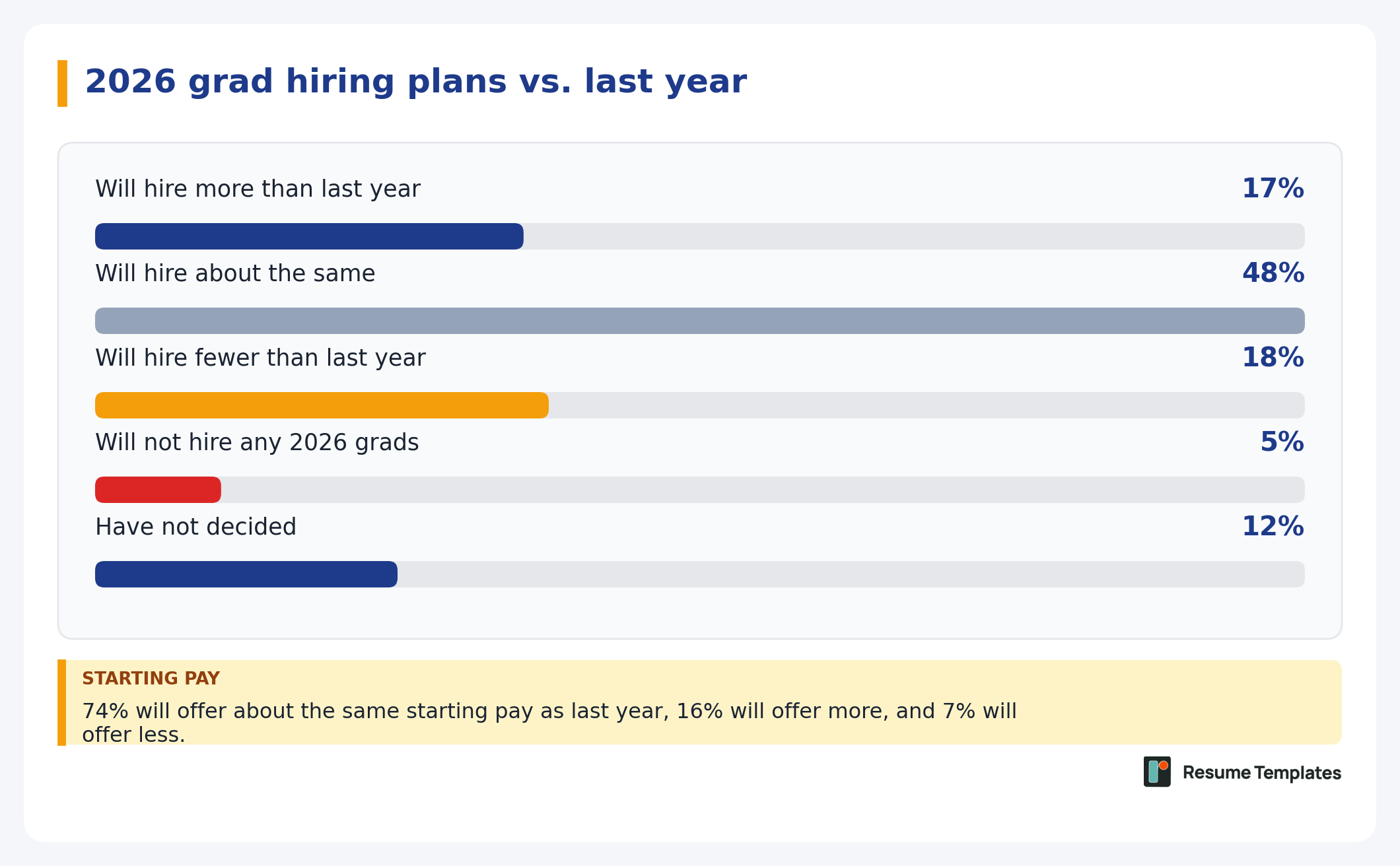
- 48% of hiring managers will hire about the same number of 2026 grads as they hired from the class of 2025, and 17% will hire more.
- 18% plan to hire fewer 2026 grads than last year, and 5% will not hire any.
- 12% have not yet decided how many to hire.
- Starting pay is mostly steady: 74% will offer about the same as last year, 16% will offer more, and 7% will offer less.
What this means: the entry-level market is splitting rather than collapsing. Most employers are keeping their hiring and pay steady. But close to a quarter are stepping back, and the undecided group leaves part of the class waiting on calls employers have not yet made.
Companies are choosing AI over entry-level hires
The survey finds AI is already a factor in how companies think about entry-level work, not a future consideration.
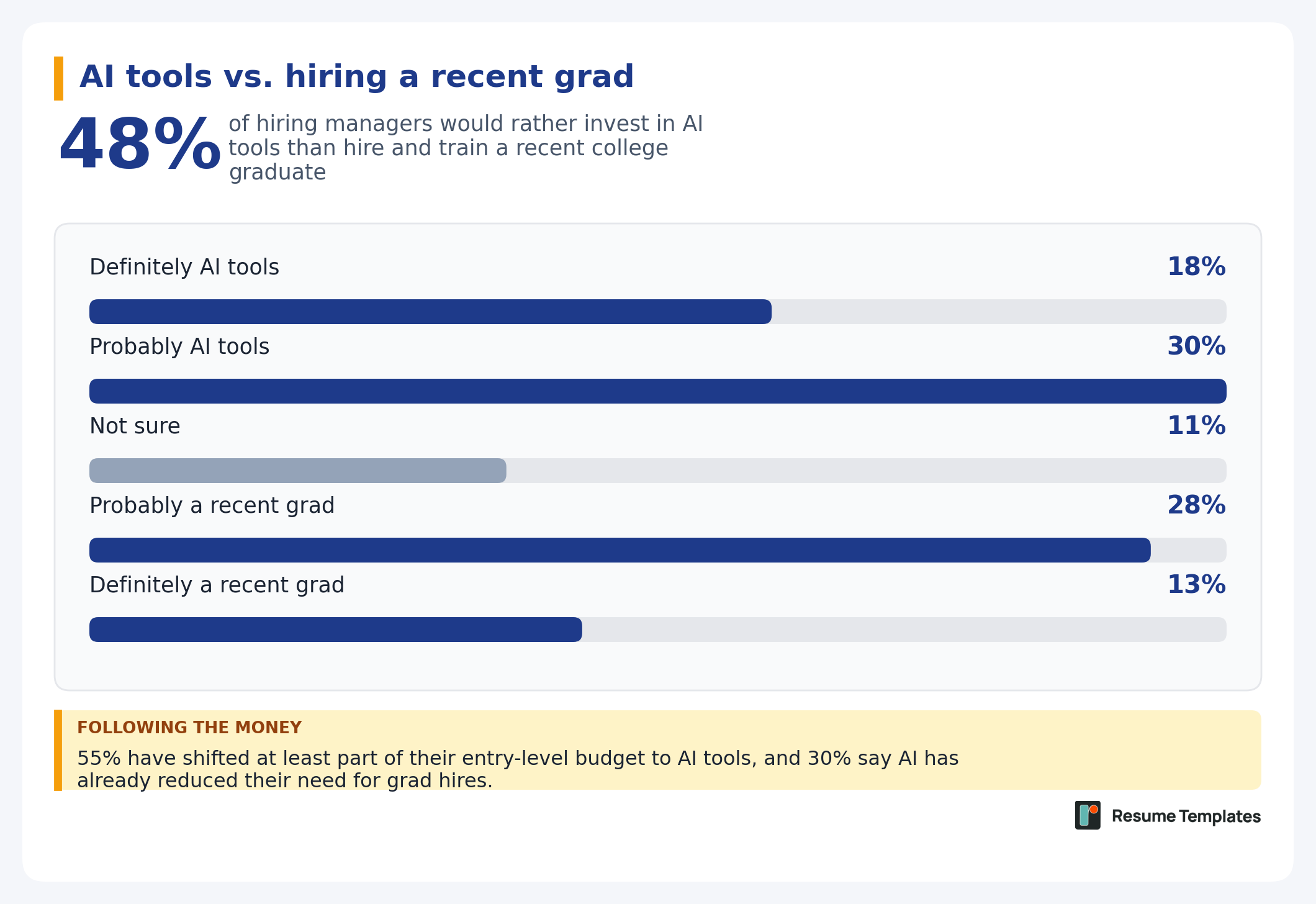
- 48% of hiring managers say their company would rather invest in AI tools than hire and train a recent college graduate, while 41% still prefer a recent grad and 11% are unsure.
- 55% have shifted at least part of their entry-level hiring budget to AI tools, including 27% who have done so fully and 28% partially.
- 30% say AI has already reduced their company’s need for entry-level grad hires.
What this means: for roughly half of employers, AI and a new graduate are now weighed against each other for the same entry-level work. Spending has started to follow that preference.
How companies are restructuring entry-level roles
Some of the work that once went to a team of junior hires is being consolidated into senior roles paired with AI.
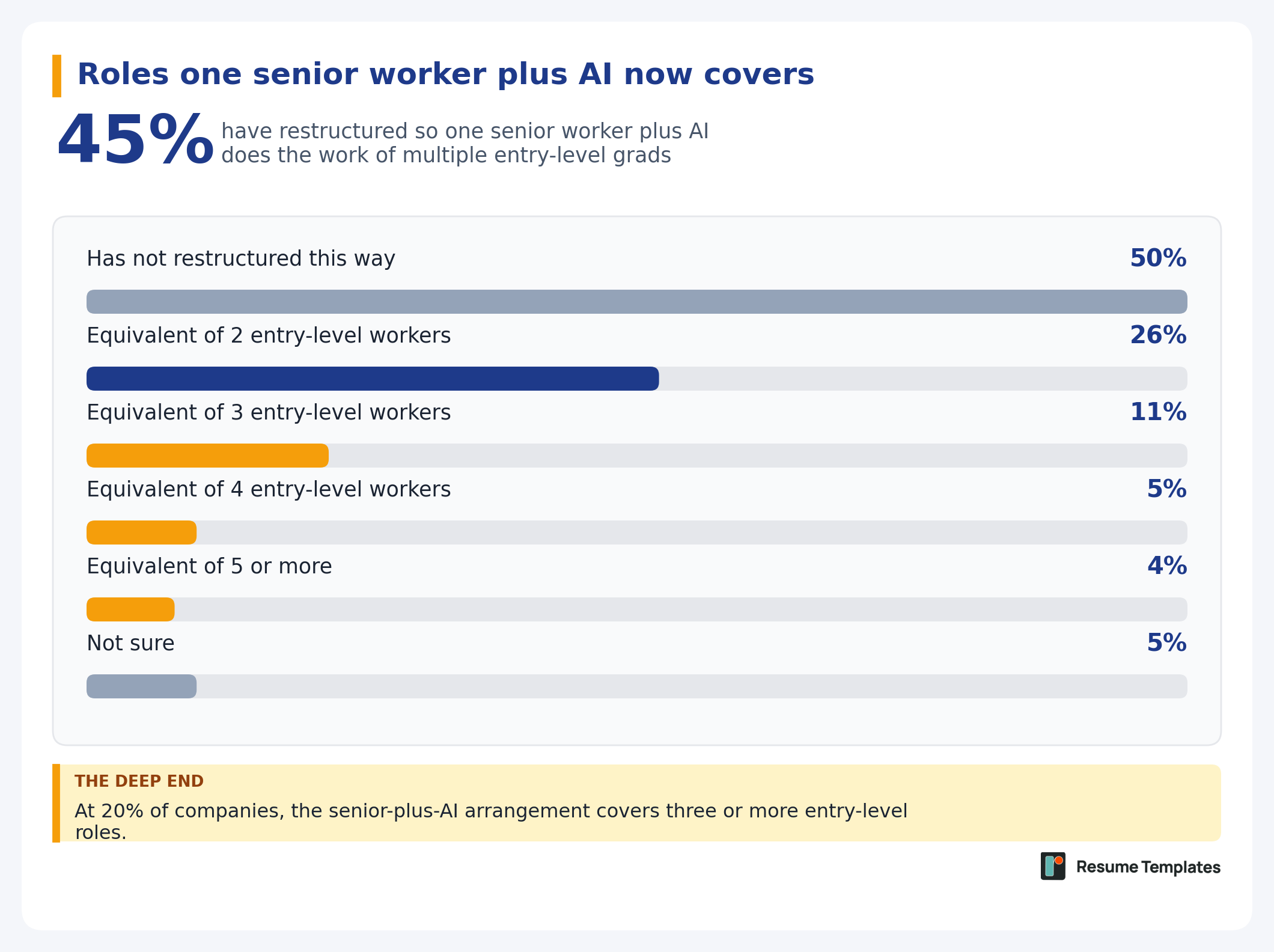
- 45% of hiring managers say their company has restructured so that one senior worker plus AI tools does the work of multiple entry-level grads.
- That arrangement covers the equivalent of two entry-level workers at 26% of companies, three at 11%, four at 5%, and five or more at 4%. In all, 20% report it covers three or more roles.
- 50% say their company has not restructured this way.
What this means: where this has happened, the openings the class of 2026 would have filled are moving up into senior roles instead of being refilled. That points to a lasting change in entry-level headcount, not a temporary pause.
What managers value in AI over a new graduate
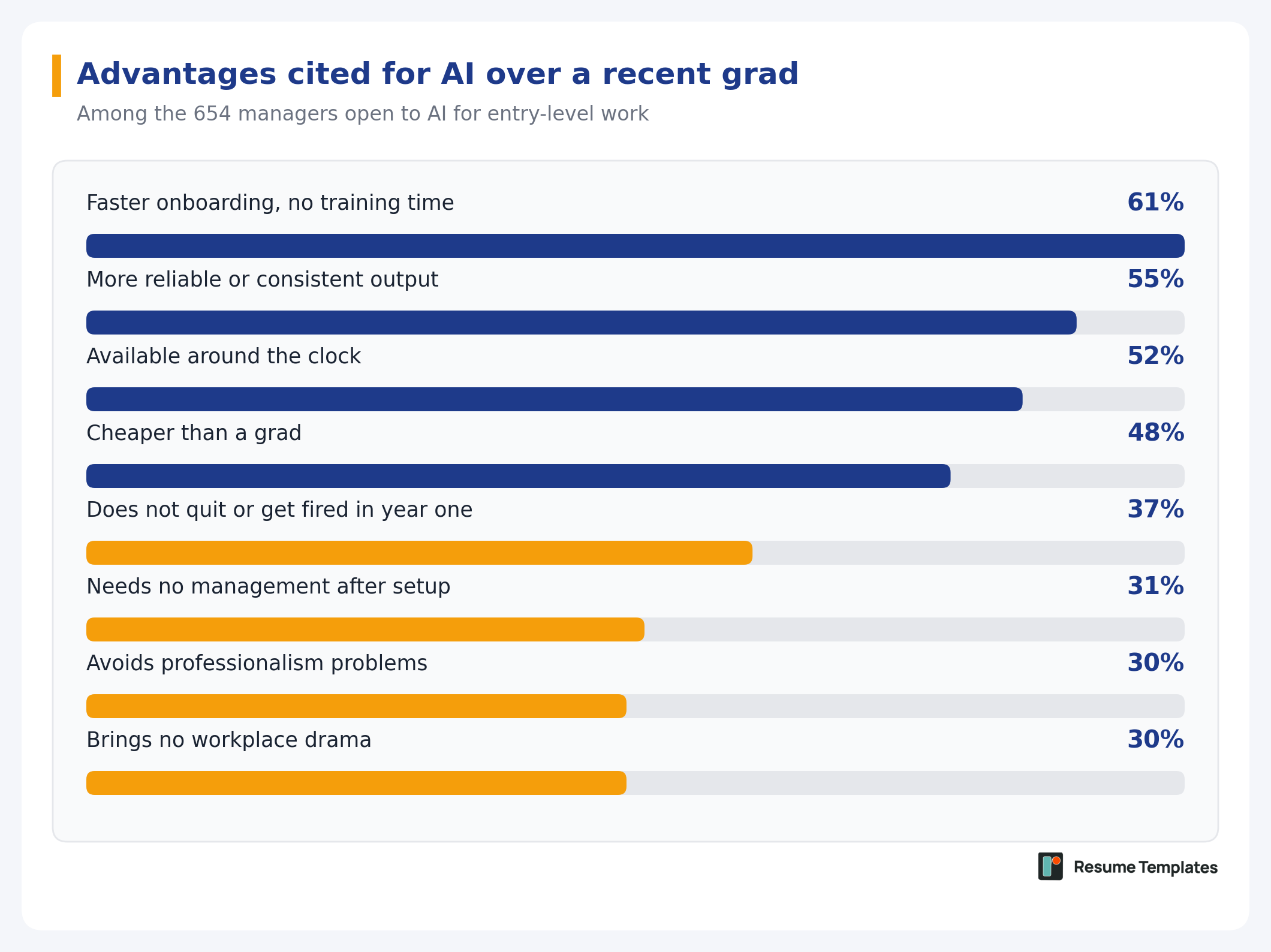
Among the roughly two-thirds of managers open to AI for entry-level work, the advantages cited are mostly operational, with a quieter set about avoiding the problems that come with new hires.
- Faster onboarding with no training time: 61%.
- More reliable or consistent output: 55%.
- Availability around the clock: 52%.
- Lower cost than a grad: 48%.
- Does not quit or get fired in the first year: 37%.
- Needs no management after setup: 31%.
- Avoids professionalism problems and brings no workplace drama: 30% each.
What this means: the case managers make for AI is built first on speed, reliability, and cost, but a recurring thread is the wish to avoid the management headaches they associate with first-year hires.
Why managers hesitate to hire recent grads
The readiness gaps managers describe are the bar a grad now has to clear to be chosen over AI. When managers explain their hesitation, the reasons center on character and conduct more than credentials.
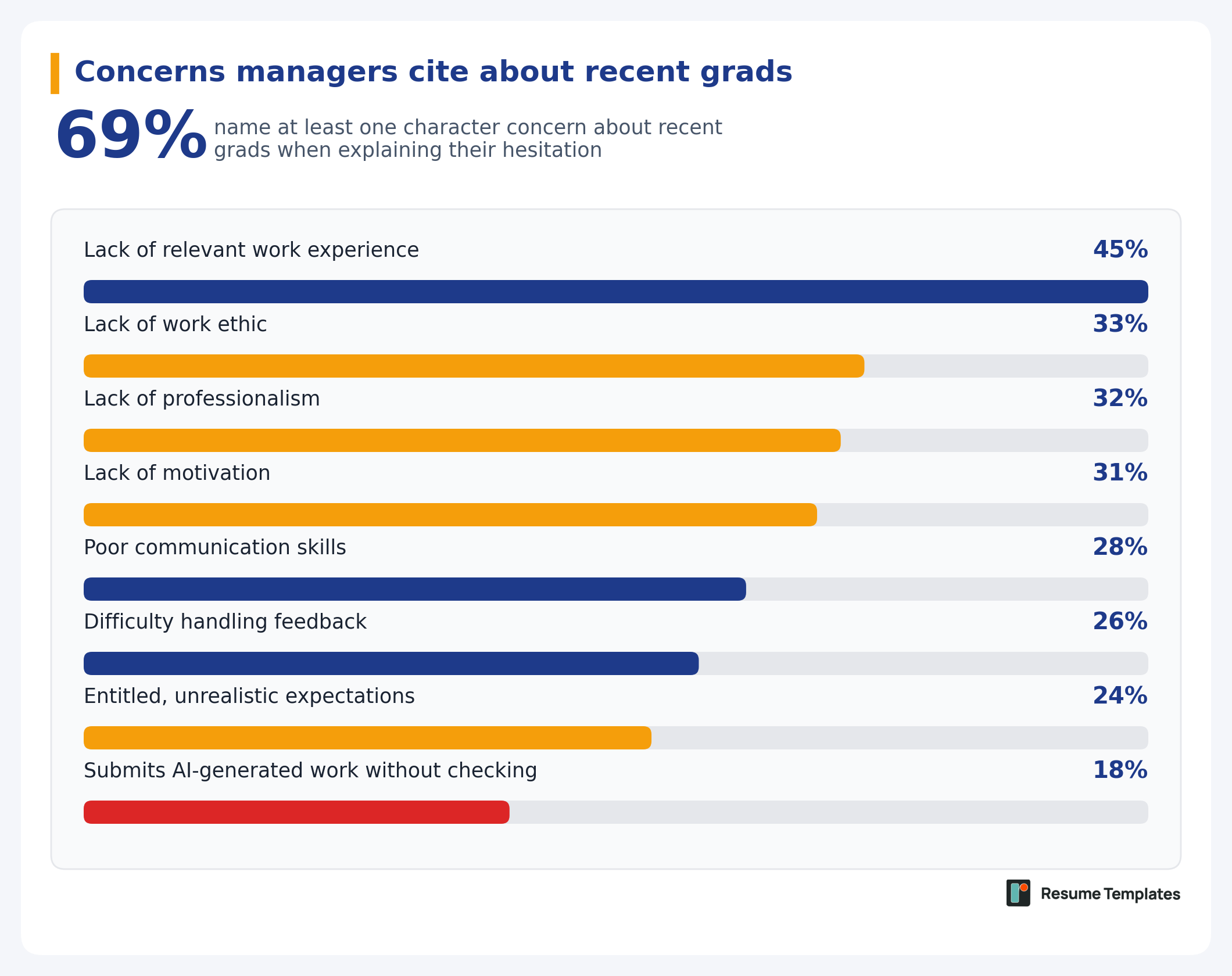
- A lack of relevant work experience is the single most-cited concern, at 45%.
- 69% name at least one character concern. The most common are a lack of work ethic (33%), professionalism (32%), and motivation (31%).
- Managers also frequently cite poor communication (28%), difficulty handling feedback (26%), insufficient technical skills (26%), and poor time management (25%).
- 24% say grads arrive entitled, with unrealistic expectations, and 18% say grads are too easily offended at work.
- Two AI-specific concerns now appear on the list: 18% say grads submit AI-generated work without checking it, and 16% say grads over-rely on AI for tasks they should do themselves.
What this means: the hesitation managers describe is less about what grads know than about how they work. A new concern, the misuse of AI, has also entered the readiness conversation.
The comprehension gap managers see in recent grads
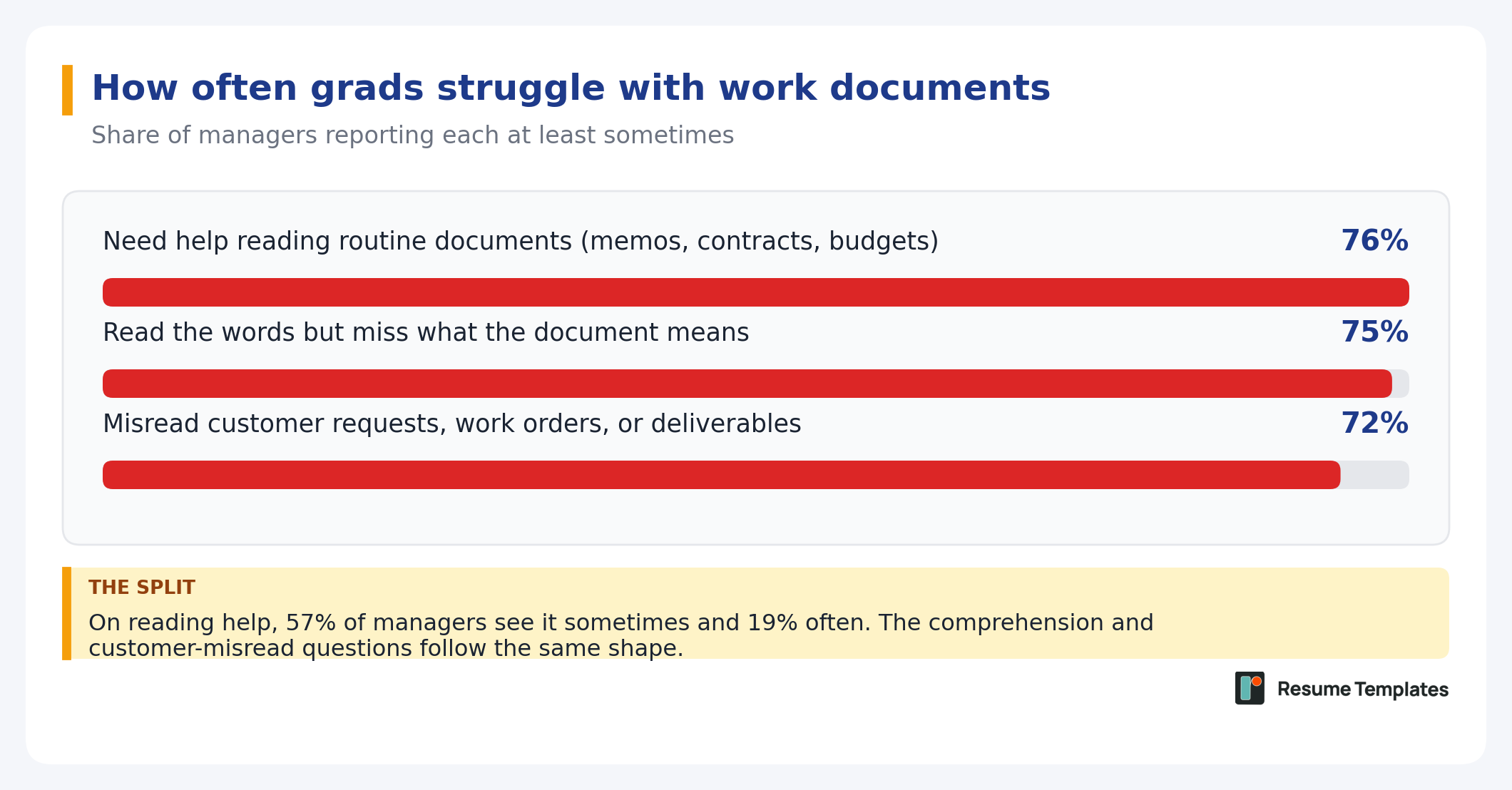
A consistent share of managers report that recent grads struggle to work with routine documents, and the problem they describe is understanding, not reading itself.
- 76% say recent grads need help reading routine documents like memos, contracts, or budgets, including 19% who see it often and 57% sometimes.
- 75% say grads make sense of the words but still miss what the document means for their work.
- 72% say grads misread customer requests, work orders, or deliverables.
What this means: managers are not describing an inability to read so much as an inability to act on what is read, and it reaches customer-facing work, where a misread carries the most cost.
The hard skills managers say grads lack
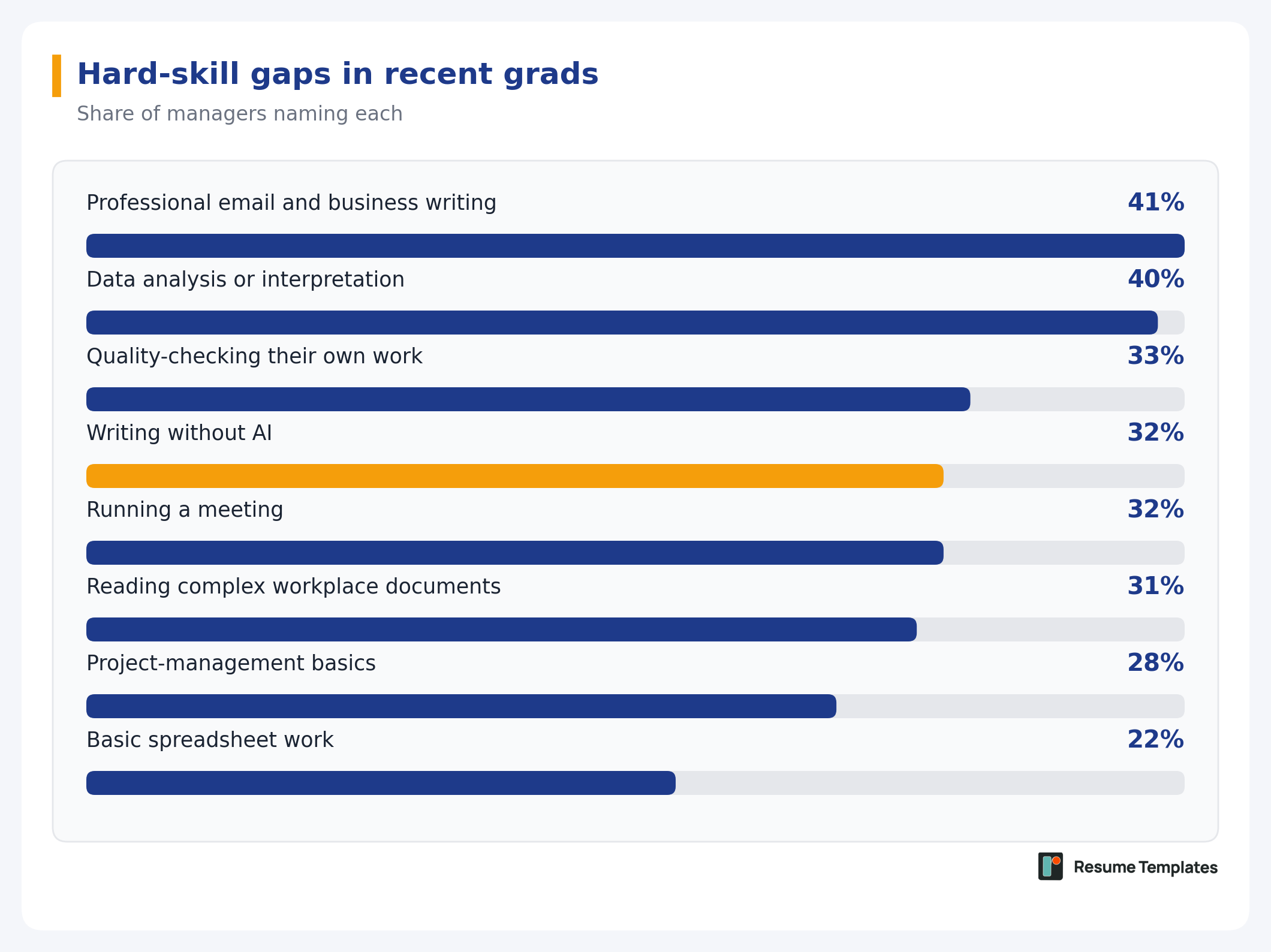
The hard-skill gaps managers report cluster around the everyday deliverables of an entry-level job.
- Professional email and business writing: 41%.
- Data analysis or interpretation: 40%.
- Quality-checking and proofing their own work: 33%.
- Writing without AI and running a meeting: 32% each.
- Reading complex workplace documents: 31%.
- Project-management basics and familiarity with enterprise software: 28% each.
- Basic spreadsheet work and source evaluation: 22% each.
What this means: the skills managers flag are not advanced or specialized. They are the routine writing, analysis, and self-checking that entry-level work runs on every day.
The soft skills managers say grads lack
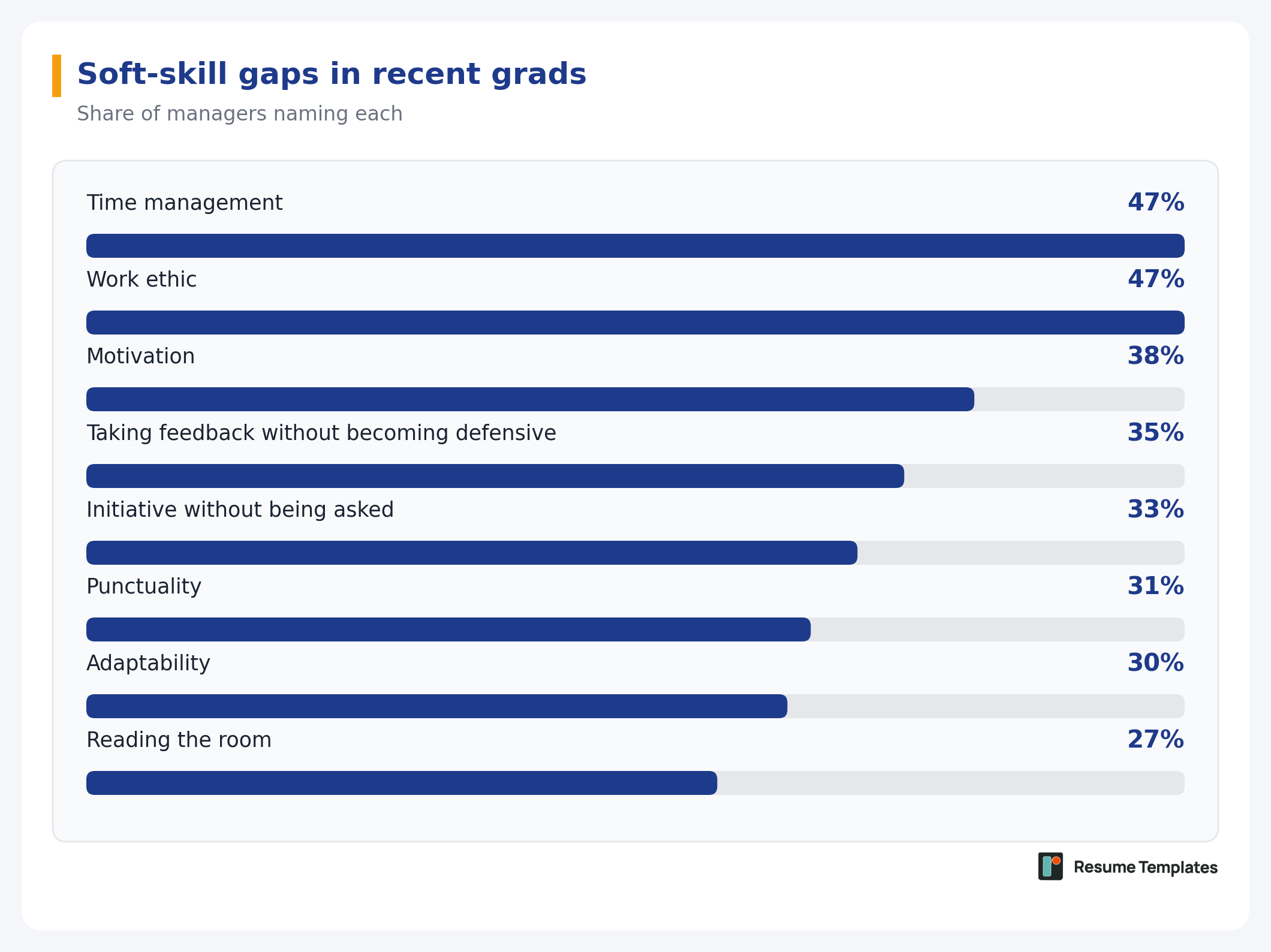
Managers cite the soft-skill gaps even more widely than the hard-skill ones.
- Time management and work ethic top the list, at 47% each.
- Motivation: 38%.
- Taking feedback without becoming defensive: 35%.
- Initiative without being asked: 33%, and punctuality: 31%.
- Adaptability: 30%, with reading the room and professional etiquette at 27% each.
What this means: managers locate the readiness gap more in workplace habits than in technical ability, which tracks with the character concerns behind their hesitation.
How much internship experience now matters
The survey suggests an internship has moved from a resume advantage toward a screening requirement.
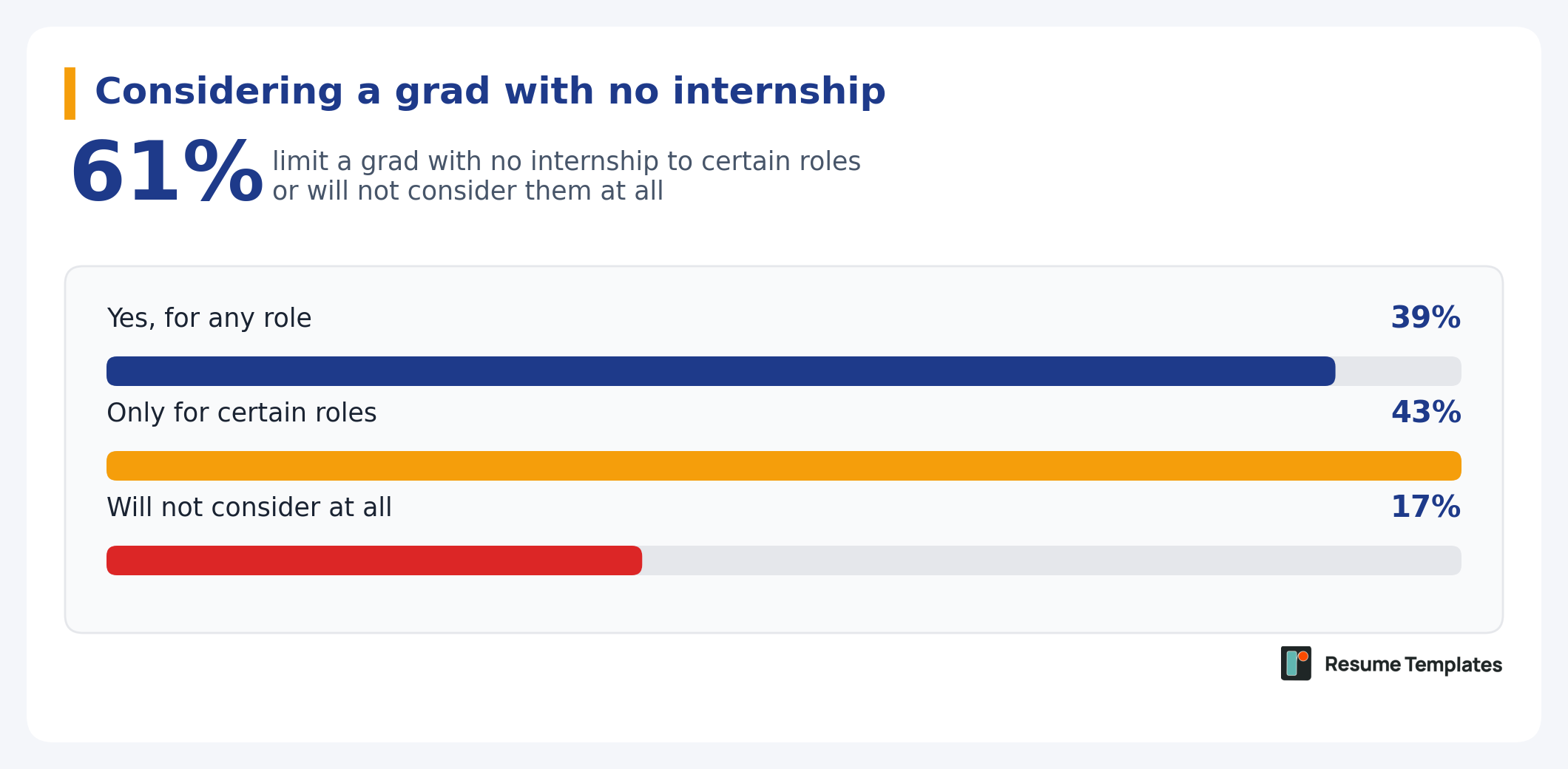
- 39% of hiring managers will consider a class of 2026 grad with no internship experience for any role.
- 43% will consider a grad with no internship only for certain roles.
- 17% will not consider a grad with no internship experience at all.
What this means: 61% of managers limit grads with no internship to certain roles or rule them out. That makes the experience gap, already their top concern, harder for new graduates to close through coursework alone.
How far managers trust recent grads
Even among the grads who get hired, full autonomy is rare across every measure the survey tested.
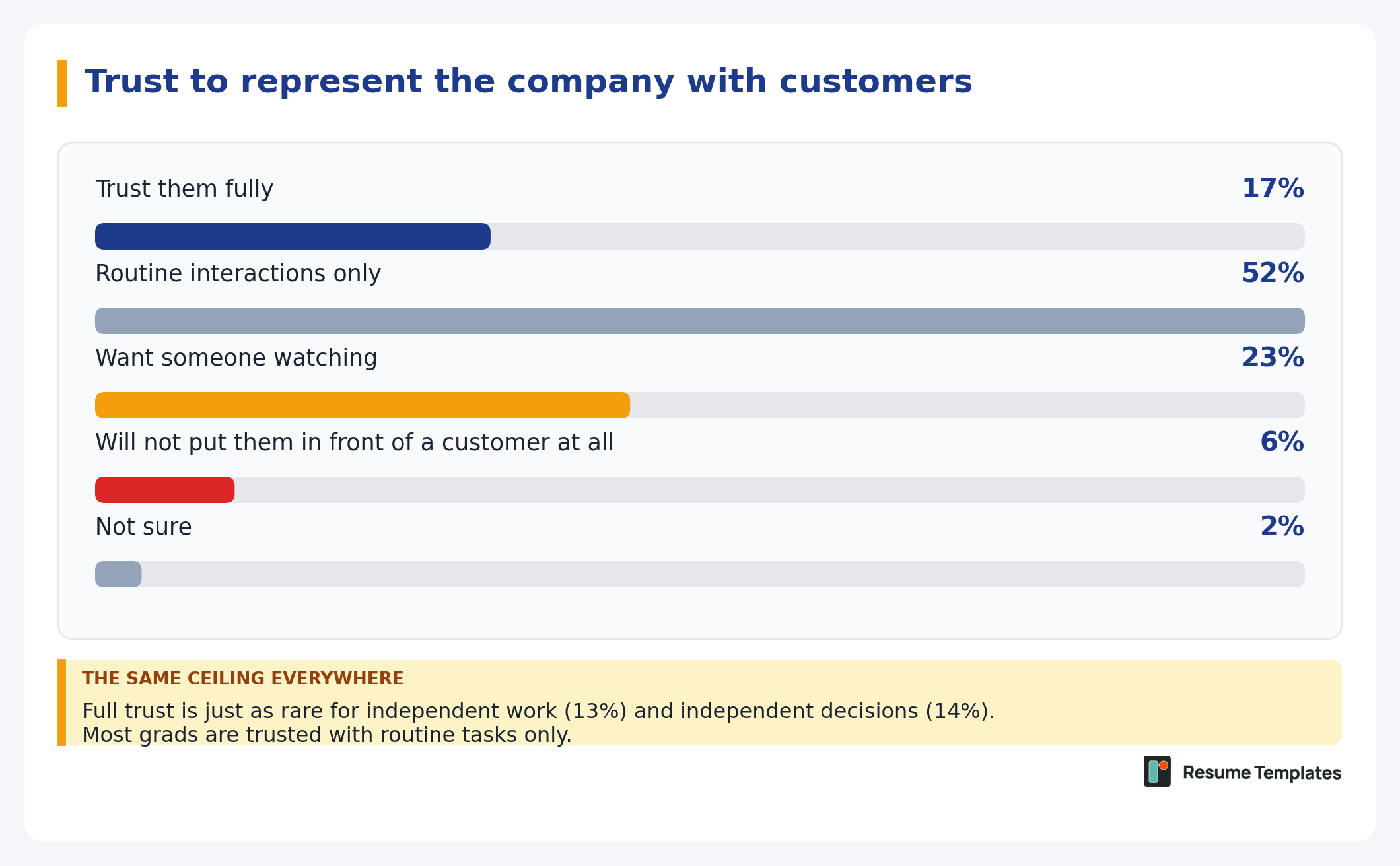
- With customers, 17% of managers fully trust recent grads. Another 52% allow routine interactions only, 23% want someone watching, and 6% will not put a grad in front of a customer at all. That leaves 83% who do not fully trust grads with customers, including 29% who will not leave a grad with one unsupervised.
- With assigned work, 13% fully trust recent grads to work without close supervision, and 64% trust them with routine work only.
- With decisions, 14% fully trust grads to decide on their own, and 62% trust them with routine decisions only.
What this means: the survey describes a trust ceiling on early-career work. The first year, for most grads who are hired, is structured around supervised, routine tasks, with broader responsibility earned over time.
What the findings add up to
Across the survey, three patterns run together. AI is moving into the entry-level work that new graduates used to do. It shows up as a stated preference, a budget shift, and a restructuring of roles. Managers also describe a class they see as underprepared, with the gaps falling in workplace habits, comprehension, and the basics of business writing and analysis. And the responsibility managers will hand to recent grads is limited. Full trust is rare in customer work, independent work, and decisions alike.
The throughline is a higher bar at the entry point, arriving at the same moment AI lowers the need to clear it. Most employers are not closing the door on the class of 2026. A majority still plan to hire at the same levels and pay about the same as last year. But they are hiring more selectively. The graduates who get offers are entering workplaces that expect them to prove the basics first.
For the class of 2026, the data points less to a single obstacle than to a raised threshold. Managers want demonstrable experience, the ability to read and act on real work documents, and the workplace habits they say they are not finding. Two questions will shape the market beyond this year’s class. How will the class meet that threshold? And how will employers weigh AI against the long-term cost of not developing junior talent?
Methodology
ResumeTemplates.com commissioned this survey, which was conducted via Pollfish in May 2026. A total of 1,000 U.S. hiring managers responsible for entry-level hiring at companies with 101 or more employees participated. Demographic and screening criteria ensured all respondents qualified. Pollfish reaches respondents in their natural digital environments through Random Device Engagement and applies quality controls to filter out inattentive or fraudulent responses. Pollfish reports a margin of error of plus or minus 3.1 percentage points at a 95% confidence level.
Resume Templates offers HR approved resume templates to help you create a professional resume in minutes. Choose from several template options and even pre-populate a resume from your profile.