Tip !

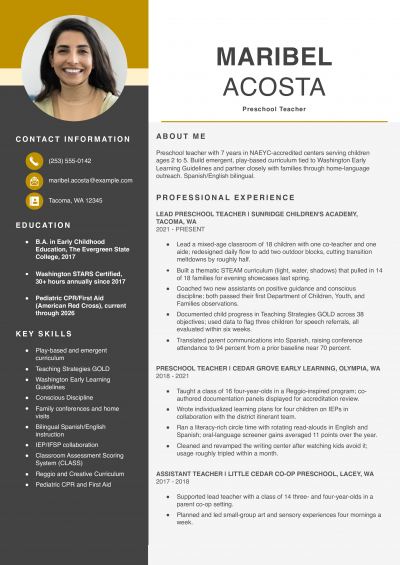
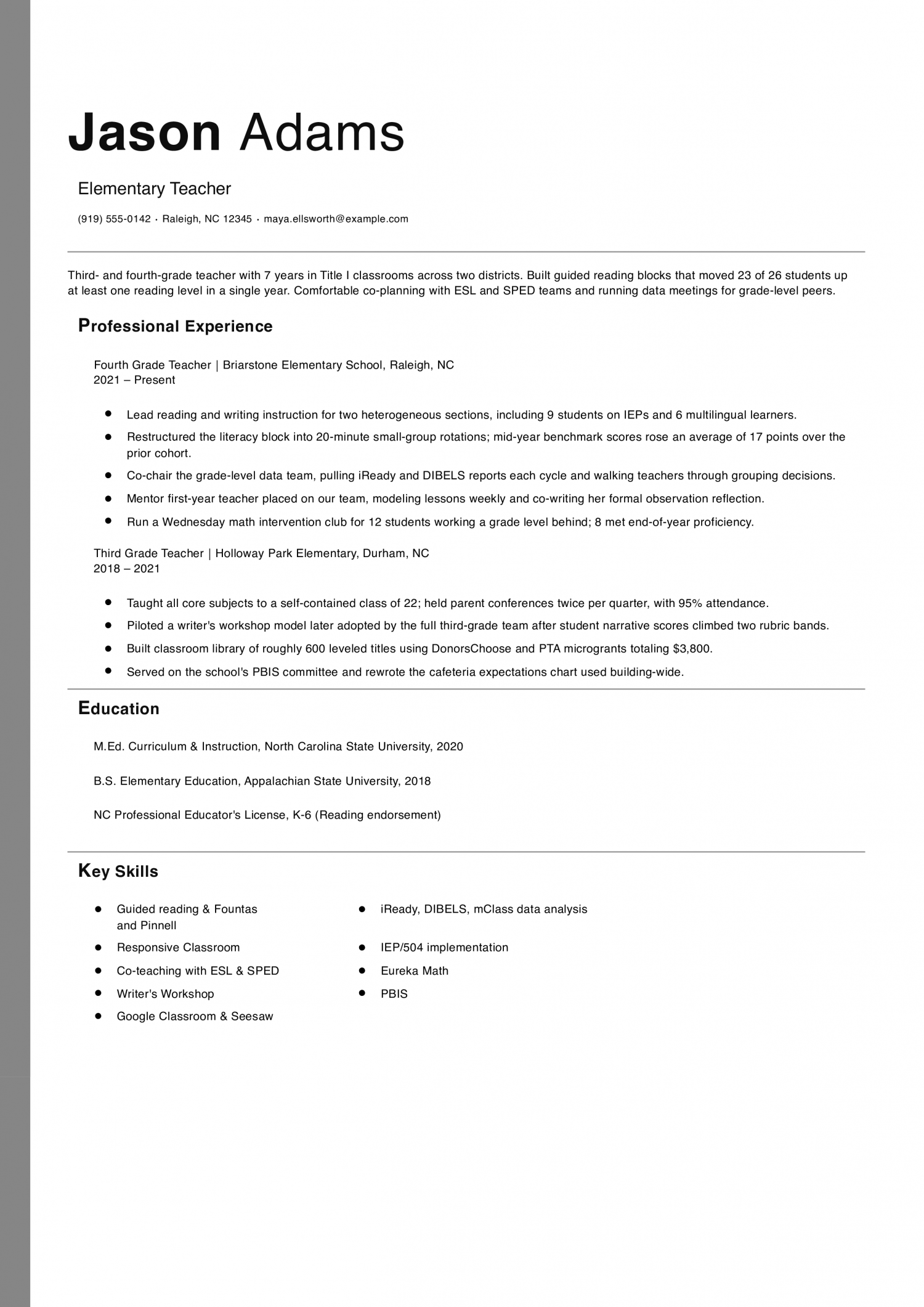
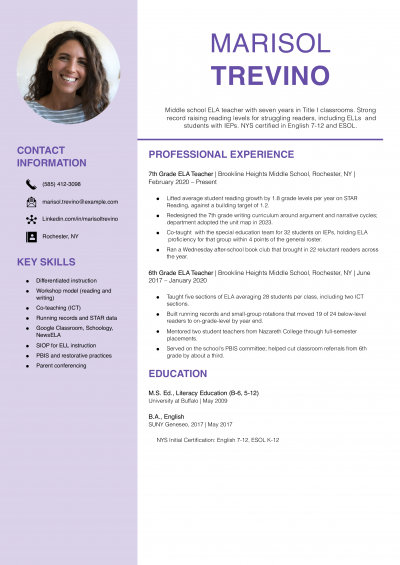
Hiring principals look for your license, endorsements, and named curricula on the first page, because that combination tells them whether you can step into the grade level and start teaching without a long ramp.

Andrew Stoner , Executive Resume Writer and Career Coach
Why this resume works
  • Names the students behind the numbers: Calling out 9 IEPs and 6 multilingual learners shows the actual classroom complexity, not just a roster size.
  • One bullet anchored on real data: The 17-point benchmark gain over the prior cohort is the kind of specific comparison principals can verify.
  • Shows growth into team leadership: Co-chairing the data team and mentoring a new teacher signal readiness for lead or instructional coach roles without claiming the title.

New Teacher Example

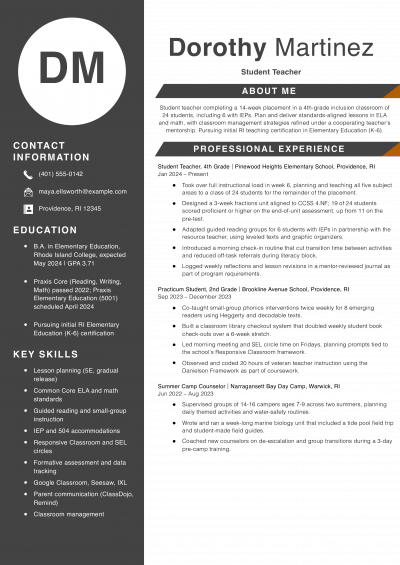
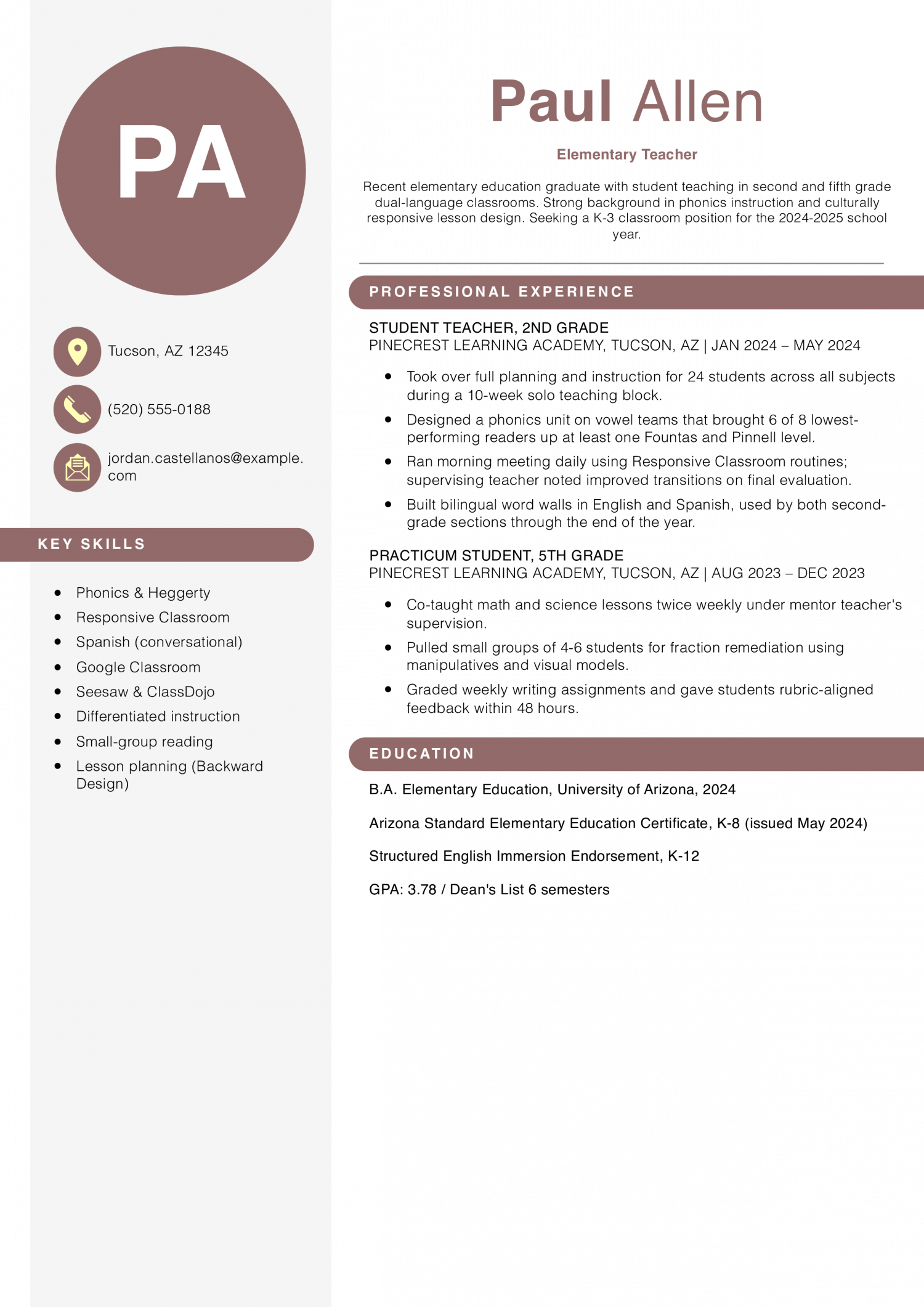
The new teacher resume covers candidates in their first two years, often fresh from student teaching or a residency program. It needs to prove classroom-ready skills through your practicum hours, cooperating teacher feedback, and any unit results.

Why this resume works
  • Names a real solo teaching stretch: Saying 24 students over a 10-week solo block tells hiring principals the candidate has actually run a classroom alone.
  • One growth number from student teaching: Moving 6 of 8 struggling readers up a level is concrete and believable for a practicum, not inflated.
  • Credentials answer hiring questions up front: Listing the certificate issue date and SEI endorsement saves the principal from emailing to confirm what’s in hand.

Experienced Teacher Example

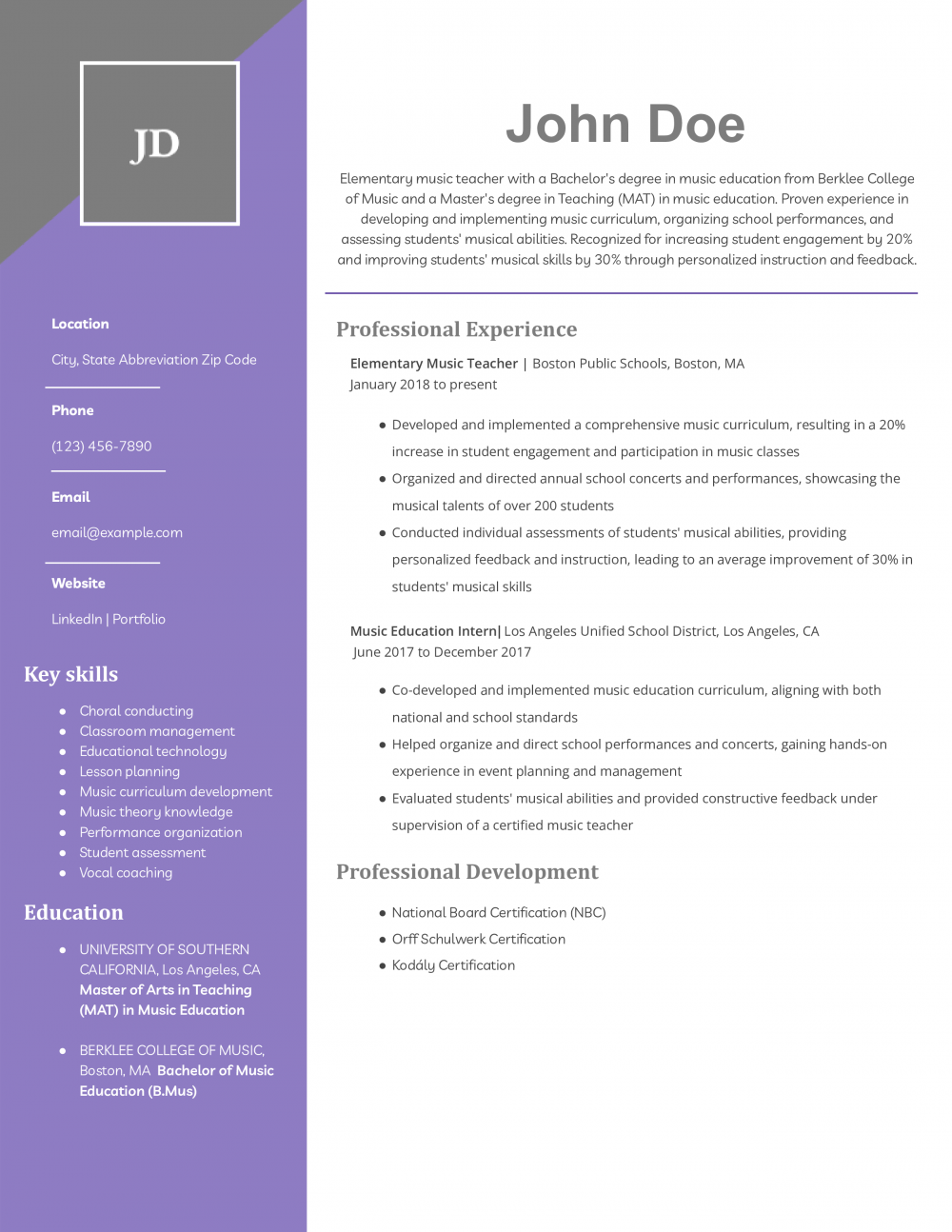
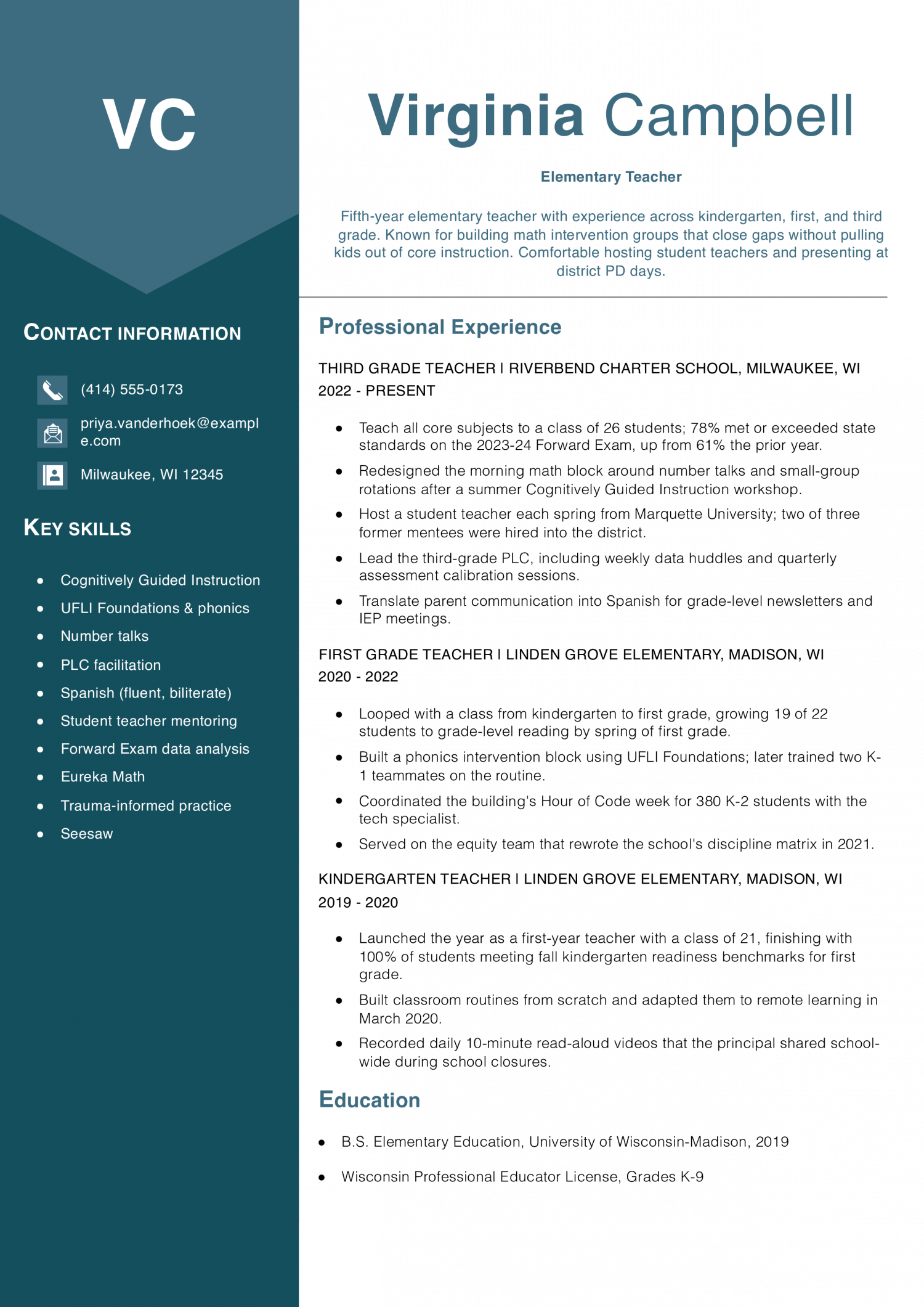
The experienced teacher resume covers three to ten years in the classroom, usually across one or two grade bands. It needs to show year-over-year growth on MAP or state assessments, the curricula you've delivered, and your role with IEP and 504 students.

Why this resume works
  • Year-over-year score jump is specific: The 61 to 78 percent move on a named state test is the kind of detail that holds up in an interview.
  • Looping shows long-term student growth: Following a class from K to 1st and reporting where they landed proves staying power, not just a single strong year.
  • Bilingual ability tied to real tasks: Translating IEP meetings and newsletters tells the principal exactly how the Spanish license gets used, not just that it exists.

Lead Teacher Example

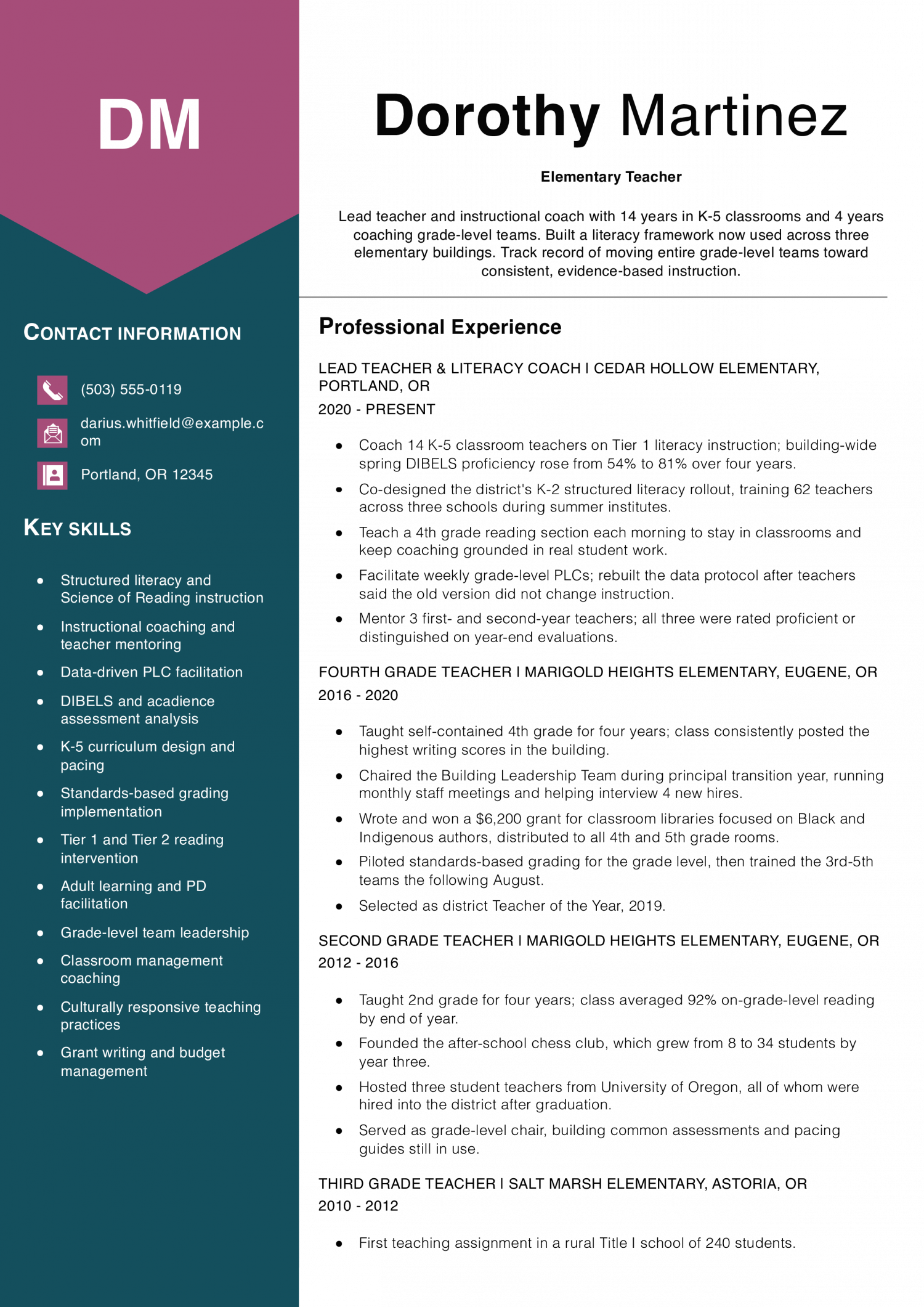
The lead teacher resume covers grade-level chairs, instructional coaches, and mentor teachers carrying schoolwide responsibilities. It needs to show team outcomes, coaching cycles you've led, and any work on curriculum adoption or MTSS rollout.

Why this resume works
  • Big number tied to a named test: Moving DIBELS proficiency from 54 to 81 percent across the whole building is the kind of result that justifies a lead role.
  • Still teaches a section daily: Keeping a 4th grade reading block while coaching tells principals this candidate is not a coach who has lost touch with kids.
  • Career arc shows steady growth: The path from rural Title I classroom to Teacher of the Year to district trainer reads as earned, not assigned.

How to Write an Elementary Teacher Resume

01 Open with a profile that names your grade band

Your profile should state your years in the classroom and the specific grade bands you’ve taught (K-2, 3-5, or self-contained K-5). Name your state of licensure and any endorsements like ESL, reading, or special education.

Add the school setting where you’ve worked: Title I, charter, dual-language, magnet, or independent. Close with one signature strength: a literacy approach, a math curriculum, or an MTSS role. Principals reading the top third of the page should know your grade level, license status, and instructional anchor before they reach your first bullet.

02 Show student growth in scope language

Strong elementary teacher bullets name the class size, the assessment, and the direction of growth. Write “Moved 18 of 22 second graders from below to at-benchmark on DIBELS across the year” rather than “improved reading scores.”

Most strong resumes cite two or three growth markers: a literacy measure (DIBELS, Fountas and Pinnell, Acadience), a math measure (MAP, iReady, state test), and a behavior or attendance shift. Bullets without a number or scope tend to read as duties. Name the curriculum that drove the gain, since principals want to know if you can carry their adopted program.

03 Group bullets by instructional category

Cluster the work into four areas principals actually scan for. Literacy instruction: phonics block, guided reading, writing workshop, the program you used. Math instruction: number talks, small-group rotations, the curriculum.

Classroom culture and management: morning meeting, Responsive Classroom, PBIS tiers, restorative circles. Family and IEP collaboration: weekly newsletters, conferences, IEP and 504 meetings you attended, accommodations you delivered. This structure lets a principal find the part of the job they care about most in a single glance.

04 Place license and endorsements page one

List your state teaching license and endorsements in a credentials block near the top of page one, under your name and contact. Use the format “Texas Standard Teaching License, EC-6 Generalist, ESL Supplemental, in good standing.” Do not print your license number on the resume itself; supply it when the application portal asks.

Add edTPA passing status if you’re a new teacher, plus any reading science credential (LETRS, Orton-Gillingham coursework). Principals and district HR officers use this block as a yes/no filter before they read your bullets, so burying it on page two costs interviews.

05 Close with education and ongoing learning

End with your degree (BA, BS, MEd, MAT), your university, your graduation year, and any GPA above 3.5. New teachers should add a student teaching block right under education: the school, the grade, the cooperating teacher’s name on request, and the units you led solo.

Add a short professional learning section listing recent PD that maps to the posting: LETRS units, Eureka Math training, Responsive Classroom, or a CPI certification. This signals you keep up with the curricula and frameworks districts are adopting, which matters for any teacher under five years in.

Five years ago, an elementary teacher resume read like a duties list under each school. The skills below come from the resumes our users built in 2026. The mix has shifted toward named curricula, science-of-reading credentials, and assessment platforms.

Principals weigh the hard skills as proof you can carry their adopted programs (Fundations, Eureka, Wit and Wisdom) and the soft skills as proof you can hold a classroom together. Both columns matter on this role. Run the hard-skills list against the job posting and mirror its language; treat the soft skills as evidence to back specific bullets, not as a standalone list.

Soft Skills % of resumes with this skill
Communication 80%
Patience 70%
Empathy 44%
Adaptability 40%
Creativity 31%

And here are the top hard skills showing up most often.

Hard Skills % of resumes with this skill
Lesson planning 73%
Classroom management 53%
Curriculum development 50%
Student assessment 38%
Educational technology 35%

Based on data from thousands of elementary teachers’ resumes built on ResumeTemplates.com, May 2026.

Must Have on an Elementary Teacher Resume

The items below are what separate an elementary teacher resume from one that gets put back in the pile.

Licensure Requirements

Principals use your credentials block as a yes/no filter before they read a single bullet. Put it on page one, near your contact information.

Format each item as state, license type, endorsement areas, and status. For example: “Illinois Professional Educator License (PEL), Elementary Education (Grades 1-6), ESL endorsement, in good standing.”

Do not print your license number on the resume. State boards and district HR offices generally advise against publishing credential numbers, and the application portal will ask for the number on its own form.

  • State and license type, written in full
  • Grade-band endorsement (EC-6, K-6, 1-6, K-5)
  • Subject or population endorsements (ESL, bilingual, reading, special education)
  • Status (in good standing, in progress, eligible for reciprocity)
  • edTPA passing status for new teachers

Classroom Management

Principals read classroom management and IEP collaboration as the two strongest predictors of whether you’ll last the year. Make both visible in your bullets, not in your summary.

  • Named framework: Responsive Classroom, PBIS, Conscious Discipline, restorative

  • Behavior data: referrals, attendance, time-on-task shifts

  • IEP and 504 caseload size in the classroom

  • Specific accommodations delivered (visuals, chunking, extended time)

  • Co-teaching model and partner role

Niche Keywords for ATS Checkers

Principals and district HR officers expect to see grade-specific curricula, assessment names, and endorsement language in your bullets. The clusters below mirror how application portals tag elementary teacher resumes.

Niche Keywords for ATS Checkers

Niche Keywords ATS scans for
Early literacy guided reading, Fundations, LETRS, DIBELS 8
Elementary math Eureka Math, Bridges, number talks, iReady
Classroom culture Responsive Classroom, PBIS, morning meeting, restorative circles
Special populations IEP, 504 accommodations, MTSS, Tier 2 intervention
English learners ESL endorsement, sheltered instruction, SIOP, dual-language

AI Skills to Add

Principals are split between teams that want teachers using MagicSchool AI and Khanmigo to cut planning time and teams that worry it flattens instruction. Name the tools you use, describe the workflow honestly, and don’t claim AI “personalizes learning” if your actual practice is drafting materials you then adapt for your students.

What AI is actually changing for this role
Lesson planning

AI drafts unit plans and exit tickets in minutes, so the resume signal is how you adapt the output, not that you used it.

Differentiation

Tools generate tiered versions of texts and problems, but the teaching skill is choosing which tier each student needs.

Family communication

AI translates newsletters and behavior notes into home languages, expanding reach in dual-language and immigrant-heavy schools.

Family communication

AI drafts parent emails and translates updates, which means principals expect faster turnaround on communication without losing tone.

Assessment analysis

Platforms now summarize DIBELS or MAP data automatically, so showing you can act on the summary matters more than running it.

AI tools to name
  • MagicSchool AI: Drafting tiered exit tickets, rubrics, IEP-aligned modifications, and parent communication in plain language.

  • Khanmigo: Generating small-group math prompts and student-facing practice scaffolded to a standard or grade level.

How to phrase AI on your resume
Do
  • Used MagicSchool AI to draft tiered reading passages, then adapted each version for two IEP students and one newcomer EL.
  • Cut weekly lesson-planning time by half using AI drafts, reallocating the hours to small-group reading conferences.
Skip
  • AI-powered classroom instruction
  • Leveraged generative AI to revolutionize student learning outcomes

Background Checks and Sensitive Information

Teaching positions require fingerprinting, state and federal background checks, and child-abuse clearances. None of those numbers or report contents belong on your resume.

What to leave off

List that you hold current clearances if the posting asks, using language like “Current Illinois fingerprint clearance and DCFS background check.” Don’t include the report numbers, dates of birth, or social security information.

If you have a gap from a personal or family caregiving leave, address it briefly in the cover letter rather than on the resume. Districts care about your readiness now, not the reason for the gap.

  • Note current clearances by name, not by number
  • Keep date of birth, home address, and SSN off the resume
  • Address employment gaps in the cover letter, not the bullet list
  • List CPR or first-aid certification with the issuing body and expiration year

Elementary Education Credentials That Get You the Job

Principals and district HR officers read the certifications list as a map of where your teaching is heading. The credentials below tell them which instructional track you’ve invested in: science of reading, math, special education, or English learners. List each item with the issuing body and the year completed.

  • LETRS (Language Essentials for Teachers of Reading and Spelling): Signals science-of-reading fluency, which most states and districts now require for K-3 teachers under new literacy laws.

  • Orton-Gillingham Associate Level or Wilson Level I: Shows structured-literacy depth that pulls weight in schools serving dyslexic readers or running heavy Tier 2 phonics groups.

  • ESL or Bilingual Endorsement: Opens dual-language and sheltered-instruction roles and signals you can serve multilingual learners without pulling a coach in.

  • National Board Certification (Early or Middle Childhood Generalist): Carries a salary lane in many districts and reads as a mid-career commitment marker for principals hiring lead or mentor teachers.

Latest BLS Statistics for Elementary Teachers

The top-paying states for elementary teachers cluster in the high-cost coastal Northeast and West, not the larger-employment markets in the South where most openings sit. That spread comes from union contracts, step-and-lane salary schedules tied to cost of living, and master’s degree premiums.

If you’re geographically flexible, your resume should foreground license portability, any reciprocity-eligible certifications, and your highest degree with the credit hours past it, since pay lanes hinge on those data points.

$62,340 National median annual
$69,790 National mean annual
$46,440 Entry-tier floor (10th percentile)
$102,010 Top-decile ceiling (90th percentile)
1,393,310 Elementary Teachers in the U.S.
Where you stand

Entry tier

$46,440 to $62,340 At the entry tier, lead with your state license, endorsements, and the grade levels you carried solo during student teaching or residency.

Mid band

$62,340 to $102,010 At the mid band, your resume needs to show year-over-year growth on MAP or DIBELS and the named curricula you've delivered.

Top decile

$102,010+ At the top decile, lead with National Board status, coaching or grade-chair work, and schoolwide outcomes from MTSS or literacy initiatives.

Top-paying states

# State Avg. Annual
1 Washington $99,110
2 California $98,190
3 District of Columbia $94,730
4 Rhode Island $86,900
5 Massachusetts $83,260
6 New York $82,480
7 Connecticut $78,740
8 New Jersey $77,150
9 Alaska $76,290
10 Oregon $75,800

Highest-employment states

# State Workers Median
1 California 141,650 $98,190
2 Texas 124,430 $61,380
3 New York 103,920 $82,480
4 Florida 78,630 $55,550
5 Illinois 61,000 $64,160
Source: U.S. Bureau of Labor Statistics, OEWS 2024 release (SOC 25-2021).
Written by professional resume writers and loved by hiring managers

Resume Templates offers HR approved resume templates to help you create a professional resume in minutes. Choose from several template options and even pre-populate a resume from your profile.

Frequently Asked Questions

Should I list my teaching license number on my resume?

No. List the state, the license type, the endorsements, and "in good standing," but leave the license number off the resume itself.

Provide the number on the district application portal when the form asks for it. State boards generally advise against publishing the number on public documents, and principals don't need it to make an interview decision.

How do I handle a license earned in a different state?

Name your current state of licensure, the reciprocity status with the target state, and any in-progress steps toward the new credential.

Most states have an interstate compact that accepts out-of-state licenses with added coursework or a content test. Spell out where you stand: "Eligible for Colorado licensure via NASDTEC reciprocity; content test scheduled June 2026."

What do I put on a first-year teacher resume with no full-time experience?

Lead with student teaching as if it were a job. Name the school, the grade, the cooperating teacher's district, and the units you delivered solo.

Add measurable growth from your edTPA, capstone, or unit assessments. Include any long-term sub work, summer school, tutoring, or camp roles where you ran instruction. Principals hiring first-year teachers want evidence you've held a classroom, not a polished narrative.

Should I disclose using AI tools like MagicSchool or ChatGPT for lesson planning?

Don't list "AI lesson planning" as a standalone skill. Principals read that as a flag, not a strength. If you use MagicSchool AI or Khanmigo, frame the workflow honestly in a bullet: "Used MagicSchool AI to draft tiered exit tickets, then adapted each set for IEP accommodations and small-group reading levels." That reads as judgment, not shortcut-taking.

What resume template should an elementary teacher use?

For an elementary teacher, a professional template is the safest pick, because it signals the polish hiring managers in this field expect. An ATS-friendly template is a solid alternative. Whichever you choose, keep the formatting clean and easy to parse: clear section headings, a standard font, and no graphics a parser can choke on.

Rate this article

Elementary Teacher Resume

Average Rating

4.8/5 stars with 173 reviews

You have given 0 Star(s)
4.8/5 stars with 173 reviews
Andrew Stoner

Executive Resume Writer and Career Coach

Andrew Stoner is an executive career coach and resume writer with 17 years of experience as a hiring manager and operations leader at two Fortune 500 Financial Services companies, and as the career services director at two major university business schools.