Teacher Resume Examples and Templates for 2026



The special education teacher resumes that get scheduled for demo lessons share three things: the endorsement code in the header, a caseload line with disability categories named, and IEP goal data showing baseline-to-mastery movement.
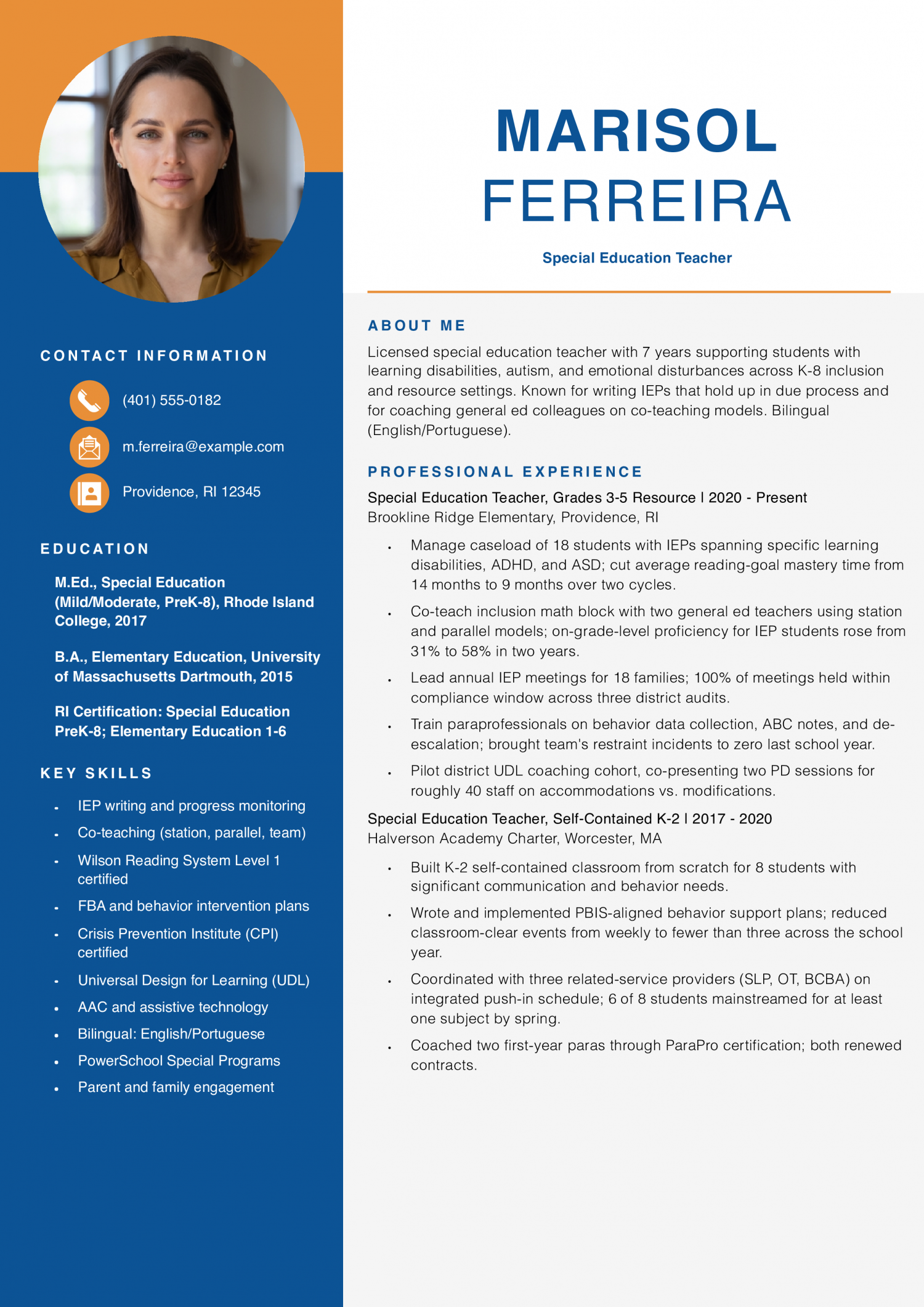
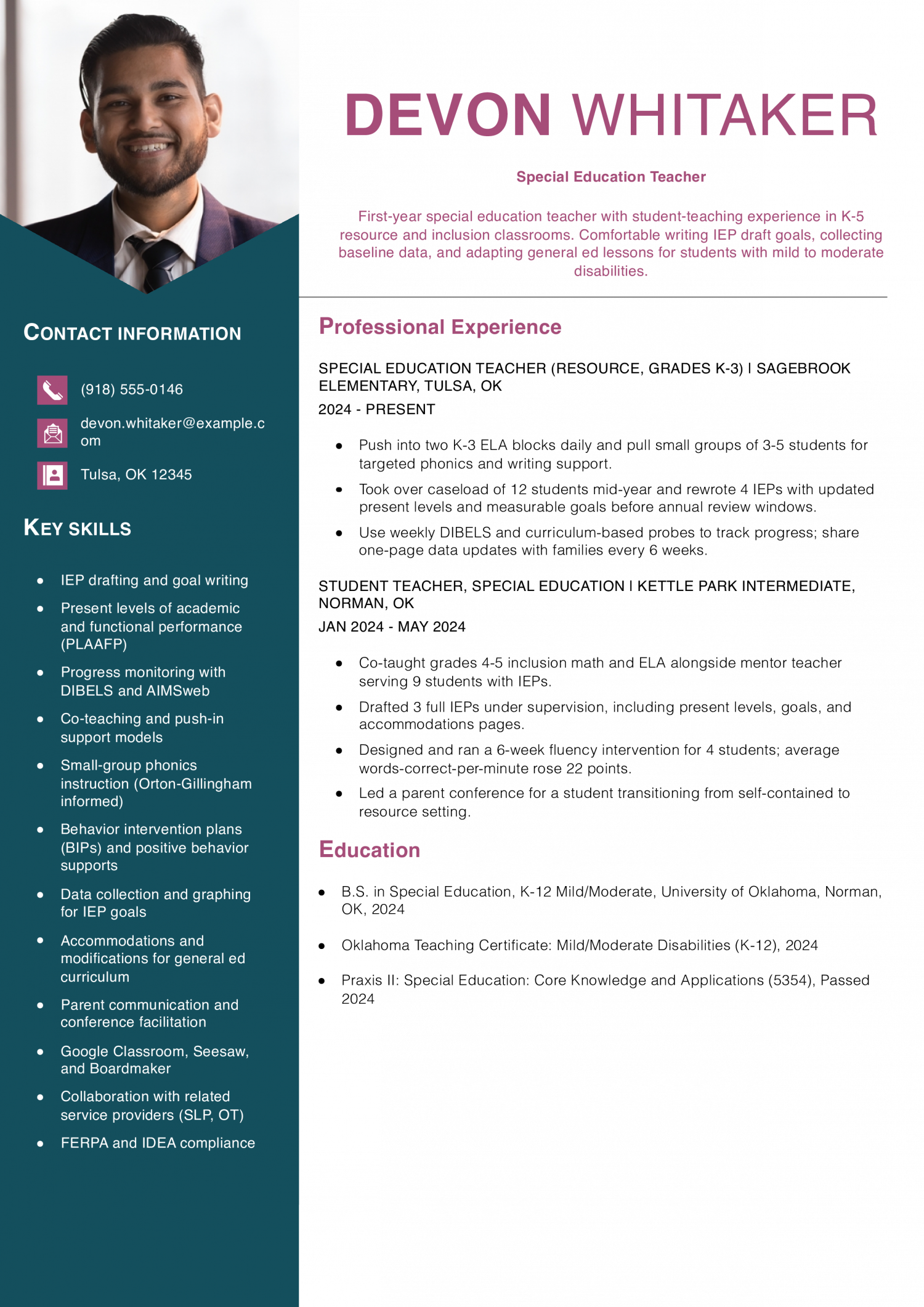
The new teacher archetype is finishing student teaching or in year one, often with a provisional or initial license. This resume needs to prove your endorsement, practicum caseload, and one or two IEP goals you tracked from baseline to mastery.
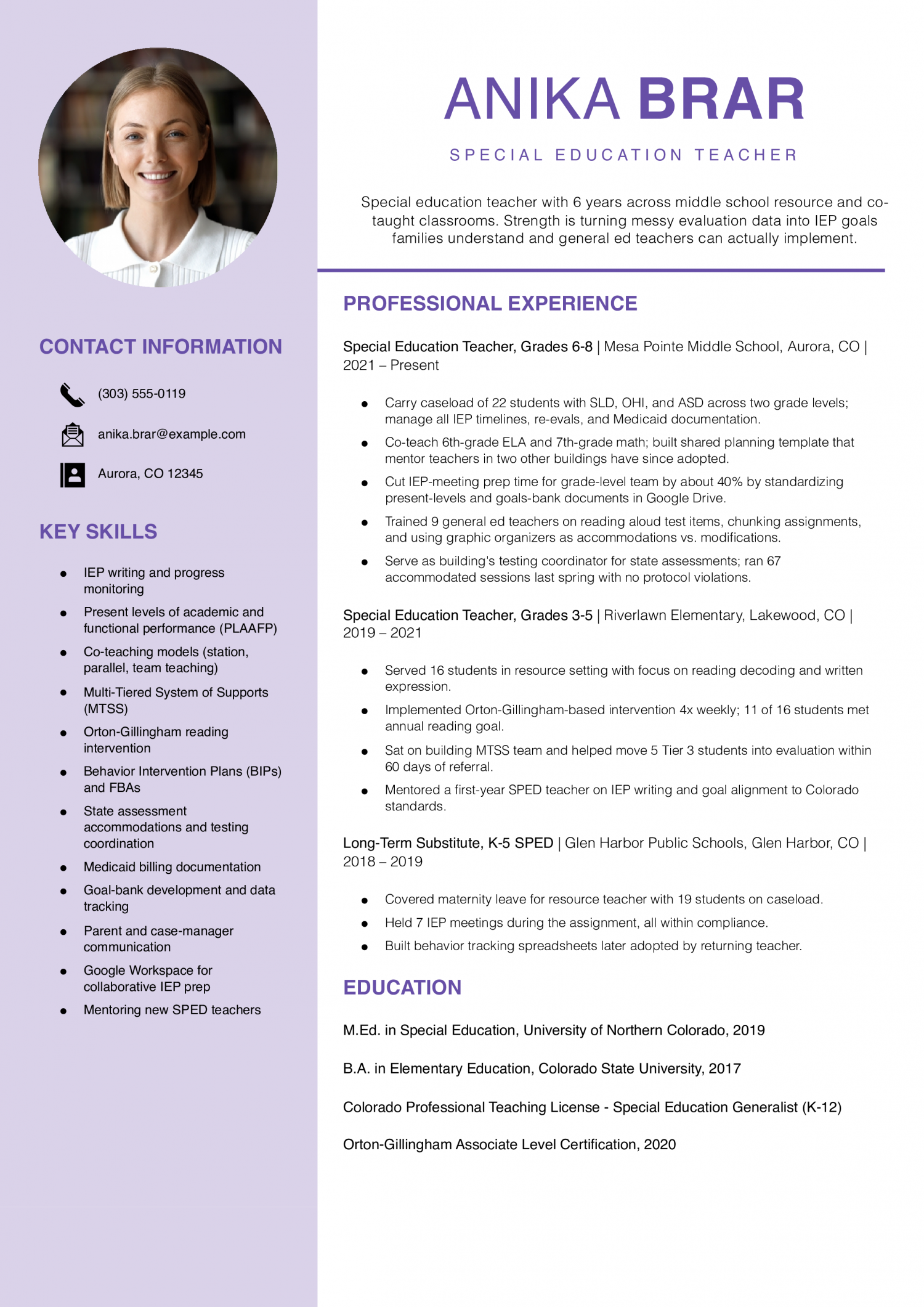
The experienced teacher archetype carries three to ten years across resource room, self-contained, or inclusion settings. This resume needs to prove caseload size, disability categories served, BIP outcomes, and the co-teaching models you've run with general education staff.
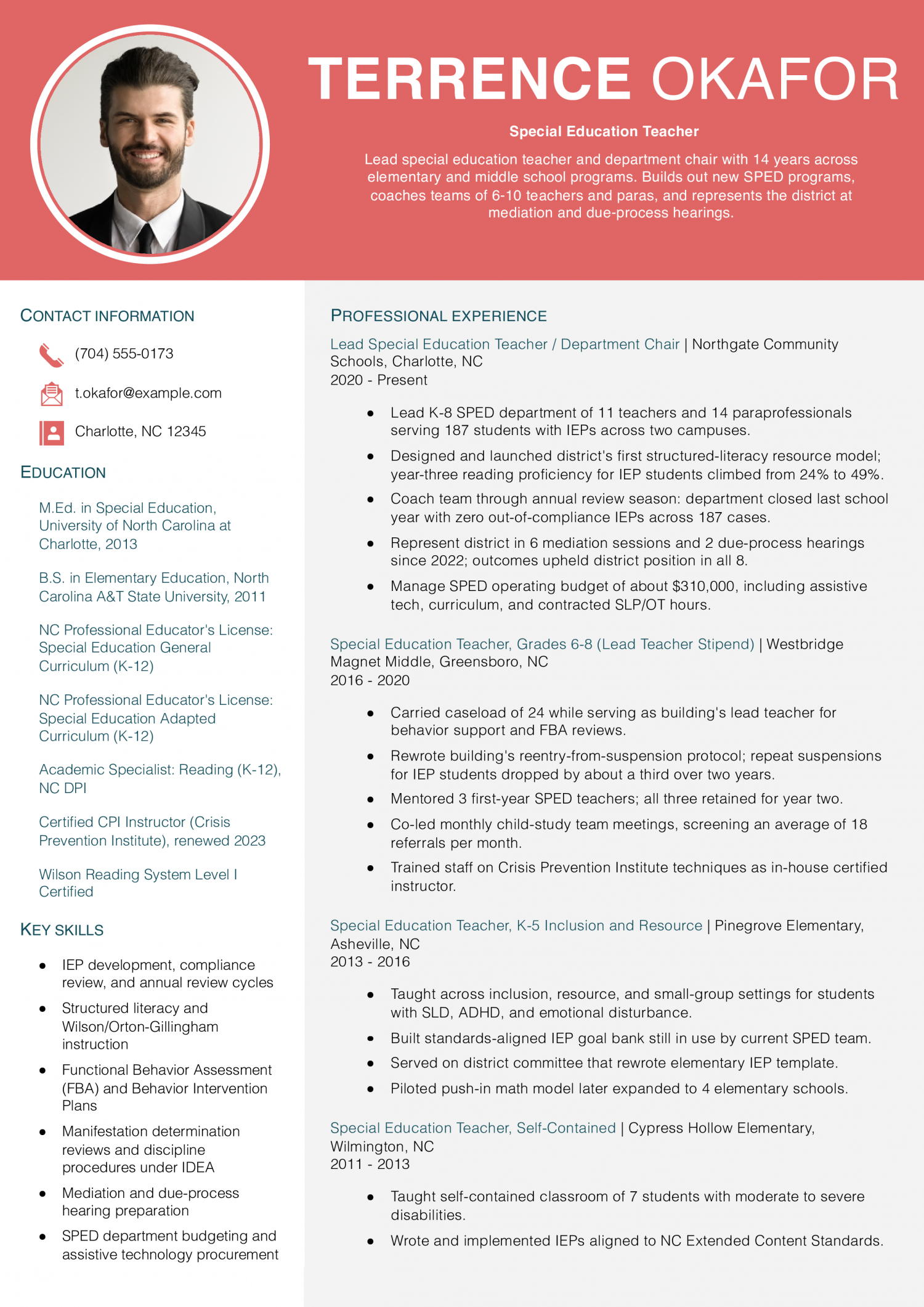
The lead teacher archetype mentors new hires, chairs IEP meetings, and often coordinates a grade band or department. This resume needs to prove case management at scale, due-process compliance, and measurable gains across a team's caseload.
Priya Lansing
Madison, WI | (608) 555-0164 | [email protected] | linkedin.com/in/priyalansing
Special education teacher with 9 years across elementary resource, middle school co-taught, and transition-age programs. Background includes IEP case management for students with autism, learning disabilities, and emotional disabilities, plus three years as a teacher-leader running building MTSS and child-study processes. Comfortable in difficult IEP meetings and known for keeping families informed between annual reviews.
Special Education Teacher, Grades 6-8 Resource and Co-Taught
Foxhill Middle School | Madison, WI | 2022-Present
Teacher-Leader, MTSS and Child Study
Foxhill Middle School | Madison, WI | 2023-Present (Concurrent Role)
Special Education Teacher, Grades 3-5
Maple Crossing Elementary | Eau Claire, WI | 2018-2022
Special Education Teacher, K-2 Inclusion
Cottonwood Lane Primary | Rockford, IL | 2016-2018
Long-Term Substitute, SPED Resource
Birch Hollow School District | Birch Hollow, IL | 2015-2016
A principal can pull your license from the state portal. They cannot see your caseload composition or which disability categories you’ve actually taught.
Put one line at the top naming your endorsement, your caseload range, and the categories you serve: autism, emotional disability, specific learning disability, intellectual disability.
If you bring a rarer signal, name it: bilingual special education, AAC user support, structured literacy training, or crisis-intervention certification. That line is what separates your file from the next one in the stack.
Special education teacher bullets work best in scope and progress language, not raw percentages that overpromise.
Name caseload size, the number of IEPs you wrote or amended in a year, and the share of goals that moved from baseline to mastery.
A strong bullet reads: managed a caseload of 14 students across grades 3 to 5, with 9 of 14 meeting annual IEP goals and 3 transitioning to general education math. Avoid vague duty bullets that any teacher could claim.
Organize bullets under four categories so a principal can scan in under a minute.
Use IEP development and compliance, instruction and accommodations, behavior support, and family and team collaboration.
Under each, name the tools and methods: SETSS, Frontline IEP, or PowerSchool Special Programs for compliance; Wilson, Orton-Gillingham, or Read 180 for instruction; CPI or Ukeru for crisis response; PBIS and FBA-driven BIPs for behavior.
Special education directors and school principals screen for license match before they read your bullets. A page-two credentials block costs you interviews.
List your state and endorsement (for example, LBS1, mild/moderate K-12, severe-profound) with status of good standing, plus highly qualified subject areas.
Add CPI or MANDT certification, Wilson or Orton-Gillingham training, and any autism or AAC coursework. Do not list license numbers on the resume; provide them on the application form.
Close the resume with your degree, certifying institution, and continued professional learning.
Name your bachelor’s or master’s in special education, the year, and any reading specialist or applied behavior analysis coursework.
Add recent CE hours tied to the role you want: structured literacy, transition planning, or co-teaching models. This block tells a principal where your practice is heading next.
Pulled from the special education teacher resumes our users built and the postings that hired them, the lists below cover both the IEP and instructional terms application portals scan for and the classroom traits a principal weighs in the interview. Special education directors and school principals read hard skills as a license-match check: Frontline IEP, FBA, BIP, co-teaching. Soft skills like de-escalation and family communication carry equal weight, but only when a bullet backs them up.
Cross-reference the tables against the posting you’re applying to, and treat each soft skill as a claim you’ll prove with a specific student or caseload example.
| Soft Skills | % of resumes with this skill |
|---|---|
| Empathy | 76% |
| Patience | 54% |
| Communication | 43% |
| Adaptability | 36% |
| Problem-solving | 31% |
And here are the top hard skills showing up most often.
| Hard Skills | % of resumes with this skill |
|---|---|
| IEP development | 79% |
| Behavior management | 70% |
| Assistive technology | 50% |
| Differentiated instruction | 36% |
| Data collection and analysis | 32% |
Based on data from thousands of special education teachers’ resumes built on ResumeTemplates.com, May 2026.
The items below are what separate a special education teacher resume from one that gets put back in the pile.
Endorsements are the first filter on a special education teacher posting, so they belong at the top of page one with state and status, not buried in a credentials list at the end.
Write the state, the license name as the state board issues it, and your endorsement code or area. Add status of good standing. Skip the license number; the application form captures it.
If you hold multiple endorsements, list each on its own line. A principal hiring for a self-contained classroom scans for severe-profound or LBS1; one for inclusion scans for mild/moderate plus a content endorsement.
Special education directors and school principals want to see that you can run the room and run the paperwork. Build a short section that proves both with specifics.
Special education directors and school principals expect these niche terms to show up because the district’s portal filters on them. Match the spelling and acronym style used in the posting you’re applying to.
| Niche | Keywords ATS scans for |
|---|---|
| IEP and compliance | iep development, idea compliance, section 504, due process |
| Behavior support | fba, bip, pbis, crisis intervention |
| Instructional methods | co-teaching, inclusion, orton-gillingham, wilson reading |
| Disability categories | autism, emotional disability, specific learning disability, intellectual disability |
| Communication and assistive tech | aac, proloquo2go, touchchat, assistive technology |
Teachers use MagicSchool AI and ChatGPT to draft measurable goal language, then revise against present levels and team input.
AI generates first-pass accommodation lists by disability category, which you edit against the actual student's profile and history.
Tools produce tiered versions of the same lesson for reading levels two to three grades apart, saving prep time.
AI helps translate complex IEP language into plain summaries for caregivers, including non-English translations you verify.
Districts run fingerprint and background checks through state portals after the interview, not from your resume. Your job is to make the check easy, not to pre-empt it.
What special education directors and school principals expect on a special education teacher resume has shifted: silence on AI now reads as out of touch with how teachers draft lessons and goal language in 2026; an honest description of where you use it and where you don’t reads as professional judgment. The items below name what to add.
Do not list your license number, fingerprint clearance card number, date of birth, or home address on the resume. State boards advise against it and recruiters do not need it to advance your file.
If you hold a current clearance under another name, note name-change history on the application form when prompted, not on the resume itself.
Special education directors and school principals read this list as a map of where your practice is heading. The certifications below tell them which instructional or behavioral track you’ve invested in beyond the baseline license. List the issuing body and year completed, and group them under a Certifications header on page one.
The 90th-percentile special education teacher out-earns the median by a meaningful margin, which tells you the market rewards endorsement scarcity, hard-to-staff settings, and master’s-level coursework more than years on a step scale alone.
Geography sets the floor, but within a district the lever is what you can teach: severe-profound endorsements, bilingual special education, or structured literacy credentials move you up the band. Lead the resume with the endorsement combination and instructional certifications that map to the harder-to-fill seats, not generalist tenure.
| # | State | Avg. Annual |
|---|---|---|
| 1 | New York | $96,600 |
| 2 | California | $87,600 |
| 3 | New Mexico | $83,030 |
| 4 | Oregon | $81,470 |
| 5 | District of Columbia | $80,670 |
| 6 | Rhode Island | $76,600 |
| 7 | Michigan | $75,820 |
| 8 | Delaware | $75,710 |
| 9 | New Jersey | $74,790 |
| 10 | Massachusetts | $74,510 |
| # | State | Workers | Median |
|---|---|---|---|
| 1 | California | 8,470 | $87,600 |
| 2 | Texas | 3,420 | $65,340 |
| 3 | Michigan | 3,240 | $75,820 |
| 4 | New York | 2,970 | $96,600 |
| 5 | Illinois | 2,330 | $61,360 |
Resume Templates offers HR approved resume templates to help you create a professional resume in minutes. Choose from several template options and even pre-populate a resume from your profile.
If you held a long-term substitute placement of 20 days or more, list it as a regular teaching role. Name the district, grade band, caseload size, and the IEPs or BIPs you carried.
For day-to-day subbing, group it as one line: Substitute Teacher, Various Districts, with the date range and a note that placements included resource room and self-contained settings.
If your subbing covered a maternity or medical leave where you wrote IEP amendments, say so. That detail moves the entry from filler to credible classroom experience.
Put a line that reads: Illinois Professional Educator License, LBS1 endorsement, in good standing. That gives the principal what they need to verify in the state portal.
Do not print the actual license number on a public resume. Most state boards advise against it, and the application form is where the district records it.
Lead with the student profile in general terms: supported a fifth-grade student with autism and complex communication needs across all academic and specials blocks.
Name the AAC device or app you used (TouchChat, Proloquo2Go), the behavior data you collected, and the related-service providers you coordinated with.
Add CPI or Ukeru certification, any paraprofessional credential your state requires, and the supervising teacher's instructional methods you reinforced.
Write: Ohio Resident Educator License, mild/moderate K-12, in good standing. Then add: Texas reciprocity application submitted, eligible for SBEC review.
This tells the principal you've done the homework and removes the reason to set your file aside while they wait on paperwork.
For a special education teacher, a professional template is the safest pick, because it signals the polish hiring managers in this field expect. An ATS-friendly template is a solid alternative. Whichever you choose, keep the formatting clean and easy to parse: clear section headings, a standard font, and no graphics a parser can choke on.
Executive Resume Writer and Career Coach
Andrew Stoner is an executive career coach and resume writer with 17 years of experience as a hiring manager and operations leader at two Fortune 500 Financial Services companies, and as the career services director at two major university business schools.