Correctional Officer Resume Examples and Templates for 2026



Hiring partners want to see bar admissions, practice area, and representative matters on the first page, because that tells them within a minute whether the candidate can staff the matters already on the docket.
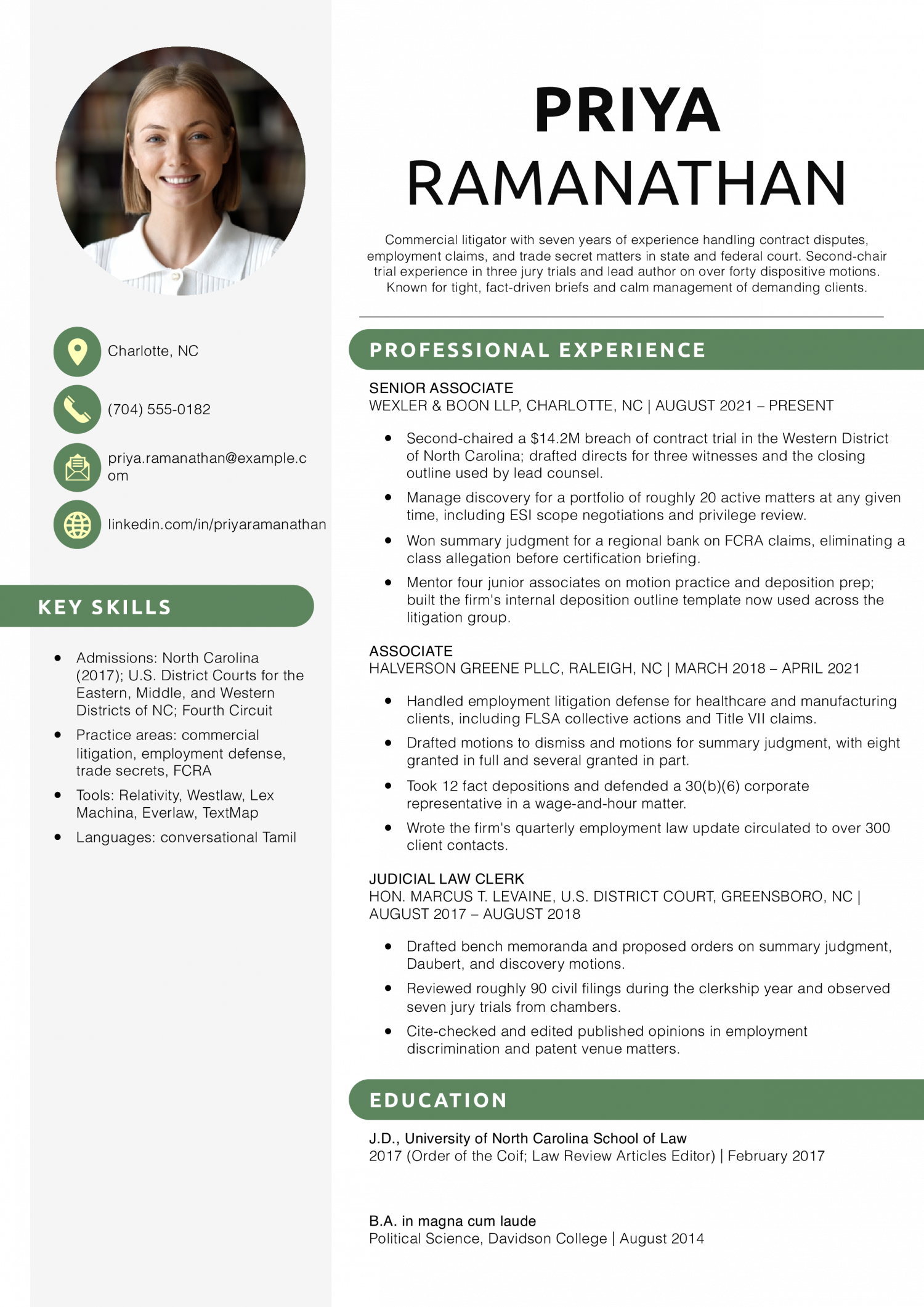
The junior associate profile covers law school graduates through year three at a firm or in-house role. This resume needs to prove drafting range, supervised matter ownership, and bar status, with judicial clerkships or law journal credit surfaced early.
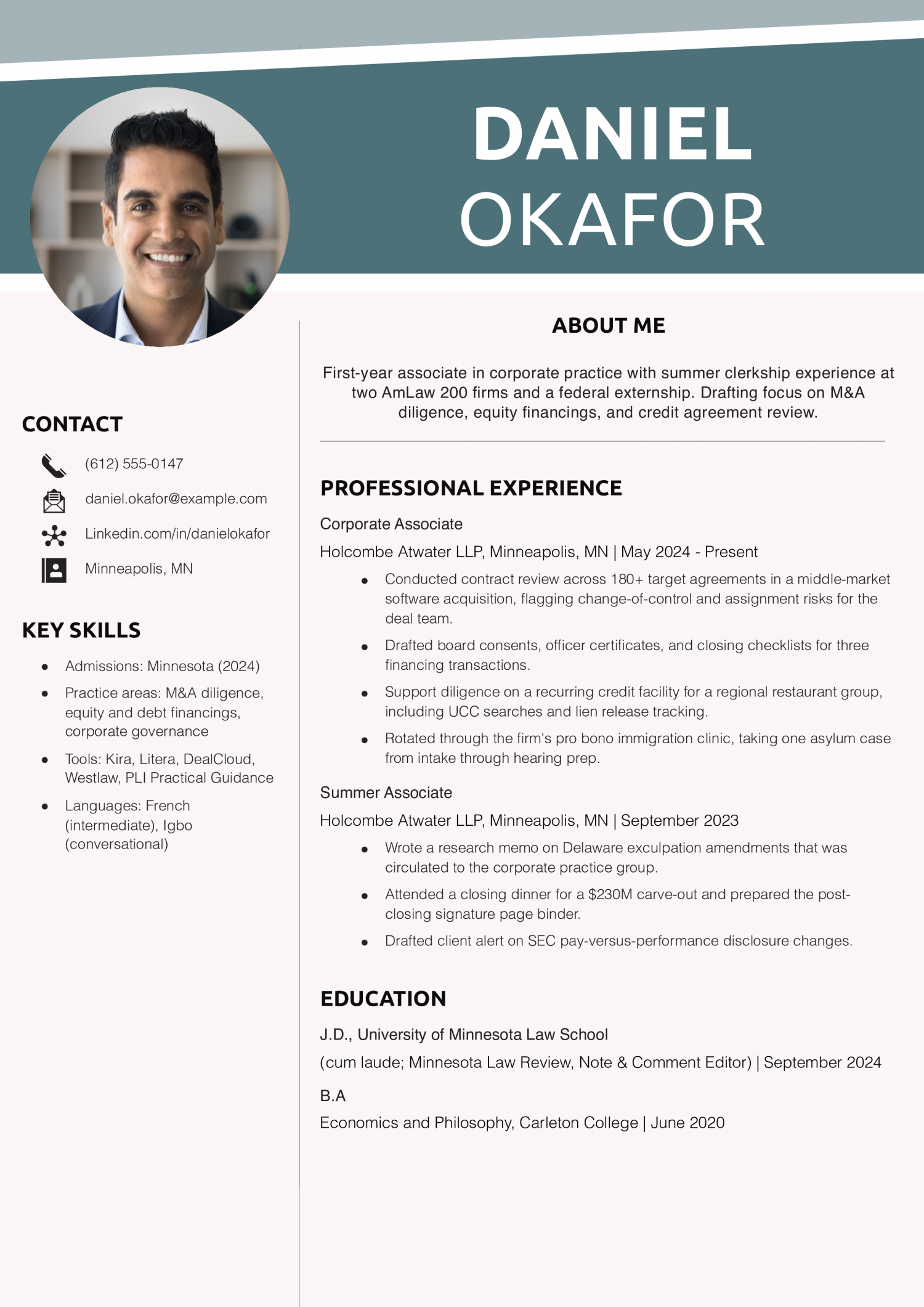
The senior associate profile covers years four through seven, when origination potential and matter leadership start to matter. The resume needs to prove deal or trial ownership, supervisory work over juniors, and a defined practice area with representative client matters.
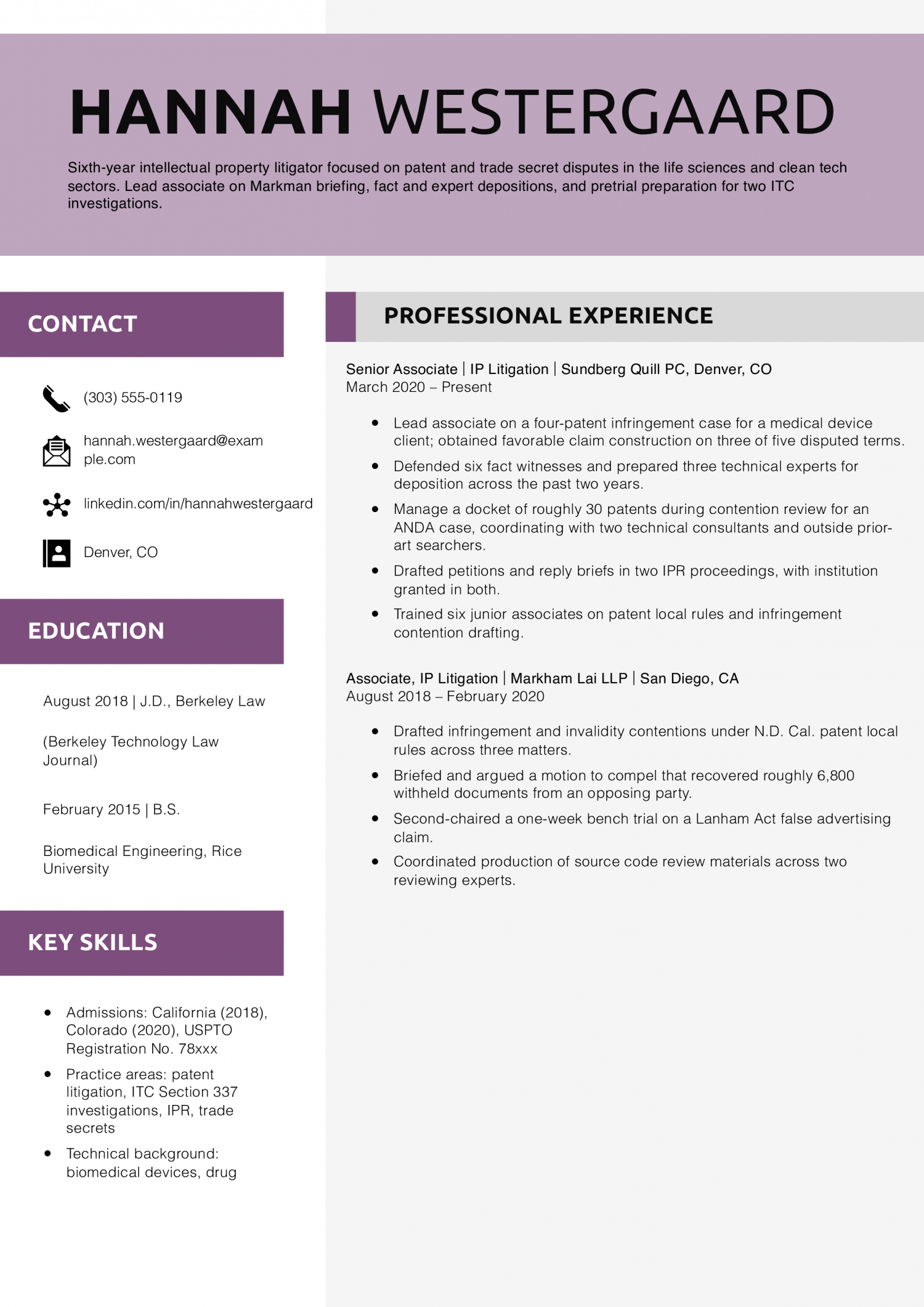
The counsel profile covers attorneys with deep subject matter expertise who lead matters without a partnership track. The resume needs to prove specialized authority, repeat client relationships, and the kind of bet-the-company work that justifies the title outside the equity ladder.
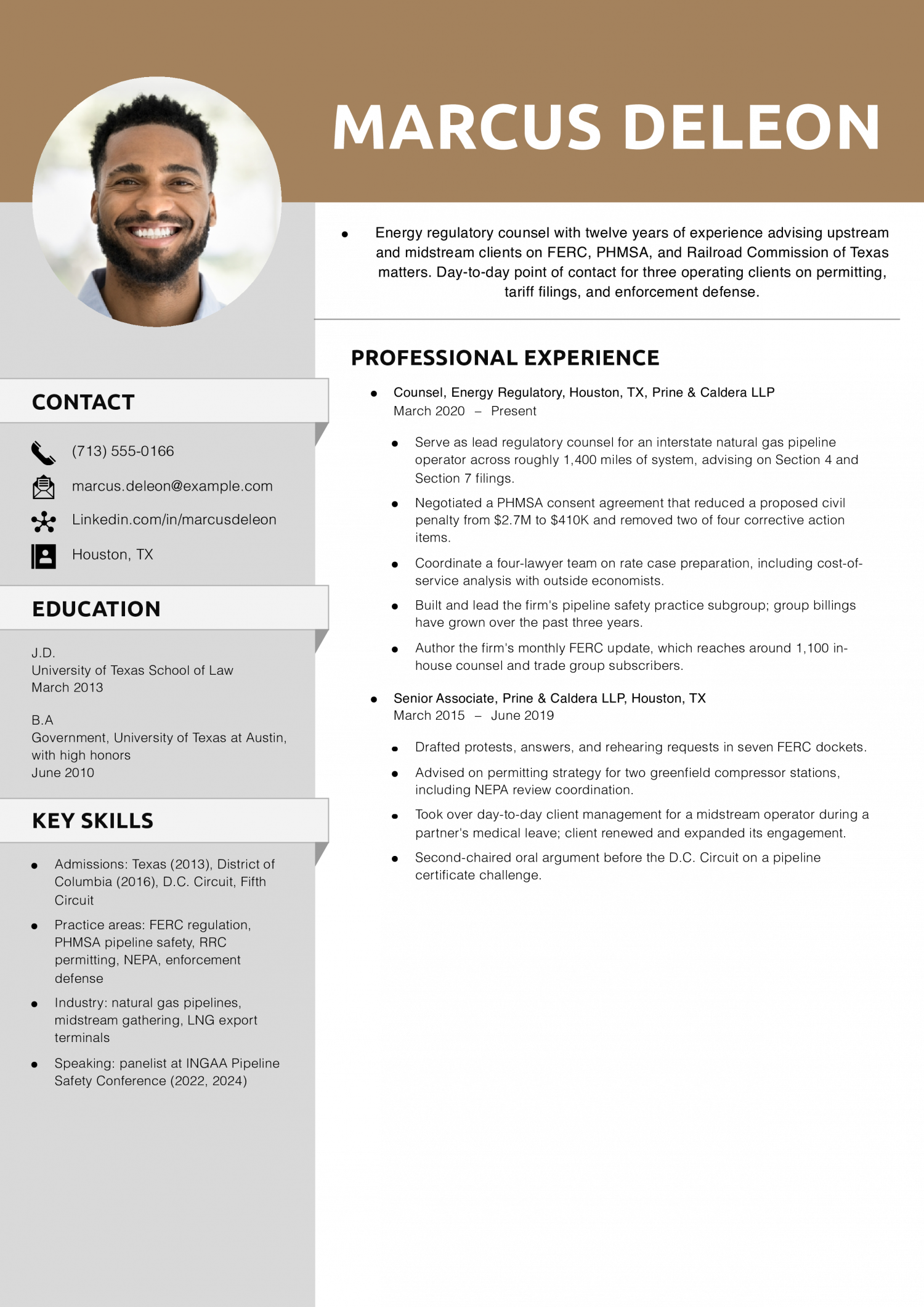
The partner profile covers attorneys with a book of business, origination credit, and firm management responsibility. The resume needs to prove portable revenue, client roster depth, and leadership roles on practice group or firm committees.

Jordan Mikhail Petersen
Seattle, WA | (206) 555-0138 | [email protected] | linkedin.com/in/jordanpetersen
Commercial litigation and white collar attorney with nine years of experience defending technology and financial services clients in federal regulatory investigations, civil litigation, and internal investigations. Lead author on dispositive briefing in 20+ matters and second-chair experience in two federal jury trials. Comfortable as the day-to-day client contact on multi-year matters involving the SEC, DOJ, and state attorneys general.
Senior Associate, Litigation & Investigations
Kessler Hwang & Romero LLP | Seattle, WA | 2021-Present
Associate, White Collar Defense
Aldridge Renton PLLC | Washington, DC | 2018-2021
Associate, General Litigation
Aldridge Renton PLLC | Washington, DC | 2016-2018
Judicial Law Clerk
Hon. Adelaide Quinn, U.S. District Court for the District of Oregon | Portland, OR | 2015-2016
Lead your summary with deal size, verdict value, or matter count, not years of practice. A partner reading the top three lines wants to know what you can staff on Monday.
Name your practice area, the forums you appear in, and the largest matter you owned. A senior litigator might lead with two federal trials and twelve dispositive motions filed last year. A corporate associate might lead with a $180 million asset purchase as lead drafter.
Most strong lawyer bullets carry a number. Deal value, settlement amount, hours billed against a matter budget, or motions filed all read as evidence the work was real.
Bullets without a number tend to read as duties. Replace ‘assisted with discovery’ with ‘managed document review across 1.2 million records on a $40 million breach of contract matter.’ For transactional work, name the deal size, counterparty type, and your specific role.
Cluster matters under three to five practice subheads inside each role: M&A, securities, commercial litigation, regulatory, or whatever fits your book.
Within each subhead, list two to three representative matters as bullets. Name the client type, deal or claim size, opposing counsel where notable, and what you drafted, negotiated, or argued. This is the structure Stanford and Berkeley lateral applicants use, and it scans faster than chronological duty lists.
Put a bar admissions block under your contact line or directly beneath your summary. List each jurisdiction and year admitted, then any federal court admissions.
Do not list your bar number on the resume itself, save that for the application form. Add your J.D., honors like cum laude or Order of the Coif, and law review or moot court below the experience section. CLE concentrations and specialty certifications go in a separate credentials block.
Senior lawyers carry too much history. Drop pre-law jobs, undergraduate GPA, and any matter older than ten years that you would not raise in an interview.
Cut LSAT scores, high school activities, and generic skills like ‘legal research.’ Trim summer associate positions once you are five years out. Keep clerkships forever, keep law review forever, and keep the matters that define your reputation.
The skills below come from lawyer resumes our users built on ResumeTemplates.com. Managing partners and legal recruiters scan hundreds of resumes a hiring cycle, and these are the terms that show up most often. Hard skills like Westlaw, e-discovery, and contract drafting get parsed by ATS filters first.
Soft skills like client counseling earn their place only when a bullet backs them with a matter. Match the list against the posting, then make sure every soft skill you claim has a deal or case behind it.
| Soft Skills | % of resumes with this skill |
|---|---|
| Persuasive communication | 68% |
| Attention to detail | 53% |
| Negotiation | 46% |
| Composure under pressure | 37% |
| Ethical judgment | 33% |
And here are the top hard skills showing up most often.
| Hard Skills | % of resumes with this skill |
|---|---|
| Legal research analysis | 78% |
| Legal document drafting | 67% |
| Contract drafting review | 49% |
| Litigation case management | 35% |
| Regulatory compliance | 32% |
Based on data from thousands of lawyers’ resumes built on ResumeTemplates.com, May 2026.
These are the credentials, software, and compliance signals hiring teams look for when scanning a lawyer resume.
Recruiters and ATS filters search by practice area first, then by tool and credential. Group keywords by the subspecialty you target so the parser reads them in cluster.
| Niche | Keywords ATS scans for |
|---|---|
| Corporate and transactional | M&A due diligence, asset purchase agreement, securities filings, contract negotiation |
| Litigation and trial | motion to dismiss, summary judgment briefing, deposition preparation, trial advocacy |
| Intellectual property | patent prosecution, trademark opposition, USPTO filings, IP licensing |
| Regulatory and compliance | SEC enforcement, HIPAA compliance, FCPA investigations, internal investigations |
| In-house and general counsel | commercial contracts, outside counsel management, board reporting, employment matters |
What hiring partners expect on a lawyer’s resume has shifted. A blanket ‘no AI use’ stance now reads as out of step with billable efficiency targets, while an honest workflow noting the tools you use and how you verify citations reads as current. The list below names what to add.
Westlaw Precision and Lexis+ AI now front-load case summaries, so associates are expected to validate cited holdings against the underlying opinions.
Relativity aiR and similar tools surface privileged and responsive documents faster, shifting associate work toward quality control and review protocol design.
Tools like Harvey and Spellbook generate first drafts of NDAs and service agreements, with attorney redlining and negotiation as the billable layer.
Generative tools produce outlines and case string cites that attorneys verify, with the rule against fictitious citations enforced under Rule 11.
Westlaw Precision with CoCounsel: Used for AI-assisted case research, brief drafting, and deposition preparation with built-in citation checking.
Harvey: Used in Big Law and in-house teams for contract review, M&A diligence summaries, and regulatory question answering.
Bar admissions are the first credential a hiring partner verifies. Place a dedicated Bar Admissions block directly beneath your contact line or summary, before education and experience.
List each jurisdiction by state, followed by the year admitted. Add federal court admissions on separate lines, naming the specific district or circuit.
If you are admitted in good standing, the phrase ‘in good standing’ is optional. Most recruiters assume current standing unless you flag otherwise. Do not list your bar registration number on the resume, that detail belongs on the application form or background check.
Beyond bar admission, the credentials below tell hiring partners which substantive areas you can staff and which compliance tracks you can lead. List the issuing body and the year earned for each, and keep CLE concentrations grouped under a single line rather than itemized.
Board Certification in a Specialty (state bar): Available in fields like civil trial, family law, or estate planning through state bar boards. Signals depth in a defined practice area.
Certified Information Privacy Professional (IAPP CIPP/US or CIPP/E): Privacy and data protection counsel use this to signal substantive GDPR or U.S. privacy law fluency on regulatory matters.
LL.M. in Taxation, IP, or Securities: List under education with the conferring school and year. Reads as commitment to a specialty track for tax, patent, or securities work.
Certified Fraud Examiner (CFE): White collar, internal investigations, and compliance attorneys use the CFE to signal forensic accounting and investigation training.
The 90th-percentile lawyer out-earns the median by a wide margin, which tells you the legal market rewards practice area, client roster, and origination credit more than years at the bar. Big Law associates, in-house GCs at public companies, and equity partners cluster at the top band, while solo and small-firm general practice anchors the middle.
Lead the resume with the practice area, client tier, and matter size the high band charges for, not your years admitted.
| # | State | Avg. Annual |
|---|---|---|
| 1 | California | $197,790 |
| 2 | District of Columbia | $179,050 |
| 3 | Massachusetts | $177,210 |
| 4 | New York | $96,580 |
| 5 | Delaware | $172,710 |
| 6 | Colorado | $167,970 |
| 7 | Connecticut | $159,240 |
| 8 | New Jersey | $158,470 |
| 9 | Virginia | $157,980 |
| 10 | Illinois | $157,320 |
| # | State | Workers | Median |
|---|---|---|---|
| 1 | California | 92,580 | $197,790 |
| 2 | New York | 91,440 | $177,210 |
| 3 | Florida | 59,010 | $127,810 |
| 4 | Texas | 54,680 | $133,570 |
| 5 | District of Columbia | 33,430 | $191,880 |
Resume Templates offers HR approved resume templates to help you create a professional resume in minutes. Choose from several template options and even pre-populate a resume from your profile.
Yes, once you have a real matter list. Partners, counsel, and senior associates with representative matter sections regularly run two to three pages, and legal recruiters expect it.
Keep page one tight: contact, bar admissions, summary, and current role. Page two and three carry prior firms, representative matters, publications, and bar activities. New graduates and junior associates should still hold to one page.
List your GPA only if you graduated within the last three years and it is above 3.5. List class rank only when applying to judicial clerkships, which expect it.
Never list your LSAT score on a lawyer resume. Honors like cum laude, Order of the Coif, and law journal positions carry the academic signal once you are past the third year of practice.
Write the jurisdiction followed by 'Bar exam taken July 2026, results pending' or 'Admission anticipated November 2026.' Move the line into the regular bar admissions block once you are sworn in.
If you are admitted in one state and sitting for another, list the active admission first, then the pending exam. Do not include your bar number on the resume itself.
Group contract attorney engagements under one header like 'Contract Attorney Engagements' with the staffing agency or firm names beneath. Bullet the substantive work, not the hourly nature of the role.
Name the matter type, document volume reviewed, and review platform used, such as Relativity or Everlaw. Strong bullets read like 'Second-level reviewed 80,000 documents on a multidistrict antitrust matter using Relativity tags and privilege logs.'
For a lawyer, a professional template is the safest pick, because it signals the polish hiring managers in this field expect. An ATS-friendly template is a solid alternative. Whichever you choose, keep the formatting clean and easy to parse: clear section headings, a standard font, and no graphics a parser can choke on.
Executive Resume Writer and Career Coach
Andrew Stoner is an executive career coach and resume writer with 17 years of experience as a hiring manager and operations leader at two Fortune 500 Financial Services companies, and as the career services director at two major university business schools.