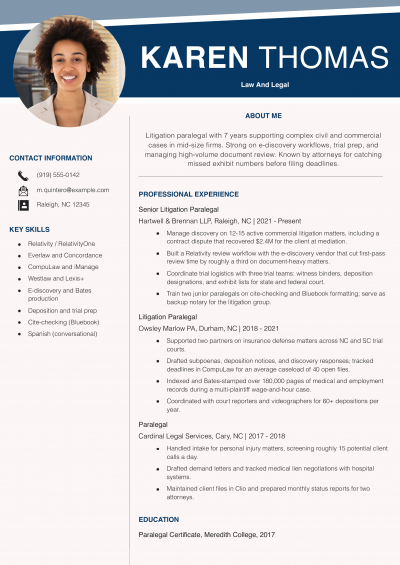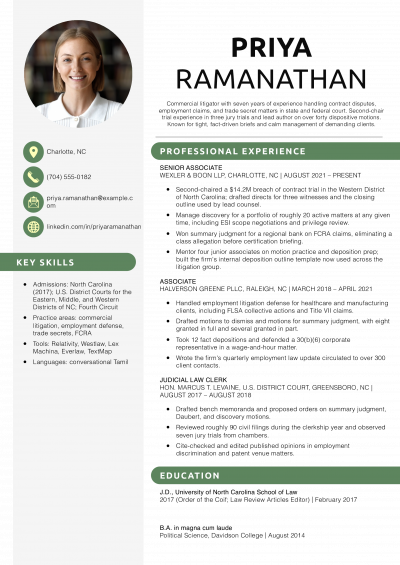
Lawyer Resume Examples and Templates for 2026



Bar admissions and a clean credentials block are what get attorney resumes past the recruiter screen; specific matter outcomes and named clients are what make them readable enough to advance to a partner interview.
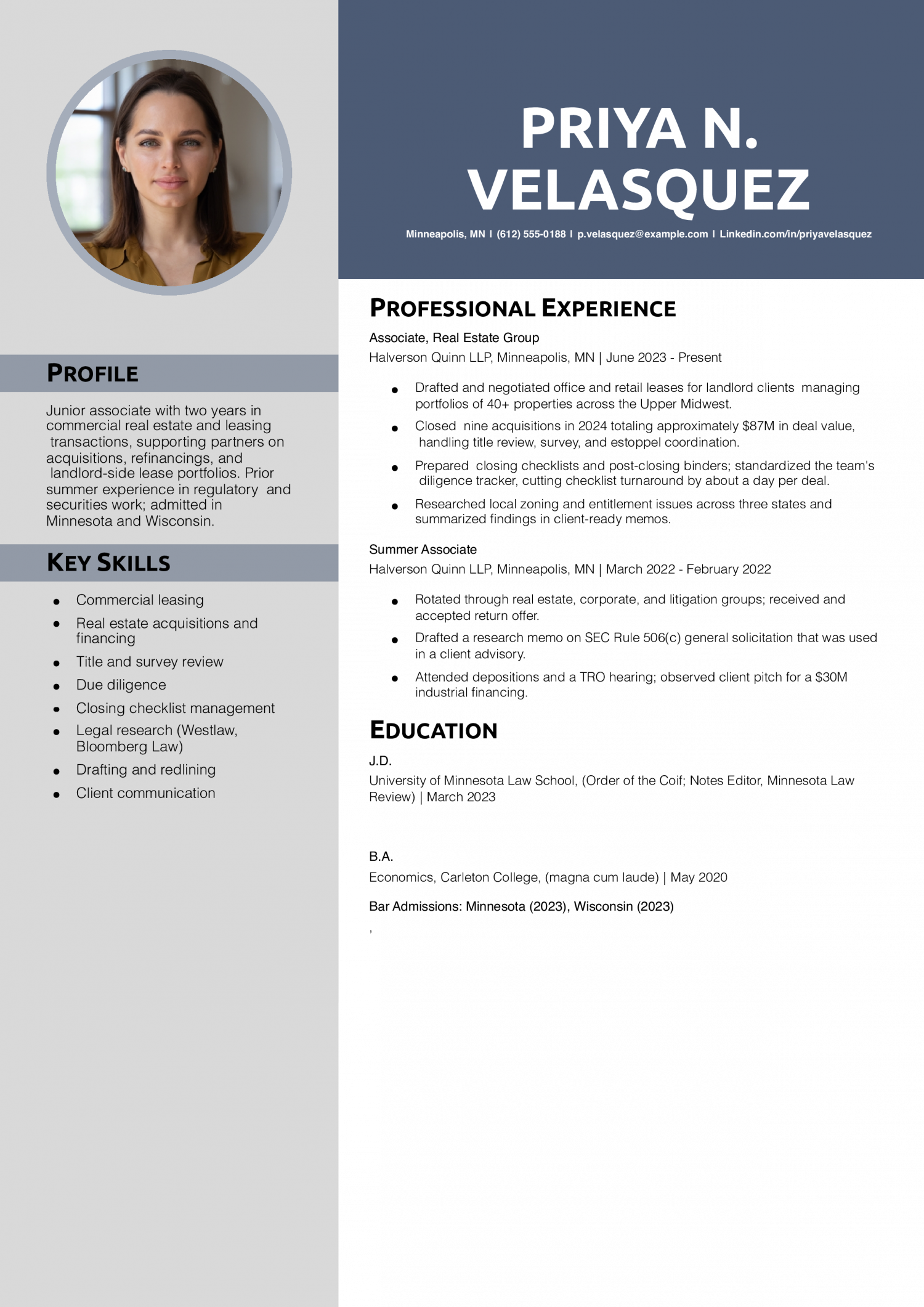
Junior associates are zero to three years post-bar, still building reps on discovery, research memos, and supervised matter work. The resume needs to prove law school rigor, bar status, and the substantive tasks you have already owned under partner supervision.
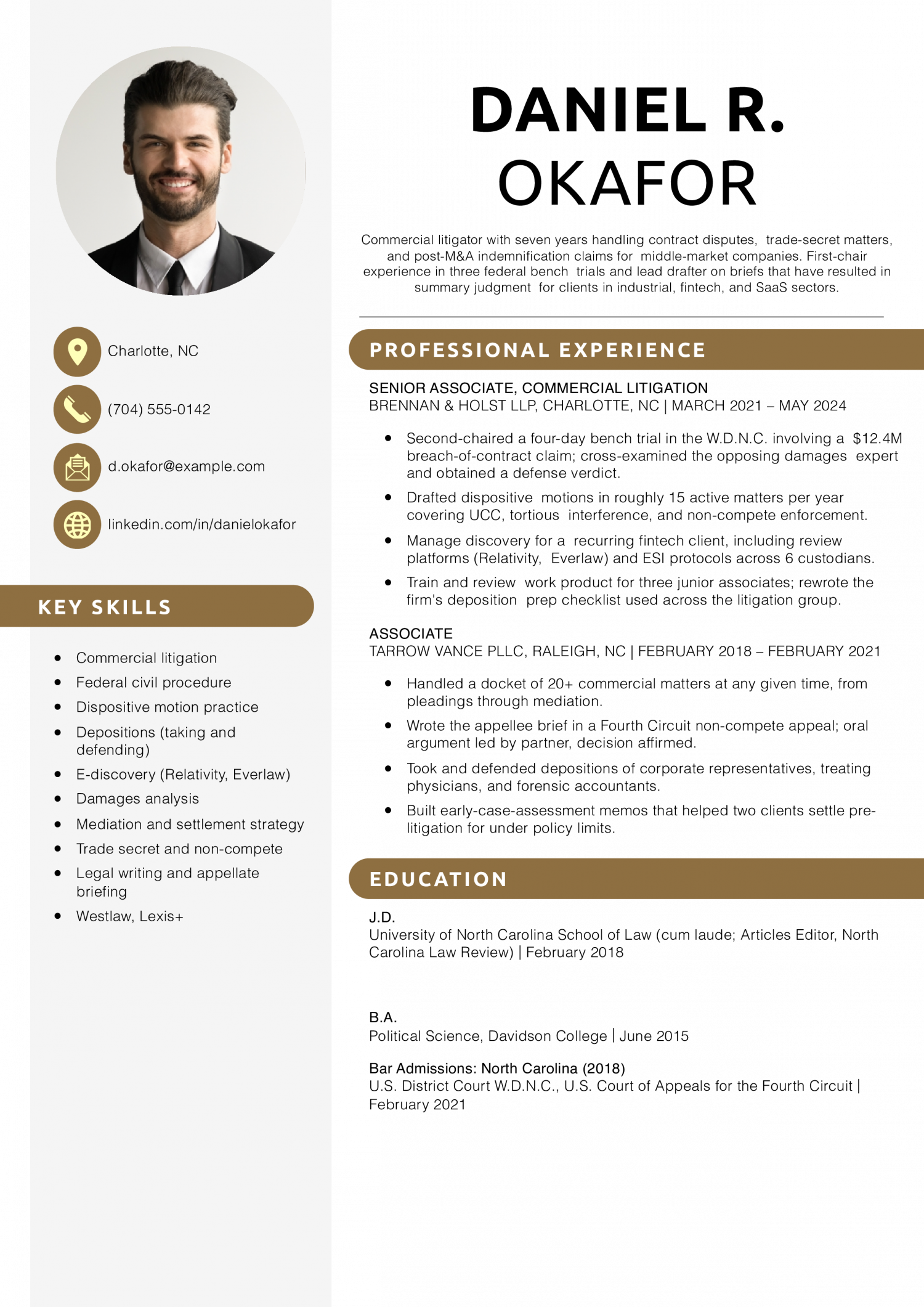
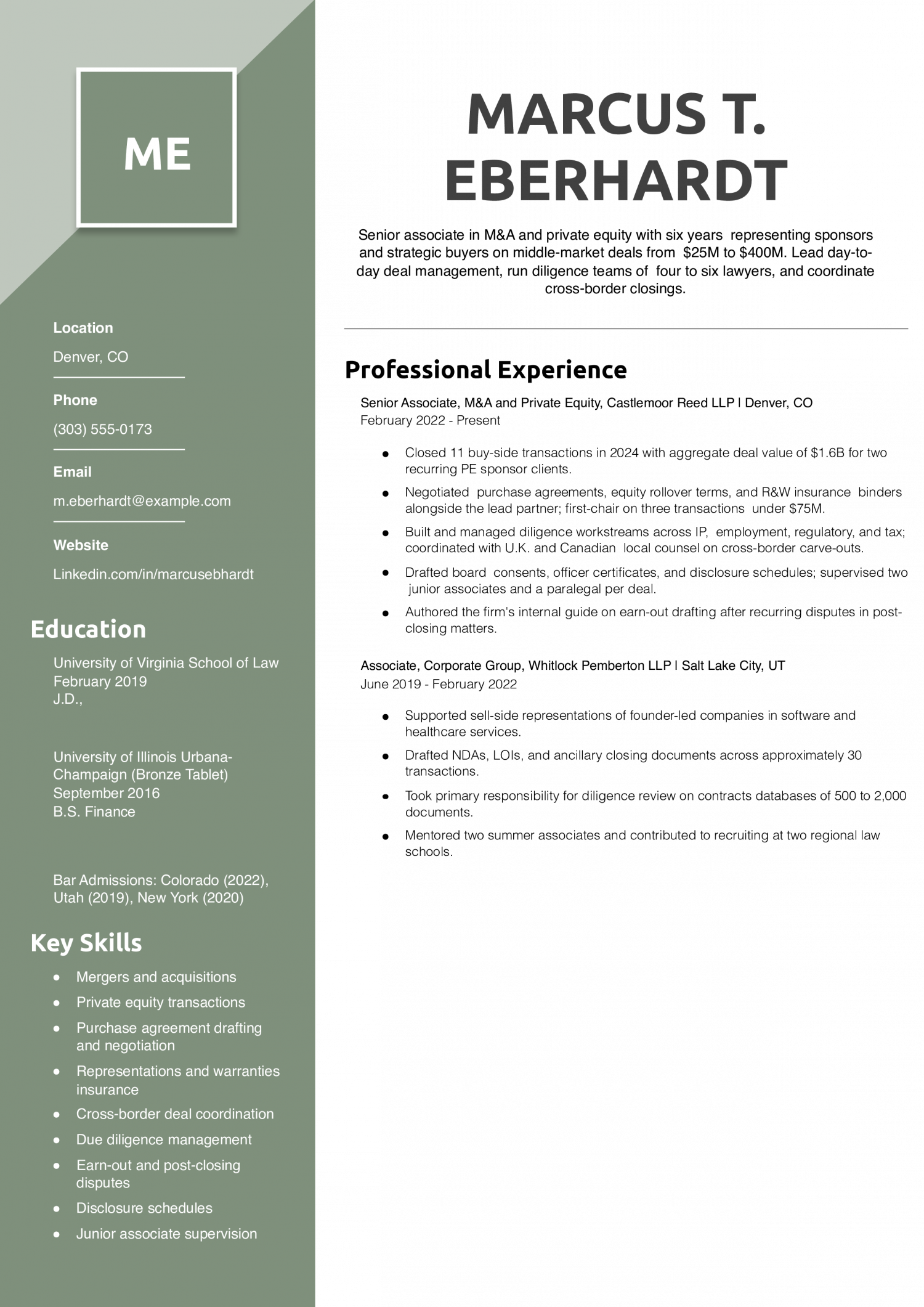
Senior associates are four to seven years in, running discrete matters or deal workstreams with limited partner oversight. The resume needs to prove matter ownership, billable hour productivity, and the case types or transactions where you draft and argue first.
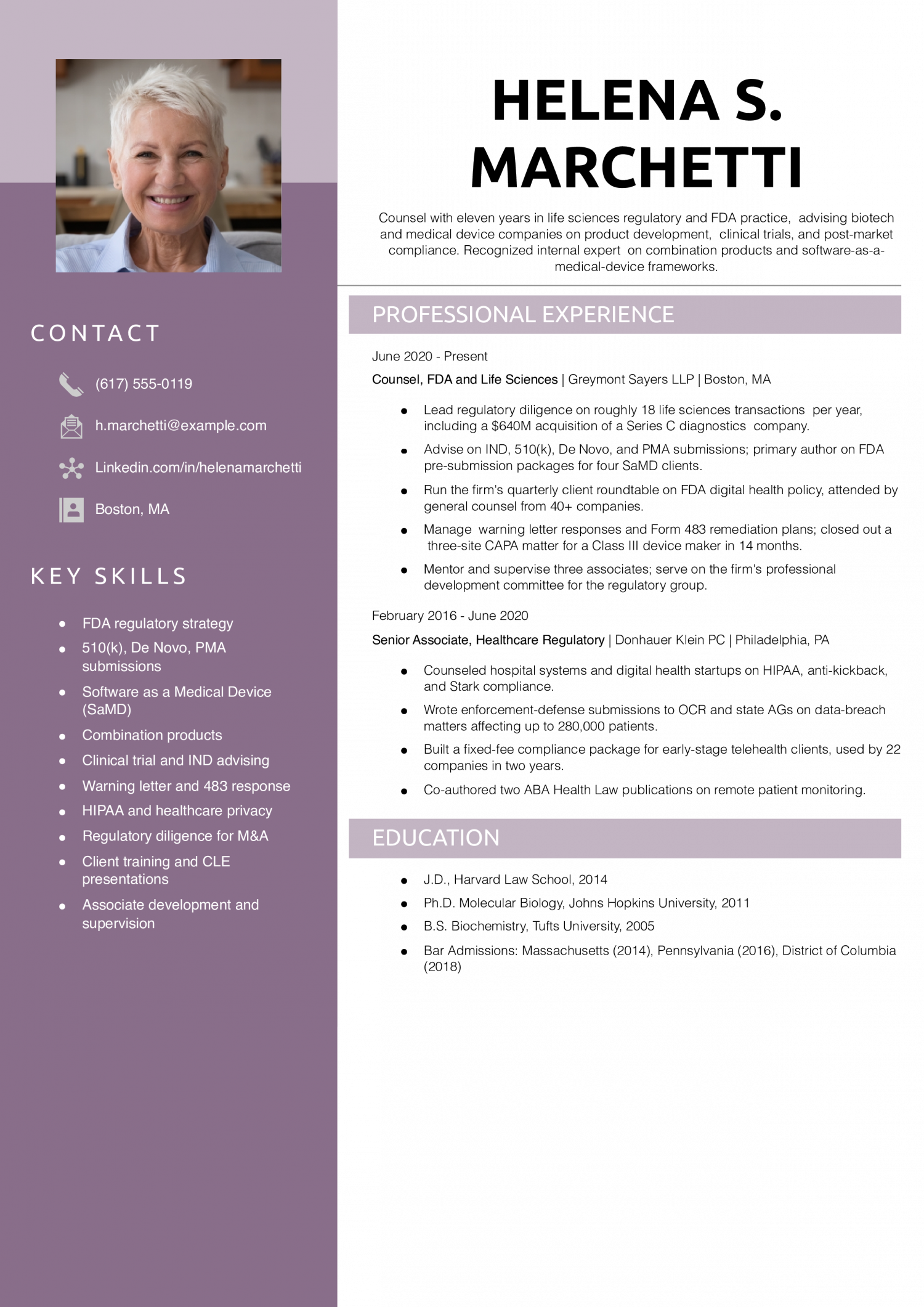
Counsel sit outside the partner track but carry deep subject-matter authority in a specific practice. The resume needs to prove specialty depth, the matters where you are the named expert, and the client relationships that follow you across firms.
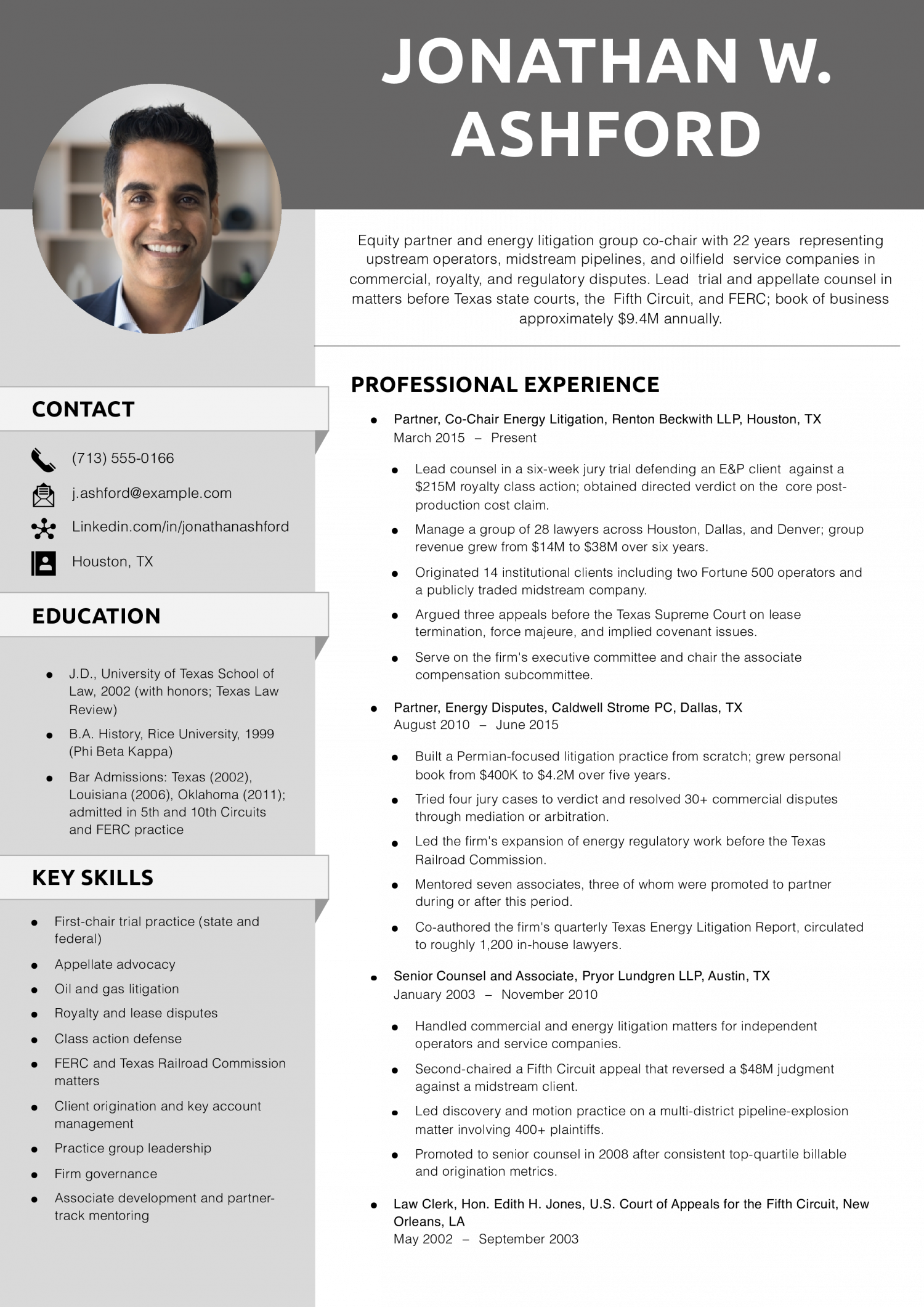
Partners carry origination, client relationships, and team leadership on top of the legal work itself. The resume needs to prove a portable book of business, matter origination numbers, and the associates and practice groups you have built.
Attorney with nine years of experience spanning technology transactions, data privacy, and commercial litigation, currently practicing as a senior associate at a Pacific Northwest firm with a tech-heavy client base. Lead drafter on SaaS and data licensing agreements, GDPR and state-privacy compliance programs, and contract-related disputes for software and consumer hardware clients. Bar admitted in Washington, Oregon, and California.
Add a single line a recruiter cannot find by searching your name on the state bar website. That might be a first-chair trial, a reported decision, a closed M&A deal over a named threshold, or a regulatory investigation you ran point on.
Bar admissions and law school confirm you are qualified to practice. They do not tell a managing partner which matters you have actually carried. Lead the summary with the work product or matter type that separates you from every other attorney admitted in your state, and name the practice area in the same sentence.
Bullets without numbers read as job descriptions. Strong attorney bullets name the matter scale: deal size, verdict or settlement amount, motions filed and won, depositions taken, or hours billed on a specific case.
Most associates can credibly cite three or four metrics. Try deal value or settlement amount, number of matters carried concurrently, billable hour totals, and a result percentage like motions granted or cases resolved pretrial. Partners should add origination dollars and the size of teams supervised.
Split your experience bullets into the three or four practice clusters that actually describe your work. Common groupings include commercial litigation, M&A and corporate transactions, regulatory and compliance, employment, IP prosecution, and white-collar defense.
Within each cluster, lead with deliverables a partner can picture: drafted summary judgment briefs, negotiated purchase agreements, took 30(b)(6) depositions, argued motions to dismiss, ran second-request HSR reviews. This structure lets a hiring partner scan for the case types they need staffed without reading every line.
Put a credentials block in the top third of page one with each state and federal court admission, the year admitted, and standing. Use the format: “State Bar of New York, admitted 2019, in good standing.” Do not list your bar number on the resume itself; provide it on application forms when asked.
Add specialty court admissions where they matter: Federal Circuit, Tax Court, the Patent Bar, or specific district courts. Law school and JD belong in education at the bottom, with honors, journal, and moot court awards if you are within seven years of graduation.
The attorney resumes that get callbacks share a specific skill mix. The lists below come from our user-built attorney resumes. Managing partners and legal recruiters scan for these patterns first, not generic phrases like “zealous advocate” or “strong analytical skills.”
Hard skills carry more weight than soft skills on legal resumes because they map to staffing needs: a partner wants someone who can take a deposition or draft a credit agreement next week.
Soft skills only land when a matter bullet proves them. Match the hard skills list against the practice areas in the target posting, and use the soft skills as evidence categories your bullets must back up.
| Soft Skills | % of resumes with this skill |
|---|---|
| Written and verbal communication | 79% |
| Critical thinking | 68% |
| Negotiation | 40% |
| Attention to detail | 38% |
| Client relationship management | 33% |
And here are the top hard skills showing up most often.
| Hard Skills | % of resumes with this skill |
|---|---|
| Legal research | 65% |
| Legal writing | 52% |
| Litigation and trial preparation | 47% |
| Contract drafting and review | 40% |
| Regulatory compliance | 33% |
Based on data from thousands of attorneys’ resumes built on ResumeTemplates.com, May 2026.
The items below are what separates an attorney resume that advances from one that gets put back in the pile.
Managing partners and legal recruiters expect to see practice-area vocabulary the posting uses, not a generic “legal skills” list. Group your keywords by the sub-niche you actually practice in.
| Niche | Keywords ATS scans for |
|---|---|
| Litigation | civil litigation, motion practice, deposition experience, trial preparation, summary judgment |
| Corporate and M&A | due diligence, purchase agreements, securities filings, transactional drafting, deal closings |
| Regulatory and compliance | SEC enforcement, HSR review, FCPA compliance, internal investigations, regulatory counseling |
| Intellectual property | patent prosecution, trademark opposition, IP licensing, claim construction, USPTO filings |
| Employment and labor | EEOC charges, wage and hour, Title VII defense, employment agreements, workplace investigations |
AI use on an attorney resume can go three ways: lead with “AI-powered legal innovator” (which recruiters screen out), leave it off entirely (which reads as evasive given Mata v. Avianca and current ABA guidance), or describe the workflow as it actually runs. The third is what managing partners can validate.
Westlaw Precision AI and Lexis+ AI now handle first-pass case summaries, so the value-add is judgment on what the tool missed or misframed.
Relativity aiR and Everlaw's AI assistant cut first-level review hours, shifting associate work toward issue coding and privilege calls.
Harvey and Microsoft Copilot draft routine NDAs, engagement letters, and discovery responses, with attorney editing and citation verification on every output.
Hallucinated citations have triggered sanctions in multiple jurisdictions, so verification workflows are now a billable skill worth naming.
Harvey: Used for first-draft contracts, deposition prep summaries, and due diligence document analysis on transactional matters.
Westlaw Precision AI / Lexis+ AI: Used for initial case law research with attorney verification of every citation before any cite reaches a brief.
Bar admissions are the first credential a legal recruiter checks, and the format matters. Put them in a dedicated block near the top of page one so the parser catches each state and court as a separate field.
List each admission on its own line with the state or court, the year admitted, and current status. Use “State Bar of California, admitted 2018, in good standing” rather than “CA Bar (2018).” Spell out federal court admissions including district courts, circuit courts, the Federal Circuit, the Tax Court, and the Patent Bar where applicable.
If you are admitted in one state but applying in another, note pending admission, UBE score portability, or reciprocity status. Many firms will sponsor admission, so naming an in-progress application keeps you in the pile rather than out of it.
Managing partners and legal recruiters read this list as a map of where your practice is heading. The certifications below tell them which specialty track you have invested in beyond bar admission. List the issuing body, the credential name, and the year earned on one line each.
Board Certification in a Specialty (state bar or ABA-accredited): State board certifications in civil trial, family, tax, or appellate law signal a recognized expertise tier beyond general practice.
Certified Information Privacy Professional (CIPP/US, CIPP/E): The IAPP credential is now a near-default for privacy and data protection counsel, especially for in-house and tech-sector roles.
LL.M. in a Specialty Area: An LL.M. in tax, IP, securities, or international law adds depth that partners staffing those matters look for on the credentials block.
Patent Bar Registration (USPTO): Required for patent prosecution work and a strong signal for IP litigation roles where technical claim construction is in play.
For attorneys, the gap between the 10th-percentile floor and the top-decile ceiling is one of the widest in knowledge work. That spread tells you firm tier, practice area, and metro market move a candidate from floor to ceiling more than years of experience do. Big Law M&A in New York pays a different number than rural solo practice, and the resume has to signal which lane you are in.
Lead the resume with the firm names, practice areas, and matter scale that map to the band you are targeting.
| # | State | Avg. Annual |
|---|---|---|
| 1 | California | $197,790 |
| 2 | District of Columbia | $191,880 |
| 3 | Massachusetts | $179,050 |
| 4 | New York | $177,210 |
| 5 | Delaware | $172,710 |
| 6 | Colorado | $167,970 |
| 7 | Connecticut | $159,240 |
| 8 | New Jersey | $158,470 |
| 9 | Virginia | $157,980 |
| 10 | Illinois | $157,320 |
| # | State | Workers | Median |
|---|---|---|---|
| 1 | California | 92,580 | $197,790 |
| 2 | New York | 91,440 | $177,210 |
| 3 | Florida | 59,010 | $127,810 |
| 4 | Texas | 54,680 | $133,570 |
| 5 | District of Columbia | 33,430 | $191,880 |
Resume Templates offers HR approved resume templates to help you create a professional resume in minutes. Choose from several template options and even pre-populate a resume from your profile.
No. List the state, the year admitted, and "in good standing." The bar number is personally identifying information that belongs on application forms, not on a document you email around or post on LinkedIn. Recruiters and partners can verify admission through the state bar's public directory using your name alone.
Group contract roles under one heading like "Contract Attorney Engagements" with the agency or firm and the date range.
Within that block, list two or three representative matters by case type, scope, and your specific deliverable. Bullets such as "reviewed 40,000 documents in Relativity for second-request HSR production" carry more weight than a generic "document review" line.
Keep your law school GPA on the resume for the first seven years of practice if it was top-third at your school or a T14 finish.
After that, drop it and let your matter results carry the resume. Honors, law review, moot court, and clerkships stay on longer because they signal selection and writing pedigree that partners still value at the senior associate level.
Describe the matter by case type, court, and your role without naming the client unless the matter is public record.
For reported decisions, named parties, or matters with press coverage, citing the case caption is fine. Otherwise use framing like "represented a Fortune 500 medical device manufacturer in product liability MDL in the Southern District of New York."
For an attorney, a professional template is the safest pick, because it signals the polish hiring managers in this field expect. An ATS-friendly template is a solid alternative. Whichever you choose, keep the formatting clean and easy to parse: clear section headings, a standard font, and no graphics a parser can choke on.
Executive Resume Writer and Career Coach
Andrew Stoner is an executive career coach and resume writer with 17 years of experience as a hiring manager and operations leader at two Fortune 500 Financial Services companies, and as the career services director at two major university business schools.
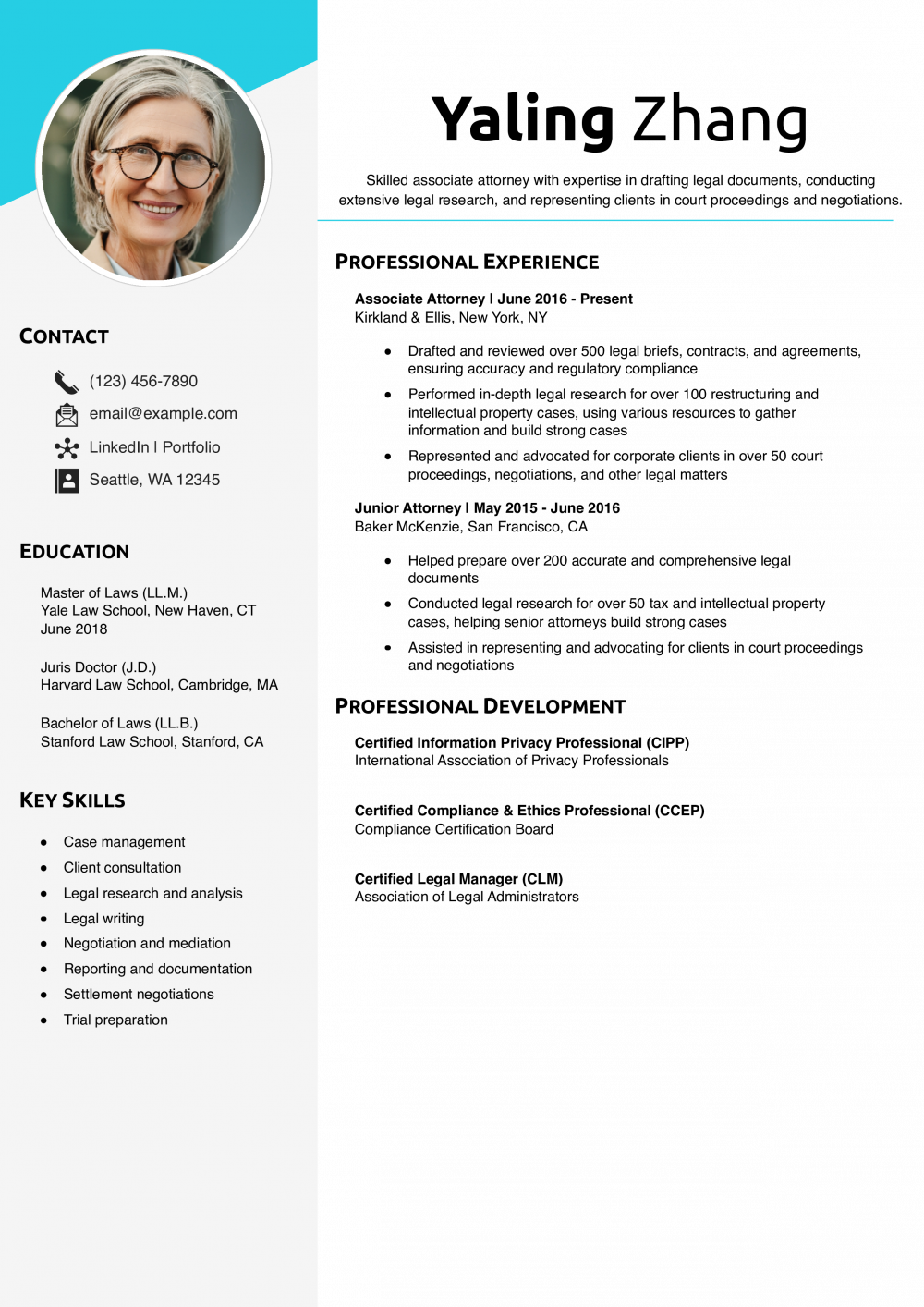
Customize this template in our builder in under 10 minutes.