Tip !

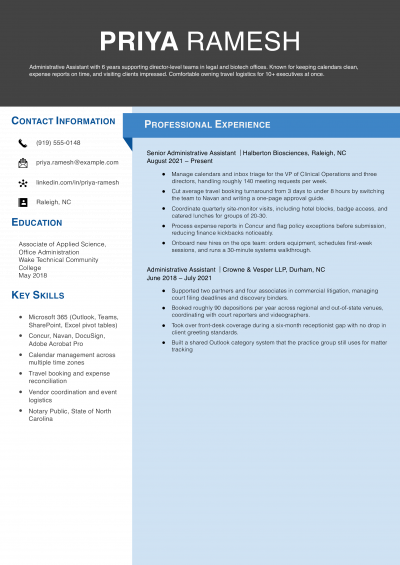
Supervising attorneys decide whether to keep reading by the first three bullets of your most recent role; if a practice area, a case management system, and a court filing aren't visible by then, the resume gets cut.

Andrew Stoner , Executive Resume Writer and Career Coach

Why this resume works

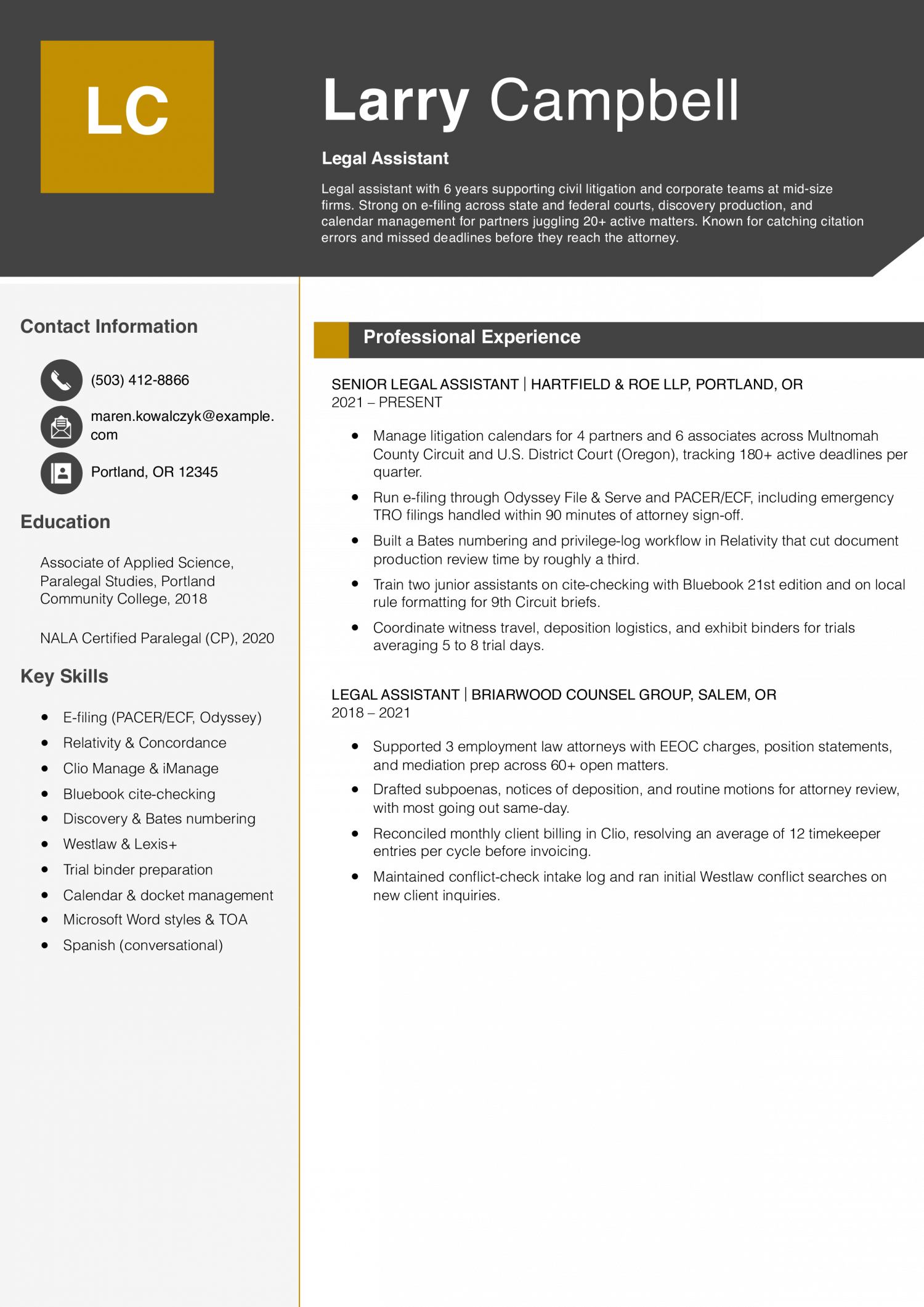
  • Real court systems named: Naming Multnomah County Circuit, PACER/ECF, and 9th Circuit shows the candidate has filed in those specific systems, not just heard of them.
  • Numbers tied to attorney workload: Tracking 180+ deadlines for 10 attorneys gives a hiring partner a concrete sense of capacity.
  • Saved the team review time: The Relativity workflow bullet shows the candidate improved a process, not just kept it running.

Entry Level Example

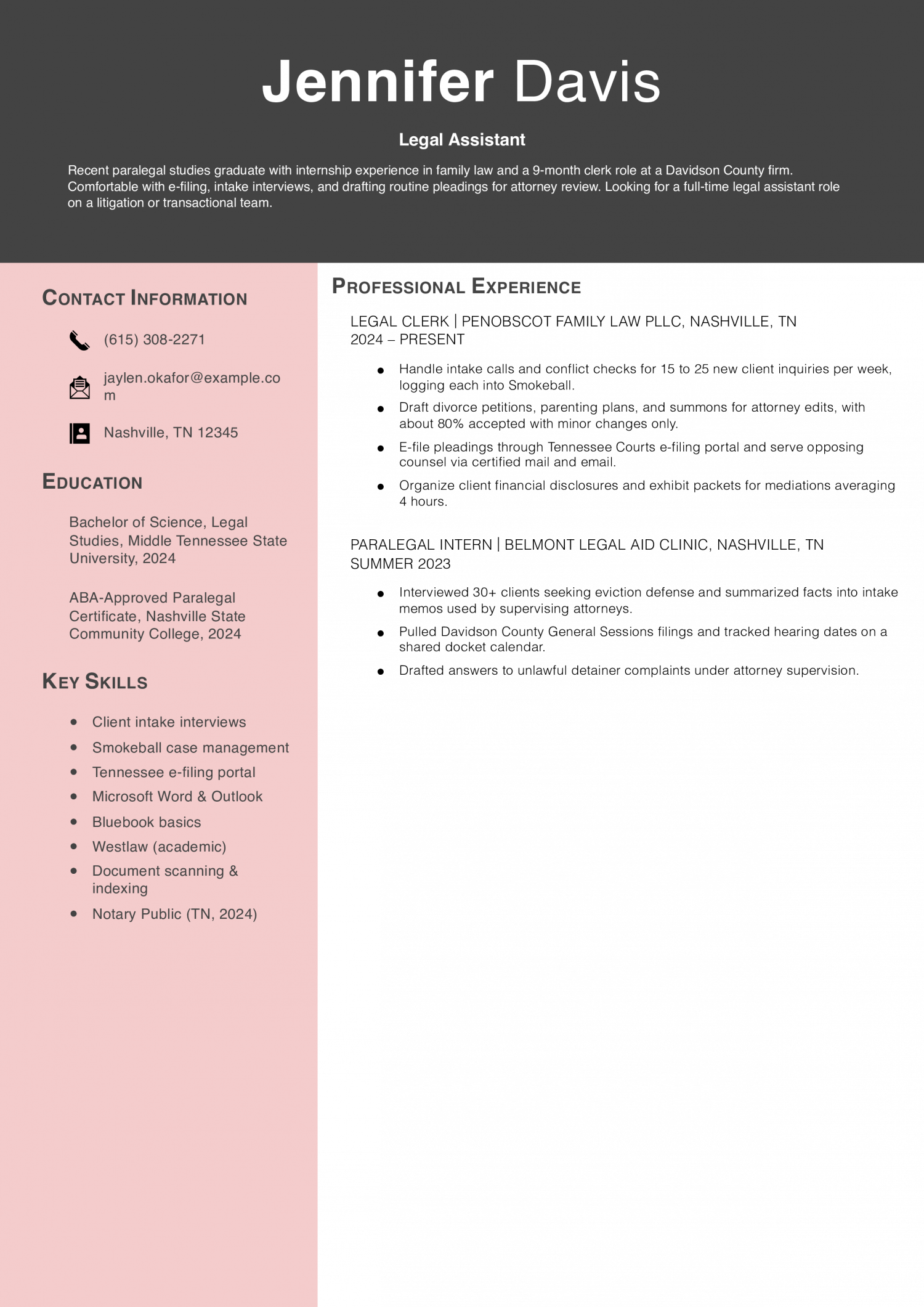
You are pivoting into legal work from an administrative role, a paralegal program, or a court internship. Your entry-level resume needs to prove you can handle court filings, calendaring, and client intake without supervision from day one.

Why this resume works

  • Two real legal roles, not just school: An internship plus a clerk job tells a hiring manager this candidate has actually been inside a law office.
  • Honest accuracy number: Saying about 80% of drafts are accepted with minor changes is specific without overclaiming for an entry-level role.
  • Notary listed: Notary Public is a small credential that gets noticed because it saves the firm a step.

Experienced Example

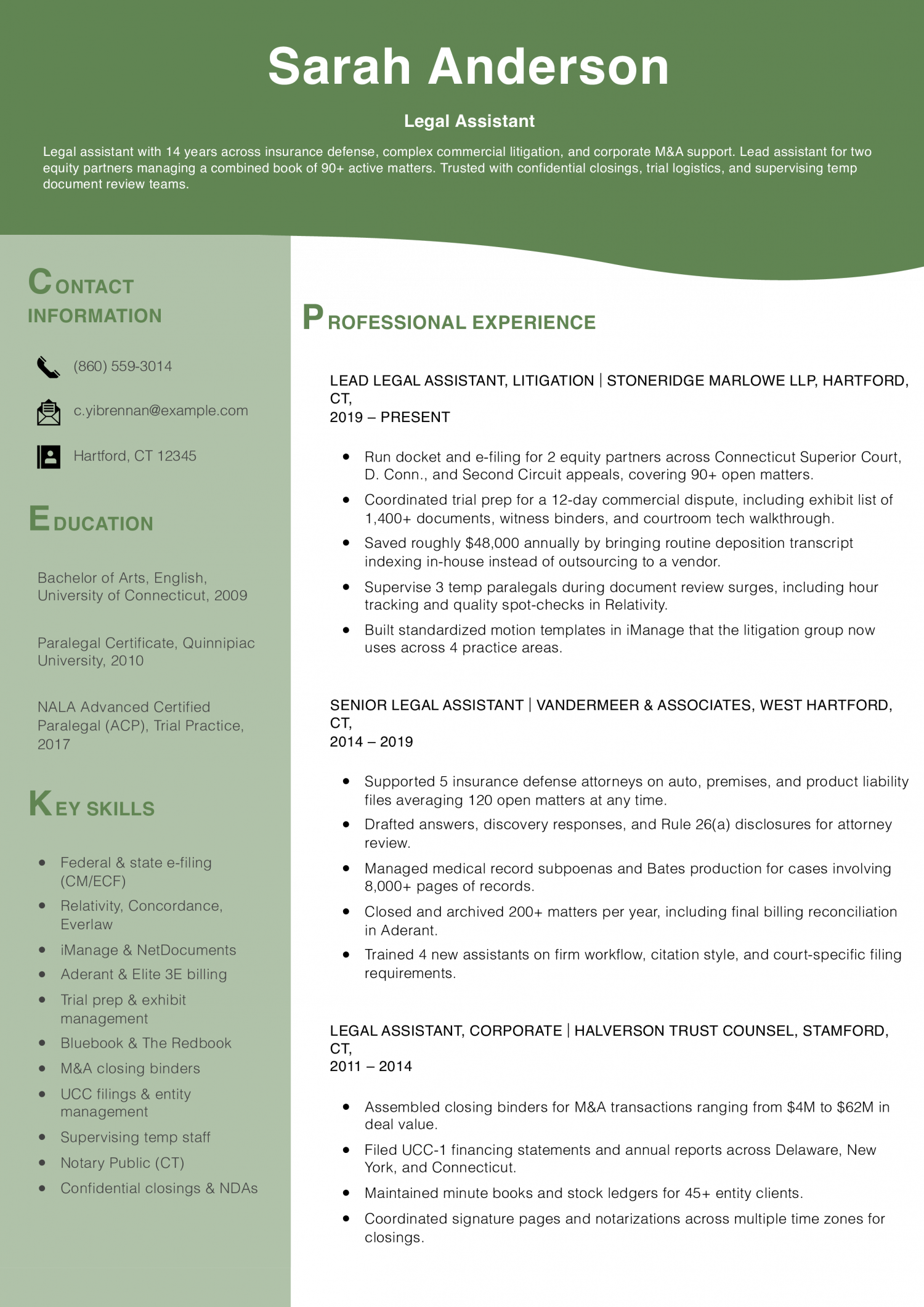
You have three or more years supporting attorneys through full case lifecycles in a defined practice area. Your experienced resume needs to prove independent docket management, drafting fluency, and the trial or closing prep you own without an attorney rewriting it.

Why this resume works

  • Saved the firm real money: Bringing transcript indexing in-house for $48,000 a year is the kind of operational win that gets noticed at the partner level.
  • Big trial concretely described: A 12-day trial with a 1,400-document exhibit list signals this candidate has actually been in the war room, not just near it.
  • Career arc makes sense: Moves from reception coverage to lead assistant supporting equity partners, which is exactly the arc a hiring partner wants to see.

01 Open with a profile that names your practice scope

Your profile should state your years supporting attorneys, the practice areas you’ve worked (litigation, corporate, family, immigration, IP), and the firm setting (solo, mid-size, AmLaw, in-house, government).

Name the case management platform you use daily and the courts you file in. A line like “Six years supporting two litigation partners in commercial disputes, managing Clio dockets and e-filing across New York state and federal courts” tells office managers and attorneys the scope before they reach your bullets.

02 Quantify caseload, filings, and turnaround

Most strong legal assistant resumes carry numbers in two thirds of their bullets. Recruiters scan for active caseload size, filing volume, and how many attorneys you support before they read the verbs.

Name three metrics that travel: open matters under management (say, 40 to 60 active files), monthly filing volume across PACER and state e-filing portals, and billable hours captured per week. Bullets without a number tend to read as duties, not results, and slide to the bottom of the stack.

03 Group deliverables into four categories

Cluster your bullets so supervising attorneys can read scope at a glance. Four categories work for most practice areas: case management, drafting and filings, client and witness contact, and billing or trust accounting.

Under drafting, name the documents (pleadings, discovery responses, subpoenas, deposition summaries, closing binders). Under case management, name the systems (Clio, MyCase, NetDocuments, iManage) and the courts. This signals practice fluency without forcing the reader to infer it from generic verbs.

04 Place credentials and tools on page one

Put a credentials block under your profile listing your paralegal certificate or degree, notary commission state, and any specialty certifications (NALA CP, NFPA CRP, state-specific paralegal credentials). List the state, not the commission number.

Below that, a short tech line: case management platforms, e-filing systems, e-discovery tools (Relativity, Everlaw), and document automation (HotDocs, Litera). Office managers and attorneys need these visible before the experience section so a CM/ECF-fluent candidate doesn’t get cut for buried keywords.

End with your paralegal certificate, associate, or bachelor’s degree, then a brief continuing education line for any recent CLE-adjacent training, vendor certifications (Clio Certified Consultant, Relativity Certified User), or state bar association courses.

If you’re early-career, add a court internship, law firm clerkship, or pro bono work above education. Skip high school, GPA below 3.5, and unrelated coursework. Attorneys want to see legal exposure and current training, not a transcript.

The legal assistant resumes that get callbacks share a specific skill mix. The lists below come from our user-built legal assistant resumes. Office managers and supervising attorneys scan for case management platforms, e-filing fluency, and drafting categories first, not generic “detail-oriented” claims.

Match the hard skills against the target job posting word for word, and use the soft skills as evidence to back specific bullets in your experience section.

Soft Skills % of resumes with this skill
Attention to detail 78%
Organization 52%
Written and verbal communication 47%
Time management 40%
Discretion and confidentiality 34%

And here are the top hard skills showing up most often.

Hard Skills % of resumes with this skill
Legal research 69%
Document drafting 58%
Case file management 45%
E-filing and court procedures 38%
Westlaw and LexisNexis 34%

Based on data from thousands of legal assistants’ resumes built on ResumeTemplates.com, May 2026.

Before a legal assistant resume gets a closer read, hiring teams check for a short list of essentials.

Niche Keywords for ATS Checkers

Office managers and supervising attorneys expect a skills or summary section that names the practice area, the case platform, and the courts. Group your keywords by sub-niche so the parser and a human reader both find what they’re scanning for.

Niche Keywords ATS scans for
Litigation support deposition summaries, discovery responses, trial binders, e-discovery
E-filing and court systems PACER, CM/ECF, state e-filing, federal court filings
Case management platforms Clio, MyCase, NetDocuments, iManage
Corporate and transactional closing binders, entity formation, due diligence, contract review
Billing and matter operations billable hour tracking, trust accounting, IOLTA, conflict checks

AI Skills to Add

Firms are split between practices that have rolled out Harvey or CoCounsel across litigation support and partners who treat generative tools as a malpractice risk. Name the tools you use, describe the workflow honestly, and avoid claiming you “draft with AI” if your real practice is prompting, verifying citations, and editing output.

What AI is actually changing for this role
Document review

AI-assisted review in Relativity and Everlaw is cutting first-pass review time, shifting your role toward quality control and privilege calls.

Drafting

Tools like CoCounsel generate first-draft motions and discovery, so attorneys want assistants who can prompt, verify, and redline output.

Legal research

Lexis+ AI and Westlaw Precision summarize cases on demand, so the value is in framing the question and checking citations.

Client intake

Intake bots handle initial fact gathering, so your work moves toward conflict checks, fee agreements, and matter setup in the case system.

AI tools to name
  • CoCounsel (Thomson Reuters): First-pass drafting of memos, discovery responses, and contract review with attorney verification.
  • Lexis+ AI: Case summarization, citation checking, and brief analysis with manual Shepardizing on key authorities.
How to phrase AI on your resume
Do
  • Used CoCounsel to generate first-draft discovery responses, then verified citations and redlined output for two litigation partners
  • Ran AI-assisted privilege review in Relativity across a 12,000-document production, escalating close calls for attorney review
Skip
  • Leveraged AI to revolutionize legal workflows
  • AI-powered legal assistant with cutting-edge prompt engineering expertise

Beyond a paralegal certificate or degree, the certifications below tell supervising attorneys and office managers which case systems you can run on day one and which practice areas you’ve trained for. List the certifying body and the year earned for each, without the certificate number.

  • NALA Certified Paralegal (CP): The most widely recognized paralegal credential in U.S. firms; signals tested competence across general legal practice and ethics.
  • NFPA Certified Registered Paralegal (CRP) or PACE-Registered Paralegal (RP): Carries weight at firms that lean on NFPA standards, and in states with formal paralegal regulation.
  • Relativity Certified User (RCU): Signals e-discovery readiness for litigation support roles where document review volume is the daily work.
  • Notary Public commission: List the state and current status; useful for client signings, real estate closings, and immigration filings without leaving the office.

The top-paying states for legal assistants cluster in markets with dense corporate, federal, and complex litigation work, not the lower-cost regions where general practice firms hire in volume. Pay tracks the matter complexity around you, so a legal assistant supporting M&A deals reads differently to a recruiter than one supporting traffic court intake.

If your experience sits in a high-complexity practice area, foreground that on page one rather than leading with years of experience alone.

$61,010 National median annual
$66,510 National mean annual
$39,710 Entry-tier floor (10th percentile)
$98,990 Top-decile ceiling (90th percentile)
367,220 Legal Assistants in the U.S.
Where you stand

Entry tier

$39,710 to $61,010 At the entry tier, lead with your paralegal certificate or degree, court internships, and the e-filing systems you trained on.

Mid band

$61,010 to $98,990 At the mid band, your resume needs to show independent docket management, drafting categories you own, and the case platforms you run daily.

Top decile

$98,990+ At the top decile, lead with the practice area, the partners you support, trial or closing prep you run, and team training you've delivered.

Top-paying states

# State Avg. Annual
1 District of Columbia $99,300
2 Washington $78,010
3 Massachusetts $74,990
4 Colorado $73,380
5 California $72,960
6 Minnesota $67,320
7 New York $66,390
8 Oregon $63,970
9 Maryland $63,560
10 Connecticut $63,260

Highest-employment states

# State Workers Median
1 California 45,740 $72,960
2 Florida 37,410 $60,280
3 Texas 28,770 $59,700
4 New York 28,510 $66,390
5 Georgia 14,480 $55,120
Source: U.S. Bureau of Labor Statistics, OEWS 2024 release (SOC 23-2011).
Written by professional resume writers and loved by hiring managers

Resume Templates offers HR approved resume templates to help you create a professional resume in minutes. Choose from several template options and even pre-populate a resume from your profile.

Frequently Asked Questions

What's the difference between a legal assistant resume and a paralegal resume?

On a paralegal resume, lead with substantive legal work attorneys delegate under supervision: legal research, drafting, and client interviews.

On a legal assistant resume, lead with case operations: calendaring, e-filing, billing, and client intake. The skills overlap, but the proof points don't.

If your title says "legal assistant" but you do paralegal-level work, name the substantive tasks in your bullets so the reader sees the scope.

Should I list bar admissions or attorney supervision on my resume?

List the supervising attorneys' practice areas, not their names. Write "supported two partners in commercial litigation" rather than naming individuals.

For bar admissions, list the courts you e-file in (Southern District of New York, New York State Supreme Court) since those are credential signals for the role.

How do I write a legal assistant resume with no legal experience?

Lead with your paralegal certificate or coursework, then any court internship, clerkship, or pro bono clinic.

Translate adjacent administrative work into legal terms: calendar management becomes docket support, customer correspondence becomes client communication, document preparation becomes drafting from templates.

Name the case management software you trained on in school. Even classroom exposure to Clio or MyCase reads as a real signal for entry-level roles.

How should I handle confidentiality when describing matters on my resume?

Never name clients, opposing parties, case captions, or matter numbers.

Describe matters by type and scale: "managed discovery for a 40-deposition commercial dispute" or "supported a $12M real estate closing."

Office managers and attorneys read confidentiality discipline as a hire signal. A resume that names a former client tells them how you'll handle theirs.

What resume template should a legal assistant use?

For a legal assistant, a professional template is the safest pick, because it signals the polish hiring managers in this field expect. An ATS-friendly template is a solid alternative. Whichever you choose, keep the formatting clean and easy to parse: clear section headings, a standard font, and no graphics a parser can choke on.

Rate this article

Legal Assistant Resume

Average Rating

4.7/5 stars with 196 reviews

You have given 0 Star(s)
4.7/5 stars with 196 reviews
Andrew Stoner

Executive Resume Writer and Career Coach

Andrew Stoner is an executive career coach and resume writer with 17 years of experience as a hiring manager and operations leader at two Fortune 500 Financial Services companies, and as the career services director at two major university business schools.