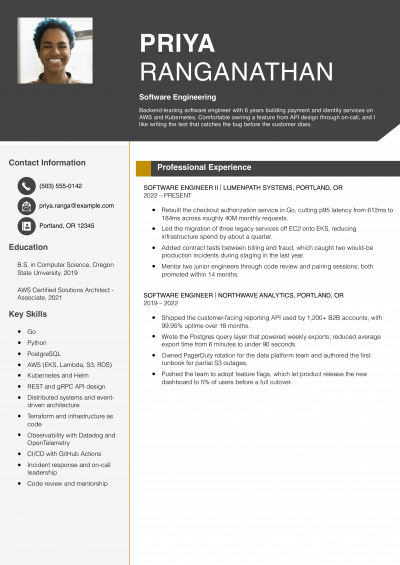
4 Best Software Engineer Resume Examples and Templates for 2026



A tight stack-and-impact block is what gets programmer resumes past the ATS keyword parse and the recruiter scan; specific production metrics like p99 latency and incident counts are what make them readable to the engineering manager.
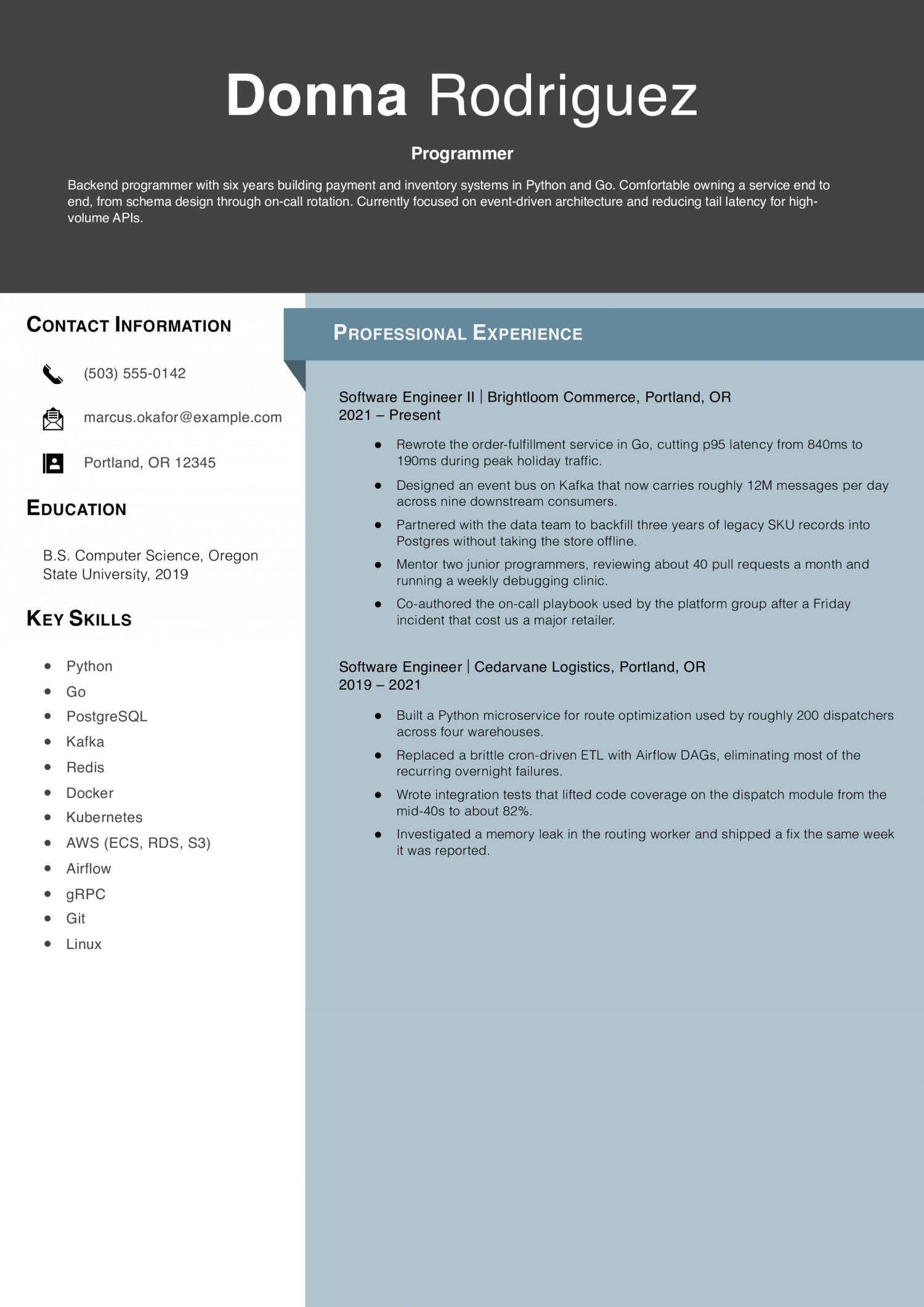
The junior programmer profile covers zero to three years post-bootcamp or post-degree, often with internship or contract work mixed in. This resume needs to prove you can ship code into a shared repo, read a code review, and own a small feature end to end.
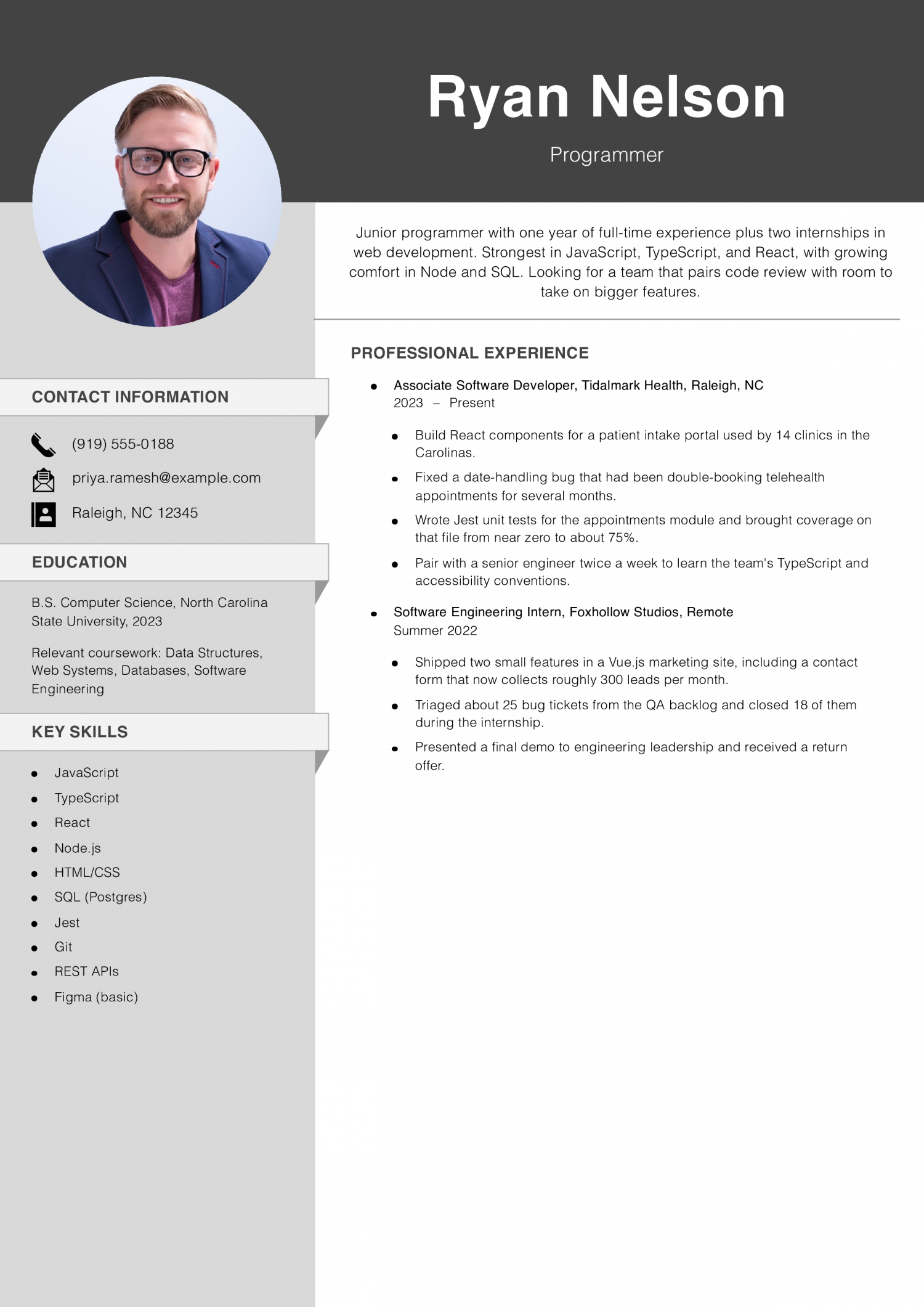
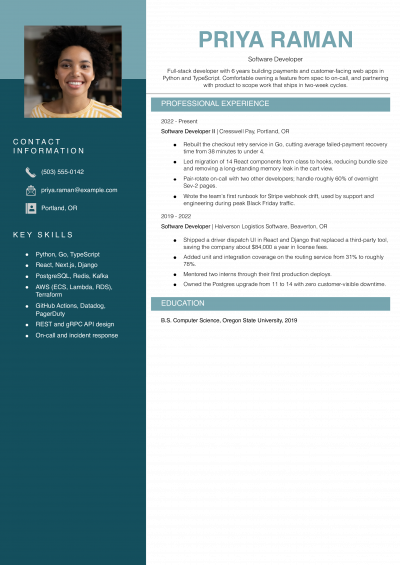
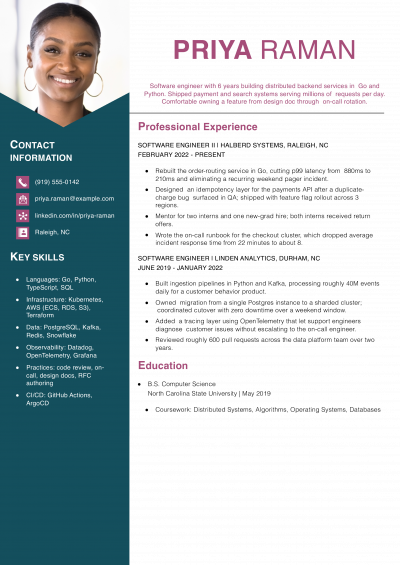
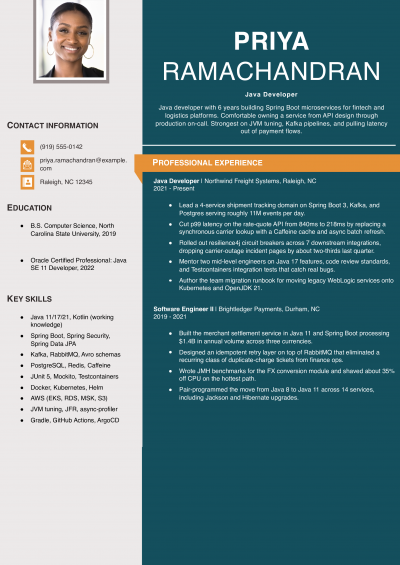
The senior programmer profile fits four to eight years owning services, modules, or core features in production. This resume needs to prove you carry on-call, lead code reviews, mentor juniors, and ship work that holds up under real traffic.
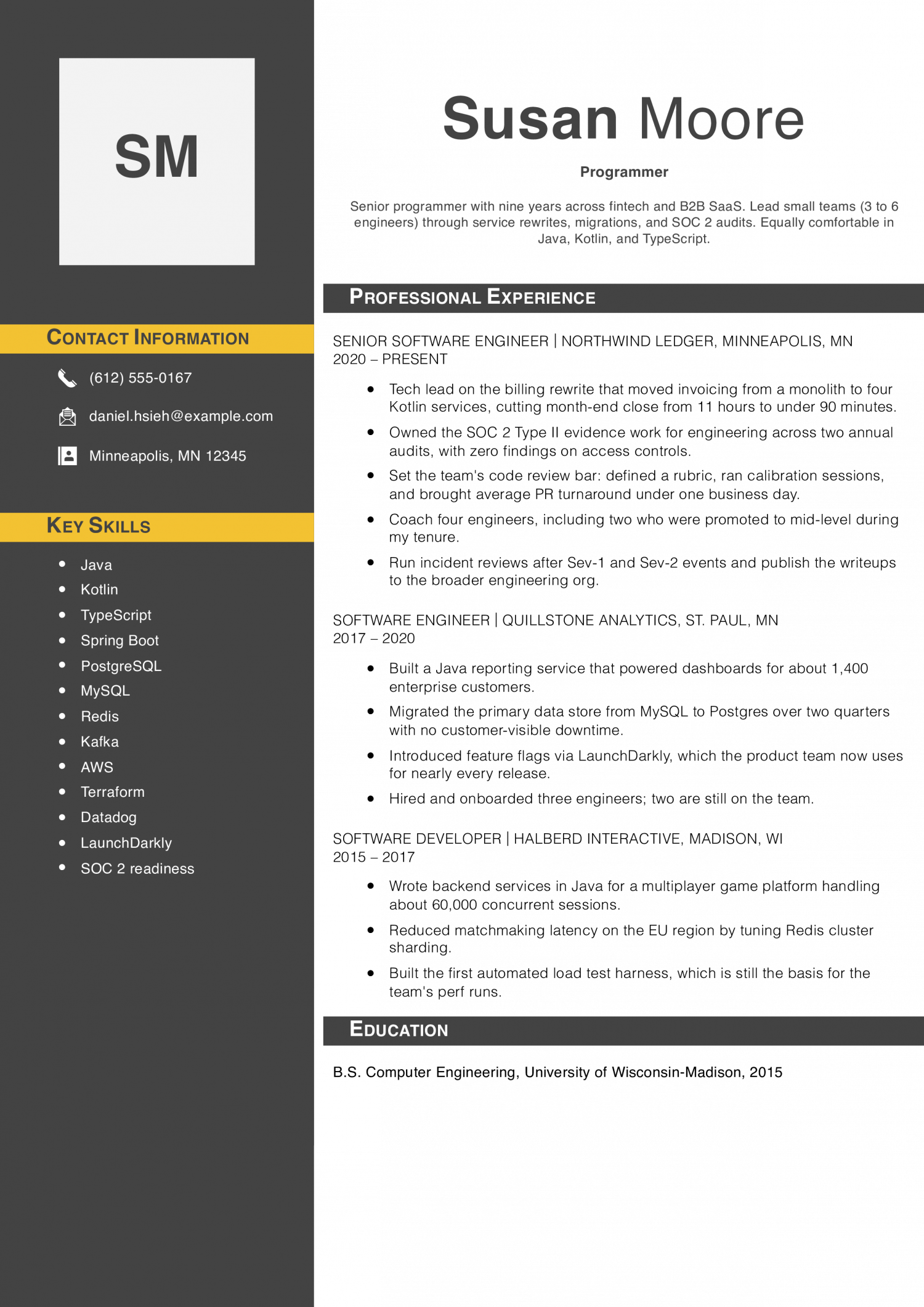
The staff programmer profile covers eight-plus years setting technical direction across multiple teams or product surfaces. This resume needs to prove architecture decisions, cross-team influence, hiring loops you ran, and platform work that outlasts a single sprint.
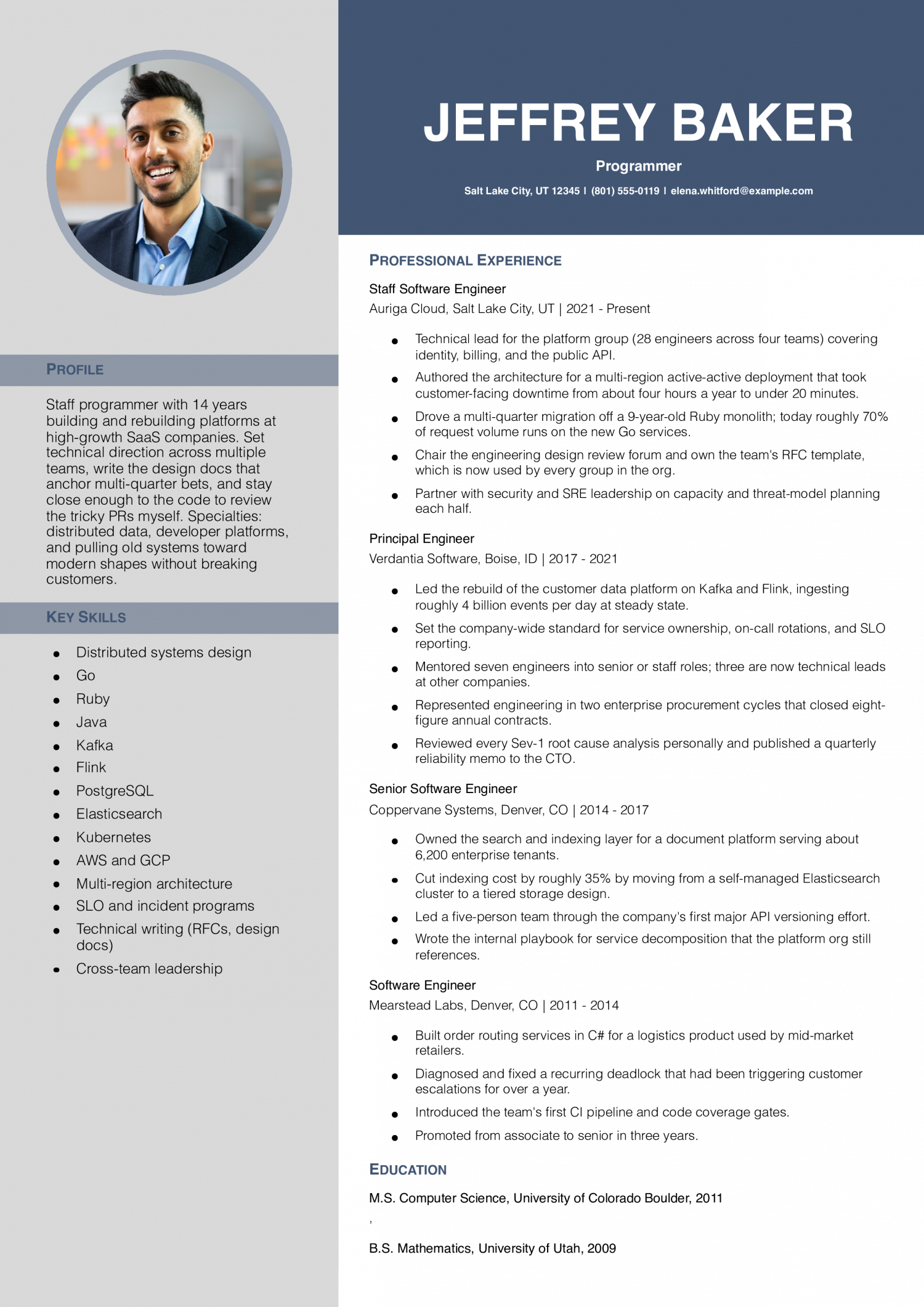
Full-stack programmer with eight years across consumer apps, internal tooling, and developer infrastructure. Strongest where product requirements meet messy backend systems: API design, data migrations, and getting unfamiliar codebases under control. Comfortable as the senior engineer on a small team or as an individual contributor inside a larger platform group.
Your profile should state years writing production code, the primary language, and the system type you build (web services, embedded firmware, data pipelines, mobile clients).
Name two or three frameworks you use weekly and the deployment target. A backend programmer might write: “Six years building Python and Go services on AWS, owning Kafka pipelines that process 40 million events daily.”
Skip soft adjectives. Engineering managers want to know what you ship, on what stack, at what scale. The profile sits above the experience block and gets eight to twelve seconds of scan time.
Bullets without a number tend to read as duties. Strong programmer bullets pair the change with a measurable outcome.
Aim for two or three of these per role: latency reduction (p50 or p99 in milliseconds), throughput gains (requests per second), bug-fix counts, test coverage lifts, infrastructure cost savings, or feature release cadence.
Example: “Rewrote the order-matching service in Go, cutting p99 latency from 180ms to 42ms and removing the nightly batch reconciliation job.” If you cannot pull exact numbers, use relative scale like “halved” or “tripled,” tied to a named system.
Break your experience into four buckets so the resume scans cleanly: feature development, performance and reliability, code quality, and collaboration.
Feature development covers shipped endpoints, services, or modules. Performance and reliability covers latency work, on-call rotations, incident response, and SLO improvements. Code quality covers refactors, test coverage, code review load, and tooling you built.
Collaboration covers cross-team APIs, design docs, RFCs, and mentorship. Mixing one bullet from each bucket per role signals range. A resume that lists only feature work reads as a feature factory, not an engineer.
Engineering managers and tech leads want the stack visible before they read a single bullet. Put a four-line technical skills block under the profile: languages, frameworks, databases and infrastructure, and tools.
Add a links line with GitHub, portfolio, and LinkedIn. Recruiters click GitHub on roughly half of programmer screens, so pin two or three readable repos with clear READMEs.
Certifications like AWS Solutions Architect or a Kubernetes credential sit in a short block above education. Degree placement depends on tier: juniors keep education near the top, senior and staff push it to the last quarter of page one or page two.
For senior and staff programmer resumes, cut HTML, CSS, jQuery, and any language you have not touched in five years. Cut bootcamp tutorial projects once you have three years of production work.
Trim early roles to two bullets each. Drop coursework, GPA, and the objective statement. Replace “proficient in” lists with stack depth indicators like “primary,” “production use,” or “shipped at scale.”
What stays: architecture decisions, hiring loops you ran, services you own, on-call leadership, and platform work that other teams depend on. Two pages is the ceiling for staff resumes.
ATS filters catch more programmer resumes than ever in 2026. The skills below come from our user-built programmer resumes, so the vocabulary matches what recruiters paste into their search filters. Engineering managers and tech leads weigh hard skills first: language fluency, framework depth, and Git workflow get the resume past the keyword parse.
Soft skills like code review judgment and incident communication decide whether it advances to the technical screen. Match the hard-skills list against the job post line by line, and use the soft-skills column as evidence backing your bullets, not as a standalone block.
| Soft Skills | % of resumes with this skill |
|---|---|
| Problem-solving | 74% |
| Communication | 65% |
| Team collaboration | 40% |
| Attention to detail | 39% |
| Adaptability | 35% |
And here are the top hard skills showing up most often.
| Hard Skills | % of resumes with this skill |
|---|---|
| Programming languages | 69% |
| Data structures and algorithms | 65% |
| Version control with Git | 48% |
| SQL and databases | 39% |
| Debugging and testing | 35% |
Based on data from thousands of programmers’ resumes built on ResumeTemplates.com, May 2026.
These are the must-haves hiring teams look for when scanning a programmer resume.
Engineering managers and tech leads expect a niche section that mirrors the language of their own job posts. The rows below group searcher-shaped keywords by programmer sub-niche, so you can paste the cluster that matches your target role.
| Niche | Keywords ATS scans for |
|---|---|
| Backend and systems | backend programmer, systems programmer, software programmer resume, server-side developer |
| Full-stack and web | full-stack programmer, web programmer, frontend developer, javascript programmer |
| Senior and lead tracks | senior programmer resume, lead programmer, principal engineer, staff programmer |
| Embedded and firmware | embedded programmer, firmware engineer, c++ programmer, real-time systems |
| Entry-level and coding portfolio | junior programmer resume, coding resume, computer programming resume, programmer cv |
AI use on a programmer resume can go three ways: lead with “AI-powered developer” buzzwords that recruiters screen out, leave it off entirely (which reads as evasive in 2026 when most teams already use Copilot), or describe the workflow as it actually runs. The third is what engineering managers can validate in a technical screen.
Copilot and Cursor draft boilerplate, tests, and small functions, shifting your time toward review, integration, and architectural decisions.
AI reviewers catch style and obvious bugs first, so human review now focuses on design intent, edge cases, and security.
LLM-assisted log triage and stack-trace summarization shorten incident response, but root-cause analysis still needs human judgment.
AI drafts docstrings, READMEs, and runbooks from code, freeing you to focus on architecture decision records and design rationale.
GitHub Copilot: Daily pair-programming for boilerplate, unit tests, and refactors inside the IDE.
Cursor: Multi-file edits and codebase-aware refactors on larger services and legacy modules.
A programmer portfolio is your GitHub, not a Squarespace site with screenshots. Recruiters click the link on roughly half of screens, so what they see in the first ten seconds decides whether the resume advances.
The default. Pin three to five readable repos with READMEs, recent commits, and clear setup instructions.
Strong for candidates targeting enterprise, government contractor, or self-hosted-CI shops.
Useful for staff and principal candidates publishing writeups, RFCs, or talks. Skip if you have nothing to write up.
Only relevant if you do ML or data work alongside programming. Skip for pure backend or full-stack roles.
Pin the right repos. Your top three pinned repos should show production-style code, not tutorials. Recruiters read commit history, README quality, and test coverage before they read your bullets.
Write the README like a resume bullet. One sentence on what the project does, one on the stack, one on what you would do differently. Include a screenshot or terminal recording for anything with a UI or CLI.
Show contribution graphs honestly. A quiet six months is fine if you were heads-down at work. An empty graph for two years next to a senior-level resume raises questions you do not want raised.
Your technical skills block sits directly under the profile and gets parsed before any bullet. Organize it in four lines so the ATS indexes each category cleanly, and so engineering managers can scan the stack in three seconds.
Languages: Python, Go, TypeScript, SQL, Bash
Frameworks and libraries: Django, FastAPI, React, Next.js, gRPC
Databases and infrastructure: PostgreSQL, Redis, Kafka, AWS (ECS, Lambda, S3, RDS), Terraform
Tools and workflow: Git, GitHub Actions, Docker, Kubernetes, Datadog, PagerDuty
A degree or equivalent project portfolio keeps you eligible. The certifications below are what move a programmer resume from the qualified-but-typical stack into the engineering manager’s shortlist, because they signal validated depth in cloud, container, or security work. List each one as: issuing body, credential name, and year earned.
AWS Certified Solutions Architect (Associate or Professional): Signals you can design production cloud systems, not just deploy to one. The Professional tier reads as senior infrastructure depth on staff resumes.
Certified Kubernetes Application Developer (CKAD): Validates hands-on container work, which most product job posts now expect. Pairs well with Docker and CI/CD bullets in the experience block.
Google Professional Cloud Developer: Carries weight at GCP-heavy shops and data-platform teams. List it when your target stack includes BigQuery, Pub/Sub, or Cloud Run.
Microsoft Certified: Azure Developer Associate: Strong signal for enterprise, healthcare, and government contractor roles where Azure dominates. Pair with .NET or C# experience for the cleanest match.
The top-paying states for programmers cluster around concentrated tech corridors and a handful of finance-heavy markets, not the full coast-to-coast spread most candidates assume. Pay tracks employer type more than headcount, so a mid-size fintech in one state often beats a Fortune 500 IT shop in another. If you are open to relocation or remote, position your resume around stack alignment with high-density employer markets.
Lead the profile with the language and cloud platform that map to your target region’s dominant industry.
| # | State | Avg. Annual |
|---|---|---|
| 1 | California | $170,910 |
| 2 | Washington | $166,910 |
| 3 | Virgin Islands | $162,820 |
| 4 | New York | $161,260 |
| 5 | Massachusetts | $150,520 |
| 6 | Maryland | $137,890 |
| 7 | District of Columbia | $136,040 |
| 8 | Oregon | $135,260 |
| 9 | Delaware | $135,160 |
| 10 | Colorado | $134,540 |
| # | State | Workers | Median |
|---|---|---|---|
| 1 | California | 292,630 | $170,910 |
| 2 | Texas | 151,460 | $130,500 |
| 3 | New York | 104,130 | $161,260 |
| 4 | Washington | 91,470 | $166,910 |
| 5 | Virginia | 83,290 | $134,470 |
Resume Templates offers HR approved resume templates to help you create a professional resume in minutes. Choose from several template options and even pre-populate a resume from your profile.
One page for junior and most mid-level programmers. Two pages once you have eight-plus years or staff-level scope to document.
Recruiters scan for three to four roles of depth, not a full career history. Trim early jobs to two bullets each, and cut internships once you have three years of production work.
Create a Projects section below experience for personal or open-source work. Each entry gets a name, a one-line description, the stack, and a link to the repo or live demo.
Add one or two bullets on what you shipped and what it changed. Skip tutorial clones and to-do apps once you have real work history. A side project that solved a problem reads stronger than three half-finished demos.
Group by depth, not by paradigm. Use three buckets: primary (daily, production use), working (shipped code in the last two years), and familiar (coursework or one project).
This stops recruiters from screening you on a language you barely touched. List frameworks and databases in their own lines so the ATS parser indexes each one cleanly.
No. Typing speed signals data-entry work, not engineering.
Replace that line with Git workflow depth, code review load, or PR merge cadence if you need to fill space. Engineering managers read for shipped code, not keystrokes.
For a programmer, a tech template is the safest pick, because it keeps your stack, tools, and impact easy to scan. An ATS-friendly template is a solid alternative. Whichever you choose, keep the formatting clean and easy to parse: clear section headings, a standard font, and no graphics a parser can choke on.
Executive Resume Writer and Career Coach
Andrew Stoner is an executive career coach and resume writer with 17 years of experience as a hiring manager and operations leader at two Fortune 500 Financial Services companies, and as the career services director at two major university business schools.