20 Best Nanny Resume Examples and Templates for 2026



Families hiring sitters look for ages cared for and length of past engagements on the first page, because those two signals tell them whether you can hold a household routine together without supervision.

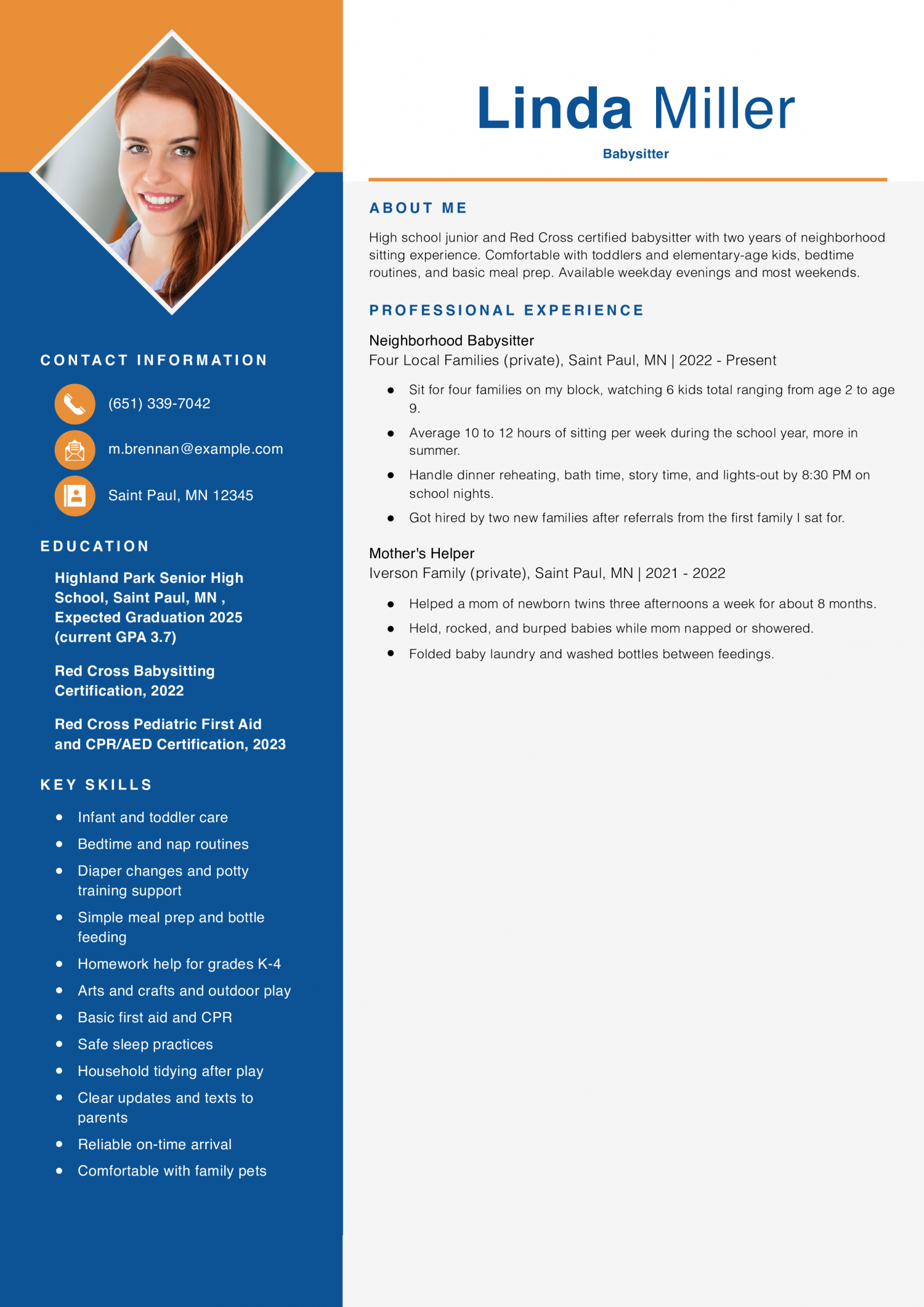
Entry-level sitters are teens, college students, or first-time caregivers leaning on family and neighborhood jobs. The resume needs to prove safety credentials, age ranges you've watched, and steady references who will pick up the phone.
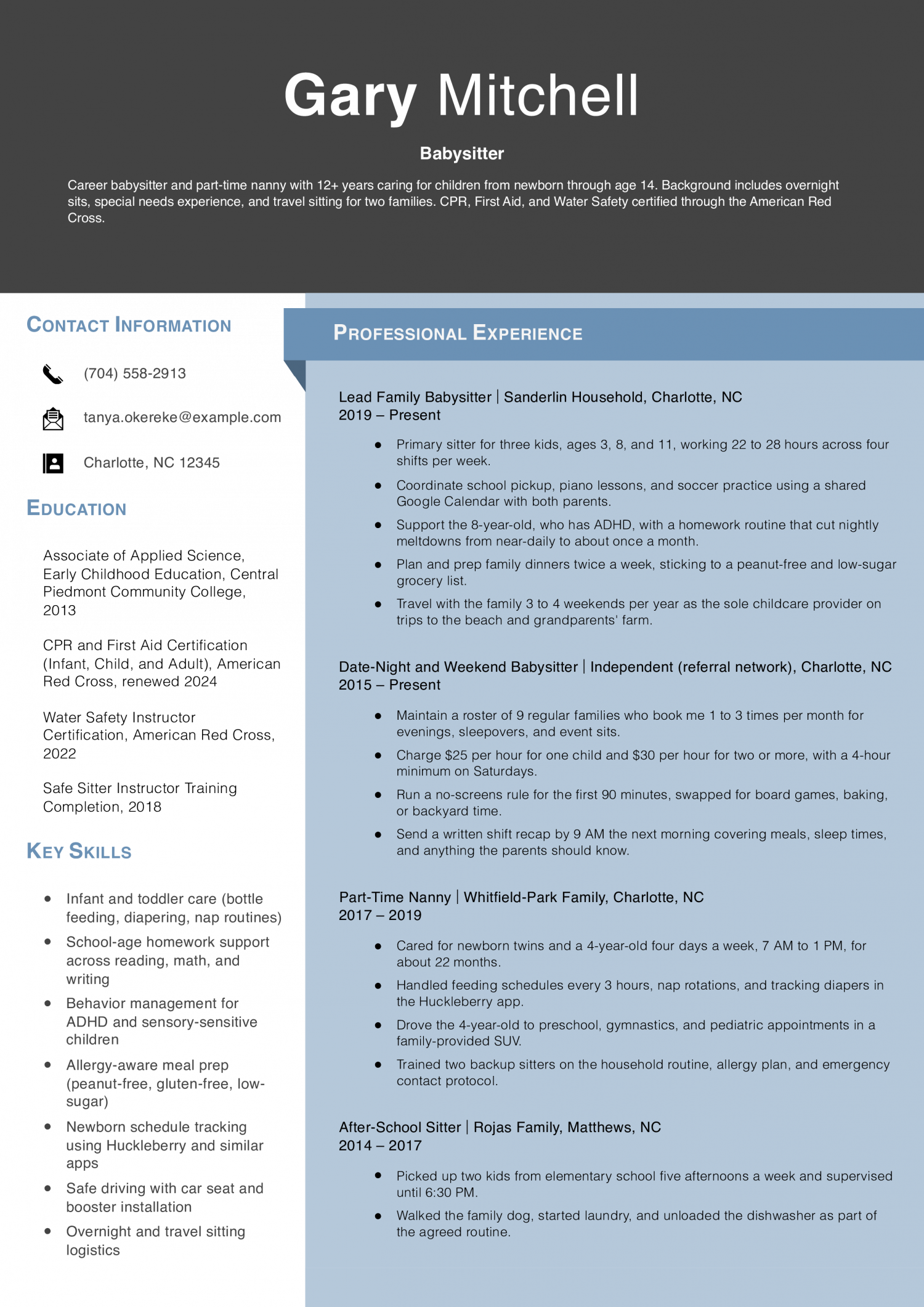
Experienced sitters have multi-year runs with the same families and often juggle two or three regular households. The resume needs to prove length of engagement, ages and number of children, and the routines you ran without a parent home.
Experienced babysitter with 9 years caring for children from infants to age 13. Holds Red Cross CPR, First Aid, and Babysitter Training certifications. Trusted by 12+ families across Albuquerque for date nights, full weekends, school breaks, and recurring after-school care. Bilingual in English and Spanish.
Lead your summary with a number the parent already cares about. Name the ages you’ve watched, the number of children per assignment, and your longest running family.
A strong opener reads: “Babysitter with five years caring for kids ages two to ten, including a three-year run with one family of three.” That answers the questions a parent asks before they even read your bullets.
Skip soft adjectives like “loving” or “responsible” in this line. The numbers do that work, and they hold up under reference checks.
Bullets without a number tend to read as duties, not proof. Name how many kids, what ages, how many hours per week, and how long the engagement ran.
Strong bullets pair scope with action: “Cared for three children ages four, seven, and nine, four evenings per week, for two school years.” That tells a parent you can handle their household.
Most strong resumes also name one routine you owned: bedtime, homework hour, meal prep, or school pickup. Pick the routine that matches the posting.
Sort your experience into three or four buckets: regular weekly families, occasional date-night jobs, overnight or travel sitting, and any group settings like a gym childcare room or summer camp.
Within each bucket, name the substantive work: meal prep, bath and bedtime, homework support, school pickup, allergy management, and screen-time rules. Parents read those words and picture their own evening.
If you’ve handled medical routines, separate them out: inhaler use, EpiPen training, or feeding-tube support. Those signals move you up the stack for families with specific needs.
Build a short credentials block under your summary so a parent sees CPR, First Aid, water safety, and any background check status without scrolling.
List the issuing body and the month and year of completion: “Pediatric CPR and First Aid, American Red Cross, March 2025.” Parents and family-care coordinators need that date because certifications expire on a two-year cycle.
If you’ve cleared a background check through a nanny agency or platform like Care.com or SitterCity, name the platform and the year. That spares the family one verification step.
End with your school, expected graduation year, and any coursework that maps to childcare: early childhood education, child psychology, special education, or nursing prerequisites.
Add a short references line: “Three family references available, longest engagement four years.” That tells a parent the calls will go well before they ask for names.
Do not put reference phone numbers on the resume itself. Share them when a family asks, after you confirm each contact is still willing to talk.
Based on data from our user-built babysitter resumes, the skills below appear most often on profiles that families call back. Hard skills carry the safety and logistics signal that parents scan for first, while soft skills back up the bullets that describe how you ran a household. Use the hard list to match keywords on the posting, especially around CPR, age groups, and special needs.
Treat the soft list as evidence you weave into bullets, not a standalone column.
| Soft Skills | % of resumes with this skill |
|---|---|
| Patience | 66% |
| Communication | 65% |
| Reliability | 46% |
| Time management | 37% |
| Problem solving | 31% |
And here are the top hard skills showing up most often.
| Hard Skills | % of resumes with this skill |
|---|---|
| First aid and CPR | 66% |
| Child development knowledge | 64% |
| Meal preparation | 45% |
| Homework help | 39% |
| Activity planning | 34% |
Based on data from thousands of babysitters’ resumes built on ResumeTemplates.com, May 2026.
These are the must-haves hiring teams look for when scanning a babysitter resume.
Families with multiple kids or a child on a care plan want to see that you can hold a routine without a parent in the room. Use this section of the resume to show the structure you brought to past households.
Bedtime and nap routines for infants through school age
Homework and reading support for elementary grades
Allergy and medication routines documented by parents
Calm-down strategies for tantrums and sibling conflict
Communication log or app notes left for parents at handoff
Sitting work runs on trust, and families verify that trust before they hand over their kids. The way you present your background on the resume sets the tone for that check.
Name the platforms where you have already cleared a screen, like Care.com, SitterCity, or a local nanny agency. Add the year you cleared so families know the check is current.
Do not put your driver’s license number, full home address, or date of birth on the resume. Share those on the application form when the family or agency asks for them directly.
If you have a record that will show on a check, address it in the interview rather than the resume. Most agencies have a clear policy on what disqualifies and what does not.
Parents read this list as a map of where your care work is heading. The certifications below tell them which track you’ve invested in, whether that is infant safety, special needs, or water-based care. List the issuing body and the month and year of completion next to each one.
Pediatric CPR and First Aid (American Red Cross or American Heart Association): The baseline credential most families filter on. Renew every two years and keep the date current on your resume.
Water Safety and Lifeguard Certification: Worth listing if you sit for families with pools, beach houses, or summer travel. Signals you can supervise water play safely.
Newborn Care Specialist or Postpartum Doula Training: Moves you into a higher-paying tier for families with infants under six months. Name the training program and contact hours.
Special Needs or Behavioral Care Training: Helpful for families seeking autism support, ADHD routines, or feeding-tube experience. List the program and any supervised hours.
Babysitter falls inside a broad personal-care occupation in BLS, which means the median pulls in a long tail of part-time, occasional, and entry-tier workers. Families and agencies who pay above the median look for sitters with a credential stack, a multi-year reference, and proof you ran a household on your own.
To position above the median, lead your resume with the families you stayed with longest, the age range you’ve owned, and the certifications you renewed on time.
| # | State | Avg. Annual |
|---|---|---|
| 1 | District of Columbia | $45,400 |
| 2 | Massachusetts | $39,290 |
| 3 | Colorado | $38,410 |
| 4 | California | $38,220 |
| 5 | Vermont | $37,830 |
| 6 | Washington | $37,800 |
| 7 | New York | $36,630 |
| 8 | Hawaii | $36,440 |
| 9 | Oregon | $36,250 |
| 10 | Connecticut | $35,290 |
| # | State | Workers | Median |
|---|---|---|---|
| 1 | California | 47,190 | $38,220 |
| 2 | Texas | 45,020 | $28,520 |
| 3 | New York | 42,780 | $36,630 |
| 4 | Georgia | 25,650 | $27,940 |
| 5 | New Jersey | 23,680 | $34,290 |
Resume Templates offers HR approved resume templates to help you create a professional resume in minutes. Choose from several template options and even pre-populate a resume from your profile.
A good description names ages, household size, and length of engagement.
Write it like a real job: "Babysitter for two children ages four and seven, three evenings per week, September 2023 to present."
Then add bullets on routines you ran and any certifications you hold.
Treat each family as a separate role with a title, dates, and bullets.
List the parent's first name and last initial as the employer, the city, and the months you worked. Add three to five bullets covering ages, routines, and any safety incidents you handled.
Close with your CPR card and a references line.
Yes, as long as you can produce a reference.
Informal jobs for neighbors, family friends, or relatives count if the parent will pick up a call.
Skip jobs you did for immediate family members like a younger sibling, since most agencies will not count that as paid care work.
Gaps are normal in sitting work because families' needs shift with school years.
Show the dates honestly and fill the gap with what you were doing: school, another job, travel, or a certification you earned.
A short line like "Completed pediatric CPR renewal, June 2024" turns a gap into a credential update.
For a babysitter, an ATS-friendly template is the safest pick, because it puts your certifications and experience where a hiring manager scans first. A basic template is a solid alternative. Whichever you choose, keep the formatting clean and easy to parse: clear section headings, a standard font, and no graphics a parser can choke on.
Executive Resume Writer and Career Coach
Andrew Stoner is an executive career coach and resume writer with 17 years of experience as a hiring manager and operations leader at two Fortune 500 Financial Services companies, and as the career services director at two major university business schools.
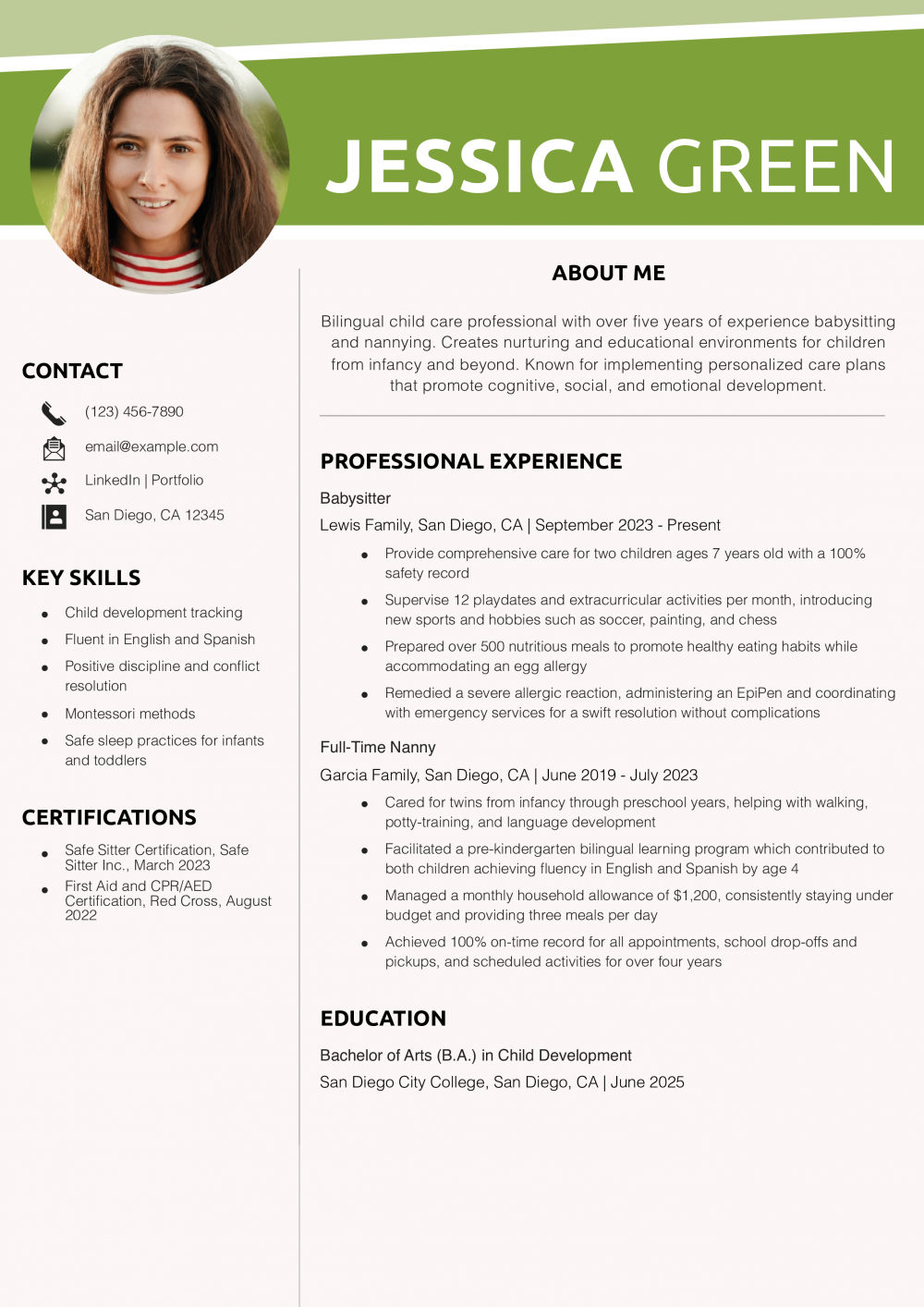
Customize this template in our builder in under 10 minutes.
![4 Best Child Care Resume Examples and Templates for [y]](/wp-content/uploads/2024/11/Child-Care-Provider-Resume-Example.x400.pdf.jpeg)