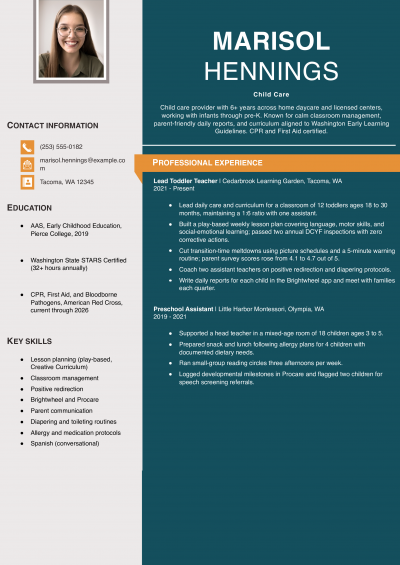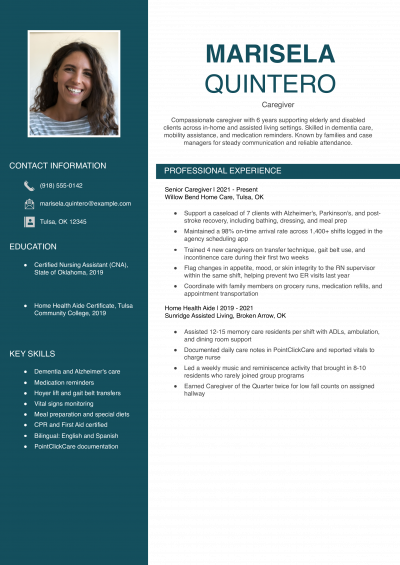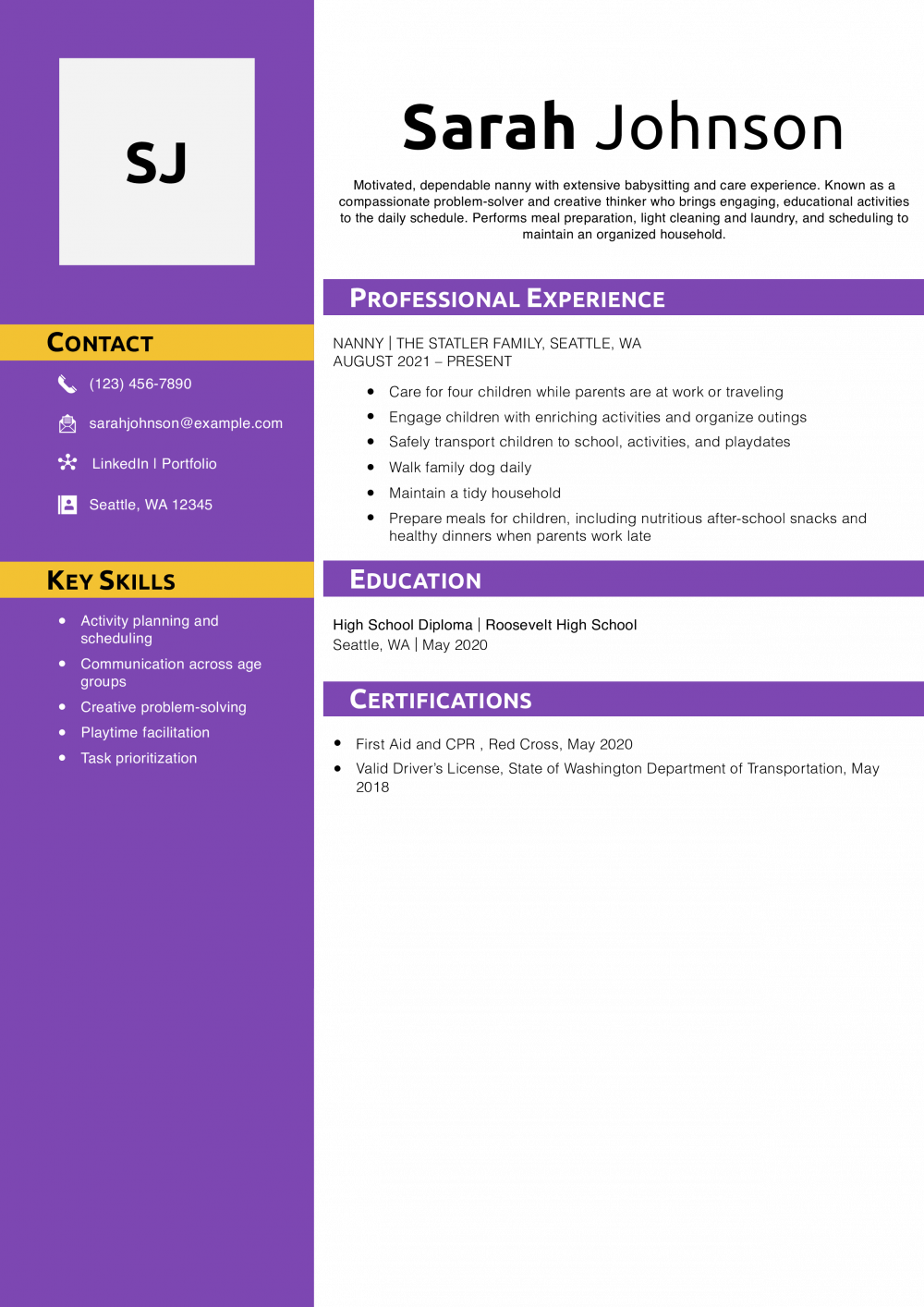
Babysitter Resume Examples and Templates for 2026



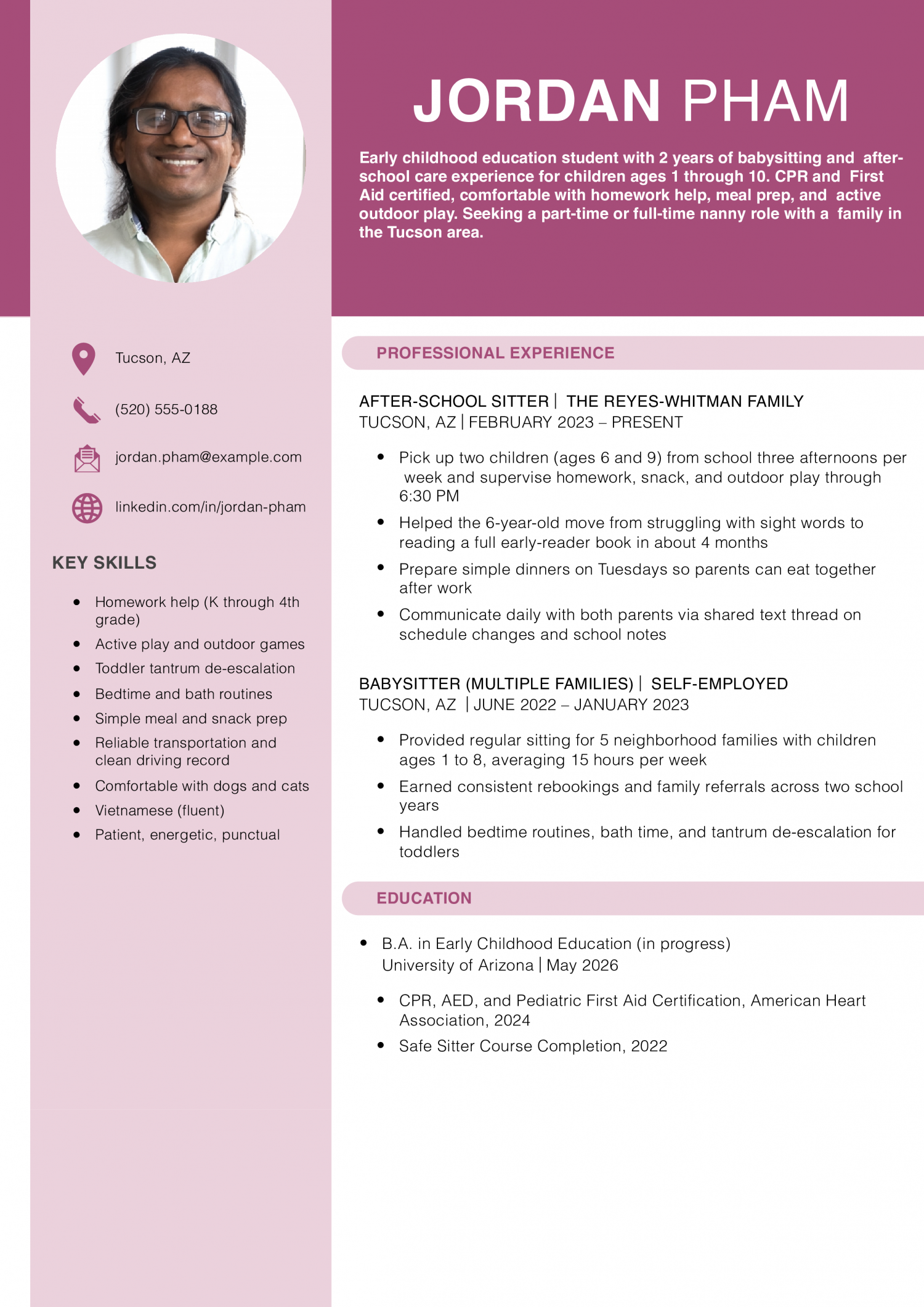
Entry-level nannies often come from babysitting, camp staff, or early childhood coursework. Your resume needs to prove safe routines, a CPR card, and steady references from the families you have already sat for.
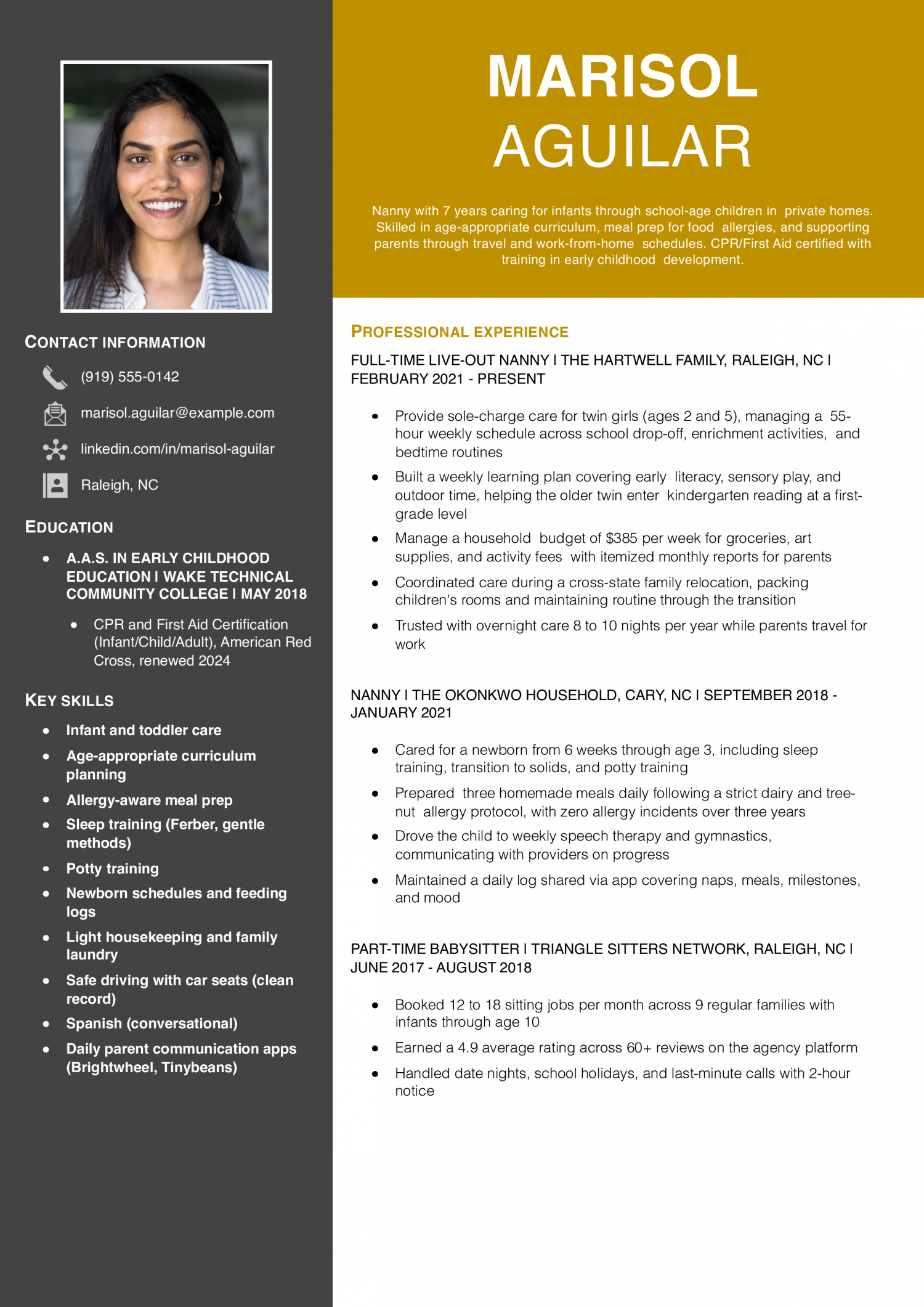
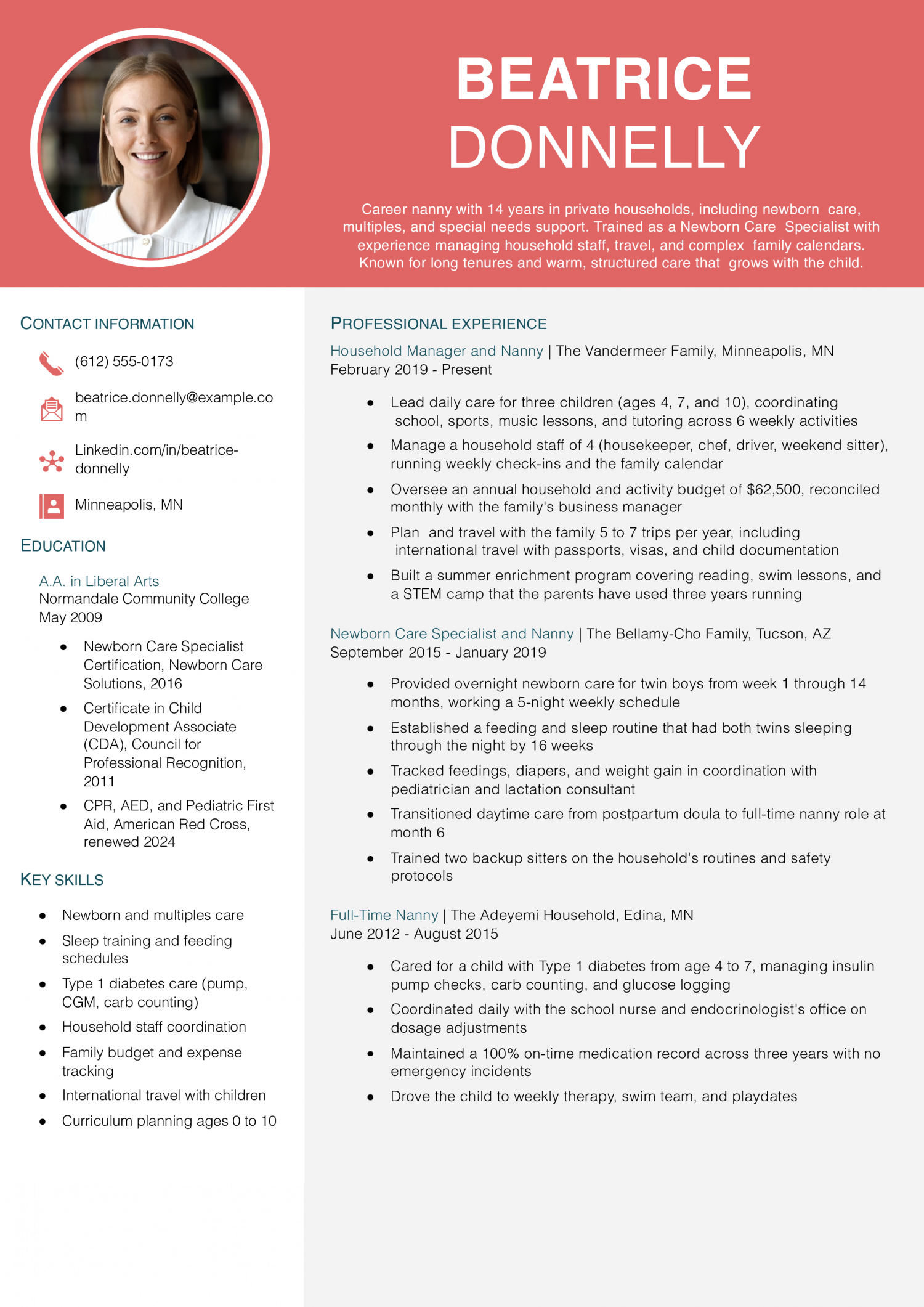
Experienced nannies run full days solo across multiple ages and household systems. Your resume needs to show years with each family, the age ranges you covered, and the routines you built from scratch.
Camille Boudreaux
New Orleans, LA | (504) 555-0119 | [email protected] | linkedin.com/in/camille-boudreaux
Professional nanny with 10 years in private homes serving families with newborns through tweens. Background spans sole-charge care, shared care with parents working from home, and travel nanny assignments. Trained in CPR, Pediatric First Aid, and water safety, with a focus on building daily routines that help children feel calm and confident.
Lead Nanny
The Marchetti Family | New Orleans, LA | 2021-Present
Travel Nanny
Coastal Family Care Agency | Placements in 6 cities | 2019-2021
Full-Time Nanny
The Halversen Household | Metairie, LA | 2016-2019
Nanny
The Castellano Family | Baton Rouge, LA | 2014-2016
Part-Time Sitter and Mother’s Helper
Self-Employed | New Orleans, LA | 2014-2015
Start with a single line a reference call cannot give a parent on its own. Name the age range, the household scope, and the certification that sets you apart.
That might be infant-twin experience, a Newborn Care Specialist credential, conversational Spanish with the kids, or a current Water Safety Instructor card. Place this line directly under your name, above the work history.
Parents and family-care coordinators read hundreds of resumes that all say ‘loves kids’ and ‘reliable.’ One concrete differentiator on line one tells them which household you fit before they reach your jobs.
Nanny work does not need clinical metrics, but it does need scope. Bullets without a number tend to read as generic duties any sitter could claim.
Name the number of children, their ages at hire, the hours per week, and your tenure with each family. A strong bullet reads: ‘Cared for three children, ages 2, 5, and 8, 50 hours per week across a 4-year tenure.’
Add the volume of school runs per week, the meals prepped per day, or the number of activities you coordinated. Specifics let a parent picture you in their own week.
Most strong nanny resumes group bullets into three or four clusters so a parent can scan for the duties that match their household. Use child-development care, daily routines, household support, and safety as the spine.
Under care, list age-appropriate activities, homework help, and behavior coaching. Under routines, list nap schedules, meal prep, bath, and bedtime. Under household, list children’s laundry, tidy-up, and grocery runs.
Under safety, list CPR response, allergy management, and pool or car safety. Clusters keep the resume scannable when a coordinator is filtering for a specific need.
Parents and agency coordinators screen for safety credentials before they read your work history. Build a small credentials block under your contact line: CPR and First Aid through the American Red Cross or American Heart Association, with the month and year of your most recent renewal.
Add a Trustline or state-equivalent background-check status, a clean driving record, and any newborn or special-needs training. Note ‘license in good standing’ or ‘background check on file’ rather than listing the actual document numbers.
Languages spoken with children belong here too. Page-one placement saves a coordinator from hunting and signals that compliance is current.
End the resume with a references-on-request line and, if space allows, the family names you can release. Nanny hiring leans on reference calls more than most fields, so signal that yours are ready.
Add a brief education line: high school, any early childhood coursework, child development associate progress, or a degree if you hold one. Skip an objective statement.
If you are early in your career, a one-page format is enough. If you have a decade or more of family tenure, a two-page resume that lists each household separately reads better than collapsing roles.
Based on data from our user-built nanny resumes, these are the hard and soft skills that show up most across roles that advanced to interviews. Match them against the posting in front of you before you paste them in.
| Soft Skills | % of resumes with this skill |
|---|---|
| Communication | 77% |
| Patience | 67% |
| Dependability | 42% |
| Adaptability | 40% |
| Time management | 31% |
And here are the top hard skills showing up most often.
| Hard Skills | % of resumes with this skill |
|---|---|
| CPR and first aid | 77% |
| Meal planning and preparation | 62% |
| Child development knowledge | 40% |
| Homework and tutoring help | 36% |
| Child safety and babyproofing | 27% |
Based on data from thousands of nannies’ resumes built on ResumeTemplates.com, May 2026.
Before a nanny resume gets a closer read, hiring teams check for a short list of essentials.
Families hiring for behavior support, neurodivergent children, or IEP follow-through read this section of the resume first. Generic ‘great with kids’ language loses to specifics about the methods and routines you actually ran.
Nanny hiring is a private-home decision, so families screen for safety signals before they read your bullets. The resume should make those signals visible without exposing personal document numbers.
Show clearances as line items, not as document numbers. Write ‘Background check on file (Trustline, California)’ or ‘Federal and state background check completed, 2025’ under your credentials block.
Do not list driver’s license numbers, social security numbers, or the case numbers from any background-check service. Families and agencies receive those through the formal application, not the resume.
If you carry a CPR card, name the issuing body and the renewal month and year. Renewals older than two years read as lapsed even when they are not.
Parents and family-care coordinators read this list as a map of where your care work is heading. The credentials below tell them which track, newborns, special needs, water safety, or early education, you have invested in. List the issuing body and the month and year of your most recent renewal.
Nanny pay spreads wider than most service roles because the job runs from part-time after-school care to full-time live-in positions with private households. The top of the band is held up by high-cost metro areas where families compete for experienced career nannies who handle newborns, twins, or special-needs care. The bottom of the band reflects part-time and entry-level roles in lower-cost markets.
Position your resume to the top of your local band by leading with the age ranges, household scope, and tenure that justify a career-nanny rate rather than a sitter rate.
| # | State | Avg. Annual |
|---|---|---|
| 1 | District of Columbia | $45,400 |
| 2 | Massachusetts | $39,290 |
| 3 | Colorado | $38,410 |
| 4 | California | $38,220 |
| 5 | Vermont | $37,830 |
| 6 | Washington | $37,800 |
| 7 | New York | $36,630 |
| 8 | Hawaii | $36,440 |
| 9 | Oregon | $36,250 |
| 10 | Connecticut | $35,290 |
| # | State | Workers | Median |
|---|---|---|---|
| 1 | California | 47,190 | $38,220 |
| 2 | Texas | 45,020 | $28,520 |
| 3 | New York | 42,780 | $36,630 |
| 4 | Georgia | 25,650 | $27,940 |
| 5 | New Jersey | 23,680 | $34,290 |
Resume Templates offers HR approved resume templates to help you create a professional resume in minutes. Choose from several template options and even pre-populate a resume from your profile.
List it as work history with the family's last name and city, your start and end dates, and a clear set of duties.
Informal pay status does not disqualify the role. Weak detail does. Treat each family like an employer entry, with bullets covering age range, hours per week, and what you owned.
Add the family as a reference if they will take a call. A direct parent reference outweighs the lack of a W-2 for most hiring families.
Open each role with a one-line scope summary: number of children, ages at hire, hours per week, and tenure.
Then write three to six bullets split across care, daily routines, and household support. Use verbs like 'managed,' 'prepared,' 'transported,' and 'coordinated' rather than 'watched' or 'helped with.'
Close with any specialty work: sleep training, behavior plans, IEP support, or travel with the family.
Use the family's last name only, the city, and the state. 'The Patel Family, Brooklyn, NY' is the standard format.
Keep full names, home addresses, and children's full names off the resume. Most experienced families expect this discretion and read it as a signal that you protect their privacy.
Share contact details for references only when a family requests them during the interview stage.
Name the gap with a one-line entry. 'Family caregiving, 2023 to 2024' or 'Early childhood coursework, community college, 2024' is enough.
Parents care less about the gap itself than about whether you can explain it cleanly. Vague gaps read as red flags in a private-home hire.
If the gap included babysitting or short-term sitter work, log it as 'On-call sitter, multiple families' rather than leaving the dates blank.
For a nanny, an ATS-friendly template is the safest pick, because it puts your certifications and experience where a hiring manager scans first. A basic template is a solid alternative. Whichever you choose, keep the formatting clean and easy to parse: clear section headings, a standard font, and no graphics a parser can choke on.
Executive Resume Writer and Career Coach
Andrew Stoner is an executive career coach and resume writer with 17 years of experience as a hiring manager and operations leader at two Fortune 500 Financial Services companies, and as the career services director at two major university business schools.