Nanny Resume Examples and Templates for 2026



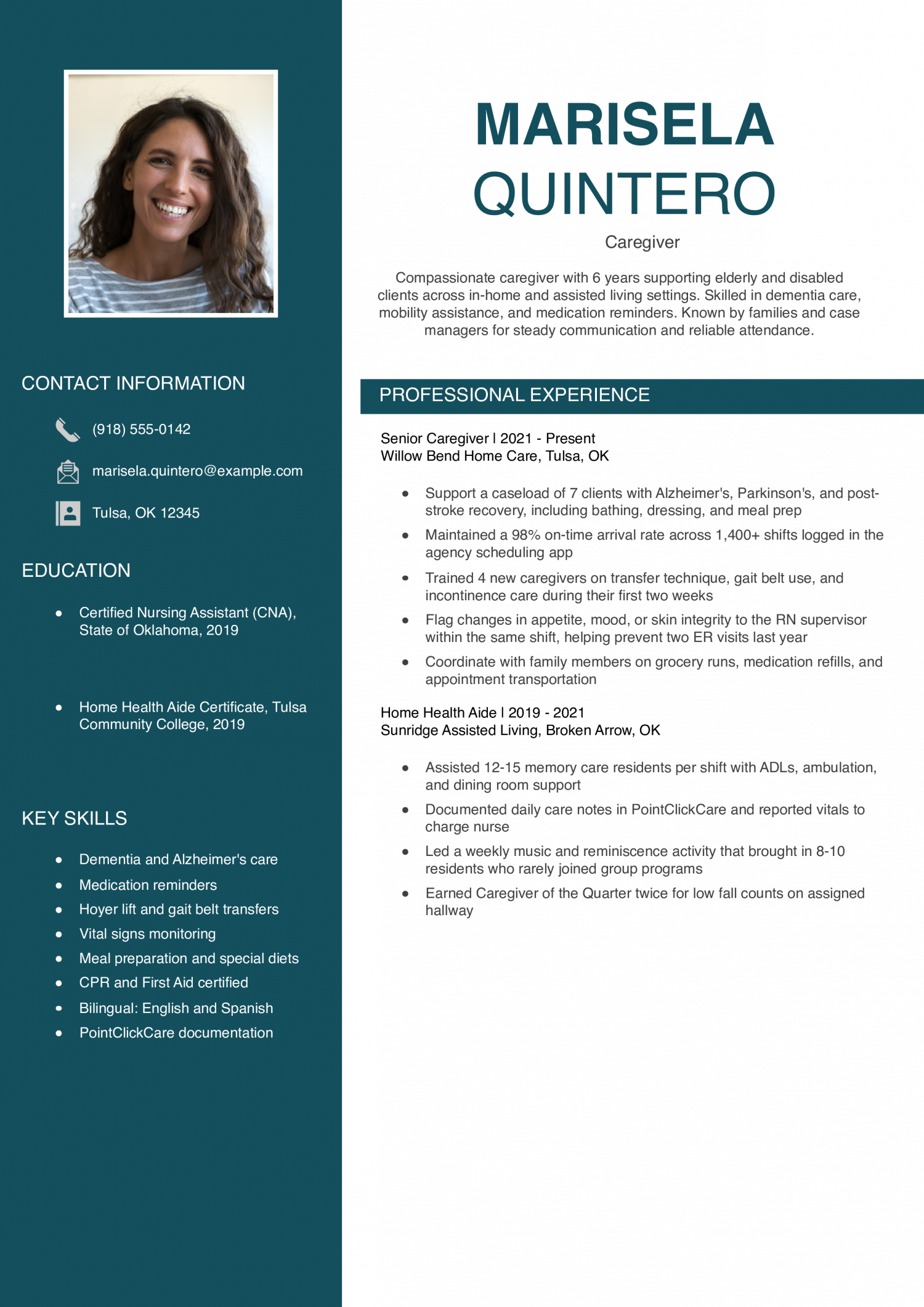
Entry-level caregivers are often newly certified HHAs or CNAs, or family caregivers formalizing years of unpaid care. This resume needs to prove safe ADL support, CPR currency, and reliability across shifts you actually showed up for.
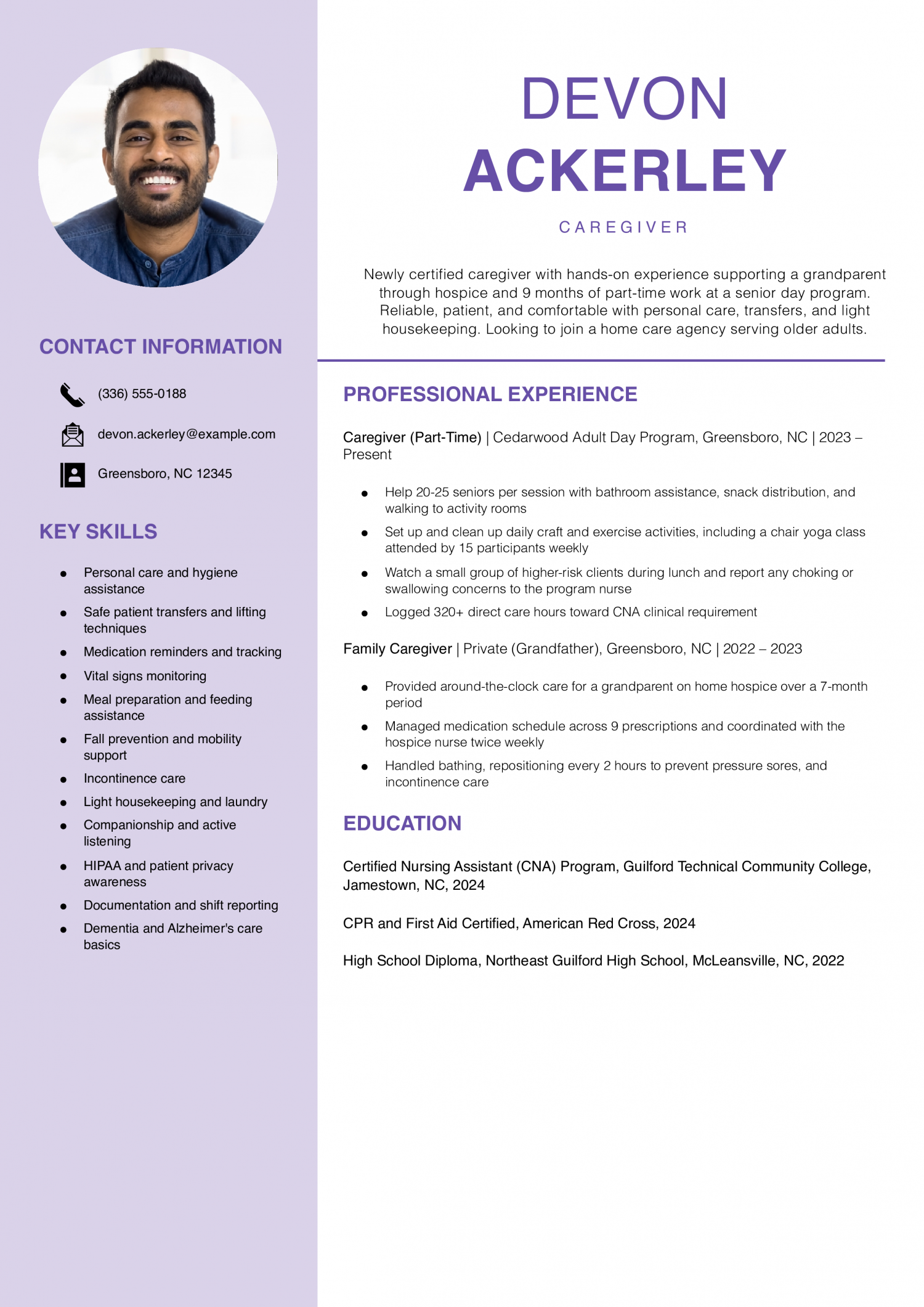
Experienced caregivers carry three or more years on private and agency cases, often with dementia or hospice exposure. This resume needs to prove a steady client roster, incident-free transfers, and the specialty care that justifies a higher hourly rate.
Priya Madhavan
Albuquerque, NM | (505) 555-0119 | [email protected] | linkedin.com/in/priyamadhavan
Experienced caregiver with 9 years across in-home, assisted living, and pediatric special needs settings. CNA and CPR certified, bilingual in English and Hindi, and known for staying calm during behavioral and medical crises. Looking for a senior caregiver role with a small agency that values long-term client matches.
Senior In-Home Caregiver
Sandia Heights Personal Care | Albuquerque, NM | 2021-Present
Pediatric Caregiver
Mesa View Special Needs Support | Rio Rancho, NM | 2018-2021
Caregiver
Acoma Ridge Assisted Living | Albuquerque, NM | 2016-2018
Home Health Aide
Desert Bloom Home Services | Santa Fe, NM | 2014-2016
An HHA or CNA registry lookup confirms you are certified. It does not show the care you can actually run.
Add a single line near your name that names the work an agency cannot verify elsewhere. Examples: six years of Alzheimer’s and Lewy body dementia care, Hoyer lift certified, bilingual Spanish, overnight and live-in availability, or two-person transfer trained.
If you have hospice exposure, end-of-life comfort care, or post-surgical recovery cases, name them here. Family coordinators staffing a difficult case scan for this line first.
Caregiving rarely produces dollar metrics, so most strong resumes lean on volume and scope instead. Bullets without a number tend to read as duties.
Name client count, shift length, and case mix. Good patterns: supported four private clients across 12-hour day shifts, managed ADLs for a 220-pound bedbound client using Hoyer lift and two-person transfers, or logged zero falls across 18 months on a fall-risk case.
Add medication-reminder counts, meal prep per shift, and the number of incident reports filed correctly. These read as evidence, not adjectives.
Walls of mixed duties read as filler. Cluster your bullets into four areas a coordinator can scan in seconds.
Personal care: bathing, toileting, peri-care, grooming, transfers, and positioning. Health monitoring: vitals, medication reminders, blood glucose checks, intake and output, and incident documentation.
Cognitive and emotional support: redirection for dementia clients, companionship, activity engagement, and family communication. Household support: light housekeeping, laundry, meal preparation per dietary restriction, and errands.
Within each group, lead with the highest-acuity example you can defend in an interview.
Agency owners and family coordinators will not scroll for your HHA, CNA, CPR, or First Aid status. Put a credentials block directly under the summary.
List the certification name, issuing body, state, and month and year of completion or renewal. Note CPR and First Aid as BLS or Heartsaver from American Heart Association or Red Cross with current expiration.
Add the state where your HHA or CNA registry record is active and say in good standing. Do not print the registry number on the resume. State that you have a clean background check, a valid driver’s license, and reliable transportation if the role requires errands or transport.
End the resume with training that maps to the cases you want next. A high school diploma or GED on its own does little work here.
List completed HHA or CNA program with hours and clinical placement site. Add specialty training such as Alzheimer’s Association essentiALZ, Teepa Snow Positive Approach to Care, hospice volunteer training, or a dementia care certificate from a community college.
If you cared for a family member for years, list it as Family Caregiver with the relationship, years, and care provided. This is real experience and coordinators recognize it. If you are looking at personal care roles too, see our personal care assistant resume examples.
The caregiver resumes that get callbacks share a specific skill mix. The lists below come from our user-built caregiver resumes. Home-care agency owners and family coordinators scan for these patterns first, not generic compassion language.
Hard skills prove you can run the shift safely; soft skills back up the bullets that describe how you ran it. Match the items below against your target posting, then move the matches into your skills block and bullets.
| Soft Skills | % of resumes with this skill |
|---|---|
| Compassion and empathy | 70% |
| Patience | 64% |
| Communication | 46% |
| Reliability | 38% |
| Adaptability | 30% |
And here are the top hard skills showing up most often.
| Hard Skills | % of resumes with this skill |
|---|---|
| Activities of daily living | 66% |
| Vital signs monitoring | 50% |
| Medication management | 48% |
| CPR and first aid | 36% |
| Mobility and transfer assistance | 27% |
Based on data from thousands of caregivers’ resumes built on ResumeTemplates.com, May 2026.
Before a caregiver resume gets a closer read, hiring teams check for a short list of essentials.
State CNA and HHA records require continuing education hours on a set cycle. Showing recent CE on your resume tells coordinators your registry record is active and your skills are current.
List CE under a clear heading near your certifications. Name the course, the issuing body, the hours, and the completion date.
Prioritize courses that map to the cases you want next, such as dementia care, infection control, body mechanics, or end-of-life care.
Your resume will be read by people outside the care team. Bullets that name a client, a family, or a clinical detail tight enough to identify them put you and the agency at risk.
Refer to clients by case profile, never by name, initials, or a detail that could identify a household. Use phrases like 78-year-old female with mid-stage Alzheimer’s or post-surgical hip replacement client.
Keep diagnoses general where you can. Specific drug regimens, room numbers, or facility names tied to a real client do not belong on a resume.
Caregiving roles run through a background check, fingerprinting, and often a state abuse-registry screen before you start. Your resume should signal you are already cleared so a coordinator does not stall on the question.
Add a short line in your credentials block that you carry a clean background check and a valid driver’s license. Note the state where your fingerprint clearance is active.
If you have a registry record (CNA, HHA, or state abuse-registry clearance), say it is in good standing without printing the number. Agencies confirm the record directly with the state.
Home-care agency owners and family coordinators read this list as a map of where your care work is heading. The certifications below tell them which client cases, dementia, hospice, or higher-acuity, you have invested in. List the issuing body, state where relevant, and the month and year of completion.
Specialty training beyond your base credential signals you can be staffed on cases that pay more. List each with the issuing body, hours, and completion date.
Caregiver is one of the larger occupations tracked by BLS, which means the published median pulls in a long tail of entry-tier companion and homemaker variants alongside skilled aides on complex cases. The spread between the 10th and 90th percentile is wider than most people expect for an hourly role.
To position above the median, lead the resume with the credential you carry (CNA over HHA), the case acuity you have run, and the specialty care families pay extra for.
| # | State | Avg. Annual |
|---|---|---|
| 1 | Washington | $46,140 |
| 2 | Rhode Island | $41,890 |
| 3 | Oregon | $41,490 |
| 4 | Massachusetts | $39,520 |
| 5 | District of Columbia | $39,420 |
| 6 | North Dakota | $39,100 |
| 7 | Alaska | $38,370 |
| 8 | Connecticut | $38,200 |
| 9 | New York | $37,980 |
| 10 | Maine | $37,670 |
| # | State | Workers | Median |
|---|---|---|---|
| 1 | California | 875,110 | $34,600 |
| 2 | New York | 623,000 | $37,980 |
| 3 | Texas | 314,610 | $23,470 |
| 4 | Pennsylvania | 242,570 | $29,310 |
| 5 | Minnesota | 120,390 | $36,200 |
Resume Templates offers HR approved resume templates to help you create a professional resume in minutes. Choose from several template options and even pre-populate a resume from your profile.
Group your duties into four buckets: ADLs, health monitoring, cognitive and emotional support, and household tasks. Coordinators scan faster when bullets are clustered.
Each bullet should name what you did, for whom, and how often. Example: assisted three dementia clients with bathing, toileting, and dressing across 12-hour day shifts.
Lead with the verb. Add a number, a frequency, or a client count whenever you can defend it in an interview.
Yes, and agency coordinators recognize it as real care experience. List it as a job entry, not a footnote.
Use the title Family Caregiver, name the relationship (mother, father, spouse), and give clear start and end dates. Treat it the same as paid work.
Write bullets in the same ADL, monitoring, and support format. Include the conditions you managed, such as Parkinson's, stroke recovery, or late-stage Alzheimer's.
Keep the summary to three lines. Line one: your credential (HHA, CNA, or experienced family caregiver) and years of hands-on care.
Line two: the client populations you have supported, such as dementia, post-surgical recovery, hospice, or pediatric special needs.
Line three: one specialty or availability detail that sets you apart, like Hoyer lift trained, bilingual Spanish, or open to overnight and live-in shifts.
No. State boards and home-care agencies advise against printing your registry number on a public-facing resume.
List the credential, the state where you are active, and the phrase in good standing with the current renewal date. That tells a coordinator everything they need to screen you.
Provide the actual number on the agency application or onboarding paperwork, where the form is access-controlled.
For a caregiver, an ATS-friendly template is the safest pick, because it puts your certifications and experience where a hiring manager scans first. A basic template is a solid alternative. Whichever you choose, keep the formatting clean and easy to parse: clear section headings, a standard font, and no graphics a parser can choke on.
Executive Resume Writer and Career Coach
Andrew Stoner is an executive career coach and resume writer with 17 years of experience as a hiring manager and operations leader at two Fortune 500 Financial Services companies, and as the career services director at two major university business schools.