

For two years the story has been the same. Companies cut jobs and handed the work to AI, from customer service roles to entire tech teams, and the cuts were often announced as proof the software was working. That story is now running in reverse. In August 2026, ResumeTemplates.com surveyed 1,000 U.S. managers whose companies made those cuts. Half have rehired or plan to, and most say the reason is what AI could not do.
Study highlights:
- 2 in 3 companies bringing people back name AI failures as the main reason
- 1 in 3 now say cutting jobs and replacing them with AI was the wrong decision
- Half of companies where AI did not fully cover the role say it missed errors an experienced worker would catch
- More than half say customers rejected AI in customer service
- 3 in 4 companies that have already rehired brought people back at the same or higher pay
- 1 in 4 companies spent more rehiring and fixing the work than the layoffs saved
- More than half of companies created new jobs just to manage AI
2 in 3 Companies Bringing Workers Back Say AI Could Not Do Their Job
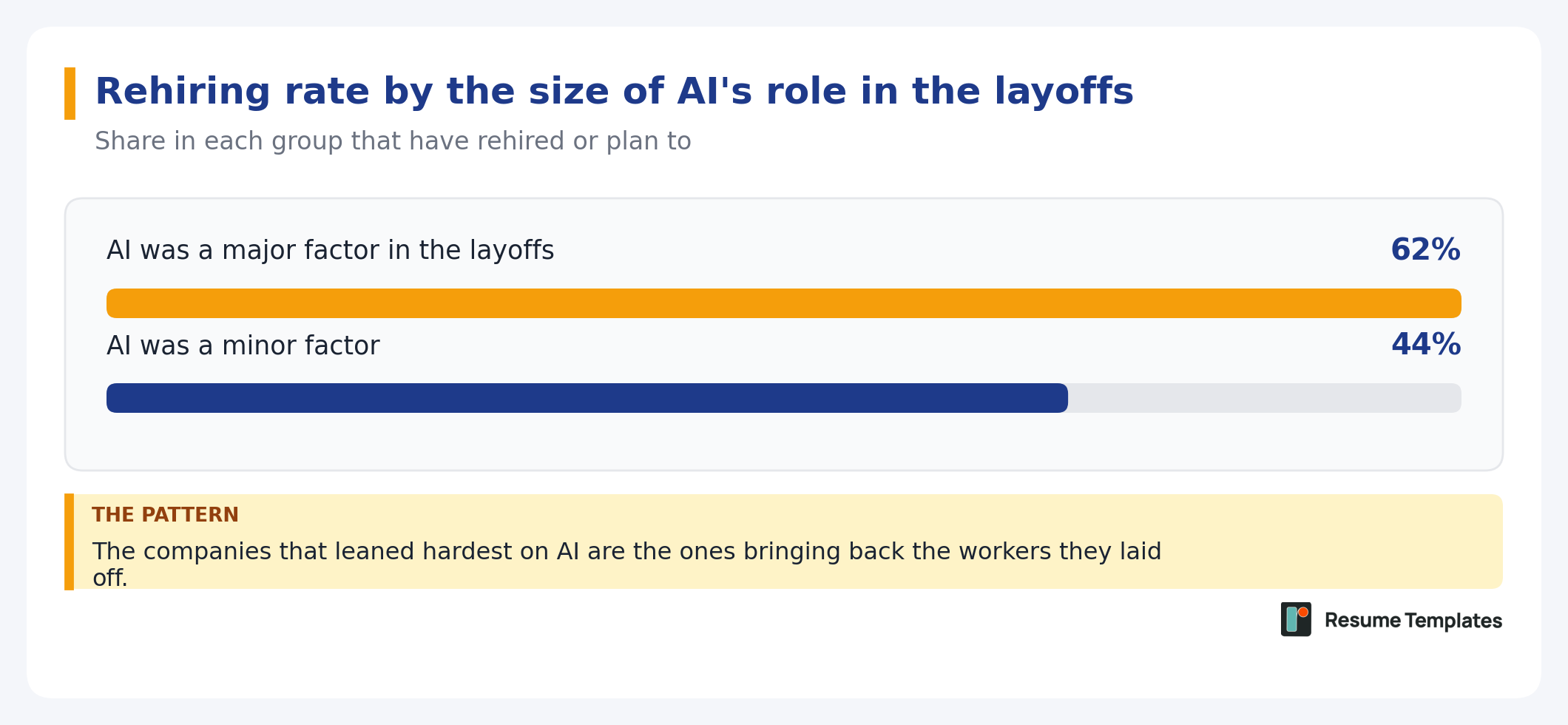
Companies that leaned hardest on AI are under the most pressure to hire back the workers they laid off. 62% of companies where AI was a major factor in the layoffs have rehired or plan to, compared with 44% at companies where AI played a minor role.
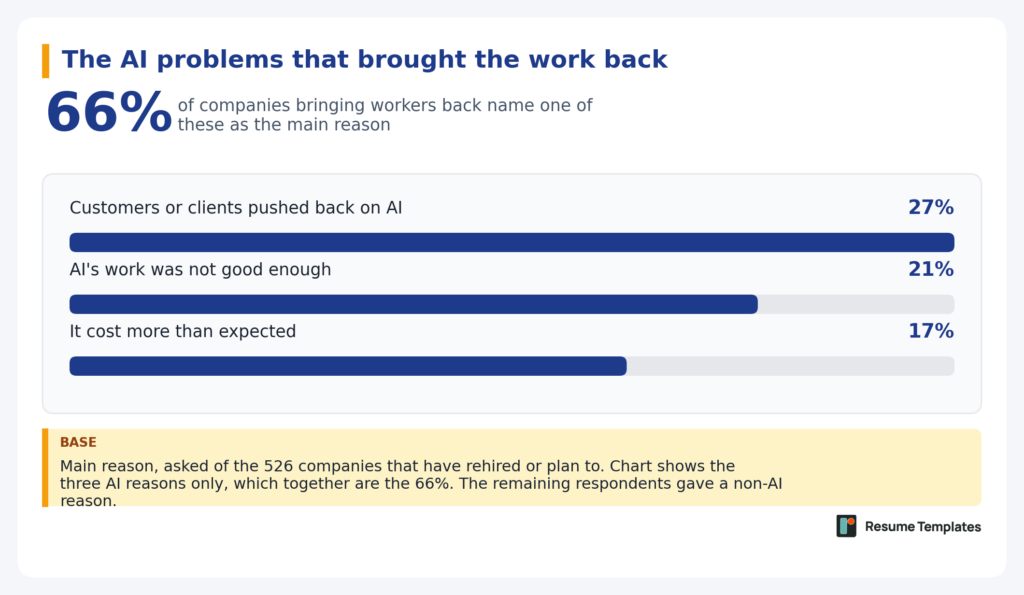
Among the companies bringing people back, 66% say the main reason is that AI could not do what was asked of it. 27% say customers pushed back on it, 21% say the work was not good enough, and 17% say it cost more than expected.
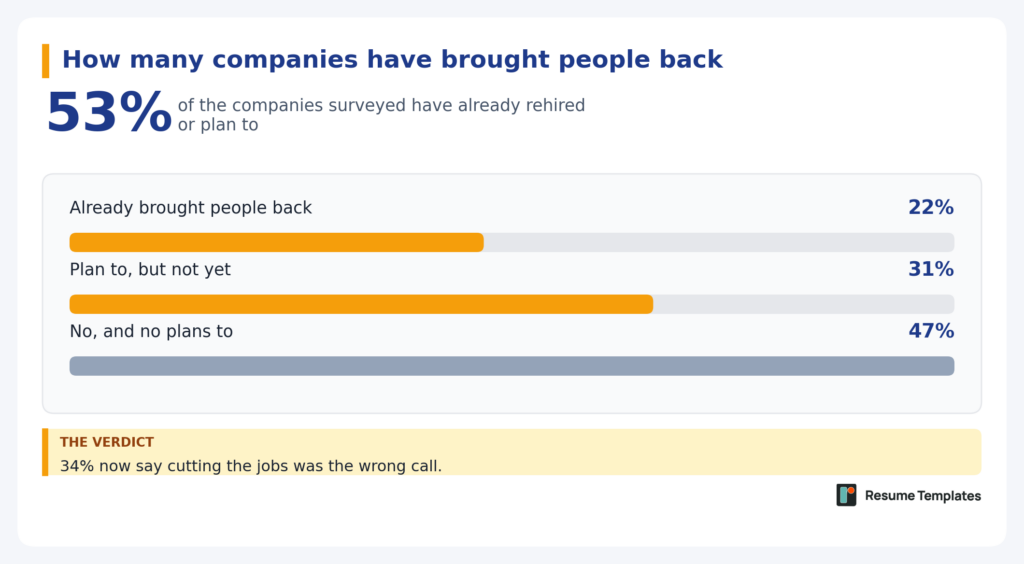
Most of that rehiring has not happened yet. 22% of companies have already brought people back, while another 31% say they intend to. More companies regret the decision than have reversed it. Among all 1,000 managers surveyed, 34% now say cutting jobs and replacing them with AI was the wrong call.
Companies did not just rehire, they restored what they had cut. Among the companies that have already rehired, 81% put workers back in their old roles, fully or in part. 62% of those companies brought people back mostly as full employees rather than as contractors, and 75% brought them back at the same pay or better.
“Companies are all learning what AI means for their business. There’s going to be trial and error, and some companies are realizing that AI can’t do everything they want or need it to do,” says Julia Toothacre, Chief Career Strategist at ResumeTemplates.com.
More Than Half of Companies Say Customers Rejected AI Customer Service
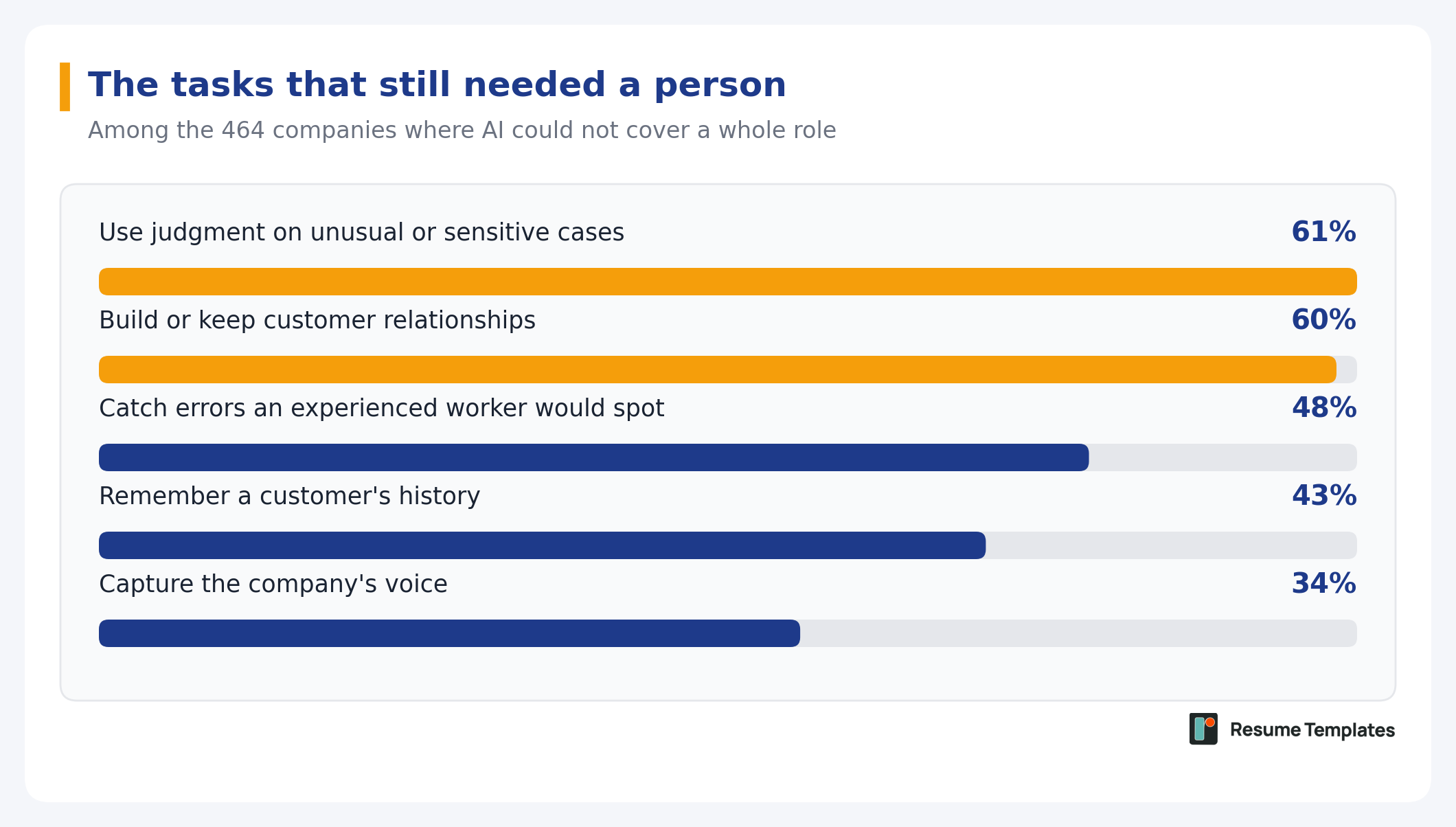
Where AI did not fully cover the role, managers were left with the tasks it could not finish. Among those companies, 61% say AI could not use judgment on unusual or sensitive cases. Keeping customer relationships came a close second, at 60%. And 48% say AI missed the errors and red flags an experienced worker would spot.
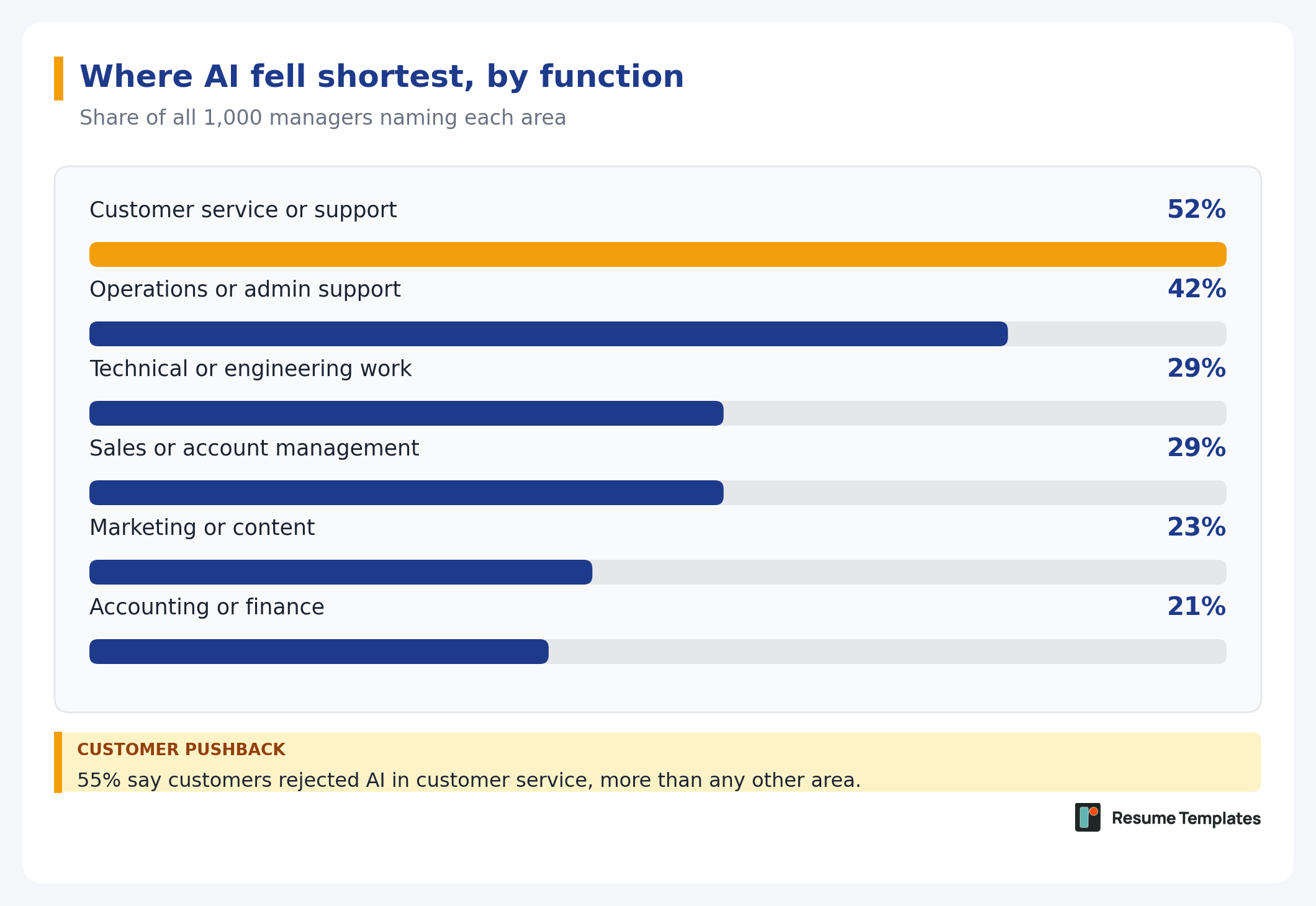
Customer service is where AI fell shortest, named as a weak spot by 52% of all managers surveyed, well ahead of operations at 42%. It is also the part of the business where customers deal with AI directly. 55% say customers or clients rejected AI used in customer service, more than they rejected it anywhere else.
1 in 4 Managers Say AI Cannot Replace the Human Element
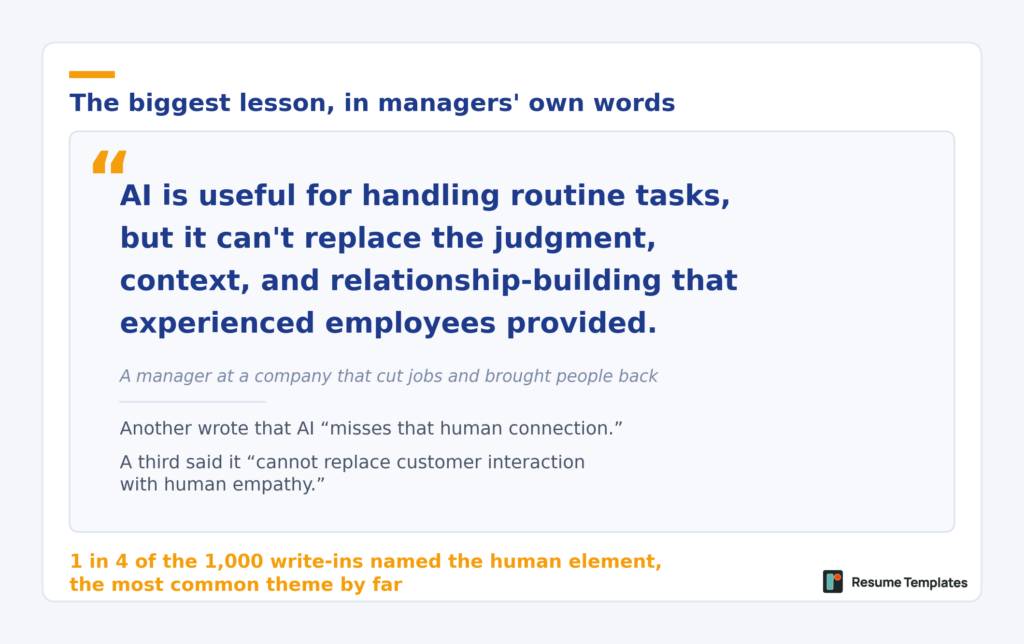
Asked for the biggest lesson in their own words, managers named one idea more than any other: AI cannot replace the human element. 1 in 4 of the write-ins made that point, more than any other theme. One manager wrote that AI “misses that human connection.” Another said it “cannot replace customer interaction with human empathy.”
“Experienced employees, especially those with extensive experience in an organization or field, have historical knowledge and pattern recognition that comes from doing the work. They can look at a customer situation and understand the nuance of what’s happening, including the feelings and relationships involved, in a way AI often can’t,” Toothacre says. “AI can deliver on tasks, but it doesn’t have an established relationship or history with that person.”
Half of Companies Erased Years of Experience and Knowledge
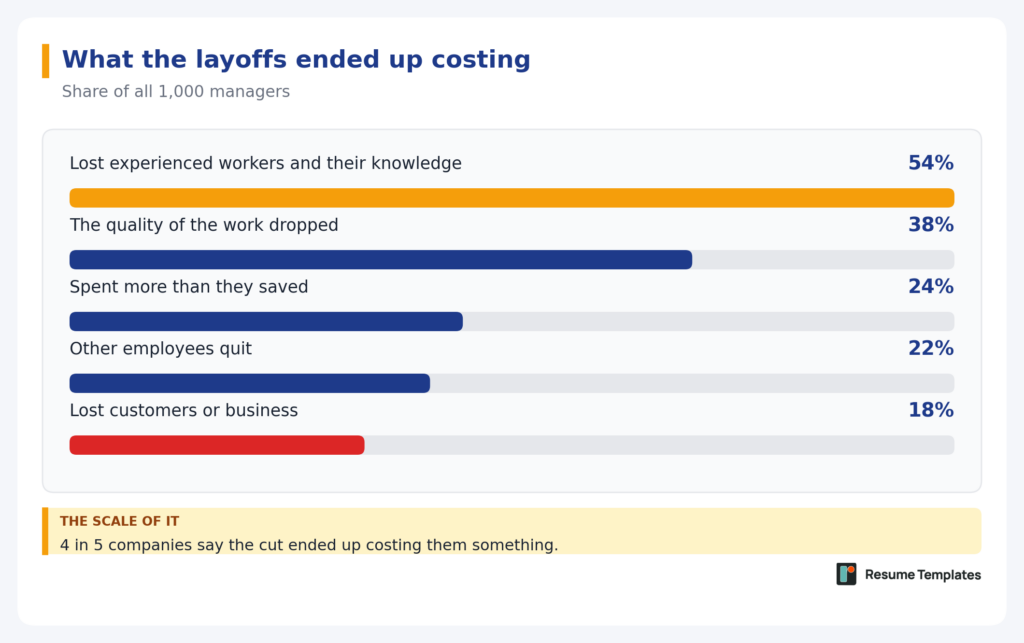
“We rushed to make decisions and lost valuable skills and people that we cannot get back,” one manager wrote. The numbers say that manager is not alone. Among all 1,000 managers surveyed, 54% say their company lost experienced workers and the knowledge those people carried out the door with them. 38% say work quality dropped after the cuts, and 24% say they spent more rehiring and fixing the work than the layoffs ever saved.
“Many workers have extensive trial-and-error knowledge from their organizations and fields. They’ve worked with different types of clients, projects, and organizations, and those experiences shape how they problem-solve as experienced professionals,” Toothacre says. “You should never underestimate the value of company and industry knowledge combined with experience.”
More Than Half of Companies Had to Create New Roles to Manage AI
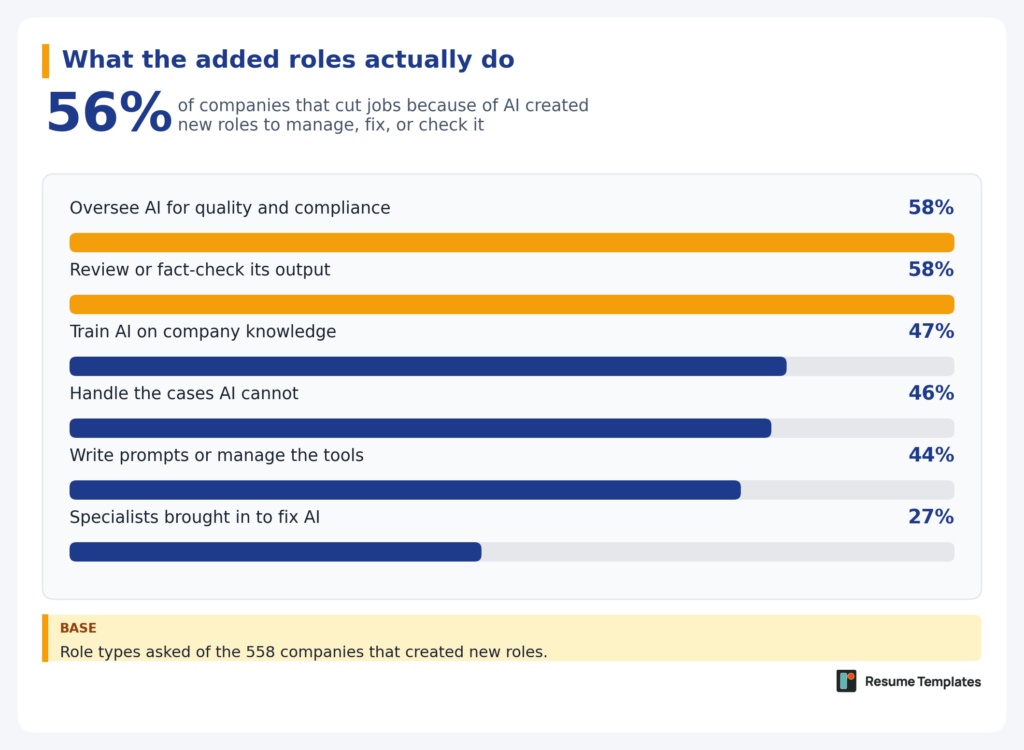
“It still needs much more oversight than anticipated,” one manager wrote of the system their company brought in. Companies hired people to provide it. 56% of managers say their company created roles that did not exist before, to manage, fix, check, or work alongside the software that replaced the workers they cut. Checking AI’s work is the most common of those new jobs. Among those companies, 58% added people to oversee quality and compliance, and the same share added people to review or fact-check what it produces. Another 47% hired people to train AI on company knowledge.
“If AI is moving into your field, you need to understand how it’s being used. It’s one thing for AI to help with repetitive tasks. It’s another when companies start replacing entire functions with AI agents and programs,” Toothacre says. “Learn what’s becoming common in your field and become a resource within your organization around AI. That gives you an opportunity to help shape how it’s used while hopefully keeping yourself at the table.”
AI mostly did the work it was handed. 81% of managers say it met or beat their expectations for the jobs it took over. What these companies misjudged was which jobs to hand over.
This survey was conducted via Pollfish in August 2026. A total of 1,000 U.S. full-time managers at companies that reduced headcount where AI or automation was a factor participated. Demographic and screening criteria ensured all respondents qualified. Pollfish reaches respondents through Random Device Engagement and applies quality controls to filter out inattentive or fraudulent responses. Pollfish reports a margin of error of plus or minus 3.1 percentage points at a 95% confidence level for the full sample. Questions asked of a subset of respondents carry a wider margin of error. Results are based on self-reported responses.
Resume Templates offers HR approved resume templates to help you create a professional resume in minutes. Choose from several template options and even pre-populate a resume from your profile.