
Tip !

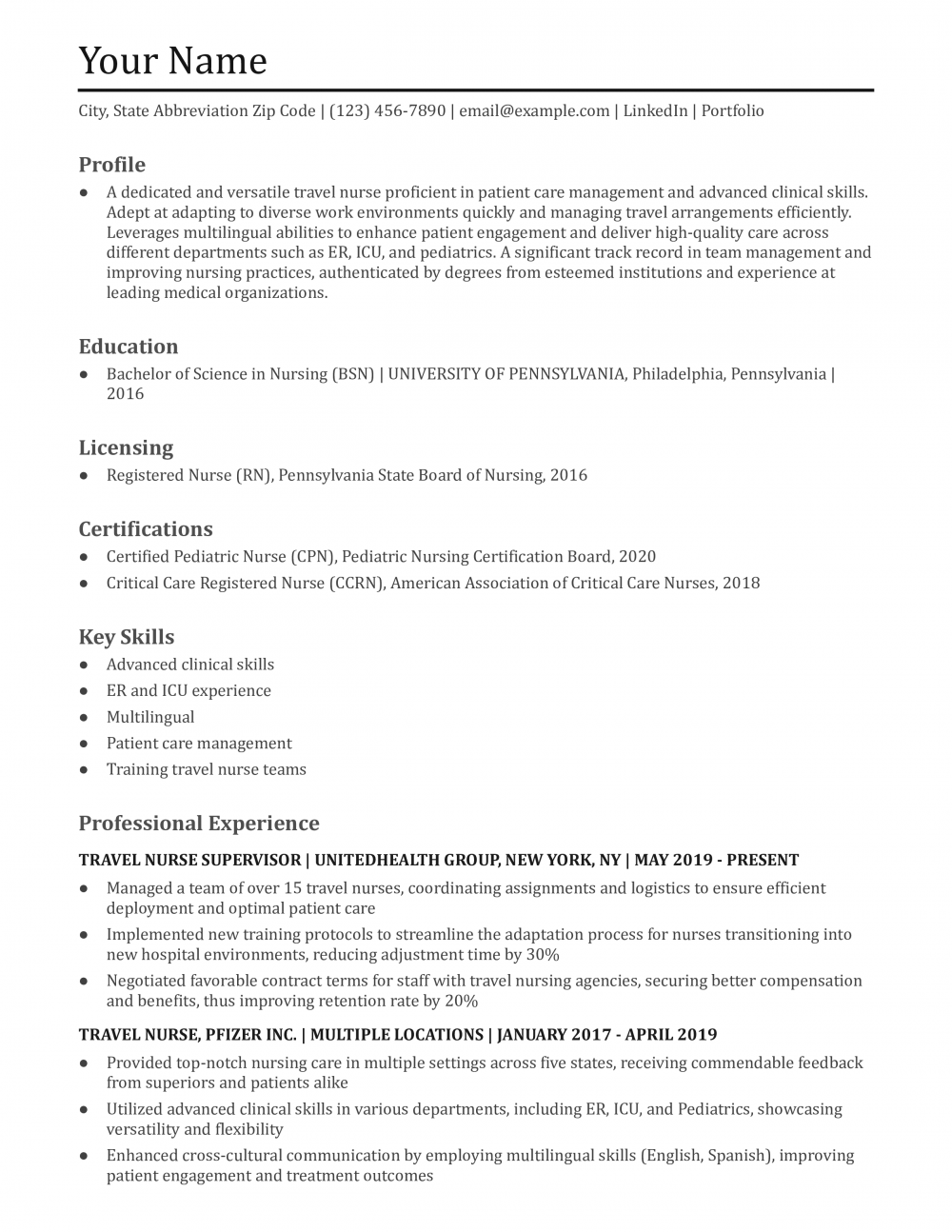
An active compact license paired with current BLS and ACLS dates is what gets travel nurse resumes past the agency credentialing screen; a tight assignment table with unit, ratios, and EMR is what makes them readable to a nurse manager.

Andrew Stoner , Executive Resume Writer and Career Coach

Why this resume works

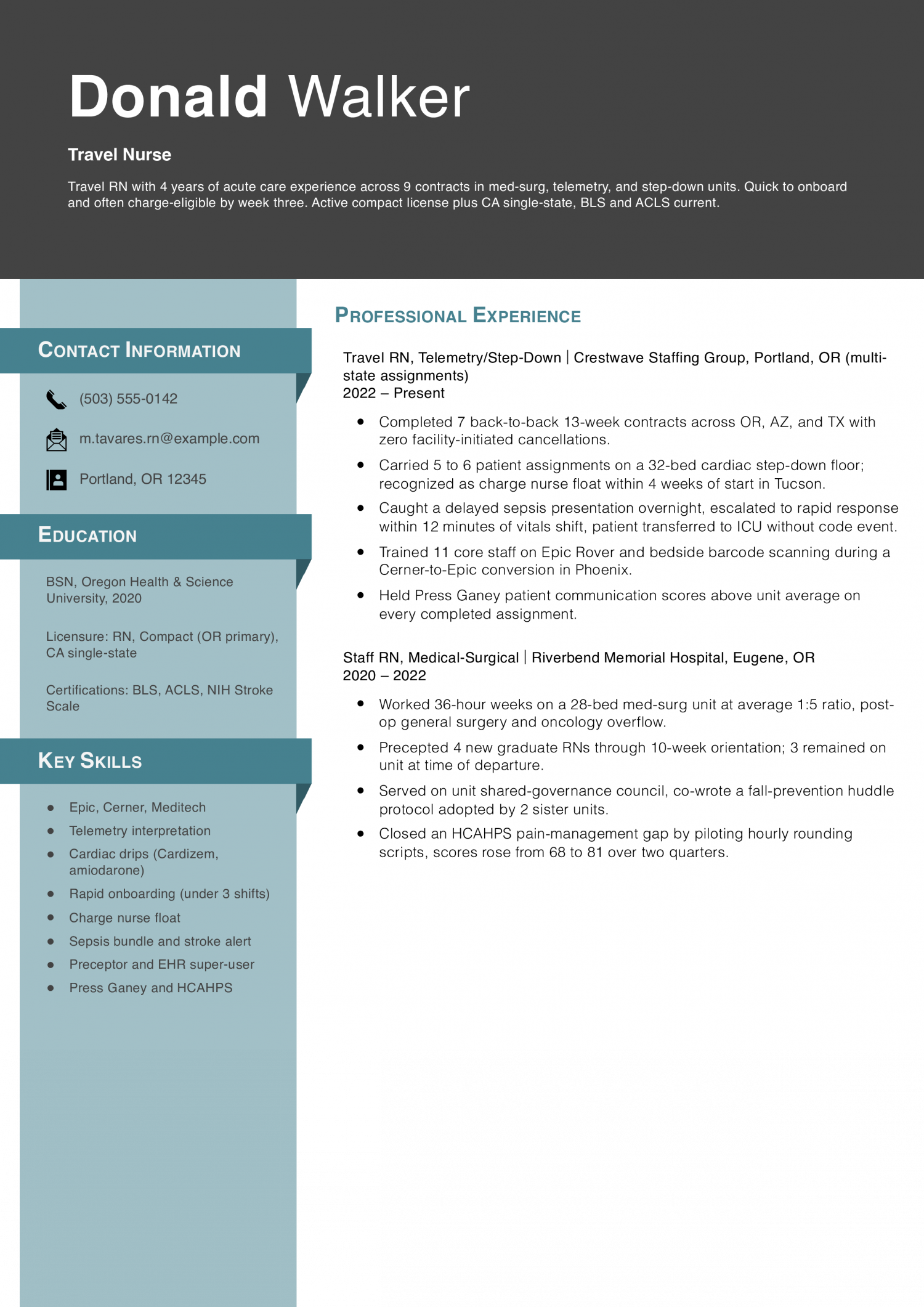
  • Shows the travel pattern clearly: Listing 7 back-to-back contracts with zero cancellations tells recruiters this nurse finishes assignments.
  • One sharp clinical save: The sepsis catch with a 12-minute escalation gives a concrete bedside story instead of vague phrases.
  • Licenses and certs up top: Compact plus CA single-state and current BLS/ACLS lets staffing agencies match assignments fast.

New Travel Nurse Example

The new travel nurse profile fits an RN with one to two years of staff experience moving into a first or second contract. Your resume needs to prove unit fluency, EMR speed, and a clean compact license, not assignment count.

Why this resume works

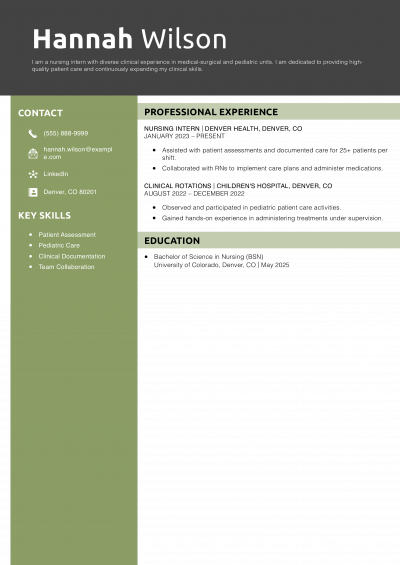
  • Float pool reads as travel-ready: Working across 4 units already shows the fast onboarding that travel agencies look for.
  • Experience level is transparent: 18 months and an extern year is plain on the page, with no inflated dates or vague titles.
  • Licenses match where they want to work: Compact license plus a stated regional preference tells recruiters which contracts to send.

Experienced Travel Nurse Example

The experienced travel nurse profile fits an RN with multiple completed contracts across facility types and EMRs. Your resume needs to prove acuity range, float flexibility, and that you onboard within a shift or two.

Why this resume works

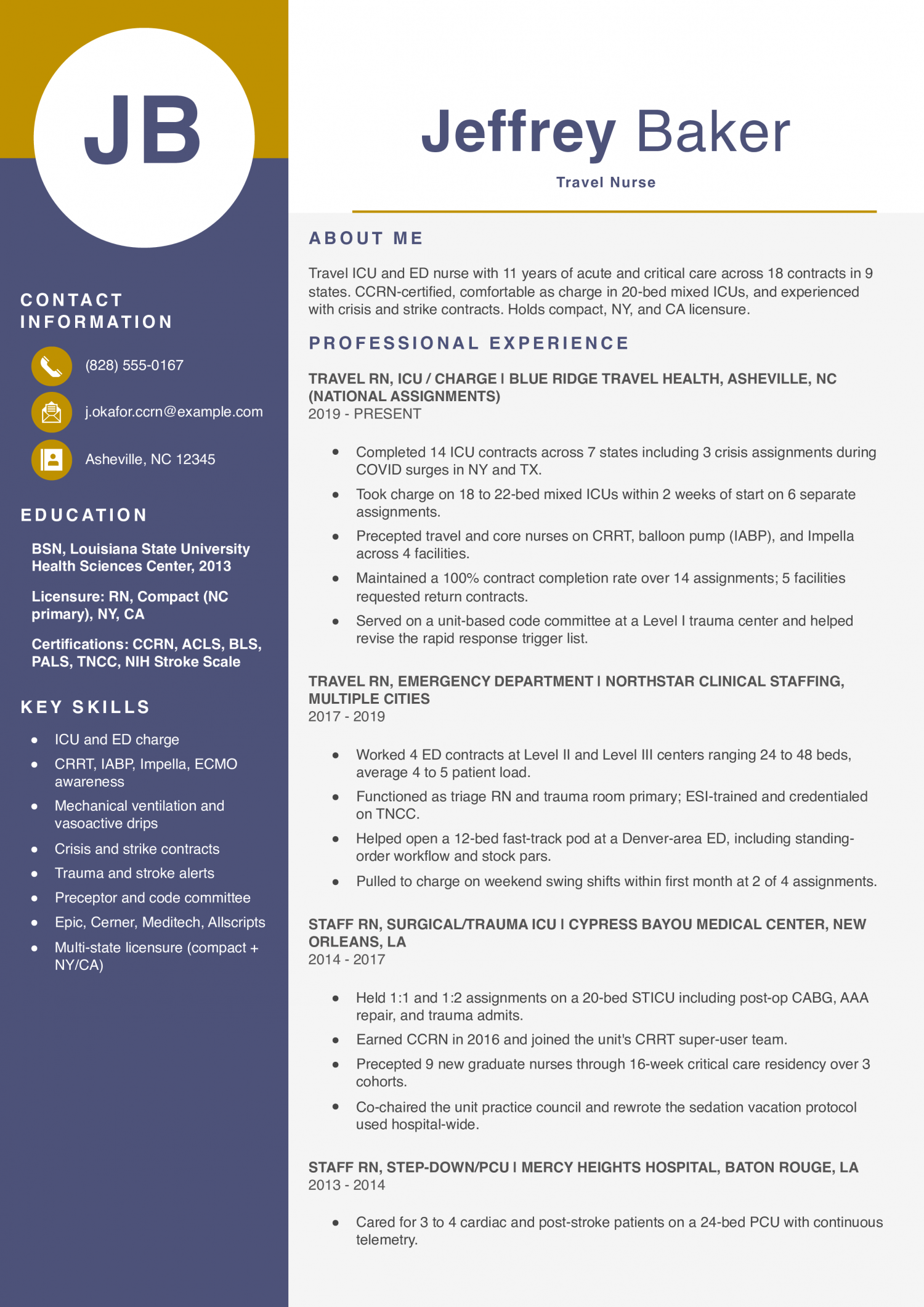
  • Numbers show real volume: 18 contracts in 9 states and a 100% completion rate tell agencies this nurse is dependable at scale.
  • High-acuity skills are specific: Naming CRRT, IABP, and Impella is more useful than ‘critical care experience’ for ICU recruiters.
  • Career arc makes sense: Staff ICU to travel ED to travel ICU shows growth into charge and crisis work, not just hopping for pay.

How to Write a Travel Nurse Resume

01 Open with what a license lookup can't show

A staffing recruiter can pull your NCSBN compact status in seconds. What they cannot see is the unit-level fit that decides the contract.

Put one line at the top that names a specialty edge another RN with the same license won’t carry. Examples: CRRT-trained ICU nurse, level-one trauma ER experience, or charge-nurse rotation on a 32-bed step-down.

Pair that line with active BLS, ACLS, and PALS expiration months. This single block tells a travel nurse recruiter you can be submitted today, not after a credentialing chase.

02 Quantify each assignment with unit specifics

Travel contracts read as duties without numbers. Nurse managers want to see acuity, ratios, and bed count to gauge whether you’ll hold up on their floor.

For each assignment, name the unit type, bed count, typical nurse-to-patient ratio, and the EMR. A strong line reads: 24-bed MICU, 1:2 ratio, Epic, vented and CRRT patients.

Most strong travel resumes also note float assignments and rapid-response participation. Bullets without a number tend to read as staff-nurse duties, which weakens the case for premium contract pay.

03 Group your clinical work by category

Cluster your bullets so a nurse manager can scan the fit in under a minute. Four categories cover most travel RN resumes.

Direct patient care covers assessments, medication administration, titrated drips, and ventilator management. Procedures cover central line care, chest tube management, code response, and rapid sequence intubation support.

Charting and handoff covers your EMR work in Epic, Cerner, or Meditech, plus SBAR handoff and bedside reporting. Preceptor and charge work covers float pool leadership, new-graduate orientation, and triage decisions during short staffing.

04 Place credentials high on page one

Travel nurse recruiters and hospital staffing managers verify credentials before they read your bullets. Bury the block on page two and your resume gets routed to a slower queue.

Build a credentials section directly under your summary. List your RN compact license with the state in good standing, plus BLS, ACLS, PALS, NIH Stroke Scale, and any TNCC or CCRN with month and year of expiration.

Do not print license numbers; agencies collect those on the application. Add immunization currency and a one-line note on COVID-19 and annual flu compliance so a credentialing specialist can clear you faster.

05 Cut staff-nurse filler that slows the read

Experienced travelers often carry a decade of staff bullets that no longer help. A staffing manager wants the last five to seven years of contract work in clear focus.

Cut generic duties like provided compassionate patient care, monitored vital signs, and documented in EMR. Those add nothing a license cannot already confirm.

Trim early roles older than ten years to a one-line entry with title, facility type, and dates. Keep the page-one real estate for assignment specifics, EMR range, and the specialty certifications that justify your bill rate.

ATS filters catch more travel nurse resumes than ever in 2026. The skills below come from our user-built travel nurse resumes. Specialty and EMR keywords like Epic and CRRT clear the first cut, and handoff and float-readiness language decides whether the resume advances.

Agency recruiters weigh hard skills first because credentialing depends on them. Nurse managers weigh soft skills second to judge how you’ll land on a new unit. Match the hard skills below against your target posting word for word, and use the soft skills as evidence backing your assignment bullets.

Soft Skills % of resumes with this skill
Communication skills 76%
Adaptability and flexibility 62%
Critical thinking 49%
Time management 39%
Teamwork and collaboration 33%

And here are the top hard skills showing up most often.

Hard Skills % of resumes with this skill
Patient care management 71%
Vital signs monitoring 57%
BLS/CPR certification 47%
IV administration 37%
Electronic health records 26%

Based on data from thousands of travel nurses’ resumes built on ResumeTemplates.com, May 2026.

Must Have on a Travel Nurse Resume

These are the must-haves hiring teams look for when scanning a travel nurse resume.

Licensure Requirements

Travel nursing runs on license portability. A compact RN license through the Nurse Licensure Compact lets you practice in all participating states with one credential, which is why most agencies require it before they submit you.

If your primary state of residence sits inside the compact, list your license as RN, multistate license, in good standing, with your home state named. Do not print the license number.

For non-compact states like California, Oregon, and New York, list each single-state license separately with the state and active status. Note any walk-through endorsement states where you can start practicing within days of application.

  • RN license, multistate compact, home state in good standing
  • Single-state licenses for any non-compact states you’ve worked
  • Endorsement applications in progress, with state and submission date
  • Active status confirmed through the NCSBN Nursys verification system

Continuing Education That Belongs on This Resume

Travel nurses cross state lines often, and CE requirements vary by state board. Listing recent CE on your resume tells a credentialing specialist you stay current without chasing renewal deadlines on contract.

Add a short CE block under credentials. Name the course, the issuing body, the contact hours, and the month and year completed.

Lead with CE that maps to high-demand contract types: sepsis management, stroke care, code blue simulation, and CRRT. These shorten credentialing for ICU and ER assignments.

  • Annual CE hours per home-state board of nursing requirements
  • Sepsis bundle and Surviving Sepsis Campaign updates
  • Stroke care CE aligned with primary and comprehensive stroke center standards
  • CRRT, ECMO, and ventilator management refreshers
  • Workplace violence prevention and trauma-informed care modules

EMR Systems Familiarity

EMR fluency is the second filter after licensure. Nurse managers want to know you can chart at full speed by the end of the first shift, not a week into orientation.

  • Epic, including ASAP for ER and ICU module for critical care
  • Cerner PowerChart, FirstNet, and SurgiNet
  • Meditech Expanse and 6.x in community and rural hospitals
  • Allscripts Sunrise and CPSI Evident in smaller acute-care settings
  • Pyxis MedStation and Omnicell automated dispensing

HIPAA and OSHA Compliance

Travel nurse resumes can leak patient information faster than staff RN resumes because you work across more facilities and units. Staffing managers notice when a bullet crosses that line.

Keep the Bullets Aggregate, Not Anecdotal

Never name a patient, diagnosis paired with a date, or a case detail specific enough to identify someone. Aggregate numbers and unit-level descriptions are safe.

Write managed 1:2 ICU assignment with vented and CRRT patients in a 24-bed MICU, not cared for a 58-year-old male on day three of CRRT. The first reads as competent; the second reads as a HIPAA risk.

Travel Nursing Credentials That Get You the Job

Travel nurse recruiters and hospital staffing managers read this list as a map of where your clinical work is heading. The certifications below tell them which specialty track and acuity tier you’ve invested in, which shapes the contracts they submit you for. List the issuing body and the month and year of expiration for each item.

  • Critical Care Registered Nurse (CCRN): Signals ICU acuity competency to nurse managers and unlocks higher bill rates on critical care contracts.
  • Certified Emergency Nurse (CEN): Tells ER staffing managers you can hold a triage assignment in a level-one or level-two trauma center.
  • Trauma Nursing Core Course (TNCC): Most level-one and level-two trauma centers require it for ER contracts, so listing it shortens the credentialing cycle.
  • NIH Stroke Scale (NIHSS): Required at primary and comprehensive stroke centers; current certification clears you for neuro and stroke-unit assignments.

Latest BLS Statistics for Travel Nurses

Registered nursing is one of the larger occupations tracked by BLS, which means the median absorbs a long tail of staff RNs on permanent assignments. Travel nurses tend to sit above that median because contract rates carry premiums for short notice and unfamiliar units, but the spread between specialties is wide.

To position above the median on your resume, lead with the acuity tier you carry and the EMR fluency that lets you start charting on day one, not the years you’ve held an RN license.

$93,600 National median annual
$98,430 National mean annual
$66,030 Entry-tier floor (10th percentile)
$135,320 Top-decile ceiling (90th percentile)
3,282,010 Travel Nurses in the U.S.
Where you stand

Entry tier

$66,030 to $93,600 At the entry tier, lead with your compact license, BLS and ACLS dates, and the specialty unit from your staff role.

Mid band

$93,600 to $135,320 At the mid band, your resume needs to show three to six completed contracts with ratios, bed counts, and EMR range.

Top decile

$135,320+ At the top decile, lead with CCRN or CEN, crisis and rapid-response contracts, charge rotations, and Epic plus Cerner fluency.

Top-paying states

# State Avg. Annual
1 California $140,330
2 Hawaii $136,320
3 Oregon $123,990
4 Washington $112,180
5 Alaska $110,690
6 New York $105,600
7 District of Columbia $104,550
8 New Jersey $102,730
9 Nevada $101,990
10 Massachusetts $101,970

Highest-employment states

# State Workers Median
1 California 326,720 $140,330
2 Texas 261,050 $90,010
3 Florida 218,100 $82,850
4 New York 204,120 $105,600
5 Pennsylvania 146,840 $87,610
Source: U.S. Bureau of Labor Statistics, OEWS 2024 release (SOC 29-1141).
Written by professional resume writers and loved by hiring managers

Resume Templates offers HR approved resume templates to help you create a professional resume in minutes. Choose from several template options and even pre-populate a resume from your profile.

Frequently Asked Questions

How should you list travel nursing assignments on a resume?

Group all travel contracts under one heading per agency. Under that, list each assignment as a sub-entry.

Each sub-entry should name the facility type, city and state, unit, contract dates, and the EMR. Add bed count and nurse-to-patient ratio in the first bullet.

This format keeps the page short and lets a staffing manager scan five contracts in under a minute.

Should you list your RN license number on the resume?

No. Print the state and that the license is active and in good standing, plus your compact or multi-state status.

Agencies collect the actual number on their credentialing application. Posting it on a public resume creates an identity-theft risk with no recruiting upside.

What's the best resume format for an experienced travel nurse?

Use reverse-chronological order with a credentials block high on page one. Lead with a three-line summary that names your top specialty and EMR range.

Follow with credentials, then assignments grouped by agency. Functional and hybrid formats hide the contract history that staffing managers most want to verify.

How do you handle gaps between travel contracts on the resume?

Short gaps of four to eight weeks between contracts are normal. Agency recruiters expect them and will not flag them.

For gaps longer than three months, add a one-line note: planned time between assignments, per-diem work at a named facility, or family leave.

This keeps the timeline clean without inventing filler roles that fall apart in a reference check.

Which resume template works best for a travel nurse?

For a travel nurse, an ATS-friendly template is the safest pick, because it puts your certifications and experience where a hiring manager scans first. A basic template is a solid alternative. Whichever you choose, keep the formatting clean and easy to parse: clear section headings, a standard font, and no graphics a parser can choke on.

Rate this article

Travel Nurse Resume

Average Rating

4.1/5 stars with 167 reviews

You have given 0 Star(s)
4.1/5 stars with 167 reviews
Andrew Stoner

Executive Resume Writer and Career Coach

Andrew Stoner is an executive career coach and resume writer with 17 years of experience as a hiring manager and operations leader at two Fortune 500 Financial Services companies, and as the career services director at two major university business schools.