Tip !

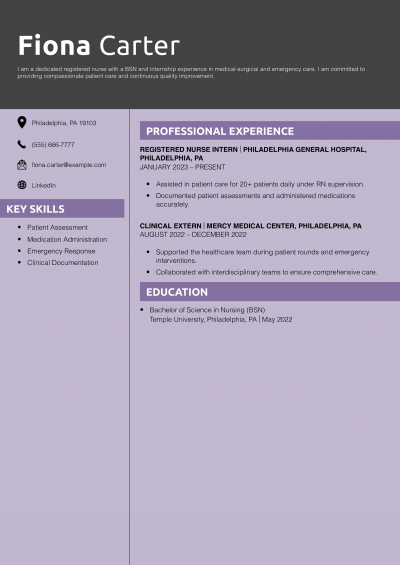
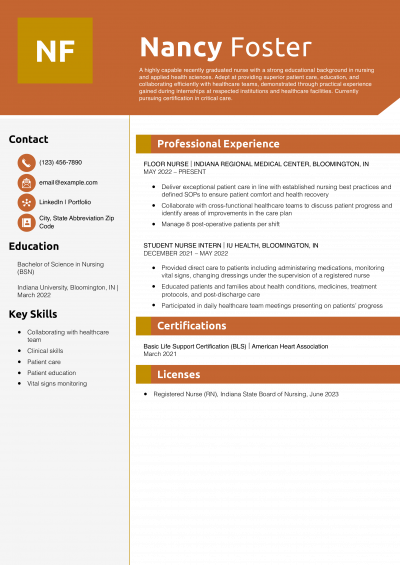
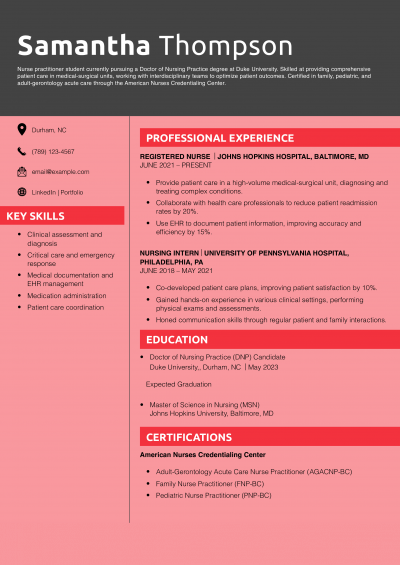
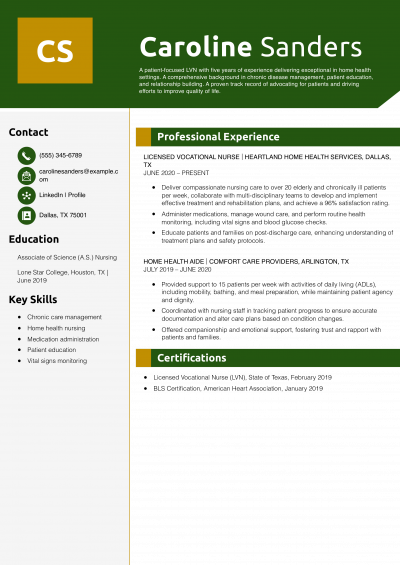
A clean clinical rotations block with sites, specialties, and hours is what gets nursing student resumes past the nurse recruiter's first screen; quantified patient loads under preceptor supervision are what make them readable enough to advance.

Andrew Stoner , Executive Resume Writer and Career Coach

Why this resume works

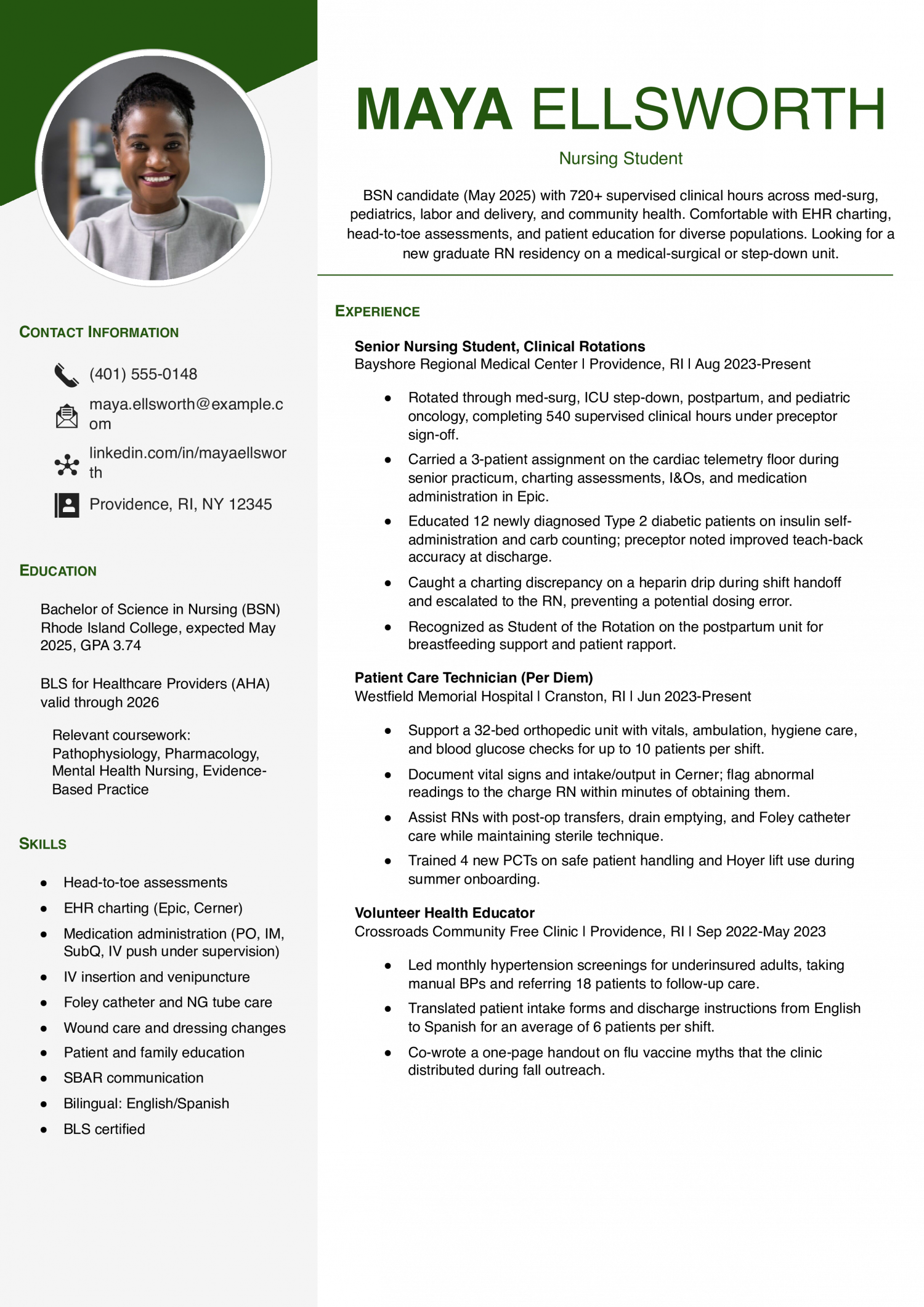
  • Clinical hours stated up front: The 720+ supervised hours number tells hiring managers exactly how much hands-on time this candidate has, which is the first thing nurse residency reviewers look for.
  • A real safety catch: Spotting the heparin charting discrepancy shows critical thinking and a safety mindset, not just task completion.
  • Skills match what new grad units need: The skills list pairs core RN tasks (assessments, IVs, Foleys) with EHR systems most hospitals actually use, so it lines up with new grad job descriptions.

Nursing Student Example

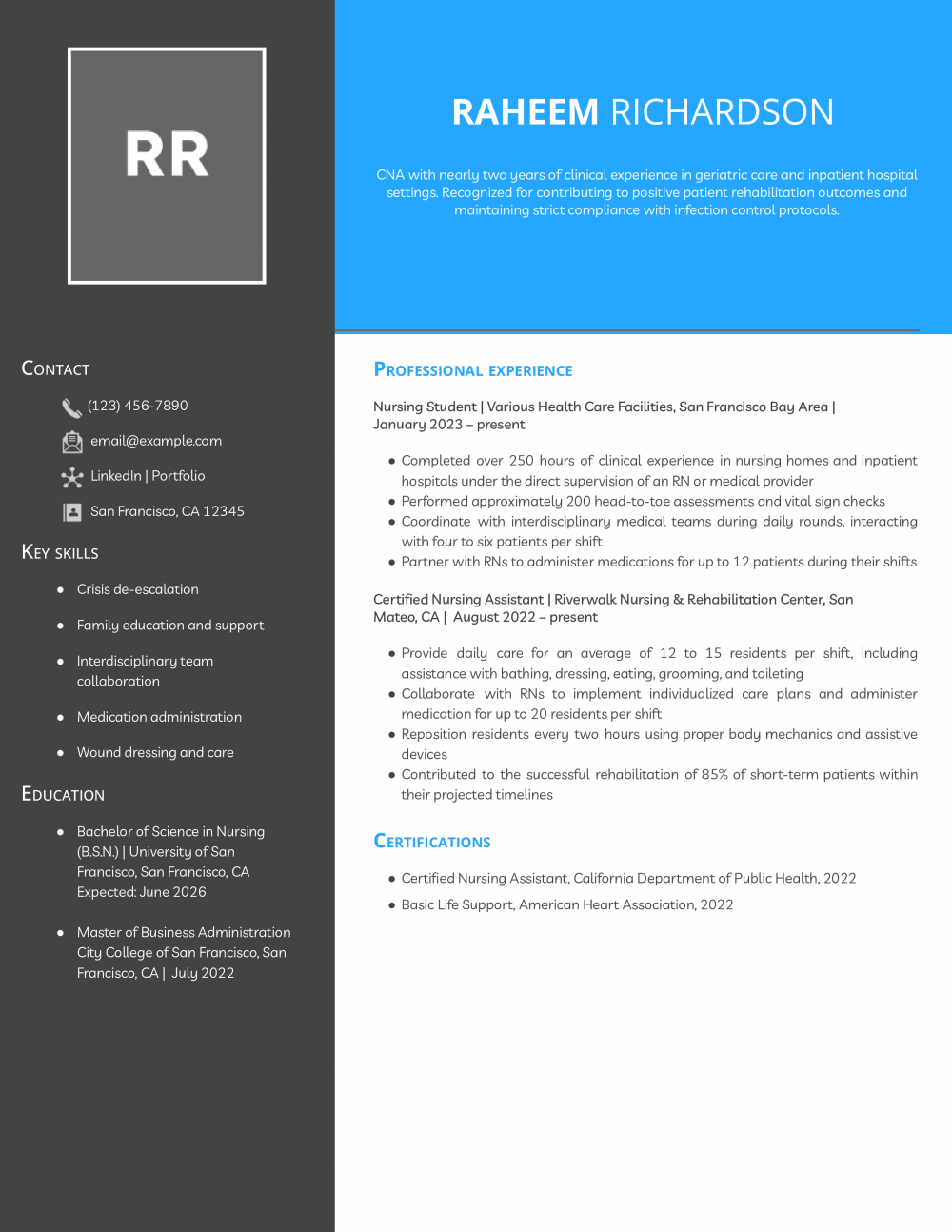
This template fits a BSN or ADN student approaching graduation with clinical rotations logged, BLS in hand, and Epic or Cerner exposure from a hospital site. The resume needs to prove rotation breadth, patient-load familiarity under preceptor supervision, and NCLEX eligibility timing.

Why this resume works

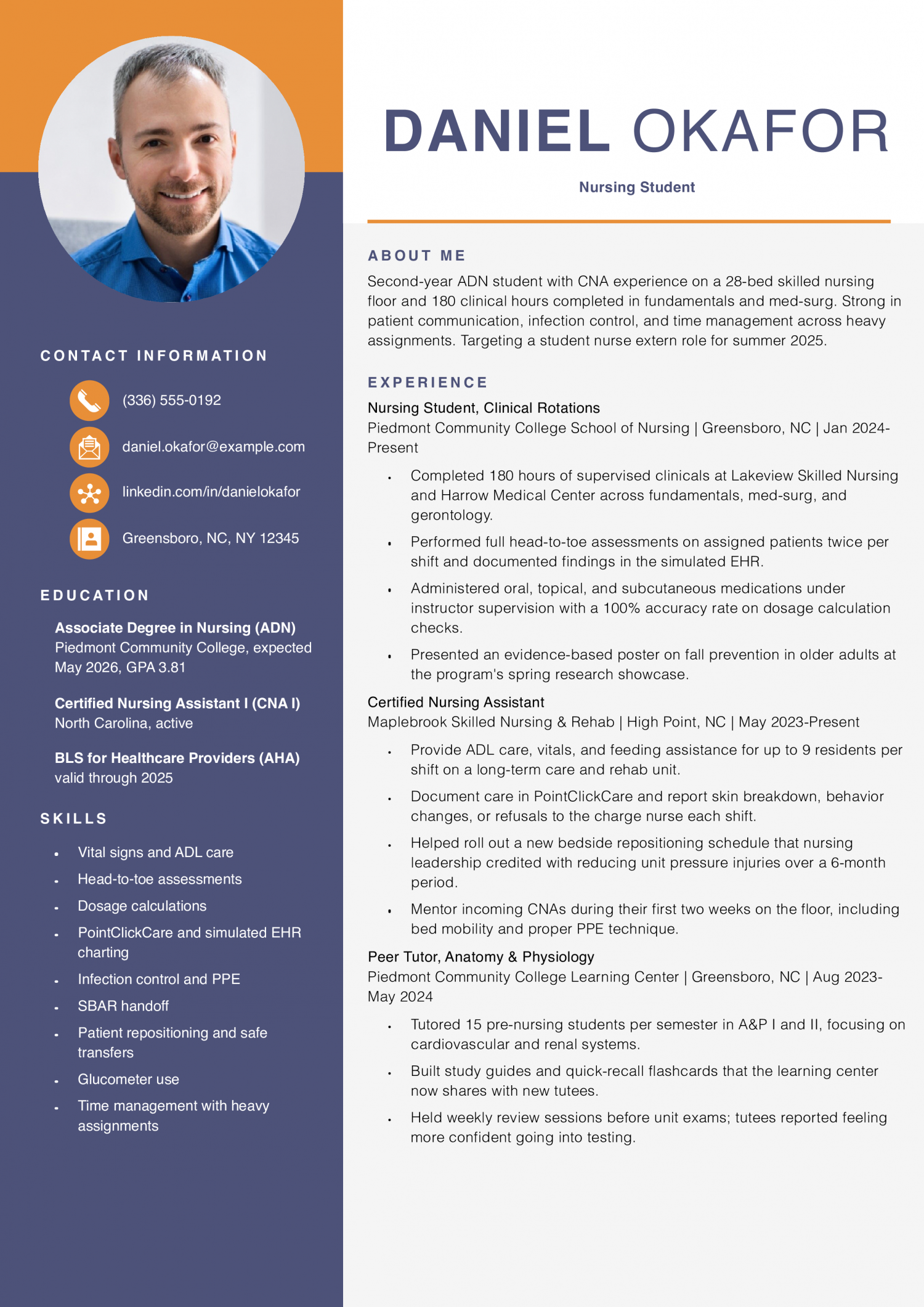
  • CNA work pairs well with nursing school: Showing active CNA hours alongside clinical rotations tells reviewers the candidate is already comfortable at the bedside, which matters for extern and new grad applications.
  • A concrete unit-level win: Helping launch a repositioning schedule tied to fewer pressure injuries shows initiative beyond assigned tasks.
  • Teaching shows mastery: Tutoring A&P signals strong content knowledge in subjects that map directly to pathophysiology and pharmacology coursework.

How to Write a Nursing Student Resume

01 Open with the metric a nurse recruiter would use to size you up

Lead your summary with rotation hours, specialty count, and graduation timing. Nurse recruiters read those three numbers as your readiness for a residency cohort.

Name your BSN or ADN program, your expected graduation month, and your total clinical hours so far. Add your highest-acuity rotation and your BLS status on the same line.

A summary that opens with “Senior BSN student, 540 clinical hours across five specialties, BLS-certified, NCLEX-eligible May 2026” reads faster than three sentences about passion for patient care.

02 Quantify rotations, patient loads, and skills

Strong nursing student bullets carry numbers. Name patient loads per shift, rotation hours per site, and the skills you logged under preceptor supervision.

Med-surg rotations often mean three to five patients per shift; ICU clinicals usually mean one to two. Bullets without a number tend to read as duties, not competency.

Track procedures you have performed or assisted with: IV starts, Foley insertions, NG tubes, and medication passes through Epic MAR. Recruiters scan for those counts first.

03 Group clinical work by specialty and setting

Cluster your rotations into three or four categories so a nurse manager can read your exposure in one pass.

Useful groupings: med-surg and telemetry, critical care and step-down, maternal-child and pediatrics, and community or psychiatric mental health. Name the host facility, the unit, and the hours.

Add a separate skills block for technical work like blood draws, wound care, sterile dressing changes, and EHR charting in Epic or Cerner. Keep simulation lab hours in their own line.

04 Place credentials and BLS on page one

Build a credentials block at the top of page one. Include BLS through the American Heart Association, your expected NCLEX-RN date, and your state of intended licensure.

List your state and “license pending” rather than a license number. State boards advise against publishing the number on a resume.

Add CNA or PCT certification if you hold one, plus any Stop the Bleed, ACLS, or PALS coursework. Nurse recruiters screen for these before they read bullets.

05 Close with education, honors, and clinical projects

End with your BSN or ADN program, expected graduation, GPA if 3.5 or higher, and relevant coursework like pathophysiology and pharmacology.

Add Sigma Theta Tau membership, Dean’s List terms, and any nursing student association roles. Capstone projects, evidence-based practice posters, and community health initiatives belong here.

Round out the page with patient care experience as a CNA, PCT, or unit secretary, plus volunteer work at clinics, blood drives, or hospice programs.

Five years ago, a nursing student resume read like a syllabus reprint. Based on data from our user-built resumes in 2026, the mix has shifted toward charted patient loads, Epic exposure, and named rotation specialties. Nurse recruiters weigh hard skills first to confirm clinical readiness, then read soft skills like handoff communication as evidence inside your rotation bullets.

Match the hard skills below against the residency posting you want, and use the soft skills to frame the bullets under each rotation.

Soft Skills % of resumes with this skill
Communication 78%
Teamwork 68%
Critical thinking 46%
Time management 39%
Compassion 33%

And here are the top hard skills showing up most often.

Hard Skills % of resumes with this skill
Patient assessment 72%
CPR and BLS certification 64%
Medication administration 46%
IV therapy 37%
Electronic health records 33%

Based on data from thousands of nursing students’ resumes built on ResumeTemplates.com, May 2026.

Must Have on a Nursing Student Resume

The items below are what separate a nursing student resume from one that gets put back in the pile.

Licensure Requirements

Residency postings screen for NCLEX eligibility and state licensure first. Make both visible in your credentials block on page one.

What to List, What to Hold Back

List your BSN or ADN program, expected graduation month, and your expected NCLEX-RN test date. If you have applied to a state board for authorization to test, note “ATT pending” with the state.

Name the state of intended licensure. If you plan to apply in a Nurse Licensure Compact state, list “multi-state license, compact state” once you are licensed.

Do not publish your license number. List the state and “license in good standing” once you pass; the issuing board and number go on the employer application.

  • Expected NCLEX-RN test date and state of application
  • Authorization to Test (ATT) status if received
  • State of intended licensure and compact status if applicable
  • BLS provider card with AHA issuance and expiration month
  • CNA or PCT license with state and expiration if held

Continuing Education That Belongs

Continuing education for a nursing student means coursework, simulation lab hours, and conference attendance that go beyond your degree plan. List items with the provider, date, and contact hours.

Nurse recruiters read continuing education as evidence you are building toward a specialty before you graduate.

Group these items under a “Continuing Education” header below your certifications block. Keep entries from the last two years.

  • Stop the Bleed training through the American College of Surgeons
  • ECG and rhythm interpretation workshops
  • Simulation lab hours with high-fidelity manikins
  • AACN or NSNA conference attendance and poster sessions
  • Trauma-informed care or substance use disorder workshops

HIPAA and OSHA Compliance

Your clinical rotation bullets describe real patients. Write them in a way that respects HIPAA before a nurse recruiter ever opens the file.

Never name the patient, room number, medical record number, or any direct identifier in a bullet. Describe the case by acuity, diagnosis category, and your role.

A bullet like “Managed care for a post-op CABG patient on telemetry under preceptor supervision” reads as competent. A bullet that names the patient or unit room reads as a compliance risk.

List the host hospital as your rotation site, not as your employer, and confirm with your nursing school whether the facility name can be published.

  • Strip patient names, MRNs, and room numbers from every bullet
  • Describe cases by acuity, diagnosis category, and your scope of action
  • Reference units by type (med-surg, ICU) rather than specific bed assignments
  • Confirm with your program whether host facility names can be published

Nursing Credentials That Get You the Job

BLS and an expected NCLEX-RN date keep you eligible for a residency posting. The certifications below are what move a nursing student resume from the qualified-but-typical stack into a nurse recruiter’s shortlist. List the issuing body, level, and expiration month on one line.

  • Basic Life Support (BLS) - American Heart Association: The baseline credential every hospital residency requires; list the AHA provider card and expiration so recruiters confirm it in one pass.
  • Certified Nursing Assistant (CNA): Signals paid bedside hours before graduation, which nurse managers read as a faster ramp on patient care and EHR charting.
  • Advanced Cardiovascular Life Support (ACLS): Uncommon for students but a strong signal for ICU, ED, and step-down residency tracks; list it if you completed the course during a senior practicum.
  • Pediatric Advanced Life Support (PALS): Move-the-needle credential for applicants targeting pediatric, NICU, or PICU residency cohorts; pair with your pediatric rotation hours.
Written by professional resume writers and loved by hiring managers

Resume Templates offers HR approved resume templates to help you create a professional resume in minutes. Choose from several template options and even pre-populate a resume from your profile.

Frequently Asked Questions

How do I write a nursing student resume with no RN experience yet?

Lead with clinical rotations as your experience section. Name the host hospital, unit, dates, and hours per rotation.

Write bullets that quantify patient loads and skills performed under preceptor supervision. Add CNA, PCT, or volunteer patient-care work below your rotations.

Should I list my nursing license number on my resume?

No. List your state and "RN license pending" with your expected NCLEX-RN date instead.

State boards of nursing advise against publishing the license number on a resume. Recruiters will request it on the application form when they need it.

What GPA should I put on a new grad nursing resume?

List your GPA if it is 3.5 or higher. Place it on the education line next to your BSN or ADN program.

If your nursing-major GPA is stronger than your cumulative GPA, list both and label them clearly.

How long should a nursing student resume be?

One page. Nurse recruiters screen large residency applicant pools and read one page front-to-back.

Use a second page only if you have extensive prior healthcare experience as a paramedic, medic, or CNA with multiple years of bedside hours.

Which resume template works best for a nursing student?

For a nursing student, an ATS-friendly template is the safest pick, because it puts your certifications and experience where a hiring manager scans first. A basic template is a solid alternative. Whichever you choose, keep the formatting clean and easy to parse: clear section headings, a standard font, and no graphics a parser can choke on.

Rate this article

Nursing Student Resume

Average Rating

4.5/5 stars with 105 reviews

You have given 0 Star(s)
4.5/5 stars with 105 reviews
Andrew Stoner

Executive Resume Writer and Career Coach

Andrew Stoner is an executive career coach and resume writer with 17 years of experience as a hiring manager and operations leader at two Fortune 500 Financial Services companies, and as the career services director at two major university business schools.