Nurse managers decide whether to forward a new grad resume by the top third of page one; if NCLEX status, BLS, and rotation specialties aren't visible there, the file gets passed over for the next one in the stack.
Featured Example
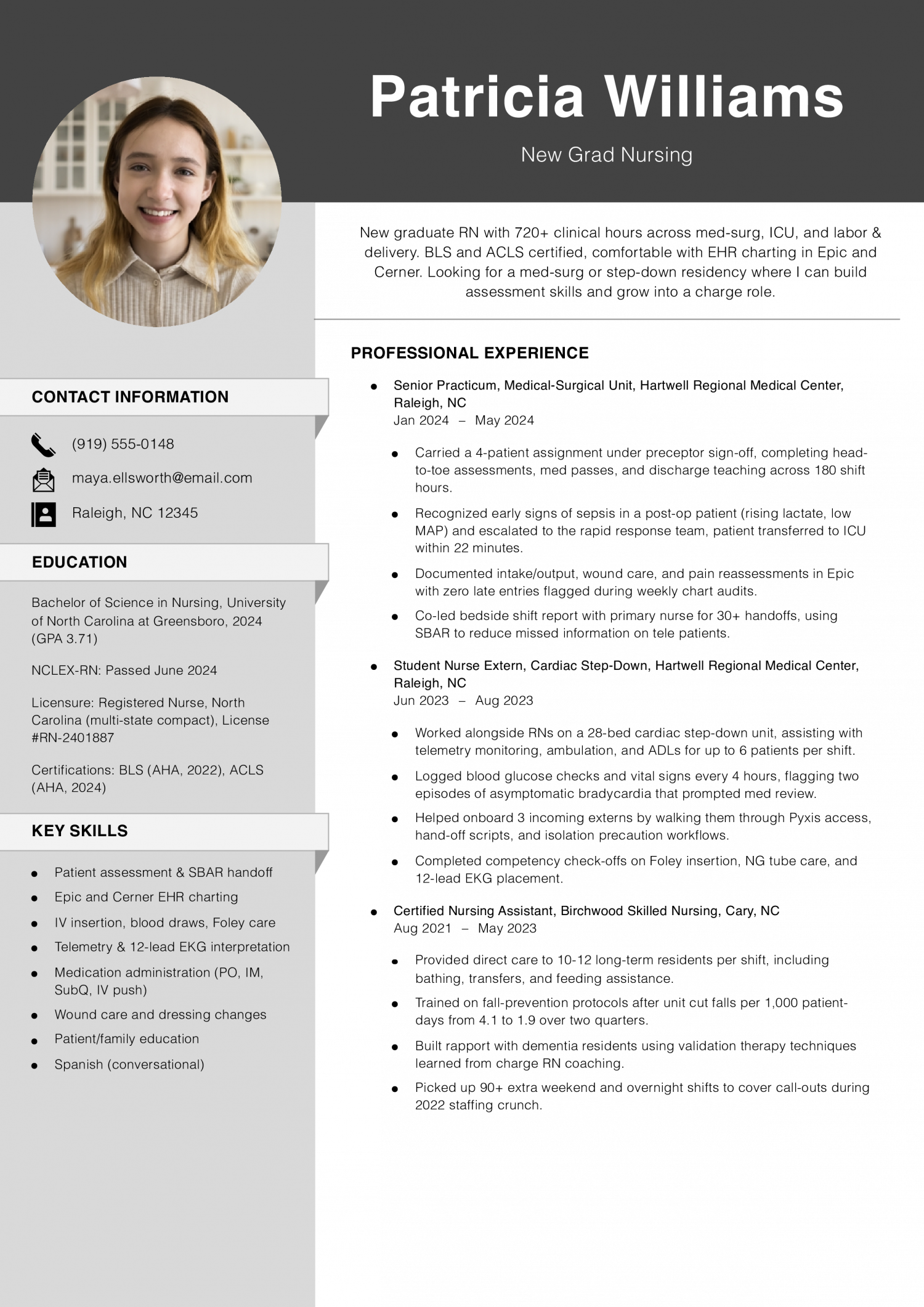
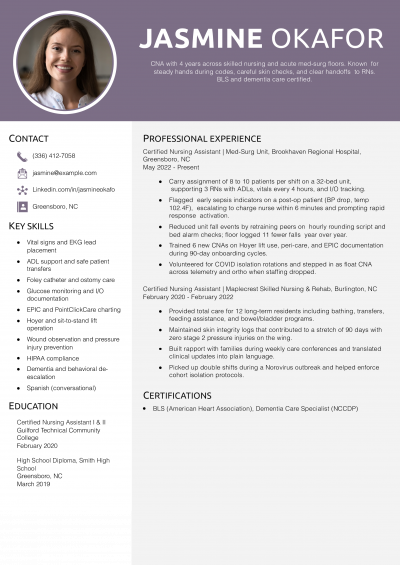
- Caught a real clinical change: The sepsis recognition bullet shows the kind of bedside judgment hiring managers want to see from a new grad.
- Hours and patient loads are specific: Numbers like 720 clinical hours and 4-patient assignments give recruiters a concrete read on her readiness.
- Built up to nursing, not jumped: Two years as a CNA before externship and practicum tells a clean story of someone who has been in patient care for a while.
New Grad RN Example
The New Grad RN archetype has clinical hours and an NCLEX date but no paid bedside experience yet. This resume needs to prove safe practice in supervised rotations, name the EHR you charted in, and front-load BLS plus license status.
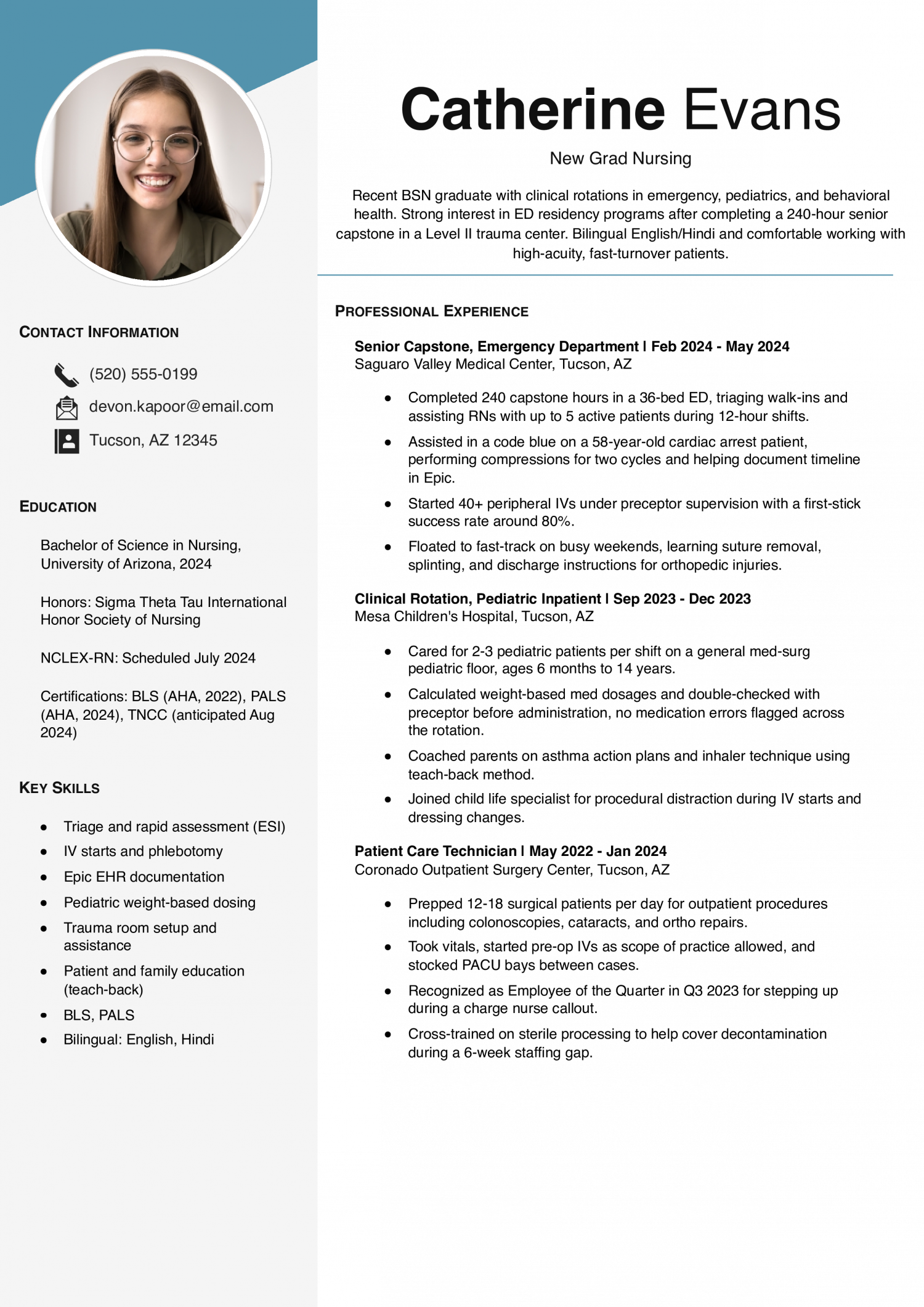
- Points to a clear specialty: Devon names ED residency as the goal and the capstone, certifications, and PCT work all back that up.
- Shows real procedure counts: 40+ IV starts with an 80% first-stick rate is the kind of detail ED nurse managers actually look for.
- Bilingual is called out up top: Listing Hindi in both the summary and skills makes the language asset easy to spot in a 6-second scan.
Text Version New Grad Nursing
PROFESSIONAL SUMMARY
New graduate RN with 720+ clinical hours across med-surg, ICU, labor & delivery, and community health. NCLEX-RN passed June 2024. BLS and ACLS certified, comfortable with Epic and Cerner. Targeting a med-surg or step-down residency with the goal of moving into charge nurse and eventually CNL within five years.
EXPERIENCE
- Carried a 4-patient assignment under preceptor sign-off, completing head-to-toe assessments, med passes, and discharge teaching across 180 shift hours.
- Recognized early signs of sepsis in a post-op patient and escalated to the rapid response team, patient transferred to ICU within 22 minutes.
- Documented intake/output, wound care, and pain reassessments in Epic with zero late entries flagged during weekly chart audits.
- Co-led bedside shift report for 30+ handoffs using SBAR.
- Contributed to unit QI project on CAUTI prevention, helping update Foley removal checklist.
- Rotated 90 hours in a 16-bed medical ICU, observing vent management, titration of vasopressors, and family conferences for end-of-life care.
- Completed 90 hours on L&D, assisted with 12 vaginal deliveries and 4 C-sections including newborn assessments and APGAR scoring.
- Practiced fetal monitor strip interpretation and reviewed strips with preceptor during 6 shift debriefs.
- Charted in Cerner with focus on hourly neuro checks and Glasgow Coma Scale scoring.
- Worked alongside RNs on a 28-bed cardiac step-down unit, assisting with telemetry monitoring, ambulation, and ADLs for up to 6 patients per shift.
- Logged blood glucose checks and vital signs every 4 hours, flagging two episodes of asymptomatic bradycardia that prompted med review.
- Helped onboard 3 incoming externs by walking them through Pyxis access and hand-off scripts.
- Completed competency check-offs on Foley insertion, NG tube care, and 12-lead EKG placement.
- Provided direct care to 10-12 long-term residents per shift, including bathing, transfers, and feeding assistance.
- Trained on fall-prevention protocols after unit cut falls per 1,000 patient-days from 4.1 to 1.9 over two quarters.
- Built rapport with dementia residents using validation therapy techniques learned from charge RN coaching.
- Picked up 90+ extra weekend and overnight shifts during 2022 staffing crunch.
- Volunteered 6 hours per month rooming patients, taking vitals, and assisting with chronic disease check-ins.
- Interpreted intake forms in Spanish for 15+ Spanish-speaking families per quarter.
- Helped coordinate seasonal flu clinic that vaccinated 240 uninsured residents in fall 2023.
EDUCATION
- Bachelor of Science in Nursing, University of North Carolina at Greensboro, 2024 (GPA 3.71)
- Dean’s List: Fall 2022, Spring 2023, Fall 2023
- NCLEX-RN: Passed June 2024
- Licensure: Registered Nurse, North Carolina (multi-state compact), License #RN-2401887
- Certifications: BLS (AHA, 2022), ACLS (AHA, 2024)
SKILLS
- Patient assessment & SBAR handoff
- Epic and Cerner EHR charting
- IV insertion, blood draws, Foley care
- Telemetry & 12-lead EKG interpretation
- Medication administration (PO, IM, SubQ, IV push)
- Wound care and dressing changes
- Code blue and rapid response participation
- Patient/family education and teach-back method
- Fall and CAUTI prevention protocols
- Spanish (conversational)
How to Write a New Grad Nursing Resume
01 Open with the metric a nurse manager would use to size you up
Your summary should not lead with personality traits. Lead with the numbers a nurse manager uses to gauge readiness.
Name your degree (BSN or ADN), graduation month, NCLEX status, and total clinical rotation hours. Add the two specialties where you logged the most time.
A strong opener reads: BSN graduate, May 2026, NCLEX-RN scheduled for July, with 720 clinical hours across med-surg and step-down. That tells the manager in one line whether you fit the unit.
02 Quantify rotations, patient loads, and procedures
Most strong new grad resumes turn rotations into countable work. Name patient loads, shift length, and the procedures you performed under supervision.
Bullets without a number tend to read as duties. Write “Cared for a 4-patient med-surg assignment across 12-hour shifts” instead of “Provided patient care.”
Name two or three realistic metrics per rotation: patient ratio, charting volume in Epic, medication passes, or admissions and discharges you supported. Recruiters scan for these first.
03 Group rotations by specialty, not by semester
Reorganize your clinical section around three to five specialty buckets: med-surg, critical care, maternal-child, mental health, and community.
Under each bucket, list the facility, hours, and two bullets covering the patient population and the skills you used. Foley insertion, IV starts, wound care, and discharge teaching all belong here.
This format lets a pediatric hiring manager find your peds hours in two seconds, which matters more than a chronological semester layout.
04 Front-load credentials, license, and EHR exposure
Put your credentials block under the contact line, above the summary. Nurse managers and residency directors need to see license status before they read about clinicals.
List your state and “RN license in good standing” or “NCLEX-RN candidate, [test date].” Add BLS through the American Heart Association and any ACLS, PALS, or NRP you hold.
Name the EHR you charted in (Epic, Cerner, Meditech) on a separate line. Charting fluency removes a real training cost from the manager’s onboarding math.
05 Close with education and one differentiator
End with your nursing program, graduation date, GPA if 3.5 or higher, and any honors like Sigma Theta Tau or dean’s list.
Add one section that separates you from the cohort. A capstone project, CNA or PCT work hours, Spanish fluency, or a preceptorship on the unit you’re applying to all qualify.
Skip high school, unrelated retail jobs older than three years, and objective statements. Those slots are better spent on a second clinical bullet.
Most Popular Skills on New Grad Nursing Resumes for 2026
Based on data from our user-built new grad nursing resumes, the skills below are what clear a nurse recruiter’s first scan. Hard skills carry the credential and EHR check; soft skills back up the bullets that prove safe practice on a busy floor.
| Soft Skills | % of resumes with this skill |
|---|---|
| Communication | 67% |
| Teamwork | 52% |
| Compassion | 49% |
| Critical thinking | 35% |
| Time management | 26% |
And here are the top hard skills showing up most often.
| Hard Skills | % of resumes with this skill |
|---|---|
| Patient assessment | 75% |
| Medication administration | 50% |
| Electronic health records | 49% |
| Basic life support | 38% |
| IV insertion | 29% |
Based on data from thousands of new graduate nurses’ resumes built on ResumeTemplates.com, May 2026.
Must Have on a New Grad Nursing Resume
Before a new grad nursing resume gets a closer read, hiring teams check for a short list of essentials.
Licensure Requirements
Nurse recruiters verify license status before reading anything else. Your resume needs to make that verification take three seconds.
List your license status under the contact line, not buried at the bottom. Use the state, the credential, and the words “in good standing” once you pass NCLEX.
If you have not tested yet, write “NCLEX-RN candidate” with the scheduled test month. Update the line the week you pass.
Do not publish your license number on the resume. State boards of nursing recommend providing the number only on application forms when asked.
- Pre-NCLEX: BSN, [School], May 2026. NCLEX-RN candidate, July 2026.
- Post-NCLEX: RN, Texas, in good standing.
- Compact state: RN, multistate license (NLC), Tennessee, in good standing.
- Pending endorsement: RN, Ohio (active); applying for California by endorsement, expected August 2026.
Continuing Education That Strengthens a New Grad Application
Most state boards do not require CE during your first license period. Voluntary CE before your first staff job signals direction.
Pick CE that maps to the unit type you want. ECG interpretation hours strengthen a tele application; trauma nursing core course (TNCC) strengthens an ED application.
List the course title, the issuing body, the contact hours, and the year. Skip generic webinars with no contact-hour credit.
- ECG and Pharmacology for Telemetry (AACN, 8 contact hours, 2026)
- Trauma Nursing Core Course (TNCC, ENA, 16 contact hours, 2026)
- Stroke Certified Registered Nurse review (ANCC self-study, 2026)
- Wound, Ostomy and Continence basics (WOCN, 6 contact hours, 2026)
- De-escalation and behavioral health response training (CPI, 2026)
EHR Systems to Name on Your Resume
Hospitals spend weeks and thousands of dollars training new grads on the EHR. If you charted in their system during clinicals, say so by brand name on page one.
-
Epic (most US academic medical centers and large health systems)
-
Cerner (Oracle Health) for community hospitals and VA facilities
-
Meditech for community and rural hospitals
-
Allscripts and athenahealth for outpatient and clinic rotations
-
PointClickCare for long-term care and skilled nursing rotations
HIPAA and OSHA Compliance
Bullets that name a patient, room number, or identifying detail can disqualify you on the spot. Nurse recruiters notice.
Write rotation bullets in aggregate. “Cared for a four-patient med-surg assignment” is safe; “cared for Mr. R in room 412” is not.
Do not paste screenshots of charting, hand-off sheets, or care plans into a portfolio. Even with names redacted, the file metadata can carry PHI.
- Use patient counts and acuity levels, not names or initials.
- Refer to facilities by name only if the rotation site is public knowledge (teaching hospital affiliations).
- Keep capstone project descriptions general; name the population and intervention, not the individuals.
- If asked about a clinical scenario in an interview, lead with the assessment and intervention, not identifying details.
Nursing Credentials That Get You the Job
Nurse managers read this list as a map of where your clinical interests are heading. The certifications below tell them which specialty track (critical care, peds, oncology) you’ve invested in before your first staff role. List the issuing body and the month and year earned.
-
Basic Life Support (BLS): Required by nearly every hospital before orientation; list the American Heart Association as issuer and the expiration date.
-
Advanced Cardiac Life Support (ACLS): Signals readiness for ICU, ED, telemetry, and step-down residency tracks; many programs prefer it before you start.
-
Pediatric Advanced Life Support (PALS): Earns a second look on peds, PICU, and family-practice clinic resumes; pair it with your peds rotation hours.
-
Neonatal Resuscitation Program (NRP): Carries weight on labor-and-delivery, mother-baby, and NICU applications; list completion year and AAP as issuer.
Latest BLS Statistics for New Graduate Nurses
The 90th-percentile registered nurse out-earns the median by a wide margin, which tells you the market rewards specialty, shift differential, and metro concentration more than years of bedside time. New grads who target high-acuity units and high-cost metros move toward that band faster than those who stay generalist. Position your resume around the specialty you want to grow into, not the rotations you happened to be assigned.
Lead with the unit type, EHR fluency, and any certification that maps to that track.
Entry tier
$66,030 to $93,600 At this tier, your resume needs to show NCLEX status, BLS, and rotation hours by specialty, and lead with the credentials block.Mid band
$93,600 to $135,320 At this tier, lead with the unit type you want (med-surg, tele, peds), Epic or Cerner charting, and ACLS or PALS.Top decile
$135,320+ At this tier, lead with high-acuity rotation hours, a capstone in ICU or ED, and any CNA or tech experience on the target unit.Top-paying states
| # | State | Avg. Annual |
|---|---|---|
| 1 | California | $140,330 |
| 2 | Hawaii | $136,320 |
| 3 | Oregon | $123,990 |
| 4 | Washington | $112,180 |
| 5 | Alaska | $110,690 |
| 6 | New York | $105,600 |
| 7 | District of Columbia | $104,550 |
| 8 | New Jersey | $102,730 |
| 9 | Nevada | $101,990 |
| 10 | Massachusetts | $101,970 |
Highest-employment states
| # | State | Workers | Median |
|---|---|---|---|
| 1 | California | 326,720 | $140,330 |
| 2 | Texas | 261,050 | $90,010 |
| 3 | Florida | 218,100 | $82,850 |
| 4 | New York | 204,120 | $105,600 |
| 5 | Pennsylvania | 146,840 | $87,610 |
Resume Templates offers HR approved resume templates to help you create a professional resume in minutes. Choose from several template options and even pre-populate a resume from your profile.
Frequently Asked Questions
Yes. Most hospital new grad residencies open applications six to nine months before cohort start dates.
They expect to hire NCLEX-eligible candidates and onboard once you pass. Write "NCLEX-RN candidate, [test date]" directly under your contact line.
Once you pass, swap that line for "RN, [State], in good standing" within a week. Do not list the license number on the resume itself.
Treat clinical rotations as your experience section. They are the closest proxy a nurse manager has to bedside performance.
Group them by specialty rather than semester. Name the teaching hospital, total hours, patient population, and the procedures or assessments you performed under preceptor supervision.
Add SBAR handoffs, medication passes, and EHR charting as concrete bullets. "Documented assessments and I&Os in Epic for a four-patient assignment" beats "Gained clinical experience."
Leave the GPA off. There is no rule that you must list it, and a 3.2 next to your degree pulls focus from your rotations.
List the degree, school, graduation date, and any honors that stand alone (dean's list, Sigma Theta Tau).
Use the saved line for a capstone, preceptorship on a target unit, or a certification like ACLS that strengthens the application.
Yes. If both your home state and the target state belong to the Nurse Licensure Compact and your license is multistate, you can practice across state lines without a second license.
If the target state is not a compact state, write "Applying for [State] RN licensure by endorsement, expected [month]" on the resume.
Nurse recruiters know endorsement timelines and will not screen you out, but they need to see the plan in writing.
For a new graduate nurse, an ATS-friendly template is the safest pick, because it puts your certifications and experience where a hiring manager scans first. A basic template is a solid alternative. Whichever you choose, keep the formatting clean and easy to parse: clear section headings, a standard font, and no graphics a parser can choke on.