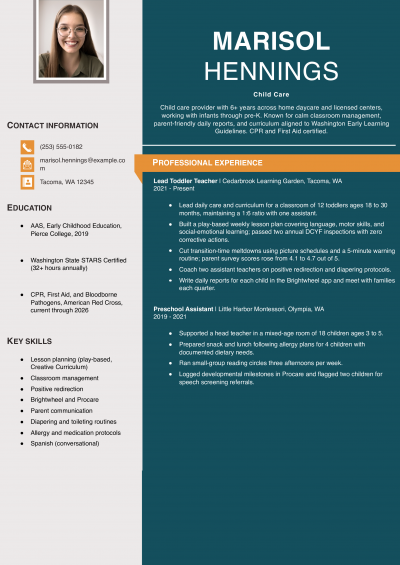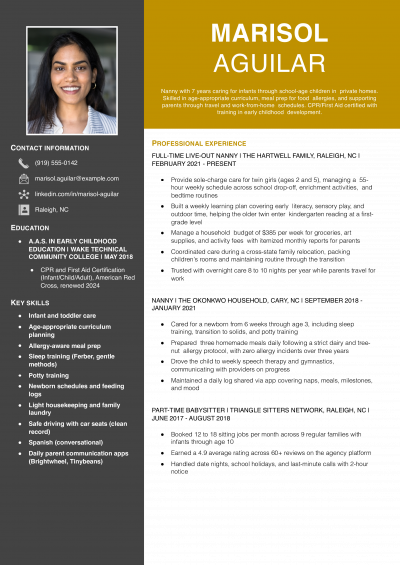
Nanny Resume Examples and Templates for 2026

Clinical supervisors decide whether to keep reading by the top third of page one; if license stage, populations served, and setting aren't visible there, the resume goes to the maybe pile and rarely comes back.
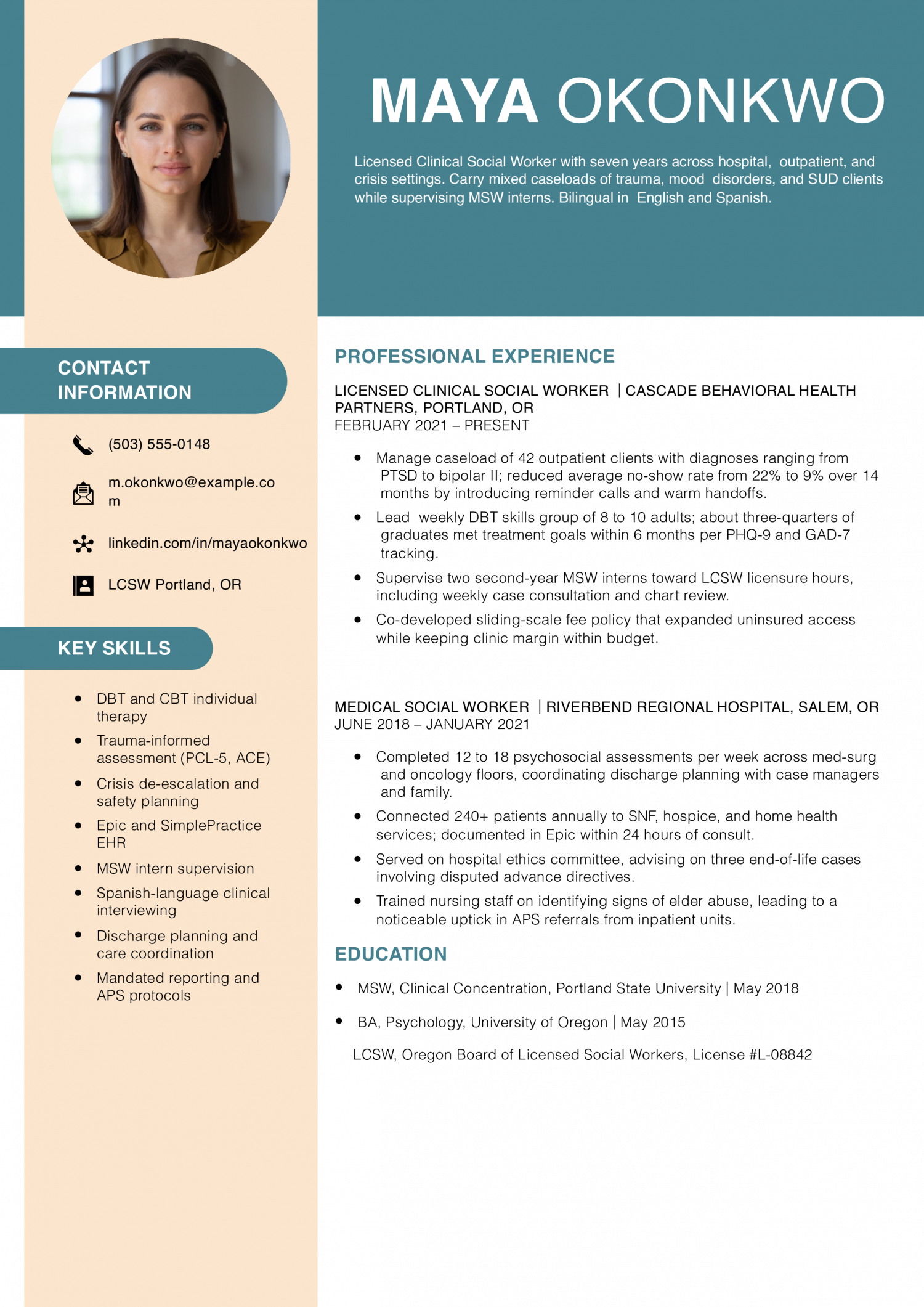
Entry-level covers BSW graduates, MSW interns, and freshly licensed LSW or LMSW practitioners moving from field placement into a first agency role. This resume needs to prove field-placement hours, populations served, and supervised modalities you used.
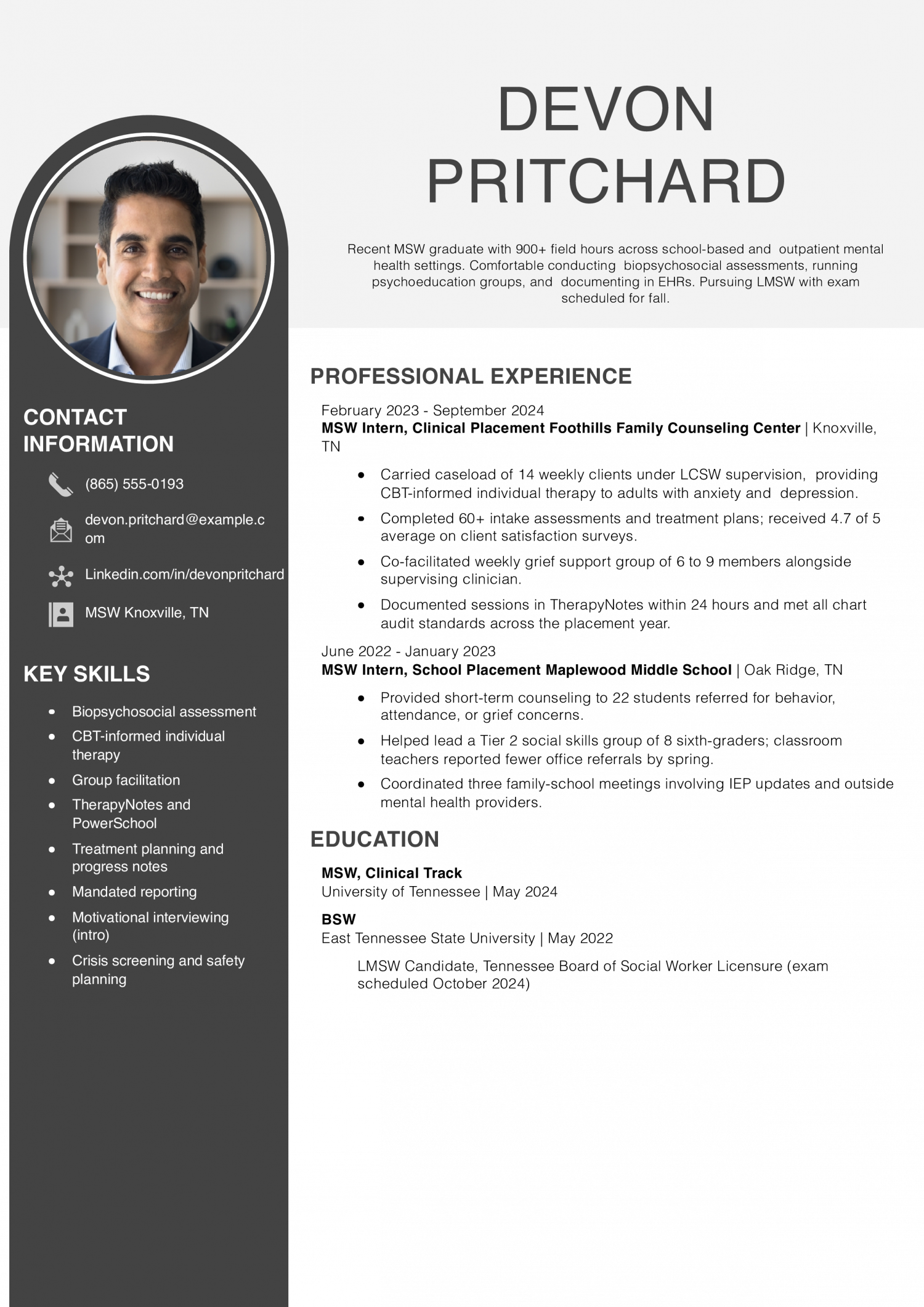
Experienced social workers carry an independent caseload, often LMSW or provisionally licensed clinical, with two to seven years across CPS, schools, hospitals, or community mental health. This resume needs to prove caseload size, documented outcomes, and EHR and assessment fluency.
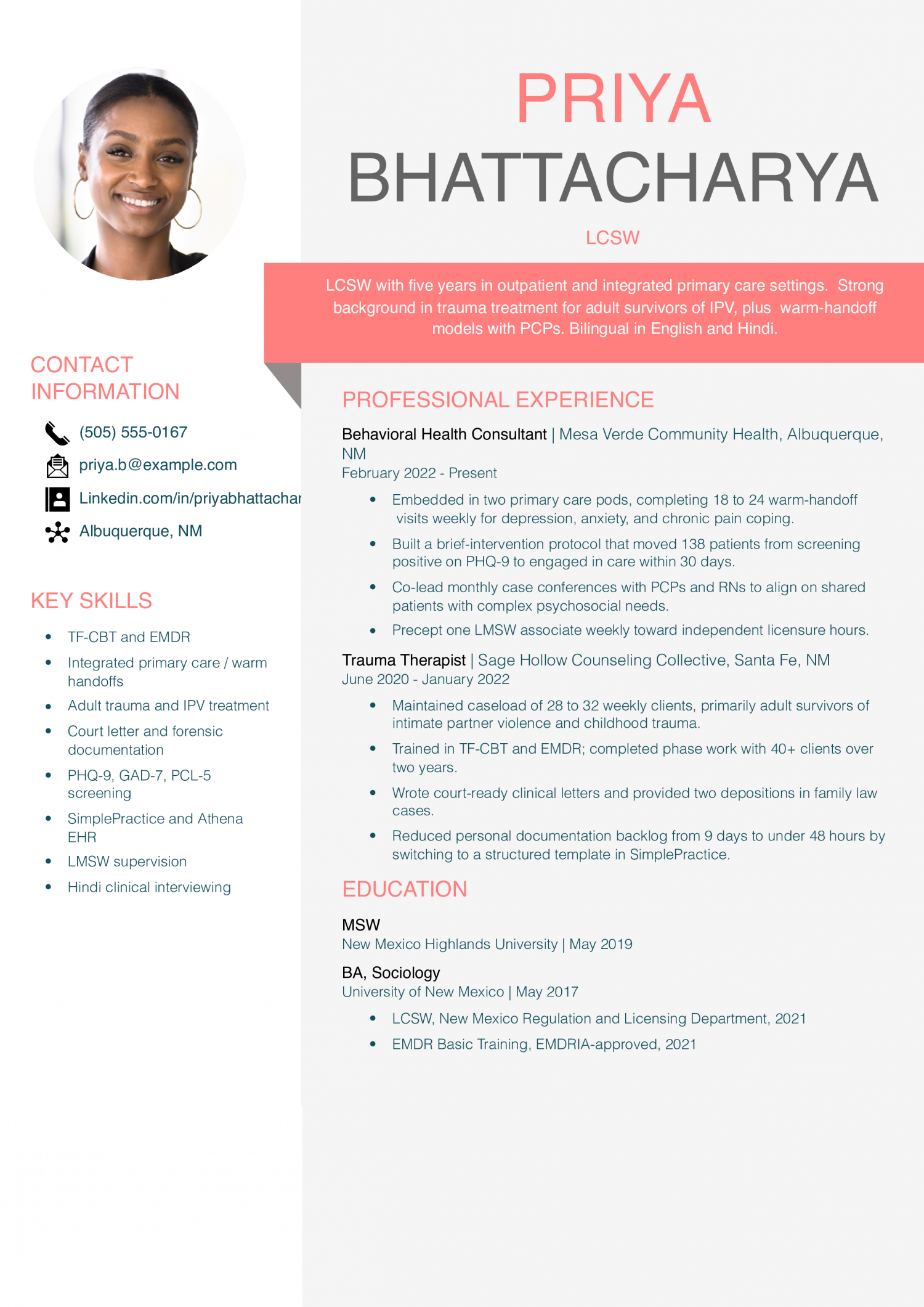
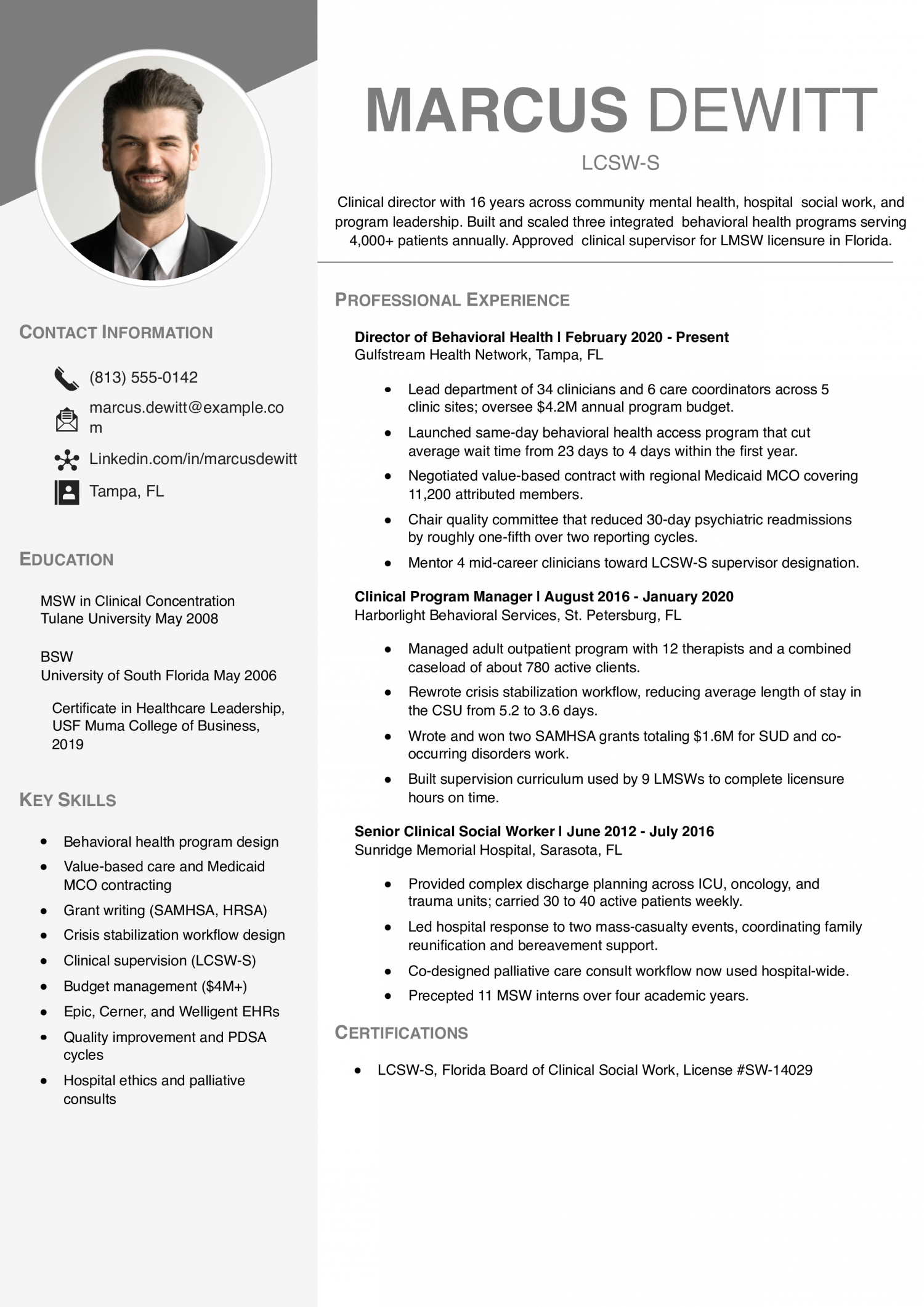
Senior social workers hold LCSW or equivalent clinical licensure and run programs, supervise interns and associates, or lead clinical teams. This resume needs to prove supervision hours signed off, program outcomes, grant or contract work, and cross-system coordination.
Aaliyah Romero, LCSW
Minneapolis, MN | (612) 555-0179 | [email protected] | linkedin.com/in/aaliyaromero
Licensed Clinical Social Worker with nine years across child welfare, hospital, and outpatient mental health settings. Specialize in trauma-focused care for children and families, with secondary expertise in perinatal mood disorders. Approved clinical supervisor in Minnesota.
Senior Clinical Social Worker
Northstar Pediatric Behavioral Health | Minneapolis, MN | 2022-Present
Perinatal Mental Health Clinician
Lakeside Women’s Health Collaborative | St. Paul, MN | 2019-2022
Hospital Social Worker
Bridgeview Children’s Medical Center | Madison, WI | 2017-2019
Child Protection Case Manager
Driftless County Human Services | La Crosse, WI | 2015-2017
MSW Field Intern
Prairie Roots Family Services | Eau Claire, WI | 2014-2015
Your profile should state your license stage (LSW, LMSW, LCSW, or pre-licensed MSW), the populations you serve, and the setting you work in.
Name the practice setting clearly: child welfare, school, medical, hospice, community mental health, or private practice. Add the modalities you use most, CBT, TF-CBT, DBT-informed, or motivational interviewing.
Close the profile with one scope marker a clinical supervisor reads in two seconds, such as average caseload size or years of post-MSW practice.
Strong social work bullets carry numbers. Name the caseload size, the assessment volume per month, and the share of clients reaching treatment goals or stable discharge.
Pair the number with the population and the intervention. A bullet like “carried 32-family CPS caseload; closed 78% with reunification or stable kin placement” reads as practice, not duties.
Bullets without a number tend to read as a job description. Recruiters scan for caseload, retention, and outcome figures first when sorting a stack.
Organize bullets under three to five practice categories so a supervisor can scan for fit. Common groupings: assessment and diagnosis, treatment and intervention, case management and coordination, crisis response, and documentation and compliance.
Under assessment, name the tools (DSM-5-TR, ACE, Columbia Protocol, ASI). Under treatment, name the modality and the population. Under coordination, name the systems you work across, courts, schools, Medicaid MCOs, or hospital discharge teams.
Put a credentials block in the top third of page one. List your MSW program, state license type, and CE-supported specialty trainings like TF-CBT, EMDR-trained, or QPR.
List the state your license is active in and note “in good standing” rather than the license number. Add the EHRs you use: Epic, Cerner, Welligent, KaleidaCare, or Penelope.
Social services directors check this block first to confirm billable scope and system fluency before reading bullets.
Close the resume with the sections that signal trajectory: clinical supervision hours logged toward LCSW, continuing education clock hours by topic, and community or advocacy work tied to your population.
If you supervise MSW interns or associate clinicians, name the number and the program. List CE hours by category, ethics, suicide assessment, cultural responsiveness, so the reviewer can confirm renewal compliance at a glance.
Based on data from our user-built social work resumes, the skills below are the ones that surface most often on resumes that move past an ATS keyword parse.
Clinical supervisors weigh hard skills, license stage, modalities, EHR, as gatekeepers; soft skills like crisis de-escalation and cultural humility are read as evidence backing the bullets.
Match the lists against the target posting, then make sure each soft skill shows up inside a bullet with a population and outcome attached.
| Soft Skills | % of resumes with this skill |
|---|---|
| Communication | 79% |
| Active Listening | 64% |
| Empathy | 49% |
| Collaboration | 35% |
| Problem-Solving | 27% |
And here are the top hard skills showing up most often.
| Hard Skills | % of resumes with this skill |
|---|---|
| Case Management | 78% |
| Crisis Intervention | 70% |
| Treatment Planning | 40% |
| Psychosocial Assessment | 37% |
| Documentation | 26% |
Based on data from thousands of social workers’ resumes built on ResumeTemplates.com, May 2026.
The items below are what separates a social work resume that advances from one that gets put back in the pile.
State licensure is the first thing a clinical supervisor checks. List the license type, the state, and the status; never print the license number on the resume itself.
Social work licensure is state-issued and tiered. The common rungs are LSW or LBSW at the bachelor level, LMSW or LSW at the master level, and LCSW (or LICSW, LISW depending on state) for independent clinical practice.
Place a credentials block in the top third of page one with the license type, issuing state, and “in good standing.” If you hold licenses in more than one state, list each one on its own line.
State boards renew social work licenses on a CE clock-hour cycle that varies by state. List CE by topic category so the reviewer can read your trajectory and confirm renewal compliance.
Group continuing education under topic headers rather than as a flat list. Most boards mandate hours in ethics, suicide assessment, and cultural responsiveness, with the remainder in clinical electives.
Name the issuing provider (NASW chapter, university school of social work, CE4Less) and the year completed. Trainings tied to a billable modality, TF-CBT, EMDR basic, CPP, carry more weight than one-off webinars.
Social workers in medical, behavioral health, and school settings handle protected health information. Your resume should signal HIPAA fluency without leaking anything that identifies a client.
Name HIPAA training as a line item under credentials or compliance. If you have worked in a covered entity, say so by setting (hospital, FQHC, community mental health center) rather than by patient story.
Never write a bullet that could identify a client. Replace narrative case examples with aggregated metrics: caseload size, population, and outcome rate. Schools should also note FERPA awareness.
Clinical supervisors expect to see niche terms that match their setting and population. Group your keywords by sub-specialty so the parser and the human reader can both find them fast.
| Niche | Keywords ATS scans for |
|---|---|
| Clinical licensure and roles | lcsw, lmsw, lsw, msw clinician |
| Child welfare and family | cps caseworker, kinship placement, reunification, foster care licensing |
| School social work | iep team, 504 plan, school-based mental health, mtss tier 2 |
| Medical and hospice | discharge planning, palliative care, advance directives, medically complex |
| Clinical therapy and trauma | tf-cbt, emdr, dbt-informed, motivational interviewing |
Clinical supervisors read this list as a map of where your practice is heading. The certifications below tell them which clinical, school, or specialty track you have invested in beyond licensure. List the issuing body and the year of completion for each item.
For social workers, the spread between the 10th-percentile floor and the top-decile ceiling is wide because the field bundles bachelor-level case aides, master-level clinicians, and licensed LCSWs into one occupation code. License stage, setting (hospital and government pay above community nonprofit), and clinical specialty move a candidate from floor to ceiling far more than tenure does.
Lead the resume with the license acronym, the setting, and the populations you serve so the reviewer can place you on that spread before reading a single bullet.
| # | State | Avg. Annual |
|---|---|---|
| 1 | Nevada | $109,220 |
| 2 | Hawaii | $108,780 |
| 3 | District of Columbia | $107,060 |
| 4 | Rhode Island | $106,910 |
| 5 | New Hampshire | 104,770 |
| 6 | Oklahoma | $100,150 |
| 7 | Washington | $96,550 |
| 8 | Massachusetts | $94,000 |
| 9 | Georgia | $92,750 |
| 10 | South Carolina | $91,940 |
| # | State | Workers | Median |
|---|---|---|---|
| 1 | Minnesota | 7,240 | $79,220 |
| 2 | California | 5,780 | $70,440 |
| 3 | Florida | 5,070 | $57,200 |
| 4 | New York | 3,190 | $75,020 |
| 5 | Oregon | 3,130 | $63,350 |
Resume Templates offers HR approved resume templates to help you create a professional resume in minutes. Choose from several template options and even pre-populate a resume from your profile.
Mirror the license acronym from the posting (LCSW, LMSW, LSW), the setting (CPS, school, medical, hospice), and the modalities you use (CBT, TF-CBT, motivational interviewing). Add the EHR by brand name: Epic, Cerner, Welligent, or Penelope. Generic phrasing like "electronic records" does not parse. Population terms also matter. "Child welfare," "SMI," "justice-involved," and "medically complex" line up with the screens hiring teams run.
No. List the license type and the issuing state, then add "in good standing." Example: "LCSW, State of California, in good standing." Provide the actual license number on the application form when the employer requests it. State boards advise against printing the number on documents you circulate.
Aggregate. Report caseload size, population served, and outcome rate; never name or describe a specific client. Frame outcomes in standard practice language: reunification rate, hospital readmission reduction, treatment plan completion, school attendance gains, crisis hold avoidance.
Treat your field placements as work entries. Name the agency, the supervising LCSW, the hours completed, the populations served, and the modalities you ran under supervision. Add your license stage and exam timing. "LMSW exam scheduled, August 2026" or "LSW, issued June 2026" tells the reviewer where you are in the pipeline.
For a social worker, a professional template is the safest pick, because it signals the polish hiring managers in this field expect. An ATS-friendly template is a solid alternative. Whichever you choose, keep the formatting clean and easy to parse: clear section headings, a standard font, and no graphics a parser can choke on.
Executive Resume Writer and Career Coach
Andrew Stoner is an executive career coach and resume writer with 17 years of experience as a hiring manager and operations leader at two Fortune 500 Financial Services companies, and as the career services director at two major university business schools.
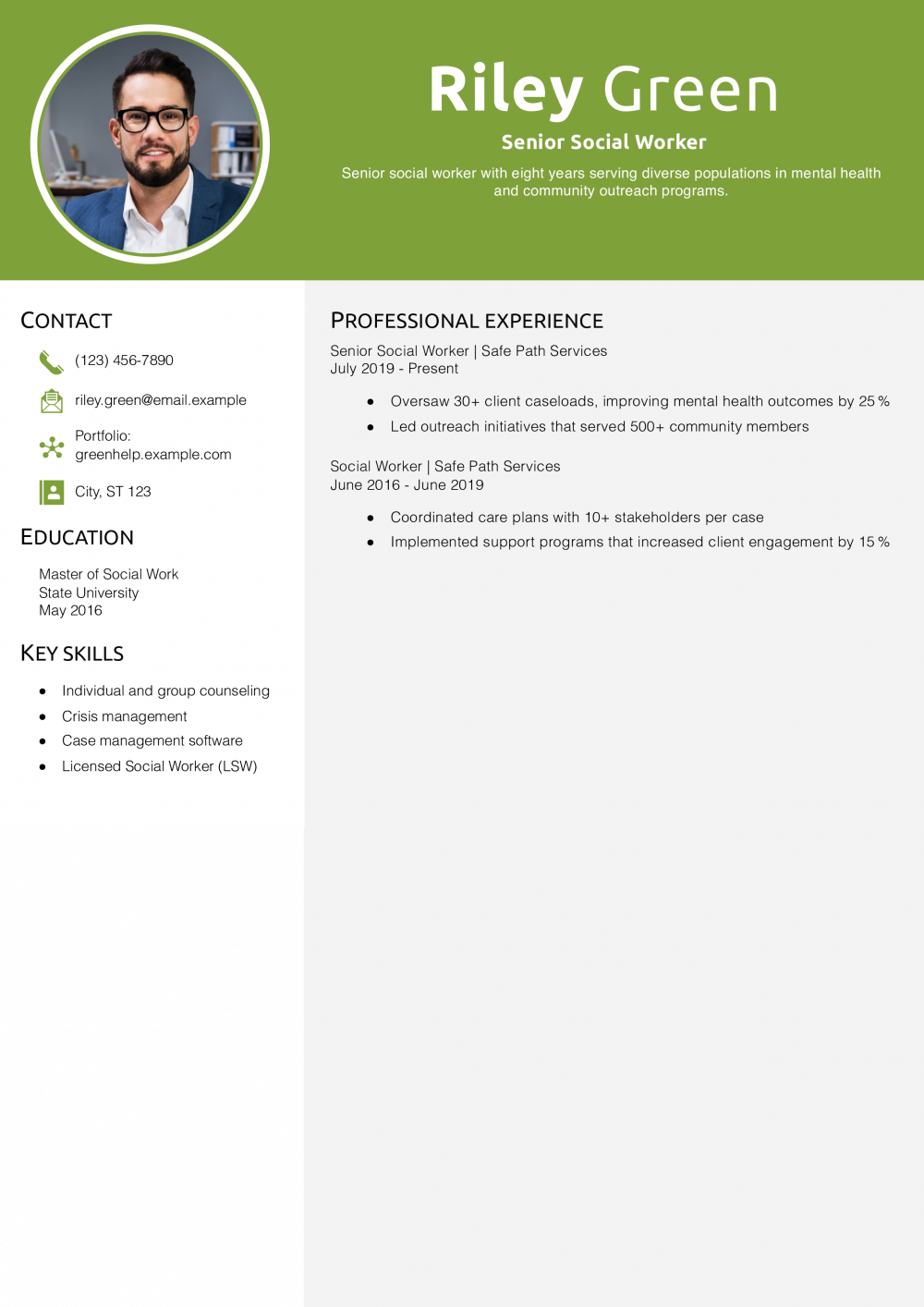
Customize this template in our builder in under 10 minutes.