Tip !

A tight metrics block covering follower growth, engagement rate and campaign reach is what gets social media resumes past the portfolio review; platform-specific wins are what make them readable enough for social media directors to advance.

Andrew Stoner , Executive Resume Writer and Career Coach

Social Media Resume Examples

Why this resume works
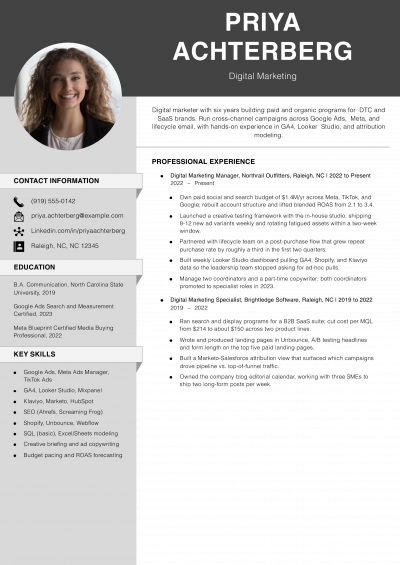
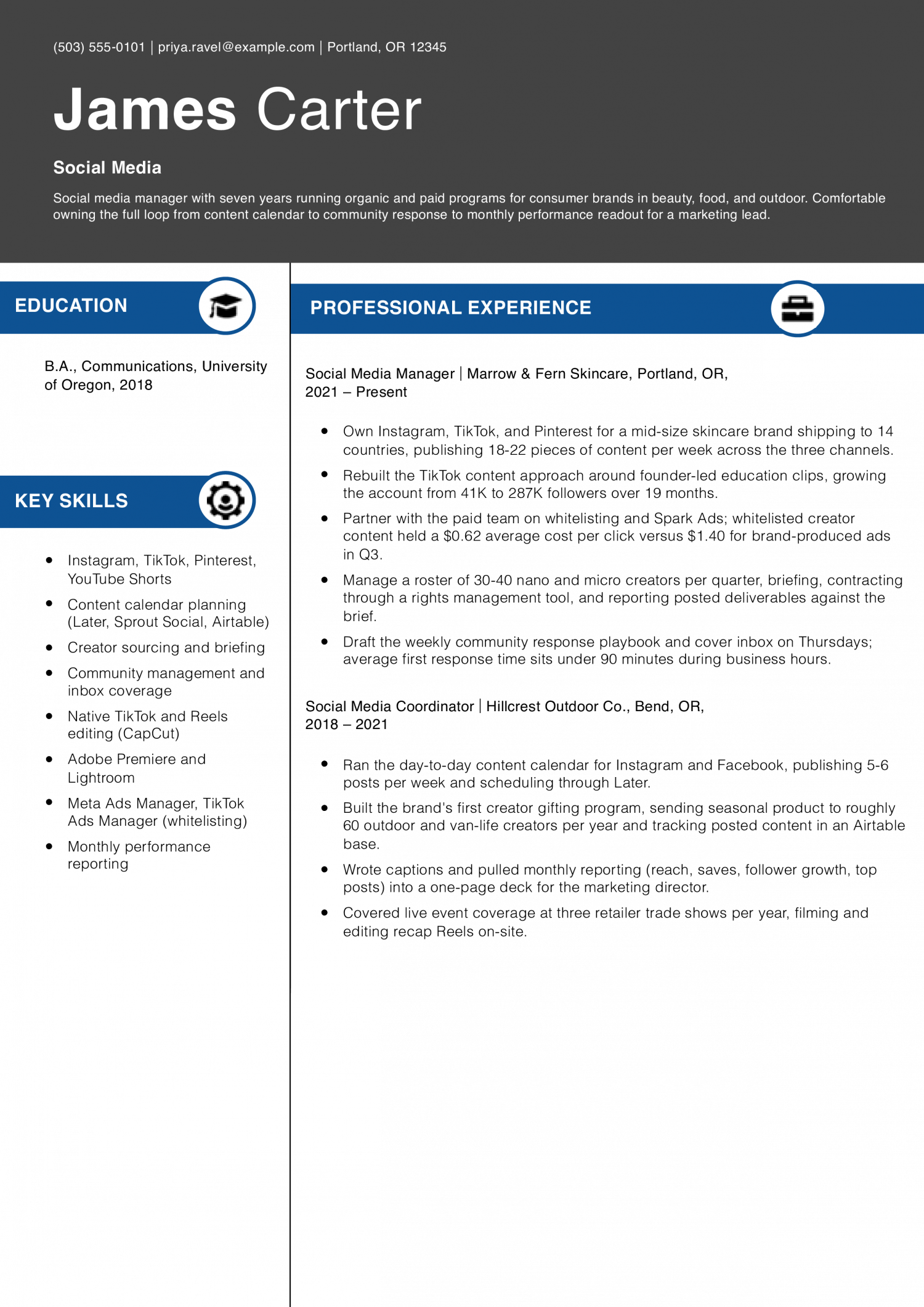
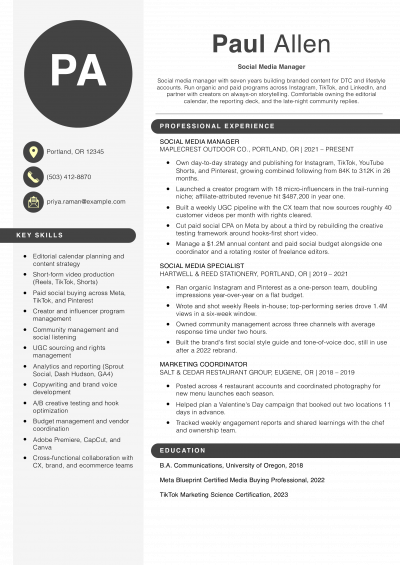
  • Follower growth tied to a real change: The TikTok bullet does not just cite a growth number, it names the content shift that drove it, which is what a hiring manager wants to see.
  • Comfortable with paid, not just organic: The whitelisting and paid cost bullet shows this candidate can sit in a room with the paid team, which is table stakes for mid-size direct-to-consumer brands.
  • Owns unglamorous work too: Community response times and creator contracting are the parts of the job that keep programs running, and this resume treats them as real work worth listing.

Entry Level Example

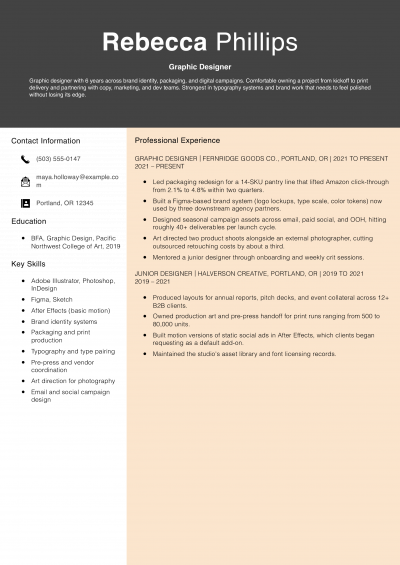
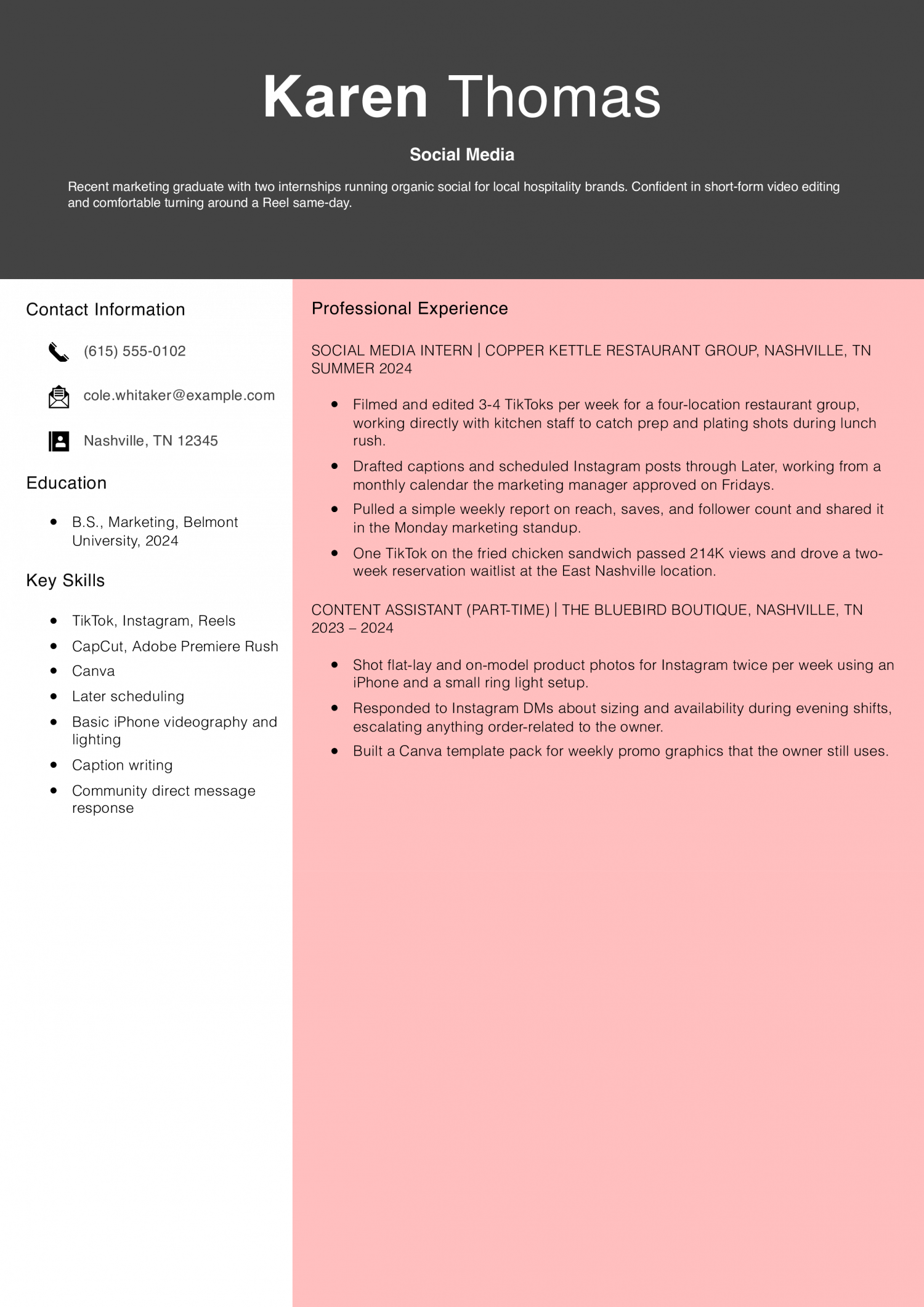
An entry level social media resume belongs to a coordinator or associate who has run brand accounts in an internship or first job. It must prove you can plan posts, write captions, and read platform analytics.

Why this resume works
  • One clear win, honestly framed: The 214K-view TikTok is called out with the real business result (a reservation waitlist), which is stronger than a vague ‘went viral’ claim.
  • Shows the boring parts of the job: Scheduling, direct message response, and Canva templates are what an entry role actually does day-to-day, and hiring managers trust a resume that admits it.
  • Two real internships, not one padded one: Two separate hospitality gigs give the resume enough shape to feel like a starting career, not a class project.

Mid Career Example

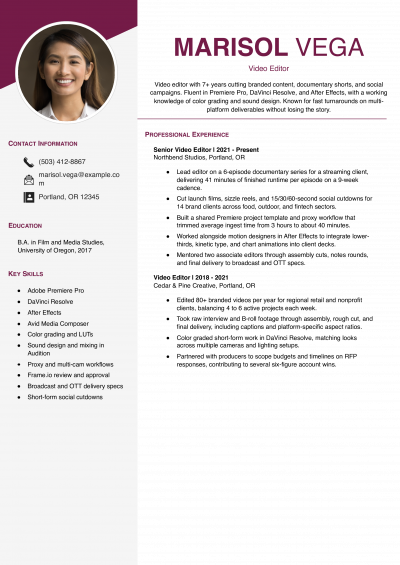
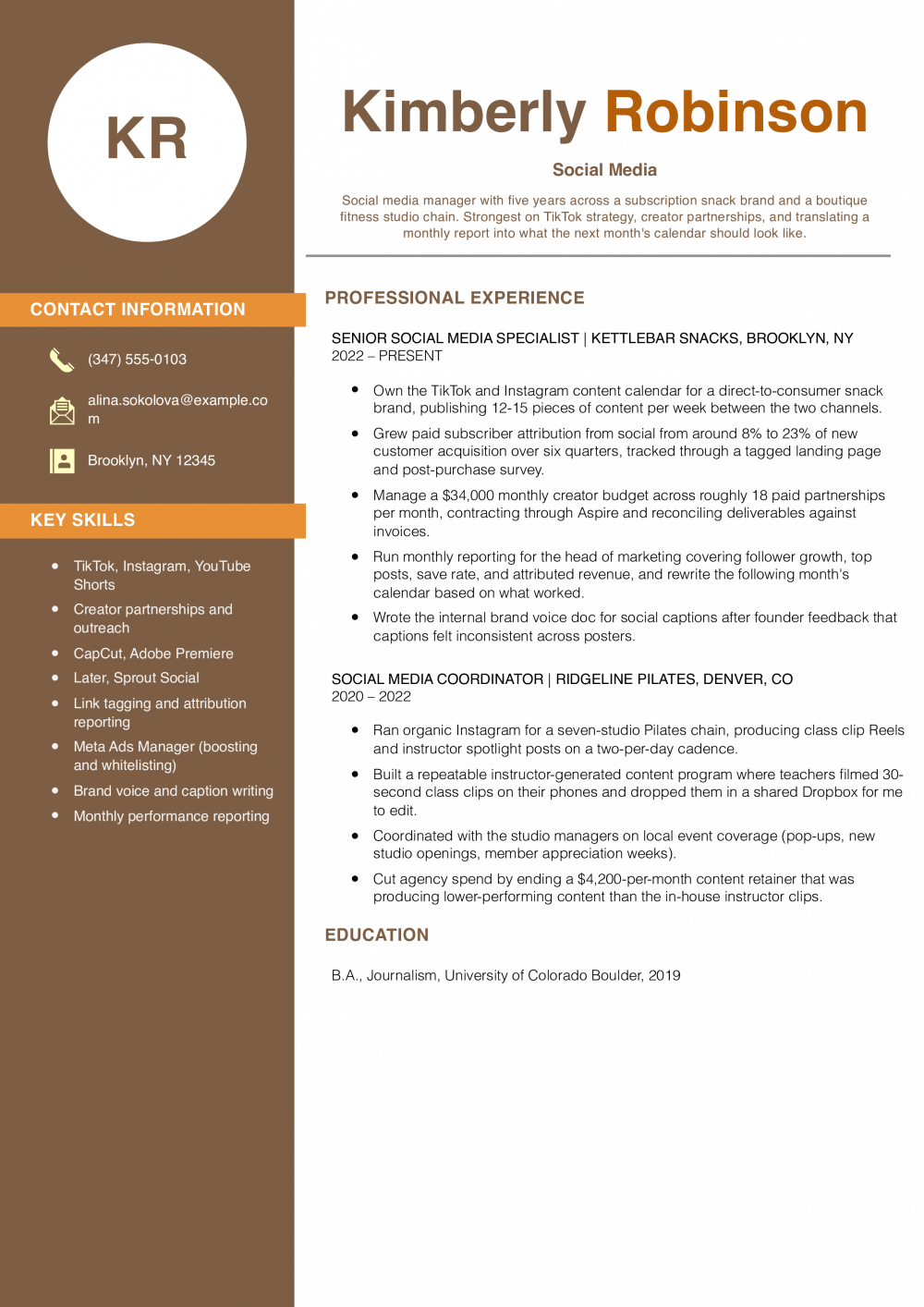
A mid career social media resume belongs to a manager who owns the calendar for one or more brands. It must prove you can grow followers, lift engagement, and brief creative and paid partners.

Why this resume works
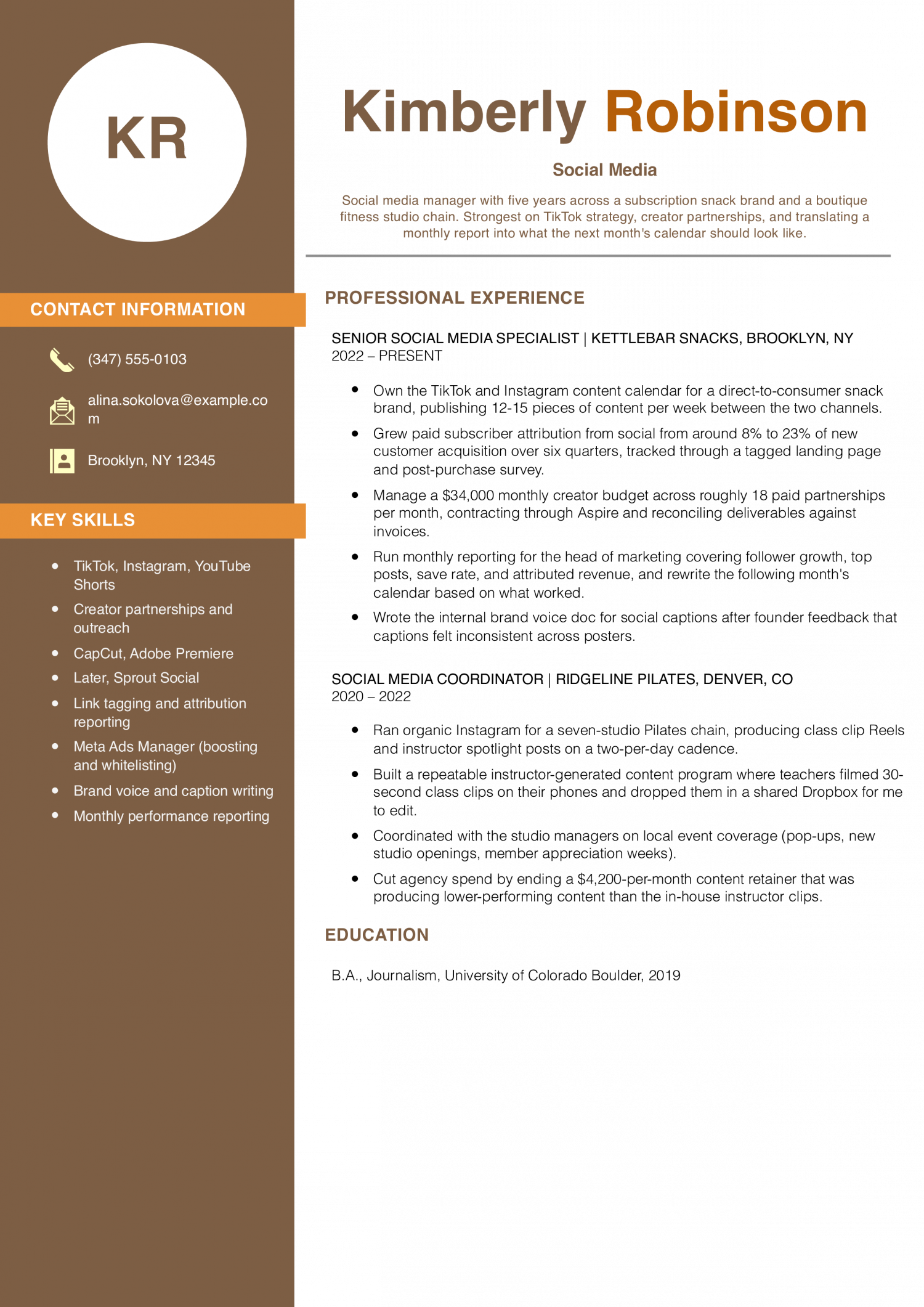
  • Tied social to actual customers: The move from 8% to 23% of new customer acquisition is the kind of number that separates a mid-career hire from a coordinator.
  • Handles a real creator budget: Naming the $34K monthly spend and the contracting tool tells a hiring manager this person has actually done paid partnerships, not just talked about them.
  • Cut work that no longer helped: Ending the underperforming agency retainer shows judgment, which is what you promote a specialist for.

Senior Example

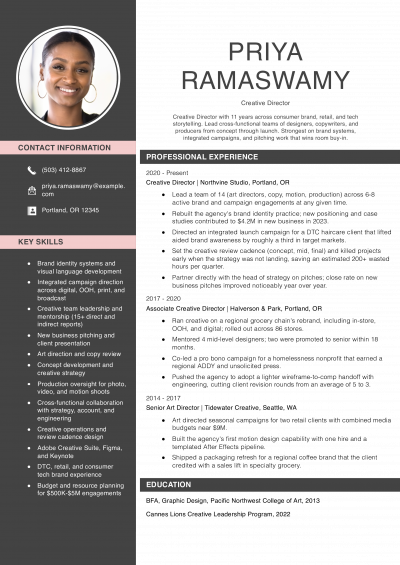
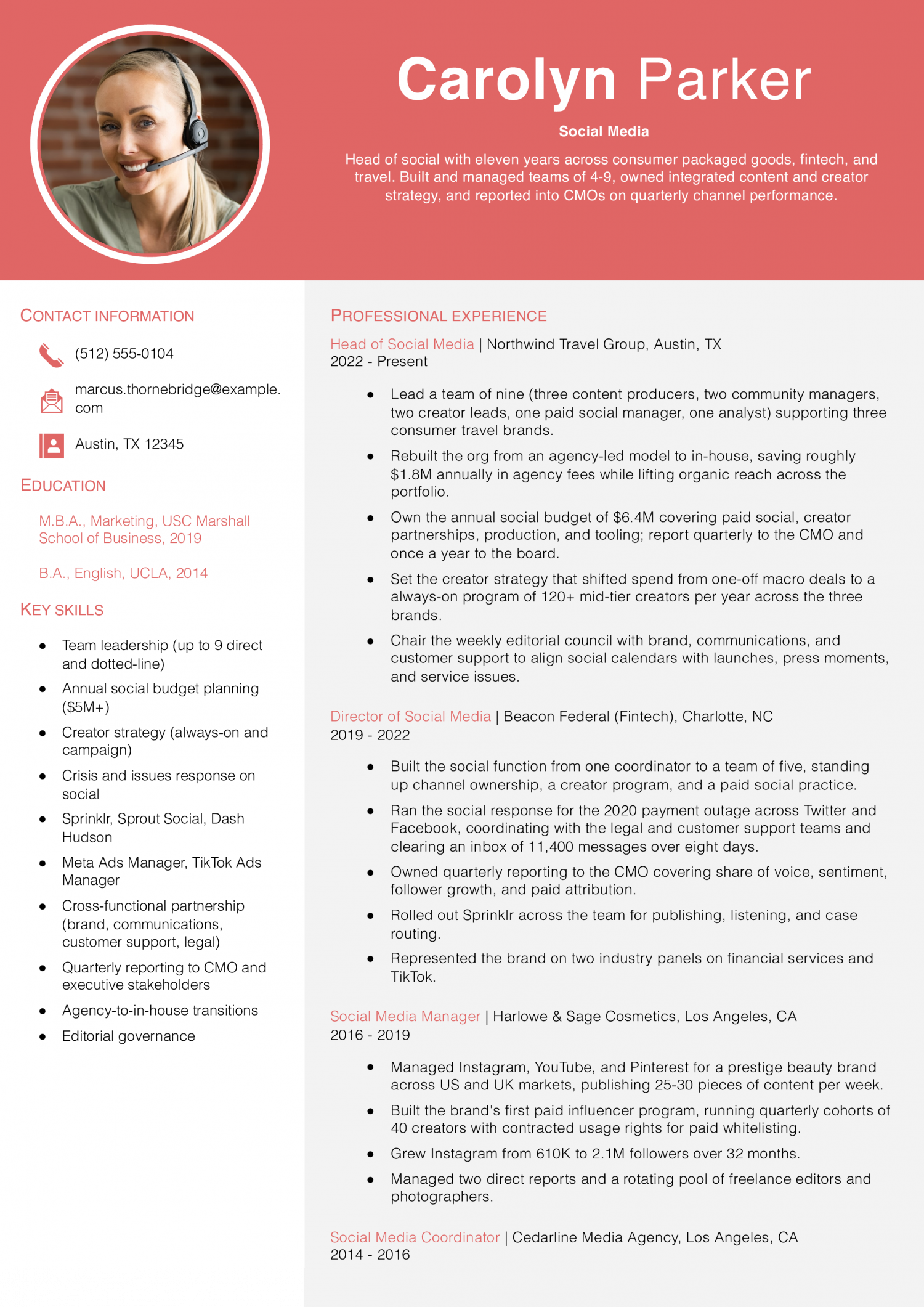
A senior social media resume belongs to a lead or head of social who sets strategy across brands. It has to prove you can shape voice, run a team, and tie social work to revenue.

Why this resume works
  • Real team and real budget: Naming a team of nine and a $6.4M annual budget makes it clear this is a head-of-social candidate, not an inflated manager title.
  • A crisis response that actually happened: The 11,400-message inbox during the payment outage is the kind of story that tells a CMO this person has been in the room when things went wrong.
  • Career arc that makes sense: Coordinator to manager to director to head of social, with the promotions and scope tracking cleanly, so the resume reads as a real eleven-year career.

How to Write a Social Media Resume

01 Open with the one thing a director cannot find elsewhere

Start with a single line that a portfolio scan will not surface on its own. Name the platform you own at a senior level, such as TikTok organic growth, LinkedIn thought leadership, or paid Meta campaigns at a defined budget. Add the vertical you know, such as beauty, B2B SaaS, sports, or nonprofit fundraising.

If you run a creator studio, edit short-form video in-house, or brief influencers end to end, put that in the summary. Social media directors and marketing managers read the top four lines to decide whether you match the brief. A generic line about storytelling and community will read as any candidate.

Name the platform, the vertical, and one workflow you own.

02 Translate posts into numbers a director reads

Skip the number, and a bullet reads as a task instead of a result. Most strong social media resumes lead each bullet with a metric the business already tracks. Name follower growth as a percentage over a defined window.

Show engagement rate against a category benchmark. Show paid results as cost per result or return on ad spend. Video creators should show average watch time, completion rate, and view counts on top posts.

Community leads should show reply rate, response time, and sentiment shifts after a campaign. If you cannot share exact numbers, use ranges or a percent lift from a stated baseline. Recruiters scan for a number in the first six words of a bullet.

03 Group your work into clear categories

Sort your bullets so a reader sees the shape of the role in ten seconds. Four groups cover most social media work. Strategy and planning covers content calendars, channel plans, and campaign briefs tied to launches.

Content production covers copywriting, short-form video, static design, and creator briefs. Paid and analytics covers Meta Ads Manager, TikTok Ads, LinkedIn Campaign Manager, link tracking, and monthly reporting. Community and partnerships covers reply queues, crisis escalation, influencer sourcing, and contract review.

Put two to four bullets under each group so no cluster looks thin. If you own only paid, drop community. If you own only organic, drop paid.

Match the mix to the posting.

04 Surface your tools and credentials early

Social media directors and marketing managers scan for platform proof before they read bullets. Put a short credentials block near the top of page one, under the summary. List the Meta Certified Community Management credential from Meta if you hold it, the Hootsuite Social Marketing Certification from Hootsuite, and the HubSpot Social Media Marketing Certification from HubSpot.

Add a tools line in the same block: Sprout Social, Later, Brandwatch, Google Analytics 4, Adobe Premiere, CapCut, Figma, or whatever you actually use. Do not bury this in a skills list at the bottom. A reader who cannot see your stack in the first scan will move on.

Only list tools you can defend in a screen share.

End with a short education section and one live link. List your degree, school, and graduation year on a single line. If you took coursework in marketing analytics, brand management, or digital media, add two lines under the degree.

Add a portfolio URL that shows real work: a personal site, a Notion case study page, or a TikTok or Instagram handle you built. Social media directors and marketing managers will click. Make sure the top three pieces on that link match the vertical on your resume.

If you volunteer as a social lead for a nonprofit or run a creator account with more than a few thousand followers, add one line for that. Keep the whole section under six lines.

Social media hiring is tight in 2026. Brand teams are running leaner rosters and the bar to clear a screen is higher. Line up both tables against the specific posting you plan to apply to.

Read the job ad once for the hard skills it names most often. Read it again for the soft skills buried in the day-to-day tasks. Put both sets in your skills section using the exact phrasing from the ad.

Social media directors and marketing managers scan first for hard skills like paid social and analytics. Soft skills like copywriting then decide who moves forward past the first review. Back each soft skill you list with a bullet in your work history.

That bullet should show the skill in action on a specific campaign or launch. Keep your skills section short so the terms that matter stay easy to spot. Add tools by their proper names, since the ATS looks for the exact string.

Update the list for every new role you apply to.

Soft Skills AI-estimated %
Written communication 69%
Creative thinking 59%
Time management 45%
Data analysis 38%
Adaptability 28%

And here are the top hard skills showing up most often.

Hard Skills AI-estimated %
Google Analytics 79%
Social media platforms 62%
Content design 46%
Paid advertising 35%
Email marketing 27%

Skill names and rankings come from an AI model grounded in U.S. Department of Labor occupation data for social media specialists, not from a count of social media specialists’ resumes built on ResumeTemplates.com.

Must Have on a Social Media Resume

The list below is what keeps a social media resume out of the reject pile.

Niche Keywords for ATS Checkers

Social media directors and marketing managers scan for the work you own. Each row below groups terms around one slice of the job. Content planning covers editorial calendars and post scheduling. Paid social covers boosted posts and campaign budgets. Community work covers reply queues and creator outreach. Analytics covers reach, engagement rate, and channel reports. Strategy covers brand voice, launch plans, and channel mix. Pick rows that match what you did at each role. Drop the exact phrases into your work history bullets. Also list them once in your skills block. That gives the tracker a clear match on both sides.

Niche Keywords ATS scans for
Content planning editorial calendar, content calendar, post scheduling
Paid social Meta Ads Manager, boosted posts, campaign budget
Community management reply queue, creator outreach, comment moderation
Analytics and reporting engagement rate, reach growth, channel reporting
Brand strategy brand voice, channel mix, launch plan

AI Skills to Add

What social media directors and marketing managers expect on a resume has shifted. A vague line about running AI tools now reads as thin. A named workflow with human review reads as current and credible. Say which tool drafts a caption or a first-pass image. Say who edits the copy before it posts. Say who checks brand voice, claims, and legal review. Name the platforms where you use it, and the ones where you do not. Tie the tool to a measured result on the account, not to hours saved. The list below names what to add.

What AI is actually changing for this role
Caption drafting

You draft variants in ChatGPT or Jasper, then edit for brand voice, hook length, and platform norms.

Comment triage

You use in-platform AI to sort inbound comments by sentiment, then route escalations to community or support leads.

Static asset ideation

You brief Midjourney for concept boards, then hand refined visuals to a designer for final production.

Trend and hook research

You use AI to surface trending audio, formats, and competitor angles, then vet each one against your brand.

AI tools to name
  • ChatGPT: Draft caption variants, hook tests, and short-form video scripts you then edit for voice.

  • Midjourney: Generate concept visuals and mood boards that a designer refines into on-brand assets.

How to phrase AI on your resume
Do
  • Name the tool and the human review step
  • Tie AI use to a measured account result
Skip
  • AI-powered content strategist
  • Leveraged AI to revolutionize social

Social Media Credentials Worth Listing

Most social media roles have no legal credential to clear. So this list works differently from a licensure section. The certifications below tell social media directors and marketing managers which platforms you have trained on. They also signal which tools you can pick up on day one. None of them are required. All of them can move you past a first screen when your work samples are still growing. Pick the ones that match the platforms and tools in the job posting. List each item with the issuing body and the month and year you earned it. Add a renewal date when the program sets one.

  • Meta Certified Community Manager: Issued by Meta, and asked for by teams that run branded communities on Facebook and Instagram.

  • HubSpot Social Media Marketing Certification: Issued by HubSpot, and worth listing early in your career or when the team runs on HubSpot.

  • Hootsuite Social Marketing Certification: Issued by Hootsuite, and useful when the posting names Hootsuite as the scheduling and listening tool.

Latest BLS Statistics for the Social Media Career Path

The Bureau of Labor Statistics does not track social media specialist as its own occupation. These numbers come from Market Research Analysts and Marketing Specialists (SOC 13-1161), the closest published match, so treat them as a proxy for the field, not an exact count of social media jobs. Even so, the top-paying states for social media roles cluster in a few high-cost coastal markets and a handful of finance and tech hubs, not every large media city you might assume. Employment, by contrast, spreads across states with big consumer brands and agency networks, so the highest-paying map and the highest-hiring map do not line up. National employment in the field is large, and the pay spread from the tenth percentile to the ninetieth is wide.

If you can work remote or relocate, name the metros you will consider on the resume header. Anchor your title to the platforms and brand categories you have run, so recruiters in either map can place you.

$78,760 National median annual
$89,490 National mean annual
$43,390 $155,480
899,580 Market Research Analysts and Marketing Specialists in the U.S. (the closest BLS match for social media roles)
Where you stand

Below median

$43,390 to $78,760 Lead with the platforms you own and one campaign with real reach or follower growth numbers.

Above median

$78,760 to $155,480 Show paid and organic budget you manage each month and the Meta or HubSpot certification.

Top 10%

$155,480+ Lead with the social team you built, revenue attributed to social, and the brands in your portfolio.

# State Avg. Annual
1 Massachusetts $101,810
2 Delaware $101,270
3 New York $98,580
4 District of Columbia $98,090
5 Washington $95,120
6 California $94,700
7 Colorado $93,050
8 New Jersey $88,190
9 Minnesota $87,510
10 Rhode Island $86,240

Highest-employment states

# State Workers Median
1 California 119,070 $94,700
2 New York 80,500 $98,580
3 Texas 63,350 $72,520
4 Florida 60,770 $75,450
5 Illinois 40,560 $79,120
7% projected growth (Much faster than average)
Job outlook, 2025-2035

Source: U.S. Bureau of Labor Statistics, Employment Projections, 2025-2035. View on bls.gov

Source: U.S. Bureau of Labor Statistics, OEWS May 2025 release (SOC 13-1161). View on bls.gov

Written by professional resume writers and loved by hiring managers

Resume Templates offers HR approved resume templates to help you create a professional resume in minutes. Choose from several template options and even pre-populate a resume from your profile.

Frequently Asked Questions

Should you put your own social media handles on a social media resume?

Yes, list handles for accounts you would want a social media director to open.

Put them in the header next to your email, with the platform named in full. Skip any personal account you would not want reviewed alongside your work samples.

How do you describe a social media manager role on a resume?

Lead the bullet with the account or brand you ran and the platform mix.

Then give the result in numbers a marketing manager tracks, such as follower growth, engagement rate, or leads sourced. Keep the verb concrete: managed, grew, launched, tested, not oversaw or handled.

How do you list social media as a skill without sounding vague?

Name the platform and the job you did on it, not the word social media on its own.

Write Instagram Reels editing, TikTok trend research, or LinkedIn thought leadership drafting. A social media director reads those as real work and reads social media savvy as filler.

Can you put influencer or content creator work on a resume?

Yes, treat it as a role with a start date, a platform, and follower and engagement figures.

List the brands you posted paid content for and the campaign types, such as unboxings, tutorials, or affiliate links. Keep it in the experience section, not in a hobbies line at the bottom.

Should you use social media logos or icons on the resume itself?

Skip decorative logos, since many applicant tracking systems drop images before a marketing manager sees the file.

Type the platform name in the link text instead, so it stays readable in every format. Keep one clean version of the resume for uploads and a designed version for portfolio review.

How do you show social media results when the brand account was small?

Report the percent change alongside the starting number, so a social media director can read the scale honestly.

Write grew the account from 800 to 3,200 followers in six months, not grew by 300 percent. Pair it with one line about the content shift that drove the growth.

What do you put on a resume when you are moving into social media from another field?

Lead the summary with the platforms you have already run, even if the work was volunteer or a side project.

Then move the marketing, writing, or analytics work from your prior job into bullets that name the transferable skill. Add one certification from Meta, Hootsuite, or HubSpot to signal you took the switch seriously.

What's the best resume template for a social media specialist?

A professional template suits a social media resume best, since it signals the visual polish hiring managers in this field expect. An ATS-friendly template is a solid alternative. Whichever you choose, keep the formatting clean and easy to parse: clear section headings, a standard font, and no graphics a parser can choke on.

Rate this article

Social Media Resume

Average Rating

4.8/5 stars with 211 reviews

You have given 0 Star(s)
4.8/5 stars with 211 reviews
Andrew Stoner

Executive Resume Writer and Career Coach

Andrew Stoner is an executive career coach and resume writer with 17 years of experience as a hiring manager and operations leader at two Fortune 500 Financial Services companies, and as the career services director at two major university business schools.