Event Planner/Coordinator Resume Examples and Templates for 2026



A clean credentials block and a covers-per-service number near the top are what get chef resumes past a thirty-second manager scan; specific food cost percentages are what make them readable enough to advance to a stage.
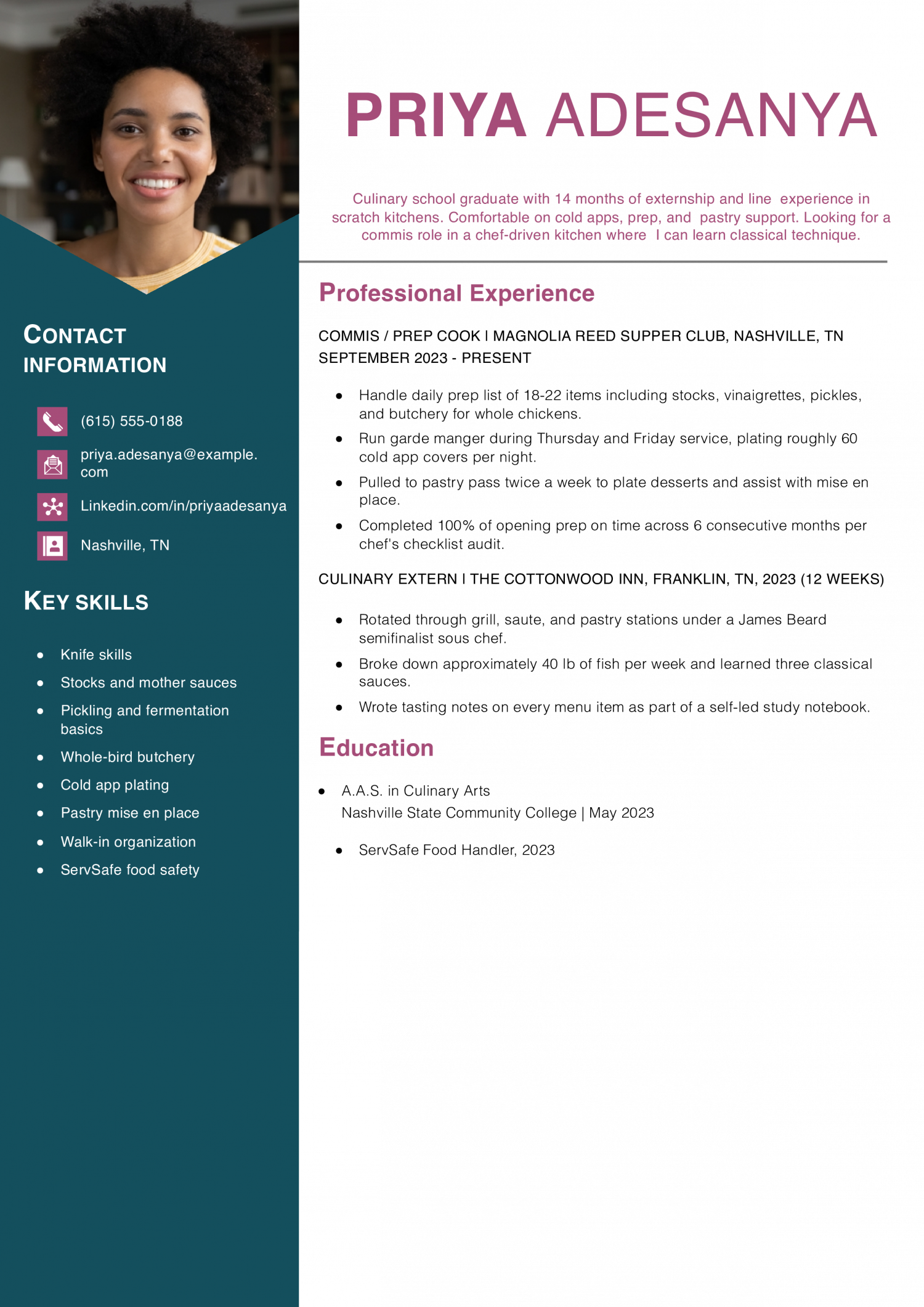
The commis resume is for cooks one to two years in, often fresh out of culinary school or a stage. It needs to prove knife skills, station prep speed, and that you can hold mise en place through a full service without falling behind.
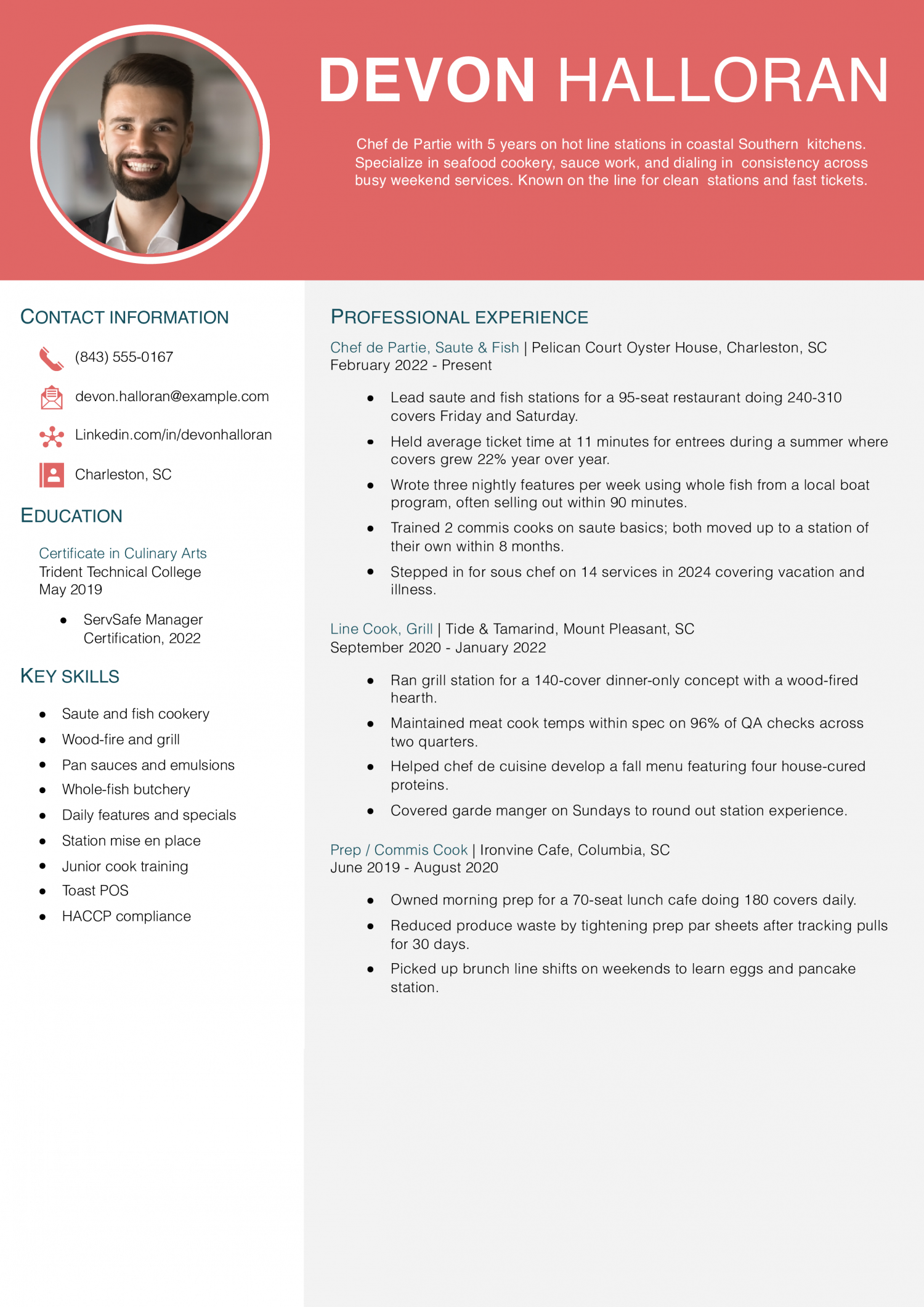
The chef de partie resume is for cooks running a station solo, usually three to five years on the line. It needs to show the stations you own (sauté, grill, garde manger), covers per service, and the menu items you execute from prep through plate.
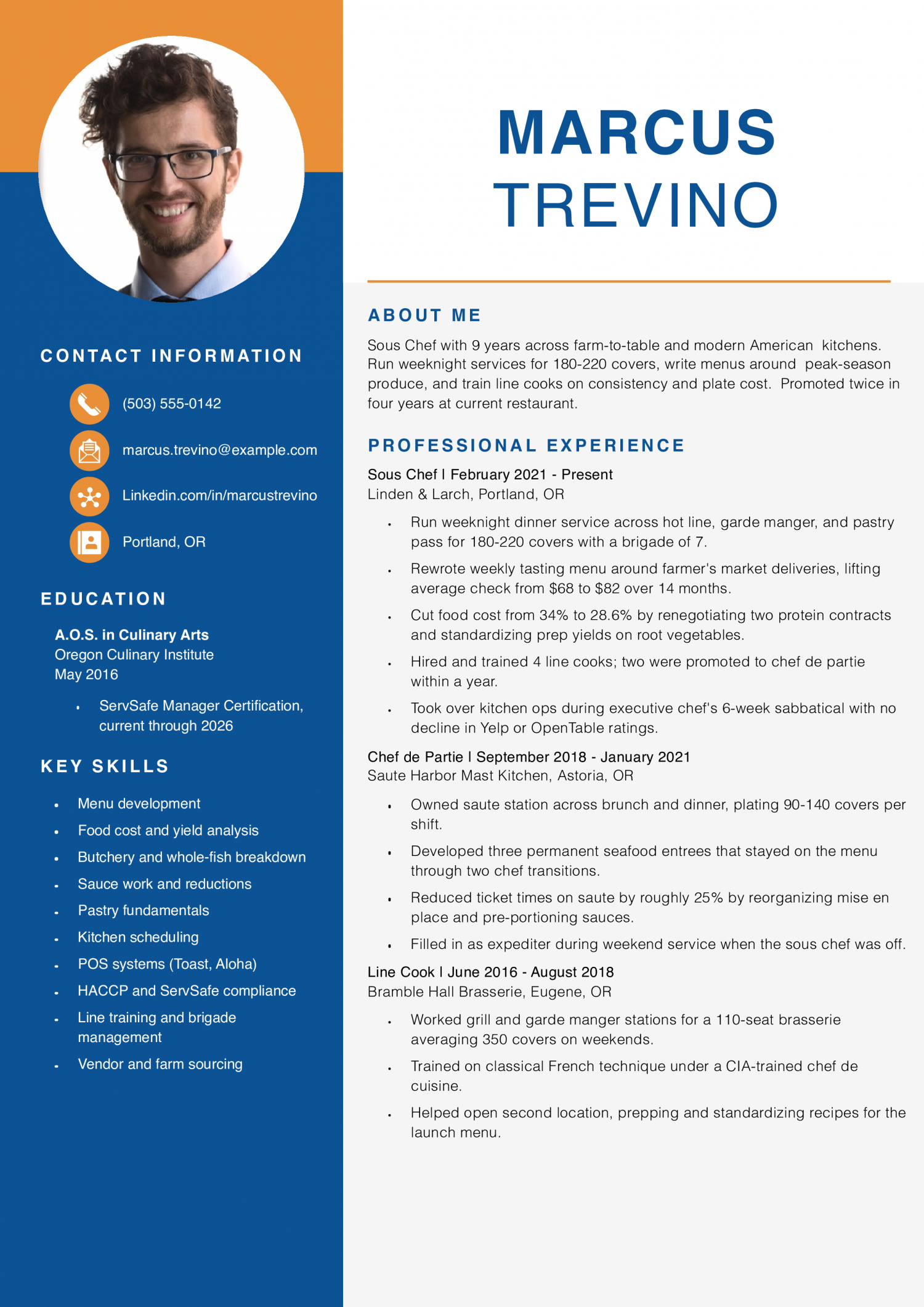
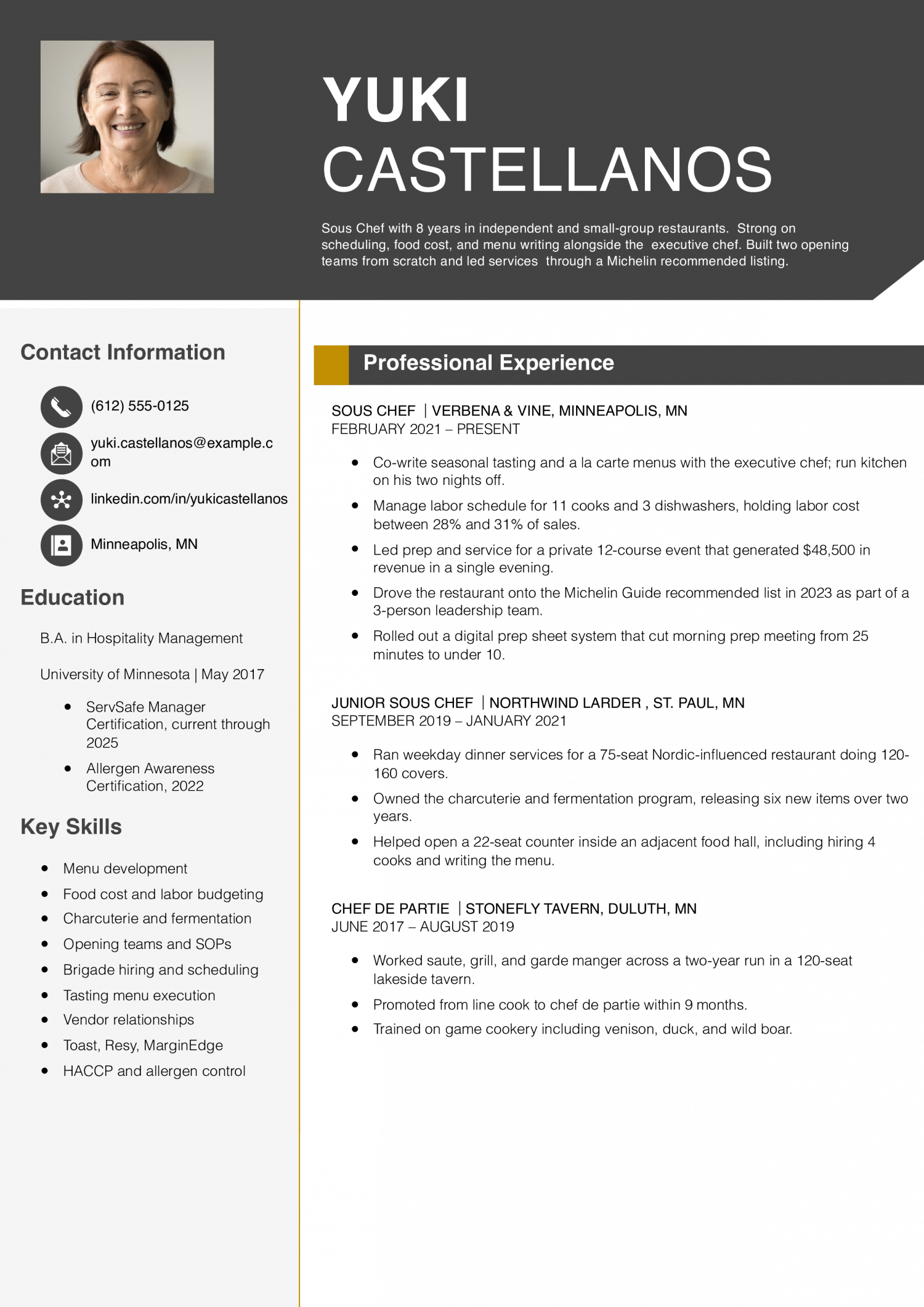
The sous chef resume is for second-in-command kitchen leaders managing schedules, ordering, and line execution under the executive. It needs to prove brigade size led, food cost and labor percentages held, and the dishes or specials you developed and rolled out.
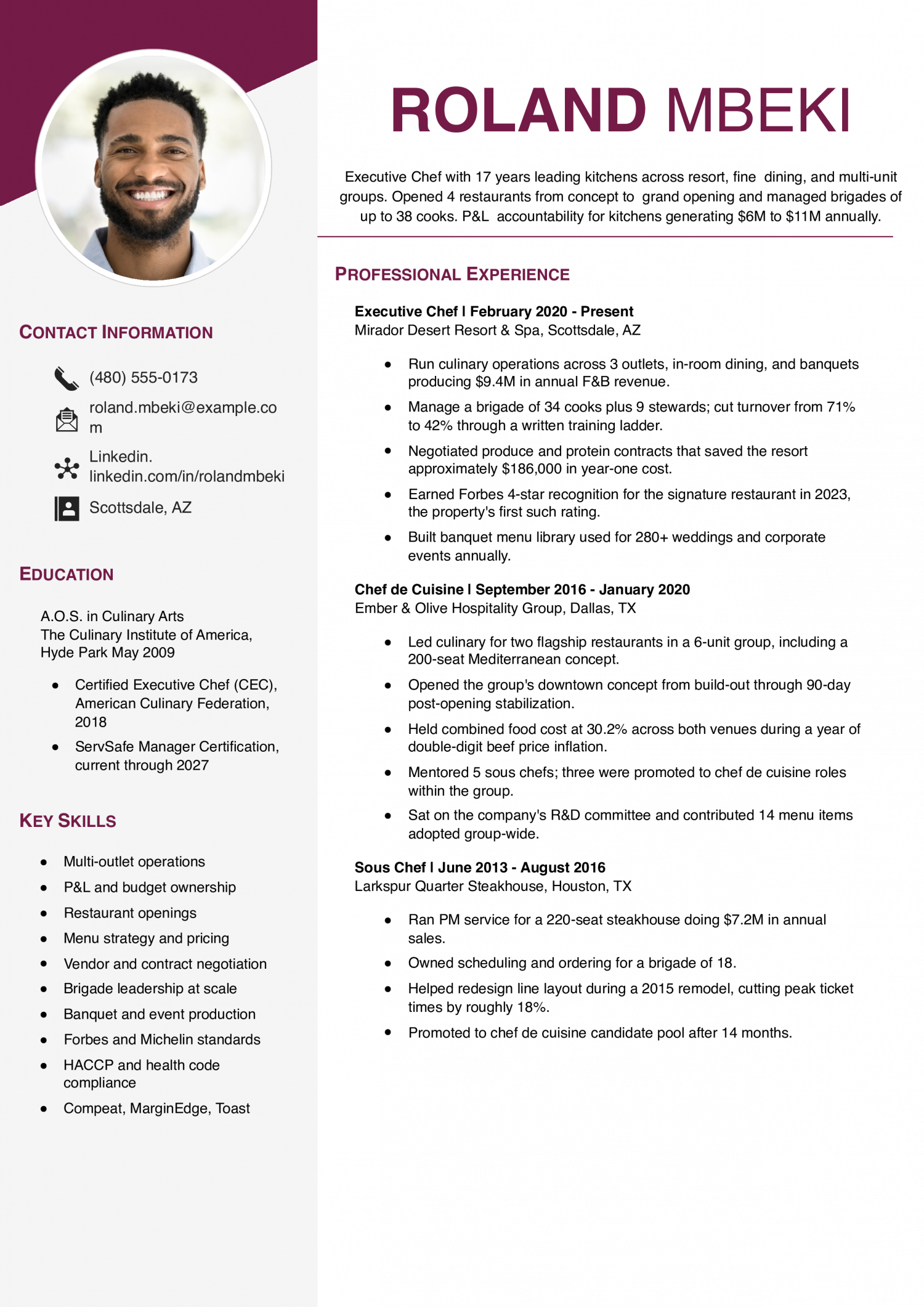
The executive chef resume is for kitchen leaders owning menu, P&L, and the full brigade across one or more concepts. It needs to lead with covers, food cost percentage, labor percentage, and revenue growth tied to menus you launched.
Camille Beaumont-Ortiz
Asheville, NC | (828) 555-0119 | [email protected] | linkedin.com/in/camillebeaumontortiz
Chef with 12 years of progressive kitchen experience from commis through sous chef, now leading a 60-seat farm-to-table restaurant. Strong on seasonal menu writing, food cost control, and building brigades that stay. Opened one restaurant from build-out, ran a tasting menu program for 4 years, and have been featured twice in regional food press.
Chef de Cuisine
Foxglove Hollow | Asheville, NC | 2022-Present
Sous Chef
Quillberry Tavern | Greenville, SC | 2019-2022
Chef de Partie, Pasta
Cantina Salvatori | Atlanta, GA | 2017-2019
Line Cook
Heron’s Crossing Restaurant | Savannah, GA | 2015-2017
Commis Cook
Rosewater Bistro | Charlotte, NC | 2013-2015
Your profile should state your years on the line, the venue type you’ve cooked in (fine dining, hotel, banquet, country club, fast-casual), and the cuisine or station you’re known for.
Name covers per service and brigade size in the same paragraph. A sous chef at a 220-cover bistro reads differently than a sous chef at a 60-seat tasting room, and executive chefs want that scope before the bullets. Close with the menu work you own: seasonal rotations, tasting menus, or banquet pivots.
Chef work runs on volume and margin, so lean on scope numbers rather than vague phrases.
Strong bullets name covers per service, average ticket times, brigade size, food cost percentage, and labor percentage. A bullet that reads ‘ran sauté for 180 covers a night, held tickets under nine minutes’ beats ‘responsible for sauté station’ every time. If you don’t have exact percentages, use ranges or volume language: cases of produce per week, prep lists for 12-station banquets, 40-cook brigade across two services.
Bundle bullets under three or four categories so a chef de cuisine can scan them in seconds.
Use station execution (sauté, grill, pastry, garde manger, butchery), menu development (seasonal changes, specials, tasting menus, allergen substitutions), cost control (food cost, waste tracking, vendor negotiation, inventory), and team leadership (hiring, scheduling, training, line discipline). Order the categories by what the posting weights most. A hotel banquet role wants volume and consistency; a chef-driven concept wants menu and sourcing.
Executive chefs and owners need to see ServSafe Manager, allergen training, and any state or county food handler card before they read your bullets.
Put a small credentials block under your profile with the certification name, issuing body, and expiration year. If you hold a culinary degree (CIA, Johnson and Wales, ICE) or an ACF certification (CC, CSC, CCC, CEC), list it there too. Tools like Toast, Resy, BlueCart, and MarginEdge belong in a skills strip near the credentials so the resume clears keyword scans early.
Drop short stages over five years old, banquet halls you covered for one shift, and any line that reads ‘passionate about food.’
Cut the objective statement and any generic phrasing about teamwork or fast-paced environments. Replace them with a covers number, a food cost figure, or a menu launch. If your resume runs past two pages and you’re under executive chef, trim early prep cook roles to a single line and let your last two positions carry the weight.
ATS filters catch more chef resumes than ever in 2026. The skills below come from our user-built chef resumes. Station and cuisine terms clear the first cut, and leadership language around brigade and pace decides whether the resume advances.
Executive chefs and owners weight hard skills like food cost control and ServSafe up top, then read soft skills as evidence behind your bullets. Match the list below against the posting, and use soft skills to frame, not replace, your numbers.
| Soft Skills | % of resumes with this skill |
|---|---|
| Leadership | 78% |
| Time management | 65% |
| Communication | 41% |
| Creativity | 35% |
| Attention to detail | 27% |
And here are the top hard skills showing up most often.
| Hard Skills | % of resumes with this skill |
|---|---|
| Food safety and HACCP | 75% |
| Menu development | 53% |
| Knife skills | 41% |
| Kitchen management | 38% |
| Food presentation | 25% |
These are the must-haves hiring teams look for when scanning a chef resume.
Most operators expect food safety credentials before they read your bullets, and many states or counties require them by law. List each one with the issuing body and the expiration year so executive chefs and owners can verify at a glance.
Executive chefs and owners read POS and back-of-house software as a shortcut for how you’ll be useful on the line. Name the systems you’ve actually used, and pair them with what you did in each one.
Executive chefs and owners scan for the station, cuisine, and venue terms that match the posting. Group the keywords below by sub-niche and pull the three or four that fit your actual experience.
| Niche | Keywords ATS scans for |
|---|---|
| Fine dining and tasting menu | tasting menu, plated service, seasonal menu development, chef de partie |
| Hotel and banquet | banquet service, high-volume production, plated banquets, room service |
| Pastry and bakery | pastry chef, viennoiserie, plated desserts, wedding cake production |
| Kitchen leadership | sous chef, executive chef, brigade management, kitchen scheduling |
| Cost and operations | food cost control, labor cost percentage, inventory management, vendor negotiation |
Hospitality hiring weighs availability alongside skill, so flag yours plainly. One line under your profile or in the header is enough.
State the shifts and days you can cover and any constraints up front. Examples: ‘Available nights, weekends, and holidays’ or ‘Open availability, including doubles and overnight prep.’
If you’re moving markets, name the city and your start date. Executive chefs and owners screen for availability before they call, and burying it costs interviews.
Beyond your state or county food handler card, the certifications below tell executive chefs and owners how prepared you are to run a kitchen safely, control cost, and lead a brigade. List the certifying body and the year earned or current expiration for each item.
For chefs, the spread between the entry-tier floor and the top-decile ceiling is wide, and it tracks more to venue type and brigade scope than to years on the line.
That spread tells you the move from line cook pay to executive chef pay runs through fine dining, hotels, clubs, and multi-unit concepts more than through tenure alone. Lead your resume with the venue type, covers per service, and food cost ownership that map you to the band you’re targeting.
| # | State | Avg. Annual |
|---|---|---|
| 1 | Hawaii | $81,200 |
| 2 | Rhode Island | $79,160 |
| 3 | North Dakota | $76,630 |
| 4 | District of Columbia | $74,000 |
| 5 | Massachusetts | $71,330 |
| 6 | Washington | $69,800 |
| 7 | New Jersey | $69,660 |
| 8 | California | $66,780 |
| 9 | Delaware | $65,290 |
| 10 | Wyoming | $64,790 |
| # | State | Workers | Median |
|---|---|---|---|
| 1 | California | 26,500 | $66,780 |
| 2 | Florida | 17,170 | $59,580 |
| 3 | Texas | 16,550 | $51,050 |
| 4 | New York | 15,420 | $64,300 |
| 5 | Pennsylvania | 7,060 | $59,630 |
Resume Templates offers HR approved resume templates to help you create a professional resume in minutes. Choose from several template options and even pre-populate a resume from your profile.
A strong chef resume opens with a profile that names venue type, covers per service, and cuisine. It groups bullets by station, menu, cost, and team, and puts ServSafe and any ACF certification in a credentials block on page one. Numbers carry the weight: covers, food cost percentage, labor percentage, brigade size, and ticket times.
Skip 'responsible for' phrasing and lead with verbs tied to the station and the volume. Write 'ran grill station for 160 covers a night, held ticket times under eight minutes' instead of 'cooked on the grill.' Pair each duty with a scope number: covers, prep volume, brigade size, or food cost outcome.
A pastry chef resume should lead with the program scope: bread, viennoiserie, plated desserts, banquet production, or wedding cakes. Name daily and weekly output (loaves, plated covers, cakes per week) and the equipment you've run, like deck ovens, sheeters, and tempering machines. List allergen substitution work and any wholesale or pastry-program P&L you've owned.
Yes, if the account shows your plating, menus, or food photography and is current. Put it next to your email in the header, not in the body. Skip it if the feed is personal, dormant, or mixed; a stale account hurts more than no account.
For a chef, an ATS-friendly template is the safest pick, because it puts your certifications and experience where a hiring manager scans first. A basic template is a solid alternative. Whichever you choose, keep the formatting clean and easy to parse: clear section headings, a standard font, and no graphics a parser can choke on.
Executive Resume Writer and Career Coach
Andrew Stoner is an executive career coach and resume writer with 17 years of experience as a hiring manager and operations leader at two Fortune 500 Financial Services companies, and as the career services director at two major university business schools.