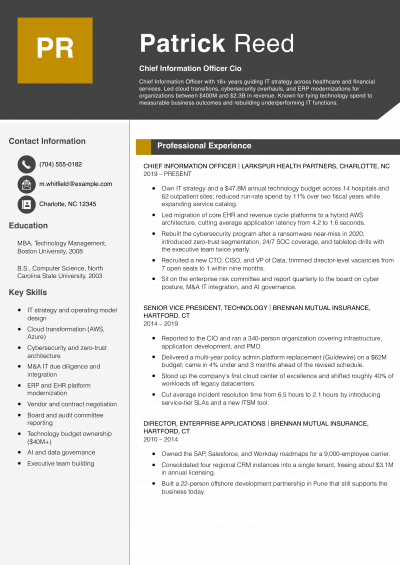
Board chairs and search partners decide whether to keep reading by the summary and first role on page one; if revenue band, EBITDA movement, and the inflection point owned aren't visible there, the CV gets cut.
Featured Example
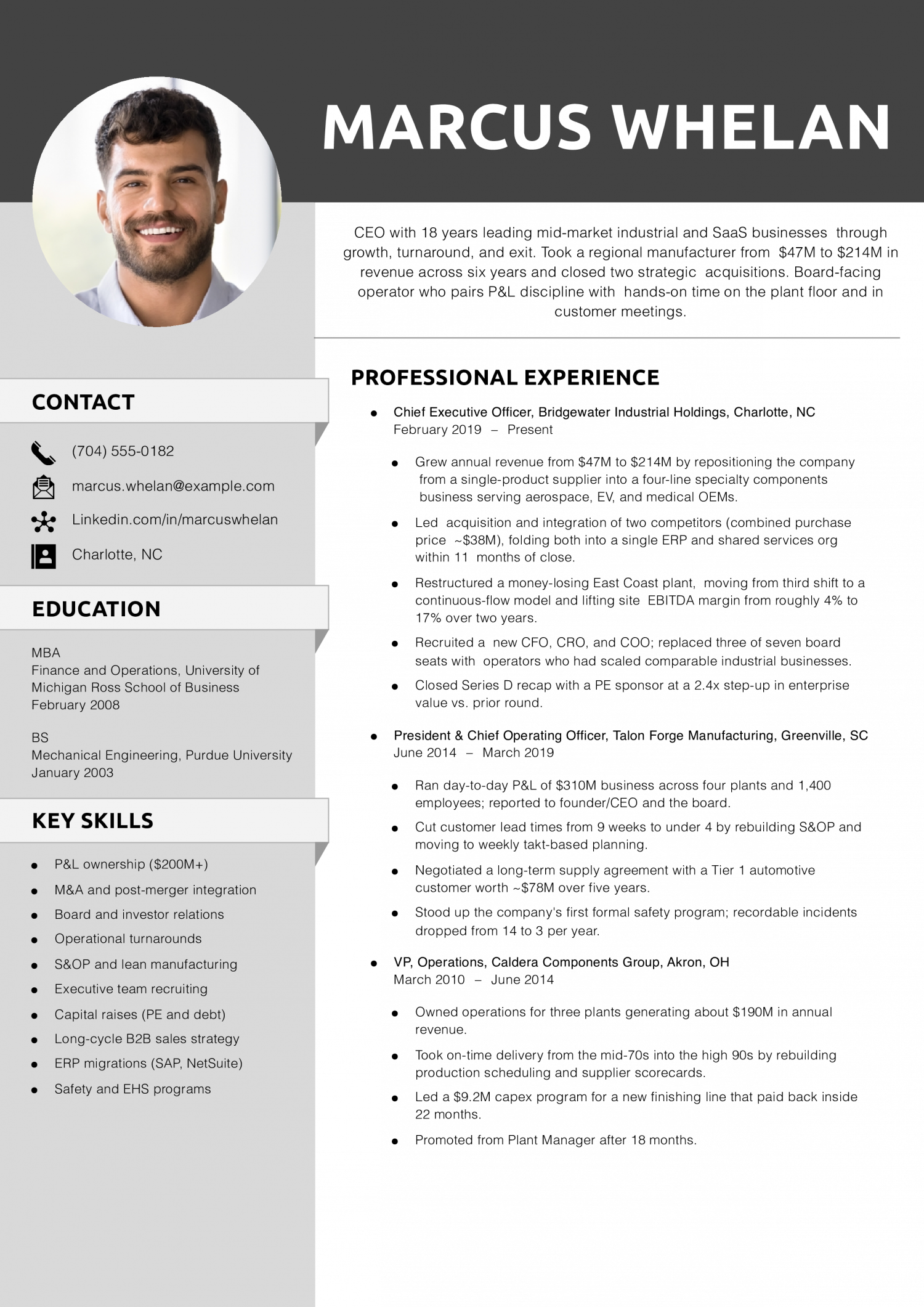
- Revenue growth in real dollars: The $47M to $214M jump is specific and easy to picture, and it is tied to a clear strategy (going from one product line to four).
- Shows both deals and operations: Bullets cover M&A, board changes, capital raises, and plant-floor metrics like EBITDA margin and lead time, which is the actual range a CEO is judged on.
- Career path makes sense: VP Ops to COO to CEO reads as a natural climb, and each role gets bigger in revenue scope, so the CEO seat feels earned.
CEO Example
This archetype covers sitting and recent CEOs moving to a larger platform, a public seat, or a PE-backed mandate. The resume needs to prove enterprise-value creation, board governance, and a credible operating thesis at the next scale.
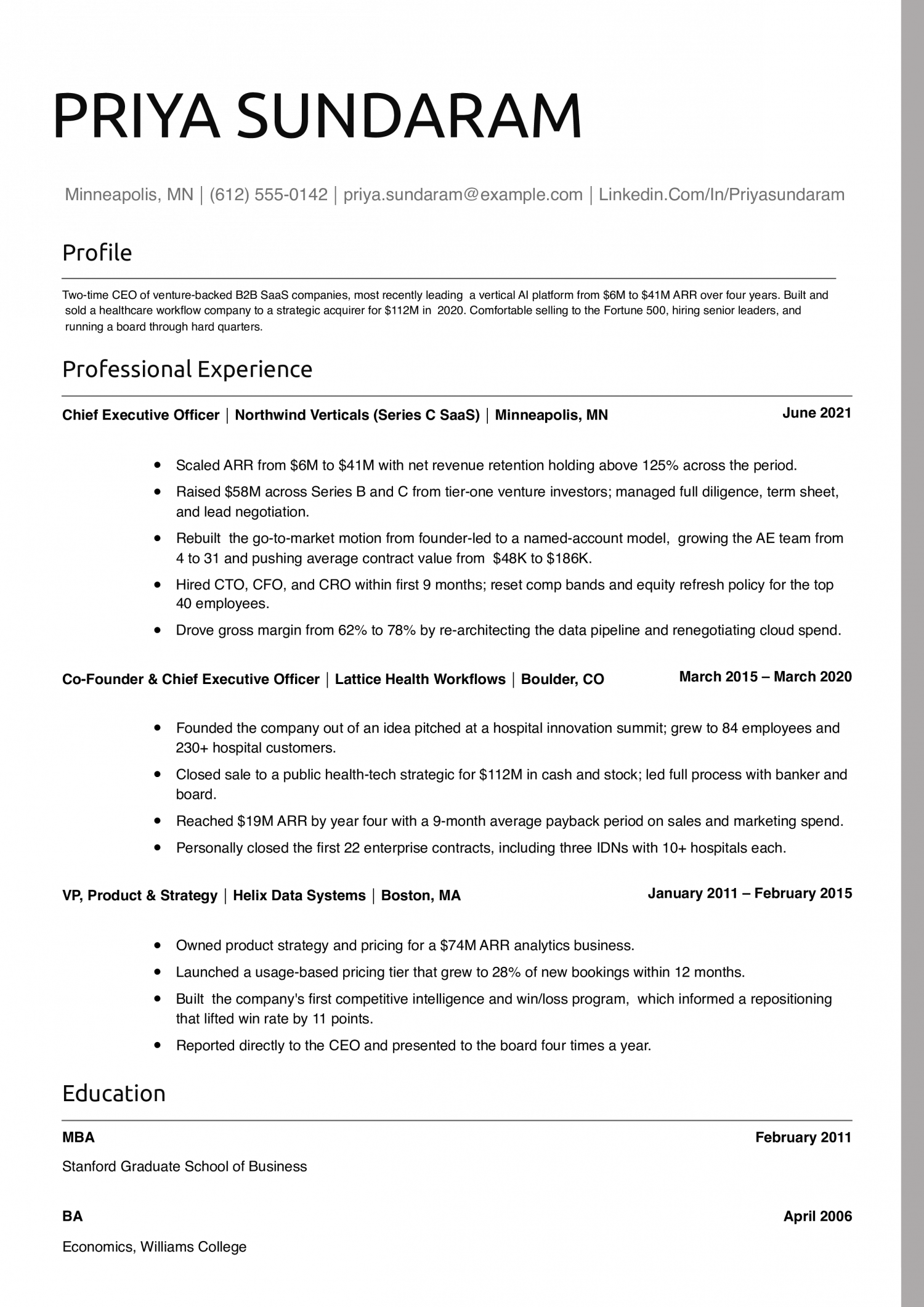
- Two CEO tours, not one: Showing a prior exit at $112M and a current scale-up to $41M ARR makes the candidate look like a repeat operator, not a first-timer.
- Numbers tied to investor concerns: Net revenue retention, gross margin, payback period, and ACV are the exact metrics a SaaS board cares about, and each one has a real before/after figure.
- Shows the full CEO job: Fundraising, executive hiring, GTM rebuild, and selling the company are all here, which covers the parts of the role that go beyond running the P&L.
Text Version Chief Executive Officer
PROFESSIONAL SUMMARY
Chief Executive Officer with 18+ years leading mid-market industrial and technology businesses through growth, turnaround, and exit. Track record of taking a regional manufacturer from $47M to $214M in revenue, closing two strategic acquisitions, and rebuilding executive teams for scale. Operator who is equally at home in the boardroom, on the plant floor, and in front of enterprise customers.
EXPERIENCE
- Grew annual revenue from $47M to $214M by repositioning the company from a single-product supplier into a four-line specialty components business serving aerospace, EV, and medical OEMs.
- Led acquisition and integration of two competitors (combined purchase price ~$38M), consolidating both onto a single ERP and shared services org within 11 months of close.
- Restructured a money-losing East Coast plant, moving from third shift to a continuous-flow model and lifting site EBITDA margin from roughly 4% to 17% over two years.
- Recruited a new CFO, CRO, and COO; refreshed three of seven board seats with operators who had scaled comparable industrial businesses.
- Closed Series D recap with a PE sponsor at a 2.4x step-up in enterprise value vs. the prior round.
- Ran day-to-day P&L of a $310M business across four plants and 1,400 employees; reported to the founder/CEO and the board.
- Cut customer lead times from 9 weeks to under 4 by rebuilding S&OP and moving to weekly takt-based planning.
- Negotiated a long-term supply agreement with a Tier 1 automotive customer worth ~$78M over five years.
- Stood up the company’s first formal safety program; recordable incidents dropped from 14 to 3 per year.
- Built a leadership development program that promoted 22 internal candidates into plant manager and director roles.
- Owned operations for three plants generating about $190M in annual revenue.
- Took on-time delivery from the mid-70s into the high 90s by rebuilding production scheduling and supplier scorecards.
- Led a $9.2M capex program for a new finishing line that paid back inside 22 months.
- Promoted from Plant Manager after 18 months on the strength of a successful turnaround at the Akron site.
- Ran a 280-person plant with $62M in annual output; full P&L accountability.
- Reduced scrap rate from 7.1% to 2.8% in 14 months through statistical process control and operator training.
- Renegotiated the local CBA without a work stoppage; held wage growth to inflation while expanding shift flexibility.
EDUCATION
- MBA, Finance and Operations, University of Michigan Ross School of Business, 2008
- BS, Mechanical Engineering, Purdue University, 2003
SKILLS
- P&L ownership ($200M+)
- M&A sourcing and integration
- Board and investor relations
- Operational turnarounds
- S&OP and lean manufacturing
- Executive team recruiting
- PE and debt capital raises
- Long-cycle B2B sales strategy
- ERP migrations (SAP, NetSuite)
- Safety and EHS programs
- Union and CBA negotiations
- Strategic planning and capital allocation
How to Write a Chief Executive Officer Resume
01 Open with a profile that names your mandate scope
Your profile should state the stage you’ve led (founder, growth, PE-backed, public, turnaround), the revenue band, and the headcount under you. Name the industry vertical and the geography.
Then name the inflection point you owned: scale from $50M to $300M, a Series C through IPO, a carve-out integration, or a margin reset. Board chairs and executive search partners read for fit at the next stage, so the scope dimension up top decides whether they keep reading.
02 Quantify enterprise value, not activity
Most strong CEO bullets carry a number a board can verify. Lead with revenue growth, EBITDA movement, gross margin shift, NRR, or TSR over your tenure.
Add capital outcomes: rounds raised, valuation step-ups, dividends, or exit multiples. Bullets without a number tend to read as duties, and duty-language at the CEO level signals a caretaker rather than an operator. Pair each outcome with the lever you pulled, whether pricing, sales coverage, manufacturing footprint, or M&A.
03 Group deliverables by the four operator categories
Sort your work under strategy and capital allocation, commercial growth, operating model, and talent or culture. Under strategy, name acquisitions closed, divestitures, and capital raises with sizes.
Under commercial growth, name segments entered, pricing actions, and channel builds. Under operating model, name margin programs, ERP cutovers, or footprint changes. Under talent, name the leadership team you hired and retention through the transition.
04 Place governance and board credentials on page one
Add a credentials block near the top listing current and prior board seats, committee roles (audit, comp, nominating), and any public-company experience. Note investor relationships by firm type, not by deal number.
Board chairs and executive search partners need this visible early because it signals fiduciary range, SEC reporting fluency, and the kind of room you can sit in. Include any operator-in-residence or advisory roles with PE or VC firms, plus governance training such as NACD Directorship Certification.
05 What to cut from your CEO resume
Cut the objective statement, the soft-skill list, and any bullet that reads like a job description. Cut early-career detail older than 15 years down to a one-line roster.
Cut vague references to digital transformation, synergies, and stakeholder alignment unless you can attach a number and a date. Keep the document to two pages for most searches, three only when public-company tenure or M&A volume genuinely earns it. References, headshots, and license numbers stay off the resume.
Most Popular Skills on Chief Executive Officer Resumes for 2026
ATS filters catch more CEO resumes than ever in 2026. The skills below come from our user-built CEO resumes. P&L scope terms and capital-allocation language clear the first cut, and governance vocabulary decides whether the resume advances.
Board chairs and executive search partners weight hard skills as table stakes and read soft skills as evidence in your bullets. Naming M&A integration without a deal size reads weaker than one quantified outcome. Match the list below against the search firm’s spec, and use soft skills to caption the bullets that prove them.
| Soft Skills | % of resumes with this skill |
|---|---|
| Leadership | 76% |
| Communication | 61% |
| Decision-making | 42% |
| Emotional intelligence | 38% |
| Strategic vision | 30% |
And here are the top hard skills showing up most often.
| Hard Skills | % of resumes with this skill |
|---|---|
| Strategic planning | 77% |
| P&L management | 65% |
| Financial management | 47% |
| Operations management | 37% |
| Risk management | 26% |
Based on data from thousands of CEOs’ resumes built on ResumeTemplates.com, May 2026.
Must Have on a Chief Executive Officer Resume
The items below are what separates a chief executive officer resume that clears credentialing from one that gets put back in the pile.
Niche Keywords for ATS Checkers
Board chairs and executive search partners expect the niche section to mirror the mandate language in the spec. Group your keywords by the sub-niche you’ve actually run, not every CEO archetype.
| Niche | Keywords ATS scans for |
|---|---|
| PE-backed platform CEO | private equity portfolio company, platform CEO, add-on acquisitions, EBITDA expansion |
| Public-company CEO | public company CEO, SEC reporting, investor relations, total shareholder return |
| Growth-stage / venture-backed CEO | Series C CEO, ARR growth, venture-backed CEO, path to profitability |
| Turnaround and restructuring CEO | turnaround CEO, operational restructuring, margin recovery, cash conservation |
| M&A and integration leadership | M&A integration, carve-out, post-merger integration, divestiture |
AI Skills to Add
What board chairs and executive search partners expect on a CEO resume has shifted. A silent stance on AI now reads as outdated on most growth and PE-backed mandates; a clear operating thesis on where AI sits in the cost structure, product, and talent model reads as current. The list below names what to add.
Boards expect a CEO to defend AI spend with a payback model, not a vision deck, and to name the metric being moved.
Search partners read for span-of-control shifts as AI absorbs middle layers, including reporting line redesigns and shared-service consolidation.
Resumes now name AI fluency on the executive team, not just CTO hires, including how the CFO and CHRO use AI tooling.
Quarterly board packs increasingly include AI-risk and model-governance sections, and search firms ask for the CEO's framework.
- ChatGPT Enterprise or Claude for Work: Used for board memo drafts, deal screens, and synthesizing competitor and market signal across the leadership team.
- Microsoft Copilot or Google Gemini for Workspace: Used to standardize executive reporting cadence, meeting prep, and cross-functional planning artifacts at the enterprise level.
Do
- Reset the operating model with AI tooling across finance and shared services, cutting SG&A by a named percent while holding revenue growth.
- Stood up an AI governance committee with the board audit chair, defining model-risk policy and approving the first three production use cases.
Skip
- Leveraged AI to revolutionize the enterprise.
- Drove an AI-first culture across all functions.
Executive and Board-Level Positioning
Treat page one as the board memo. The summary names stage, sector, revenue band, headcount, and the one inflection point that defines your tenure. Below the summary, list current and prior board seats with committee roles and term dates.
Treat each operating role as a thesis with a result. Open with the mandate the board hired you for, then the operating moves you made, then the enterprise-value outcome. Name the investors and the chair you reported to when the context adds signal.
- Summary names stage, sector, revenue band, headcount, and the defining inflection point
- Board seats block on page one with committee roles (audit, comp, nominating) and term dates
- Each role opens with the board mandate, then the operating moves, then the enterprise outcome
- Capital events named with size: raises, recaps, acquisitions, divestitures, IPOs
- Investor and chair context included where it sharpens the fit signal
Executive Leadership Credentials That Get You the Job
An MBA or equivalent operating record keeps you eligible. The certifications below move a CEO resume from the qualified-but-typical stack into the shortlist for board chairs and executive search partners. List the issuing body, year earned, and any active board or committee role tied to it.
-
NACD Directorship Certification: Signals current fluency in board governance, audit oversight, and ESG reporting expected for public and PE-backed seats.
-
Harvard Business School Advanced Management Program (AMP): Reads as a credible step from divisional president to enterprise CEO, especially for operators without a formal MBA.
-
Stanford Directors' College: Carries weight for tech and life-sciences boards screening for governance depth alongside operating range.
-
Certified M&A Advisor (CM&AA): Strengthens a resume built on roll-ups, carve-outs, or PE-backed platform plays where deal cadence is the story.
Latest BLS Statistics for Ceos
The 90th-percentile CEO out-earns the median by a wide margin, which tells you the market rewards stage, sector, and verifiable enterprise-value creation far more than tenure or title escalation. A long run at one company without quantified outcomes lands closer to the median than the top band.
Lead the resume with the revenue band, EBITDA movement, and capital events that put you in a higher-paying tier, not the years of executive experience.
Entry tier
$73,710–$206,420At the entry tier, your resume needs to show full P&L ownership at a real operating unit and lead with one quantified enterprise outcome.
Mid band
$206,420–$239,200At the mid band, lead with revenue band, EBITDA expansion, and the capital event you ran (raise, recap, or acquisition).
Top decile
$239,200+At the top decile, your resume needs to show public-company or PE-backed scale, named investor relationships, and a verifiable TSR or exit multiple.
Top-paying states
| # | State | Avg. Annual |
|---|---|---|
| 1 | Connecticut | $239,200 |
| 2 | District of Columbia | $239,200 |
| 3 | Illinois | $239,200 |
| 4 | Maryland | $239,200 |
| 5 | Massachusetts | $239,200 |
| 6 | Nevada | $239,200 |
| 7 | New Jersey | $239,200 |
| 8 | North Carolina | $239,200 |
| 9 | Oregon | $239,200 |
| 10 | South Dakota | $239,200 |
Highest-employment states
| # | State | Workers | Median |
|---|---|---|---|
| 1 | California | 36,980 | $220,600 |
| 2 | Pennsylvania | 14,140 | $220,510 |
| 3 | New York | 7,830 | $219,320 |
| 4 | Massachusetts | 7,110 | $239,200 |
| 5 | Minnesota | 6,690 | $194,160 |
Resume Templates offers HR approved resume templates to help you create a professional resume in minutes. Choose from several template options and even pre-populate a resume from your profile.
Frequently Asked Questions
A CEO resume reads more like a board pitch than a job history. The summary names stage, sector, revenue band, and the inflection point you owned.
Bullets lead with enterprise-value outcomes, not function-level wins. Board seats and investor context sit on page one, not buried at the end.
Two pages is the working standard for most CEO searches. A third page is defensible only when you have public-company tenure, heavy M&A volume, or multiple board seats that genuinely need the space.
Cut early-career roles older than 15 years to a one-line roster. Search partners reading 80 CVs in a week reward density over completeness.
In the US, board chairs and search partners expect a resume format even at the CEO level. A longer CV with publications and speaking engagements is standard in academia, healthcare systems, and many non-US markets.
When in doubt, ask the search partner what format the board prefers. Send the format they ask for, not the one you have on file.
Lead the summary with the full P&L you owned as a division president, COO, or general manager, including revenue band and headcount. Name the strategic decisions you made that a CEO normally makes: pricing, capital allocation, M&A, or leadership team hires.
Add any board exposure, whether reporting to the board, sitting on a subsidiary board, or holding an outside seat. That exposure closes the credibility gap for boards weighing a first-time CEO.
For a chief executive officer, a professional template is the safest pick, because it signals the polish hiring managers in this field expect. An ATS-friendly template is a solid alternative. Whichever you choose, keep the formatting clean and easy to parse: clear section headings, a standard font, and no graphics a parser can choke on.