
A current credentials block is what gets personal trainer resumes past a fitness director's first scan; named client outcomes and a retention rate are what make them readable enough to earn a floor audition.
Featured Example
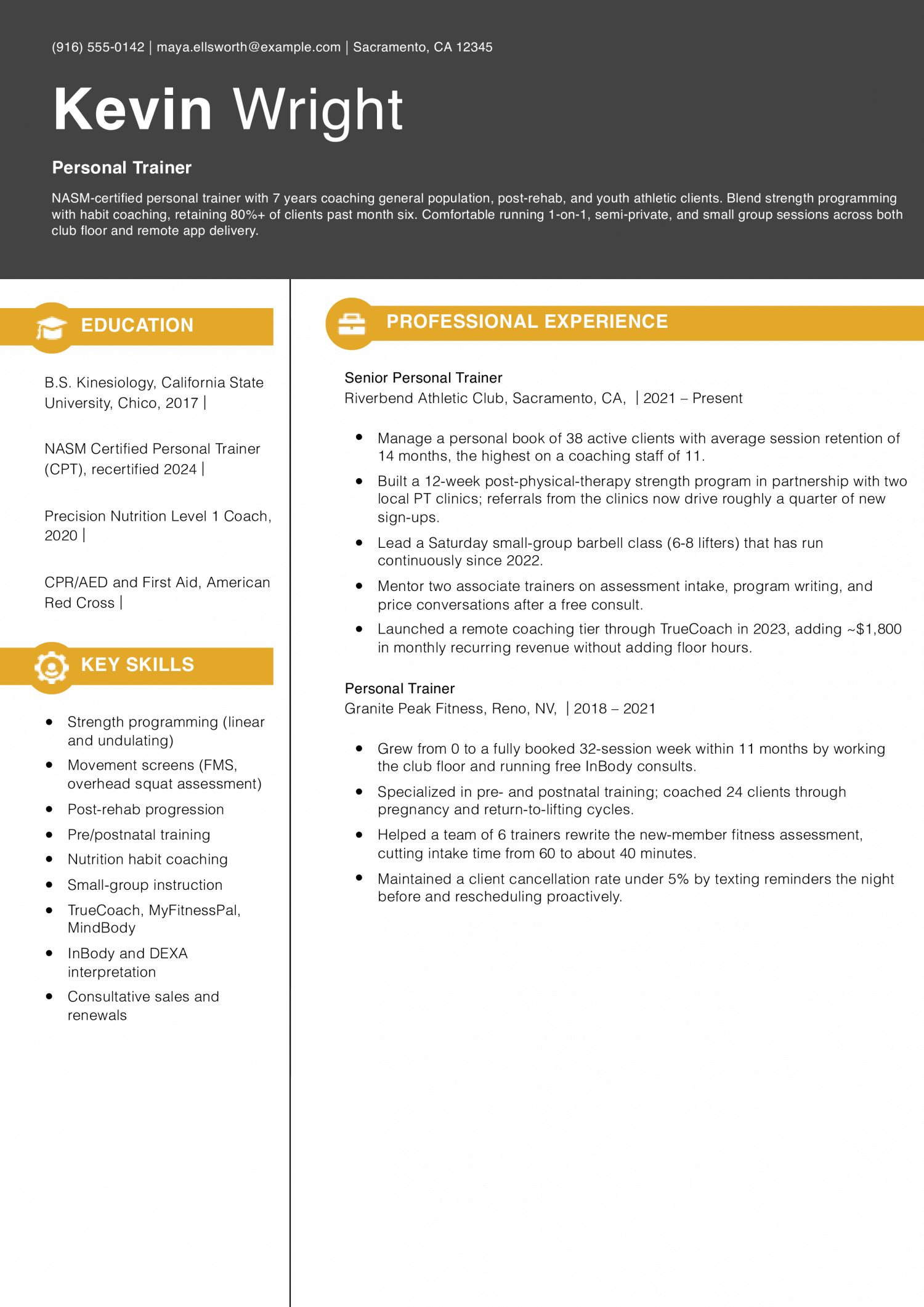
Why this resume works
- Retention is the hardest number to fake: Leading with 80%+ six-month retention and 14-month average tenure tells a gym owner this trainer keeps clients paying, which is the metric that decides hiring.
- Brings in revenue, not just sessions: The clinic referral pipeline and the ~$1,800/month remote tier show this trainer can build a book, not only fill one assigned to them.
- Real specialties, not a long list: Post-rehab and pre/postnatal are named with client volume and program length, so the specialization reads as actual case experience instead of a buzzword stack.
Entry Level Example
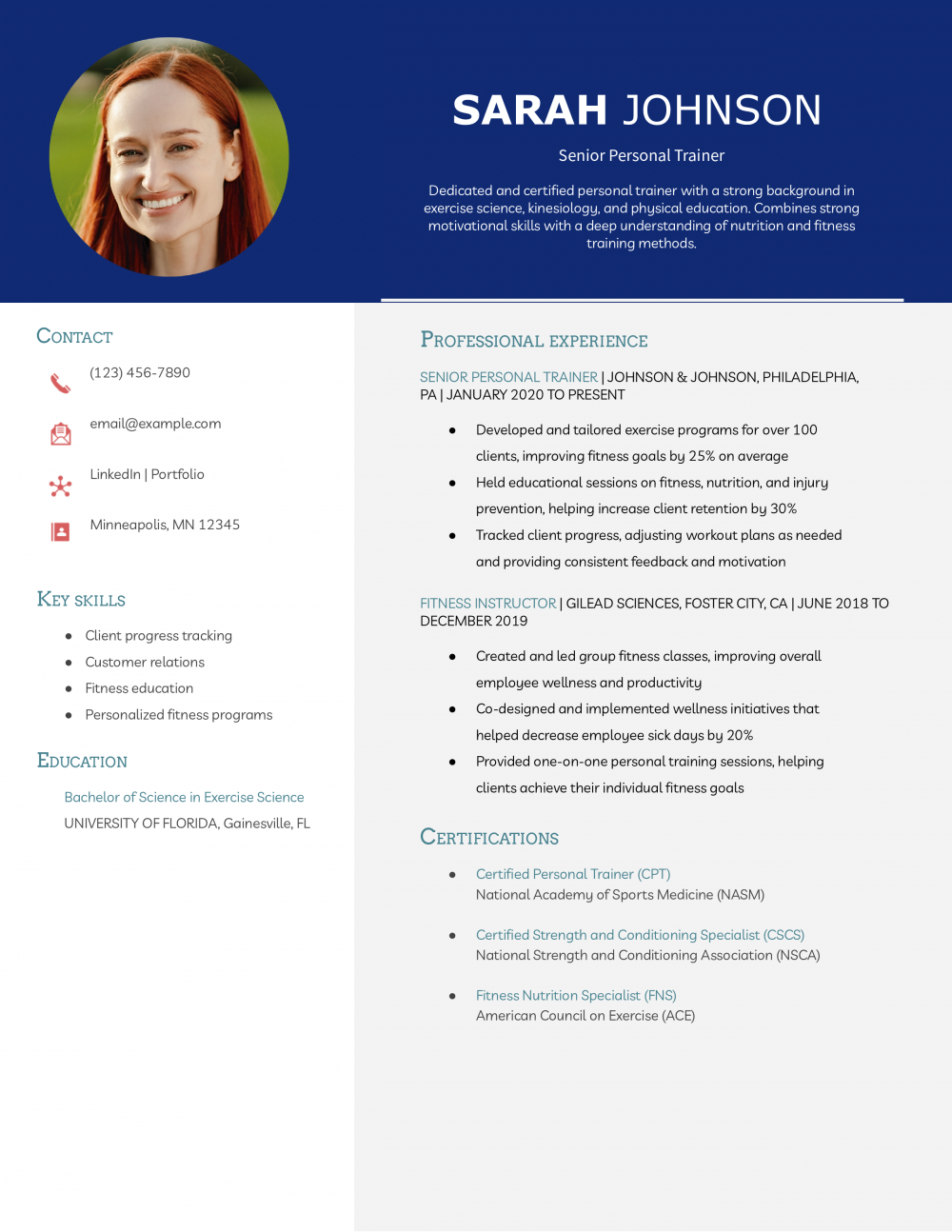
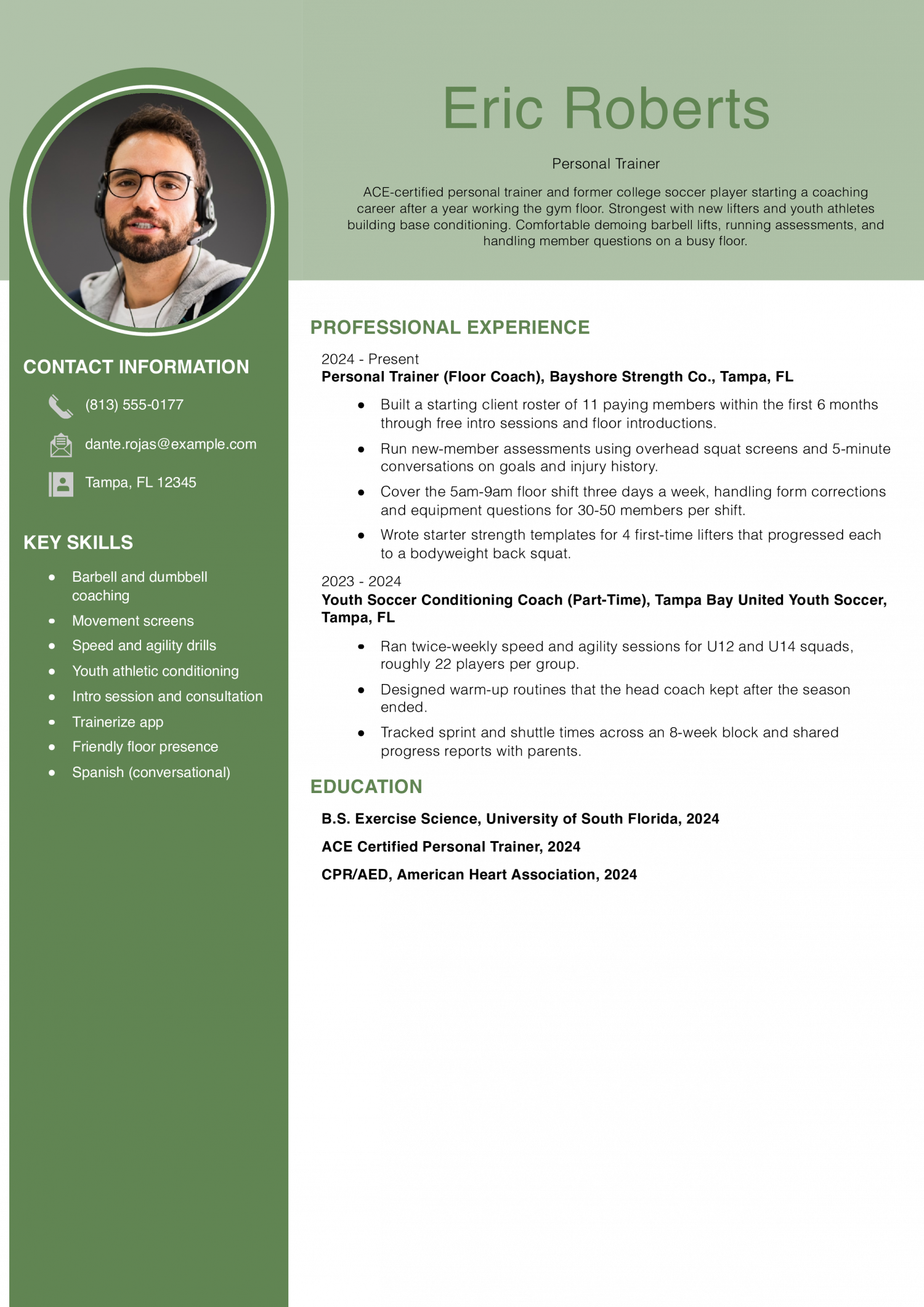
Entry level covers new NASM, ACE, or ACSM grads moving from gym floor staff or group fitness subs into a paid book. This resume needs to prove certification currency, CPR/AED readiness, and any shadow hours or pro-bono client results you can name.
Why this resume works
- Honest about starting out: 11 clients in 6 months and a floor shift is exactly what an entry-level trainer should show, not inflated numbers that a hiring manager won’t believe.
- Background that fills the gap: The youth soccer coaching gives concrete coaching reps before the personal training job, which softens the thin client list.
- Picks one client base to own: New lifters and youth athletes is a tight focus that fits the certifications and the soccer background, so the resume reads like a person with a direction.
Experienced Example
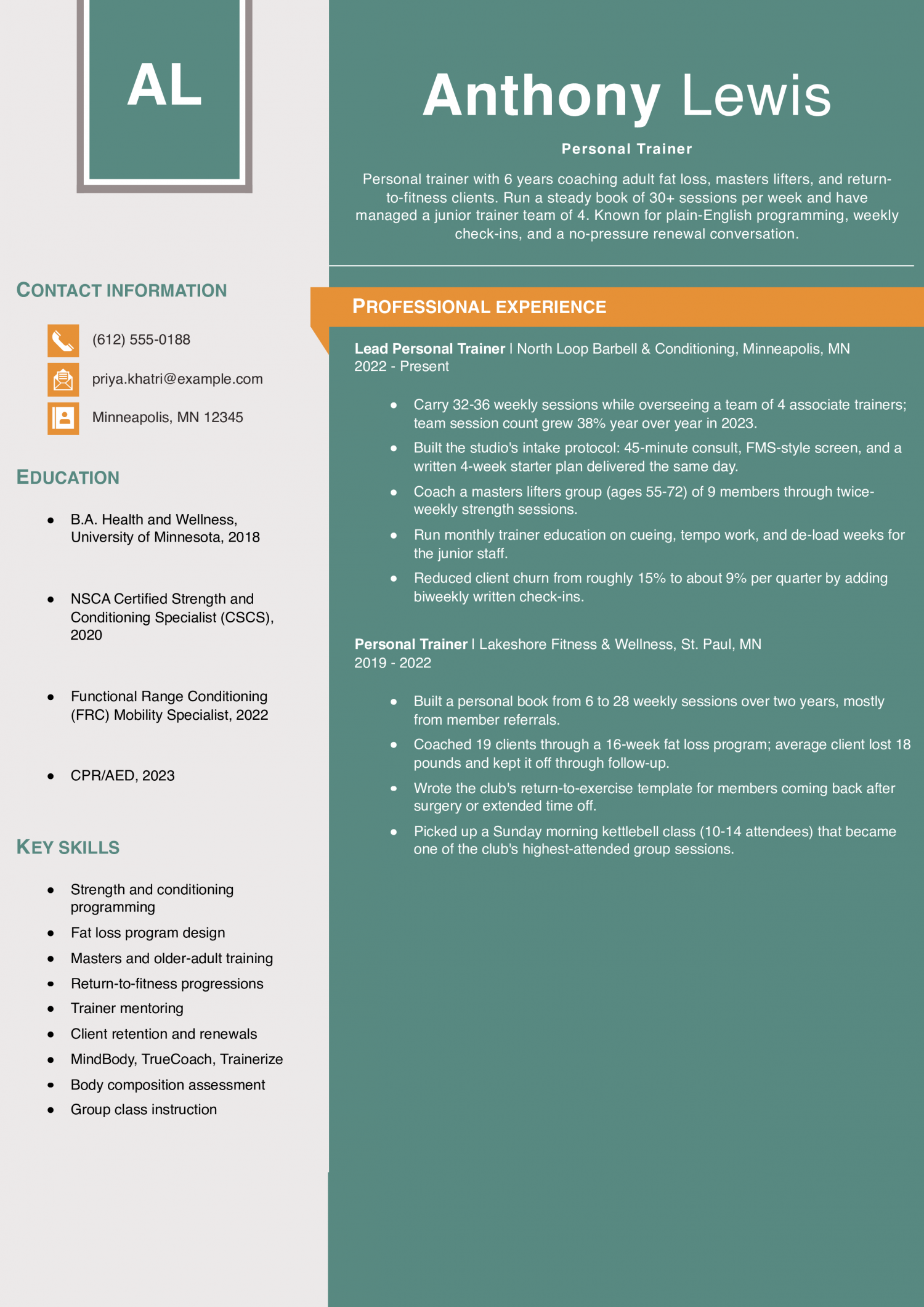
Experienced covers trainers with two to seven years of session volume, a steady book, and one or two specialty add-ons. This resume needs to prove client retention rate, weekly session count, and measurable outcomes across strength, weight loss, or post-rehab tracks.
Why this resume works
- Shows the lead trainer step: Managing four associates and running monthly education is the credential a mid-career trainer needs to stand out from people still only running their own book.
- Churn number tied to a fix: Dropping churn from 15% to 9% with biweekly check-ins names the problem, the solution, and the result, which is the structure managers trust.
- Two distinct client groups, not vague: Masters lifters and fat loss clients each get their own bullet with numbers, so the resume reads as someone with real range instead of a generalist.
Master Trainer Example
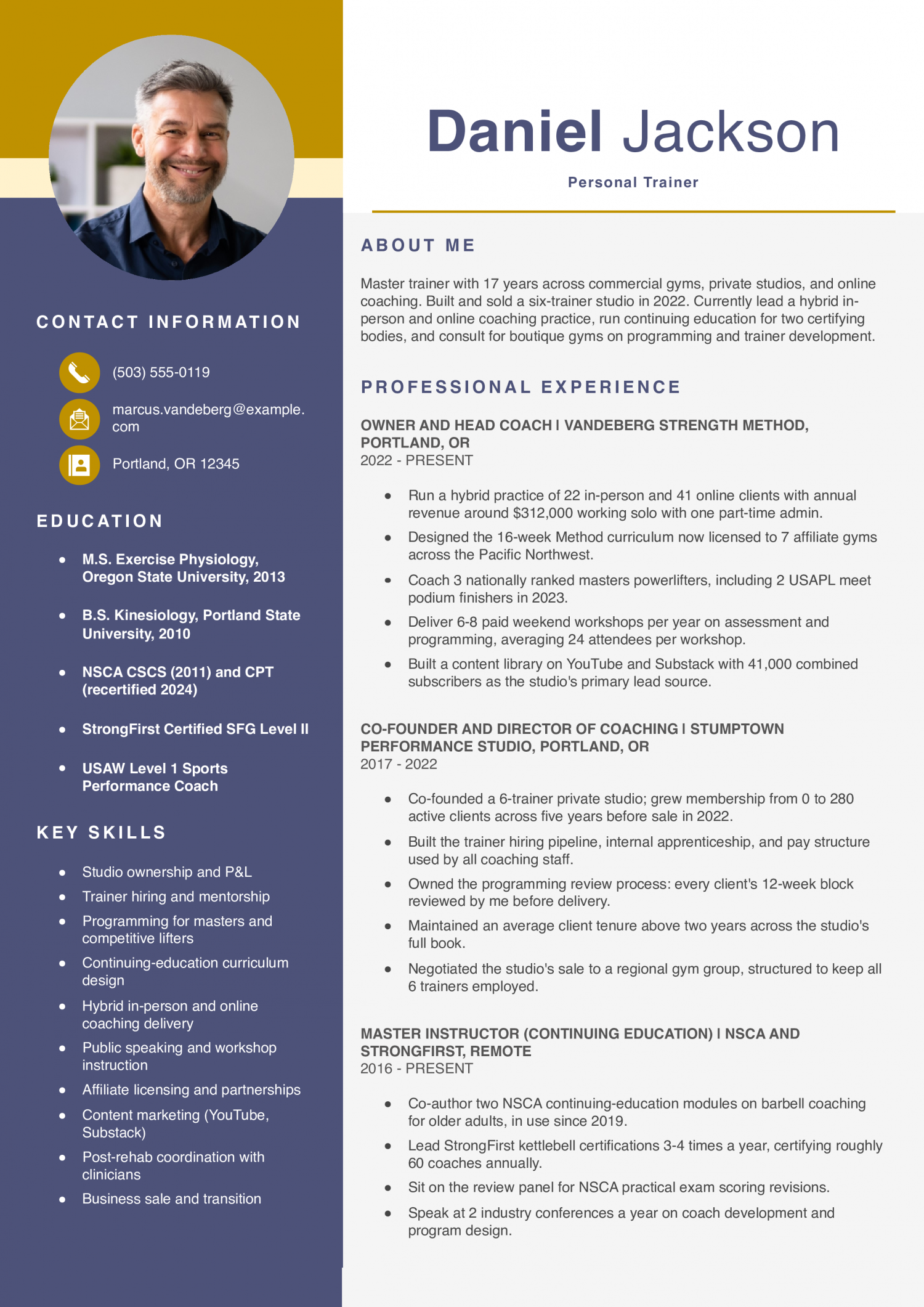
Master trainer covers senior staff who mentor floor trainers, run programming for a studio, or hold advanced credentials like CSCS or CES. This resume needs to prove revenue contribution, retention across a full book, and the trainers or programs you have built.
Why this resume works
- Owned the business, not just the clients: Founding a studio, scaling it to 280 clients, and selling it is the kind of story master-level employers and partners want to see, and the resume tells it in numbers.
- Teaches other coaches, not only members: NSCA module authorship, StrongFirst certifications, and 60 coaches certified per year prove the master-level title with industry-recognized work.
- Real revenue figure on the practice: Listing ~$312,000 in annual revenue with the client mix shows what the hybrid model actually produces, which is rare and credible at this level.
Text Version Personal Trainer
Alicia Brennan
Charlotte, NC | (704) 555-0163 | [email protected] | linkedin.com/in/aliciabrennan
PROFESSIONAL SUMMARY
Personal trainer with 9 years in commercial gyms, boutique studios, and online coaching. Strongest with women returning to lifting, postpartum clients, and adult beginners. Hold NASM CPT, Pre/Postnatal Coaching Certification, and Precision Nutrition Level 1. Carry 30+ sessions a week and have led teams of up to 5 trainers.
EXPERIENCE
Head Personal Trainer
Queen City Strength Studio | Charlotte, NC | 2022-Present
- Manage a personal book of 34 active clients while overseeing 5 associate trainers across two studio locations.
- Rebuilt the studio’s onboarding process: a 60-minute consult, full movement screen, and a written 6-week starter program emailed within 24 hours.
- Cut new-client drop-off in the first 60 days from roughly 22% to under 12% after introducing weekly text check-ins.
- Run a postpartum return-to-lifting group (currently 11 members) that meets twice a week.
- Co-host a monthly client education night on nutrition, sleep, and recovery, averaging 28 attendees.
Personal Trainer and Online Coach
Foothill Fitness Collective | Asheville, NC | 2019-2022
- Built a hybrid book of 22 in-person and 18 online clients within two years of starting the position.
- Generated approximately $4,600 in monthly online coaching revenue through Trainerize at peak.
- Coached 31 postpartum clients through a 12-week return-to-training framework I wrote and refined over three program rounds.
- Co-led a Saturday women’s barbell class that grew from 4 attendees to a 14-person waitlist.
Personal Trainer
Crescent Health Club | Raleigh, NC | 2017-2019
- Promoted from associate to full trainer in 9 months after hitting club’s session-count target two quarters early.
- Carried 26-30 weekly sessions, mostly adult beginners and members returning after injury.
- Built a referral relationship with a chiropractor’s office that produced 14 new clients across an 18-month stretch.
- Trained alongside the club’s group fitness team to cover Sunday morning conditioning classes when needed.
Group Fitness Instructor and Floor Trainer
Tidewater Athletic Center | Wilmington, NC | 2015-2017
- Taught 6 group fitness classes per week including cycling, barre, and strength circuit formats.
- Worked the gym floor 15 hours a week, running free intro consults that converted to roughly 30% sign-ups.
- Earned the club’s Instructor of the Year recognition in 2016 based on attendance numbers and member surveys.
- Helped onboard 4 new instructors through shadow sessions and form coaching.
EDUCATION
- B.S. Exercise and Sport Science, University of North Carolina at Greensboro, 2015
- NASM Certified Personal Trainer, recertified 2024
- Pre and Postnatal Coaching Certification (Girls Gone Strong), 2020
- Precision Nutrition Level 1 Coach, 2021
- CPR/AED and First Aid, American Red Cross
SKILLS
- Strength programming for beginners and intermediate lifters
- Postpartum return-to-training
- Movement screens and intake assessment
- Nutrition habit coaching
- Hybrid online coaching (Trainerize, TrueCoach)
- Small-group and barbell class instruction
- Trainer hiring and mentorship
- Client retention and renewal conversations
- Studio operations across multi-location teams
- MindBody scheduling
How to Write a Personal Trainer Resume
01 Open with the metric a fitness director would use to size you up
The first line of your summary should name the number a fitness director uses to budget headcount: weekly billable sessions, active client count, and retention rate over the last 12 months.
A line like “NASM-CPT trainer running 28 sessions per week with a 71 percent six-month retention rate across a 22-client book” tells a manager you can carry a floor. Add one specialty and one outcome category right after.
Skip the years-of-passion opener. Fitness directors read session volume and retention before they read anything else, because those numbers translate directly to studio revenue.
02 Quantify sessions, retention, and client outcomes
Strong personal trainer bullets carry three numbers: session volume, retention, and a client result you can attribute. Bullets without a number tend to read as duties any cert holder could claim.
Name weekly or monthly sessions, your six- or 12-month retention rate, and at least one outcome metric per specialty: average body fat reduction, one-rep max gains, 5K time drops, or post-op range-of-motion progress.
If you sell packages, add revenue or package conversion. A bullet like “Converted 38 percent of intro sessions into 12-pack packages, adding $2,100 monthly recurring revenue” reads as business value, not floor work.
03 Group your work by training specialty
Split your experience into three or four specialty buckets so a fitness director can match you to open programs. Common groupings are strength and conditioning, weight loss and metabolic, post-rehab and corrective exercise, and group or small-group training.
Under each bucket, name the assessment tools you use (FMS, InBody, Y-Balance), the programming method (linear periodization, conjugate, MetCon blocks), and the client profile you handled.
Add a separate line for online or hybrid coaching if you run it through Trainerize, TrueCoach, or MyPTHub. Studios hiring for hybrid books want to see the platform named, not just “virtual training.”
04 Put credentials and CPR at the top
Page-one credentials block, right under your summary. List the certifying body and the credential: NASM-CPT, ACE-CPT, ACSM-CPT, NSCA-CSCS, or NASM-CES, plus expiration month and year.
Add CPR/AED and first aid with the issuer (American Red Cross or American Heart Association) and the expiration date. Liability insurance through IDEA or NFPT is worth a line if you contract independently.
Fitness directors need these visible before they read bullets because an expired CPR card or lapsed cert disqualifies you at the screening step. Burying them on page two costs interviews.
05 Close with continuing education and specialties
End the resume with a short continuing education section listing CEU courses, workshops, and specialty certs you have completed in the last three years. Name the provider: PN1 from Precision Nutrition, FRC from Functional Range Systems, RKC kettlebell, or PRI courses.
Education comes after this for experienced trainers; lead with it only if you hold an exercise science or kinesiology degree relevant to a corporate wellness or clinical role.
Skip high school, generic computer skills, and “references available on request.” That space is better spent on one more specialty or a client outcome bullet.
Most Popular Skills on Personal Trainer Resumes for 2026
The skills below come from personal trainer resumes our users built on ResumeTemplates.com. Gym managers and fitness directors scan dozens of resumes a week, and these show up most often. Hard skills like NASM-CPT and corrective exercise prove you can be insured and put on the floor.
Soft skills like client retention behaviors back up the numbers in your bullets. Match the hard skills against the posting language word for word, then use the soft skills as evidence anchors for your strongest bullets.
| Soft Skills | % of resumes with this skill |
|---|---|
| Client motivation | 70% |
| Communication | 66% |
| Active listening | 46% |
| Empathy | 39% |
| Time management | 25% |
And here are the top hard skills showing up most often.
| Hard Skills | % of resumes with this skill |
|---|---|
| Fitness assessment | 80% |
| Exercise program design | 62% |
| Strength and conditioning | 50% |
| Nutrition planning | 39% |
| CPR and first aid | 29% |
Based on data from thousands of personal trainers’ resumes built on ResumeTemplates.com, May 2026.
Must Have on a Personal Trainer Resume
These are the must-haves hiring teams look for when scanning a personal trainer resume.
Niche Keywords for ATS Checkers
Gym managers and fitness directors expect to see specialty language that matches the program they are hiring for. The clusters below pull the exact phrasing studios search for across the most common personal trainer niches.
| Niche | Keywords ATS scans for |
|---|---|
| Strength and conditioning | NSCA-CSCS, periodization, strength programming, sport-specific training |
| Corrective exercise and post-rehab | NASM-CES, post-rehab training, corrective exercise, FMS assessment |
| Weight loss and nutrition coaching | Precision Nutrition, habit coaching, body composition, InBody analysis |
| Group and small-group training | small group training, group fitness instructor, bootcamp programming, class scheduling |
| Online and hybrid coaching | Trainerize, TrueCoach, online personal training, remote coaching |
Portfolio Strategy
Personal trainers do not need a portfolio in the design sense, but a short proof layer beats a resume alone when you are competing for a studio chair or a corporate wellness contract. Build a one-page client outcomes sheet and a clean booking link you can drop into the resume header.
Public coach profile showing active program count, specialties, and client testimonials.
One-page site with credentials, specialties, before/after outcome ranges, and a booking link.
Short-form video showing programming logic and client work, useful for boutique and online roles.
Standard profile with a PDF outcomes sheet uploaded as featured media for wellness director searches.
Build a one-page client outcomes sheet as a PDF: aggregate retention rate, average session volume, and three to five outcome ranges by specialty (body fat reduction, strength gains, post-op return-to-sport timelines). Link it from the resume header next to your email.
Use before-and-after photos only with written client permission, and blur identifying features unless the client has signed a media release. Most studios will not hire a trainer who posts client images without consent, and some carriers explicitly prohibit it.
Keep your booking link live. A dead Calendly or Trainerize link in a resume header is a faster disqualifier than a typo, because it tells the director you have not opened your own funnel in months.
Personal Training Credentials That Get You the Job
Gym managers and fitness directors read this list as a map of where your training work is heading. The credentials below tell them which specialty track you have invested in: corrective, strength, nutrition, or group programming. List the issuing body, the credential acronym, and the month and year of expiration on one line.
- NSCA Certified Strength and Conditioning Specialist (CSCS): Signals you can program for athletes and sports performance clients, which moves your resume into university, D1, and high-end studio pools.
- NASM Corrective Exercise Specialist (CES): Tells directors you can take post-PT and orthopedic referral clients, the highest-paying segment at most commercial gyms and wellness centers.
- Precision Nutrition Level 1 (PN1): Documents nutrition coaching scope without crossing into RD territory, useful for trainers selling habit-based weight loss packages.
- Functional Range Conditioning (FRC) Mobility Specialist: Reads as a current mobility credential at boutique studios and CrossFit affiliates that program joint prep into every session.
Latest BLS Statistics for Personal Trainers
Personal trainer is one of the larger occupations BLS tracks, which means the median pulls in a long tail of part-time floor staff, hourly group fitness leaders, and big-box trainers paid below studio rates. The spread between the 10th and 90th percentile is wide because pay shifts hard with specialty, book size, and city.
To position above the median, lead your resume with weekly billable session volume, retention rate, and one or two advanced credentials, not a list of generic training duties.
Entry tier
$27,580 to $46,180 At the entry tier, lead with your NASM, ACE, or ACSM cert, current CPR/AED, and any shadow hours or pro-bono client results.Mid band
$46,180 to $82,050 At the mid band, your resume needs to show weekly session count, six-month retention, and one specialty like CES, CSCS, or PN1.Top decile
$82,050+ At the top decile, lead with revenue contribution, full-book retention, trainers you have mentored, and advanced credentials like CSCS or CES.Top-paying states
| # | State | Avg. Annual |
|---|---|---|
| 1 | Connecticut | $65,790 |
| 2 | New Jersey | $60,620 |
| 3 | Massachusetts | $60,390 |
| 4 | California | $56,600 |
| 5 | New Hampshire | $51,340 |
| 6 | Vermont | $51,240 |
| 7 | Washington | $50,350 |
| 8 | Illinois | $50,290 |
| 9 | Oregon | $49,700 |
| 10 | Nevada | $49,530 |
Highest-employment states
| # | State | Workers | Median |
|---|---|---|---|
| 1 | California | 40,010 | $56,600 |
| 2 | New York | 19,430 | $47,780 |
| 3 | Texas | 18,730 | $39,980 |
| 4 | Illinois | 18,100 | $50,290 |
| 5 | Florida | 17,120 | $37,420 |
Resume Templates offers HR approved resume templates to help you create a professional resume in minutes. Choose from several template options and even pre-populate a resume from your profile.
Frequently Asked Questions
Yes. List CPR/AED and first aid in your credentials block with the issuer and the expiration month and year.
Use the issuer name fitness directors recognize: American Red Cross or American Heart Association. "BLS for Healthcare Providers" is the version most hospital-affiliated wellness centers want.
Most commercial gyms and liability carriers require a current card before you train clients, so an expired date is a screening disqualifier.
Use aggregate numbers and client profiles, never names. Group results by specialty: weight loss, strength, post-rehab, or sport-specific.
A bullet like "Coached 14 post-op knee clients to full squat range within 12 weeks" reads as outcome-driven without breaching client privacy.
If you trained a recognizable athlete or executive, name the sport or industry, not the person, unless you have written permission.
Recert before you apply, then list only the current expiration month and year. The resume does not need to show the lapsed window.
Add a continuing education section with two or three recent CEU courses or workshops. That tells fitness directors you are actively back in the field.
If a manager asks about the gap in interview, name what you did during it: contract work, parenting, school, or a different industry.
Yes, and name the platform: Trainerize, TrueCoach, MyPTHub, or Everfit. Studios building hybrid books search for the tool by name.
Add the active client count you carry on the platform and the average program length. "Manage 18 online clients on Trainerize with average 16-week program adherence" reads as a real remote book.
Group online coaching as its own bullet cluster or its own role, depending on whether you billed it through a studio or independently.
For a personal trainer, an ATS-friendly template is the safest pick, because it puts your certifications and experience where a hiring manager scans first. A basic template is a solid alternative. Whichever you choose, keep the formatting clean and easy to parse: clear section headings, a standard font, and no graphics a parser can choke on.