Tip !

The truck driver resumes that move past the safety screen share three things: CDL class and endorsements in the header, verifiable safe miles by year, and a clean MVR statement a recruiter can confirm in one DAC pull.

Andrew Stoner , Executive Resume Writer and Career Coach

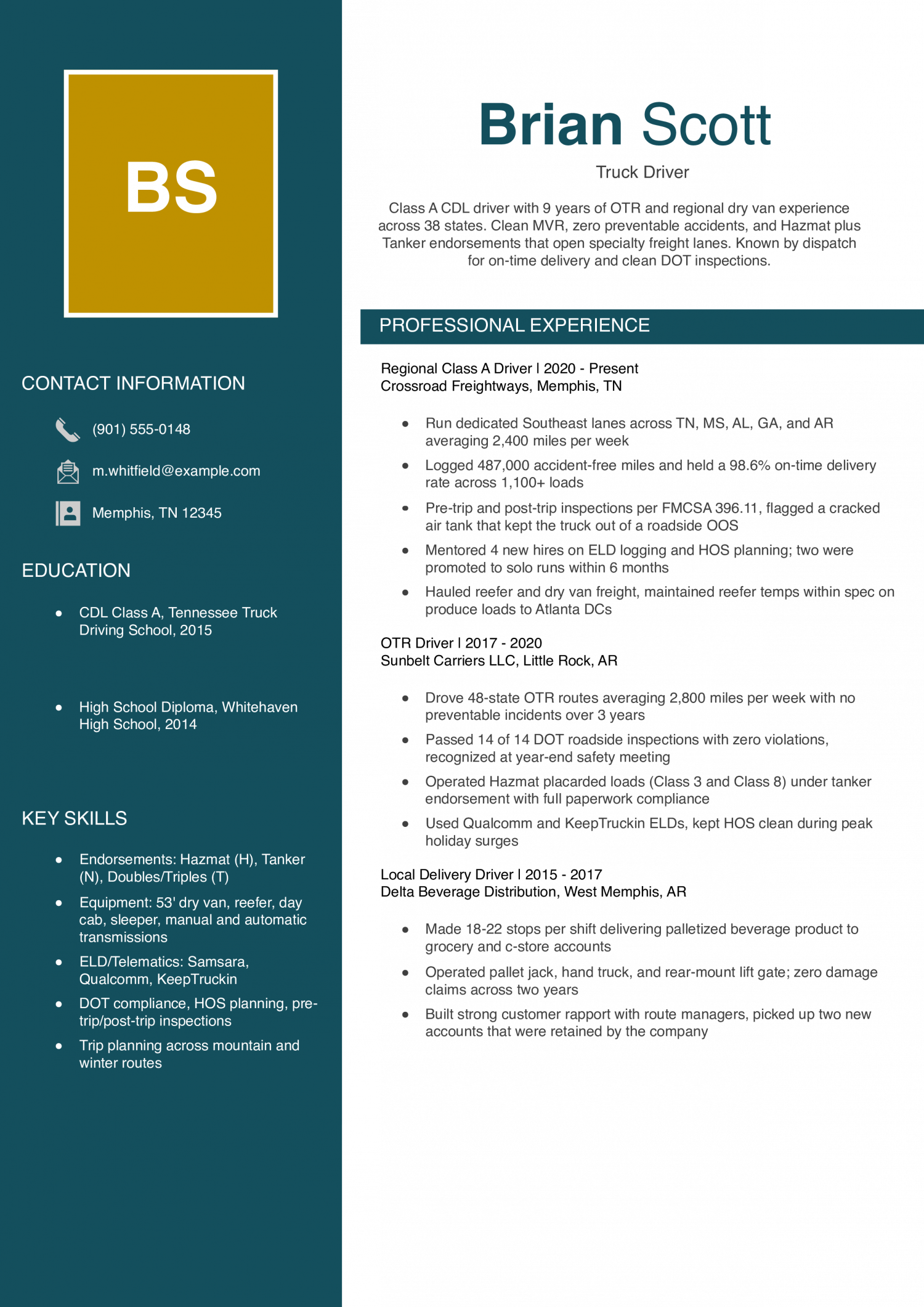
Why this resume works

  • Numbers that matter to dispatchers: Miles per week, on-time percentage, and incident-free miles are the exact stats fleet managers screen for.
  • Endorsements listed up front: HazMat, Tanker, and TWIC appear in education and skills so recruiters spot them in the first scan.
  • Real equipment named: Listing Samsara ELD, 53-foot dry vans, and APU shows the candidate has hands-on time, not just a license.

Entry Level Example

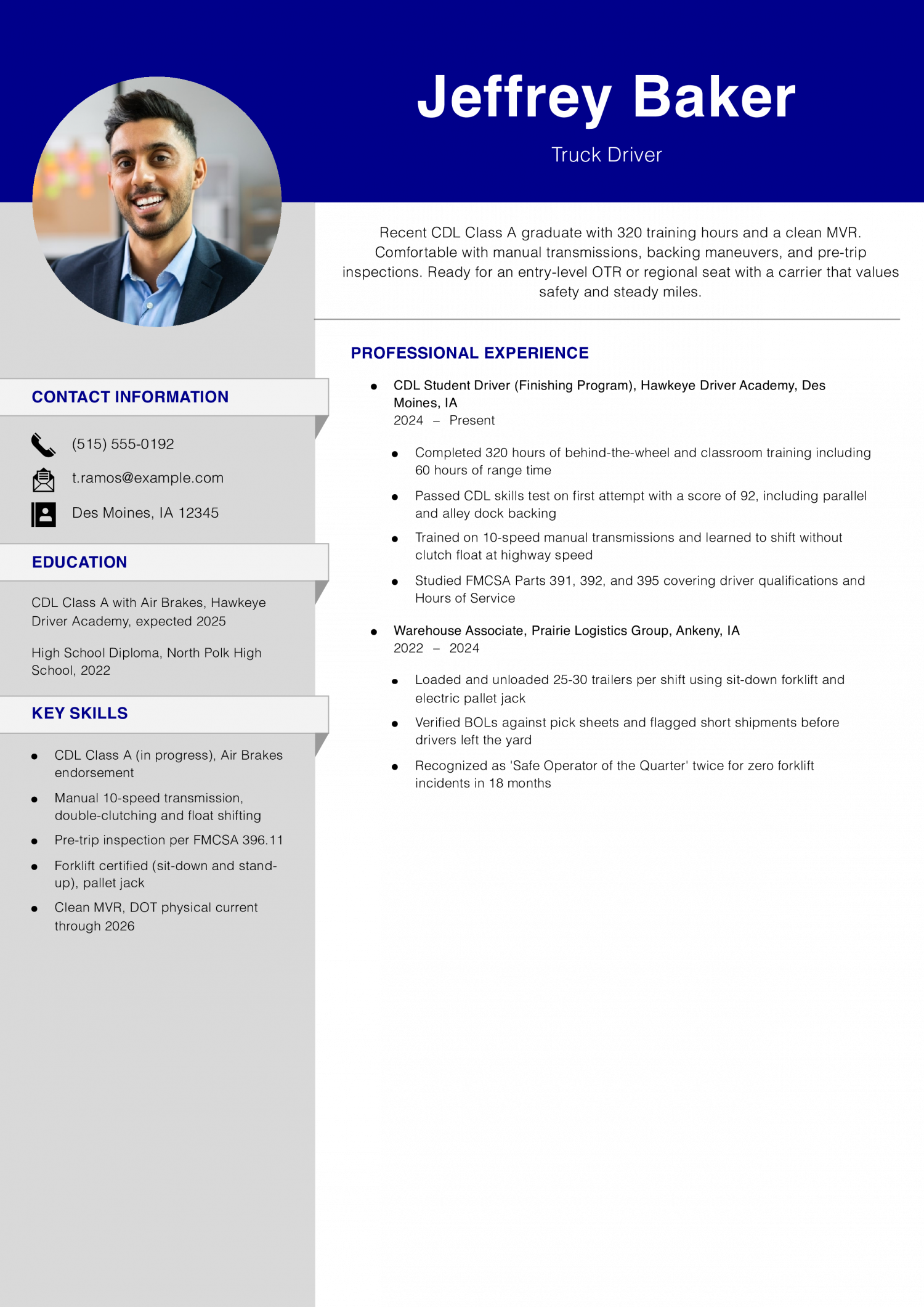
You hold a CDL Class A but have under a year of paid seats behind the wheel. This resume needs to prove your school record, any pre-hire trainer miles, and a clean MVR that satisfies insurance.

Why this resume works

  • Honest about being new: Frames CDL school hours and skills test results as the main experience instead of stretching prior jobs.
  • Useful prior work: Warehouse and forklift work tie directly to loading docks and freight, which entry-level recruiters value.
  • Shows the basics are covered: Listing the medical card, clean MVR, and OSHA forklift cert answers screening questions before the call.

Experienced Example

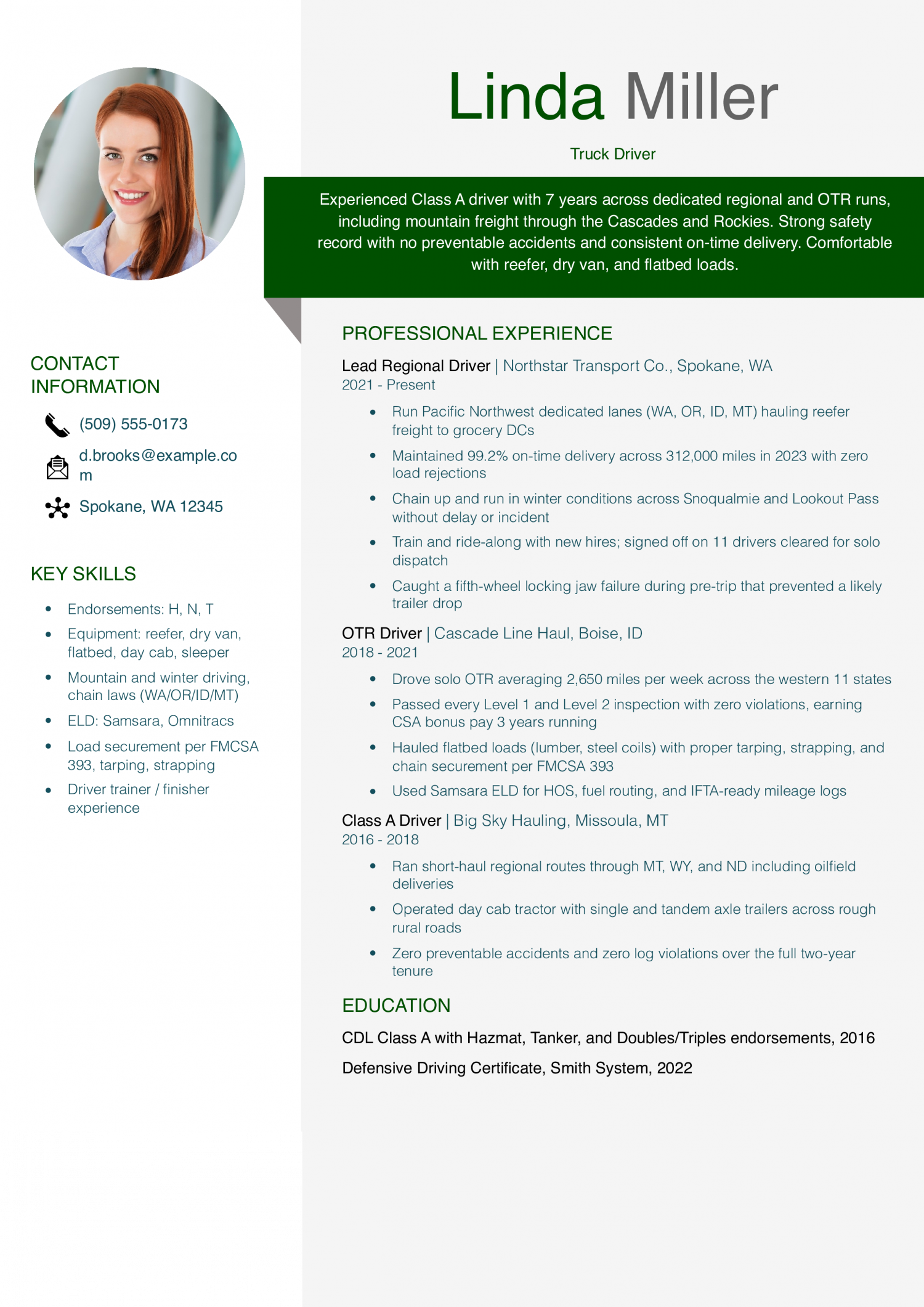
You have two or more years of verifiable CDL driving with a clean DAC report and known freight types. This resume needs to prove safe miles logged, on-time delivery rate, and the equipment and endorsements you run.

Why this resume works

  • Million-mile credibility: Naming the safe driver award and zero preventable accidents signals senior-driver tier.
  • Mentoring shows leadership: Check rides and safety committee work tell recruiters this driver can grow into a trainer or lead role.
  • Equipment range is clear: Dry van, reefer, flatbed, and bobtail experience all appear, so dispatch knows what loads this driver can take.

Owner-Operator Example

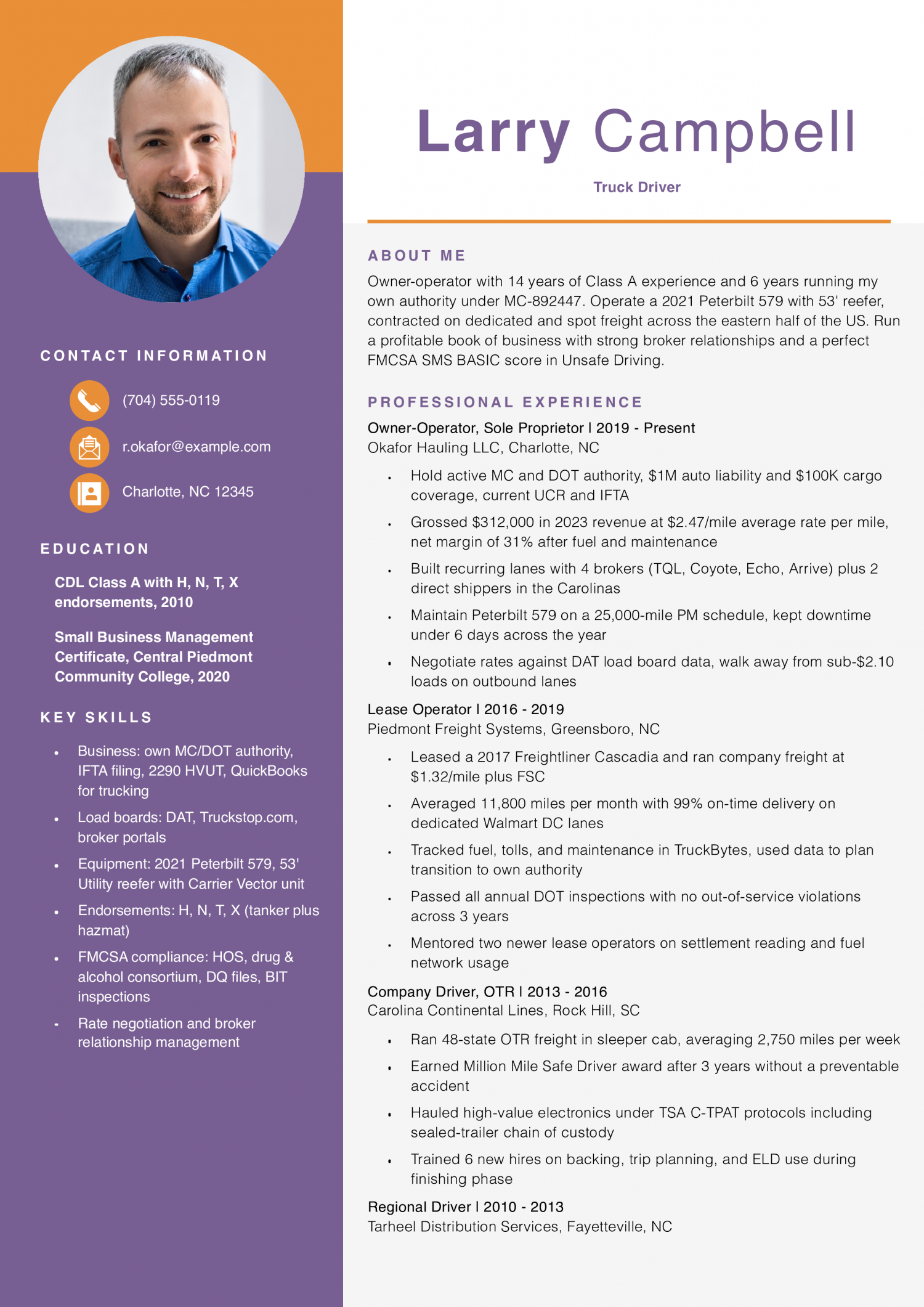
You run your own authority or lease on with a carrier, hauling your own truck and managing the business side. This resume needs to prove revenue per mile, deadhead percentage, broker relationships, and FMCSA compliance you handle yourself.

Why this resume works

  • Business numbers, not just driving: Revenue per truck, broker-direct percentage, and CSA scores show this is a business owner, not only a driver.
  • Career arc reads clearly: Company driver, lease driver, then MC holder shows the natural path that lenders and insurers want to see.
  • Back-office work is named: IFTA, IRP, UCR, and 2290 tell readers this owner-operator handles compliance without an outside admin.

How to Write a Truck Driver Resume

01 Open with the metric a dispatcher would use to size you up

Lead your summary with safe miles logged, not a generic statement about being reliable. Dispatch managers and fleet supervisors scan the top of the page for verifiable numbers.

Name your total accident-free miles, your CDL class, and the freight types you have run. A strong opener reads like: Class A CDL holder with 480,000 accident-free miles across reefer and dry van, OTR and regional, clean MVR and DAC report.

That single line tells a recruiter your scale, equipment fit, and safety profile before they read further.

02 Quantify miles, on-time rate, and loads

Every bullet should carry a number a safety director can verify against your DAC report. Miles per year, on-time delivery rate, and loads hauled are the three metrics most strong driver resumes lead with.

Replace vague duty lines with specific volume. Instead of delivered freight on time, write delivered 1,200 loads across 11 states with a 98 percent on-time rate over two years.

Bullets without a number tend to read as duties, not driving. Add scope to every line where you can verify the figure.

03 Group the work by route, freight, and equipment

Cluster your bullets under three buckets so a fleet supervisor can find what they need fast. Route type covers OTR, regional, dedicated, and local. Freight type covers dry van, reefer, flatbed, tanker, and HazMat.

Equipment covers tractor make, trailer length, ELD platform, and any specialty gear like chains, tarps, or pumps. Name the brands you have run, including Peterbilt, Freightliner, Kenworth, KeepTruckin, and Samsara.

Pre-trip and post-trip inspections, load securement, and hours-of-service logging belong under a daily operations cluster near the top of each role.

04 Put your CDL and endorsements above experience

Recruiters screen for CDL class and endorsements before they read a single bullet. Put a credentials block on page one, directly under your contact info.

List your CDL class (A or B), your endorsements (H, N, T, X, P, S), your TWIC and HazMat status, and your DOT medical card expiration month. Note your state of issue without the license number itself, since publishing the number creates fraud risk.

Add your last DOT physical date and any clean DAC or PSP statement. This block is what gets your file past the safety review and into a recruiter’s hands.

05 Close with training, schools, and recent CE

For entry and mid-level drivers, the closing section carries your CDL school, any company-paid training, and refresher courses. Name the school, the program length in weeks, and your graduation month.

List Smith System, defensive driving, and any carrier-specific orientation you completed in the last three years. Add forklift certification if you load or unload.

Veterans should note any military driving experience and the FMCSA Military Skills Test Waiver if used. Keep this section to four lines so the page-one credentials block stays the focal point.

Based on data from the truck driver resumes our users build, the skills below are the ones safety recruiters and fleet supervisors search for first. Hard skills get you past the ATS and the DAC review. Soft skills get you through the dispatcher interview, where attitude, communication, and reliability decide whether you get the keys.

Match the hard-skill list against the carrier’s posting before you apply, and use the soft skills as evidence behind your bullets.

Soft Skills % of resumes with this skill
Time Management 79%
Communication 67%
Attention to Detail 47%
Patience 38%
Problem-Solving 34%

And here are the top hard skills showing up most often.

Hard Skills % of resumes with this skill
Commercial Driver’s License 78%
Navigation and GPS 69%
Safe Driving 45%
Vehicle Maintenance 39%
Cargo Handling 28%

Based on data from thousands of truck drivers’ resumes built on ResumeTemplates.com, May 2026.

Must Have on a Truck Driver Resume

These are the must-haves hiring teams look for when scanning a truck driver resume.

CDL and Endorsements

Your CDL credentials block is the single most important inch on a truck driver resume. Put it directly under your contact info on page one, where the safety screener and the ATS will both find it first.

What to List, What to Leave Off

Fleet supervisors read this block before they read your work history. If your class, endorsements, and medical card status are not visible in the first scan, your file goes to the no pile.

Use clean labels and short lines. List what you hold, where it was issued, and when it expires. Skip the numbers themselves.

  • CDL Class A or B, state of issue, original issue year
  • Endorsements held: H (HazMat), N (Tanker), T (Doubles/Triples), X (HazMat + Tanker), P (Passenger), S (School Bus)
  • TWIC card status and expiration month
  • DOT medical card with expiration month
  • Clean MVR statement and clean DAC report, both verifiable
  • Years of verifiable CDL driving and total safe miles
  • Equipment operated: tractor makes, trailer types, ELD platforms

DOT Requirements

Carriers run pre-employment, random, and post-accident drug screens under FMCSA Part 382. A short compliance line on your resume tells the safety director you understand the program and have nothing to hide.

Clearinghouse and HOS Compliance

Add a one-line compliance statement near your credentials block. Something like: Enrolled in DOT random drug and alcohol testing pool, FMCSA Clearinghouse registered, clean record.

If you have a prior positive or refusal on the Clearinghouse, do not address it on the resume. Wait for the application stage, where you can explain the return-to-duty process and any SAP evaluation you completed.

  • FMCSA Drug and Alcohol Clearinghouse registered
  • Current participation in employer random testing pool
  • Last DOT physical month and year (no card number)
  • Clean pre-employment screening history available on request

Truck Driving Credentials That Get You the Job

A valid CDL, current DOT medical card, and clean MVR keep you eligible. The certifications below are what move a truck driver resume from the qualified-but-typical stack into a fleet supervisor’s shortlist. List the issuing body, level, and expiration month, with no card numbers on the page.

  • HazMat Endorsement (H): Opens chemical, fuel, and placarded freight lanes that pay higher per mile and screen out drivers without TSA clearance.
  • TWIC Card: Required for port, refinery, and secure facility access, which signals you can run drayage and energy-sector loads.
  • Tanker (N) and Doubles/Triples (T) Endorsements: Show carriers you can run liquid bulk and LTL doubles, two equipment types that command premium pay at most fleets.
  • Smith System or Defensive Driving Certificate: Insurance underwriters look for recognized safety training, and listing it tells the safety director your CSA score is defensible.

Latest BLS Statistics for Truck Drivers

The top-paying states for truck drivers cluster in energy and port economies where freight demand outpaces the local driver pool, not the high-population corridors most drivers default to. Pay pressure follows the freight, and that means oil patches, mining regions, and gateway ports beat the long-haul lanes through the Sun Belt.

If you are open to relocation or running dedicated regional, foreground the endorsements that match those freight types: HazMat, tanker, and TWIC tend to be the unlock.

$57,440 National median annual
$58,400 National mean annual
$38,640 Entry-tier floor (10th percentile)
$78,800 Top-decile ceiling (90th percentile)
2,070,480 Truck Drivers in the U.S.
Where you stand

Entry tier

$38,640 to $57,440 At the entry tier, lead with your CDL Class A, the school you graduated from, and any pre-hire trainer miles logged.

Mid band

$57,440 to $78,800 At the mid band, your resume needs to show verifiable safe miles by year, freight types run, and a clean DAC report.

Top decile

$78,800+ At the top decile, lead with HazMat and tanker endorsements, dedicated account history, and revenue per mile if you run your authority.

Top-paying states

# State Avg. Annual
1 Alaska $64,890
2 New Jersey $64,720
3 Washington $63,760
4 District of Columbia $63,610
5 Oregon $61,180
6 Minnesota $61,090
7 Nevada $60,900
8 Massachusetts $60,630
9 New York $60,520
10 Wyoming $60,270

Highest-employment states

# State Workers Median
1 Texas 212,700 $53,070
2 California 211,740 $59,950
3 Florida 105,730 $50,000
4 Ohio 91,090 $58,080
5 Pennsylvania 90,160 $58,540
Source: U.S. Bureau of Labor Statistics, OEWS 2024 release (SOC 53-3032).
Written by professional resume writers and loved by hiring managers

Resume Templates offers HR approved resume templates to help you create a professional resume in minutes. Choose from several template options and even pre-populate a resume from your profile.

Frequently Asked Questions

What should a truck driver resume objective say?

Skip the objective. Recruiters at carriers want facts in the top two inches, not career goals.

Write a three-line summary instead. Lead with your CDL Class A, your accident-free miles, your route type (OTR, regional, local), and the equipment you have operated.

If you are switching freight types or returning to driving after a break, add one line explaining the move and the recent training that supports it.

Should I put my CDL number on my resume?

No. List your CDL class (A or B), your endorsements, and your state of issue.

Leave the actual license number off the page. Carriers will pull it during the application and DAC verification step.

The same rule applies to your DOT medical card and TWIC card. Name them as held and current, without the card numbers.

How do I list miles driven on a trucking resume?

Give the total miles per job and the years covered. A clean line reads: 220,000 accident-free miles over two years hauling reefer across the Southeast.

Break it down by route type if it varies. OTR miles, regional miles, and local stops each tell a recruiter something different about your driving profile.

Round to the nearest 10,000 miles. Recruiters know drivers estimate, and over-precise numbers raise flags during DAC verification.

How do I handle a gap in my driving history?

Name the gap and keep it short. A one-line entry like Family caregiver, 2024 or Out of seat for medical recovery, 2023 to 2024 closes the question.

Note any refresher training you completed before returning. Safety directors look for recent road time and a current DOT physical above all else.

The DAC report will surface the gap regardless. Addressing it on the resume controls the framing.

Which resume template works best for a truck driver?

For a truck driver, an ATS-friendly template is the safest pick, because it puts your certifications and experience where a hiring manager scans first. A basic template is a solid alternative. Whichever you choose, keep the formatting clean and easy to parse: clear section headings, a standard font, and no graphics a parser can choke on.

Rate this article

Truck Driver Resume

Average Rating

4.1/5 stars with 106 reviews

You have given 0 Star(s)
4.1/5 stars with 106 reviews
Andrew Stoner

Executive Resume Writer and Career Coach

Andrew Stoner is an executive career coach and resume writer with 17 years of experience as a hiring manager and operations leader at two Fortune 500 Financial Services companies, and as the career services director at two major university business schools.