3 Best Military Resume Examples and Templates for 2026



The firefighter resumes that advance to oral boards share three things: a credentials block above the experience section, named fireground tasks on every bullet, and incident counts a chief can scan in under 30 seconds.
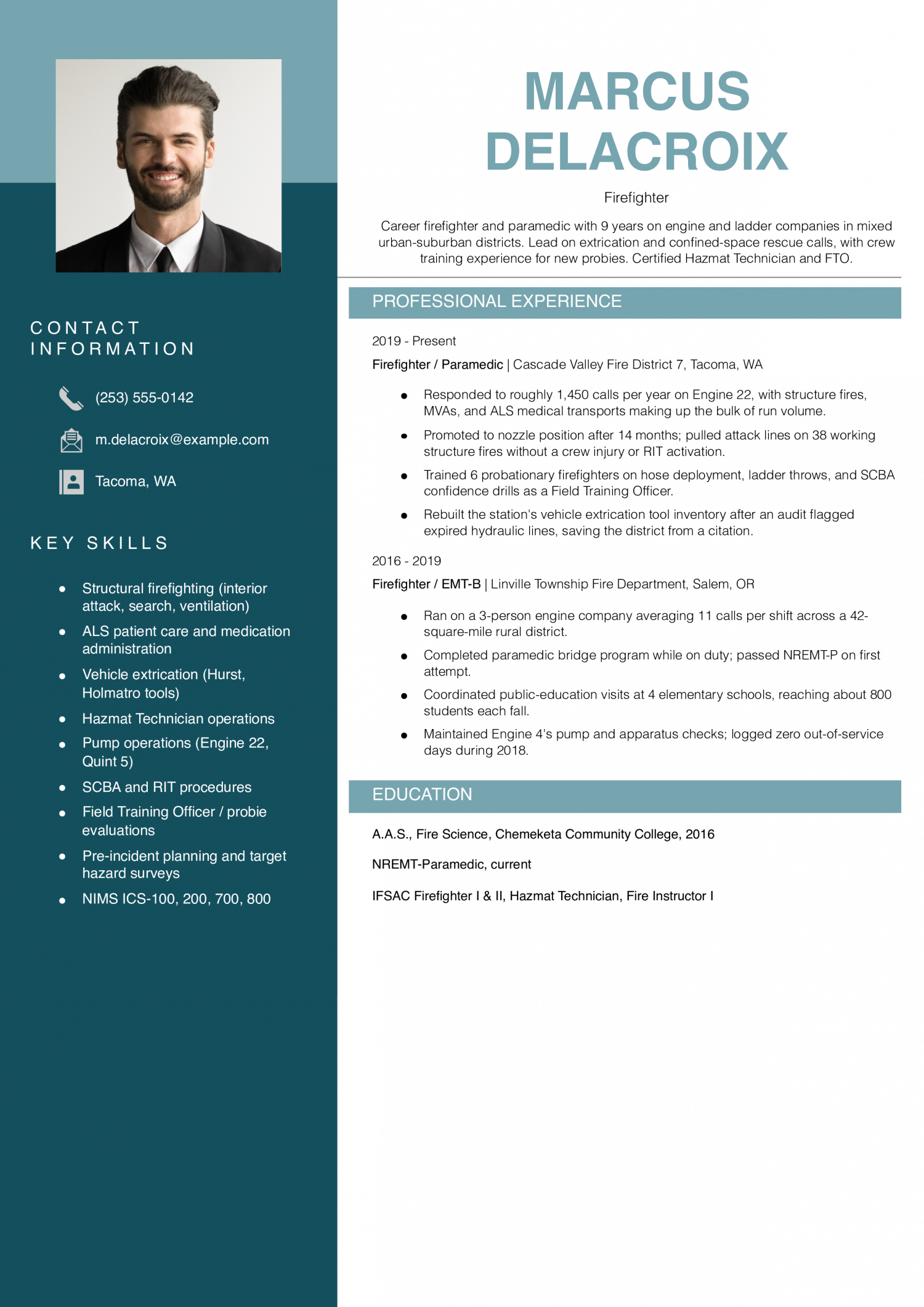
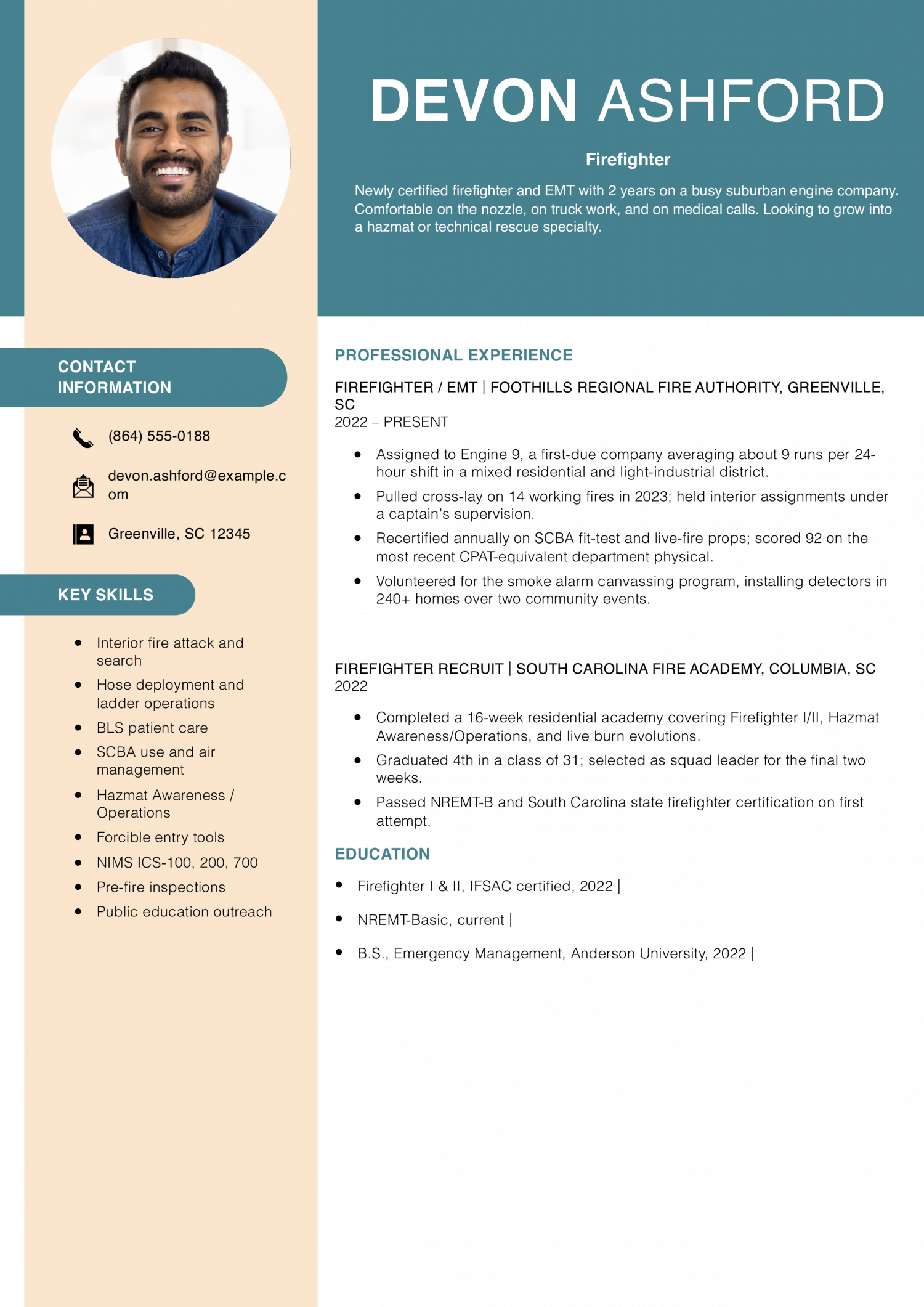
The Firefighter tab fits probationary and line firefighters with academy completion and one to five years on the apparatus floor. This resume needs to prove certifications, CPAT pass date, and the incident types you have actually run.
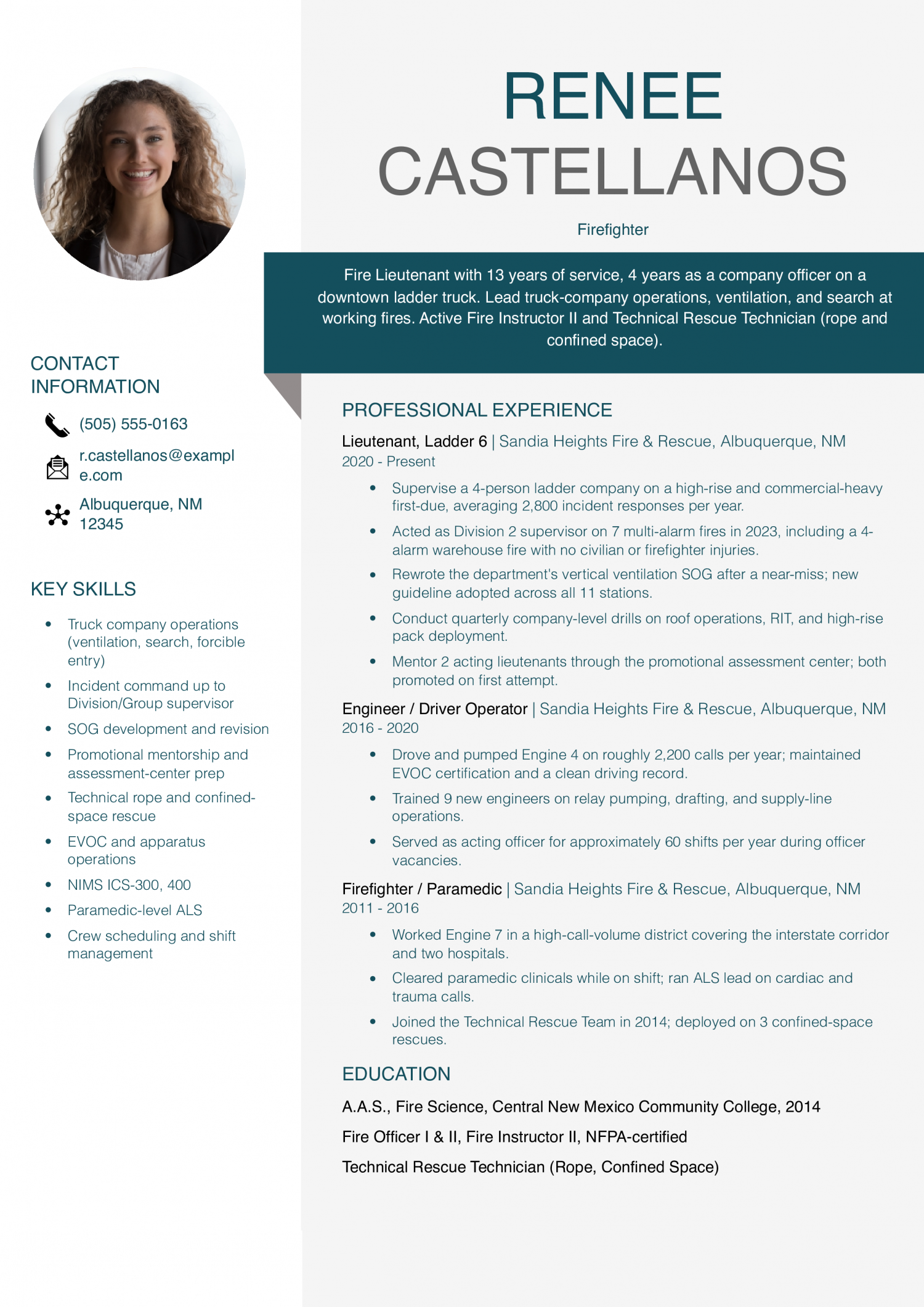
The Lieutenant tab fits company officers leading a four-person crew on engine, ladder, or rescue. The resume needs to show fireground command experience, ICS qualifications, and the run volume your company carried during your tenure.
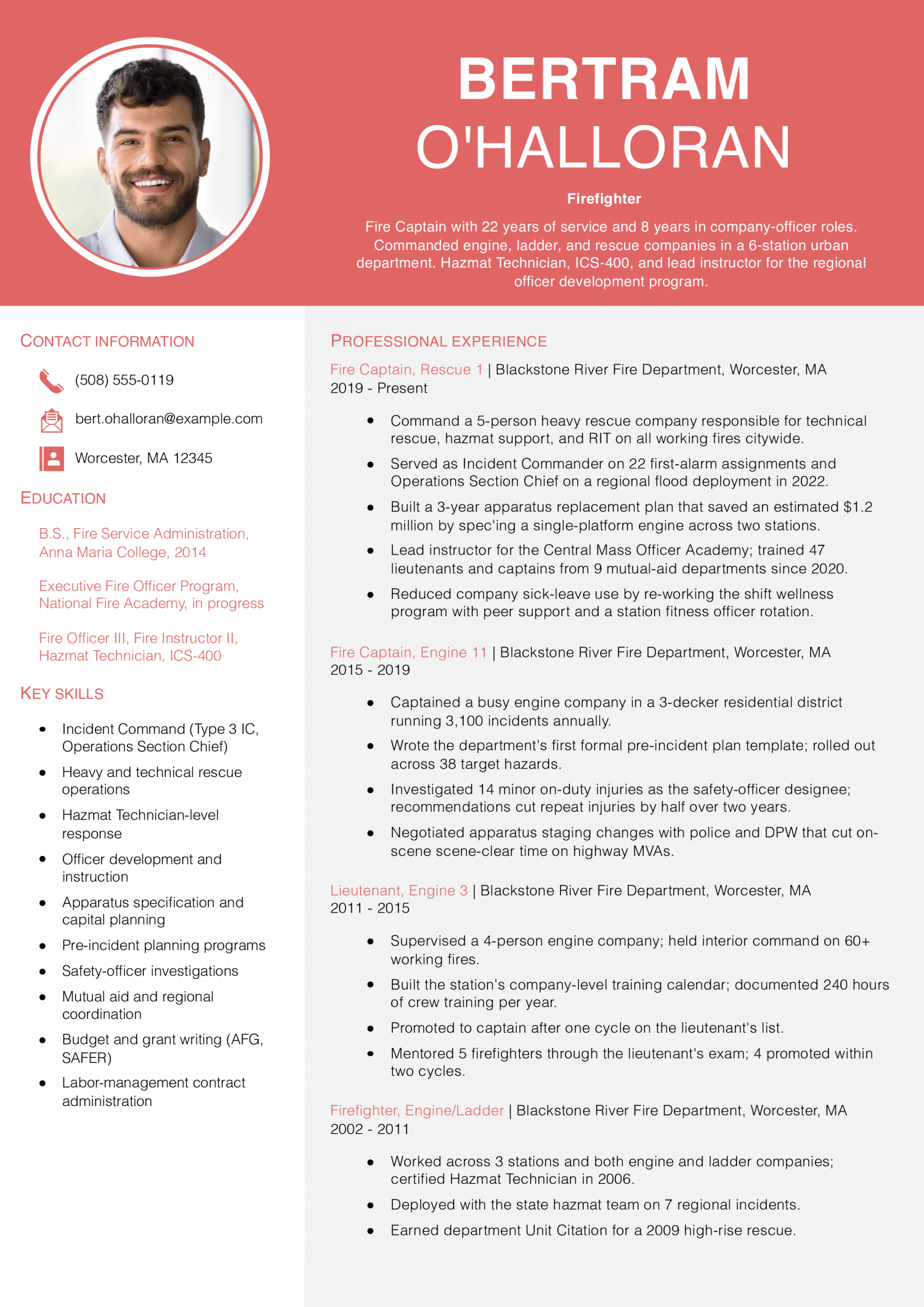
The Captain tab fits station commanders running multiple companies, training programs, or specialty teams. This resume needs to prove incident command at multi-alarm scenes, budget responsibility, and the personnel and apparatus under your supervision.
Imogen Whitfield-Park
Chattanooga, TN | (423) 555-0177 | [email protected] | linkedin.com/in/imogenwhitfieldpark
Fire Lieutenant and paramedic with 11 years in a combined urban-suburban department. Company officer on a first-due engine in a busy interstate corridor district. Hazmat Technician, Fire Instructor II, and peer support team coordinator.
Lieutenant, Engine 18
Tennessee River Fire & Rescue | Chattanooga, TN | 2021-Present
Engineer / Paramedic
Tennessee River Fire & Rescue | Chattanooga, TN | 2017-2021
Firefighter / Paramedic
Tennessee River Fire & Rescue | Chattanooga, TN | 2014-2017
Firefighter / EMT
Lookout Mountain Volunteer Fire Department | Lookout Mountain, TN | 2012-2014
Your profile should state your years on the apparatus floor, the department type you have worked in (career, combination, volunteer, wildland, ARFF), and the apparatus you ride.
Name the incident types that make up your run volume: structure fires, EMS calls, MVCs, HAZMAT, technical rescue, or wildland interface. Add your NFPA Firefighter I/II status and EMT level in the same block so a chief sees scope in one pass.
Bullets without a number tend to read as duties. Strong firefighter bullets show annual run volume, the share that were working fires, and the apparatus position you held.
Name 2 or 3 metrics: total runs per year, fires versus EMS split, and patients treated or transported. If you held a riding assignment such as nozzle, backup, or irons, name it. Specific counts read faster than adjectives like heavy or active.
Cluster your work into 3 or 5 categories so a battalion chief can scan the resume in one column. Common groupings are fire suppression, EMS and patient care, technical rescue, HAZMAT response, and training or preceptor work.
Under each, name the actual tasks: forcible entry, primary search, ventilation, RIT, hoseline advancement, extrication, decon, and live-fire instruction. Use the NFPA verbs your department uses on the run report.
Fire chiefs and battalion commanders screen for certifications before they read a single bullet. Build a credentials block at the top of page one with NFPA Firefighter I/II, HAZMAT Operations, EMT-B or Paramedic, CPAT pass date, and ICS 100/200/700/800.
List the issuing body and expiration month and year. Do not include certificate numbers on the resume; provide those on the application form when the department asks.
Close with your fire science degree or academy, plus continuing education hours in suppression, EMS, or command. Note the state and the sponsoring fire academy.
If you served as a volunteer, explorer, or fire cadet before paid time, include it. Departments weigh residency, community ties, and military service, so list those in a short closing block.
The skills below come from firefighter resumes our users built on ResumeTemplates.com. Fire chiefs and battalion commanders scan hundreds of resumes per civil service posting, and these are the skills that show up most often. Chiefs weigh hard skills like NFPA Firefighter I/II and EMT-B as gating credentials, then read soft skills like crew leadership as evidence behind your fireground bullets.
Match the hard skills against the posting language, and tie each soft skill to a bullet that proves it.
| Soft Skills | % of resumes with this skill |
|---|---|
| Composure under pressure | 79% |
| Team collaboration | 70% |
| Clear communication | 44% |
| Critical thinking | 38% |
| Physical endurance | 30% |
And here are the top hard skills showing up most often.
| Hard Skills | % of resumes with this skill |
|---|---|
| Fire suppression | 67% |
| Emergency medical response | 63% |
| SCBA and apparatus operation | 42% |
| Vehicle extrication and rescue | 38% |
| HAZMAT operations | 30% |
Based on data from thousands of firefighters’ resumes built on ResumeTemplates.com, May 2026.
Fire chiefs and civil service boards screen for credentials before they read bullets. Put a credentials block on page one with the items below, dated and current.
NFPA Firefighter I/II, EMT-B, and a current CPAT keep you eligible for most postings. The certifications below move a firefighter resume from the qualified-but-typical stack into the chief’s shortlist. List each with the issuing body, level, and expiration month and year.
For firefighters, the 10th-percentile floor sits well below the 90th-percentile ceiling, and that spread tracks more with department size, specialty assignment, and metro cost of living than with raw tenure.
Urban career departments with HAZMAT, technical rescue, and ARFF specialties pay toward the ceiling; smaller combination departments cluster near the floor. Lead the resume with the specialty teams you ride on, the apparatus you operate, and the metro you serve so a chief reads your tier before your years.
| # | State | Avg. Annual |
|---|---|---|
| 1 | Washington | $93,490 |
| 2 | New York | $88,380 |
| 3 | New Jersey | $87,660 |
| 4 | California | $83,400 |
| 5 | District of Columbia | $79,430 |
| 6 | Illinois | $79,080 |
| 7 | Connecticut | $77,660 |
| 8 | Colorado | $76,560 |
| 9 | Oregon | $73,270 |
| 10 | Massachusetts | $73,110 |
| # | State | Workers | Median |
|---|---|---|---|
| 1 | Texas | 30,400 | $60,840 |
| 2 | California | 27,580 | $83,400 |
| 3 | Florida | 21,470 | $58,360 |
| 4 | Ohio | 18,750 | $59,470 |
| 5 | North Carolina | 18,200 | $37,250 |
Resume Templates offers HR approved resume templates to help you create a professional resume in minutes. Choose from several template options and even pre-populate a resume from your profile.
Yes. Volunteer time counts as fireground experience for most career departments and oral boards.
List the department, your years of service, your rank, and the run volume you supported. Name the apparatus you rode and the incident types you ran.
Treat it as a real job entry, not a hobby line at the bottom of the page.
Strong bullets name the fireground task, the riding position, and a count or scope figure.
Use NFPA verbs like advanced, vented, forced, searched, and extricated. Pair each with a number where you can: hoseline size, patients treated, or runs per year.
Skip soft phrasing like assisted with or helped to. Chiefs read those as ride-along language.
Lead with your NFPA Firefighter I/II status, EMT level, CPAT pass date, and academy graduation.
Add volunteer, explorer, or cadet time with run counts and incident types. Include military service, EMS shifts, or wildland seasons if you have them.
Close with community ties and residency, since many departments weigh both for entry-level hires.
No. List the credential, issuing body, level, and expiration month and year.
Provide certificate numbers on the department's application form when asked. Putting NREMT or state fire marshal numbers on a public-facing resume creates an identity-theft risk and adds no screening value.
Chiefs verify numbers through the state registry, not your resume.
For a firefighter, an ATS-friendly template is the safest pick, because it puts your certifications and experience where a hiring manager scans first. A basic template is a solid alternative. Whichever you choose, keep the formatting clean and easy to parse: clear section headings, a standard font, and no graphics a parser can choke on.
Executive Resume Writer and Career Coach
Andrew Stoner is an executive career coach and resume writer with 17 years of experience as a hiring manager and operations leader at two Fortune 500 Financial Services companies, and as the career services director at two major university business schools.
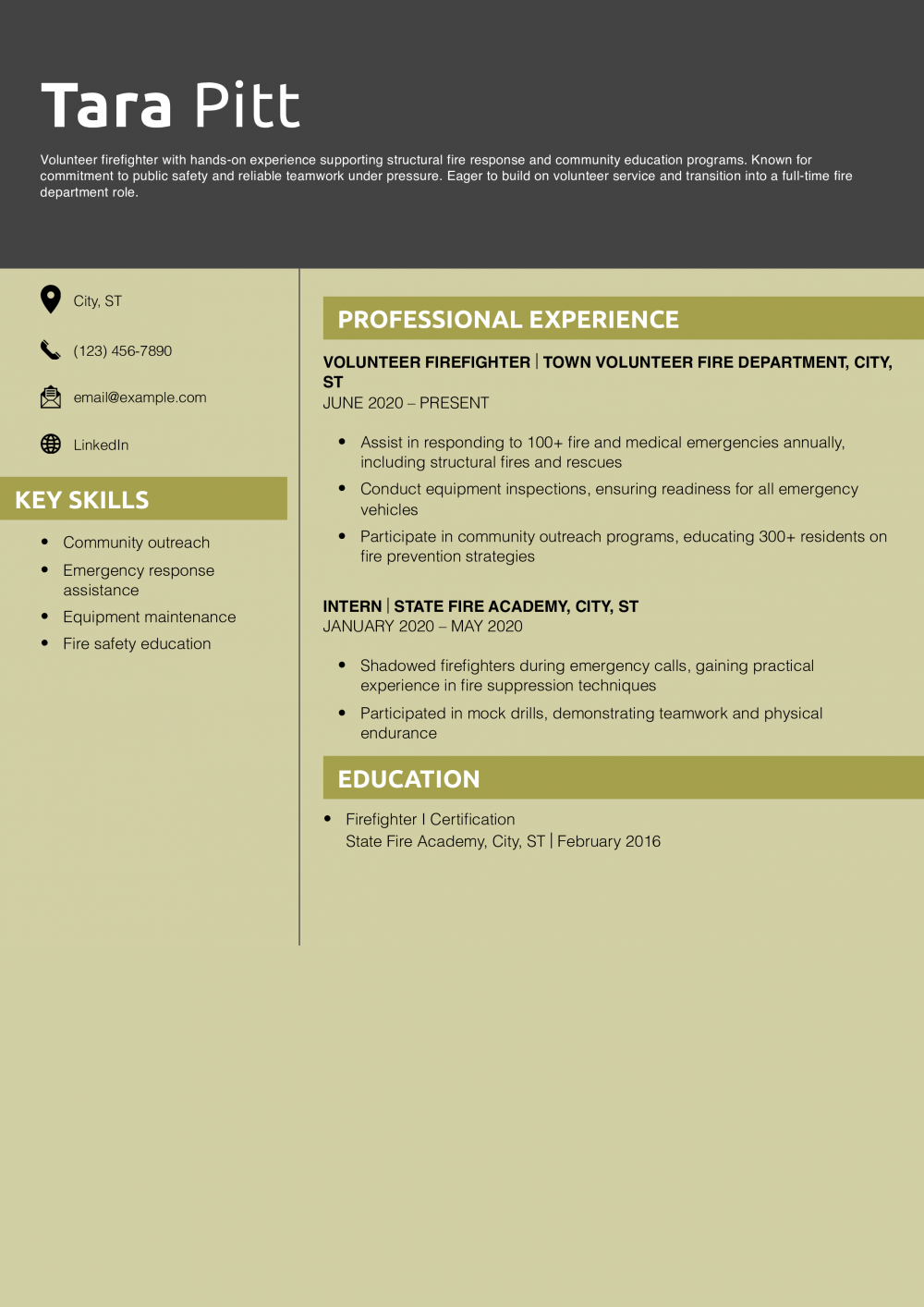
Customize this template in our builder in under 10 minutes.
![5 Best Police Officer Resume Examples and Templates for [y]](/wp-content/uploads/2024/10/Police-Officer-Resume-Example.x400.pdf.jpeg)