Truck Driver Resume Examples and Templates for 2026



A clean license class and MVR line is what gets delivery driver resumes past the dispatch screen; specific stop counts and on-time percentages are what make them readable enough to advance to a road test.
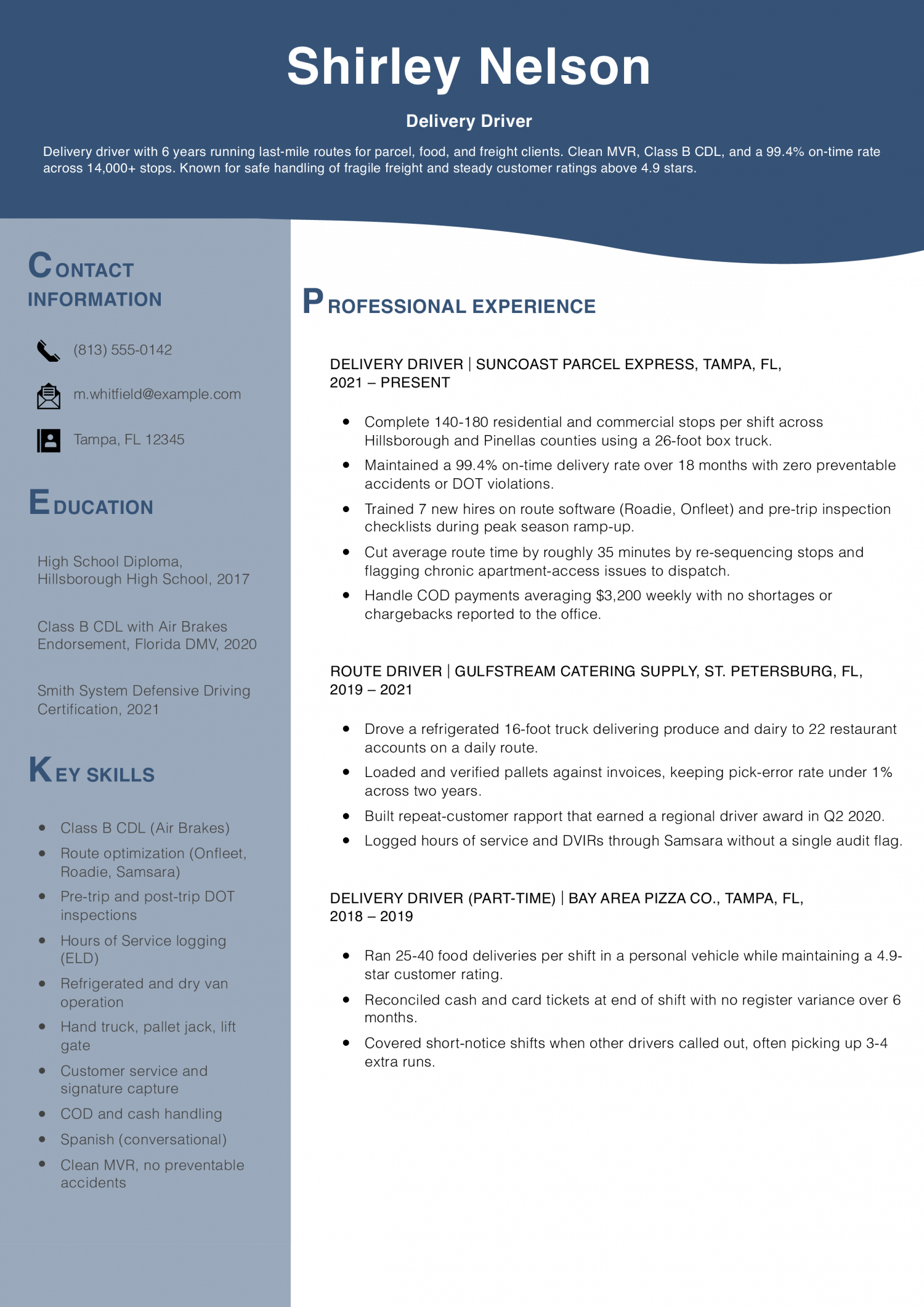
Drivers in their first one to three years on a route, often coming from rideshare, warehouse, or food service. The entry resume needs to prove a clean driving record, license class, and reliability under daily stop quotas.

Drivers with three or more years running scheduled routes, often with a CDL or hazmat endorsement. The experienced resume needs to prove route ownership, on-time percentages, and safe miles driven across vehicle classes.
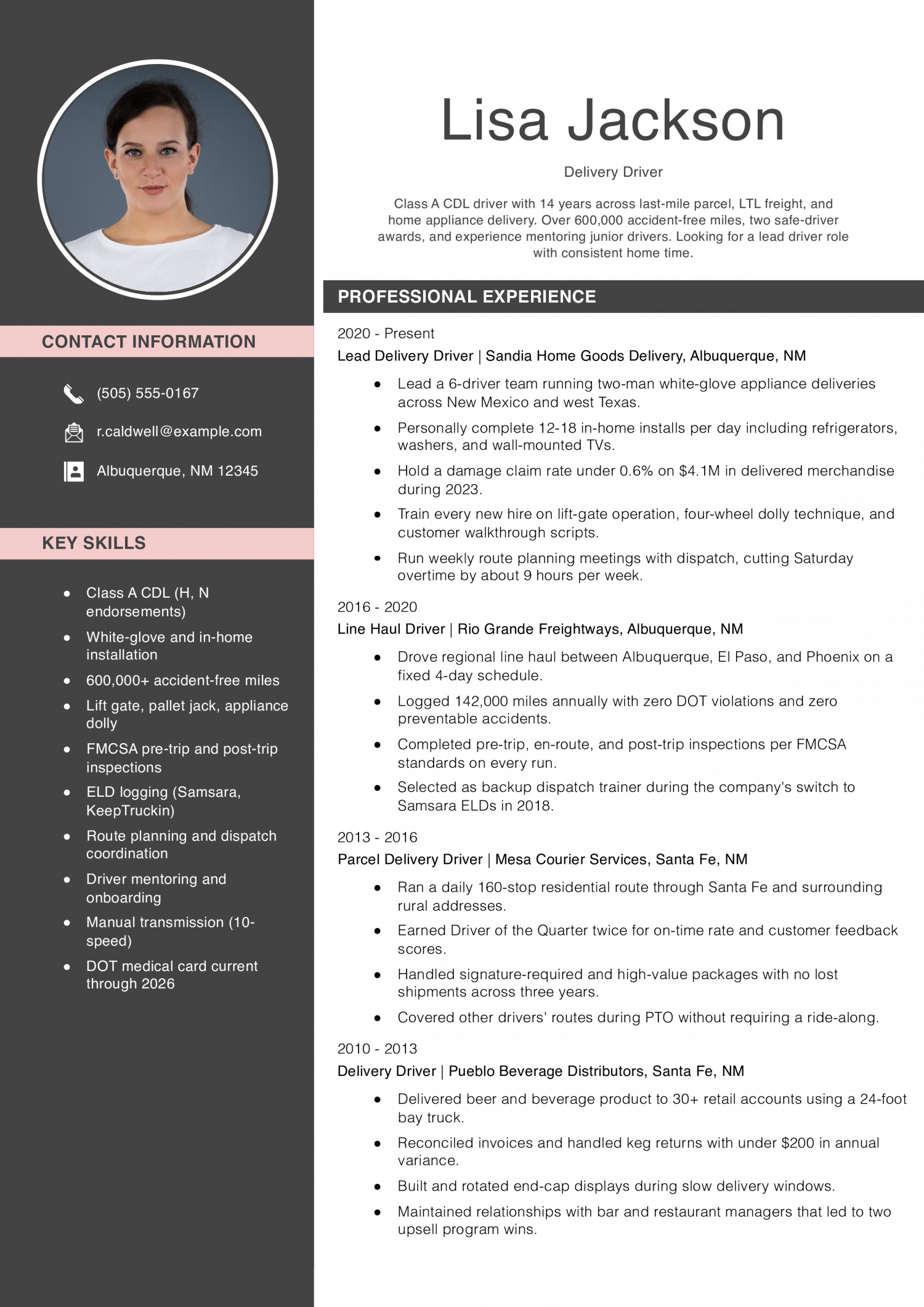
Delivery driver with 9 years of experience across last-mile parcel, medical courier, and grocery delivery. Class B CDL holder with a clean MVR, 400,000+ accident-free miles, and a steady record of customer service ratings above 4.85 stars. Comfortable on tight urban routes, long rural runs, and high-volume peak seasons.
Add one line at the top a dispatch manager cannot pull from a motor vehicle record check. That might be a four-year stretch with zero preventable incidents, a hazmat or tanker endorsement on a Class A, fluent Spanish on a bilingual route, or 60,000 safe miles on refrigerated last-mile work.
License class and a clean MVR are table stakes once the screen runs. The differentiator is what you carry on top of that: a specialty vehicle, a route type, a customer base, or a tenure marker. Put it in your headline or summary, not buried in bullet six of your last job.
Dispatch managers read bullets without numbers as duties, not results. Most strong driver resumes carry two or three metrics per role: daily stop count, on-time delivery percentage, and either safe miles driven or annual route volume.
Pull these from your scanner data, telematics reports, or a manager’s annual review. A bullet like ‘Completed 140 to 160 stops per day on a fixed metro route with a 98% on-time rate’ reads as evidence. ‘Responsible for timely deliveries’ reads as filler.
Volume language works when exact figures aren’t available: ‘high-density last-mile route,’ ‘multi-stop refrigerated route.’
Sort your bullets into three or four buckets so dispatch reads the shape of your experience fast. Most driver resumes cluster around route execution, vehicle handling, customer-facing work, and compliance.
Under route execution, list stop volume, on-time rates, and route optimization with GPS or routing apps. Under vehicle handling, name the classes you’ve driven: cargo van, 16-foot box truck, 26-foot straight truck, tractor-trailer. Under customer-facing work, cite proof-of-delivery handling, signature capture, and cash or POS work if you carried it.
Under compliance, include DOT pre-trip inspections, hours-of-service logging, and any incident-free streaks.
Dispatch managers and logistics supervisors check license class and endorsements before they read a single bullet. Place a credentials block directly under your summary, above work history. List your license class (CDL-A, CDL-B, or standard Class C / non-commercial), endorsements (hazmat, tanker, doubles/triples, passenger), and the state of issue.
Do not print the license number itself. Use ‘in good standing’ instead. Add your DOT medical card status, TWIC card if you have port access, and any forklift or pallet jack certification.
Smartphone-app fluency (Onfleet, Circuit, Amazon Flex, DoorDash Driver) belongs in the same block when it’s a job requirement.
Education sits at the bottom for driver resumes. Most postings ask for a high school diploma or GED; list it as one line with the school and graduation year. If you completed a CDL training program at a community college or a private driving academy, add that as a second line with the program length.
Then add a short ‘safety record’ or ‘driving record’ line at the end: years of accident-free driving, any safe-driver awards from past employers, and your most recent MVR date if it’s within the last six months. This closing signal reassures hiring fleets before they pay for their own background pull.
Five years ago, a delivery driver resume read like a list of vehicles driven and routes covered. The skills below come from the resumes our users built in 2026. The mix has shifted toward routing-app fluency, telematics, and on-time data drivers can name from memory.
Dispatch managers weight hard skills first: license class, endorsements, vehicle classes, and the apps you’ve used on the road. Soft skills back the bullets, not the headline. Match this list against your target posting and use the soft skills as evidence cues when you write your work history.
| Soft Skills | % of resumes with this skill |
|---|---|
| Customer service | 66% |
| Time management | 59% |
| Reliability | 45% |
| Attention to detail | 36% |
| Communication | 34% |
And here are the top hard skills showing up most often.
| Hard Skills | % of resumes with this skill |
|---|---|
| Route planning | 76% |
| GPS navigation | 57% |
| Safe driving practices | 43% |
| Package handling | 38% |
| Vehicle inspection | 34% |
Based on data from thousands of delivery drivers’ resumes built on ResumeTemplates.com, May 2026.
The items below are what separate a delivery driver resume from one that gets put back in the pile.
Dispatch screens your credentials block before they read your bullets. Put it directly under your summary so the gate-checks happen in the first six seconds of the read.
List the credential, the issuing state, the status, and the year. Skip license numbers and DOT registration numbers; provide those on the application form, not the resume.
If you hold multiple license classes, lead with the highest. CDL-A outranks CDL-B, which outranks a standard Class C non-commercial license.
Any commercial route covered by federal DOT rules requires pre-employment drug testing, random testing, and post-incident testing. Your resume doesn’t need to mention these, but you should be ready for them on day one.
Most W-2 fleets pull a five-panel DOT drug screen, a motor vehicle record from every state you’ve held a license in for the last three years, and an employment verification through the FMCSA Clearinghouse.
Register yourself on the FMCSA Clearinghouse before you apply. Fleets check it during the first review, and a missing or unregistered profile slows the offer.
Dispatch managers read this list as a map of where your driving work is heading. The certifications below tell them which vehicle class, cargo type, or compliance track you’ve invested in. List the issuing body and the year of completion next to each.
Commercial Driver's License (CDL-A or CDL-B): The single biggest pay and access lever for delivery drivers; list the class and state of issue near the top of the resume.
Hazmat Endorsement (H): Opens fuel, chemical, and specialty cargo routes; requires TSA background check, so list it where compliance-heavy fleets scan first.
DOT Medical Examiner's Certificate: Required for commercial routes and often checked before the interview; list current expiration year to signal you're road-ready.
Smith System or National Safety Council Defensive Driving: Signals formal safety training beyond MVR data; useful when you're targeting fleets with insurance-driven hiring standards.
The top-paying states for delivery drivers cluster in high cost-of-living markets and union-strong freight corridors, not the Sun Belt metros where most drivers apply. Pay tracks closely with vehicle class, cargo type, and whether the role sits inside a union contract or a gig contractor pool.
If you’re geographically flexible or open to a vehicle class upgrade, the resume should foreground your CDL class, endorsements, and any union or W-2 fleet tenure rather than total years behind the wheel.
| # | State | Avg. Annual |
|---|---|---|
| 1 | Hawaii | $47,240 |
| 2 | Vermont | $44,900 |
| 3 | California | $44,370 |
| 4 | Michigan | $44,200 |
| 5 | Colorado | $43,560 |
| 6 | Kansas | $43,380 |
| 7 | Massachusetts | $42,790 |
| 8 | Louisiana | $41,950 |
| 9 | Alaska | $41,590 |
| 10 | Tennessee | $41,200 |
| # | State | Workers | Median |
|---|---|---|---|
| 1 | Texas | 38,930 | $35,580 |
| 2 | California | 35,220 | $44,370 |
| 3 | New York | 23,860 | $40,970 |
| 4 | Florida | 23,270 | $36,340 |
| 5 | Ohio | 20,580 | $32,500 |
Resume Templates offers HR approved resume templates to help you create a professional resume in minutes. Choose from several template options and even pre-populate a resume from your profile.
No. Gig-app driving uses an in-app onboarding flow with license upload and a background check, not a resume.
You do need one for Amazon DSP routes, FedEx Ground contractors, and any W-2 last-mile job. Keep a resume ready even if you start on gig apps.
Most drivers move to a salaried route within two years, and the salaried roles pay better than gig work once benefits are factored in.
Use volume and scope language instead of fabricated metrics. Write 'high-density urban route' or 'multi-stop refrigerated last-mile' to signal the shape of the work.
Name the vehicle class, the customer type (residential, commercial, restaurant), and the routing app you used.
Dispatch managers read scope language correctly when the surrounding bullets are concrete.
No. List the license class, the issuing state, and 'in good standing' instead.
State motor vehicle departments warn against publishing license numbers on documents that get emailed and forwarded.
You'll provide the number on the employer's application form, where it sits behind a login.
Don't mention it on the resume. The MVR pull during the background check will surface it, and that's the right place for the conversation.
Use your resume to show what came after: accident-free miles since, a defensive driving course you completed, and steady tenure with one fleet.
If the violation is recent, target fleets with point-tolerant insurance carriers and address it briefly in the interview.
For a delivery driver, an ATS-friendly template is the safest pick, because it puts your certifications and experience where a hiring manager scans first. A basic template is a solid alternative. Whichever you choose, keep the formatting clean and easy to parse: clear section headings, a standard font, and no graphics a parser can choke on.
Executive Resume Writer and Career Coach
Andrew Stoner is an executive career coach and resume writer with 17 years of experience as a hiring manager and operations leader at two Fortune 500 Financial Services companies, and as the career services director at two major university business schools.
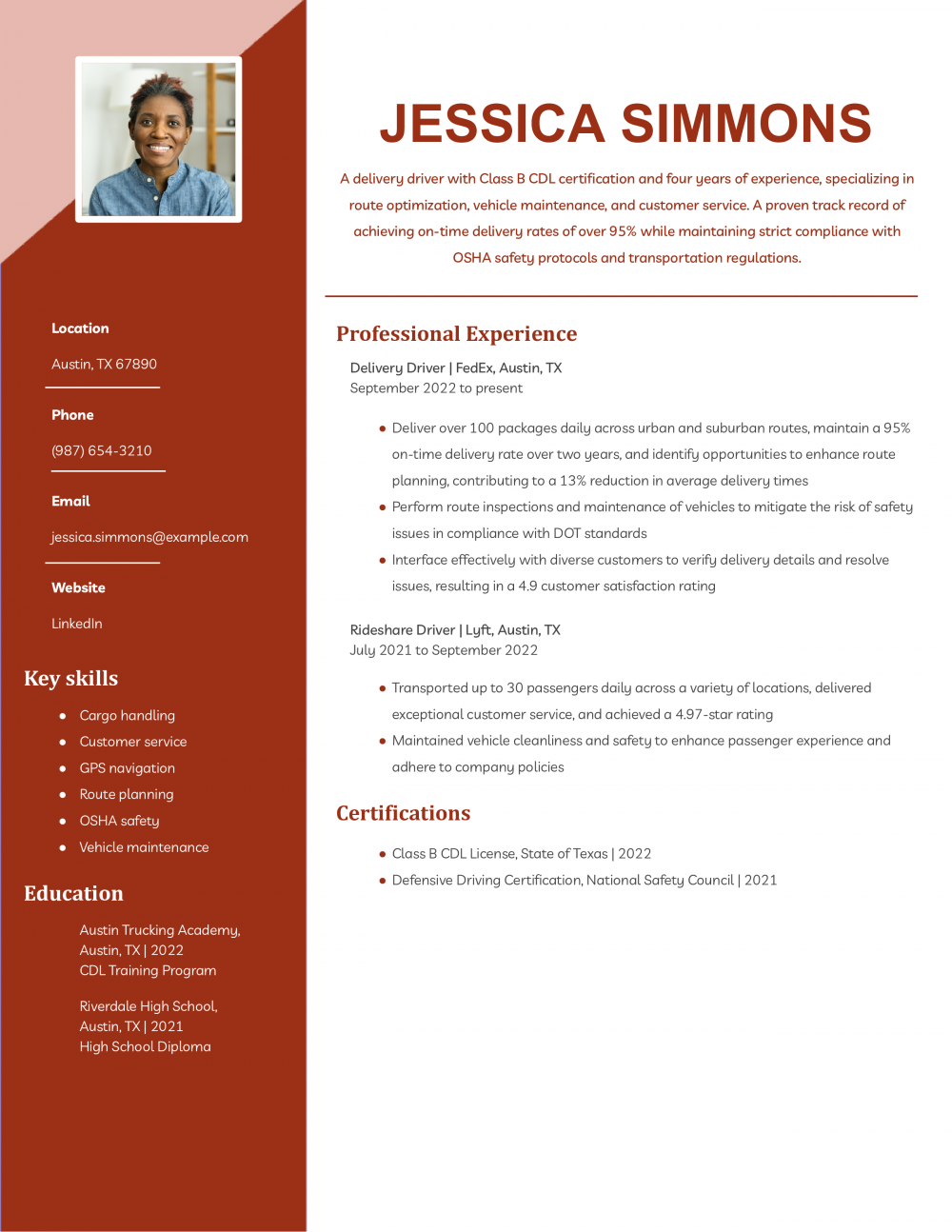
Customize this template in our builder in under 10 minutes.