

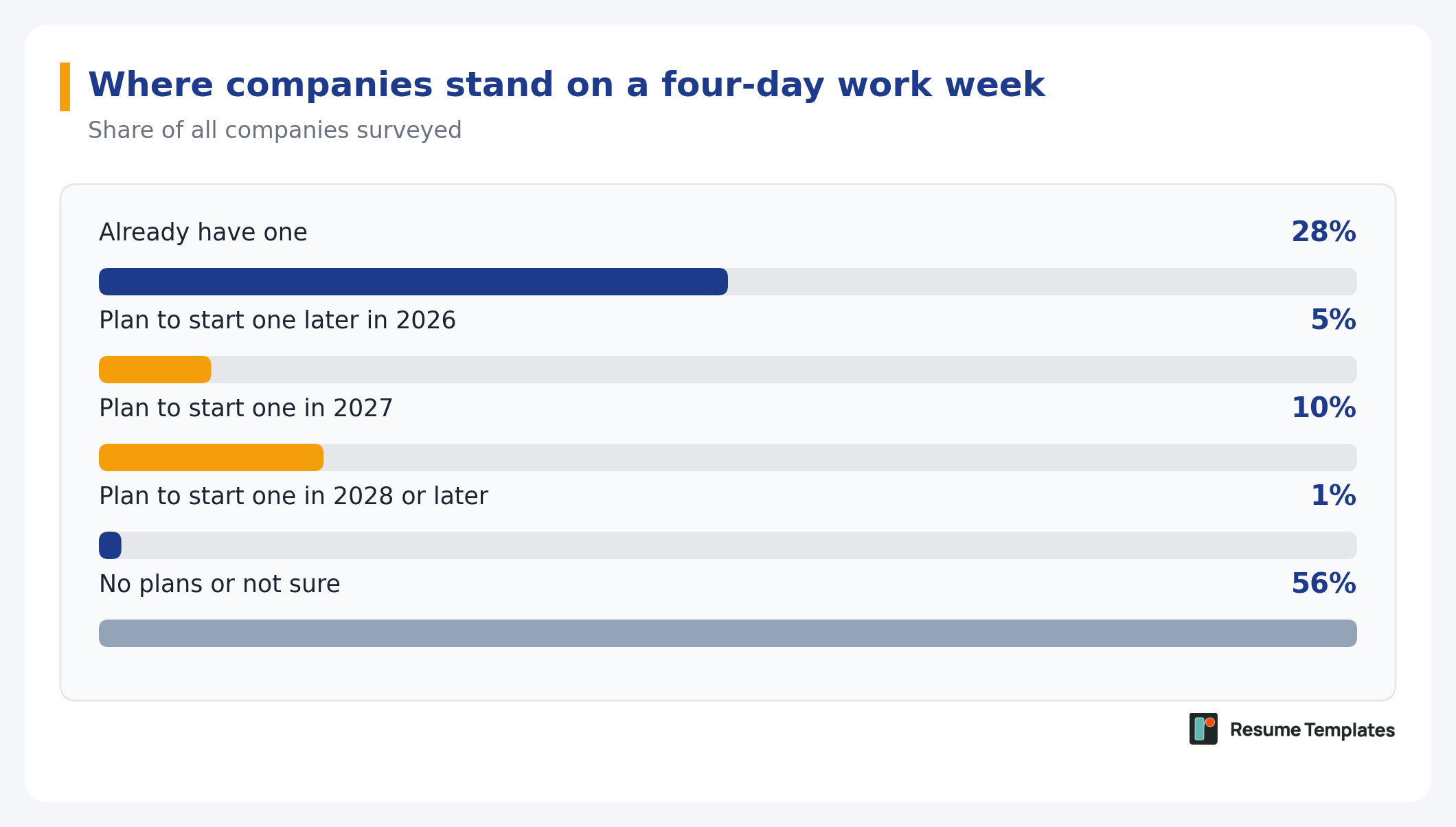
Senator Bernie Sanders of Vermont and Representative Mark Takano of California reintroduced the Thirty-Two Hour Workweek Act in September 2026. The federal proposal would cut the standard work week from 40 hours to 32 over several years without a reduction in pay or benefits. With the bill back in Congress, ResumeTemplates.com surveyed 2,274 U.S. business leaders in September to find out how many companies already have a 4-day work week or plan to start one. Overall, 41% of companies will have a 4-day work week in 2027, and 28% already have one.
Key findings:
- 87% of business leaders say a 4-day work week has helped them compete for top talent
- 16% of companies planning a 4-day work week say the proposed 32-hour work week law is the main reason, compared with 9% of companies that already offer it
- 68% of companies with a 4-day work week expect employees to get the same amount of work done as in a 5-day week
- 48% of companies with a 4-day work week now expect employees to work more total hours each week than before
- 85% of business leaders at companies with a 4-day work week say it has improved profitability
28% of Business Leaders Say Their Company Is Already on a 4-Day Work Week
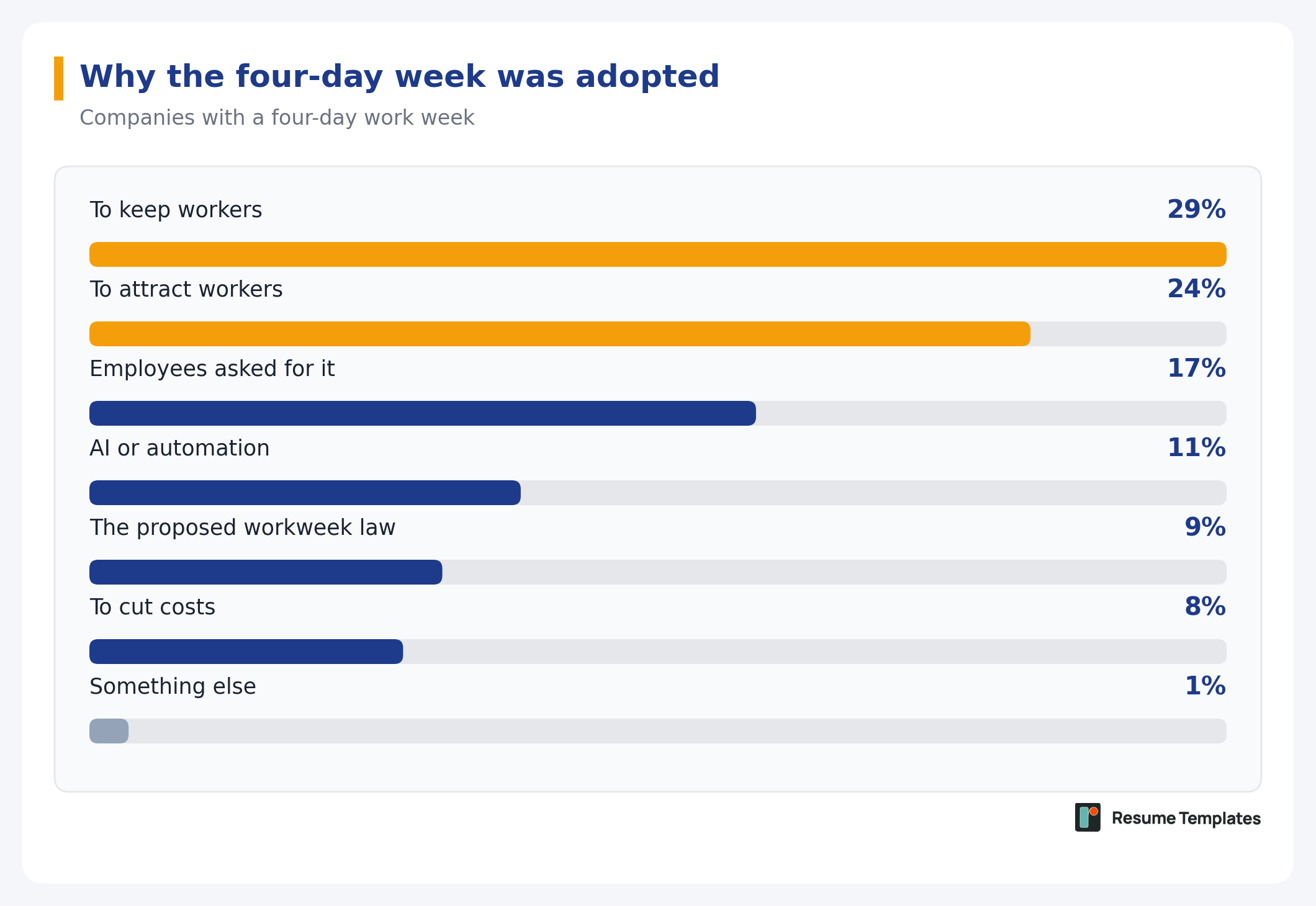
Of the 2,274 business leaders surveyed, 28% say their company already has a 4-day work week policy. Fully in-person workplaces make up 48% of these companies, and hybrid workplaces make up 44%. AI or automation is the main reason for the policy at 11% of them.
Asked about the biggest change the policy has made at their company, one business leader whose company adopted it to keep workers wrote: “We have adopted more digital tools and automation, which have improved efficiency, communication and overall productivity.”
Looking ahead, 93% of companies with a 4-day work week plan to keep it in 2027.
8 in 10 Say Policy Has Helped the Company Compete for Top Talent
When it comes to hiring, 79% of business leaders at companies with a 4-day work week say it has helped their company compete for top talent, and one of them wrote: “It’s made us more appealing, helping us attract top talent and be more competitive.” Keeping or attracting workers is the main reason for the policy at 54% of these companies.
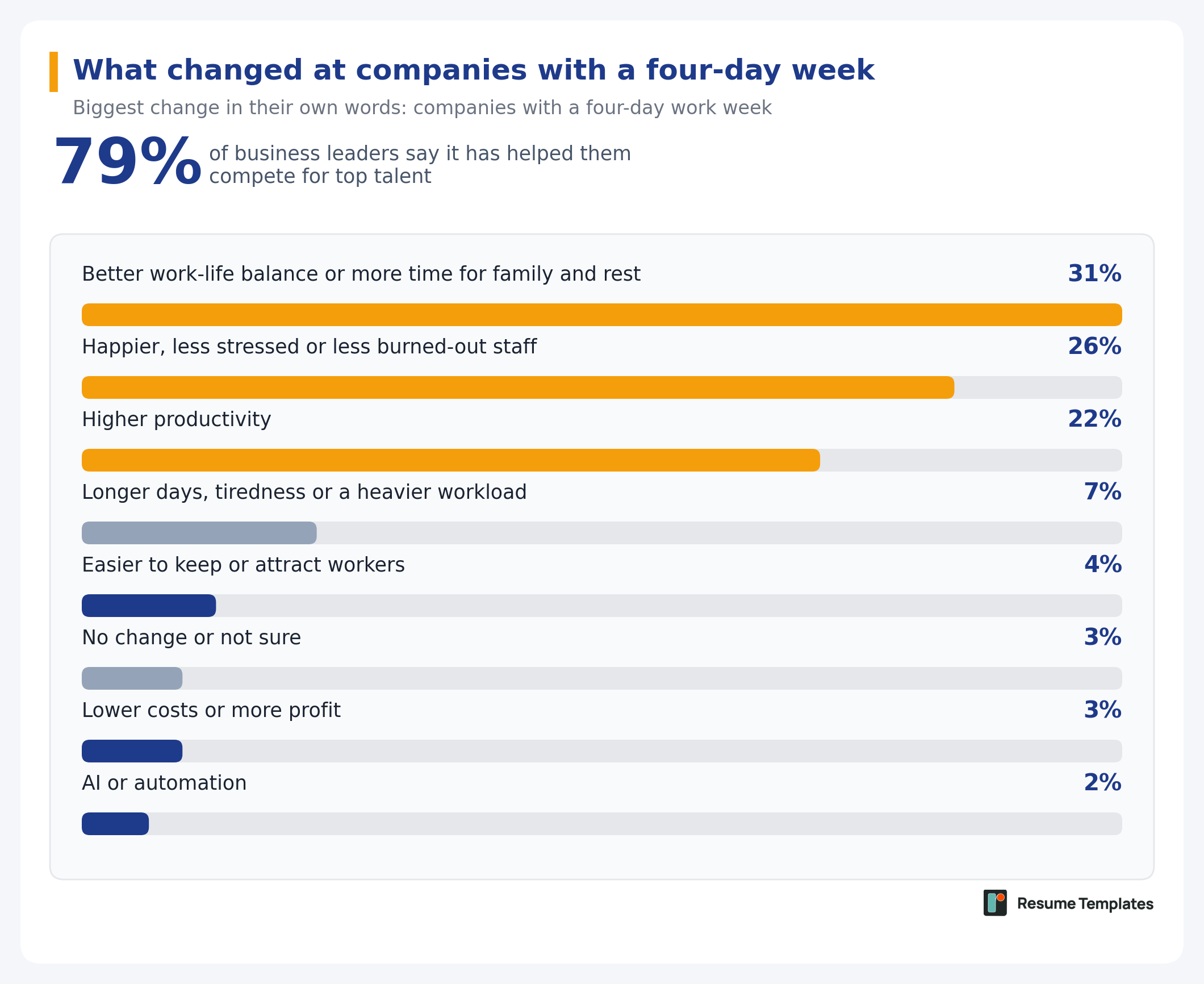
Every full-time employee is eligible at 39% of companies with a 4-day work week. Where everyone is eligible, 87% of business leaders say the policy has helped their company compete for top talent, compared with 73% at companies that limit who is eligible. “The employees that are not eligible to work a four day work week are not happy,” wrote one manager whose company limits who is eligible.
The policy also came with trade-offs. When it went into effect, 4% of companies with a 4-day work week cut both working hours and salaries, and 5% cut both hours and paid time off. One manager whose company cut hours and pay wrote: “It reduces our overtime hours and expense therefore saving us money.”
“A four-day workweek stands out to job seekers because of the flexibility it provides,” says Julia Toothacre, Chief Career Strategist at ResumeTemplates.com. “If they aren’t losing pay or benefits, it becomes a meaningful differentiator because they’re getting more time back for life outside of work. For companies that reduce both hours and pay, whether that model works will ultimately show up in who stays and who leaves.”
1 in 7 Companies Plan to Implement a 4-Day Work Week by the End of 2027
In all, 15% of the companies surveyed plan to start a 4-day work week by the end of 2027: 10% in 2027 and 5% later in 2026. Together with the 26% of companies that have a 4-day work week and will keep it, they make up the 41% that will have one in 2027.
For companies planning a 4-day work week, the most common main reason is keeping or attracting workers, cited by 45% of them. “I think it would make employees a lot happier and more motivated. I also think it would make it easier to recruit talent,” wrote one manager whose company plans to adopt the policy to attract workers.
The proposed 32-hour work week law is the main reason for 16% of companies planning a 4-day work week, compared with 9% of companies that already offer it. A business leader whose company plans to adopt the policy because of the proposed law wrote: “It creates a better work/life balance. The 32 hours also increase overall morale.”
Cost savings show the same gap: cutting costs is the main reason for 15% of companies planning a 4-day work week, compared with 8% of companies that already have the policy. “It would reduce costs, one less day we’re paying employees, having a building operating, needing to be cleaned, managed, etc.,” wrote one business leader whose company plans to adopt it to cut costs.
Asked about the biggest change a 4-day work week would make, business leaders at companies planning one most often mention better work-life balance or more time for family and rest (34%), happier or less burned-out employees (33%), and higher productivity (25%).
5 in 10 Companies With a 4-Day Work Week Still Pack 40 or More Hours Into 4 Days
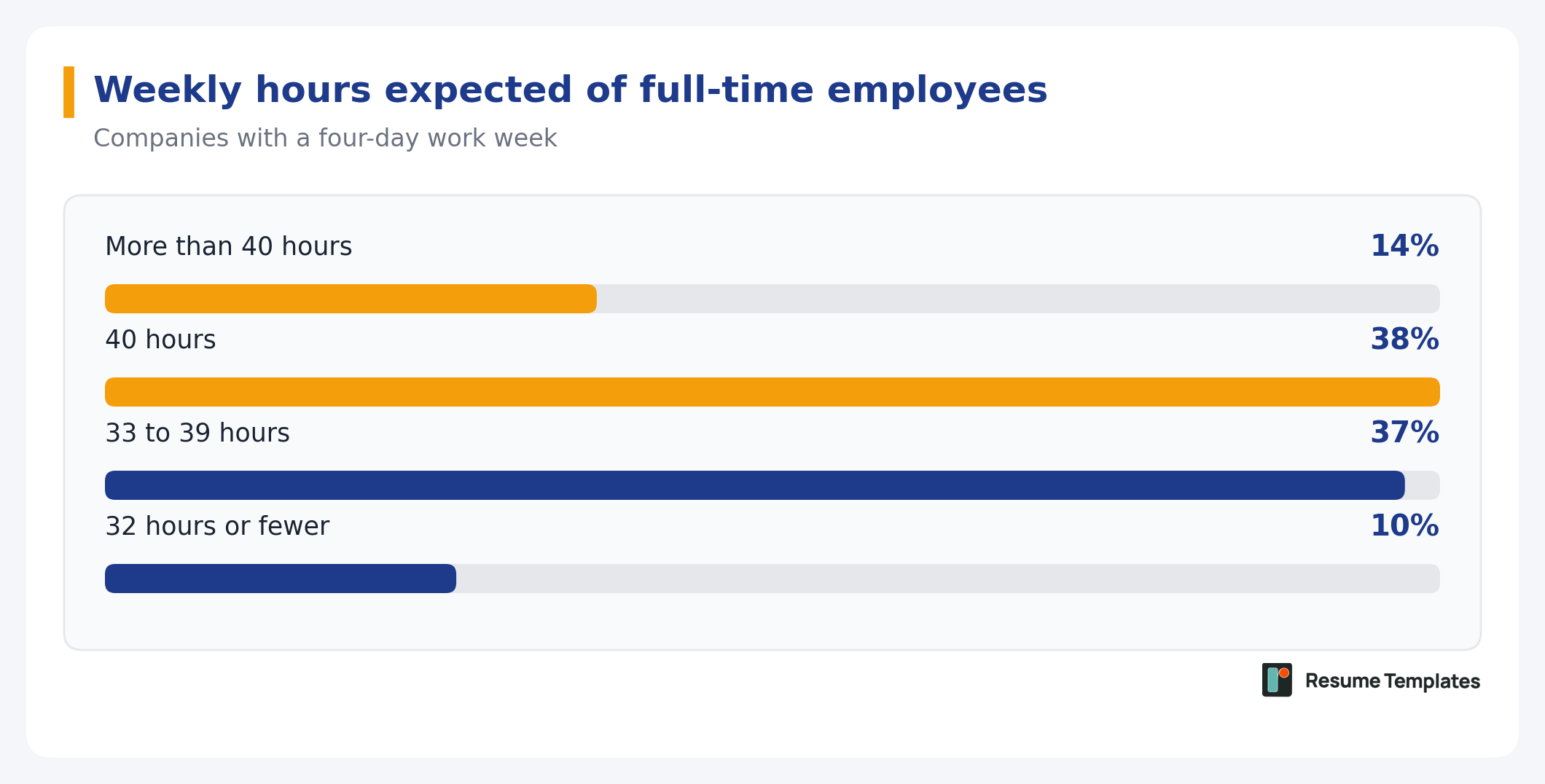
Full-time employees are expected to work 40 or more hours a week at 53% of companies with a 4-day work week, 33 to 39 hours at 37%, and 32 hours or fewer at 10%. “People like the extra day off, but the days are long,” wrote one business leader at a company where full-time employees are expected to work 40 or more hours a week.
Compared with a 5-day week, 68% of companies with a 4-day work week expect full-time employees to get the same amount of work done, and 26% expect more. One business leader at a company that expects the same amount of work wrote: “There are good things and bad things. Not working so many days is obviously awesome. Being expected to get the same amount of work done? Not so awesome.”
Across all companies with the policy, 51% present it to employees as a flexible work schedule. Where full-time employees are expected to work 40 or more hours a week, 43% present it that way. Hours went up more often than down: 48% of all companies with the policy now expect employees to work more total hours each week than before the 4-day work week, while 11% expect fewer.
“If you’re switching to four 10-hour days, those longer workdays can create fatigue,” says Toothacre. “Theoretically, you still have 40 hours to complete the same work, so there shouldn’t be major changes in overall delivery.”
Methodology: ResumeTemplates.com commissioned this survey, which was conducted in September 2026 using the Pollfish platform. Its results cover 2,274 U.S. business leaders, all full-time managers at companies with 101 or more employees. Demographic and screening criteria ensured all respondents qualified. Pollfish gathers responses through Random Device Engagement with quality controls, including an attention check. Pollfish reports a margin of error of plus or minus 3.1 percentage points at the 95 percent confidence level for the 1,000 completed surveys. Results are based on self-reported responses.
Resume Templates offers HR approved resume templates to help you create a professional resume in minutes. Choose from several template options and even pre-populate a resume from your profile.