

Challenger, Gray & Christmas reported on November 5 that U.S.-based employers announced 617,189 job cuts from January through October 2026. Technology companies accounted for 171,501 of those cuts, already more than they announced in all of 2025. To find out what companies are planning for the first half of 2027, ResumeTemplates.com surveyed 1,000 business leaders at companies with more than 100 employees in November 2026.
Key findings:
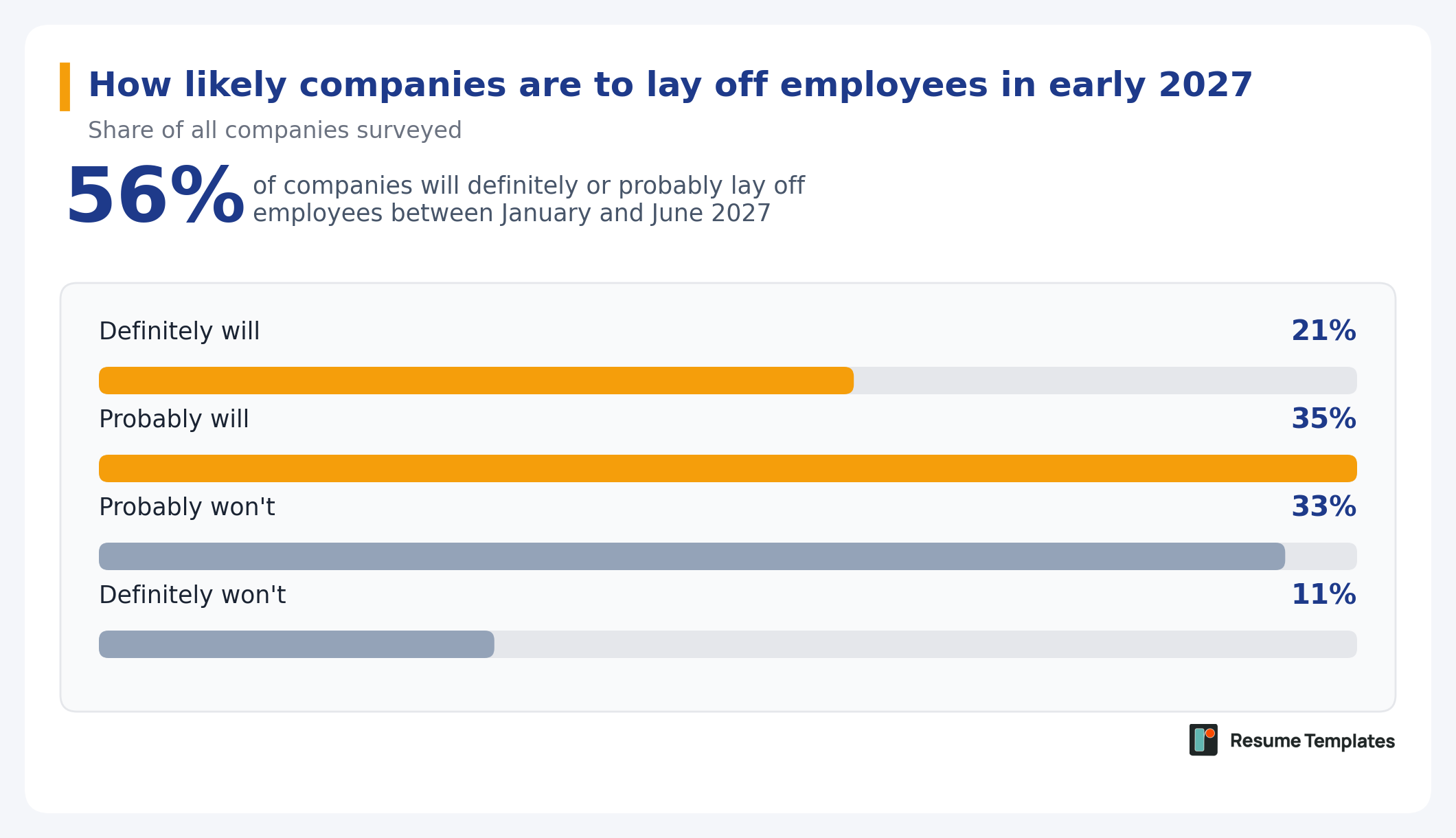
- 21% of companies will definitely lay off staff in the first half of 2027
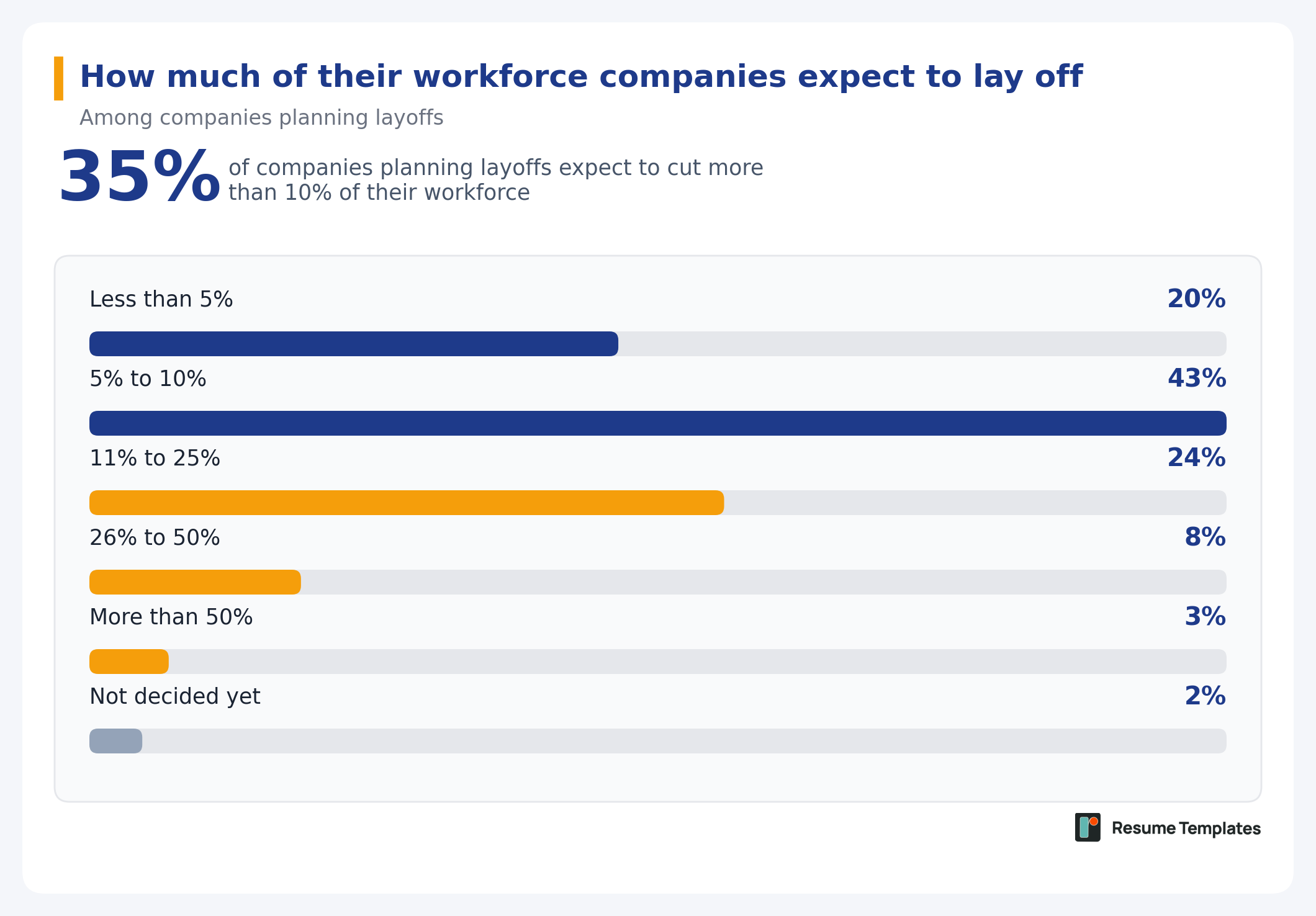
- 35% of companies planning layoffs expect to cut over 10% of staff
- 75% of tech companies expect layoffs
- 41% of companies planning layoffs cite AI or automation
- 63% of companies not planning layoffs won’t increase headcount
- 35% of companies not planning layoffs are cutting back
56% of Companies Will Likely Lay Off Employees in the First Half of 2027
For most companies, layoffs are part of the plan for early 2027. In the first half of the year, 21% of companies definitely will lay off employees, and an additional 35% probably will.
Technology companies are the most likely to expect layoffs, at 75%. Next come professional services at 68%, construction or real estate at 64%, and transportation, logistics or energy at 61%.
Many of the planned layoffs won’t be small. Among companies planning layoffs, 35% expect to cut more than 10% of their workforce, including 11% that expect to lay off more than a quarter. Another 43% expect cuts between 5% and 10%, and 20% expect to lay off fewer than 5% of their workforce.
One business leader whose company will probably lay off employees wrote: “The economy is so unpredictable it’s hard to make any decisions.”
76% of Companies Planning Layoffs Blame the Current Administration’s Policies
Economic and cost pressures top the reasons companies give for layoffs. Among companies planning layoffs, 76% cite at least one of these: an economic downturn or lower sales, tariffs or trade policy, higher interest rates, higher energy or fuel costs, or rising health care costs.
An economic downturn or lower sales is the most common reason, at 43%. Tariffs or trade policy come up at 29%, higher interest rates at 27%, higher energy or fuel costs at 24%, and rising health care costs at 23%. Industry-specific challenges come up at 32%.
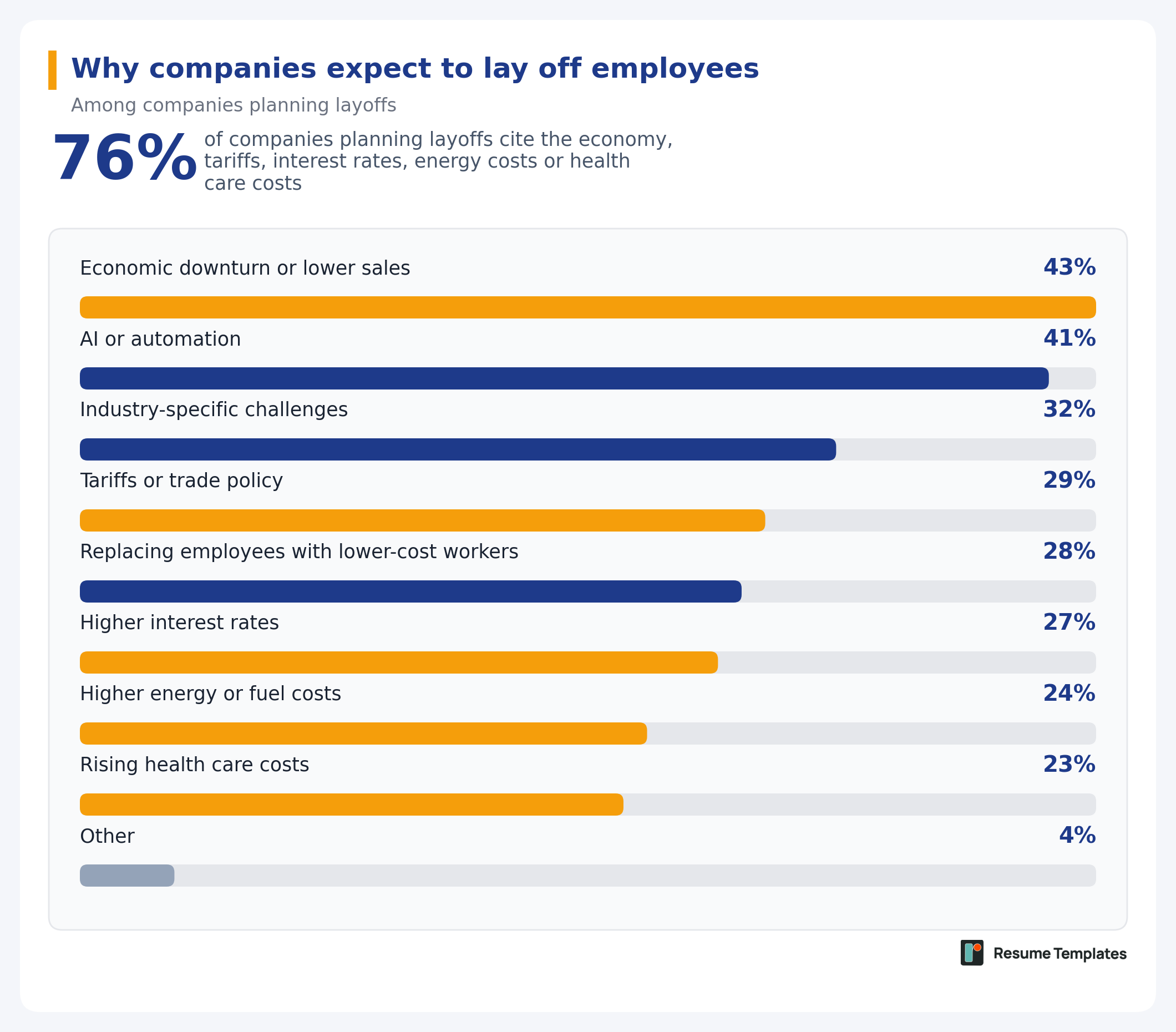
AI or automation is the second most common reason, cited by 41% of companies planning layoffs and 23% of all companies. And 28% of companies planning layoffs cite replacing employees with lower-cost workers.
In their own words, though, AI came first. Asked to describe the biggest thing shaping their staffing plans, business leaders at companies planning layoffs mentioned AI or automation more than any other topic.
One business leader whose company will definitely lay off employees pointed to “the rising usefulness of AI and how much cheaper it is than staff.”
What this means for employees: “If a company is planning to use AI, I recommend learning how AI can be used in your position and within the organization,” says Julia Toothacre, Chief Career Strategist at ResumeTemplates.com. “Using built-in AI for basic tasks is different from knowing how to implement AI agents to make your position more efficient. Knowing how to use and implement AI may make you more valuable to an organization during a layoff, depending on why the company is reducing staff.”
44% of Companies Not Planning Layoffs but Will Be Holding Back
Of all companies, 44% don’t expect to lay off employees in the first half of 2027. Most of them aren’t adding staff either: 63% won’t increase their number of employees, with 59% expecting headcount to stay the same and 4% expecting it to go down.
Replacing people who leave is the most common reason they’ll hire: 60% will hire to replace employees who quit or retire, compared with 43% of companies planning layoffs. And 26% will hire to add new skills or roles, such as AI.
Even without layoffs, some are holding back: 35% have a hiring freeze in place or planned, or will cut bonuses, raises, benefits, salaries or office space. That includes 20% with a hiring freeze in place or planned, 11% that will cut or reduce bonuses and 11% that will freeze or delay raises.
One business leader whose company probably won’t lay off employees wrote: “Slower business growth and keeping costs under control while we add AI skills.”
What this means for employees: “To keep your career growing in a more stagnant market, I recommend looking at what you want to do or accomplish next,” says Toothacre. “From there, take time to learn what you need, build relationships, and gain influence so you can move toward what you want. Don’t let yourself get stagnant when the market is stagnant. This is a good time to grow your skills.”
Methodology
The findings presented are based on a nationally representative survey commissioned by ResumeTemplates.com and conducted via Pollfish in November 2026. The survey collected responses from 1,000 full-time U.S. managers at companies with 101 or more employees who said they know their company’s hiring and layoff plans, and examined companies’ plans for layoffs, hiring and cost cuts in 2027.
Respondents answered different question types, including multiple-choice, likelihood-scale, select-all-that-apply and open-ended questions. The survey examined how likely companies are to lay off employees between January and June 2027, what share of their employees they expect to lay off, and the factors driving those layoffs.
Respondents were also asked whether their company’s number of employees will go up, stay about the same or go down by the end of June 2027, why their company will hire and what kinds of workers it will hire, whether their company has a hiring freeze in place or plans to start one, which cost cuts, such as reducing salaries or freezing raises, their company will make between January and June 2027, and which industry their company is in.
The sample consisted of 9.6% Generation Z (born 1997 or later), 52.2% millennials (born 1981-1996), 35.5% Generation X (born 1965-1980), and 2.7% baby boomers (born 1946-1964). Participants also identified their gender: 58.0% identified as male and 42.0% as female.
Resume Templates offers HR approved resume templates to help you create a professional resume in minutes. Choose from several template options and even pre-populate a resume from your profile.