Scrum Master Resume Examples and Templates for 2026



Engineering managers decide whether to forward a computer science resume to the recruiter screen within the first 20 seconds of skimming page one; if a GitHub link, a language stack, and a shipped project are not visible by then, the resume gets passed over.
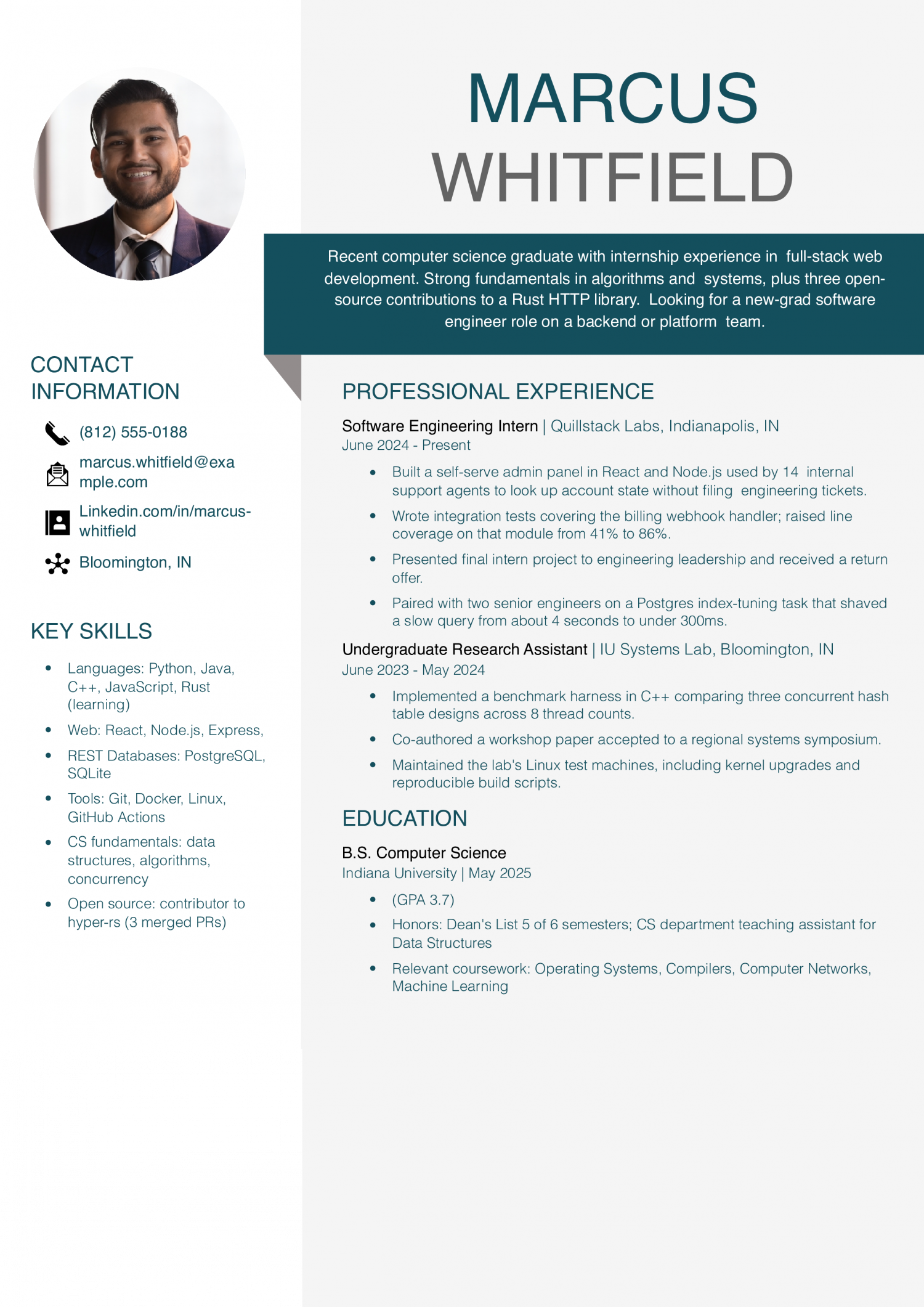
Recent graduates need to prove they have shipped working code, not just attended lectures. The resume should lead with internships, capstone projects, and a GitHub link recruiters can open without hunting.
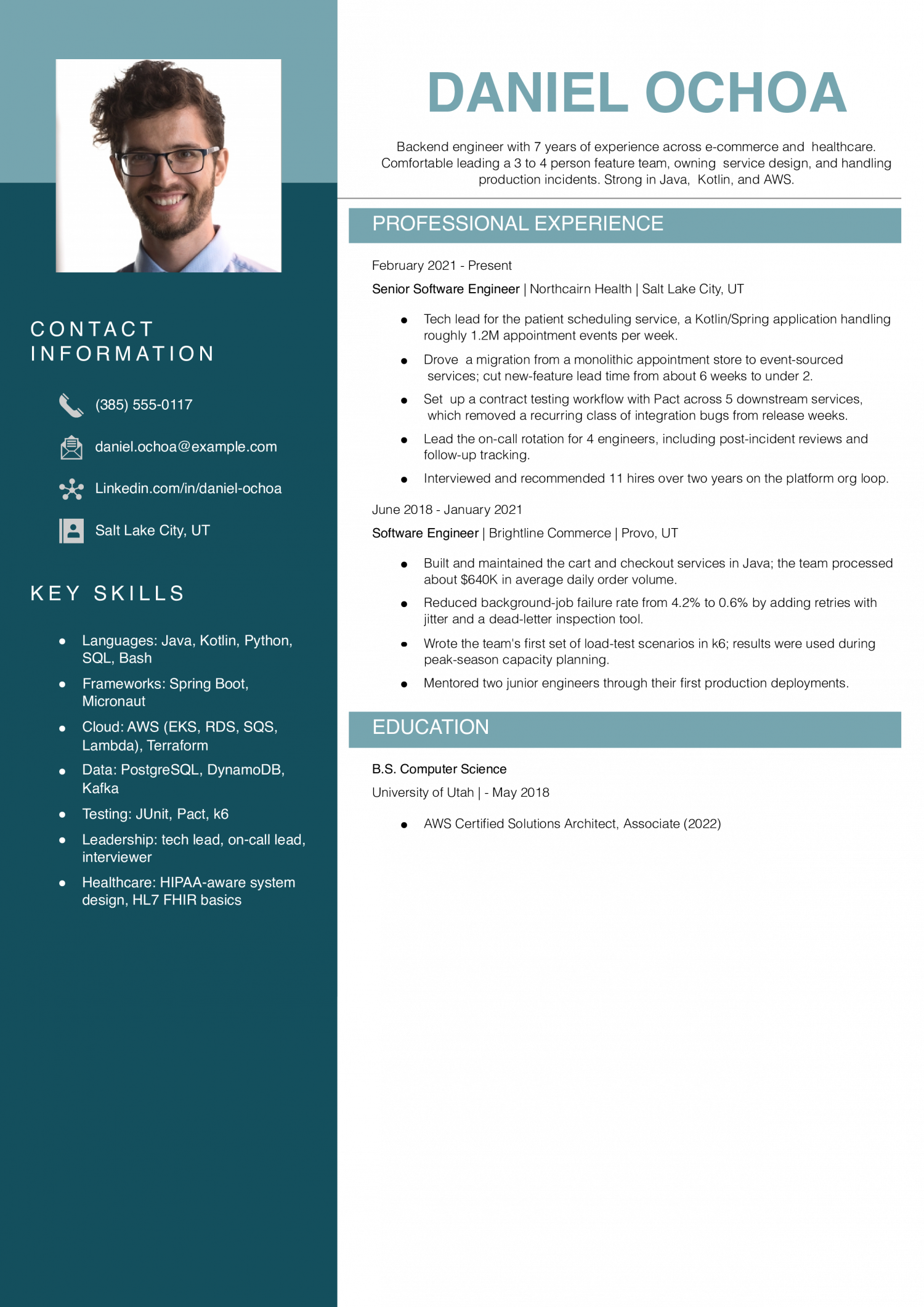
Mid-career engineers own services in production and ship features across a sprint cadence. The resume should show the systems you maintain, your on-call rotations, and the scale numbers behind your work.
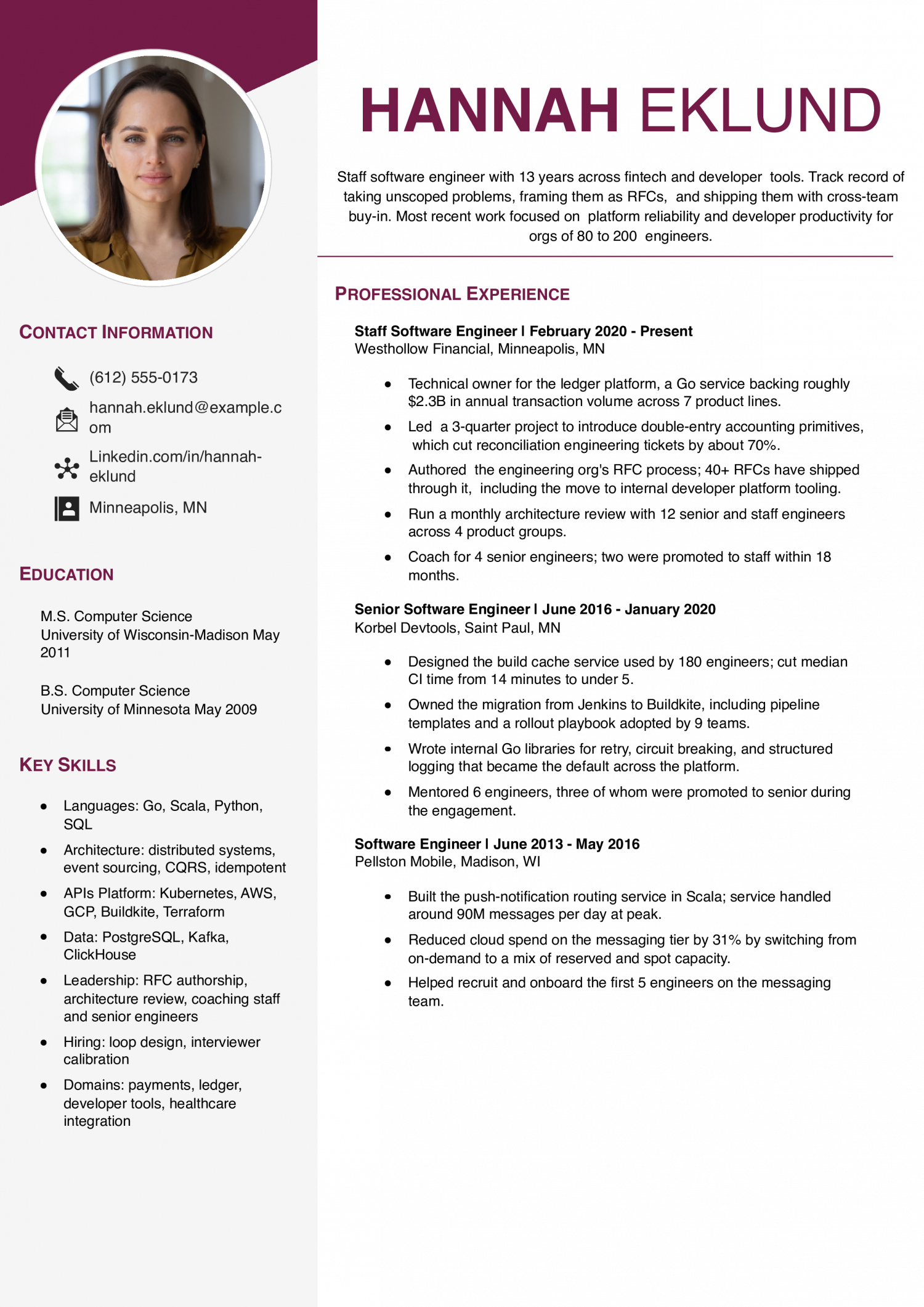
Senior engineers set technical direction for a team or a domain. The resume should lead with the platforms you architected, the engineers you mentored, and the migrations or rewrites you owned end-to-end.
Elena Sorensen
Pittsburgh, PA | (412) 555-0198 | [email protected] | linkedin.com/in/elena-sorensen | github.com/esorensen
Software engineer with 9 years of experience building backend services and data infrastructure for consumer and B2B products. Comfortable as a senior IC or a small-team tech lead. Strong in Python, Go, and AWS, with a side interest in developer tooling and incident review.
Senior Software Engineer
Marrowfield Insurance Tech | Pittsburgh, PA | 2022-Present
Software Engineer
Cobblepoint Media | Cleveland, OH | 2019-2022
Software Engineer
Tidewater Logistics | Norfolk, VA | 2017-2019
Associate Software Engineer
Greenfern Analytics | Charlotte, NC | 2015-2017
Software Engineering Intern
Greenfern Analytics | Charlotte, NC | Summer 2014
The first line of your summary should name something measurable: users served, latency cut, test coverage hit, or a public project with stars and forks.
Engineering managers and technical recruiters read that opener as a readiness signal. A bullet like ‘Shipped a Flask API serving 12,000 daily active users with 99.9% uptime’ tells them more than ‘passionate CS graduate.’ If you are pre-internship, lead with a capstone outcome or a Kaggle ranking. The point is to anchor the resume in something a reviewer can verify by clicking a link.
Most strong computer science resumes attach a number to every project bullet: requests per second, dataset size, model accuracy, or build-time reduction.
Bullets without a number tend to read as coursework. Recruiters scan for three metrics first: scale (users, QPS, rows), performance (latency, accuracy, throughput), and impact (cost saved, time cut, coverage hit). Even a class project can say ‘92% test coverage across 4,000 lines of Go’ or ‘reduced query time from 2.1s to 180ms.’ If the project is solo, own the whole number.
If it was a team of four, say so.
Sort the substantive work into three or four categories Engineering managers and technical recruiters recognize: production code, systems and infrastructure, data and ML, and open-source or research.
Under each, list the project, the stack, your role, and the measurable outcome. A backend project lists the API framework, the database, the deploy target, and the traffic it handled. An ML project names the model family, the dataset, the metric you optimized, and the baseline you beat.
This grouping helps a reviewer match you to the req without having to read every line.
Engineering managers and technical recruiters skim for the stack before they read prose. Put a Technical Skills block at the top of page one with languages, frameworks, databases, and cloud platforms grouped by category.
List certifications you actually finished: AWS Certified Developer, Google Cloud Associate, or relevant Coursera specializations from credible programs. Put your GitHub URL, portfolio site, and LinkedIn next to your name in the header. If you have a security clearance or an H-1B status that matters to the employer, note it in a single line near the top so recruiters do not have to ask.
For entry and mid-level computer science resumes, the education block carries weight. List your degree, graduation year, GPA if it is 3.5 or higher, and four to six relevant courses by name.
Pick the courses that map to the jobs you want: Operating Systems, Distributed Systems, Algorithms, Machine Learning, Compilers, Computer Networks. Add research assistantships, TA roles, or hackathon placements as short bullets. If you completed a study abroad term that involved coursework or a research project, list it as an academic entry, not a travel note.
The computer science resumes that get callbacks share a specific skill mix. The lists below come from our user-built computer science resumes. Engineering managers and technical recruiters scan for these patterns first, not generic ‘fast learner’ or ‘team player’ language.
Hard skills carry more weight than soft skills at the parse stage, but a senior loop will probe for collaboration and code review behavior. Pair every soft skill with a bullet that proves it. Use the tables to cross-check your resume against the target job posting, and treat soft skills as evidence backing your project bullets, not as standalone claims.
| Soft Skills | % of resumes with this skill |
|---|---|
| Problem-solving | 68% |
| Analytical thinking | 61% |
| Communication | 43% |
| Teamwork | 36% |
| Attention to detail | 29% |
And here are the top hard skills showing up most often.
| Hard Skills | % of resumes with this skill |
|---|---|
| Programming languages | 68% |
| Data structures and algorithms | 54% |
| Software development | 42% |
| Database management | 37% |
| Version control | 34% |
Based on data from thousands of computer scientists’ resumes built on ResumeTemplates.com, May 2026.
These are the must-haves hiring teams look for when scanning a computer science resume.
Engineering managers and technical recruiters expect to see the stack and the sub-specialty named in the same language the job posting uses. Group the keywords below by track so the ATS parses them as related skills, not a random skills dump.
| Niche | Keywords ATS scans for |
|---|---|
| Backend and APIs | rest api, microservices, postgresql, node.js |
| Cloud and DevOps | aws lambda, docker, kubernetes, terraform |
| Data and ML | pytorch, pandas, sql, feature engineering |
| Frontend and full stack | react, typescript, next.js, tailwind |
| Systems and infrastructure | linux, c++, distributed systems, observability |
Engineering teams are split between shops that expect Copilot-fluent developers and shops that ban AI assistants on proprietary code. Name the tools you use, describe the workflow honestly, and avoid claiming you ‘built with AI’ if your actual practice is using Copilot for boilerplate and writing the logic yourself.
Copilot and Cursor handle repetitive setup, so reviewers expect cleaner first commits and faster project starts from junior engineers.
Teams use AI-assisted review tools to catch obvious bugs early, which raises the bar for what human reviewers flag.
More employers now ask candidates to disclose AI use on take-homes, and some explicitly forbid it to test fundamentals.
Engineers are expected to ship docs alongside code, with AI handling the first draft and the engineer verifying accuracy.
A computer science portfolio is a clickable extension of your resume. Engineering managers and technical recruiters open one or two links during a 30-second scan, so the top of the GitHub profile and the top of the portfolio site have to load proof fast.
Pin three to six repos with strong READMEs, working demos, and recent commits.
A single-page site with name, stack, three project cards, and resume PDF link.
Featured section for the same projects, with screenshots and short writeups.
Use when applying to ML or data roles; rankings and model cards both count.
Pin your strongest three repos. A pinned repo with 200 lines of clean code and a clear README beats a private repo with 5,000 lines.
Write the README like a recruiter will read it first. Open with what the project does, the stack, and one screenshot or GIF. Put architecture details lower.
Show recent activity. A GitHub graph with commits in the last 30 days reads as active. A profile that went quiet 18 months ago raises questions.
Group your stack by category so a recruiter can match you to the req at a glance. Naming versions when they matter (Python 3.11, React 18) signals you actually work in the tooling, not just the buzzword.
Engineering managers and technical recruiters read this list as a map of where your work is heading. The certifications below tell them which cloud, data, or security track you have invested in beyond coursework. List the issuing body and the year you completed each one.
Software developer roles are one of the larger occupations in BLS data, which means the median pulls in a long tail of bootcamp graduates, contractors, and lower-tier IC work alongside the computer science degree track. The spread between the 10th and 90th percentiles is wide, and geography drives a meaningful share of it.
To position above the median, lead the resume with the systems you have shipped in production and the scale numbers behind them, not the languages you have touched.
| # | State | Avg. Annual |
|---|---|---|
| 1 | California | $170,910 |
| 2 | Washington | $166,910 |
| 3 | Virgin Islands | $162,820 |
| 4 | New York | $161,260 |
| 5 | Massachusetts | $150,520 |
| 6 | Maryland | $137,890 |
| 7 | District of Columbia | $136,040 |
| 8 | Oregon | $135,260 |
| 9 | Delaware | $135,160 |
| 10 | Colorado | $134,540 |
| # | State | Workers | Median |
|---|---|---|---|
| 1 | California | 292,630 | $170,910 |
| 2 | Texas | 151,460 | $130,500 |
| 3 | New York | 104,130 | $161,260 |
| 4 | Washington | 91,470 | $166,910 |
| 5 | Virginia | 83,290 | $134,470 |
Resume Templates offers HR approved resume templates to help you create a professional resume in minutes. Choose from several template options and even pre-populate a resume from your profile.
Lead with projects and internships, not coursework. The header should carry your GitHub, portfolio site, and LinkedIn next to your name.
Put a Technical Skills block above your education on page one so recruiters can match you to the stack in 10 seconds. Under each project, name the language, the framework, your role, and one measurable outcome.
Keep the resume to one page until you have three years of full-time experience. Education sits near the bottom unless you graduated within the last year.
Each project gets three to four lines: the name with a clickable link, the stack in parentheses, your role if it was a team, and one or two outcome bullets with numbers.
Treat class projects the same as personal projects. A reviewer cares whether the code runs and what it does, not whether it was assigned. Name the metric you optimized: latency, accuracy, throughput, or coverage.
Skip the project category if you have three or more strong internships. At that point, work history carries the resume.
Replace the experience block with a projects block. List three to five projects with stack, role, and outcome.
Add teaching assistantships, research roles, hackathon placements, and open-source contributions as supporting evidence. A merged pull request on a known library reads stronger than a tutorial follow-along.
Include any data entry, IT support, or technical tutoring work even if it was part-time. It shows you can hold a job and manage a manager.
Yes, if the role produced a concrete output. Organizing a hackathon, leading a project team in ACM, or running a CTF squad reads as initiative when you name the outcome.
Quantify it: '120 attendees, four sponsors, $3,500 prize pool' beats 'organized a hackathon.' Engineering managers and technical recruiters use these bullets to gauge ownership beyond coursework.
Skip generic membership lines. 'Member of CS Club' adds nothing if there is no output attached.
For a computer scientist, a tech template is the safest pick, because it keeps your stack, tools, and impact easy to scan. An ATS-friendly template is a solid alternative. Whichever you choose, keep the formatting clean and easy to parse: clear section headings, a standard font, and no graphics a parser can choke on.
Executive Resume Writer and Career Coach
Andrew Stoner is an executive career coach and resume writer with 17 years of experience as a hiring manager and operations leader at two Fortune 500 Financial Services companies, and as the career services director at two major university business schools.
Customize this template in our builder in under 10 minutes.