
Tip !

A named stack with one quantified business outcome per role is what gets data scientist resumes past the recruiter parse; a clean problem-to-decision narrative is what makes them readable enough to advance to the technical screen.

Andrew Stoner , Executive Resume Writer and Career Coach

Why this resume works

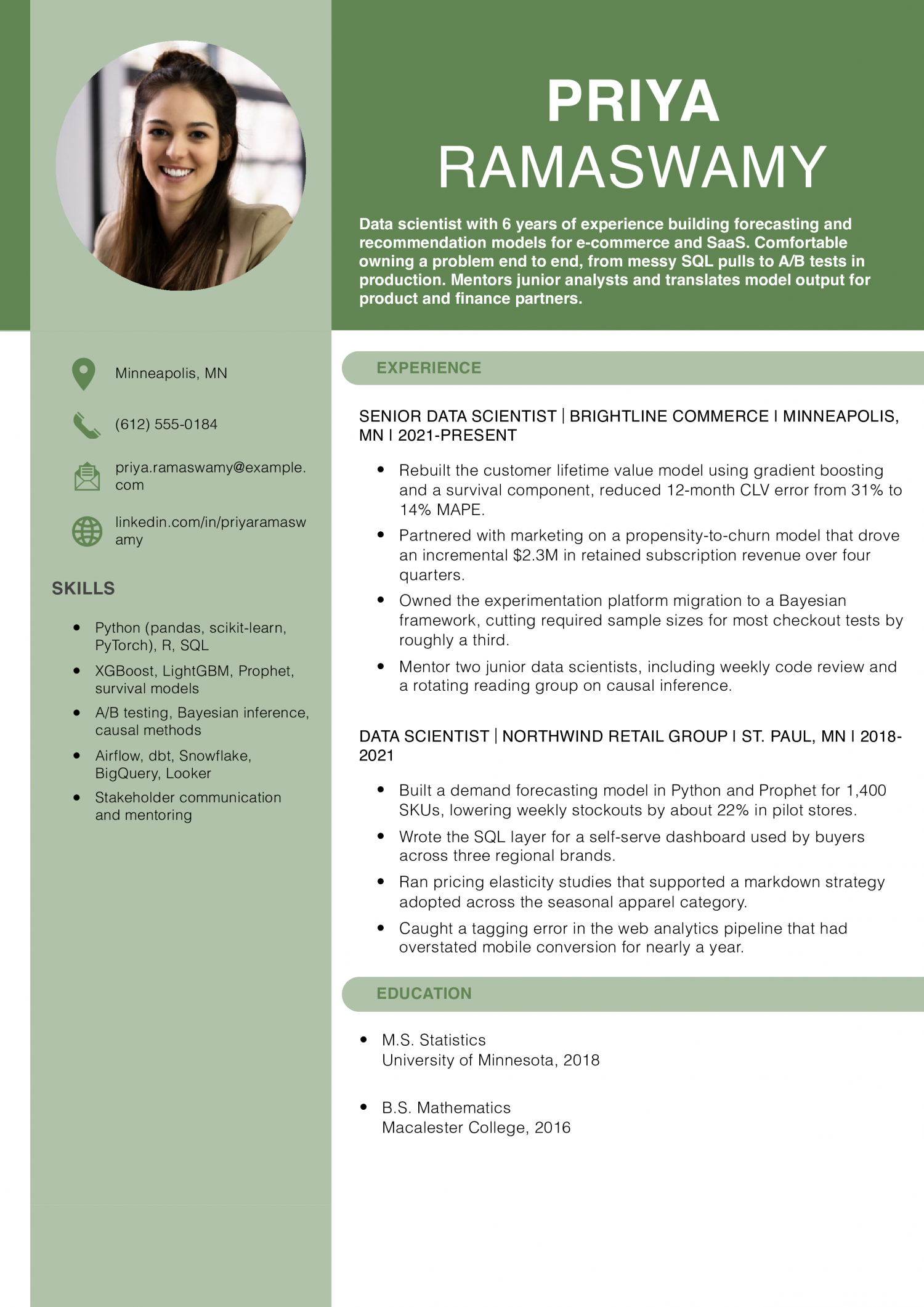
  • Numbers tied to revenue: The churn model bullet pairs a method with a dollar figure leadership actually tracks.
  • Caught a costly data error: Finding the mobile conversion tagging bug shows judgment, not just modeling skills.
  • Mentoring shown plainly: Naming code review and a reading group makes the mentoring claim believable instead of generic.

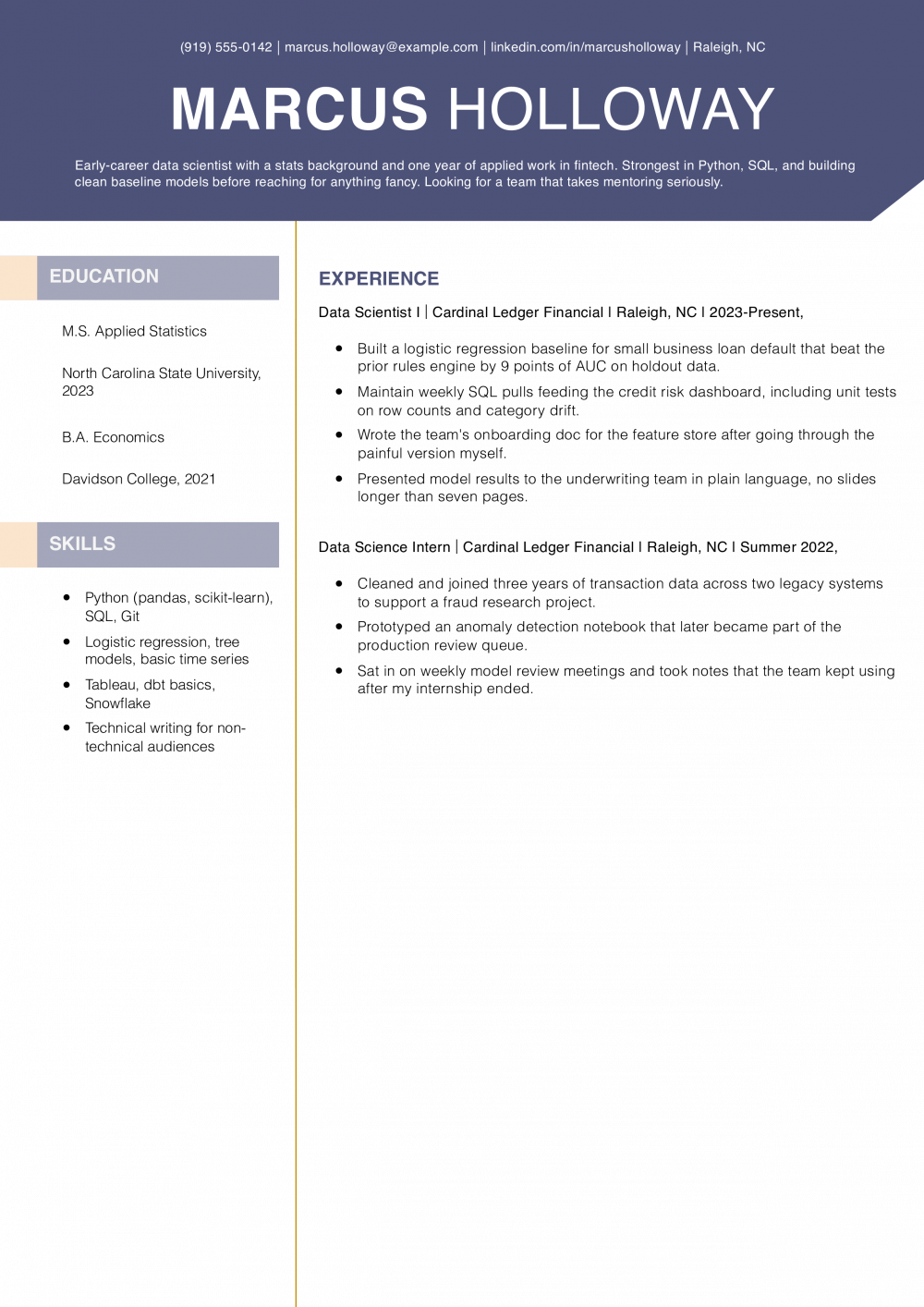
Junior Example

The junior data scientist is one to three years in, often out of a master's program or a pivot from analytics. This resume needs to prove you can pull, clean, and model real data and explain the result to a non-technical reader.

Why this resume works

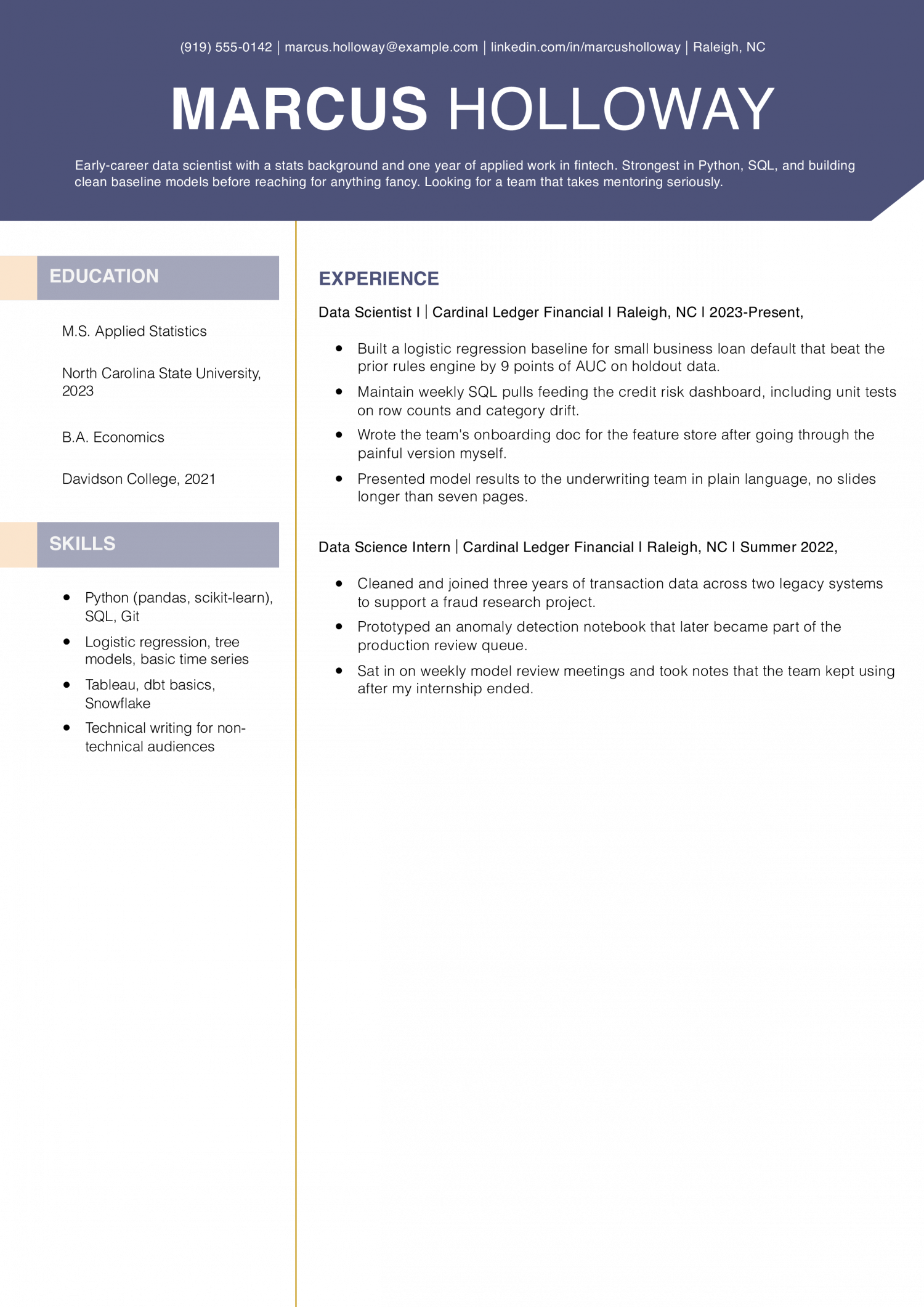
  • Honest about being junior: The summary says one year of work without dressing it up, which reads as trustworthy.
  • One strong number: The 9-point AUC lift gives a clean anchor while the other bullets stay qualitative.
  • Internship still earns its space: The intern bullets show real artifacts (a notebook, notes) that outlasted the internship itself.

Senior Example

The senior data scientist owns problems end-to-end and ships models that touch production. This resume needs to prove scope: dataset size, business metric moved, and the cross-functional partners you worked with on PM and engineering.

Why this resume works

  • Grew into more responsibility: The path from analyst to senior is right there on the page, with a promotion line that makes it explicit.
  • Cut work that no longer helped: Collapsing seven DAGs into three shows judgment about maintenance cost, not just shipping new things.
  • Real revenue figure: The $4.7M pricing impact is specific enough that a hiring manager can ask about it in detail.

Staff Example

The staff data scientist sets technical direction across multiple teams and mentors other scientists. This resume needs to prove influence: roadmap calls you made, experimentation systems you built, and the revenue or retention numbers tied to your bets.

Why this resume works

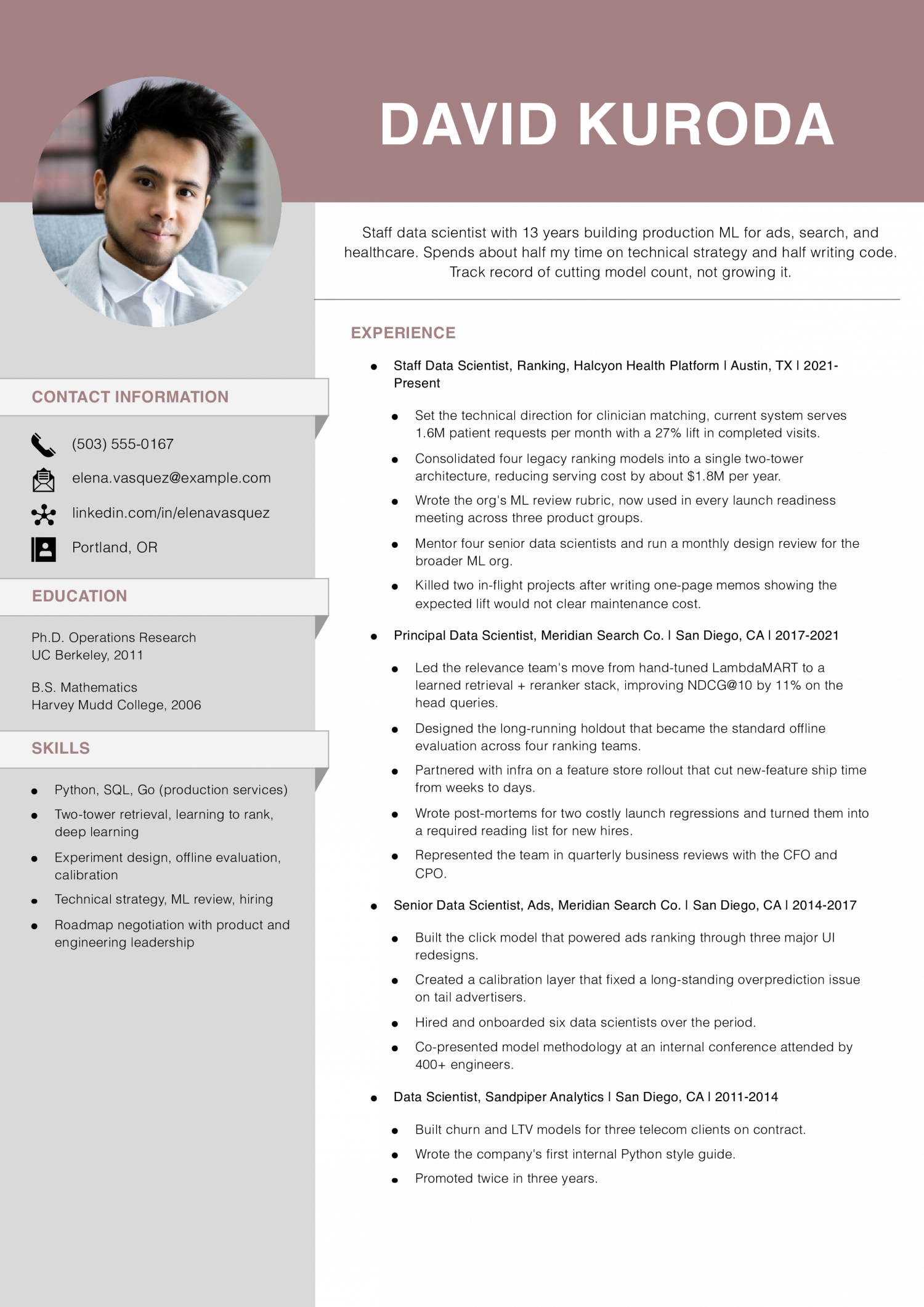
  • Strategy and code, both visible: The summary names the time split and the bullets back it up with technical and organizational work.
  • Stopped projects that were not worth it: Killing two projects with a one-page memo is the kind of senior judgment most resumes hide.
  • Real serving cost number: The $1.8M serving cost cut tells you this person thinks about ML as a budget item, not just an accuracy chart.

How to Write a Data Scientist Resume

01 Open with the metric a hiring manager would use to size you up

The first line of your summary should name a business metric you moved, not your years of modeling. Heads of data science read that line as your readiness to ship.

Lead with the lift, the scope, and the method in that order. “Built a churn model that recovered 7% of at-risk revenue across 2.1M users using XGBoost and SHAP” beats “experienced data scientist skilled in machine learning.”

If you’re earlier in your career, pull the metric from a capstone, internship, or Kaggle placement. Specific beats senior every time on the first read.

02 Quantify every bullet you can defend

Most strong data scientist bullets carry two numbers: the scale of the data and the business outcome. “Trained a ranking model on 40M events that lifted click-through 12%” reads as evidence.

Name 2 or 3 metrics that fit your work: AUC or RMSE for model quality, percent lift or dollars saved for business impact, and rows or users for scale.

Bullets without a number tend to read as duties. If you can’t measure the outcome, measure the input: dataset size, experiment count, or stakeholders briefed.

03 Group your work by problem type, not by tool

Heads of data science scan for problem fluency across a few categories. Cluster your bullets into experimentation and causal inference, predictive modeling, NLP or recommendations, and analytics or stakeholder work.

Inside each cluster, name the methods in context: A/B testing with CUPED, gradient boosting with XGBoost, transformer fine-tuning on Hugging Face, or difference-in-differences for a pricing study.

This structure shows range without a skills dump. A reader can place you on their team in under a minute.

04 Place credentials and stack where they get read

Put a tight technical skills block on page one, under the summary. Group it: languages (Python, SQL, R), ML libraries (PyTorch, scikit-learn, XGBoost), data infra (Spark, Snowflake, dbt), and cloud (AWS SageMaker, GCP Vertex).

Heads of data science need to confirm stack overlap before they read bullets. A buried skills section costs you the scan.

List a master’s or PhD with the field of study and any published papers or NeurIPS, KDD, or ICML acceptances. Certifications go in their own block lower on page one.

05 Cut the noise that dilutes a senior resume

Drop coursework, GPA, and tutorial-grade projects once you have two production roles behind you. They signal early-career and crowd out the work that matters.

Cut generic phrases like “strong analytical skills” and “passionate about data.” Replace them with a specific model, dataset, or decision.

Trim the stack list to tools you’ve used in the last 18 months. A long-tail skills list weakens the credible ones.

ATS filters catch more data scientist resumes than ever in 2026. The skills below come from our user-built data scientist resumes, so they reflect what real applicants are showing in 2026 hiring cycles. Stack names like Python, SQL, and PyTorch clear the first cut, and stakeholder-facing language decides whether the resume advances to a recruiter.

Heads of data science weigh hard skills as table stakes and soft skills as the tiebreaker. Two candidates with the same stack get sorted by who can frame a problem and brief a PM. Match the hard skills against the target job posting word for word, and use the soft skills as evidence behind your bullets, not as a standalone list.

Soft Skills % of resumes with this skill
Communication 66%
Problem solving 52%
Business acumen 50%
Collaboration 40%
Critical thinking 31%

And here are the top hard skills showing up most often.

Hard Skills % of resumes with this skill
Python programming 80%
Machine learning 56%
Statistical analysis 43%
SQL and data querying 35%
Data visualization 30%

Based on data from thousands of data scientists’ resumes built on ResumeTemplates.com, May 2026.

Must Have on a Data Scientist Resume

Before a data scientist resume gets a closer read, hiring teams verify a short list of licenses, tools, and compliance signals.

Niche Keywords for ATS Checkers

Heads of data science expect a niche-specific keyword footprint, not a generic skills wall. Cluster your terms by the sub-specialty you’re targeting so the ATS and the recruiter both land on the right shelf.

Niche Keywords ATS scans for
Machine learning engineering xgboost, pytorch, model deployment, mlops
Experimentation and causal inference a/b testing, causal inference, cuped, difference-in-differences
NLP and LLM applications hugging face, transformers, fine-tuning, embeddings
Product analytics and growth sql, retention modeling, funnel analysis, cohort analysis
Data infrastructure and scale spark, snowflake, dbt, airflow

AI Skills to Add

Hiring teams are split between groups that want data scientists fluent in LLM tooling and groups that distrust scientists who outsource judgment to a chatbot. Name the tools you use, describe the workflow honestly, and don’t claim “built LLM applications” if your actual practice is prompting GPT-4 in a notebook.

What AI is actually changing for this role
EDA and prototyping

Copilot and ChatGPT speed up first-pass pandas and SQL, but reviewers still expect you to vet logic and edge cases.

Modeling baselines

Hugging Face and pretrained models shifted the starting line from training to fine-tuning and evaluation rigor.

Documentation and design docs

LLM drafts compress writing time, so headcount expectations now include cleaner design docs and post-mortems per project.

Stakeholder communication

AI summarization tools mean PMs read more analyses, so written framing and visualization quality matter more, not less.

AI tools to name
  • GitHub Copilot: Use it for boilerplate, test scaffolding, and pandas one-liners; review every line before commit.
  • Hugging Face Transformers: Fine-tune pretrained models for classification, embeddings, or NER instead of training from scratch.
How to phrase AI on your resume
Do
  • Used GitHub Copilot to accelerate feature engineering on a 12M-row training set, cutting prototype time from two weeks to four days.
  • Fine-tuned a Hugging Face DistilBERT model for support ticket routing, lifting accuracy from 78% to 91% across 6 categories.
Skip
  • Leveraged AI to revolutionize data-driven decision-making across the enterprise.
  • Cutting-edge generative AI expert with deep LLM expertise.

Portfolio Strategy

A data scientist portfolio is your second resume. Heads of data science click through to verify the modeling depth your bullets claim, so the artifacts need to load fast and read clean.

#1 GitHub

Hosts the code reviewers actually read; pin three repos that match the target role's specialty.

#2 Kaggle

Competition placements and well-documented notebooks signal modeling chops and community engagement.

#3 Personal site or blog

A short write-up per project, problem, method, result, beats a raw notebook for non-technical readers.

#4 Hugging Face Spaces

Useful for hosting an interactive demo of a fine-tuned model so reviewers can click and try.

Pin three repos, not ten. Reviewers scan the top of your GitHub profile for 30 seconds. A churn model, an A/B testing toolkit, and an NLP fine-tuning project covers the bases for most roles.

Write a README that reads like a design doc. Open with the problem and the business framing, then the data, the method, the result, and the limitations. Reviewers weight clarity over cleverness.

The Data Scientist Tech Stack to Name

Heads of data science scan the skills block for stack overlap before they read your bullets. Name the tools you’ve used in the last 18 months, grouped by category, so the parser and the reader find them fast.

  • Languages: Python, SQL, R, Scala
  • ML libraries: PyTorch, TensorFlow, scikit-learn, XGBoost, LightGBM, Hugging Face Transformers
  • Data infrastructure: Spark, Snowflake, BigQuery, dbt, Airflow, Kafka
  • Cloud ML: AWS SageMaker, GCP Vertex AI, Azure ML, Databricks
  • Experimentation: Optimizely, Statsig, internal A/B platforms, CUPED
  • Visualization and BI: Tableau, Looker, Streamlit, Plotly

Data Science Credentials That Get You the Job

Heads of data science read this list as a map of where your work is heading. The certifications below tell them which track, cloud ML, deep learning, or applied analytics, you’ve invested in beyond the day job. List the issuing body and the year of completion under a dedicated heading on page one.

  • AWS Certified Machine Learning Specialty: Signals you can ship models on SageMaker and reason about cloud cost, which matters for any team running production ML on AWS.
  • Google Cloud Professional Machine Learning Engineer: Strong signal for shops on Vertex AI or BigQuery ML, and a clean tiebreaker against candidates with equal modeling experience.
  • DeepLearning.AI Deep Learning Specialization (Coursera): Useful for analytics-heavy scientists pivoting toward neural network or NLP work, especially paired with a Hugging Face project.
  • Databricks Certified Machine Learning Professional: Carries weight at enterprises running Spark and MLflow in production, where lakehouse fluency is now a hiring filter.

Latest BLS Statistics for Data Scientists

For data scientists, the 10th-percentile floor reflects entry analytics-adjacent roles, and the top-decile ceiling reflects senior IC and staff scientists at large tech, finance, and AI-native employers. That spread tells you employer type and specialty, recommender systems, causal inference, applied ML, move a candidate from floor to ceiling faster than tenure alone. Geography compounds the gap.

The Bay Area, New York, and Seattle pay materially above the national mean for the same job titles. Lead your resume with the specialty and the employer category, large tech, fintech, biotech, that match the ceiling you’re targeting.

$136,148 National median annual
$87,714 Entry-tier floor (10th percentile)
$193,467 Top-decile ceiling (90th percentile)
233,440 Data Scientists in the U.S.
Where you stand

Entry tier

$87,714–$136,148 At the entry tier, your resume needs to show shipped projects with real data, your Python and SQL stack, and one quantified outcome.

Mid band

$136,148–$193,467 At the mid band, lead with end-to-end model ownership, the business metric moved, and the experimentation framework you ran tests on.

Top decile

$193,467+ At the top decile, your resume needs to show staff-level scope, ML platform or research contributions, and revenue impact across multiple teams.

Top-paying states

# State Avg. Annual
1 Washington $158,760
2 District of Columbia $137,120
3 California $136,800
4 Massachusetts $132,250
5 New Jersey $130,370
6 Virginia $126,070
7 New York $125,400
8 Maryland $124,340
9 Hawaii $123,880
10 Vermont $120,670

Highest-employment states

# State Workers Median
1 California 36,850 $136,800
2 Texas 23,420 $106,540
3 New York 20,070 $125,400
4 Pennsylvania 10,430 $100,320
5 North Carolina 10,140 $115,380
A note on these numbers. The Bureau of Labor Statistics groups data scientists with data analysts, so its standard figure can understate pay for data scientists in technology. The title-specific number here is higher and draws on U.S. Department of Labor visa wage filings, which skew toward large technology employers, so treat it as the upper end. For data scientists, pay swings most with employer type, the specialty you work in, and metro location relative to major tech hubs. Use it as a guide, not a guarantee.

Primary data: U.S. Bureau of Labor Statistics. Title-specific base pay: U.S. Department of Labor (H-1B LCA disclosures). View on bls.gov
Written by professional resume writers and loved by hiring managers

Resume Templates offers HR approved resume templates to help you create a professional resume in minutes. Choose from several template options and even pre-populate a resume from your profile.

Frequently Asked Questions

What does an entry-level data scientist resume need if I have no industry experience?

Lead with projects that used real data, not tutorial datasets. A capstone on a 5M-row dataset with a deployed model beats a Titanic notebook every time.

Name the problem, the method, the metric, and the stakeholder you presented to, even if the stakeholder was a professor or a hackathon judge.

List your stack tightly: Python, SQL, one ML library, and one cloud. Cut coursework lists down to the three classes that matter.

How do I list MOOCs and online specializations on a data scientist resume?

Group them under a "Continuing Education" or "Certifications" block, not under Education. Name the issuing platform, the specialization title, and the completion year.

Skip single-course listings unless the course is well-known, like Andrew Ng's deep learning specialization. If a MOOC produced a project, link the project from the work itself.

Hiring managers weight the artifact over the badge. A GitHub repo with clean code carries more weight than three certificates.

Should I disclose that I used ChatGPT or Copilot to draft my resume?

No, not on the resume itself. The resume is your asserted record of work.

Use AI tools to draft and tighten copy, then verify every number, tool, and date against your own files.

The risk is not disclosure; it's a bullet that overclaims a model you didn't build or a metric you can't reproduce in an interview.

How do I show pivoting from analyst or engineer to data scientist on the resume?

Reframe the prior role around the data scientist signals it already carried. SQL depth, A/B test reads, and stakeholder briefings count as data science work even under an analyst title.

Add a side project or Kaggle placement that shows modeling depth your title didn't. A deployed model on a public dataset closes the gap fast.

Then put a one-line summary at the top that names the target role and your transferable proof, so the recruiter doesn't have to infer the pivot.

What resume template should a data scientist use?

For a data scientist, a tech template is the safest pick, because it keeps your stack, tools, and impact easy to scan. An ATS-friendly template is a solid alternative. Whichever you choose, keep the formatting clean and easy to parse: clear section headings, a standard font, and no graphics a parser can choke on.

Andrew Stoner

Executive Resume Writer and Career Coach

Andrew Stoner is an executive career coach and resume writer with 17 years of experience as a hiring manager and operations leader at two Fortune 500 Financial Services companies, and as the career services director at two major university business schools.