
2 Best Federal Resume Examples and Templates for 2026


Federal HR specialists want to see the GS series, grade, and hours-per-week on the first job block, because that tells them in under a minute whether the applicant clears time-in-grade and specialized experience.
Featured Example
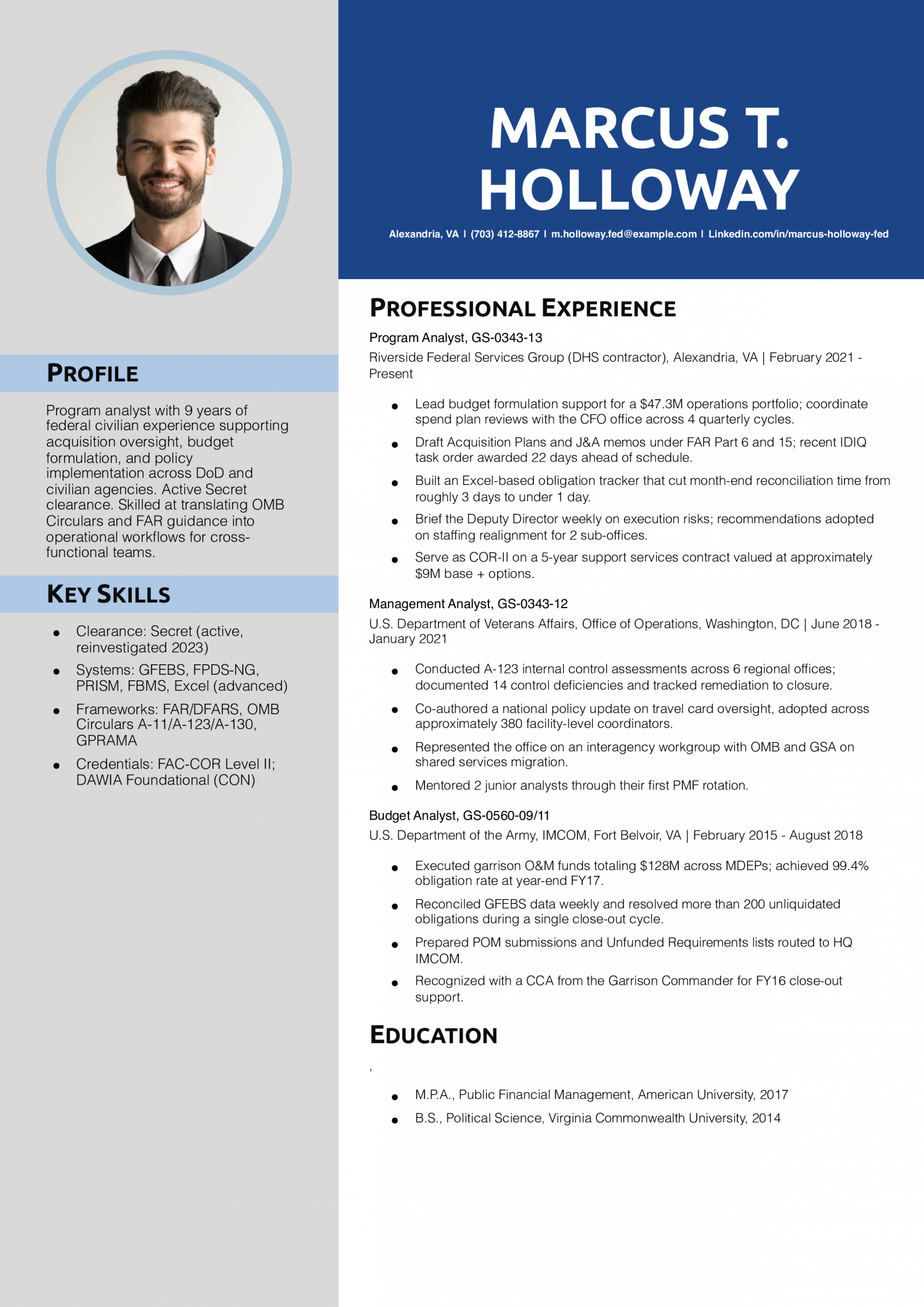
- Series And Grade Stated: Every position lists the GS series and grade (0343-13, 0560-09/11), which is the first thing federal HR specialists scan for in USAJOBS submissions.
- Clearance Surfaced Early: Active Secret clearance appears in the summary and again in skills, signaling immediate eligibility without a hiring manager hunting through the document.
- Authority Citations Used: References to FAR Part 6/15, A-123, and GFEBS demonstrate fluency in the exact frameworks the position description will cite.
Federal Resume Example
The Federal Resume tier covers GS-5 through GS-15 applicants going through USAJOBS, where length runs three to five pages and every job needs supervisor contact, hours, and salary.
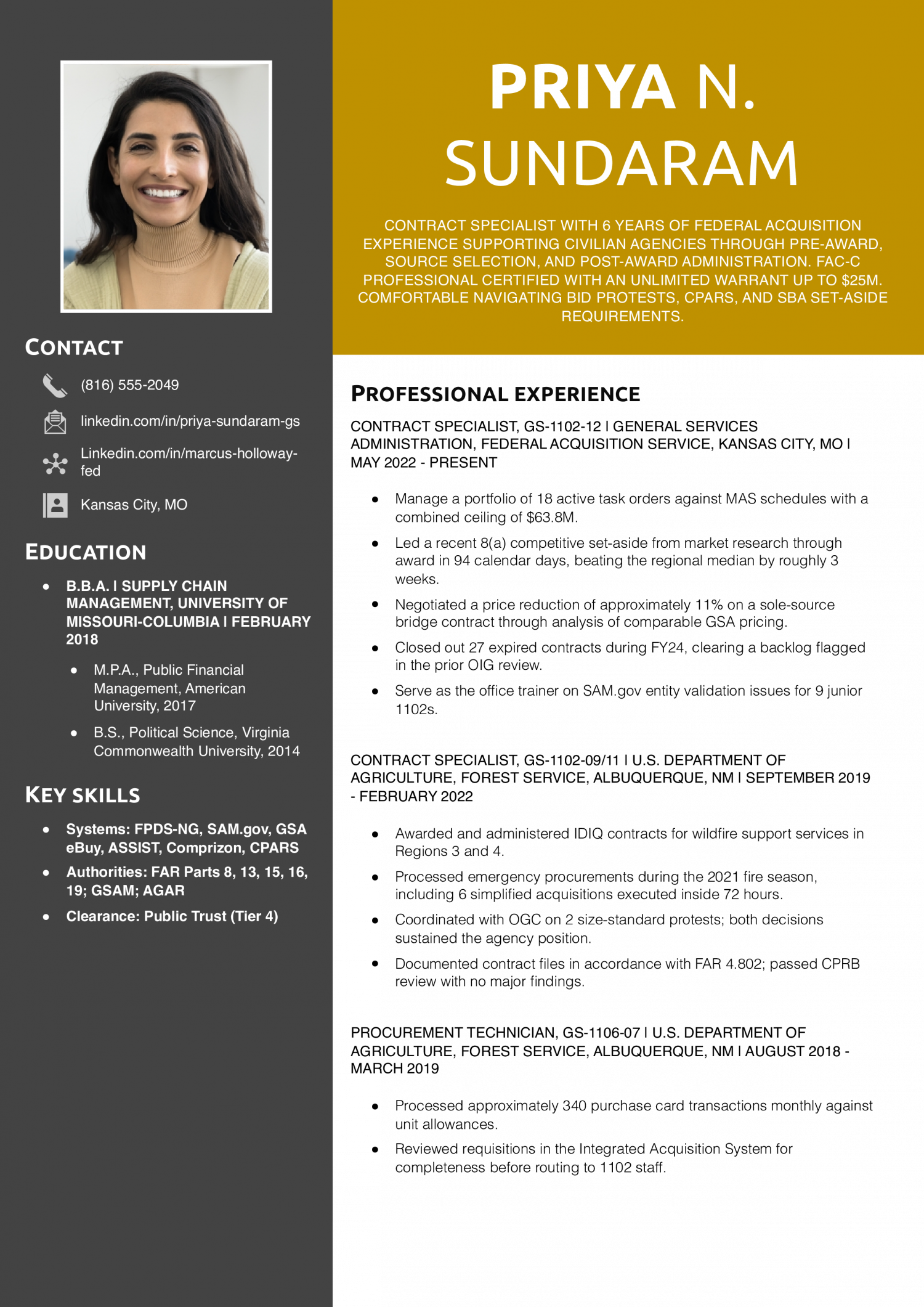
- Warrant Level Named: Stating the unlimited warrant authority up to $25M tells the selecting official this candidate can sign awards on day one without further certification.
- Far Citations Specific: Calling out FAR Parts 8, 13, 15, 16, and 19 mirrors how 1102 position descriptions are written and helps HR match KSAs during the rating panel.
- Progression Documented: Showing GS-1106-07 to GS-1102-09/11 to GS-1102-12 demonstrates a clean time-in-grade record, which is verified before any tentative offer.
Text Version Federal
Daniel R. Okafor
Huntsville, AL | (256) 555-1133 | [email protected] | linkedin.com/in/daniel-okafor-gs | U.S. Citizen | Veterans’ Preference: 5-pt (TP)
PROFESSIONAL SUMMARY
Logistics management specialist with 11 years of combined active-duty Army and federal civilian experience supporting Army Materiel Command and the Defense Logistics Agency. Active Secret clearance with current SF-86 on file. Demonstrated record managing depot-level supply operations, AWCF transactions, and CONUS/OCONUS distribution under DoDM 4140.01.
CORE COMPETENCIES
- Supply Chain Management (DoDM 4140.01, AR 710-2)
- Property Accountability (GCSS-Army, LMP, DPAS)
- Inventory Management and ABC Stratification
- Foreign Military Sales (FMS) case execution
- Lean Six Sigma process improvement (Green Belt)
EXPERIENCE
Logistics Management Specialist, GS-0346-12
U.S. Army Aviation and Missile Command (AMCOM) | Redstone Arsenal, AL | March 2022-Present (40 hrs/week, Salary: $94,317)
- Oversee secondary item demand planning for 1,240 NSNs supporting two aviation weapon systems; reduced backorder rate from 14.8% to 6.2% over four quarters.
- Serve as the AMCOM action officer on a joint sustainment working group with DLA Aviation, coordinating monthly stock positioning decisions valued at approximately $18.4M.
- Authored the FY24 Materiel Release recommendation packet for a tail rotor assembly modification, accepted by the PEO with no revisions.
- Manage FMS case execution for two partner nations; closed out 3 legacy cases that had been open more than 5 years.
- Supervise 2 GS-09 logistics specialists, including writing performance plans under DPMAP.
EXPERIENCE
Supply Systems Analyst, GS-2003-11
Defense Logistics Agency, DLA Distribution | New Cumberland, PA | June 2019-March 2022 (40 hrs/week, Salary: $76,221 at separation)
- Analyzed warehouse throughput data across 7 distribution depots and recommended slot re-profiling that improved pick accuracy to 99.1%.
- Reconciled approximately 4,200 inventory discrepancies during a wall-to-wall inventory cycle, recovering an estimated $612,000 in misposted stock.
- Drafted SOPs for the receipt-not-in-system workflow now used across the J3 directorate.
- Received a DLA Director’s Coin in 2021 for COVID-response PPE distribution support.
EXPERIENCE
Inventory Management Specialist, GS-2010-09
U.S. Army, 401st Army Field Support Brigade | Camp Arifjan, Kuwait | August 2017-May 2019 (40 hrs/week, Salary: $58,940 base + 35% post differential)
- Tracked Army Prepositioned Stock (APS-5) equipment readiness across 3 storage sites containing roughly 1,800 rolling-stock end items.
- Coordinated issue and turn-in operations during 4 unit set fieldings without a property accountability finding.
- Liaised with host-nation customs on cargo release; cleared 96 surface shipments through Shuaiba Port in FY18.
EXPERIENCE
Sergeant (E-5), Automated Logistical Specialist (92A)
United States Army, Active Duty | Fort Bragg, NC and OCONUS deployments | July 2013-July 2017
- Supervised the Class IX repair parts section for a brigade support battalion managing approximately $11M in on-hand inventory.
- Trained and certified 8 soldiers as GCSS-Army operators during the unit’s fielding transition.
- Deployed to Afghanistan (2015-2016) in support of Operation Resolute Support; awarded the Army Commendation Medal.
- Honorable Discharge, July 2017.
EDUCATION
- M.S., Logistics and Supply Chain Management, Florida Institute of Technology, 2021 (GPA 3.78/4.0)
- B.A., Business Administration, University of Alabama in Huntsville, 2017
- Army Logistics University, Basic Officer Logistics Course equivalency, 2020
CERTIFICATIONS AND TRAINING
- DAWIA Life Cycle Logistics, Practitioner level, 2023
- Lean Six Sigma Green Belt, Villanova University, 2020
- DAU CLM 031, Improved Statement of Work, 2022
- Defense Acquisition University LOG 200, completed 2023
AWARDS
- AMCOM Commander’s Award for Civilian Service, 2024
- DLA Director’s Coin, 2021
- Army Commendation Medal (2 OLC), 2016
- Army Achievement Medal (3 OLC)
REFERENCES
Available upon request. Current and former supervisors may be contacted.
Use this in our builder Copy text
How to Write a Federal Resume
01 Translate your private-sector role into federal language
Open your summary with one line that maps your prior title to the GS series and grade you are targeting. Name the announcement number and the specialized experience paragraph you are claiming.
Career-changers from industry, the military, or contract work should foreground transferable artifacts that federal HR recognizes: contracts administered under FAR, programs you ran, budgets you controlled, and people you supervised. Pull the announcement’s verbs into your summary so the human reviewer sees the match on page one. Avoid private-sector buzzwords like ‘rockstar’ or ‘thought leader’ that read as noise in a federal pipeline.
02 Quantify scope, budget, and people
Federal reviewers weigh scope before adjectives. Most strong bullets include a number for budget, headcount, caseload, contracts, or geography.
Name three to five realistic metrics per job: dollars managed, employees supervised, transactions processed, or square feet maintained. Bullets without a number tend to read as duties and lose to applicants who show volume. If the work is classified or sensitive, give an order of magnitude and note the constraint, rather than leaving the figure blank.
03 Group duties into specialized-experience buckets
Mirror the four or five major duties listed in the announcement and use those as the spine of each job block. Common buckets include program management, acquisition and contracting, policy analysis, supervision, and stakeholder coordination.
Under each bucket, write three to five bullets that show how you did the work, what authority you held, and what changed because of it. Cite the regulation, system, or framework by name: FAR Part 15, NIST 800-53, GAAP, Title 38, or the agency-specific directive.
04 Place credentials, clearance, and tools up front
Federal HR specialists and selecting officials need credentials visible before they read bullets. Put citizenship status, veterans’ preference, security clearance level and date of last investigation, and any required certifications in a credentials block under the summary.
List PMP, CISSP, Contracting Officer warrants, FAC-C or DAWIA levels, and clinical licenses with the issuing body and current status. Do not include license numbers, badge numbers, or clearance investigation case numbers on the resume itself, since those belong on the application form.
05 Add the federal-required closing details
Each job block needs the supervisor’s name, phone number, and a yes or no answer on contacting them, plus your start and end dates by month and year, hours per week, and salary or pay grade. Schedule A applicants and veterans should add the relevant statement near the top.
Close with education listing GPA if above 3.0, relevant coursework for entry-level roles, and any training hours that map to the announcement’s required experience. Federal resumes commonly run three to five pages, so do not cut these closing details to save space.
Federal Resume Format: USAJOBS Builder vs. Uploaded Resume
The USAJOBS builder forces a standard order: contact, citizenship, work experience, education, training, references. Every field has a character limit and a required structure. The advantage is that your resume cannot accidentally miss a required field.
Uploaded resumes give you typographic control but require self-discipline. You must still include every USAJOBS-required field, in a layout the rating panel can parse on screen. Use 11 or 12 point body text, clear H2-style job block headers, and consistent date formats.
Most Popular Skills on Federal Resumes for 2026
Pulled from the resumes our users build on ResumeTemplates.com, these skills reflect what federal HR specialists actually keyword-match against announcement language. Match the list against your target announcement, then back each soft skill with a bullet that shows the behavior.
| Interagency collaboration | % of resumes with this skill |
|---|---|
| Discretion with sensitive information | 51% |
| Stakeholder communication | 46% |
| Stakeholder communication | 31% |
| Adaptability to policy shifts | 26% |
| Detail orientation | 26% |
And here are the top hard skills showing up most often.
| Hard Skills | % of resumes with this skill |
|---|---|
| Federal regulation compliance | 52% |
| Grant administration | 30% |
| Policy analysis | 27% |
| Government procurement | 23% |
| Budget formulation | 20% |
Based on data from thousands of federal job seekers’ resumes built on ResumeTemplates.com, May 2026.
How to List a Security Clearance on a Federal Resume
Federal HR specialists and selecting officials need to verify your clearance level and currency before they can route your application to a cleared role. Put clearance information in a credentials block under your summary, not buried in a job description.
Clearance Block Format
List the clearance level (Secret, Top Secret, TS/SCI), the adjudicating agency or DoD CAF, and the date of your last completed investigation (Tier 3, Tier 5, or continuous evaluation enrollment). State whether the clearance is active, current, or expired with a reinstatement window.
Do not include your case number, investigation ID, or polygraph dates on the resume itself. Those details belong on the SF-86 and the application form. For positions requiring a polygraph, note ‘CI polygraph’ or ‘full-scope polygraph’ and the year completed, without case identifiers.
- Active Top Secret / SCI, DoD CAF, Tier 5 investigation completed 2023, CE-enrolled.
- Active Secret clearance, OPM Tier 3 investigation completed 2024.
- Inactive Top Secret, last investigation 2022, eligible for reinstatement within 24 months.
- Public Trust (High Risk), adjudicated 2025.
Federal Resume Formatting Credentials That Get You the Job
Beyond citizenship and any required clearance, the certifications below tell federal HR specialists which work series you can step into and which warrants or authorities you can carry. List the issuing body, level or grade, and current status under each entry.
-
Project Management Professional (PMP): Signals program-management capacity for GS-13 and above roles in acquisition, IT, and operations; list PMI as issuer and expiration year.
-
CISSP or CompTIA Security+: Maps directly to DoD 8570 and 8140 baseline requirements for cybersecurity positions; list certifying body and current cycle dates.
-
FAC-C or DAWIA Contracting Certification: Required for contracting series 1102 roles; list level (Professional, Practitioner) and the warrant dollar threshold you have held.
-
Certified Government Financial Manager (CGFM): Strengthens 0510, 0501, and 0560 series applications; AGA-issued and signals fluency in federal appropriations and GAAP for government.
Resume Templates offers HR approved resume templates to help you create a professional resume in minutes. Choose from several template options and even pre-populate a resume from your profile.
Frequently Asked Questions
A federal resume is the long-form resume used to apply for jobs on USAJOBS and at federal agencies. It includes details a private-sector resume leaves out.
Every job block needs hours per week, supervisor name and phone, GS grade or salary, and full duty descriptions. Federal resumes commonly run three to five pages, while civilian resumes target one or two.
Most federal resumes run three to five pages for mid-career applicants and five to seven pages for GS-14 and above.
Length comes from required detail per job, not padding. Include every position from the last 10 years in full, then summarize older roles in a brief earlier-experience section.
USAJOBS asks for salary or pay grade on every job in the work history. List your annual salary or your GS grade and step.
Federal HR uses this to verify time-in-grade for current and former federal employees and to compare scope for private-sector applicants.
Lead with your veterans' preference code (TP, CP, CPS, or XP) under your name, and translate ranks and MOS codes into federal job series language.
List rank, dates, hours per week, and a final-grade salary equivalent for each assignment. Use plain English for duties so a civilian HR specialist outside your branch can score the experience.

Executive Resume Writer and Career Coach
Andrew Stoner is an executive career coach and resume writer with 17 years of experience as a hiring manager and operations leader at two Fortune 500 Financial Services companies, and as the career services director at two major university business schools.
