Illustrator Resume Examples and Templates for 2026



Creative directors open the portfolio link before they read the resume, then scan the first page for shipped product names and the tools behind them, because that combination signals whether a designer can move from brief to launch.
The Junior tab fits designers in their first one to three years, often coming out of a bootcamp, BFA program, or a first agency seat. This resume needs to prove tool fluency in Figma and Adobe CC, plus shipped work with a real brief behind it.
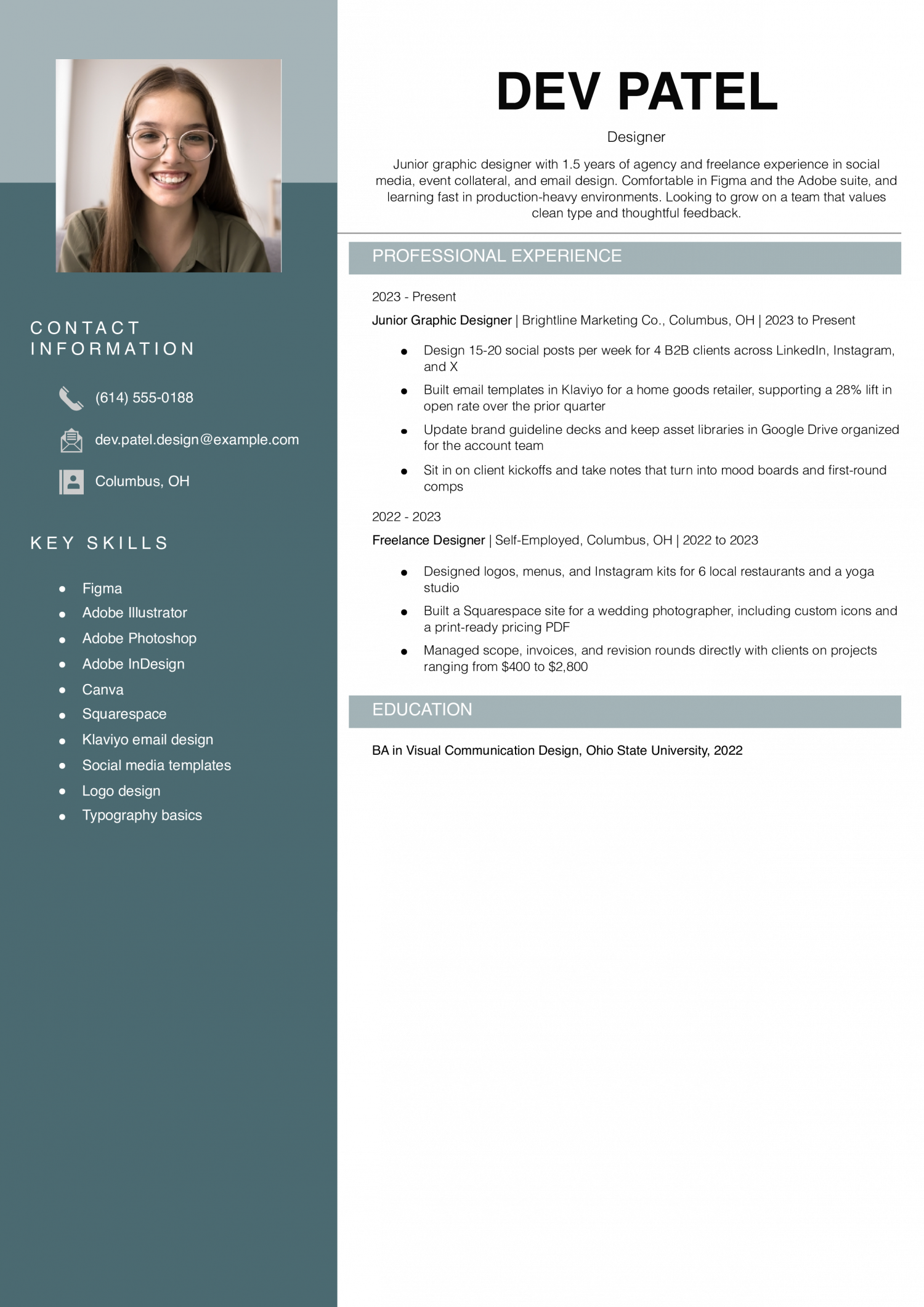
The Senior tab fits designers with four to seven years who own projects end to end and mentor juniors on a team. This resume needs to prove design decisions tied to conversion, engagement, or launch metrics, and cross-functional work with PMs and engineers.
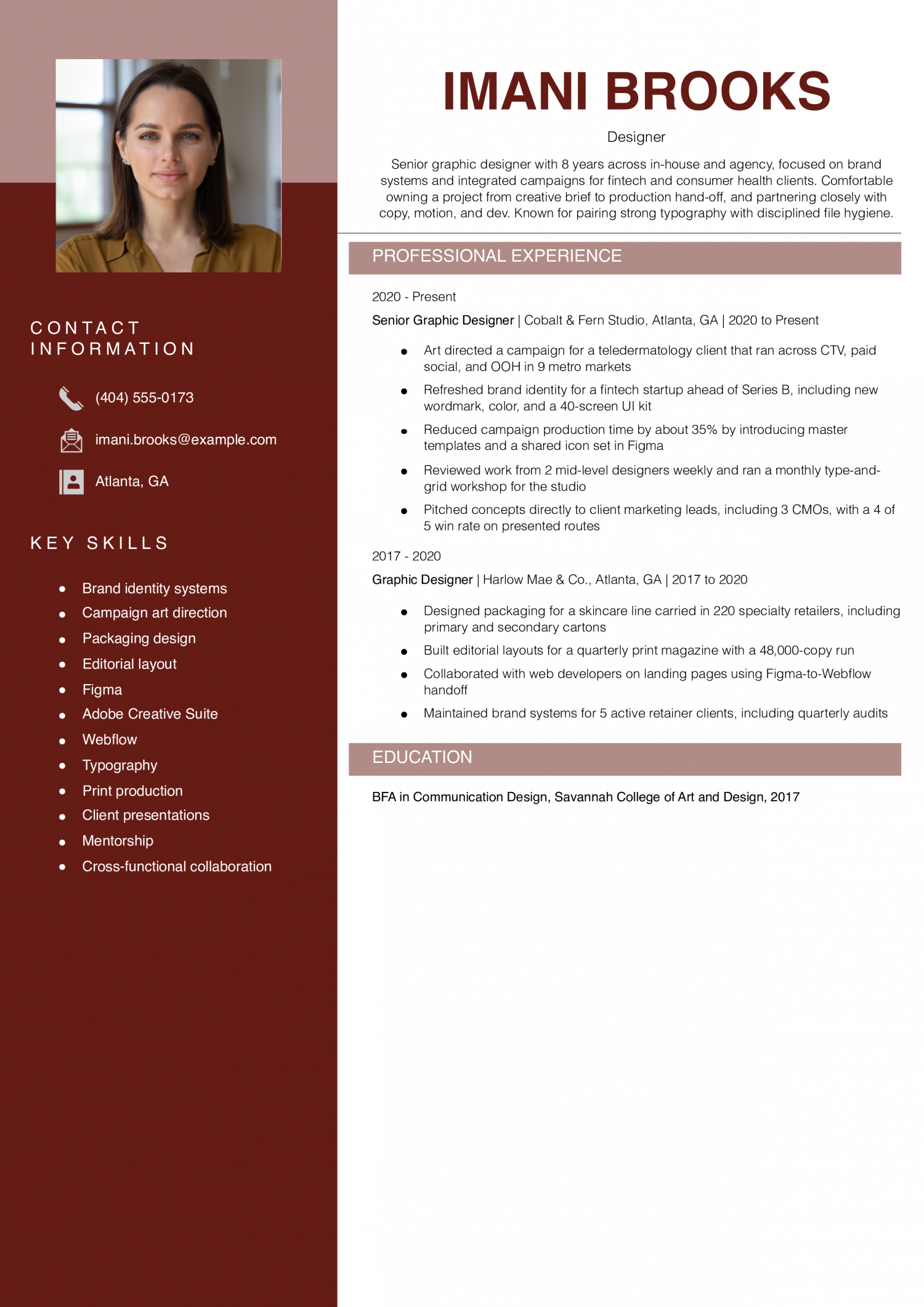
The Lead tab fits design leads and principals running systems, brand frameworks, or multi-designer pods. This resume needs to prove team scope, design-system ownership, and business outcomes you influenced beyond a single screen or campaign.
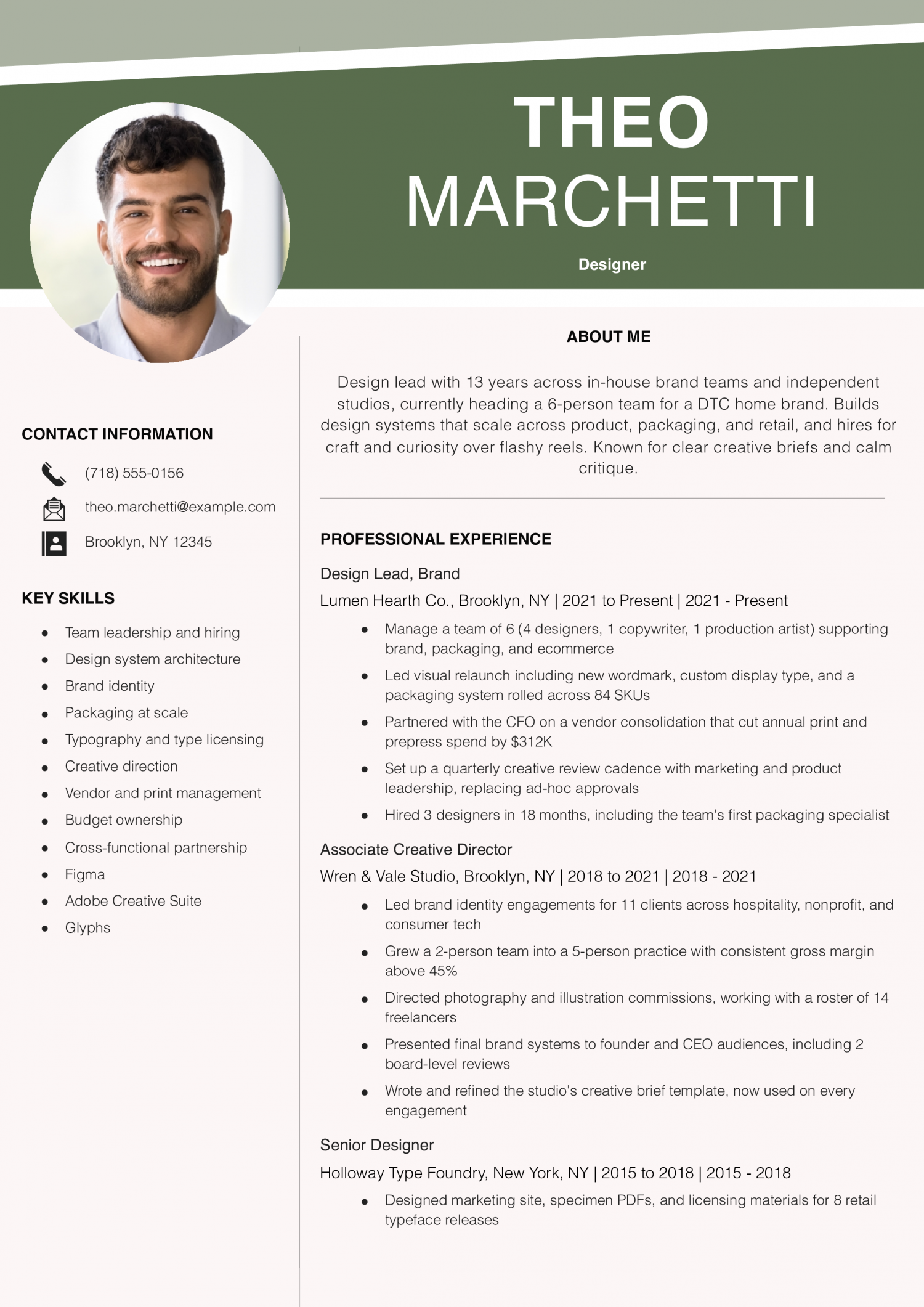
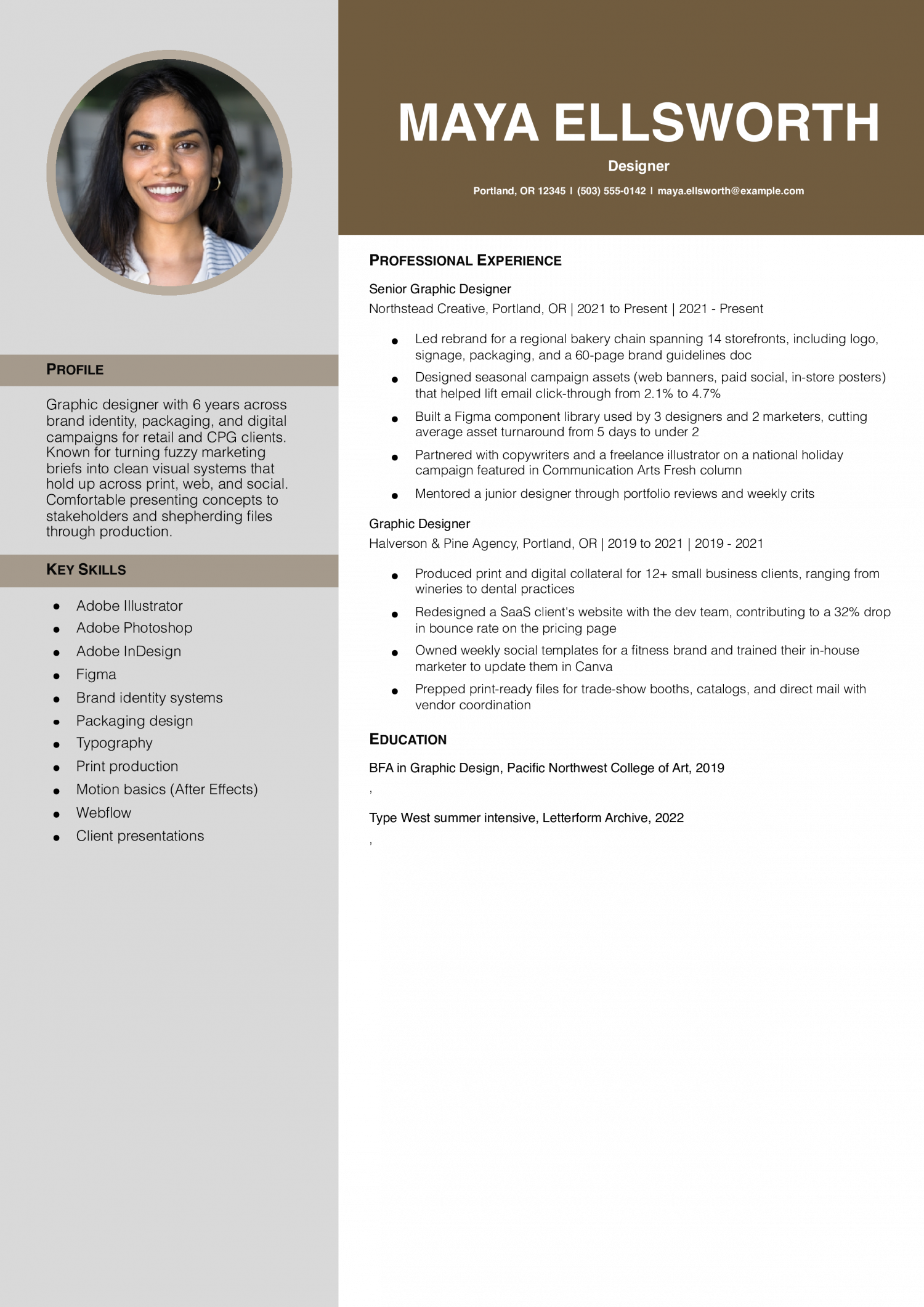
Graphic designer with 9 years across agency, in-house, and freelance, focused on brand identity, packaging, and integrated campaigns for consumer brands. Comfortable leading projects from kickoff through production and translating marketing goals into clear visual systems. Recent work spans CPG packaging refreshes, ecommerce site redesigns, and trade-show experiences.
Your profile should state your years of design experience, the type of work you do (brand, product, motion, packaging), and the surfaces you ship on.
Name the team setup you’ve worked in: in-house brand team, product squad, agency pod, or solo contractor. Add the industries (consumer, B2B SaaS, fintech, health) and the portfolio URL on line one. Creative directors want to know in five seconds whether your scope matches the opening, then click through to the work itself.
Bullets without a number tend to read as task lists. Strong designer bullets pair the design call with what it moved.
Name three metric types: conversion lift on a redesigned flow, engagement on a shipped feature, and launch cadence (campaigns shipped per quarter, components added to the system). When the data isn’t yours to share, lean on scope language: users reached, SKUs covered, brand touchpoints unified. Most strong resumes also note the research signal behind a decision, so the work reads as judgment, not decoration.
Sort your experience bullets into three or four buckets the role recognizes: brand systems, product UI and flows, marketing and growth assets, and motion or illustration.
Inside each bucket, name the artifact (component library, landing page system, packaging line, onboarding flow) and the partners involved (PMs, engineers, copywriters, brand managers). This structure helps Creative directors and design managers map your range against the opening without rereading every line.
Put a tools block on page one, under the profile or the first role. Name Figma, Adobe CC (Photoshop, Illustrator, InDesign), and any specialist software the posting calls out: After Effects, Cinema 4D, Webflow, Framer, Rive.
Include the AI tools you actually use in production: Firefly, Midjourney, generative fill. Creative directors and design managers scan this block to confirm you can plug into the existing stack without a ramp.
Drop the skills bar charts, the self-rated proficiency dials, and the long soft-skill list. Cut the personal statement that opens with passion language.
Trim coursework once you have three years in, and pull early internships unless they ship work that maps to the role. The space you reclaim goes to one more outcome bullet or one more shipped project link, both of which carry more weight with hiring design leads than design flourishes on the resume itself.
The designer resumes that get callbacks share a specific skill mix. The lists below come from our user-built designer resumes. Creative directors and design managers scan for these patterns first, not vague creative-flair language.
Hard skills get you past the parse; soft skills should appear as evidence inside bullets, not as a stand-alone list. Match the hard-skill terms below against the target posting before you submit, and trim anything the role doesn’t ask for.
| Soft Skills | % of resumes with this skill |
|---|---|
| Creativity | 72% |
| Communication | 52% |
| Attention to detail | 50% |
| Time management | 36% |
| Collaboration | 33% |
And here are the top hard skills showing up most often.
| Hard Skills | % of resumes with this skill |
|---|---|
| Adobe Creative Suite | 74% |
| Typography | 55% |
| Layout and composition | 44% |
| Color theory | 35% |
| Branding and logo design | 26% |
Based on data from thousands of designers’ resumes built on ResumeTemplates.com, May 2026.
These are the must-haves hiring teams look for when scanning a designer resume.
Creative directors and design managers expect the niche section to mirror the posting’s vocabulary. Group your terms by sub-specialty so the parser catches both the role family and the seniority lane.
| Niche | Keywords ATS scans for |
|---|---|
| Visual and graphic design | graphic design, visual design, layout design, typography |
| Product and UX design | ux designer, product design, interaction design, prototyping |
| Creative and brand design | creative designer, brand identity, design systems, art direction |
| Seniority signal | senior designer, design lead, junior designer, design manager |
| Output and deliverables | design experience, design portfolio, case studies, shipped product |
What Creative directors and design managers expect on a designer resume has shifted. A clean ‘no AI’ stance now reads as defensive on most product and brand teams; an honest workflow naming Firefly, generative fill, or Midjourney inside your process reads as current. The block below names what to add.
Midjourney and Firefly compress the early exploration phase, so designers move from brief to direction in hours, not days.
Generative fill, background removal, and upscaling absorb the production tax on photo retouching and asset variants.
Designers now arrive at the first review with placeholder copy and layout variants generated, then refined with the writer.
Figma AI features speed up component naming, auto-layout cleanup, and variant generation inside design systems.
Adobe Firefly: Generative fill, text effects, and on-brand image generation inside Photoshop and Illustrator workflows.
Midjourney: Early ideation, moodboard generation, and concept exploration before moving into Figma or Illustrator.
Signals craft and ownership; lets you write proper case studies with process, decisions, and outcomes.
Image-forward templates built for editorial pacing and full-bleed work without heavy build time.
Low setup cost and built-in discovery; pair it with a one-page personal site for the URL on your resume.
Useful for shots and quick sharing; weak as a primary portfolio because case studies don't fit the format.
Lead with three to five case studies, not 20 shots. Each case study should name the brief, your role on the team, two or three design decisions you made, and the outcome (metric, launch, or scope). Creative directors read for judgment, not gallery volume.
Put the URL on line one of the resume, next to your name. The URL should be short, branded, and live. Test it on mobile before you submit, a broken link kills the funnel before the resume gets read.
The software block is one of the first things Creative directors scan, because it tells them whether you can plug into the team’s stack on week one. Group it by function, not alphabetical order.
Design and prototyping: Figma, Sketch, Adobe XD
Visual and production: Photoshop, Illustrator, InDesign, Affinity
Motion and 3D: After Effects, Cinema 4D, Rive, Lottie
Web and no-code: Webflow, Framer, Spline
AI in production: Adobe Firefly, Midjourney, generative fill
An awards and credits block tells Creative directors and design managers which standards your work has already been measured against. Keep it short, named, and dated.
Brand New (UnderConsideration) feature, 2024, for the Cresthaven rebrand system
AIGA 50 Books / 50 Covers selection, 2023, for editorial design series
Awwwards Site of the Day, 2024, for product launch microsite
Type Directors Club Certificate of Typographic Excellence, 2023
Creative directors and design managers read this list as a map of where your work is heading. The certifications below tell them which track you’ve invested in: product, brand systems, motion, or research. List the issuing body and the year of completion next to each item.
Google UX Design Certificate: Signals product and research grounding for designers moving from brand or graphic work into UX or product design teams.
Nielsen Norman Group UX Certification: Carries weight with senior product orgs because the curriculum maps to research, interaction, and IA practice at depth.
Interaction Design Foundation Certificates: Useful for designers building a specialization (design systems, accessibility, mobile UX) outside their day job and want it documented.
Adobe Certified Professional: Helps junior and production designers prove software fluency when the portfolio is still thin or the role is print-heavy.
For designers, the 10th-percentile floor sits well below the top-decile ceiling, and that spread is wide. The gap is driven less by tenure than by specialty and employer type. Product designers at tech companies and senior brand designers at major agencies cluster near the ceiling; print and small-shop production roles cluster near the floor.
Lead your resume with the specialty that maps to your target band, then back it with shipped work in that lane.
| # | State | Avg. Annual |
|---|---|---|
| 1 | District of Columbia | $90,710 |
| 2 | California | $76,440 |
| 3 | Massachusetts | $76,370 |
| 4 | Washington | $76,010 |
| 5 | New York | $74,530 |
| 6 | Virginia | $70,060 |
| 7 | New Jersey | $66,600 |
| 8 | Colorado | $66,360 |
| 9 | Maryland | $66,290 |
| 10 | Connecticut | $65,360 |
| # | State | Workers | Median |
|---|---|---|---|
| 1 | California | 28,310 | $76,440 |
| 2 | Texas | 19,360 | $62,030 |
| 3 | New York | 16,730 | $74,530 |
| 4 | Florida | 14,010 | $57,900 |
| 5 | Pennsylvania | 8,280 | $52,990 |
Resume Templates offers HR approved resume templates to help you create a professional resume in minutes. Choose from several template options and even pre-populate a resume from your profile.
Yes, but less than designers tend to think. Creative directors expect typography, hierarchy, and spacing to be tight, because the resume is itself a small design artifact.
They don't expect the resume to be the portfolio. Keep the layout clean, single-column, and ATS-readable. Save the experimental layouts for the portfolio site itself.
Pair the deliverable with the audience and the outcome. Instead of 'designed marketing materials,' write 'designed quarterly campaign system across email, paid social, and landing pages for a 40-product launch.'
Name the partners (copywriter, marketing manager, PM), the tools (Figma, Illustrator), and the result (engagement, click-through, or volume shipped). That structure reads as judgment, not output.
Reframe your existing work in product terms. Print layout becomes information hierarchy; brand systems become design-system thinking; client revisions become stakeholder feedback loops.
Add a small product project to your portfolio (a redesign case study, a side app) and link it from the resume header. Pair that with a UX certificate (Google or NN/g) in the credentials block.
Yes. Name Firefly, generative fill, and Midjourney in your tools block if you use them in production, and describe the workflow in one bullet.
Creative directors prefer honest workflow framing over silence. Show where AI accelerates your ideation or asset production and where the human design call still sits.
For a designer, a modern template is the safest pick, because it shows visual polish while keeping your work the focus. A creative template is a solid alternative. Whichever you choose, keep the formatting clean and easy to parse: clear section headings, a standard font, and no graphics a parser can choke on.
Executive Resume Writer and Career Coach
Andrew Stoner is an executive career coach and resume writer with 17 years of experience as a hiring manager and operations leader at two Fortune 500 Financial Services companies, and as the career services director at two major university business schools.
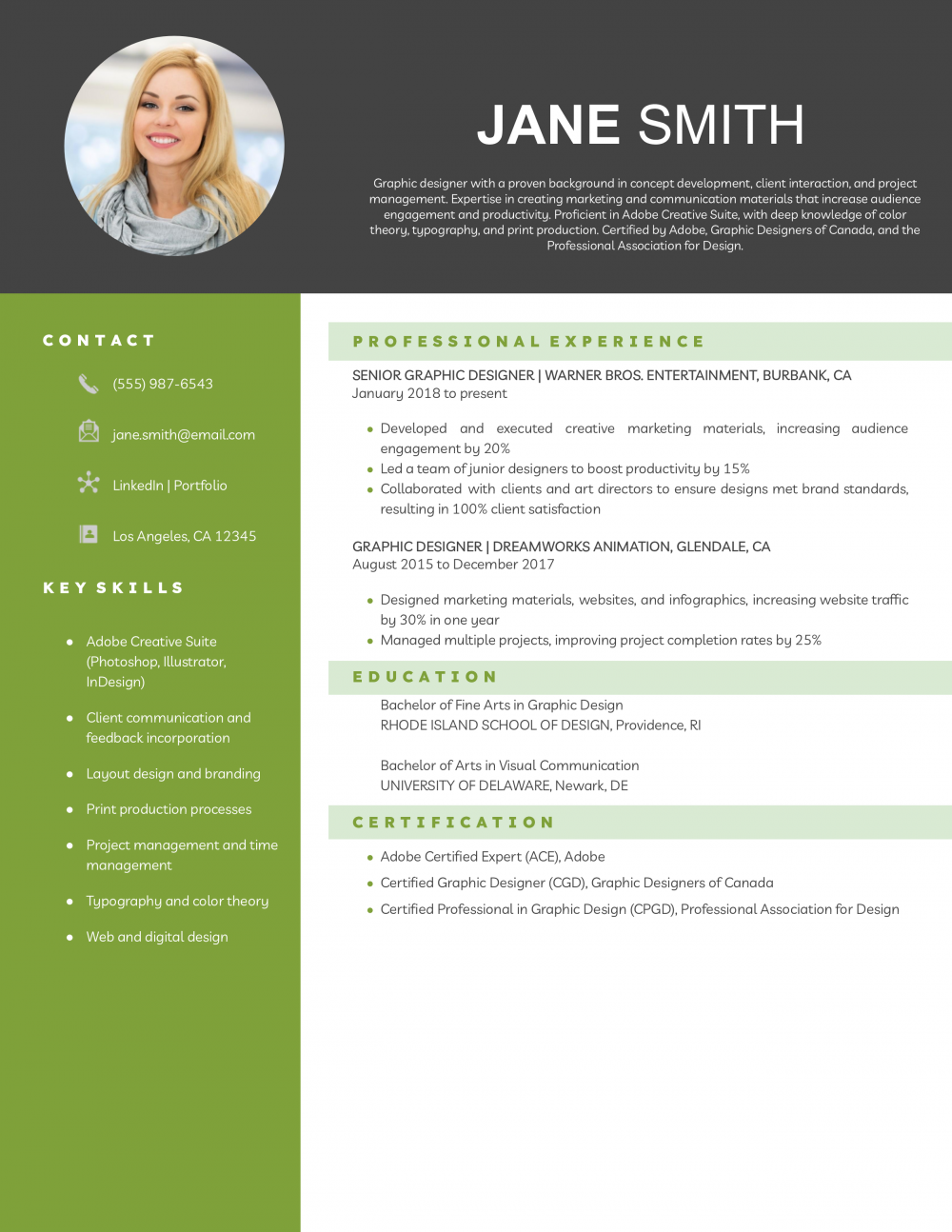
Customize this template in our builder in under 10 minutes.