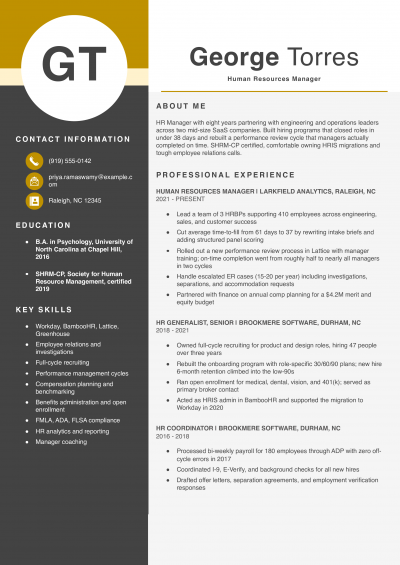
Human Resources Manager Resume Examples

Your profile should state your years in HR and the function you run: generalist, ER, talent, or total rewards. Name the headcount you support, the number of sites or states, and the HRIS that runs…
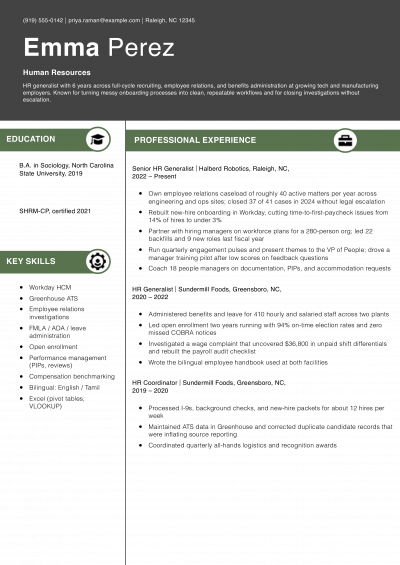
Every resume example is written and reviewed by our team of Certified Professional Resume Writers to ensure top-quality content and formatting.
Most HR director hires come down to one thing: proof you built people programs that improved business results. CHROs and CEOs want to see metrics like turnover reduction, time to fill, and cost per hire tied to your leadership. A credential such as the SHRM-SCP or SPHR signals depth, but numbers tell the real story.
Show how you shaped workforce planning, total rewards, or employee relations at scale. To compare layouts before you start, browse our resume templates.
CHROs and CEOs reviewing HR Director resumes filter first for org-wide workforce metrics and strategic program outcomes, because those signal whether a candidate can lead people operations at the enterprise level.
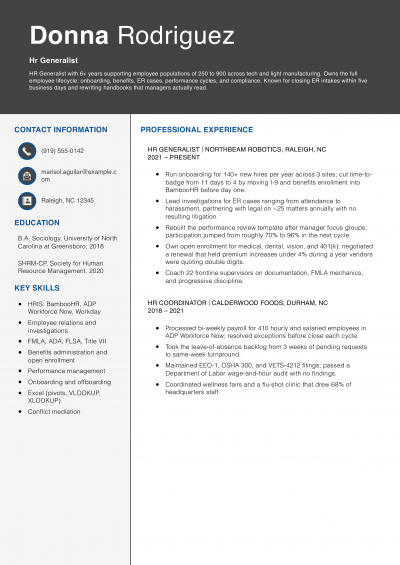
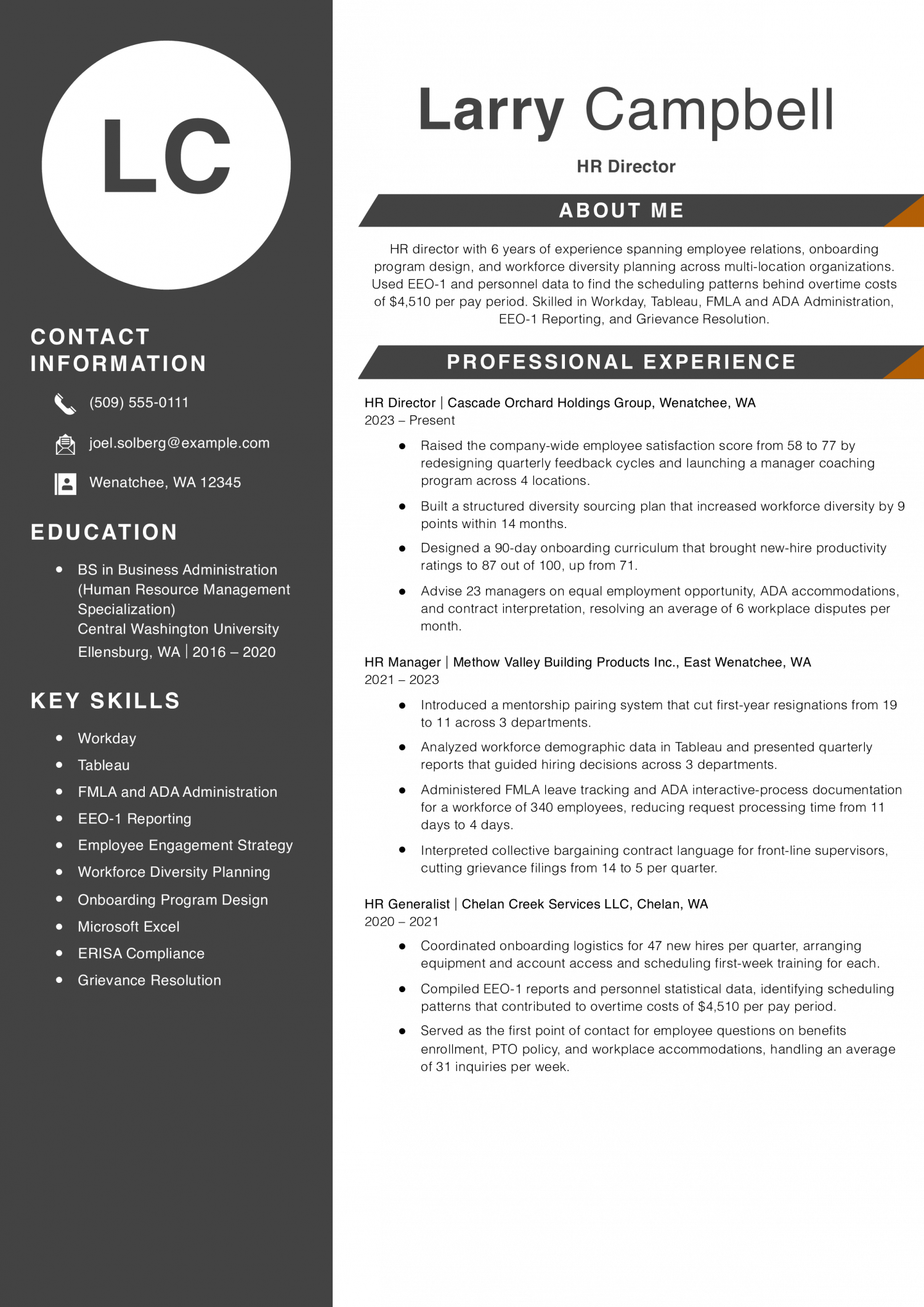
Consider this resume if you are an HR director at a company with several locations and want to tie your programs to satisfaction scores and new-hire results. Lead with the score changes and the program change behind each.
CHROs and CEOs hiring a director want to see that you can run people programs, handle disputes and manage a heavy workload. This resume counts the managers advised and the disputes settled each month, so the weight of the job is clear. List your own caseload with a count and a time period, such as disputes settled per month.
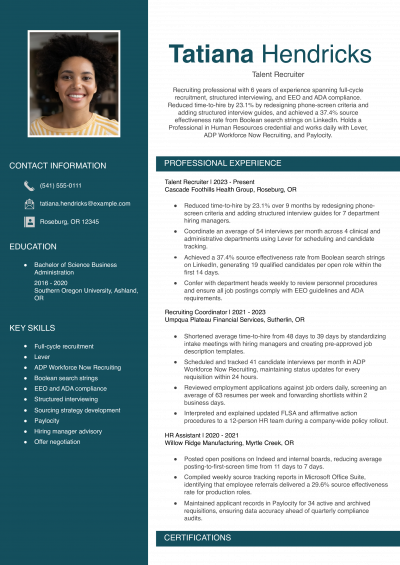
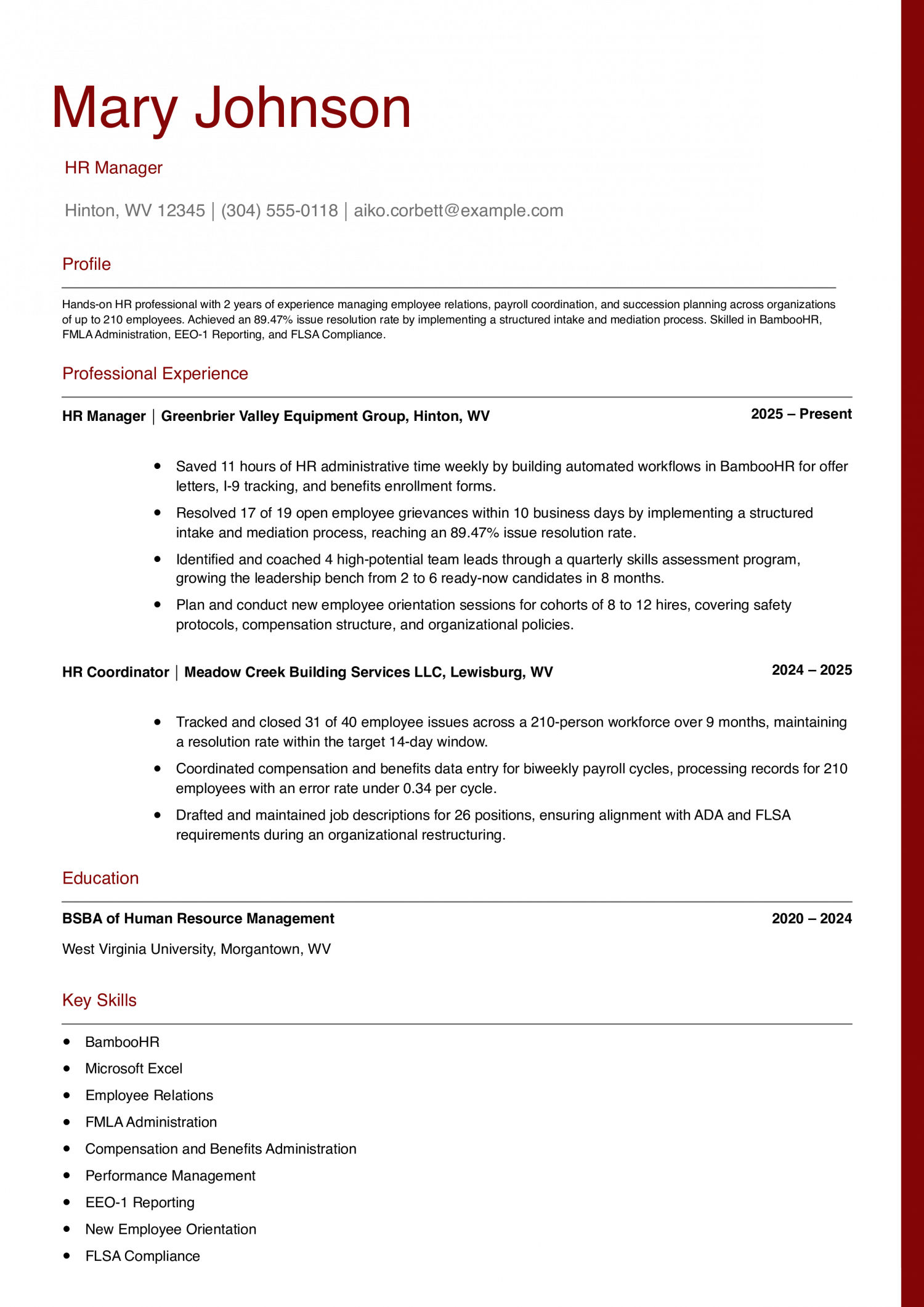
Choose this resume if you are an early-career HR professional, about two years in, stepping up to your first HR Manager role. Lead with grievance resolution rates so readers see you can handle employee relations from intake through closure.
Owners hiring an HR manager look for someone who closes employee issues instead of letting them sit. This resume pairs the grievances resolved with the days it took and the share that was settled. When you describe your own casework, give how many issues came in, how many you closed and how long it took.
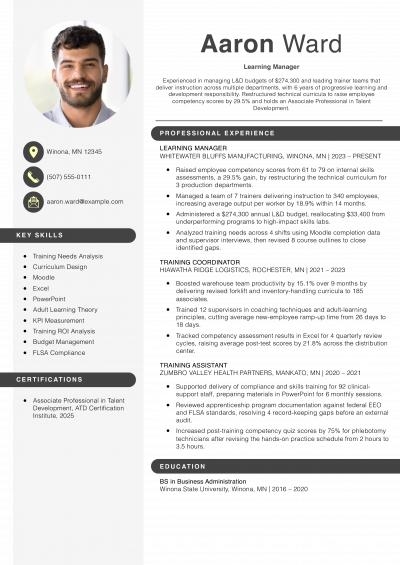
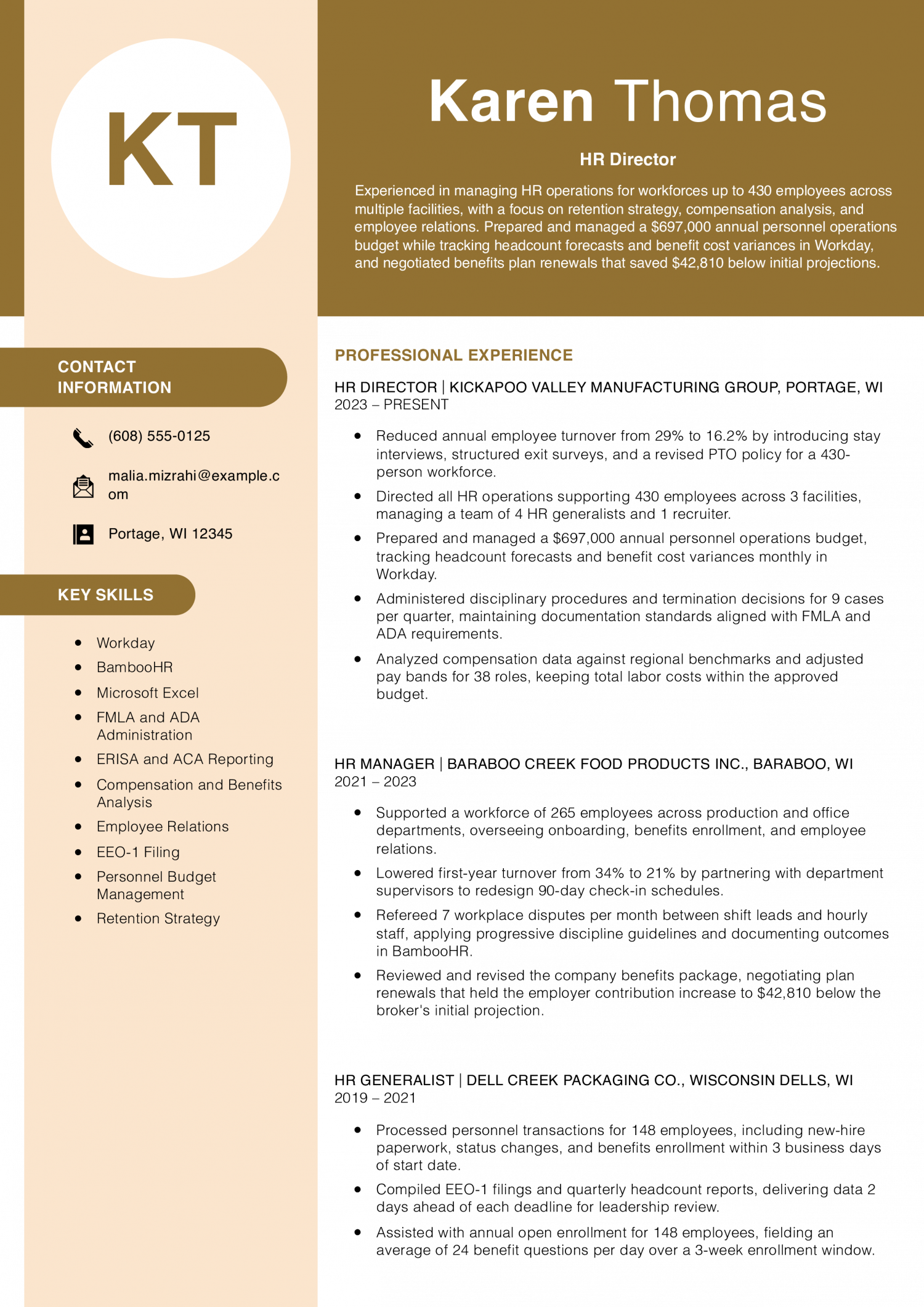
Try this resume if you are a mid-level HR professional with 7 years of experience stepping into an HR Director role. Lead with pay band adjustments tied to approved budget limits to show you balance compensation competitiveness against fiscal discipline.
Hiring executives want to know a director can cut turnover and stay inside a budget. This resume gives the starting and ending turnover rates, the number of people covered and the actions behind the drop. If you lowered turnover, state both rates, the size of the workforce and what you changed.
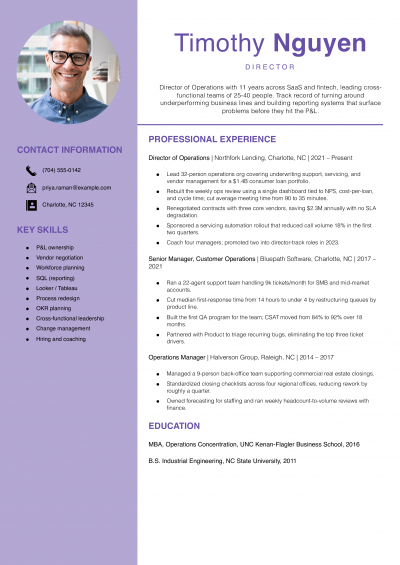
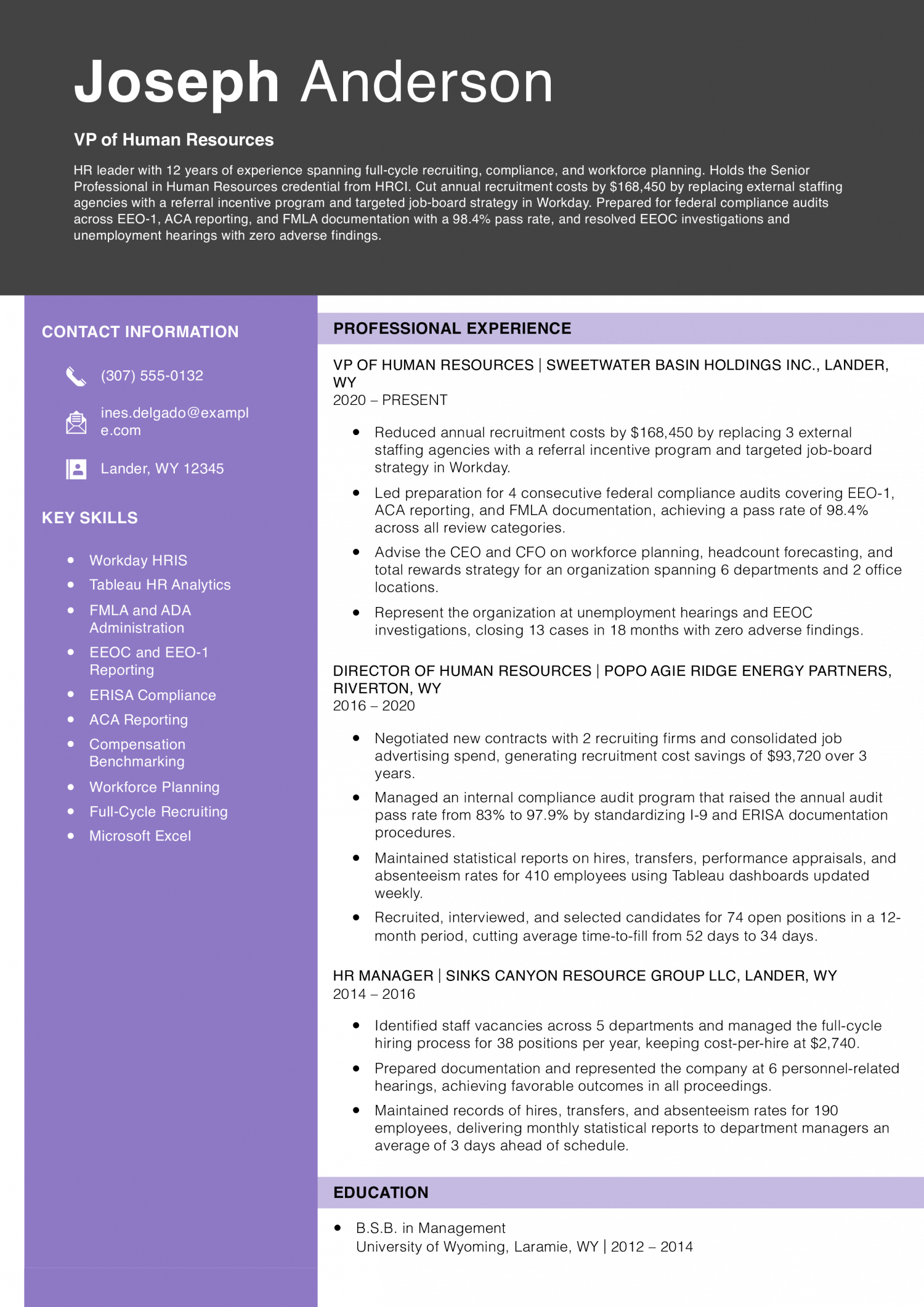
Lean on this resume if you are a senior HR leader with about twelve years of experience pursuing a VP of Human Resources role. Lead with federal audit outcomes tied to specific reporting categories and pass-rate percentages.
At the VP level, CEOs look for savings and legal outcomes they can trust. This resume attaches a case count, a time span and a clean result to hearings and investigations. For each hearing or audit you handled, give the number of cases, the period covered and how they ended.
Dedicated to building internal talent pipelines, having raised the internal promotion rate from 11.71% to 41.3% by launching a career-ladder framework with quarterly skills-gap reviews across 4 departments. Across 6 years of HR experience spanning coordination, generalist, and operations management roles, built expertise in benefits enrollment auditing, labor contract interpretation, industrial accident investigation, and FMLA and ADA administration using Workday, ADP Workforce Now, and Microsoft Excel.
Your title history is already on LinkedIn and in your work history. Lead your summary with the one detail those sources leave out, whether that is a particular compliance specialty or a record of building HR functions from scratch. That might be a union negotiation specialty or fluency in a second language your workforce speaks.
It could be a track record of post-acquisition culture integration. Name the differentiator in your opening line, then add your total years leading HR teams.
CHROs and CEOs scan dozens of profiles in a sitting, so a sharp opener gives them a reason to keep reading. Skip vague phrases like “strategic HR leader” and replace them with the exact scope of your work.
HR Director work produces clear data. Use it. Start each bullet with a verb, then tie it to a metric CHROs and CEOs care about.
Headcount managed and turnover rate reduced are strong first picks, and benefits cost per employee is another useful data point to feature. You might cite time-to-fill for open roles, annual training hours delivered per capita, or the number of grievances resolved in a fiscal year. Percentages work well for retention gains.
Dollar figures work well for cost savings from vendor renegotiations. Frame each number with a time span so readers see pace. “Cut voluntary turnover from 22% to 14% in 18 months” reads stronger than “reduced turnover.” Pair scope with outcome in every line.
Sort your bullets under headings that match how HR departments run. Talent acquisition covers workforce planning, recruiting strategy, and employer branding. Employee relations covers investigations, policy writing, and grievance resolution.
Compensation and benefits covers pay equity audits and open enrollment cycles. Organizational development covers succession planning and leadership coaching. Compliance covers EEO reporting and labor law adherence.
Pick three or four of these groups per role, then give each group two to four bullets that show measurable results. This structure helps CHROs and CEOs see your strongest areas and the range of HR functions you know.
Add a short credentials block on page one, right under your summary. List your SHRM-SCP from SHRM or your SPHR from HRCI on its own line, each with the year you earned it.
If you hold a GPHR from HRCI, add that on a separate line. Pending credentials belong here too, with your expected exam date noted. Below that block, name the HRIS platforms you have administered or configured.
Workday, SAP SuccessFactors, and UKG are common requirements in director-level postings, so list the version or module where you can. CHROs and CEOs want to see system fluency early on page one. It signals that your ramp-up time will be short on day one.
Two pages are fine at this level. But every line must pull weight. Remove entry-level HR roles older than 15 years unless they show a rare skill.
Delete bullet points that repeat a competency you already proved in a later role. Skills grids filled with soft labels like “team player” add no signal.
If you held an interim CHRO title, keep that. Drop committee seats that had no measurable outcome. White space on page two looks better than filler, and a tight two-page resume tells CHROs and CEOs you know how to edit, which is a core skill for the role itself.
Check the HRIS tools and compliance terms below against each posting you read.
CHROs and CEOs weigh hard skills to confirm you can run systems and audits. They weigh soft skills to gauge how you lead through change. A term like “employee relations” signals depth in day-to-day people work.
A term like “strategic thinking” shows you plan beyond the current quarter. Pull each matching hard skill into your skills block.
Then weave each soft skill into a result in your work history. A bullet that names the skill and a metric carries more weight. Skip any term that does not appear in the posting.
| Soft Skills | AI-estimated % |
|---|---|
| Executive-level communication | 67% |
| Conflict resolution | 62% |
| Organizational leadership | 45% |
| Cross-functional collaboration | 39% |
| Change management | 25% |
And here are the top hard skills showing up most often.
| Hard Skills | AI-estimated % |
|---|---|
| Workforce planning | 75% |
| HRIS administration | 60% |
| Compensation benchmarking | 48% |
| Employee relations management | 39% |
| Compliance policy development | 31% |
Skill names and rankings come from an AI model grounded in U.S. Department of Labor occupation data for HR directors, not from a count of HR directors’ resumes built on ResumeTemplates.com.
For an HR director resume, CHROs and CEOs look at workforce planning and HRIS administration first, so the items below back those up with detail.
CHROs and CEOs scan for terms tied to your focus. Talent planning covers how you build the pipeline. Total rewards covers pay and benefits design. Labor relations covers union and compliance work. HRIS terms show which platforms you have run. Org development covers culture and change programs. Use the phrases your field uses for each area. Match the wording in each job posting you target. Swap keywords in or out based on the role. These groups help your resume pass automated filters. They also help a reader find your strengths fast.
| Niche | Keywords ATS scans for |
|---|---|
| Talent Strategy | succession planning, workforce analytics, talent acquisition |
| Total Rewards | compensation benchmarking, benefits administration, pay equity audit |
| Labor Relations | collective bargaining, EEOC compliance, employee relations |
| HRIS Platforms | Workday HCM, SAP SuccessFactors, ADP Workforce Now |
| Org Development | change management, employee engagement strategy, leadership development |
CHROs and CEOs see AI claims on HR Director resumes with mixed trust. The options are to overstate AI fluency with buzzwords that fall apart in interviews. Or to leave AI off and address it only when asked. Or to name the exact tools and the human judgment steps around them. The third option is what CHROs and CEOs can validate in a conversation. List each tool you have used in real work. Describe the workflow, not a vague skill. State what you reviewed or changed before acting on the output. That specificity signals honest, tested experience.
AI models flag attrition risk and internal mobility patterns, but you interpret context and set action plans.
Generative AI produces first drafts of handbook language that you edit for legal compliance and tone.
AI tools pull market pay data faster, though you still validate sources and approve final ranges.
Sentiment analysis tools scan survey comments at scale while you decide which themes to escalate.
Visier: Run predictive workforce analytics to model headcount needs and turnover trends.
ChatGPT or Copilot: Draft policy language, job descriptions, and internal communications for your review.
Senior certifications signal deep policy and strategy knowledge. They carry weight with CHROs and CEOs reviewing your file. Place them near your name or in a dedicated section.
List each executive contribution under the role where it happened. State the scope in headcount, revenue, or geography. Quantify the outcome in one short phrase.
CHROs and CEOs scan for proof you can partner at the top.
A solid track record in HR keeps you in the running. CHROs and CEOs scan your credentials block to gauge your depth in strategy, compliance, and talent work.
They want to see that you invest in your own growth. A credential tied to senior practice signals you can lead policy, not follow it. Most postings do not require a specific one, but many favor it.
Add the issuing body, the year you earned it, and the renewal date if one applies.
Keep the block near the top of page one so it is easy to find. If a credential is in progress, note your expected completion date.
BLS groups HR Directors with all Human Resources Managers, a broader category. That broader group is a moderate-sized occupation tracked by BLS. The median pulls in generalists and specialists at every level of scope.
The top of the range, at the 90th percentile, is roughly 79 percent above the median; the 10th percentile is about 41 percent below it. That wide spread tells you the pay range rewards proof of organizational scale.
On your resume, lead with the headcount you oversaw and the HR budget you controlled. Those two numbers help CHROs and CEOs place you in the right tier before a conversation starts.
| # | State | Median Annual |
|---|---|---|
| 1 | District of Columbia | $184,350 |
| 2 | Massachusetts | $181,780 |
| 3 | New York | $176,650 |
| 4 | New Jersey | $172,440 |
| 5 | California | $170,080 |
| 6 | Rhode Island | $167,110 |
| 7 | Colorado | $166,400 |
| 8 | Virginia | $165,980 |
| 9 | Connecticut | $165,930 |
| 10 | Washington | $165,530 |
| # | State | Workers | Median |
|---|---|---|---|
| 1 | California | 27,450 | $170,080 |
| 2 | Texas | 23,220 | $136,500 |
| 3 | New York | 17,920 | $176,650 |
| 4 | Illinois | 13,520 | $151,370 |
| 5 | Florida | 11,570 | $137,790 |
Resume Templates offers HR approved resume templates to help you create a professional resume in minutes. Choose from several template options and even pre-populate a resume from your profile.
Your resume should show org-wide programs you built or restructured, not daily tasks. Lead with workforce planning outcomes, total rewards redesigns, or culture initiatives tied to scores. CHROs want proof that you shaped policy, not only followed it.
Two pages is the standard length when you have ten or more years of experience. If a second page holds only dated early-career entries, trim it to one page.
Yes, a three-line summary at the top gives a CHRO or CEO the scope of your work fast. State the workforce size you supported and the functions you led. Add one signature result, and keep the whole block under 50 words.
Lead with transferable achievements from your prior function, such as headcount planning or org restructuring. Place those in a summary that frames the pivot clearly for reviewers. List any HR-specific credentials right below that summary so they appear early on the page.
Turnover rate reductions and time-to-fill improvements carry strong weight because they tie to labor cost. Employee engagement score gains and benefits cost per head are also valued. Pair each metric with the action you took so the number has clear context.
List the gap period with a brief label such as family leave, consulting, or professional development. If you earned a credential or advised a startup during the gap, note the outcome in one bullet. CHROs care more about what you did with that time than the gap itself.
Yes, name the platforms you have managed, such as Workday or SAP SuccessFactors. Place them in a short tools line near your skills so ATS filters can match them. Avoid listing tools you only used as an end user with no admin role.
You can write an HR director resume in either an ATS-friendly template or in a basic template if you prefer. Choose whichever looks cleaner to you. Make section titles plain, stay with a standard font, and drop the graphics.
HR Director Resume
4.8/5 stars with 105 reviews

Executive Resume Writer and Career Coach
Andrew Stoner is an executive career coach and resume writer with 17 years of experience as a hiring manager and operations leader at two Fortune 500 Financial Services companies, and as the career services director at two major university business schools.
© 2026 Resumetemplates.com All rights reserved.