20 Best Human Resources Resume Examples and Templates for 2026



A clean compliance and HRIS line is what gets HR generalist resumes past the ATS and the recruiter screen; specific employee relations caseload numbers are what make them readable enough for the HR director.
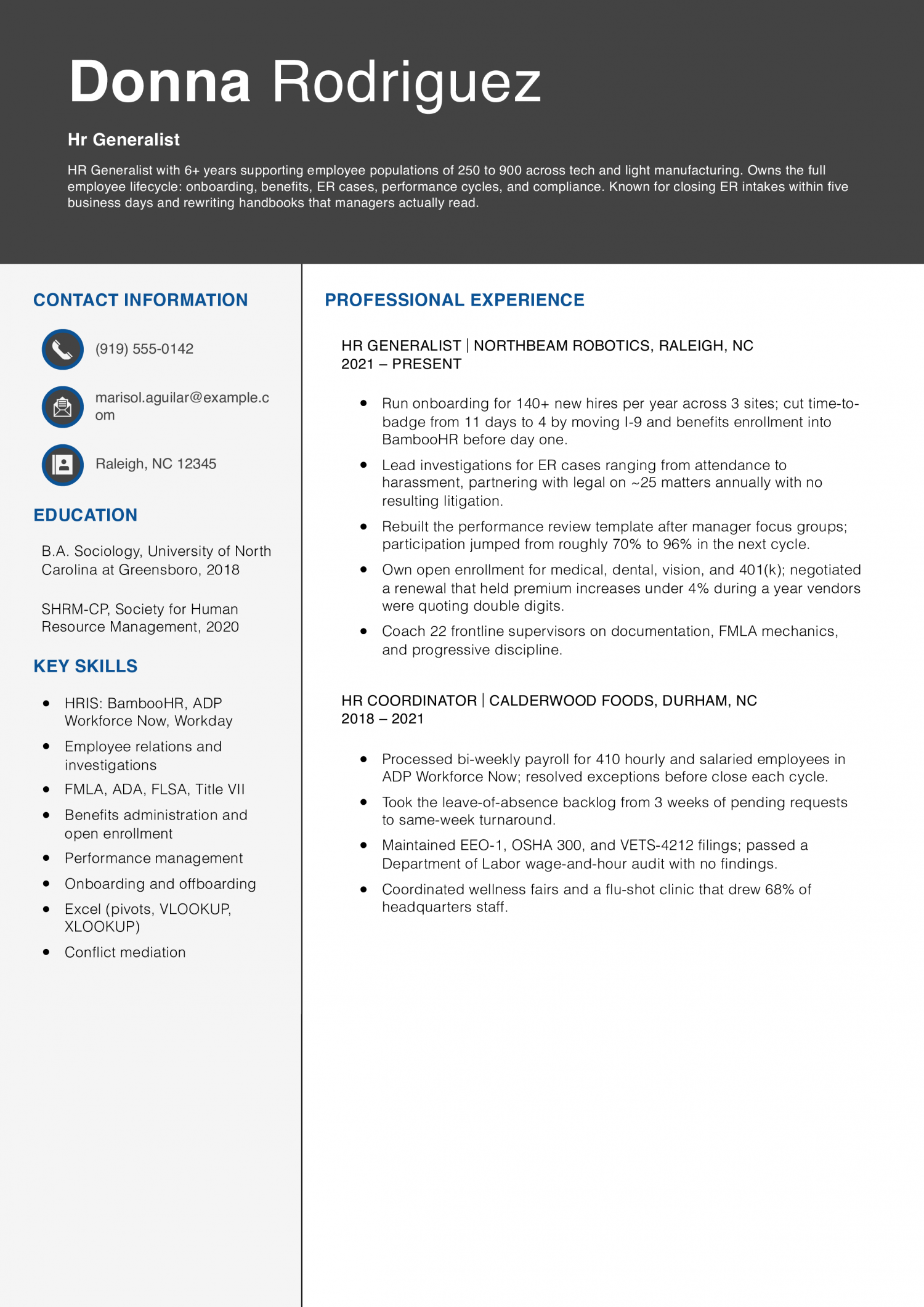
The junior HR generalist resume is for one to three years in coordinator or associate roles. It needs to prove HRIS fluency, onboarding cycles run, and the compliance basics you handled without an escalation.
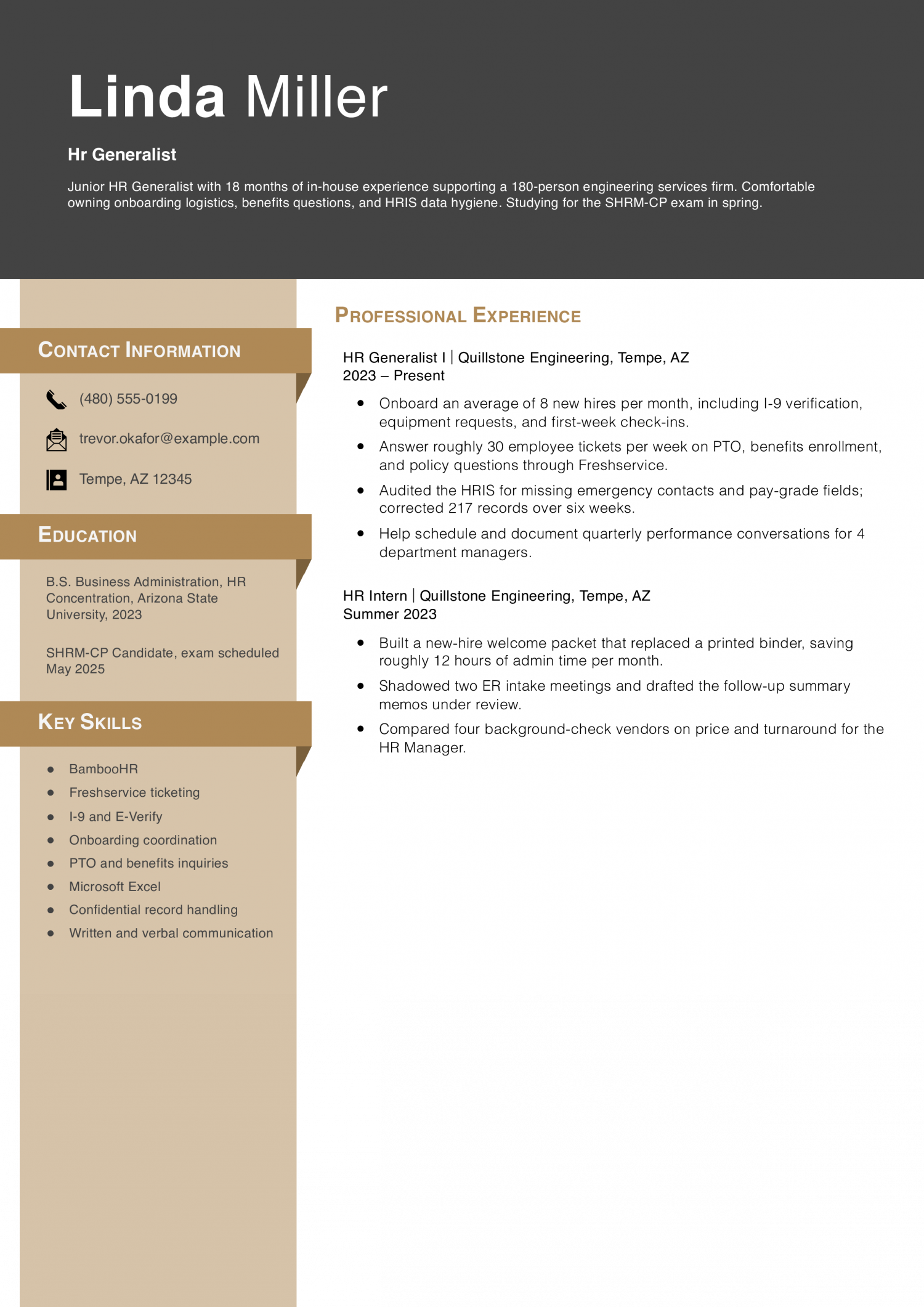
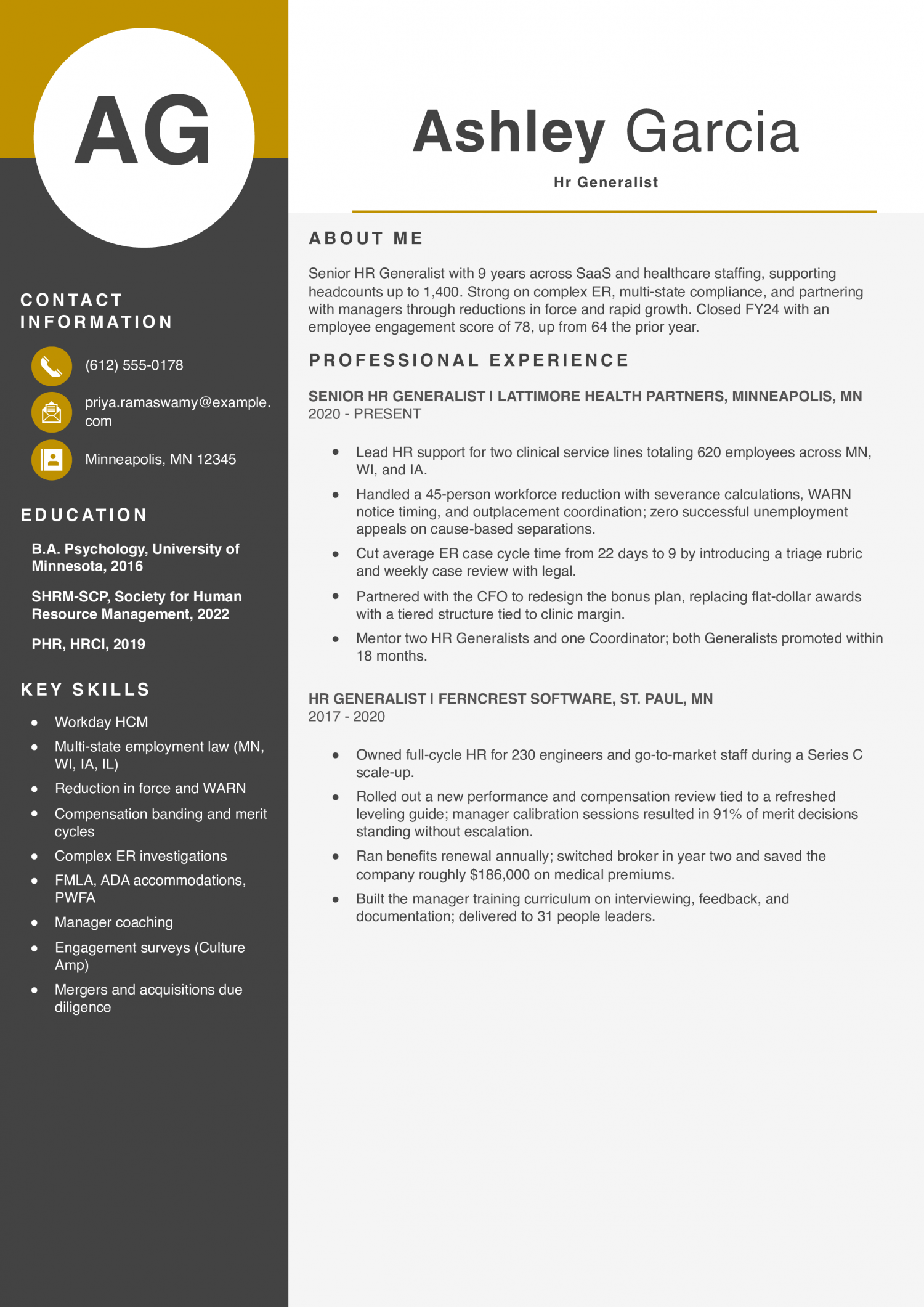
The senior HR generalist resume covers four to seven years owning employee lifecycle for a defined population. It needs to prove ER caseload size, multi-state compliance scope, and benefits or open enrollment cycles you led.
The lead HR generalist resume is for eight-plus years acting as a single point of HR for a business unit or site. It needs to prove headcount supported, manager coaching depth, and policy work you authored or rewrote.
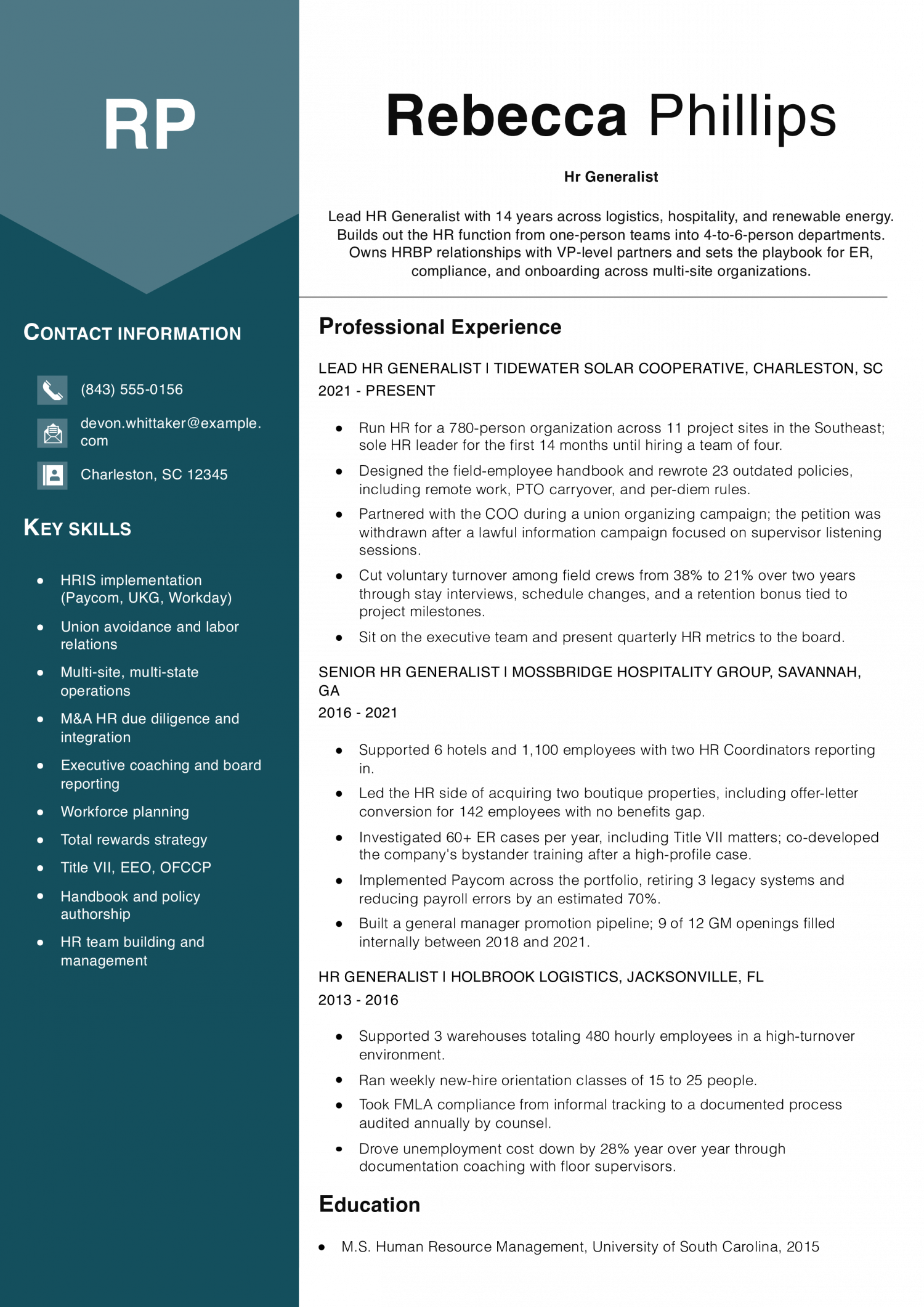
HR Generalist with 8 years across financial services and nonprofit operations supporting employee populations of 300 to 1,050. Strength in employee relations, benefits administration, multi-state compliance, and partnering with managers on performance issues before they escalate. Comfortable being the sole HR contact at a site and also operating inside a larger COE structure.
Your profile should state years in HR, the headcount you support, and the HRIS you run day to day.
Name the population type too: exempt and nonexempt mix, single-state or multi-state, union or non-union, and the industry. An HR director reading the top of page one wants to know within five seconds whether your scope matches the open role. A generic ‘HR professional with experience in all areas of human resources’ line tells them nothing and reads as filler.
Be specific: ‘650-person multi-state retailer, Workday HCM, exempt and nonexempt, two-state compliance’ lands harder than three lines of adjectives.
HR work has real numbers, and strong HR generalist resumes show them. Lead with the headcount you support and the employee relations caseload you carry.
Name two or three figures recruiters scan for: open enrollment population size, time-to-fill on reqs you owned, turnover or retention movement on your watch, and investigations closed. A bullet like ‘Managed employee relations’ reads as a duty. ‘Closed 40-plus ER cases per year across two states with zero escalations to outside counsel’ reads as ownership.
Cluster bullets under the buckets HR directors recognize: employee relations and investigations, talent acquisition and onboarding, benefits and leave administration, and compliance and policy.
Within each, name the substantive work: FMLA and ADA accommodations processed, performance improvement plans coached through, open enrollment cycles administered, I-9 and EEO-1 reporting owned. This structure mirrors how senior HR leaders divide the function, and it makes your scope readable on a quick scan. Skip the wall of soft-skill nouns.
Your SHRM-CP, PHR, or aPHR belongs in a credentials block at the top, with the certifying body and current status. HRIS systems sit in the same zone or in a dedicated tools line.
Name the platform and the modules: Workday HCM and Absence, ADP Workforce Now, BambooHR, UKG Pro, or Greenhouse for ATS. HR directors and people operations leaders need this visible early because the systems you know determine how fast you ramp. Burying Workday on page two costs you screens.
Education sits at the bottom for anyone past two years in the field: degree, school, and graduation year if within the last decade.
Use the closing section for items that change the read: a second language tied to your employee population, CE hours in employment law, or a volunteer board role at a SHRM chapter. Skip generic interests, high school details, and references-available lines. Every line should earn its space by reinforcing scope or compliance depth.
The skills below come from HR generalist resumes our users built on ResumeTemplates.com. HR directors and people operations leaders scan dozens of resumes per req, and these are the terms that show up most often. Hard skills like Workday and FMLA administration get parsed by the ATS first.
Soft skills like conflict resolution only carry weight when a bullet underneath shows the behavior. Match the list against your target posting and mirror the wording, then back each soft skill with a specific example bullet.
| Soft Skills | % of resumes with this skill |
|---|---|
| Communication | 73% |
| Conflict resolution | 58% |
| Confidentiality and discretion | 44% |
| Relationship building | 40% |
| Attention to detail | 29% |
And here are the top hard skills showing up most often.
| Hard Skills | % of resumes with this skill |
|---|---|
| HRIS management | 68% |
| Full-cycle recruiting | 53% |
| Benefits administration | 47% |
| Employment law compliance | 40% |
| Performance management | 26% |
Based on data from thousands of HR generalists’ resumes built on ResumeTemplates.com, May 2026.
Before an hr generalist resume gets a closer read, hiring teams check for a short list of essentials.
HR directors and people operations leaders expect to see the specific HRIS, compliance domain, and HR sub-function you ran. Group your keywords into the niches below and mirror the wording from the target posting.
| Niche | Keywords ATS scans for |
|---|---|
| Employee relations | employee relations investigations, performance improvement plans, workplace conflict resolution, employee grievance handling |
| Benefits and leave | open enrollment administration, FMLA leave administration, ADA accommodations, COBRA administration |
| Talent acquisition | full-cycle recruiting, onboarding program management, applicant tracking system, offer letter administration |
| Compliance and reporting | EEO-1 reporting, I-9 audits, multi-state employment law, FLSA classification |
| HRIS and analytics | Workday HCM, ADP Workforce Now, BambooHR, turnover analytics |
What HR directors and people operations leaders expect on an HR generalist resume has shifted. A resume that ignores AI tools now reads as out of date on most postings; an honest line naming the tools you use for screening, drafting, and analytics reads as current. The list below names what to add.
LinkedIn Recruiter AI and HireVue now front-load sourcing and first-round assessment, so generalists narrate the shortlist instead of building it from scratch.
ChatGPT and Copilot draft first-pass policy language and manager talking points, with the generalist owning legal review and tone.
HRIS-embedded chatbots in Workday and BambooHR handle tier-one PTO and benefits questions, freeing the generalist for escalations.
Turnover, comp, and engagement dashboards now surface patterns the generalist used to pull by hand from spreadsheets.
ChatGPT or Microsoft Copilot: Drafting policy language, manager coaching scripts, and offer letter variants before legal review.
LinkedIn Recruiter AI: Sourcing and shortlisting candidates against scorecards for reqs you partner on with the recruiter.
HR generalist roles get screened on credentials and HRIS depth before anything else. Place both at the top of page one in a clean credentials block so recruiters and ATS scans hit them inside the first read.
Beyond a degree, the certifications below tell HR directors and people operations leaders which HR domains you can run without escalation and how current your employment-law knowledge is. List each with the certifying body and your current status; omit certification numbers from the resume itself.
The top-paying states for HR generalists cluster around high-cost coastal metros and a few tech-heavy markets, not the population centers where most openings sit. Pay tracks the local cost of labor and the concentration of large employers, so a generalist supporting a Bay Area tech firm earns differently than one in a high-employment midwest market.
If you can relocate or work remote, the resume should foreground multi-state compliance experience and the HRIS modules that travel.
| # | State | Avg. Annual |
|---|---|---|
| 1 | District of Columbia | $102,500 |
| 2 | Washington | $83,230 |
| 3 | Massachusetts | $81,960 |
| 4 | California | $81,810 |
| 5 | Maryland | $81,140 |
| 6 | New York | $81,140 |
| 7 | Virginia | $78,580 |
| 8 | Colorado | $78,170 |
| 9 | New Jersey | $78,170 |
| 10 | Connecticut | $77,750 |
| # | State | Workers | Median |
|---|---|---|---|
| 1 | California | 104,880 | $81,810 |
| 2 | Texas | 85,580 | $64,560 |
| 3 | Florida | 62,880 | $63,960 |
| 4 | New York | 53,030 | $81,140 |
| 5 | Pennsylvania | 36,710 | $66,020 |
Resume Templates offers HR approved resume templates to help you create a professional resume in minutes. Choose from several template options and even pre-populate a resume from your profile.
Lead with the headcount you support, the HRIS you run, and your compliance scope.
Then name two or three domains you own end to end, like employee relations and benefits administration. Close with a credential line citing your SHRM-CP or PHR.
Keep it to four lines so the rest of page one stays scannable.
Reframe adjacent work that already touches HR functions.
Recruiting coordinator, office manager, and operations roles often include onboarding, benefits enrollment, and policy work. Pull those duties out of the parent bullet and group them under an HR-shaped category on the resume.
Add a SHRM-CP or aPHR in progress to the credentials block to signal commitment.
List the volume and type, never the names or facts.
A bullet like '40-plus ER cases per year covering harassment, performance, and accommodation requests' is safe and informative.
Naming a specific investigation or employee breaches confidentiality and reads as a red flag to any HR director.
Name each platform and the modules you ran, not the years on each.
A tools line reading 'Workday HCM, Absence, Recruiting; ADP Workforce Now; BambooHR' lets ATS scans hit every variant.
Then in the role bullets, specify which platform supported the work so the depth is clear.
For an HR generalist, a professional template is the safest pick, because it signals the polish hiring managers in this field expect. An ATS-friendly template is a solid alternative. Whichever you choose, keep the formatting clean and easy to parse: clear section headings, a standard font, and no graphics a parser can choke on.
Executive Resume Writer and Career Coach
Andrew Stoner is an executive career coach and resume writer with 17 years of experience as a hiring manager and operations leader at two Fortune 500 Financial Services companies, and as the career services director at two major university business schools.
![General (Universal) Resume Templates and Examples for [y]](/wp-content/uploads/2025/01/General-Universal-Resume-Template.x400.pdf.jpeg)