Cook Resume Examples and Templates for 2026



Active TIPS or state alcohol-server cards are what get bartender resumes past the manager's first 60-second scan; specific pace numbers like covers per shift or peak-hour drink counts are what make them readable enough to earn a trial.
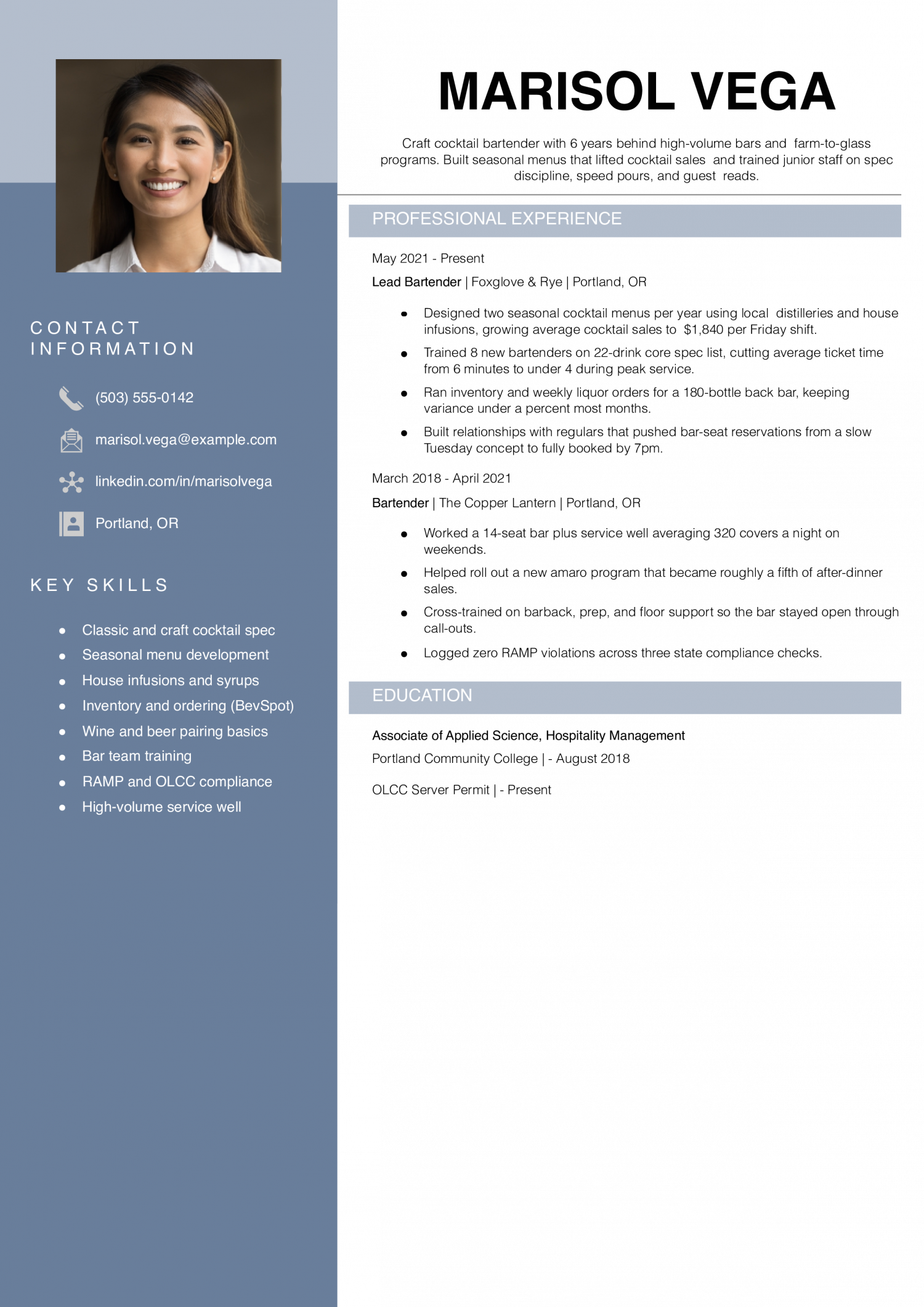
The entry-level bartender has barback time, a serving background, or fresh certifications and is fighting to land a first full bar shift. This resume needs to prove you know the well, hold pace, and can be trusted with a register and an ID check.
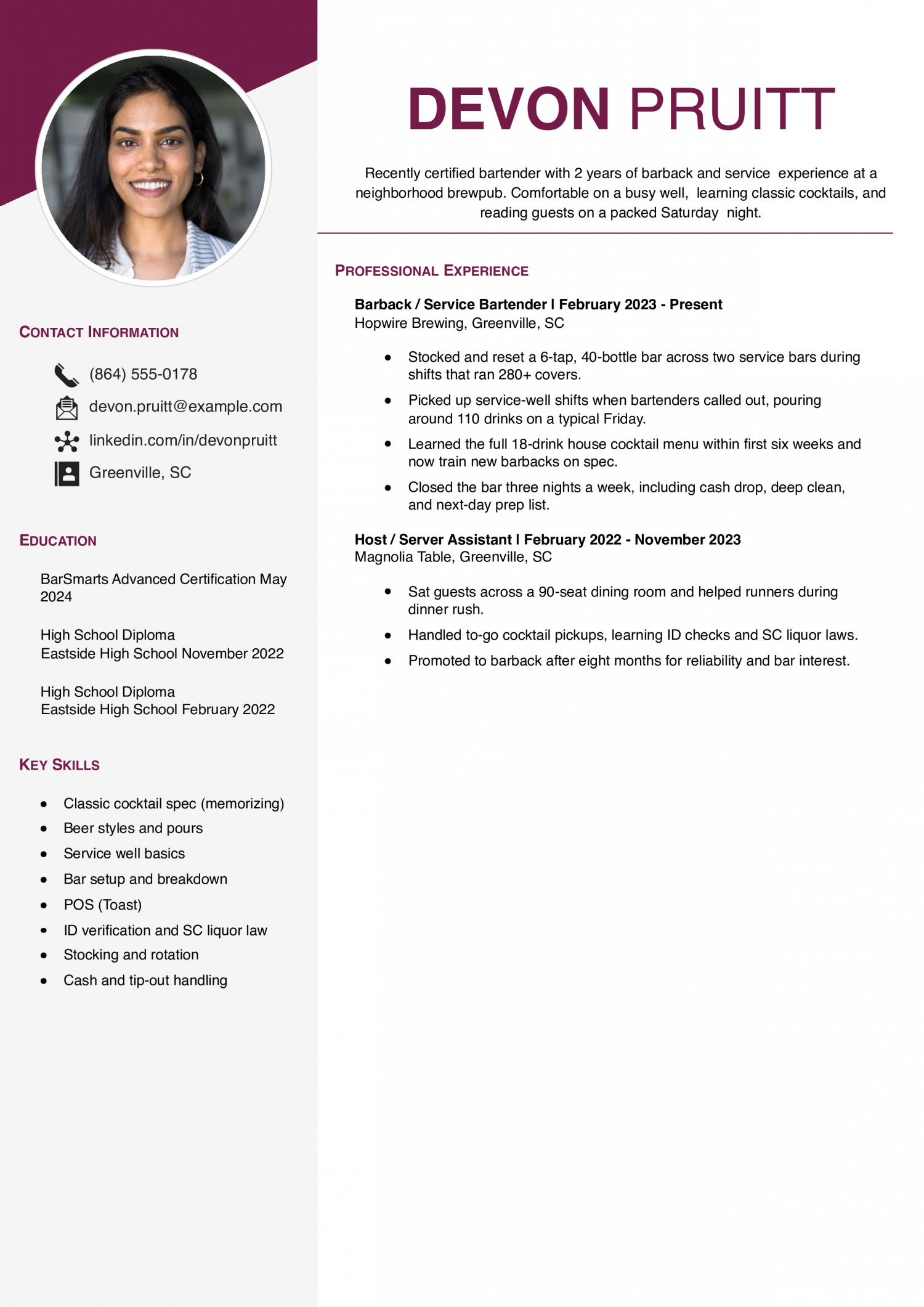
The experienced bartender has two to five years on the rail and a section of regulars. This resume needs to prove repeat covers per shift, classic cocktail range, POS fluency, and a clean cash-out history under a real GM.
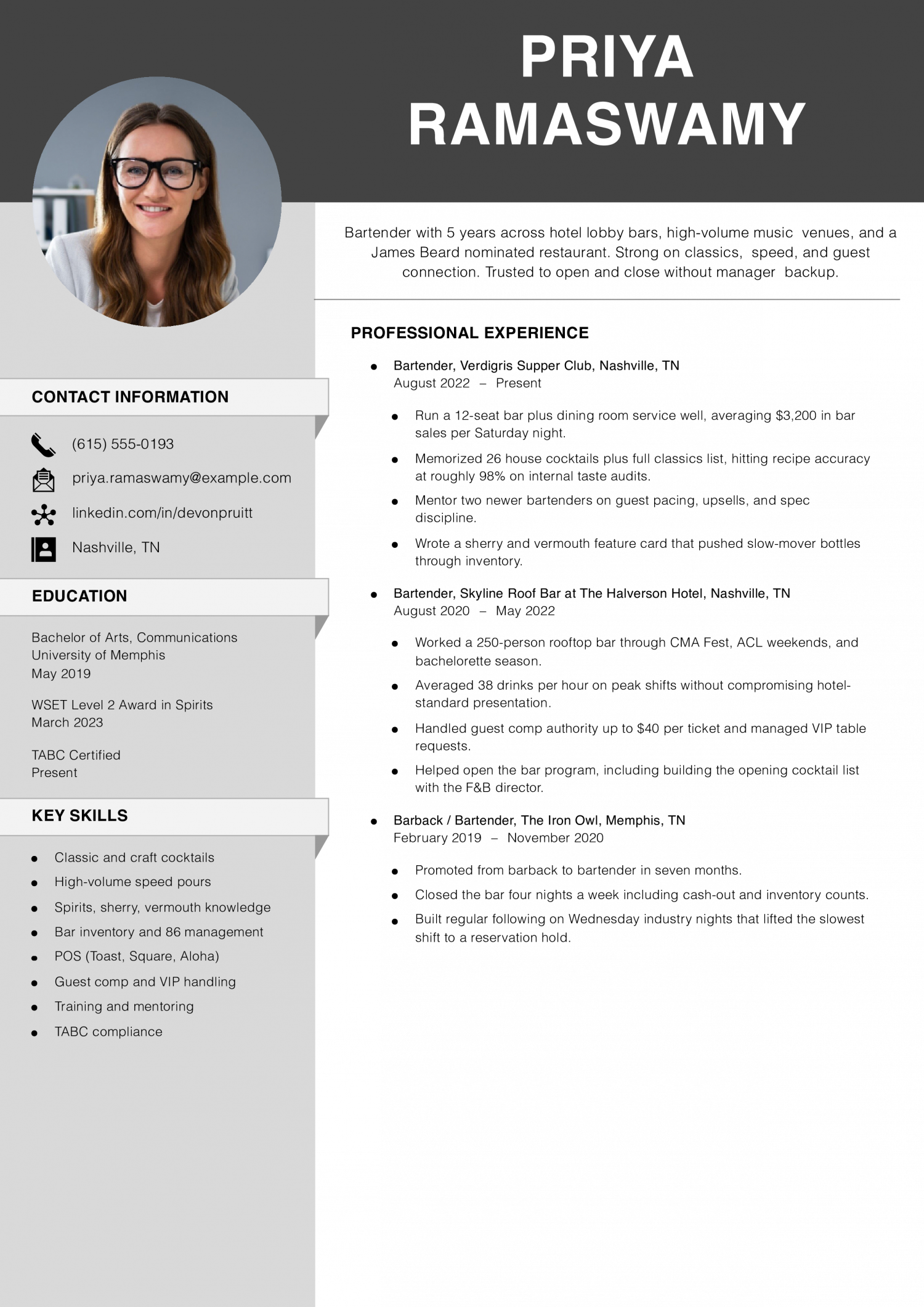
The head bartender writes the menu, orders the liquor, and trains the team. This resume needs to prove menu rollouts, pour cost held under target, and a bar program that survived staff turnover.
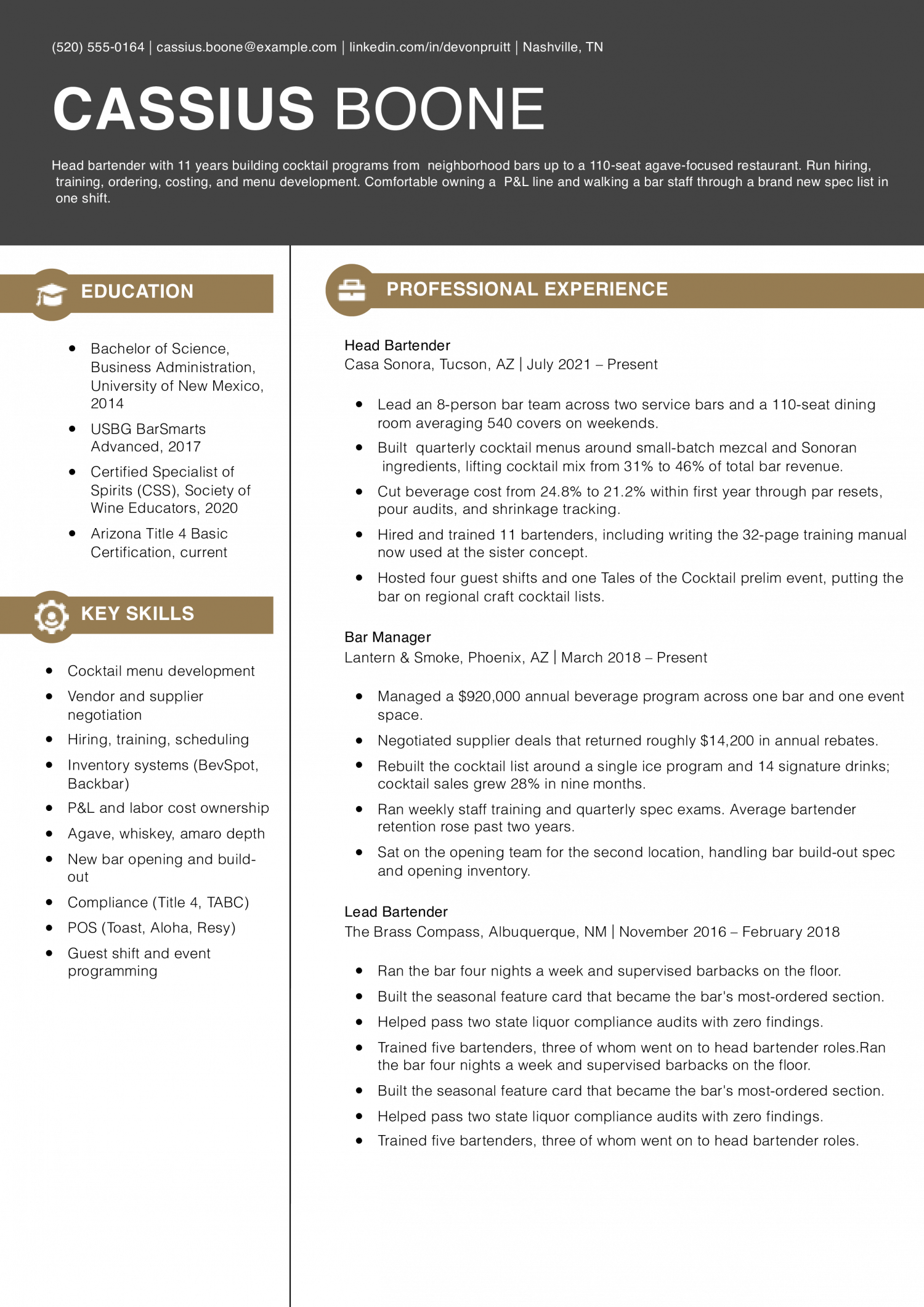
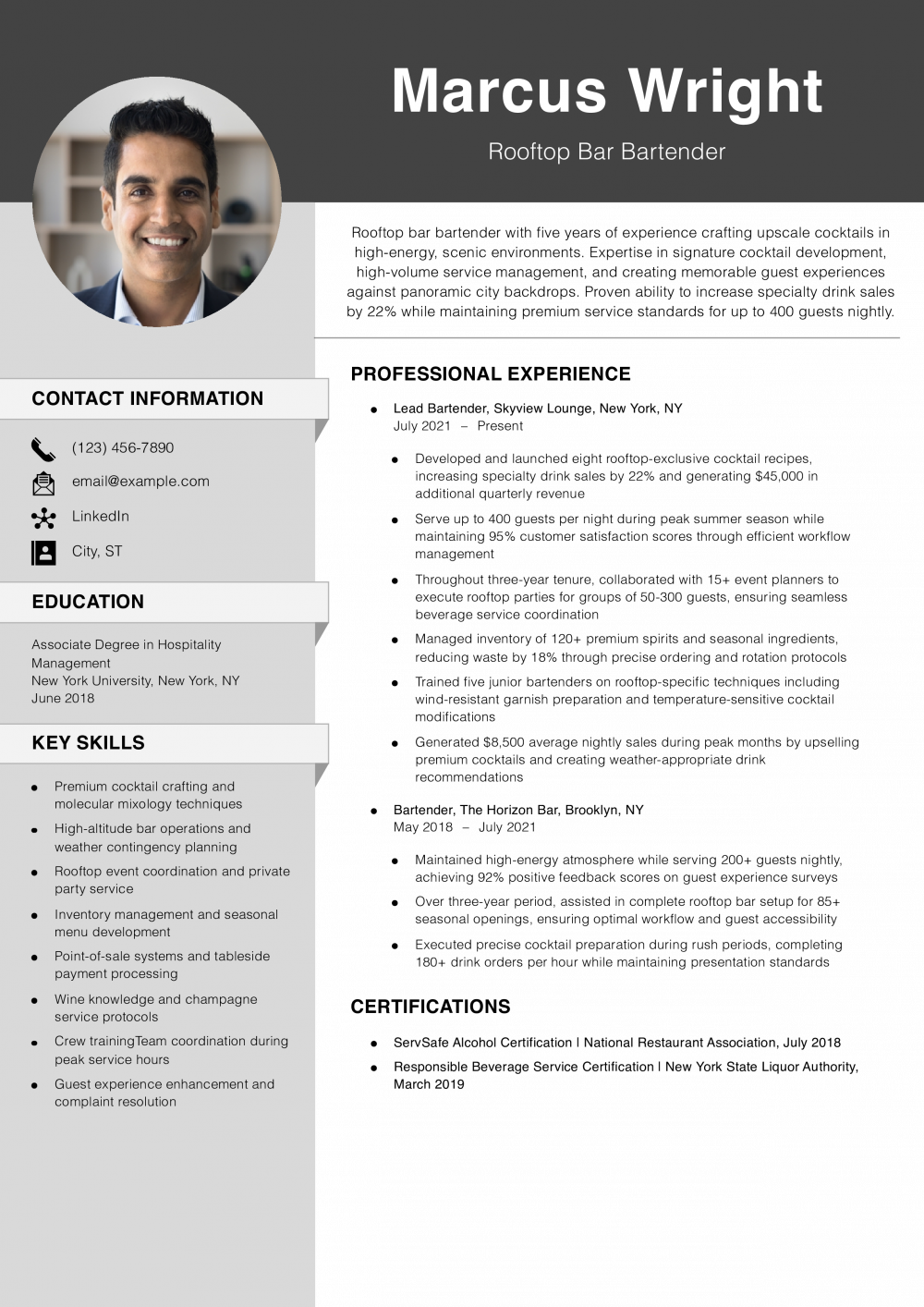
Bartender with 8 years across ski-town lobby bars, a downtown speakeasy, and a 200-seat brewery taproom. Build menus around what’s pouring well and what’s slow-moving. Known for clean specs, fast tickets, and training newer bartenders without losing the room.
The first line of your summary should name covers per shift, drinks per hour at peak, or weekly bar sales at your last spot. Bar managers and restaurant GMs read that number as your readiness for their Friday rail.
Skip the “passionate about craft cocktails” opener. A bartender with three years at a 200-cover gastropub holding the service well at peak tells the reader more in one sentence than a paragraph of adjectives. If you’ve worked multiple venues, lead with the busiest one and name the format, whether high-volume, craft cocktail, or banquet.
Strong bartender bullets carry numbers. Most resumes that advance show covers per shift, average ticket, tips averaged, or weekly bar sales. Bullets without a number tend to read as duties.
Aim for two or three real figures per role: drinks per hour at peak, signature cocktails on the menu you helped build, ounce-pour accuracy on inventory variance, or zero cash-drawer shortages across a year. If you don’t have exact figures, use volume language like “high-volume rail averaging 300 covers nightly” rather than inventing precision.
Break your bullets into clear buckets so the reader doesn’t have to hunt. Pace and execution, cocktail and beer program, cash and POS, guest experience, and inventory or ordering are the five that map cleanly to how bar managers think.
Name the formats you’ve worked: nightclub well, craft cocktail bar, hotel lobby bar, banquet, service well behind a kitchen. Name the POS too, whether Toast, Aloha, Square, TouchBistro, or Micros. Specifics here are the difference between a generic resume and one a GM trusts on sight.
Bar managers and restaurant GMs need to see your alcohol-service card before they read your bullets, because they can’t legally schedule you without it. Put a small credentials line directly under your summary listing TIPS or ServSafe Alcohol, your state card (CA RBS, WA MAST, TX TABC, IL BASSET), and food handler.
List the state and “in good standing” or the issue year, but do not publish the card number on a public resume. Note any optional craft credentials like BarSmarts or WSET Level 1 or 2 in the same block if you’re going after a cocktail program.
If you’re entry-level or career-changing into bartending, close with a short education or training block: bartending school if you attended one, plus any hospitality coursework or serving roles that show transferable cash handling, pace, and guest service.
If you’re applying with no prior bar shifts, reframe retail cashier, server, or barback work into bartender-readable bullets: cash accuracy, multitasking at peak, age-verification habits, and POS speed. A short “availability” line naming nights, weekends, and holidays helps a GM see scheduling fit on the first pass.
Bar hiring is denser in 2026 after a wave of restaurant closures. GMs are running leaner floors and the bar to clear a first read is higher. The skills below come from our user-built bartender resumes.
Bar managers weight hard skills like POS fluency and classic cocktail range first, then read soft skills as proof behind your pace and guest numbers. Match the list against the posting and use each soft skill to back a specific bullet, not as a standalone claim.
| Soft Skills | % of resumes with this skill |
|---|---|
| Customer service | 80% |
| Communication | 50% |
| Multitasking under pressure | 48% |
| Teamwork | 36% |
| Composure | 33% |
And here are the top hard skills showing up most often.
| Hard Skills | % of resumes with this skill |
|---|---|
| Mixology and drink prep | 72% |
| POS and cash handling | 50% |
| Responsible alcohol service | 40% |
| Inventory management | 39% |
| Food safety and sanitation | 26% |
Based on data from thousands of bartenders’ resumes built on ResumeTemplates.com, May 2026.
These are the must-haves hiring teams look for when scanning a bartender resume.
Most bars and restaurants will not schedule you without a valid alcohol-service card on file, and many cities add a food handler requirement on top. List both in a credentials line under your summary so the GM sees them on the first pass.
TIPS (Training for Intervention ProcedureS): widely accepted national alcohol-service credential
ServSafe Alcohol: chain-restaurant and hotel-bar standard
ServSafe Food Handler: covers food safety basics required in many counties
State alcohol-server card: CA RBS, WA MAST, TX TABC, IL BASSET, or your state's equivalent
Local health-department food card where required (for example, Clark County Health Card)
POS fluency is a hard filter on most bartender postings. Naming the exact system by brand picks up keyword scans and tells the GM you can step on the rail without a week of training.
Toast: common in independent restaurants and bars
Aloha (NCR): standard at many chain and casual-dining bars
Square for Restaurants: small bars, food trucks, and pop-ups
Micros (Oracle Simphony): hotel bars and large hospitality groups
TouchBistro: independent restaurants and gastropubs
Upserve and Lightspeed: independent bars and restaurants
BevSpot and Craftable: bar inventory and pour-cost tracking
A bar manager schedules by shift coverage as much as by skill. A short availability line near your contact block tells them, in one read, whether you fit the holes they need to fill.
Be specific. “Available nights, weekends, and holidays” carries more weight than “flexible schedule.” If you can cover doubles, brunch, or closing shifts, say so.
If you’re limited (school schedule, second job, child-care window), state the window honestly. A GM would rather know on the resume than after a trial shift.
Bar managers and restaurant GMs read this list as a map of where your work is heading. The certifications below tell them which track you’ve invested in, whether responsible service, food safety, or craft cocktail depth. List the issuing body and the year of completion, and skip the card number.
TIPS (Training for Intervention ProcedureS): The most widely accepted responsible-alcohol-service credential in the U.S.; many employers treat it as a baseline before you can pour.
ServSafe Alcohol and ServSafe Food Handler: Industry standard for alcohol and food safety; hotel bars and chain restaurants often list one or both as required.
State alcohol-server permit (CA RBS, WA MAST, TX TABC, IL BASSET): Required by law in many states before you tend bar; list the state and current status without the card number.
BarSmarts or WSET Level 1 or 2: Signals craft cocktail and wine depth; carries weight at cocktail bars, hotel programs, and venues with structured beverage lists.
Bartender is one of the larger occupations tracked by BLS, which means the median pulls in a long tail of part-time, neighborhood-bar, and entry-tier roles. The top decile sits well above the median and clusters in destination cities, hotel programs, and high-check craft cocktail rooms.
To position above the median, lead your resume with the format you’ve worked (high-volume, craft, banquet), the covers or sales numbers you held, and the POS and certifications that signal you can step behind the bar on day one.
| # | State | Avg. Annual |
|---|---|---|
| 1 | Hawaii | $68,820 |
| 2 | New York | $60,750 |
| 3 | District of Columbia | $54,930 |
| 4 | Vermont | $54,310 |
| 5 | Washington | $48,320 |
| 6 | Maine | $47,630 |
| 7 | Virginia | $46,860 |
| 8 | New Jersey | $45,660 |
| 9 | Virgin Islands | $42,630 |
| 10 | Arizona | $40,860 |
| # | State | Workers | Median |
|---|---|---|---|
| 1 | California | 69,790 | $35,900 |
| 2 | Texas | 57,990 | $27,750 |
| 3 | Florida | 54,800 | $30,850 |
| 4 | New York | 42,550 | $60,750 |
| 5 | Illinois | 40,520 | $29,120 |
Resume Templates offers HR approved resume templates to help you create a professional resume in minutes. Choose from several template options and even pre-populate a resume from your profile.
Lead each bullet with a verb and a number. "Poured 180 drinks an hour on Friday rail" beats "responsible for making drinks."
Name the format (high-volume, craft, banquet), the POS, and the cocktail range you ran. Treat bartending as operations work: pace, cash accuracy, inventory, and guest experience.
Reframe what you already have. Cashier work shows cash handling and ID checks. Serving shows pace, POS fluency, and guest reads.
Open with TIPS or your state alcohol card, list any bartending school or training shifts, then translate prior roles into bartender-readable bullets with real numbers.
No. List the credential name, state, and current status, such as "California RBS, active." Do not publish the card number on a public resume or job board.
Provide the number on the application form or W-4 packet when the employer requests it. This keeps the document scannable and protects you from credential misuse.
Pace and POS fluency lead the list. Name the system by brand (Toast, Aloha, Square, Micros, TouchBistro).
Add classic and craft cocktail range, cash-drawer accuracy, and responsible service. Soft skills like guest rapport and de-escalation matter, but only if they back a bullet with a number behind it.
For a bartender, an ATS-friendly template is the safest pick, because it puts your certifications and experience where a hiring manager scans first. A basic template is a solid alternative. Whichever you choose, keep the formatting clean and easy to parse: clear section headings, a standard font, and no graphics a parser can choke on.
Executive Resume Writer and Career Coach
Andrew Stoner is an executive career coach and resume writer with 17 years of experience as a hiring manager and operations leader at two Fortune 500 Financial Services companies, and as the career services director at two major university business schools.
Customize this template in our builder in under 10 minutes.