Tip !

Hiring physical therapists look for your specialty certs, setting mix, and caseload volume on the first page, because those signal whether you can carry an active outpatient or acute panel without ramp time.

Andrew Stoner , Executive Resume Writer and Career Coach

Why this resume works

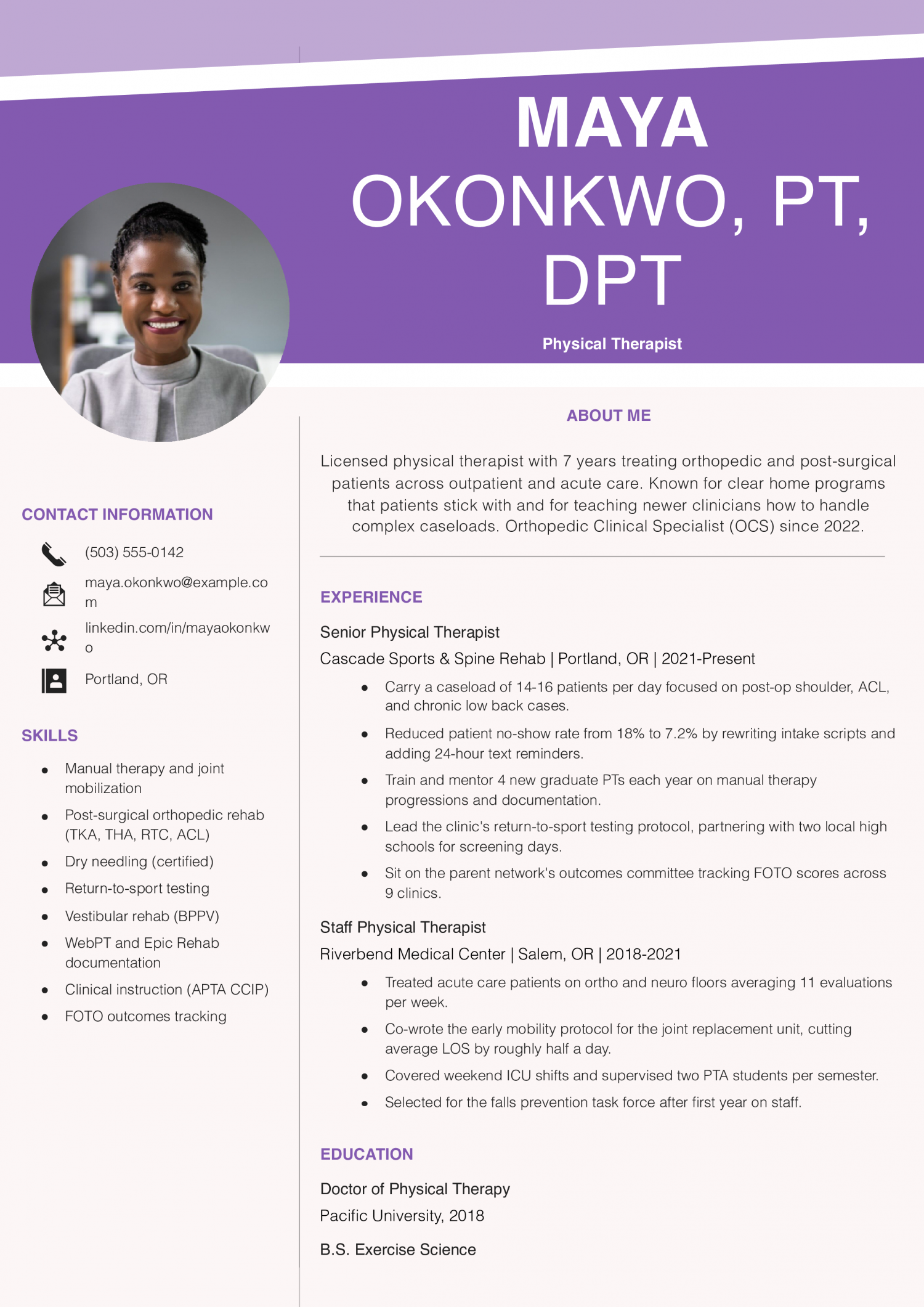
  • Numbers tied to patient outcomes: The no-show drop from 18% to 7.2% shows operational impact beyond just clinical hours.
  • Grew into mentoring others: Moving from staff PT to mentoring 4 new grads a year signals trusted senior clinician status.
  • Specialty credential is visible: OCS certification appears in the summary and education so recruiters spot it in the first scan.

Entry Level Example

Entry-level physical therapists are new DPT graduates or clinicians within their first year of licensure. This resume needs to prove your clinical rotations, caseload exposure across settings, and any specialty interest you bring out of school.

Why this resume works

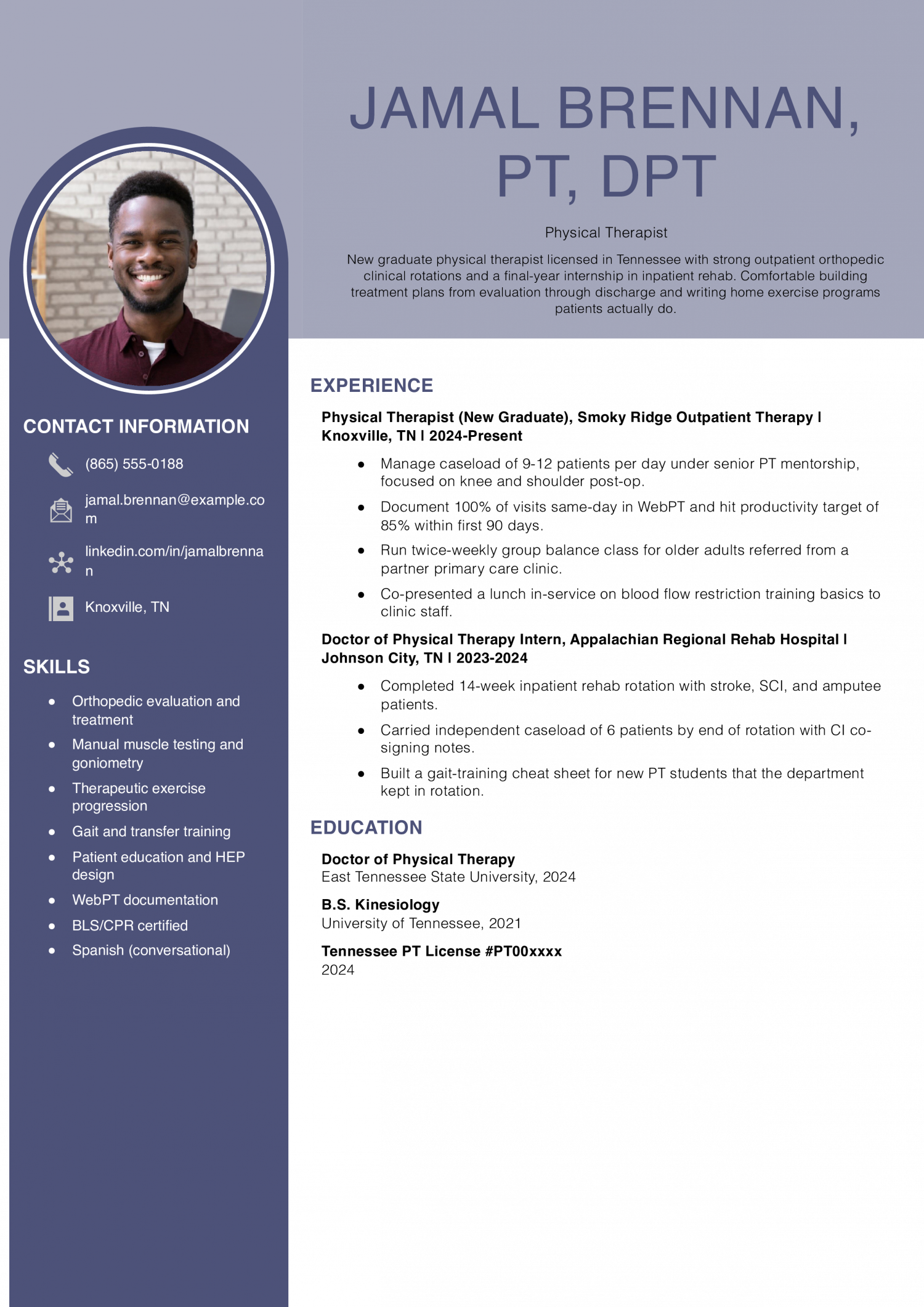
  • Shows licensure right away: Listing the Tennessee PT license in education answers a hiring manager’s first question.
  • Real productivity numbers: Hitting the 85% productivity target by day 90 proves the new grad can carry weight.
  • Internship reads like a job: Treating the final clinical as a structured EXPERIENCE block fills out the resume without padding.

Experienced Example

Experienced physical therapists carry three to seven years of licensed practice and a defined patient population. This resume needs to prove your productivity, documentation discipline in Epic or WebPT, and outcomes on the diagnoses you treat most.

Why this resume works

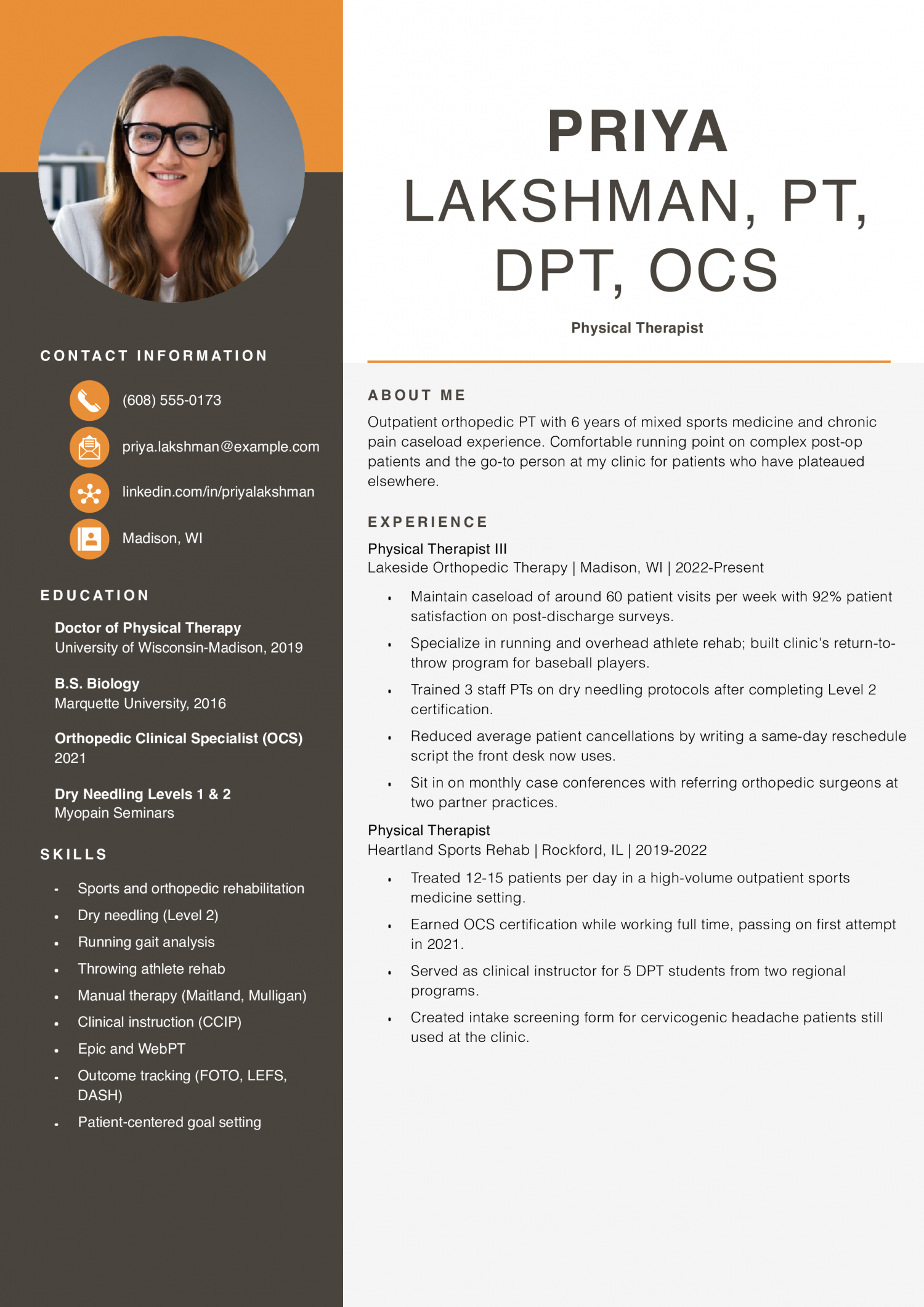
  • Specialty credential earned on the job: Passing OCS while working full time shows ambition without taking time off the clinic floor.
  • Real outcomes data: The 92% satisfaction number and FOTO mention prove this PT pays attention to results, not just visits.
  • Niche the resume can sell: Return-to-throw and running gait specialties give the candidate something specific to pitch in interviews.

Senior Example

Senior physical therapists hold eight or more years of practice plus specialty certification or clinic leadership. This resume needs to prove the caseloads you mentor, the outcomes you own, and the OCS, NCS, or GCS credentials you carry.

Why this resume works

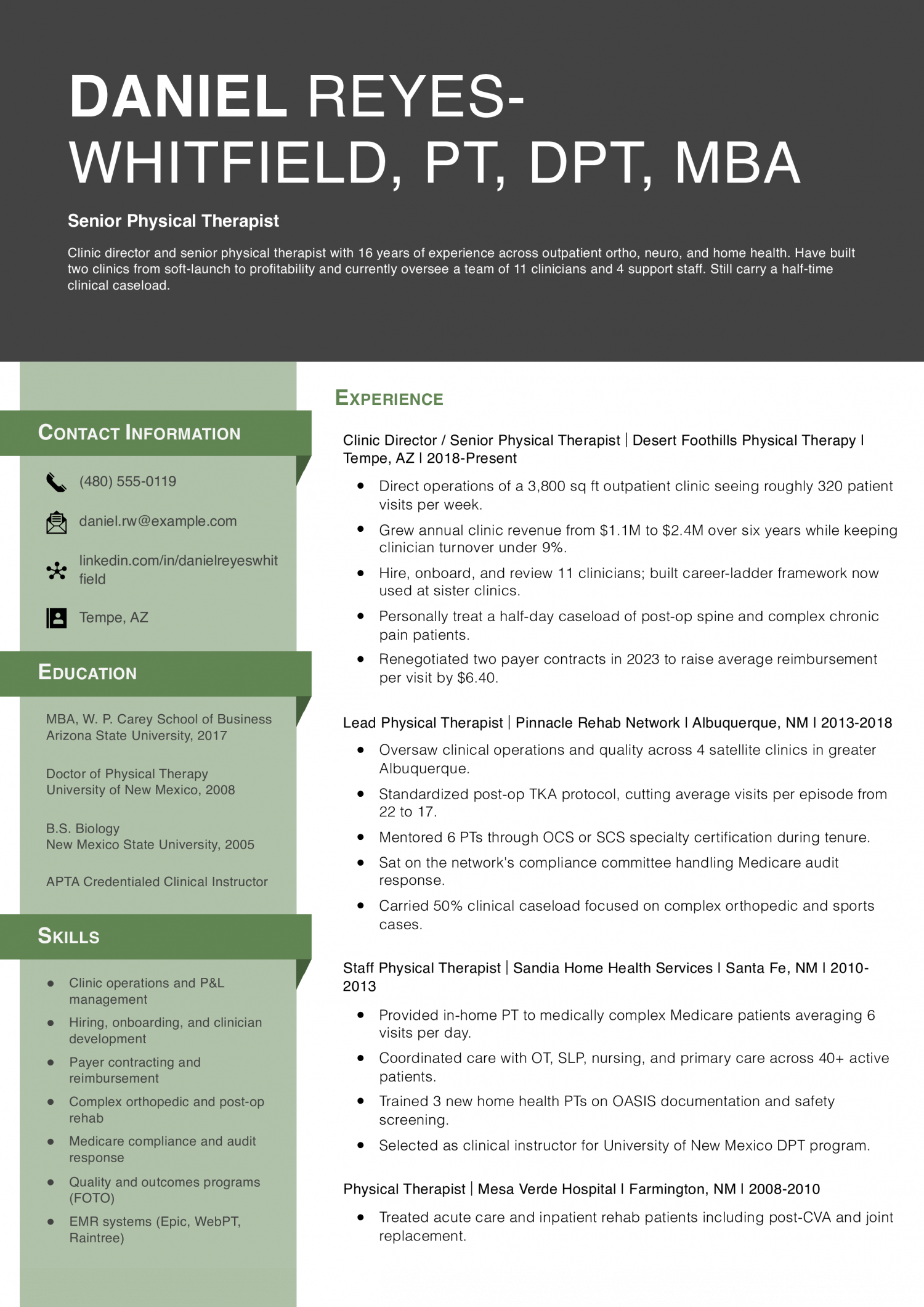
  • Revenue growth tied to leadership: Going from $1.1M to $2.4M under his direction makes the business case for the hire obvious.
  • Still treating patients: Keeping a half-day clinical caseload tells a hiring committee he hasn’t lost touch with the floor.
  • Mentorship shows up as numbers: Six PTs guided through specialty boards turns vague leadership talk into a concrete track record.

How to Write a Physical Therapist Resume

01 Open with what a license lookup won't show

Lead with the one signal a PT clinic director cannot pull from your state board record. That could be your OCS or NCS specialty board, a vestibular or LSVT BIG certification, or a manual therapy fellowship.

It could also be a setting other applicants lack: pediatric NICU coverage, inpatient stroke acuity, or post-surgical ortho volume after a specific protocol. Name the patient population and the outcome measure you track most often, whether that is LEFS, DASH, or Berg Balance scores.

02 Quantify caseload, outcomes, and productivity

Strong PT bullets carry numbers a rehab manager can compare against their own clinic. Most resumes that move forward show daily visit counts, productivity percentages, and discharge outcomes on the diagnoses you treat.

Name two or three real metrics: average visits per day, productivity percentage on an 8-hour schedule, and patient-reported outcome gains. Bullets without a number tend to read as duties, not results, and PT clinic directors tend to skip them.

03 Group your work by clinical category

Cluster your bullets so a reader can see your scope in one pass. Use three to five buckets: evaluation and plan of care, manual therapy and therapeutic exercise, modalities, documentation, and interdisciplinary coordination.

Inside each bucket, name the protocols you follow and the populations you treat. Post-op ACL, total knee, rotator cuff repair, CVA, Parkinson’s, and lumbar radiculopathy read more concretely than “orthopedic and neuro caseload.”

04 Place credentials and EMR tools up top

Build a credentials block under your name that lists your DPT, state license (“Licensed PT, California, in good standing”), BLS, and any specialty board certification. Do not list license numbers on the resume; provide those on the application form.

Add a tools line for Epic, WebPT, Raintree, or Net Health so PT clinic directors can confirm EMR fluency before reading further. Page-one placement matters because credentialing screens often run before clinical fit.

05 Close with education, clinicals, and CEUs

End with your DPT program, graduation year, and clinical affiliation sites if you are within five years of licensure. Name the settings (acute, outpatient ortho, SNF, home health) and patient volume each rotation carried.

Add a continuing education line listing recent coursework in manual therapy, dry needling, vestibular rehab, or pelvic health. CEU currency tells a rehab manager you are tracking toward your next license renewal.

The physical therapist resumes that get callbacks share a specific skill mix. The lists below come from our user-built physical therapy resumes, pulled from the resumes our users actually build. PT clinic directors and rehab managers scan for these patterns first, not generic compassion language or “patient-centered care” platitudes.

Hard skills clear the credential and EMR check; soft skills earn weight when they back a specific bullet. Match the hard-skill list against your target job posting, and treat soft skills as evidence labels for outcomes you already wrote.

Soft Skills % of resumes with this skill
Patient communication 72%
Empathy 54%
Active listening 49%
Critical thinking 35%
Patient motivation 26%

And here are the top hard skills showing up most often.

Hard Skills % of resumes with this skill
Treatment plan development 79%
Manual therapy 50%
Therapeutic exercise prescription 41%
Patient assessment 37%
EHR documentation 25%

Based on data from thousands of physical therapists’ resumes built on ResumeTemplates.com, May 2026.

Must Have on a Physical Therapist Resume

These are the must-haves hiring teams look for when scanning a physical therapist resume.

Licensure Requirements

Every U.S. physical therapist holds a state PT license issued by the state’s physical therapy board after passing the NPTE. List your license on page one, but do not publish the number.

Write your credentials line as “Licensed Physical Therapist, [State], in good standing,” followed by the expiration year if space allows. If you hold compact privileges through the PT Compact, name that on the next line so multi-state employers see it.

If you are applying out of state, note that you have applied for licensure by endorsement and give the expected issue date. Provide the actual license number on the employer’s credentialing packet, not on the resume.

  • DPT from a CAPTE-accredited program
  • Passed the National Physical Therapy Examination (NPTE)
  • Active state PT license, listed with state and status only
  • PT Compact privileges, if held, listed by state
  • Current BLS certification with expiration date

Continuing Education

State PT boards require continuing competence hours each renewal cycle, and hiring clinics read your CEU list as a signal of where your practice is going next. Show recent coursework that maps to the role you want.

Add a short Continuing Education section near your credentials or at the end of the resume. List the course title, certifying body, and year completed.

Group courses by theme so a reader can see your direction. Manual therapy, dry needling, vestibular rehab, pelvic health, and LSVT BIG or PWR! Moves are common themes that map to specific service lines.

  • List CEUs from the last three years; older coursework reads as filler
  • Match course themes to the job posting’s specialty language
  • Note any certificate-track coursework (manual therapy fellowship, vestibular cert)
  • Confirm CEU hours meet your state board’s clock-hour requirement before each renewal

HIPAA and OSHA Compliance

Patient stories sell your clinical skill, but HIPAA still applies on a resume. Strip every identifier before a single bullet leaves your desk.

Keep Patient Stories Aggregated

Never name a patient, never include a date of service, and never describe a case specific enough to identify someone. “Treated a 34-year-old post-op ACL patient at [named small clinic] in March” is a HIPAA risk.

Use aggregate language instead: “Managed a caseload of 12 post-op orthopedic patients per day, including ACL, total knee, and rotator cuff repair.” Volume, diagnosis category, and outcome trends are safe; specifics that point to one person are not.

  • No patient names, ages, or dates of service
  • No identifying case details, even with the name removed
  • Aggregate caseload, diagnosis mix, and outcome trends are safe
  • Confirm any case study or in-service material is de-identified before linking it

Physical Therapy Credentials That Get You the Job

Beyond your state PT license, DPT, and BLS, the certifications below tell PT clinic directors which patient populations you can take on day one and which specialty service lines you can grow. List the certifying body and current expiration date for each item.

  • Orthopaedic Clinical Specialist (OCS): Signals advanced ortho expertise to outpatient clinics and unlocks higher pay bands at most hospital systems and private practices.
  • Neurologic Clinical Specialist (NCS): Tells acute rehab and stroke programs you can manage CVA, TBI, and Parkinson's caseloads without supervised ramp-up.
  • Geriatric Clinical Specialist (GCS): Strong signal for SNF, home health, and outpatient geriatric roles where balance, falls, and dementia caseloads dominate.
  • Certified Manual Therapist or Dry Needling Certification: Expands your billable scope in outpatient ortho and tells clinic directors you can handle complex musculoskeletal referrals.

Latest BLS Statistics for Physical Therapists

For physical therapists, the 10th-percentile floor reflects new-grad outpatient and SNF roles, while the top-decile ceiling tracks specialty-certified clinicians and rehab leaders in high-cost metros. The spread tells you setting, specialty board status, and geography move you from floor to ceiling more than tenure alone.

Lead the resume with your specialty certifications, setting mix, and caseload outcomes that map to where you want to sit on this curve.

$101,020 National median annual
$102,400 National mean annual
$74,420 Entry-tier floor (10th percentile)
$132,500 Top-decile ceiling (90th percentile)
248,630 Physical Therapists in the U.S.
Where you stand

Entry tier

$74,420 to $101,020 At the entry tier, lead with your DPT, clinical rotation settings, and the patient populations you handled with measurable outcome gains.

Mid band

$101,020 to $132,500 At the mid band, your resume needs to show productivity percentage, daily visit volume, EMR fluency, and the diagnoses you own.

Top decile

$132,500+ At the top decile, lead with OCS, NCS, or GCS credentials, clinical mentorship, and program or service-line outcomes you built.

Top-paying states

# State Avg. Annual
1 California $123,300
2 Alaska $108,640
3 New Jersey $106,310
4 Nevada $105,170
5 Oregon $104,430
6 Maryland $104,330
7 Connecticut $103,720
8 Texas $103,710
9 Illinois $103,380
10 Delaware $103,120

Highest-employment states

# State Workers Median
1 California 24,380 $123,300
2 Texas 18,930 $103,710
3 Florida 17,050 $98,880
4 New York 15,810 $99,430
5 Pennsylvania 11,100 $99,570
Source: U.S. Bureau of Labor Statistics, OEWS 2024 release (SOC 29-1123).
Written by professional resume writers and loved by hiring managers

Resume Templates offers HR approved resume templates to help you create a professional resume in minutes. Choose from several template options and even pre-populate a resume from your profile.

Frequently Asked Questions

How long should a physical therapist resume be?

One page if you have under 10 years of licensed practice. Most outpatient and acute roles will read a single page in full.

Move to two pages once you carry specialty certifications, clinic leadership, published research, or CEU coursework that fills the second page with real content.

Should I list my PT license number on my resume?

No. Write the state and "Licensed PT, [State], in good standing" with the expiration year if you want.

State boards warn against publishing license numbers in public documents. Provide the number on the employer's application form or during credentialing, not on the resume itself.

How do I write a physical therapy resume with no experience beyond clinicals?

Lead with your DPT graduation date and your three or four clinical affiliations. For each, name the setting, weekly caseload, and diagnoses you treated.

Add outcome measures you used (LEFS, Berg, TUG) and any case presentations or in-services you delivered. Close with BLS, state license status, and any CEU coursework you completed during school.

What's the difference between a physical therapist resume and a PTA resume?

Physical therapist resumes lead with evaluation skills, plan-of-care authorship, and clinical reasoning on complex diagnoses. The DPT and state PT license sit at the top.

PTA resumes lead with the Associate degree, PTA license, treatment delivery volume, and the supervising PTs and settings you worked under. Productivity and patient handling get more weight than diagnostic reasoning.

What resume template should a physical therapist use?

For a physical therapist, an ATS-friendly template is the safest pick, because it puts your certifications and experience where a hiring manager scans first. A basic template is a solid alternative. Whichever you choose, keep the formatting clean and easy to parse: clear section headings, a standard font, and no graphics a parser can choke on.

Rate this article

Physical Therapist Resume

Average Rating

4.2/5 stars with 168 reviews

You have given 0 Star(s)
4.2/5 stars with 168 reviews
Andrew Stoner

Executive Resume Writer and Career Coach

Andrew Stoner is an executive career coach and resume writer with 17 years of experience as a hiring manager and operations leader at two Fortune 500 Financial Services companies, and as the career services director at two major university business schools.