Medical Doctor Resume Examples and Templates for 2026



The medical resumes that advance past credentialing share three things: a license-and-certification block above the experience section, patient-volume numbers tied to acuity, and named EHR systems a recruiter can match against the posting in under a minute.
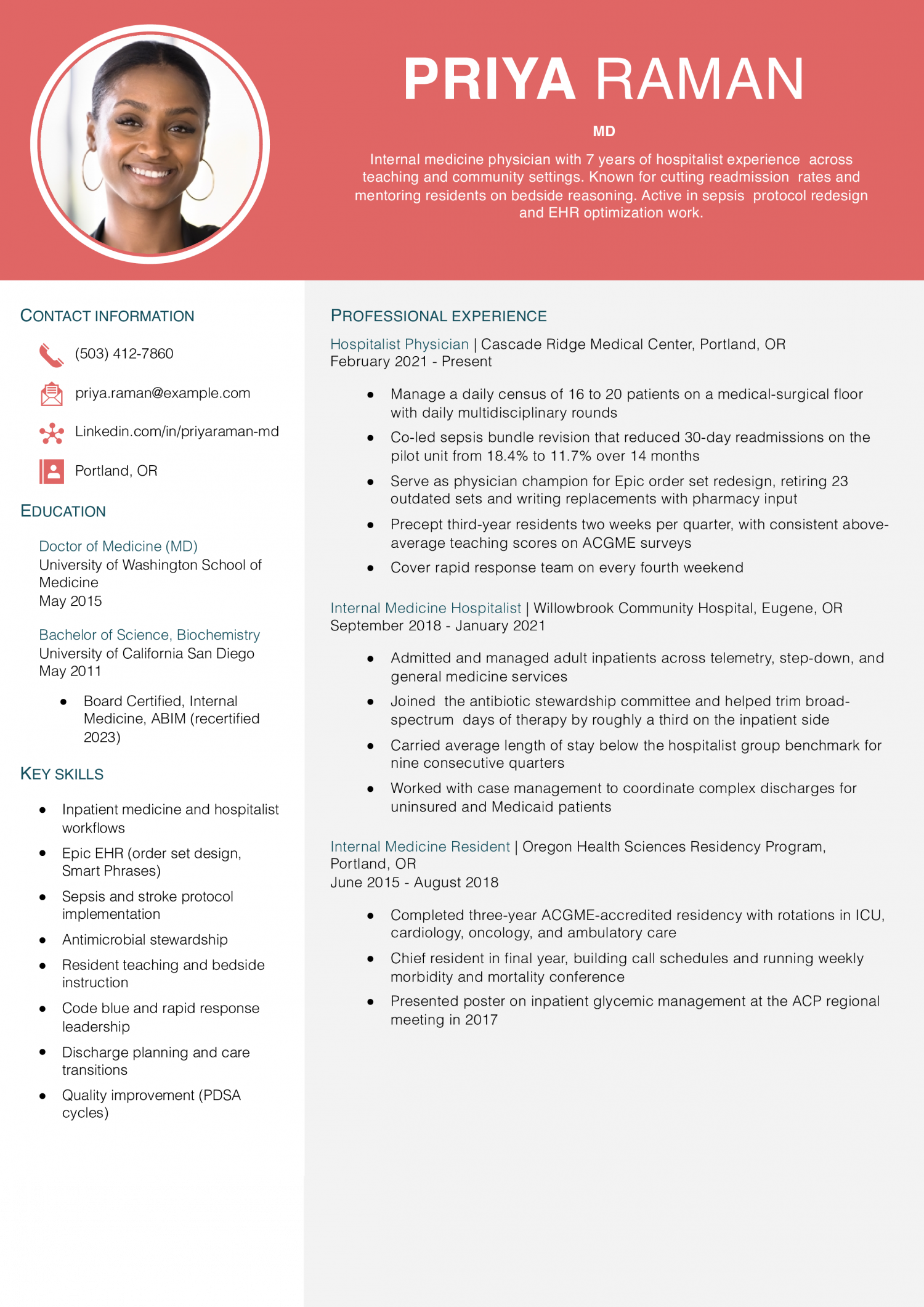
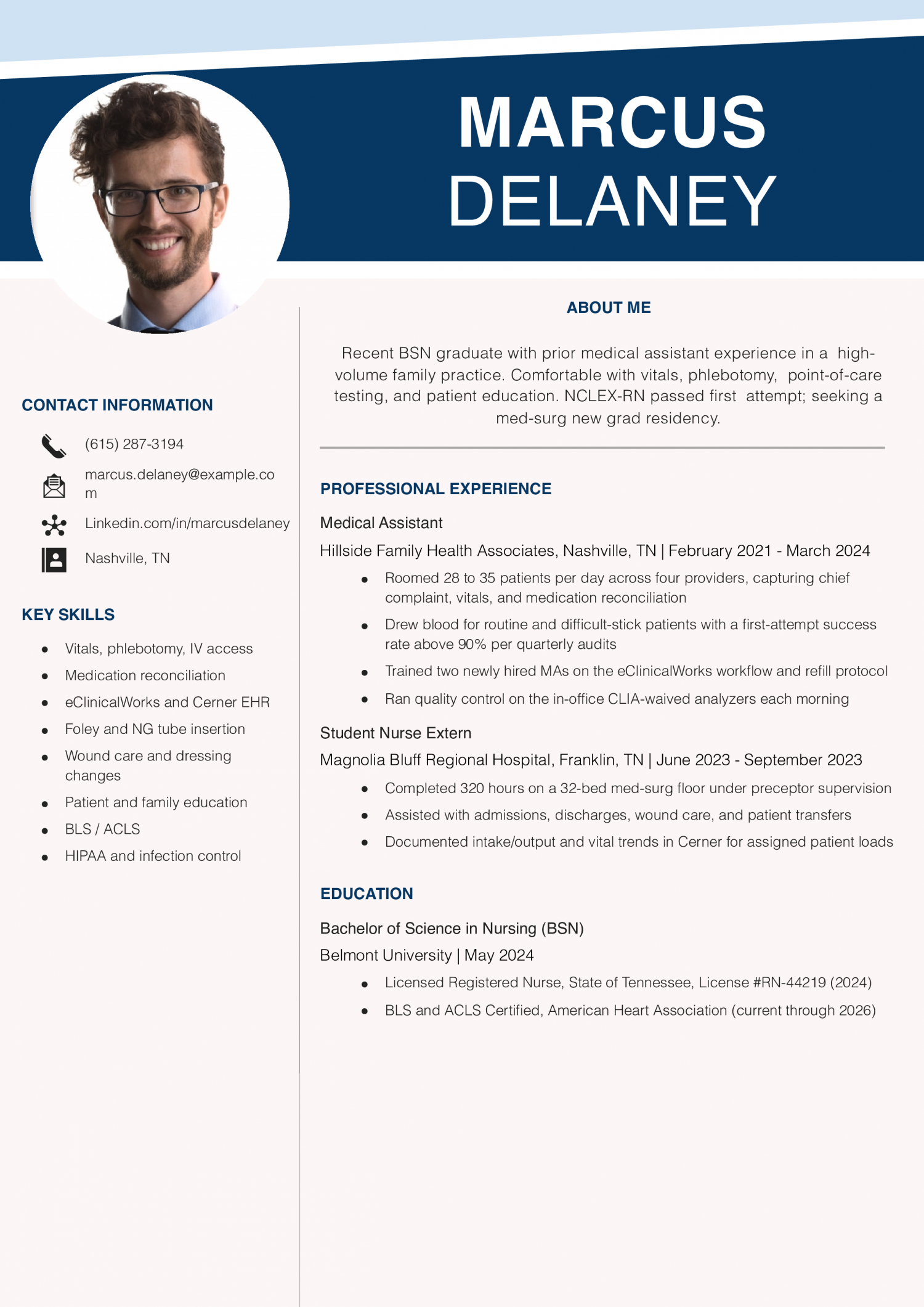
Entry-level medical resumes belong to new grads, recent licensees, and clinicians inside their first two years. The resume needs to prove clinical rotations, patient volume during training, and the EHR systems you charted in.
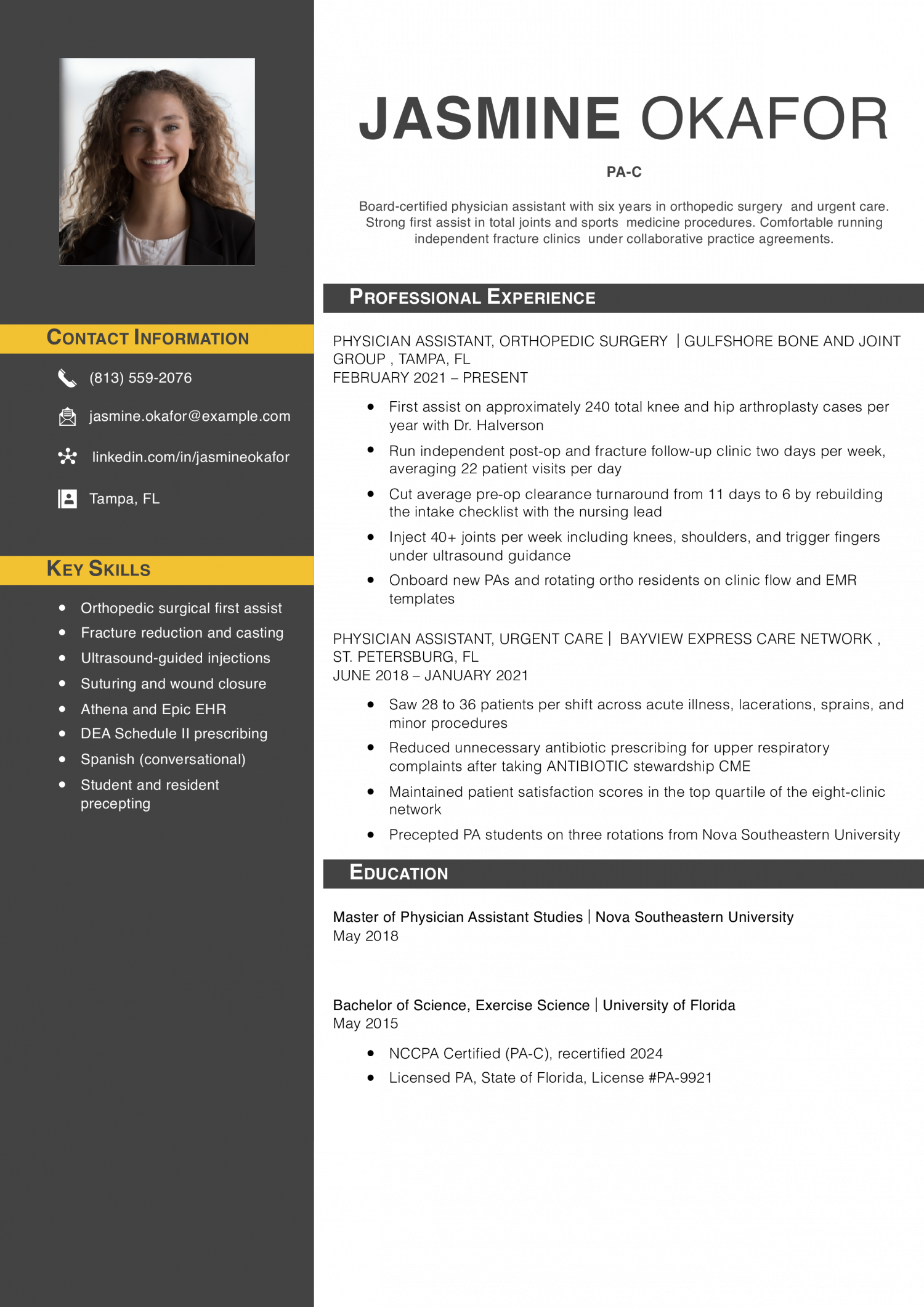
Mid-career medical resumes belong to clinicians with three to eight years in one or two specialties and stable license history. The resume needs to prove acuity ownership, charge or preceptor roles, and outcome metrics tied to your unit.
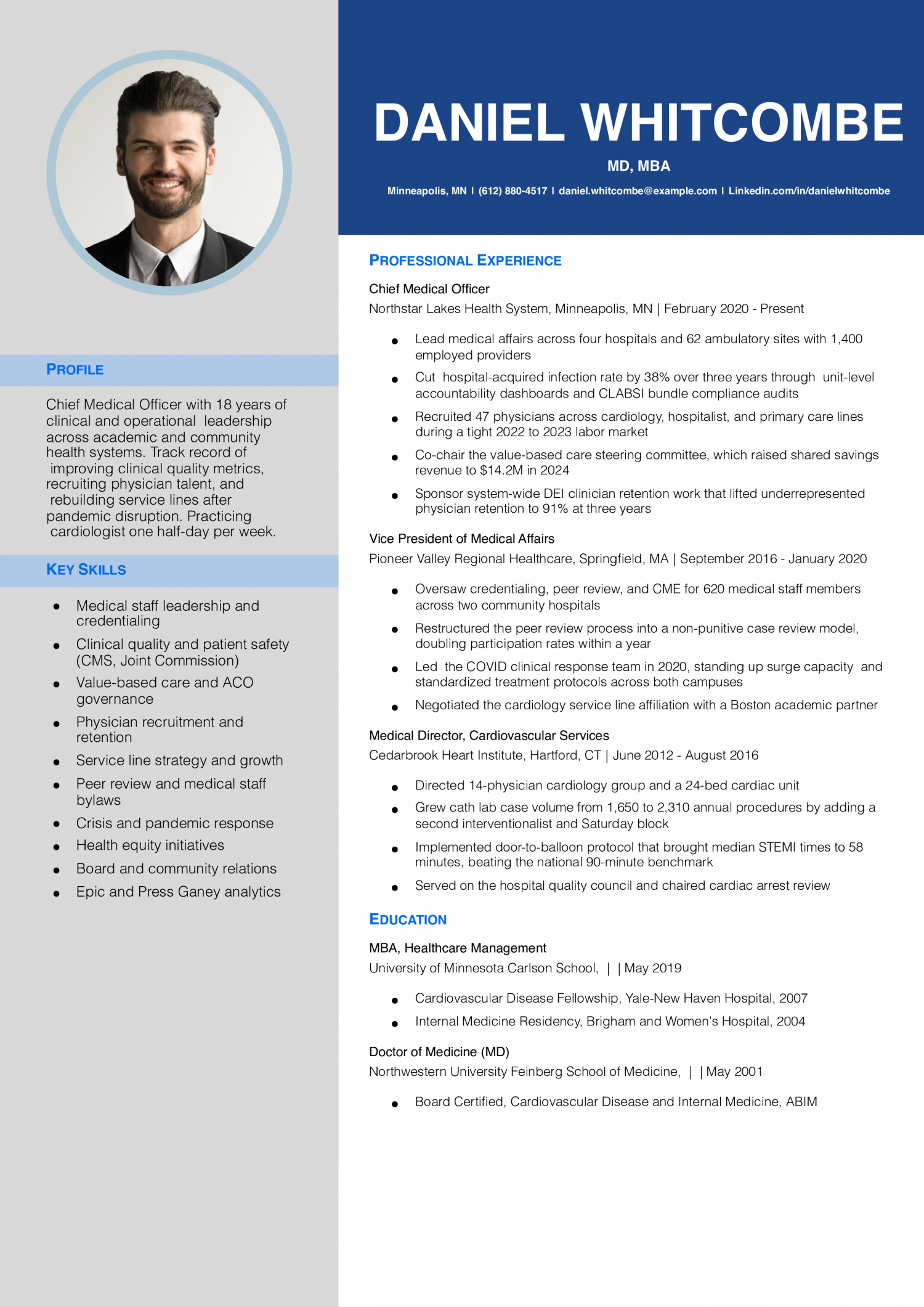
Senior medical resumes belong to clinicians moving into lead, charge, or director roles across hospital systems and multi-site clinics. The resume needs to prove staff oversight, budget or scheduling scope, and quality measures you moved on your floor.
Elena Marchetti, RN, MSN
Phoenix, AZ | (480) 663-9842 | [email protected] | linkedin.com/in/elenamarchetti-rn
Critical care nurse leader with 12 years of bedside and management experience across academic and community ICUs. Built and ran a 28-bed COVID surge unit in 2020 and now manages day-to-day operations for a level I trauma medical ICU. Strong background in staff development, throughput, and high-acuity protocol design.
Nurse Manager, Medical ICU
Sonoran Mesa Medical Center | Phoenix, AZ | 2022-Present
Assistant Nurse Manager, Surgical ICU
Copperline Regional Hospital | Tucson, AZ | 2019-2022
Charge Nurse, Cardiothoracic ICU
Saguaro University Medical Center | Phoenix, AZ | 2016-2019
Staff Nurse, Medical-Surgical and Step-Down
Saguaro University Medical Center | Phoenix, AZ | 2013-2016
Staff Nurse, Telemetry
Riverbend Catholic Hospital | Mesa, AZ | 2012-2013
A nurse manager can pull your license status from the state board in under a minute. What they cannot pull is the line that makes you specific.
Open with the signal another comparable clinician is unlikely to have. That might be a Level I trauma rotation, bilingual patient care on a high-Spanish-speaking floor, or chemotherapy administration certification.
It could be EHR build experience in Epic, a preceptor track for new grads, or stroke-certified clinical hours under the Joint Commission program. Put that line in the summary, not buried on page two.
Most strong medical resumes carry numbers a nurse manager can map to staffing ratios. Bullets without a number tend to read as duties, not outcomes.
Name three things: patients per shift, acuity level, and the unit’s bed count. A med-surg bullet reads stronger as ‘Managed 5 to 6 patients per shift on a 32-bed med-surg unit, average acuity 2.8.’
Add an outcome where you have one: HCAHPS scores, fall rates, CLABSI reduction, door-to-balloon times, or readmission percentages. Recruiters scan for these first when filtering against the posting’s quality metrics.
Walls of clinical jargon lose readers. Group your work into three to five categories that match how the posting is written.
For most clinical roles, those are direct patient care, procedures and interventions, documentation and EHR, patient and family education, and care coordination. Under direct care, name acuity and ratios.
Under procedures, name what you do solo versus assist: IV starts, central line dressings, wound vacs, conscious sedation monitoring, ventilator management. Documentation gets the EHR name and any super-user or build-team role you held.
Medical directors and clinic administrators need to confirm you are eligible before they read your experience. Put a credentials block on page one, under the summary.
List state license with state and status as ‘active, in good standing’ without the license number, then BLS, ACLS, PALS, or specialty boards with issuing body and expiration month. Add NIH Stroke Scale, TNCC, or CPI where the posting asks.
Name your primary EHR (Epic, Cerner, Meditech, Athena) and any modules you built or trained on. HIPAA training belongs here, not in the body.
For entry and mid-career medical resumes, the closing block carries weight that senior resumes can drop. List your degree, school, graduation month, and GPA if it is 3.5 or higher.
Below that, name clinical rotations or preceptorships with hospital, unit, and hour counts: ‘ICU rotation, Cedars-Sinai, 180 hours.’ For new grads, this section sits above experience.
Add capstone projects, evidence-based practice work, or QI projects with the measure you moved. Continuing education hours from the last 24 months go here, grouped by topic rather than listed line by line.
Five years ago, a medical resume read like a duty list copied from the job description. The skills below come from the resumes our users built in 2026. The mix has shifted toward named EHR systems, acuity-specific care, and quality metrics.
Nurse managers and medical directors weigh hard skills first against the posting, then read soft skills as evidence backing your bullets. A ‘team collaboration’ claim only lands when a bullet about huddles or rapid response backs it. Match the hard skills below against your target posting word-for-word, and treat the soft skills as headers your experience bullets need to prove.
| Soft Skills | % of resumes with this skill |
|---|---|
| Communication skills | 75% |
| Empathy | 56% |
| Attention to detail | 45% |
| Time management | 39% |
| Teamwork and collaboration | 35% |
And here are the top hard skills showing up most often.
| Hard Skills | % of resumes with this skill |
|---|---|
| Electronic health records | 77% |
| Medical terminology | 63% |
| Clinical assessment | 43% |
| Vital signs collection | 40% |
| HIPAA compliance | 27% |
Based on data from thousands of medical professionals’ resumes built on ResumeTemplates.com, May 2026.
Before a medical resume gets a closer read, hiring teams check for a short list of essentials.
Your resume proves clinical experience without naming patients, charts, or identifiable details. Recruiters read HIPAA awareness in how you write bullets, not in a ‘HIPAA-compliant’ tagline.
Write about volume, acuity, and unit type. Skip patient initials, room numbers, diagnoses tied to dates, and anything a reader could trace back to a person.
Name your HIPAA training under certifications with the issuing body and most recent completion date. That signals current knowledge without a generic claim.
An active state license and BLS keep you eligible for most medical roles. The certifications below are what move a medical resume from the qualified-but-typical stack into a nurse manager’s shortlist. List each as ‘issuing body, level, expiration month/year’ on one line.
Resume Templates offers HR approved resume templates to help you create a professional resume in minutes. Choose from several template options and even pre-populate a resume from your profile.
List the credential, the state, and status as 'active, in good standing.' Skip the license number itself.
Most state boards advise against publishing the number on a public document like a resume. Provide it on the application form when the employer asks.
Place this line in a credentials block on page one, under your summary, alongside BLS, ACLS, and specialty certifications.
Pull keywords from the target posting and match them word-for-word. Write 'Epic' if the posting says Epic, not 'electronic health records.'
The strongest keywords across medical postings are unit names (med-surg, telemetry, ICU), EHR systems (Epic, Cerner, Meditech), certifications (BLS, ACLS, PALS, CCRN), and acuity terms (ESI level, ratios, charge).
Spread them across your summary, skills block, and experience bullets so the parser sees each term in context.
Keep the resume focused on dates and roles. Do not add a line that says 'medical leave' on the resume itself.
If the gap is longer than six months, address it in one sentence in your cover letter: 'I took a planned medical leave from March 2024 to October 2024 and returned to clinical practice in November.'
If you kept your license active and completed CE during the gap, list those CE hours under education so the timeline reads as continuous professional development.
Medical student resumes lead with education, then clinical rotations by site and hour count, then research and publications.
Licensed clinician resumes flip that order. Licensure and certifications go first, then experience with patient volume and acuity, then education at the bottom.
For student resumes, name your school, expected graduation, USMLE step scores if competitive, and any away rotations or sub-internships with the institution and dates.
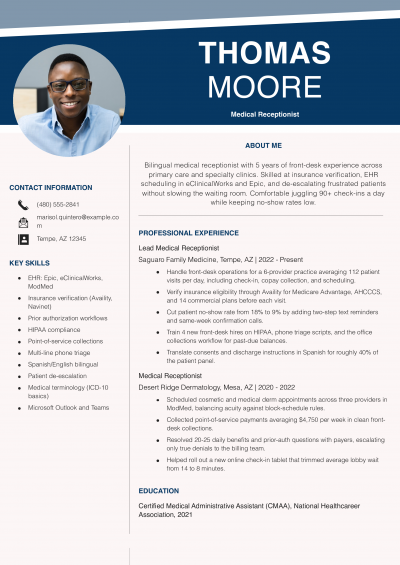
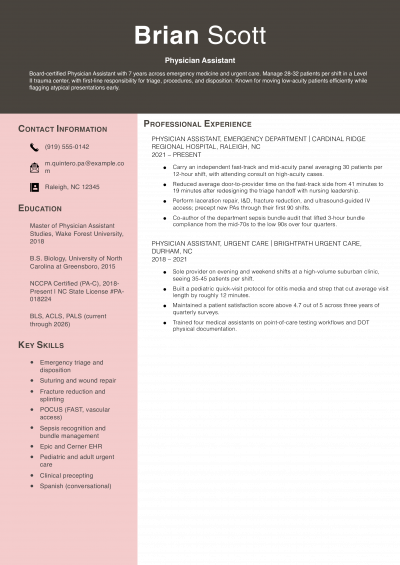
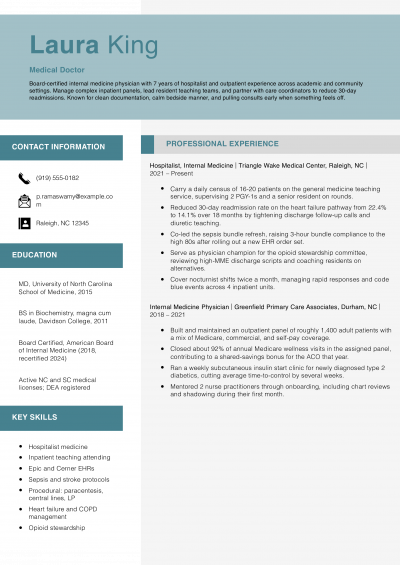
For a medical professional, an ATS-friendly template is the safest pick, because it puts your certifications and experience where a hiring manager scans first. A basic template is a solid alternative. Whichever you choose, keep the formatting clean and easy to parse: clear section headings, a standard font, and no graphics a parser can choke on.
Executive Resume Writer and Career Coach
Andrew Stoner is an executive career coach and resume writer with 17 years of experience as a hiring manager and operations leader at two Fortune 500 Financial Services companies, and as the career services director at two major university business schools.
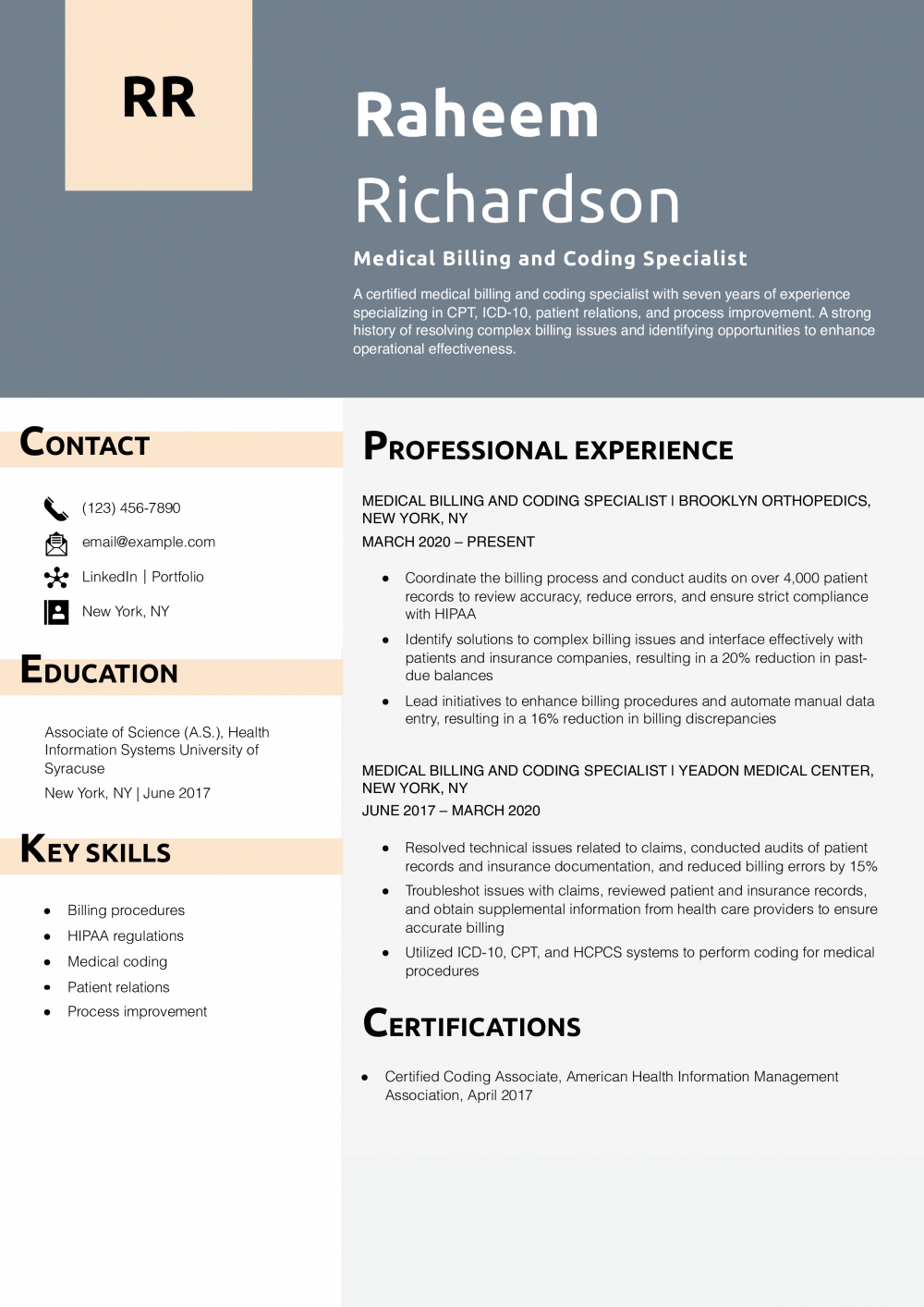
Customize this template in our builder in under 10 minutes.