Tip !

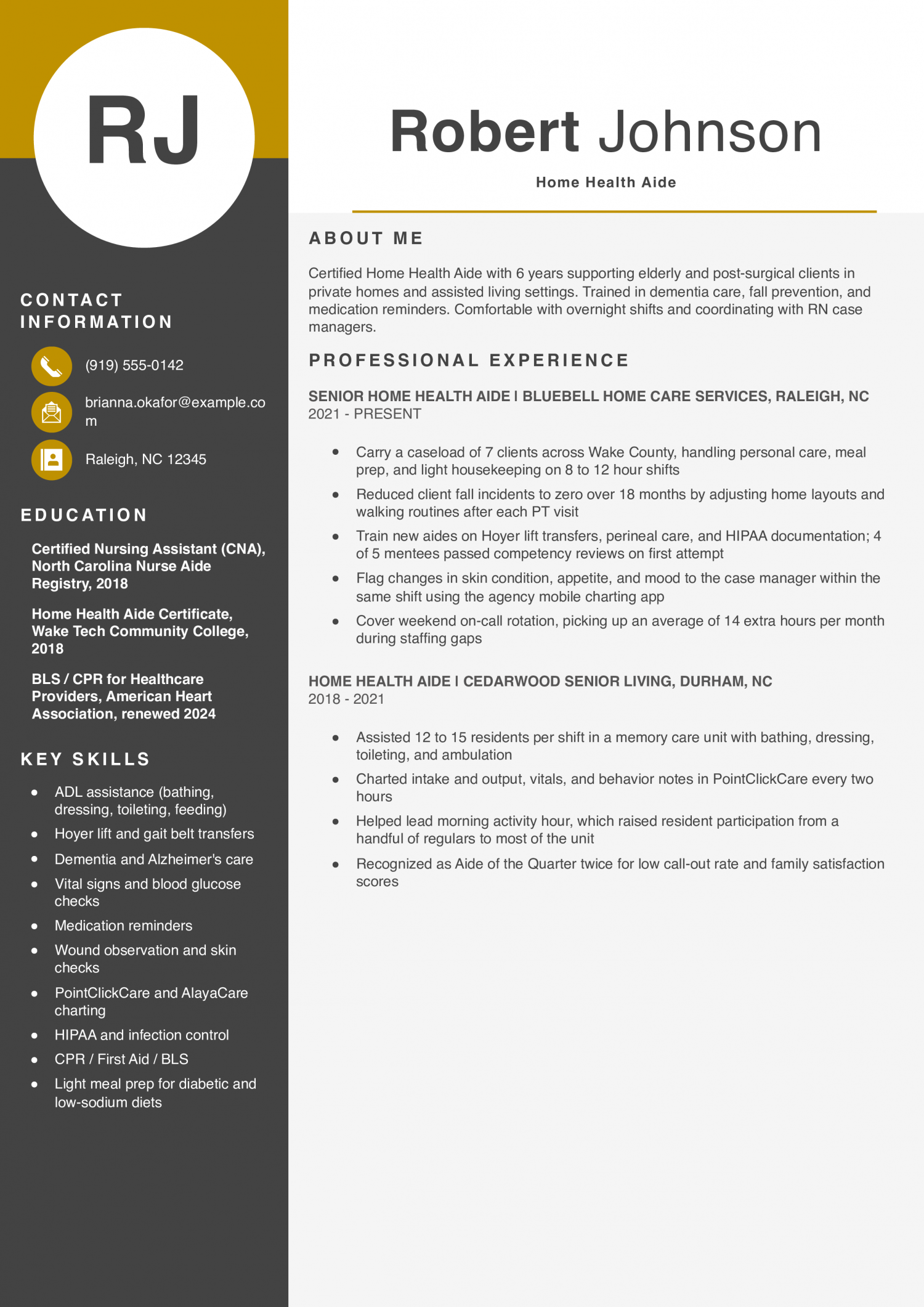
The home health aide resumes that get scheduled for an interview within a week share three things: a credentials block at the top with HHA and CPR dates, ADL bullets that name the actual tasks, and client-load context.

Andrew Stoner , Executive Resume Writer and Career Coach

Why this resume works

  • Safety result tied to a number: Zero falls over 18 months is the kind of concrete outcome agencies and families look for first.
  • Shows real caseload size: Naming 7 clients and 8 to 12 hour shifts tells a reader exactly how much this aide handles in a week.
  • Mentors newer aides: Training other aides and tracking how many passed competency reviews signals this candidate is ready for a lead role.

Entry Level Example

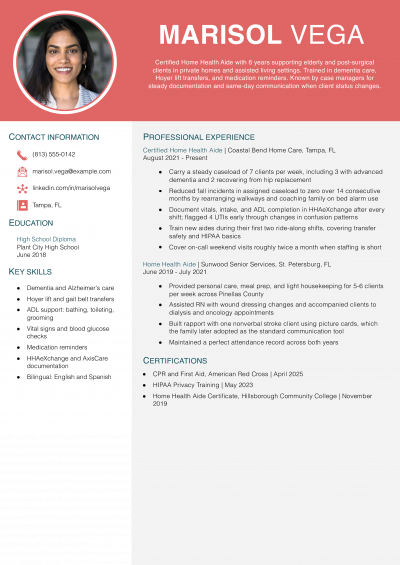
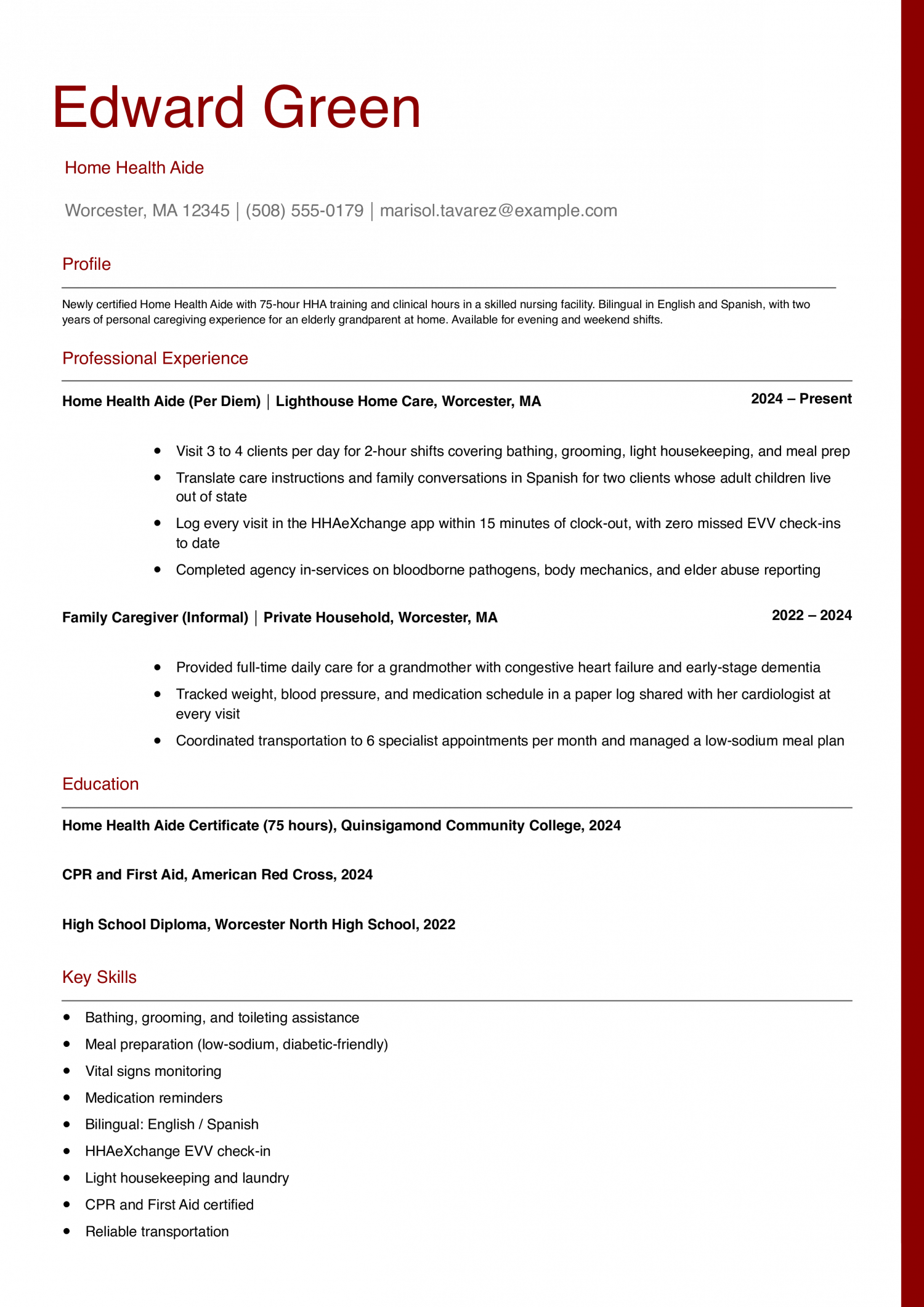
Entry-level home health aides are usually within a year of HHA or CNA training, often with clinical or personal caregiving hours but no agency tenure. The resume needs to prove your certification is current, your ADL training is hands-on, and you can hold a regular shift.

Why this resume works

  • Turns family caregiving into real experience: Listing two years of grandparent care with concrete tasks like medication logs gives this new HHA a credible work history.
  • Bilingual skill called out clearly: Agencies serving Spanish-speaking families will read that line and reach out first.
  • Shows reliable charting habits: Zero missed EVV check-ins tells a hiring manager this aide will not cause billing problems.

Experienced Example

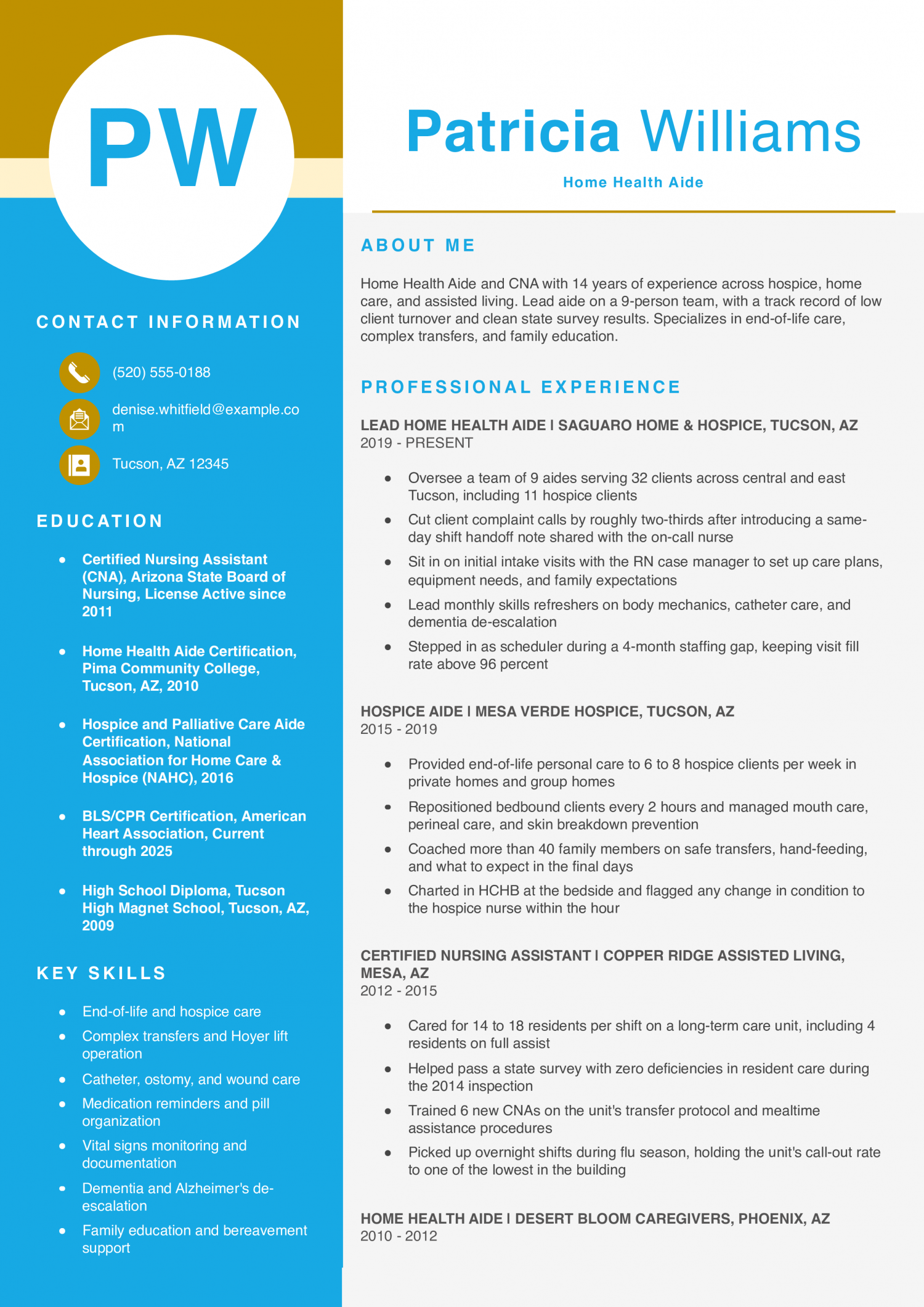
Experienced home health aides carry two or more years across private homes, hospice, or agency rotations with steady client loads. The resume needs to prove specialty exposure (dementia, post-op, palliative), retention with long-term clients, and clean compliance with care plans.

Why this resume works

  • Real leadership over a real team: Running 9 aides and 32 clients shows this is more than a senior aide; it’s a working lead role.
  • Concrete service improvement: Cutting complaint calls by about two-thirds with a specific change (handoff notes) is the kind of fix a director will remember at interview.
  • Clean state survey result: Zero deficiencies on a state inspection is a credential agencies trust more than any self-described strength.
  • Hospice depth, not just length: Family coaching numbers and bedside charting in HCHB tell a reader this aide actually handled end-of-life work, not just clocked years.

How to Write a Home Health Aide Resume

01 Open with what a credential check won't show

An HHA certificate is the floor, not the differentiator. Open your summary with the one thing another aide on the stack is unlikely to have.

Name a specialty: dementia and Alzheimer’s care, post-surgical recovery, hospice and end-of-life support, pediatric special needs, or bariatric transfers. Add a language other than English if you speak one, since bilingual aides move faster through staffing.

If you’ve held one client for over a year, lead with that retention number. Long-tenure private-duty work signals reliability that no certificate proves on its own.

02 Quantify clients, shifts, and ADL volume

Home health agency administrators and nurse managers scan for scope before they read duties. Bullets without a number tend to read as a job description, not a track record.

Name two or three real metrics: the number of clients you’ve supported (concurrent or over the year), shift length and pattern (12-hour overnights, four-day rotations), and ADL volume where it fits.

Strong bullet shape looks like: ‘Supported 4 clients per week across private homes, providing bathing, transfers, and medication reminders across 36-hour shift blocks.’ That reads differently than ‘assisted clients with daily activities.’

03 Group your work into care categories

Walls of duties hide your range. Group bullets under three or four care categories the reader already thinks in.

Personal care covers bathing, grooming, dressing, toileting, and incontinence care. Mobility and safety covers transfers, gait belts, fall prevention, and range-of-motion exercises. Health monitoring covers vital signs, blood glucose checks, medication reminders, and symptom reporting to the case nurse.

Household and care plan support covers meal prep for prescribed diets, light housekeeping, laundry, and documentation in the agency’s electronic visit verification system. Categories let a nurse manager confirm fit in seconds.

04 Put credentials and compliance up top

Home health agency administrators verify credentials before they read experience. Put a Credentials block on page one, right under the summary.

List your HHA certification with state and issuing program, CPR and First Aid with expiration month and year, TB test clearance date, and any add-ons (CNA, med tech, dementia care training, hospice volunteer hours).

Note your state license status as ‘in good standing’ without printing the certificate number. Add reliable transportation, a valid driver’s license, and auto insurance if you work private-duty or rural routes, since agencies screen for these early.

05 Close with education and continuing training

For entry-level and mid-tenure home health aides, education sits below experience but does real work. List your HHA or CNA training program, the state-approved hours completed, and graduation month and year.

Add a continuing education line for any CEUs you’ve taken in dementia care, hospice and palliative support, infection control, or HIPAA refreshers. Even short employer-paid modules belong here if they’re recent.

Skip an objective statement and skip references on the resume. The space reads better as one more client-care bullet or a second specialty line.

The home health aide resumes that get callbacks share a specific skill mix. The lists below come from our user-built home health aide resumes. Home health agency administrators and nurse managers scan for these patterns first, not generic compassion language.

Hard skills prove you can do the ADLs and run the documentation; soft skills back the bullets where retention and judgment showed up. Match the hard skills against the job posting, then use the soft skills as evidence anchors inside your experience bullets.

Soft Skills % of resumes with this skill
Compassion and empathy 80%
Patient communication 70%
Patience 49%
Reliability 37%
Time management 25%

And here are the top hard skills showing up most often.

Hard Skills % of resumes with this skill
Activities of daily living assistance 65%
Vital signs monitoring 58%
Medication reminders 43%
Personal hygiene care 38%
Wound care and first aid 35%

Based on data from thousands of home health aides’ resumes built on ResumeTemplates.com, May 2026.

Must Have on a Home Health Aide Resume

The items below are what separate a home health aide resume from one that gets put back in the pile.

Continuing Education That Belongs on the Resume

State HHA renewal usually requires a set number of in-service training hours per year. List the recent and relevant ones; skip the boilerplate.

Add a Continuing Education subsection under your Credentials or Education block. List the training name, the issuing body or employer, and the year.

Prioritize topics that match the role you’re applying for: dementia and Alzheimer’s care, hospice and palliative care, infection control, fall prevention, diabetes management, and Hoyer lift safety.

Keep the list to four or five recent items. Agencies care that you’ve kept training current, not that you can recall every module from five years back.

  • Dementia Capable Care Training, 2026
  • Bloodborne Pathogens and Infection Control, 2026
  • Hoyer Lift and Safe Transfer Techniques, 2026
  • End-of-Life and Hospice Care In-Service, 2026

HIPAA and OSHA Compliance

Home health aides see protected health information every shift. Your resume should show you know the rules without violating them in the document itself.

Never name a client by first or last name, even initials. Write ‘private-duty client with early-stage Alzheimer’s’ instead of identifying details.

Do not list a client’s address, diagnosis specifics tied to a date, or a family member’s name. Agencies treat this as a red flag and will move your resume to the bottom.

List any HIPAA training you’ve completed (annual agency module, online certificate) as a one-line entry under Continuing Education with the year.

  • Refer to clients by setting and condition, not name or initials
  • Aggregate client work (‘four clients per week’) rather than listing individuals
  • Add ‘HIPAA training, 2026‘ under Continuing Education
  • Skip photos of clients or care settings in any portfolio link

Background Checks and Working With Vulnerable Clients

Home health aide hiring runs through a deeper background process than most jobs. Your resume can either smooth that step or stall it.

Agencies and private families verify state HHA registry status, criminal history, abuse registries, and driving records before scheduling a first shift.

Anything you can confirm on the resume itself shortens the timeline. List your state HHA registry status as ‘active and in good standing’ without printing the registry number.

If your state requires fingerprint clearance or a TB test, add the most recent clearance date. These signals tell a staffing coordinator you’ve cleared the gates before.

  • Note ‘TB clearance current as of [month/year]’ in your Credentials block
  • Add ‘Valid driver’s license and reliable transportation’ if you travel between client homes
  • List CPR and First Aid with expiration month, not just ‘certified’
  • Mention ‘No findings on state HHA registry’ only if a posting asks; otherwise let the verification step confirm it

Home Health Care Credentials That Get You the Job

An active HHA certificate, CPR, and First Aid keep you eligible for most agency rosters. The certifications below are what move a home health aide resume from the qualified-but-typical stack into the shortlist for higher-paying private-duty and hospice work. List each one with the issuing body, completion date, and expiration month.

  • Certified Nursing Assistant (CNA): Adds skilled-task scope (vital signs, catheter care, more complex transfers) and unlocks home health agencies that bill at a higher rate.
  • Certified Dementia Practitioner (CDP): Signals you can handle behavior changes, sundowning, and family coaching, which private-duty memory care families pay a premium for.
  • Hospice and Palliative Care Certification: Shows you can hold steady through end-of-life shifts, a skill hospice agencies screen for explicitly when filling open routes.
  • Medication Aide or Med Tech Certification: Where your state allows it, this lets you administer (not just remind) and qualifies you for assisted living and group home roles.

Allied Health Credentials That Open More Doors

Stacking one allied health credential on top of your HHA certificate moves you into roles that pay above the home care median. Pick the one that matches the work you want next.

  • CNA: state-approved program plus competency exam, typically 75 to 150 hours
  • PCT: builds on CNA with phlebotomy and EKG modules
  • Med Tech: state-specific; check your state board for scope and renewal
  • Restorative Aide: adds range-of-motion and rehab support skills for post-acute work

Latest BLS Statistics for Home Health Aides

Home health aide is one of the larger occupations in BLS data, which means the median pulls in a long tail of part-time, agency-pool, and minimally certified variants. The spread between the 10th and 90th percentile is narrower than in most healthcare roles, so small differentiators (a specialty cert, a long-term private-duty client, bilingual care) move pay more than they would elsewhere.

To position above the median, lead your resume with the credential stack and care specialty, not the number of years on the job.

$34,900 National median annual
$34,990 National mean annual
$25,600 Entry-tier floor (10th percentile)
$44,190 Top-decile ceiling (90th percentile)
3,988,140 Home Health Aides in the U.S.
Where you stand

Entry tier

$25,600 to $34,900 At the entry tier, lead with your HHA certificate, CPR and First Aid dates, and clinical or practicum ADL hours from your training program.

Mid band

$34,900 to $44,190 At the mid band, your resume needs to show two-plus years of client load, EVV documentation use, and one named specialty like dementia or post-op.

Top decile

$44,190+ At the top decile, lead with CNA or med tech credentials, hospice or memory care specialty, and long-term private-duty retention with one client.

Top-paying states

# State Avg. Annual
1 Washington $46,140
2 Rhode Island $41,890
3 Oregon $41,490
4 Massachusetts $39,520
5 District of Columbia $39,420
6 North Dakota $39,100
7 Alaska $38,370
8 Connecticut $38,200
9 New York $37,980
10 Maine $37,670

Highest-employment states

# State Workers Median
1 California 875,110 $34,600
2 New York 623,000 $37,980
3 Texas 314,610 $23,470
4 Pennsylvania 242,570 $29,310
5 Minnesota 120,390 $36,200
Source: U.S. Bureau of Labor Statistics, OEWS 2024 release (SOC 31-1120).
Written by professional resume writers and loved by hiring managers

Resume Templates offers HR approved resume templates to help you create a professional resume in minutes. Choose from several template options and even pre-populate a resume from your profile.

Frequently Asked Questions

How do you describe a home health aide on a resume?

Describe yourself by the care setting, your certification, and the ADLs you actually perform.

A summary like 'HHA-certified caregiver with three years supporting up to four private-duty clients per week, specializing in dementia care and post-surgical recovery' reads stronger than a generic line.

Skip phrases like 'compassionate caregiver' on their own and pair any soft trait with proof in a bullet.

How do you write a good summary for a home health aide resume?

Keep it to three sentences. Open with your certification and years of care experience.

Name the setting (private home, hospice, agency, assisted living), then close with one specialty or population.

Add a language other than English if you speak one, since bilingual aides clear screening faster at urban agencies.

How do I handle a gap in care work on my resume?

List the gap honestly with a one-line label like 'Family caregiver, 2023 to 2024' if you cared for a relative.

Include the ADLs you performed, even unpaid, since nurse managers count this as relevant experience.

If the gap was unrelated, put your most recent role first and let the experience section carry the weight.

Should I list every client or every agency I've worked for?

List agencies, not individual clients. Private-duty clients stay confidential, so write 'Private-Duty Home Health Aide, self-employed' or 'Private-Duty HHA via [Agency Name]' as your employer line. Then aggregate the work in bullets: 'Supported four to six clients per year across dementia, post-op, and hospice cases.' This protects client privacy and reads cleaner than a fragmented job history.

Which resume template works best for a home health aide?

For a home health aide, an ATS-friendly template is the safest pick, because it puts your certifications and experience where a hiring manager scans first. A basic template is a solid alternative. Whichever you choose, keep the formatting clean and easy to parse: clear section headings, a standard font, and no graphics a parser can choke on.

Rate this article

Home Health Aide Resume

Average Rating

4.2/5 stars with 131 reviews

You have given 0 Star(s)
4.2/5 stars with 131 reviews
Andrew Stoner

Executive Resume Writer and Career Coach

Andrew Stoner is an executive career coach and resume writer with 17 years of experience as a hiring manager and operations leader at two Fortune 500 Financial Services companies, and as the career services director at two major university business schools.