Tip !

Directors of nursing decide within the first ten seconds whether to keep reading by checking the header for registry status, BLS, and patient-load context; if those three signals are not visible, the resume gets set aside.

Andrew Stoner , Executive Resume Writer and Career Coach

Why this resume works

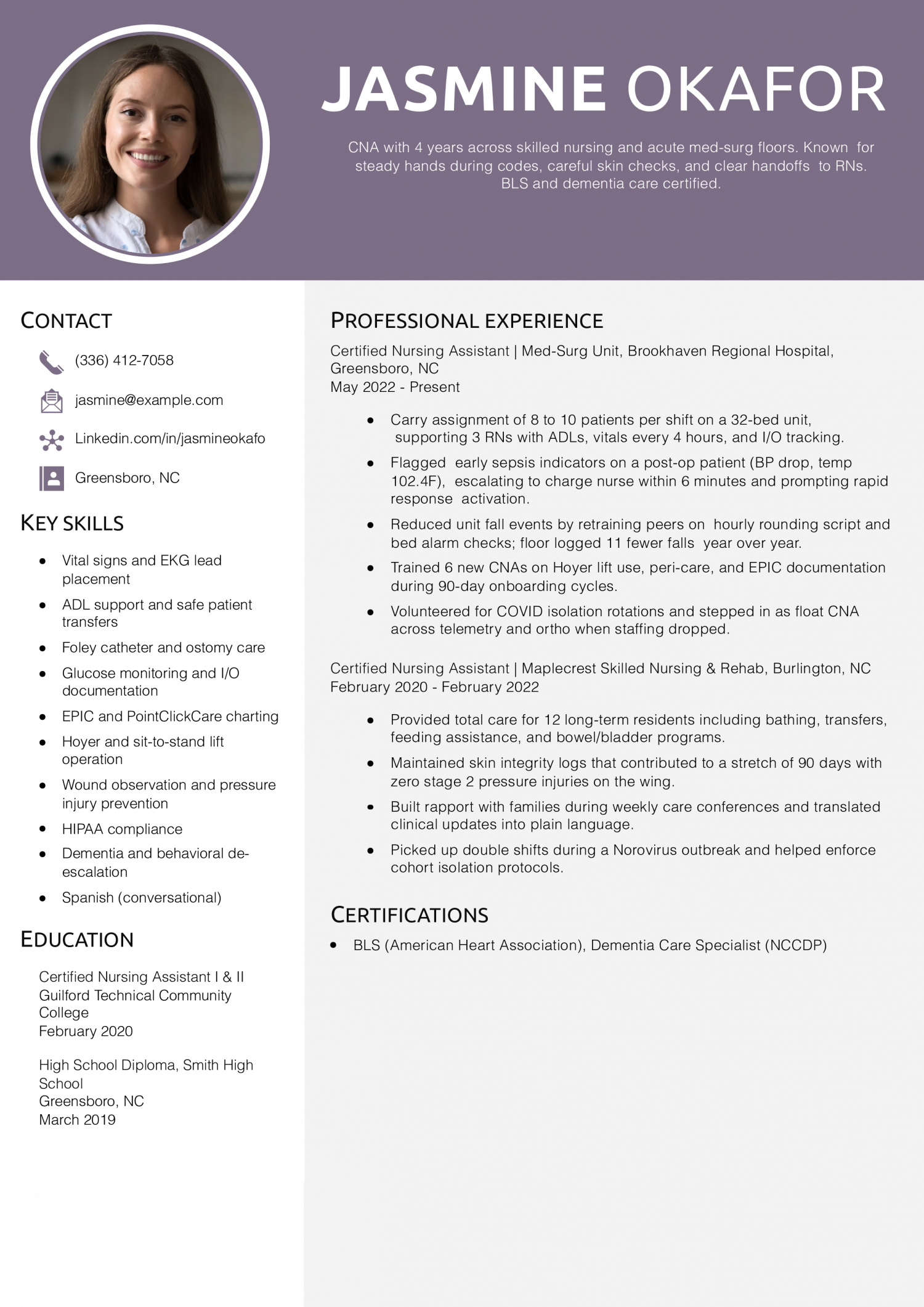
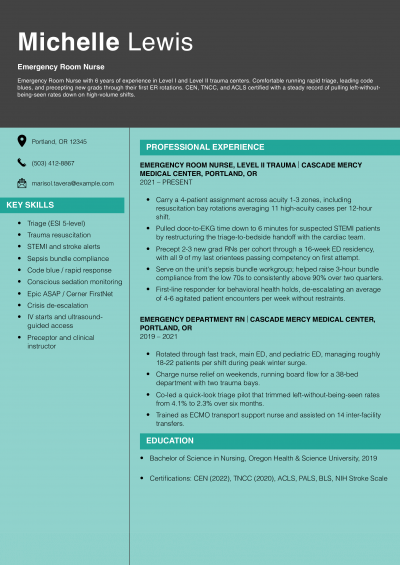
  • Caught a patient going downhill: The sepsis escalation bullet shows real clinical judgment, not just task work, which is what charge nurses look for.
  • Numbers tied to patient safety: Specific counts (11 fewer falls, 90 days without pressure injuries) prove the candidate moves quality metrics, not just completes tasks.
  • Trained newer CNAs: Onboarding 6 new hires signals reliability and readiness for charge CNA or preceptor roles.

Entry Level Example

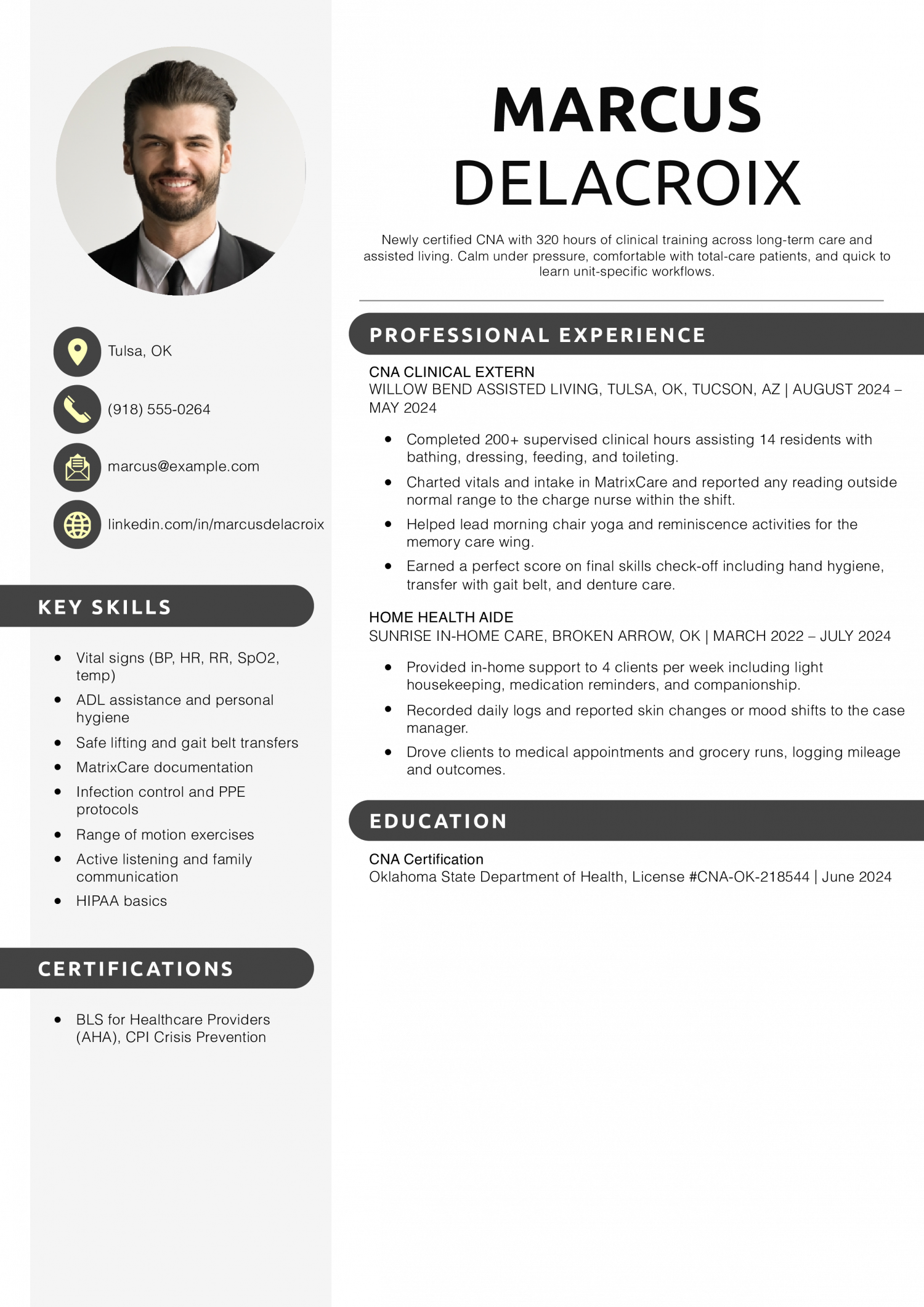
You finished your state-approved program in the last 18 months and need the resume to read as ready for a 1:8 or 1:10 assignment. The Entry Level tab leads with registry status, clinical hours, and the populations you rotated through.

Why this resume works
  • Clinical hours up front: Leading with 320 supervised hours tells hiring managers this candidate is ready for the floor, even without paid CNA history.
  • Real prior care work: Home health aide experience shows the candidate already does the job, which lowers training risk for the manager.
  • Listed the license number: Including the state license number and issuing body speeds up credentialing and HR verification.

Experienced Example

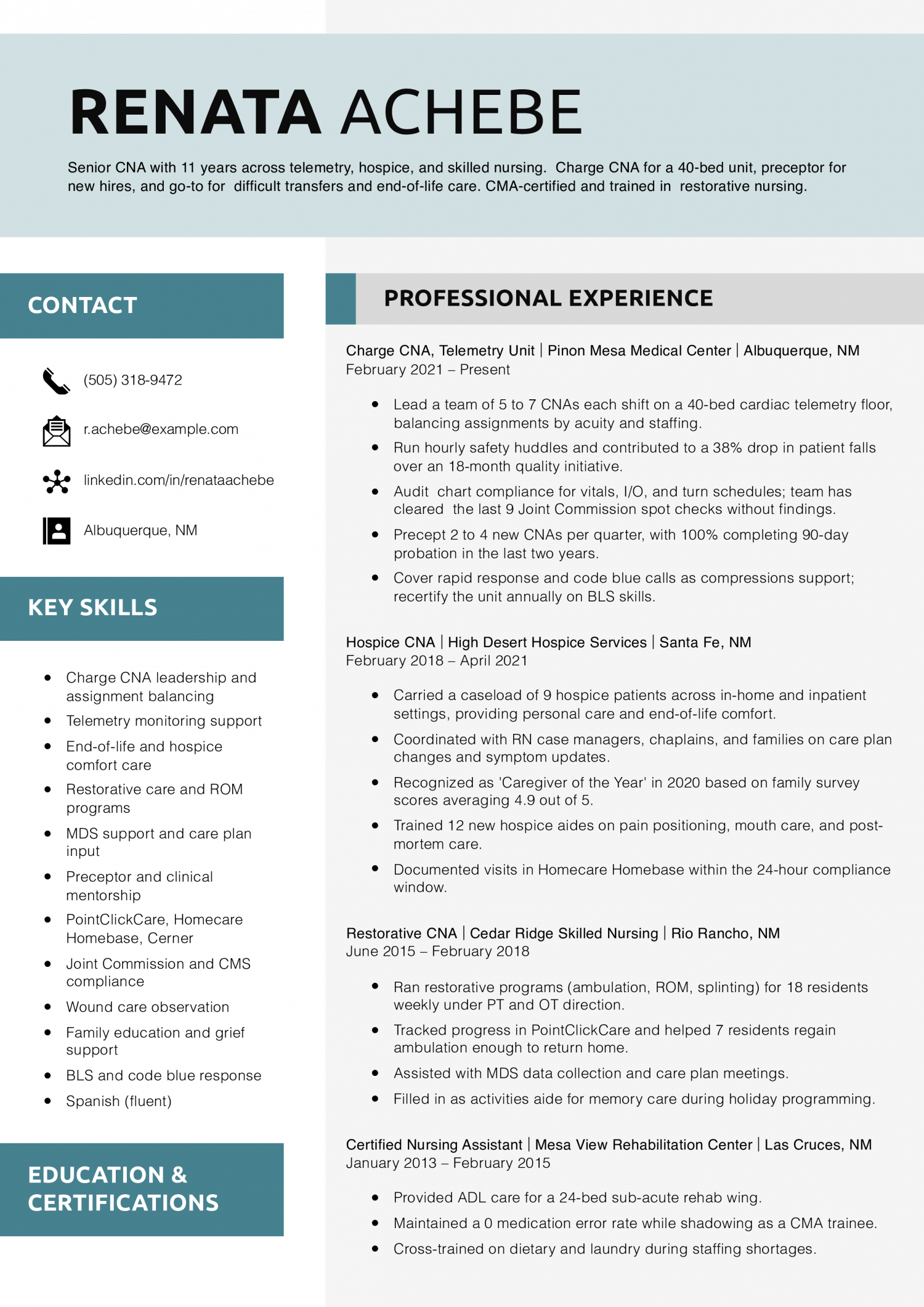
You have two-plus years on the floor and have likely trained newer aides or floated between units. The Experienced tab proves acuity, charting fluency in PointClickCare or Epic, and reliability signals like attendance and lift-team work.

Why this resume works
  • Leads a team, not just patients: Running 5 to 7 CNAs as charge proves leadership at the bedside, which is what large hospitals pay senior CNAs for.
  • Audit and survey track record: Joint Commission spot checks cleared without findings is hard evidence the candidate can pass real inspections.
  • Career grew with the work: The job titles climb from CNA to restorative to hospice to charge, showing range across the most common CNA settings.

How to Write a Certified Nursing Assistant Resume

01 Open with what a registry lookup cannot show

A state registry lookup confirms you are a CNA in good standing. It does not show the setting you worked in or the patients you carried.

Put that on line one. Name the population, the acuity, and the charting system you used.

A line like ‘CNA, 28-bed memory care unit, 1:9 ratio, PointClickCare’ tells a director of nursing more than three bullets of generic ADL language.

02 Quantify the bedside load

Most strong CNA bullets carry a number. Patient ratio, bed count, shift length, and lift assists are the metrics directors of nursing scan for first.

Write the patient load you carried, not the unit’s total census. ‘Cared for 9 to 11 residents per shift on a skilled nursing unit’ beats ‘provided compassionate care.’

Add vitals frequency, turn schedules, and intake/output tracking where they apply. Bullets without a number tend to read as duties rather than work.

03 Group bedside work by category

Break your bullets into four buckets so a charge nurse can scan them fast. ADLs and mobility come first: bathing, toileting, transfers, gait belts, Hoyer lifts.

Then clinical monitoring: vitals, blood glucose checks, intake and output, skin checks, fall precautions. Then documentation in PointClickCare, MatrixCare, or Epic.

Last, communication: handoff to RNs, family updates, and behavior logs on the memory care side. This grouping mirrors how unit managers think about your day.

04 Place credentials in the header

Your active CNA status, BLS or CPR, and any state-specific add-ons belong in the header block, not buried at the bottom.

List the state and ‘in good standing’ rather than your registry number. Add the issuing body and expiration month for BLS.

If you carry dementia care training, phlebotomy, or restorative aide certification, list those next. Directors of nursing match these against the unit’s staffing gaps before reading your job history.

05 Close with clinicals or recent training

End the resume with your CNA program, clinical hour count, and the facilities you rotated through. For newer CNAs, this section carries weight.

Name the school, the program length, and the practicum site. Add any continuing education completed in the last 12 months: dementia care, infection control, or wound care basics.

If you have a high school diploma or GED only, list it on one line. Do not pad this section with coursework unrelated to bedside care.

ATS filters catch more certified nursing assistant resumes than ever in 2026. The skills below come from our user-built CNA resumes. Charting system names and patient-care procedures clear the first cut, and reliability language decides whether the resume advances.

Directors of nursing weight hard skills like PointClickCare fluency and Hoyer lift training first, then read soft skills as evidence backing your bullets. Match these against the posting and use the soft skills as proof points inside your work history.

Soft Skills % of resumes with this skill
Compassion 77%
Communication 51%
Attention to detail 45%
Patience 35%
Teamwork 26%

And here are the top hard skills showing up most often.

Hard Skills % of resumes with this skill
Vital signs monitoring 77%
Activities of daily living 56%
Patient transfers and mobility 49%
Infection control 37%
Electronic health records 28%

Based on data from thousands of certified nursing assistants’ resumes built on ResumeTemplates.com, May 2026.

Must Have on a Certified Nursing Assistant Resume

The items below are what separates a certified nursing assistant resume that clears credentialing from one that gets put back in the pile.

Continuing Education Hours to Track

Most states require a set number of in-service hours per year to keep CNA registry status active. Listing recent CE on your resume signals you stay current without being asked.

Track your CE in a dated list at the bottom of the resume. Name the topic, the provider, and the hour count. Infection control, dementia care, and wound recognition are the topics that read strongest for floor work.

Check your state board for the current annual clock-hour requirement. Hours completed beyond the minimum are worth listing when you are competing for acute care or specialty unit roles.

  • Dementia care and behavior management
  • Infection control and standard precautions
  • Skin integrity and wound recognition
  • Fall prevention and safe patient handling
  • End-of-life and hospice care basics

EMR and Charting Systems to Name

Most CNA postings filter on the charting system the facility uses. Naming the system by brand tells the parser and the director of nursing you can start documenting on day one.

  • PointClickCare (ADL charting, vitals, behavior notes):
  • MatrixCare (long-term care documentation):
  • Epic (Rover mobile vitals, flowsheets):
  • Cerner PowerChart (acute care documentation):
  • Meditech Expanse (vitals and I/O entry):

HIPAA and OSHA Compliance

Directors of nursing read your resume itself as a HIPAA test. Names, room numbers, and facility-identifiable detail in your bullets are a red flag.

Quick HIPAA check before you send

Describe patients by population and acuity, never by identifier. ‘Cared for a 1:9 memory care assignment’ is safe. ‘Cared for Mrs.

K in room 214’ is not, even as a hypothetical.

List annual HIPAA training as a one-line item under continuing education. Do not paste screenshots, photos, or scans of facility documents into a portfolio.

Nursing Assistance Credentials That Get You the Job

An active state CNA registry status and BLS keep you eligible. The certifications below are what move a CNA resume from the qualified-but-typical stack into a director of nursing’s shortlist. List each with the issuing body and expiration month.

  • Certified Dementia Practitioner (CDP): Signals you can work memory care units without retraining, which is a constant staffing pressure point in long-term care.

  • Restorative Nursing Assistant (RNA): Tells skilled nursing facilities you can run range-of-motion and ambulation programs that drive their MDS reimbursement.

  • Phlebotomy Technician (CPT): Adds a billable skill in acute and clinic settings where CNAs cross-trained on draws move into expanded patient-care roles.

  • Certified Medication Aide (CMA or QMA): State-specific credential that lets you pass medications in long-term care; pay bumps follow in most states that recognize the role.

Allied Health Add-Ons That Open Doors

Beyond the base CNA, a handful of allied health credentials widen the roles you qualify for and the pay bands you can target. Pick ones that match the setting you want next.

  • Certified Medication Aide (CMA or QMA), state-issued:
  • Restorative Nursing Assistant (RNA):
  • Certified Phlebotomy Technician (CPT) through NHA or ASCP:
  • EKG Technician (CET) through NHA:
  • Home Health Aide (HHA) certification:
  • Certified Dementia Practitioner (CDP):

Latest BLS Statistics for Certified Nursing Assistants

Certified nursing assistant is one of the larger occupations in BLS, which means the median pulls in a long tail of entry-tier and float-pool variants across nursing homes, hospitals, and home health.

The spread between the 10th and 90th percentile is narrower than for licensed roles, so specialty add-ons and setting do most of the lifting. To position above the median, lead the resume with acuity, charting system, and the credential stack beyond the base CNA.

$39,530 National median annual
$41,270 National mean annual
$31,390 Entry-tier floor (10th percentile)
$50,140 Top-decile ceiling (90th percentile)
1,388,430 Certified Nursing Assistants in the U.S.
Where you stand

Entry tier

$31,390–$39,530 At the entry tier, lead with registry status, clinical hour count, and the populations you rotated through during your practicum.

Mid band

$39,530–$50,140 At the mid band, your resume needs to show patient ratios, charting fluency in PointClickCare or Epic, and any restorative or dementia certifications.

Top decile

$50,140+ At the top decile, lead with charge aide or preceptor work, acute or specialty unit experience, and medication aide or phlebotomy add-ons.

Top-paying states

# State Avg. Annual
1 Oregon $48,390
2 Washington $48,260
3 New York $47,390
4 District of Columbia $46,860
5 California $46,420
6 New Hampshire $46,050
7 Alaska $45,840
8 Maine $45,640
9 Minnesota $45,580
10 Massachusetts $45,410

Highest-employment states

# State Workers Median
1 California 102,380 $46,420
2 Florida 91,280 $36,850
3 Texas 87,050 $36,390
4 New York 85,310 $47,390
5 Pennsylvania 65,410 $41,110
Source: U.S. Bureau of Labor Statistics, OEWS 2024 release (SOC 31-1131).
Written by professional resume writers and loved by hiring managers

Resume Templates offers HR approved resume templates to help you create a professional resume in minutes. Choose from several template options and even pre-populate a resume from your profile.

Frequently Asked Questions

How do you describe a CNA job on a resume?

Lead each role with the setting, bed count, and patient ratio. A line like '28-bed skilled nursing unit, 1:9 ratio' anchors the rest of your bullets.

Then list ADLs, vitals frequency, charting system, and specialty work. Memory care, post-op recovery, and hospice all read differently to a director of nursing.

Numbers carry more weight than adjectives. Skip 'compassionate' and write the patient load instead.

How do I put my CNA certification on my resume?

List the state, the credential, and 'in good standing' in the header block. Format it as 'Certified Nursing Assistant, [State] Nurse Aide Registry, in good standing.'

Do not include your registry number. Facilities verify that themselves through the state registry, and posting the number creates needless exposure.

Add the issuing body and expiration month for BLS or CPR on the next line.

What CNA responsibilities should I list on a resume?

Group responsibilities into four buckets: ADLs and mobility, clinical monitoring, documentation, and communication with the care team.

Each bucket carries two or three bullets with a number attached. Patient ratio, vitals frequency per shift, and transfers per day are the metrics charge nurses recognize.

Skip generic 'assisted residents' phrasing. Name the lift equipment, the charting system, and the unit type.

I have a gap between my CNA program and my first job. How do I handle it?

Address the gap in a one-line note under your education section. 'CNA registry maintained in good standing; BLS renewed [month, year]' covers most situations.

If you took a refresher course or did clinical hours to reactivate, list those. A short volunteer stint at a long-term care facility also works.

Directors of nursing care more about current credentials and ratio readiness than continuous employment.

What's the best resume template for a certified nursing assistant?

For a certified nursing assistant, an ATS-friendly template is the safest pick, because it puts your certifications and experience where a hiring manager scans first. A basic template is a solid alternative. Whichever you choose, keep the formatting clean and easy to parse: clear section headings, a standard font, and no graphics a parser can choke on.

Rate this article

Certified Nursing Assistant Resume

Average Rating

4.1/5 stars with 101 reviews

You have given 0 Star(s)
4.1/5 stars with 101 reviews
Andrew Stoner

Executive Resume Writer and Career Coach

Andrew Stoner is an executive career coach and resume writer with 17 years of experience as a hiring manager and operations leader at two Fortune 500 Financial Services companies, and as the career services director at two major university business schools.