Occupational Therapy Resume Examples and Templates for 2026



An active certification line and a current CPR date are what get home health aide resumes past the agency credentialing screen; named patient populations and concrete ADL bullets are what make them readable enough to advance to a phone screen.
Why this resume works
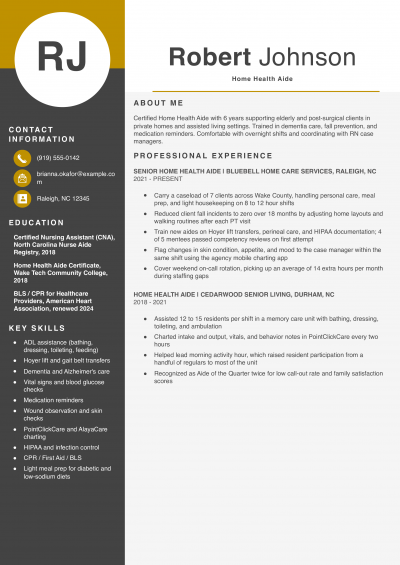
This profile fits aides finishing certification or working their first agency assignment. The entry-level resume needs to prove an active HHA credential, CPR and first aid, and the ADLs and vital-signs work logged during clinicals.
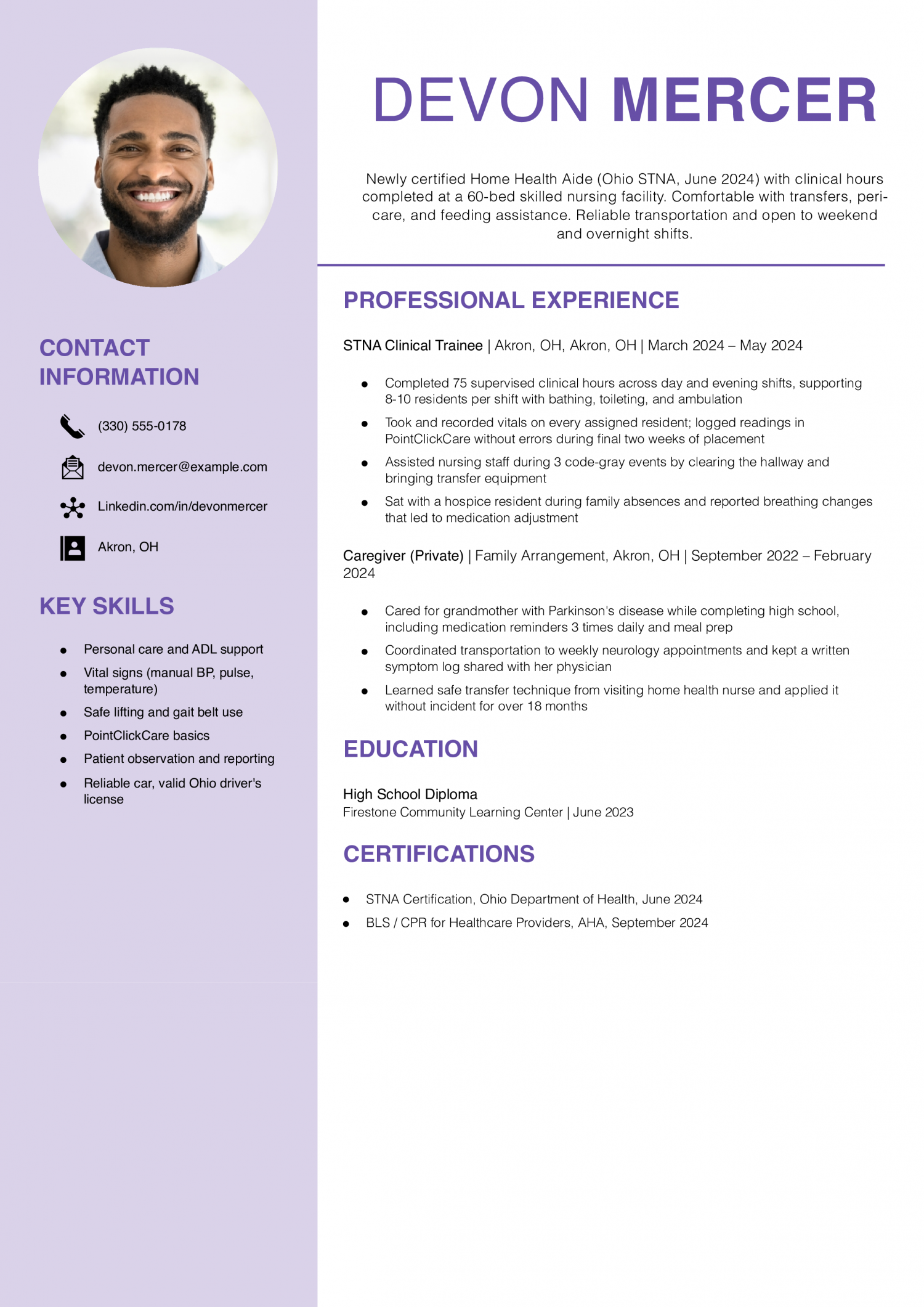
Why this resume works
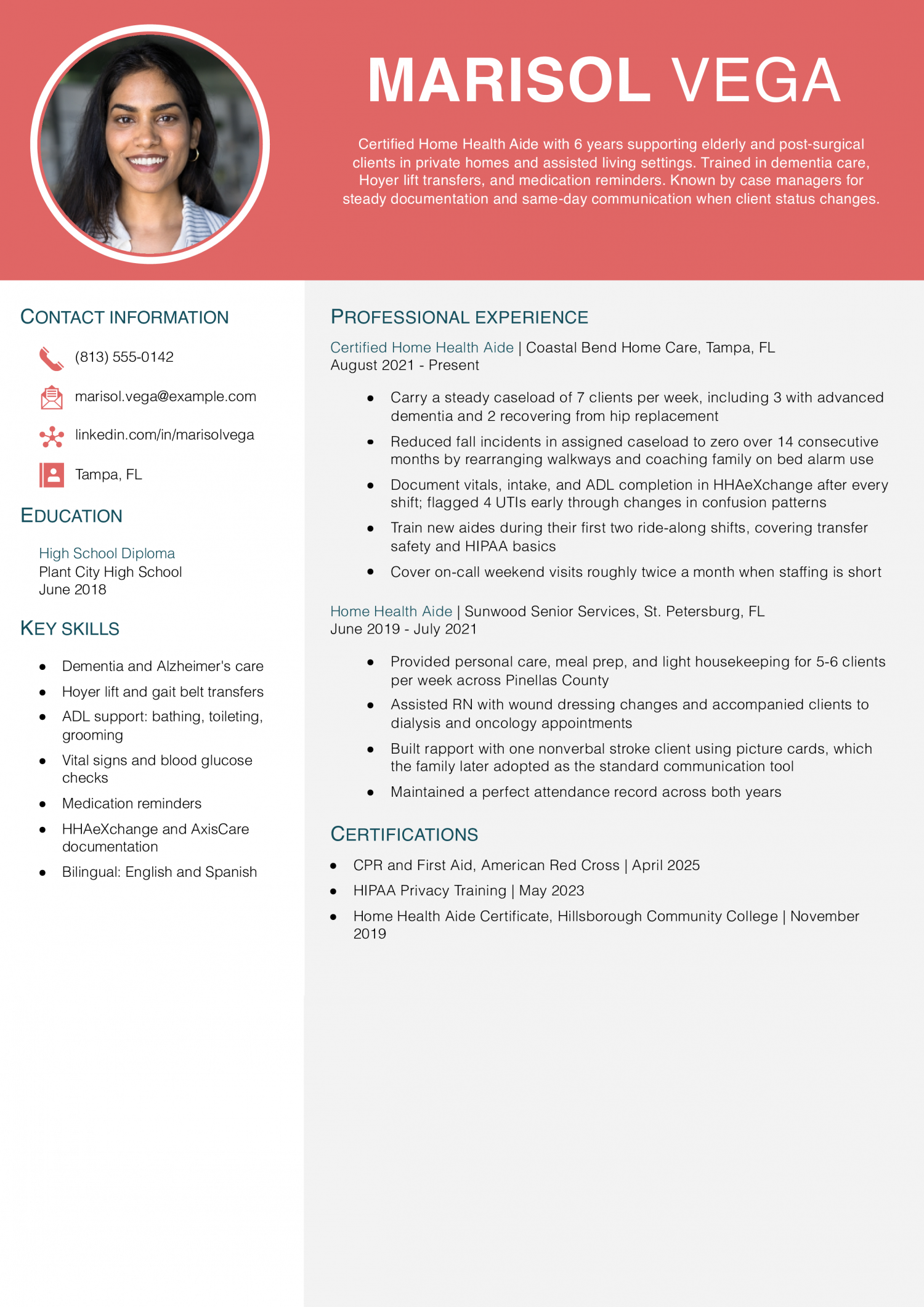
This profile fits aides with two or more years of in-home or facility care across mixed caseloads. The experienced resume needs to prove population depth (dementia, hospice, pediatric) and reliable documentation against the agency's care plan.
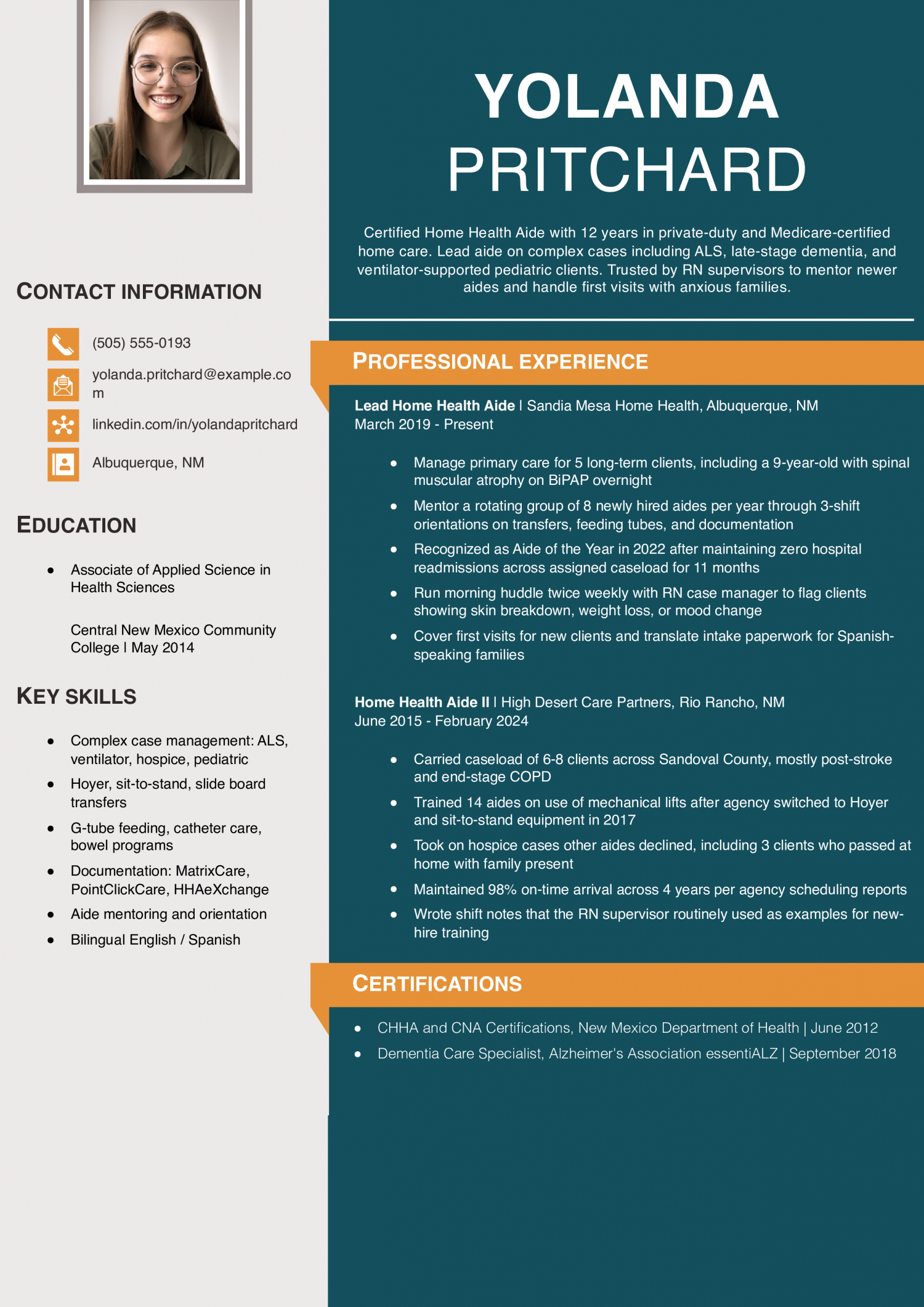
Why this resume works
Rashida Calloway
Greensboro, NC | (336) 555-0166 | [email protected] | linkedin.com/in/rashidacalloway
Certified Home Health Aide with 8 years in Piedmont Triad home care and assisted living. Comfortable with dementia behaviors, end-of-life care, and clients transitioning home after orthopedic surgery. Steady documentation, dependable transportation, and a track record of staying with long-term clients through the full arc of care.
Senior Home Health Aide
Piedmont Trail Home Care | Greensboro, NC | 2021-Present
Home Health Aide
Magnolia Crest In-Home Services | High Point, NC | 2018-2021
Certified Nursing Assistant
Brookhaven Assisted Living | Winston-Salem, NC | 2016-2018
Personal Care Aide
Heartland Companion Services | Burlington, NC | 2015-2016
Lead your summary with a verifiable number, not a scope statement. Name your case load size, the populations you served, and your years on home care shifts.
Branch directors and scheduling coordinators read the first two lines as a staffing decision. A summary like ‘3 years HHA, 6 to 8 weekly cases, dementia and post-surgical’ beats ‘compassionate caregiver dedicated to patient well-being.’ Add your active HHA certification and CPR status on the same line if space allows.
Most strong home health aide resumes name a population, a case rhythm, and a credential in the first 30 words.
Home care work has numbers most aides forget to write down. Name weekly case count, shift length, patient acuity, and how many ADLs per shift you support.
Bullets without a number tend to read as duties. ‘Supported 6 weekly clients across 8-hour shifts, including 2 dementia cases and 1 hospice transition’ tells a scheduler what you can absorb.
Recruiters scan for shift type (live-in, hourly, overnight) and whether you have handled Hoyer lifts, two-person transfers, or G-tube feeding. Name these directly.
Cluster your bullets into three or four buckets so a reader can find the skill they need. Useful categories: personal care and ADLs, vital signs and observation, mobility and transfers, and household and meal support.
Within each bucket, name the populations: dementia, hospice, pediatric, post-stroke, or post-surgical. Add the equipment you have used, like gait belts, mechanical lifts, blood pressure cuffs, and glucometers.
This structure helps a coordinator staffing a specific case match you to the client in under a minute.
Your HHA certification, CPR and first aid status, TB clearance, and any state registry listing belong in a credentials block on page one, directly under your summary. Home health administrators and nurse managers need to confirm you are billable before they read your experience.
List the state where you are certified and note ‘in good standing,’ but do not publish the certification number itself. Add CPR or BLS expiration month and year so the reader can see it is current.
If you completed dementia training, hospice training, or medication reminder coursework, list those here too. If personal care work is on your list, see our personal care assistant resume examples for ways to present your credentials.
End with your HHA training program, the hours completed, and your high school diploma or GED. Name the training site, the state-approved program, and the completion year.
If you have CNA, PCA, or DSP credentials in addition to HHA, list them here. Add languages spoken at conversational or fluent level, since bilingual aides often get matched to clients faster.
Skip a generic ‘references available’ line and use the space for one more care skill or population instead.
The certified home health aide resumes that get callbacks share a specific skill mix. The lists below come from our user-built home health aide resumes. Home health administrators and nurse managers scan for these patterns first, not generic compassion language.
Hard skills carry more weight here than soft skills, because agencies staff by clinical capability. Soft skills matter, but treat them as evidence for your bullets, not standalone claims. Match these lists against the agency posting you are targeting and rewrite your bullets to mirror the exact phrasing they use.
| Soft Skills | % of resumes with this skill |
|---|---|
| Compassion | 73% |
| Patience | 52% |
| Communication | 41% |
| Reliability | 39% |
| Time management | 29% |
And here are the top hard skills showing up most often.
| Hard Skills | % of resumes with this skill |
|---|---|
| Activities of daily living assistance | 74% |
| Vital signs monitoring | 56% |
| Medication reminders | 50% |
| Mobility and transfer assistance | 37% |
| CPR and first aid | 31% |
Based on data from thousands of certified home health aides’ resumes built on ResumeTemplates.com, May 2026.
The items below are what separates a certified home health aide resume that clears credentialing from one that gets put back in the pile.
Most state home care registries require continuing education hours each year to keep your HHA status active. List the topics and hours, not the certificate ID.
Continuing education tells a coordinator which case types you have trained for recently. It also confirms your registry status is current.
Group your CE under one header and list each course with the hour count and the year completed.
Your resume is a HIPAA artifact. How you describe cases tells agencies whether you can be trusted in a client home.
Never name a client, list a client address, or include identifying details like age plus condition plus city. That combination can identify a real person.
Describe cases by population, care setting, and clinical task. Agencies read this as a signal that you understand patient privacy.
Home health agencies run state and federal background checks on every aide before staffing. Address this directly on your resume by listing your registry status and any cleared screenings.
Most states maintain a home care aide registry and a separate abuse and neglect registry. Agencies pull both before you are placed on a case.
If you have a record, do not list it on the resume. Address it during the agency conversation when asked, with documentation in hand.
Home health administrators and nurse managers read this list as a map of where your care work is heading. The credentials below tell them which population track, hospice, dementia, pediatric, or chronic care, you have invested in. List each certification with the issuing body and the year you completed it.
Stacking an allied health credential on top of HHA opens cases that pure HHA registry status does not. These are the credentials agencies pay more for.
Top-paying states for certified home health aides cluster in tight-labor regions with strong Medicaid reimbursement rates and aging populations, not the largest metro areas most aides assume. Reimbursement structure, union density, and workforce shortages drive the spread more than cost of living. If you are open to relocation or travel-aide assignments, foreground your multi-state HHA registry listings and any reciprocity-eligible CNA credential at the top of your resume.
That portability is what regional agencies pay a premium for.
| # | State | Avg. Annual |
|---|---|---|
| 1 | Washington | $46,140 |
| 2 | Rhode Island | $41,890 |
| 3 | Oregon | $41,490 |
| 4 | Massachusetts | $39,520 |
| 5 | District of Columbia | $39,420 |
| 6 | North Dakota | $39,100 |
| 7 | Alaska | $38,370 |
| 8 | Connecticut | $38,200 |
| 9 | New York | $37,980 |
| 10 | Maine | $37,670 |
| # | State | Workers | Median |
|---|---|---|---|
| 1 | California | 875,110 | $34,600 |
| 2 | New York | 623,000 | $37,980 |
| 3 | Texas | 314,610 | $23,470 |
| 4 | Pennsylvania | 242,570 | $29,310 |
| 5 | Minnesota | 120,390 | $36,200 |
Resume Templates offers HR approved resume templates to help you create a professional resume in minutes. Choose from several template options and even pre-populate a resume from your profile.
Name the reason briefly and date your credentials so the reader knows you are ready to staff. Gaps for family caregiving, your own health, or pandemic-era furlough are common in this field.
Add a one-line note in your work history like 'Family caregiver, full-time, 2023 to 2024' if the gap is over six months. Then confirm your HHA certification is active and your CPR date is current.
Agencies care more about credential status than the gap itself.
No. List private-duty work by case type and dates, not by client name or home address.
Write the role as 'Private-duty home health aide, 2022 to 2024' and describe the case by population: '24-hour care for a post-stroke client with mobility limitations.' This matches how HIPAA-aware agencies expect aides to talk about cases.
If a recruiter asks for references, you can share names verbally with client consent at that point.
List the state where you are currently certified and note that you have applied for reciprocity or testing in the target state.
Home care registries are state-specific, so a branch director cannot staff you in a state where you are not on the registry. Write 'HHA, State of [origin state], in good standing. Reciprocity application submitted to [target state] [month/year].'
This shows you are aware of the registry requirement and have started the process.
Use neutral, professional language and frame the case by your role, not the outcome.
Write 'Provided 8-hour daily hospice support for a late-stage cancer client, including pain comfort measures and family bereavement support.' This is standard hospice resume language and tells a hospice agency you can handle end-of-life cases.
Avoid emotional phrasing or anything that names the client.
For a certified home health aide, an ATS-friendly template is the safest pick, because it puts your certifications and experience where a hiring manager scans first. A basic template is a solid alternative. Whichever you choose, keep the formatting clean and easy to parse: clear section headings, a standard font, and no graphics a parser can choke on.
Executive Resume Writer and Career Coach
Andrew Stoner is an executive career coach and resume writer with 17 years of experience as a hiring manager and operations leader at two Fortune 500 Financial Services companies, and as the career services director at two major university business schools.
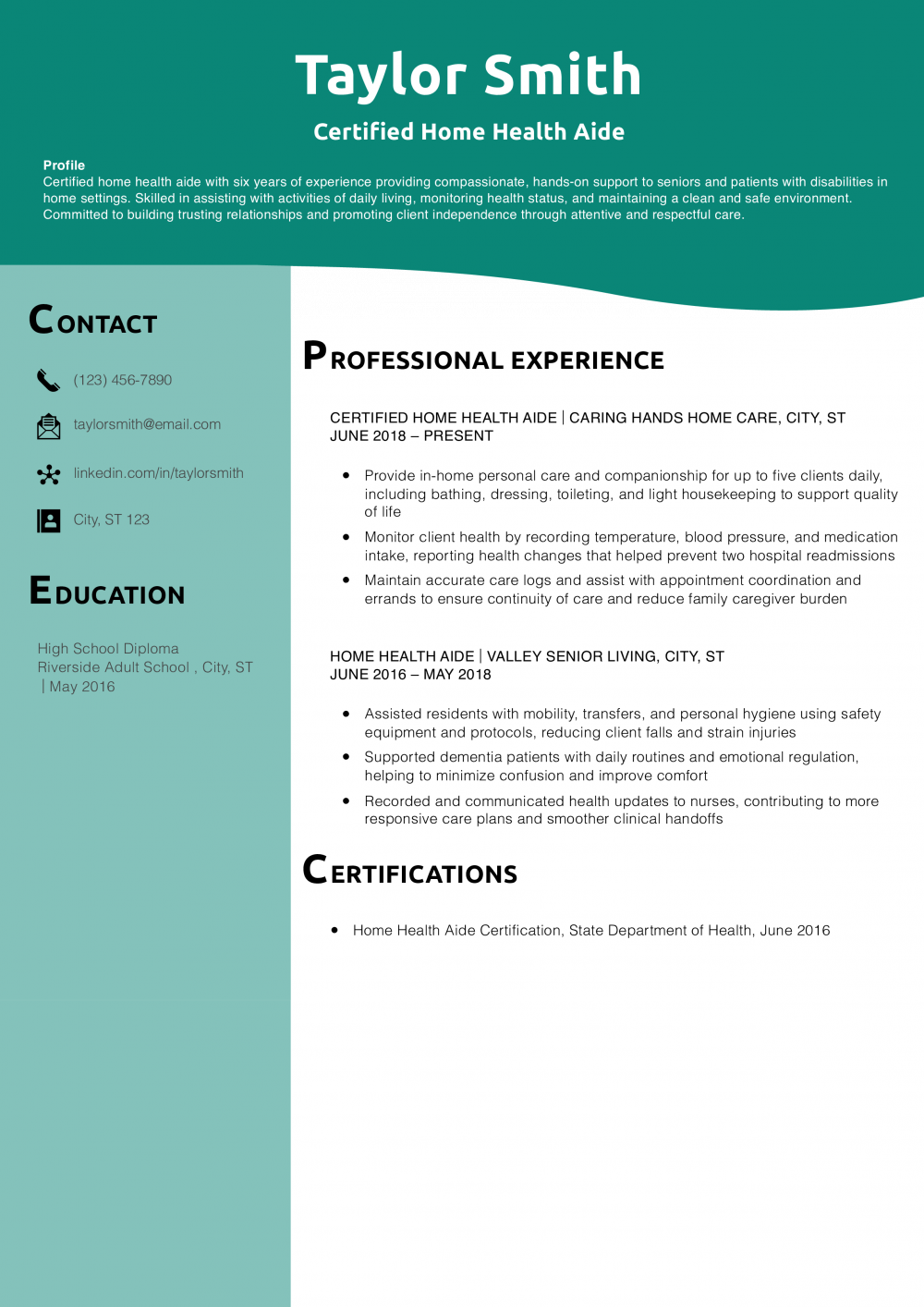
Customize this template in our builder in under 10 minutes.