Android Developer Resume Examples and Templates for 2026



A named framework stack and one live production link are what get front end developer resumes past the ATS and recruiter screen; Core Web Vitals numbers are what make them readable enough to advance to a technical loop.
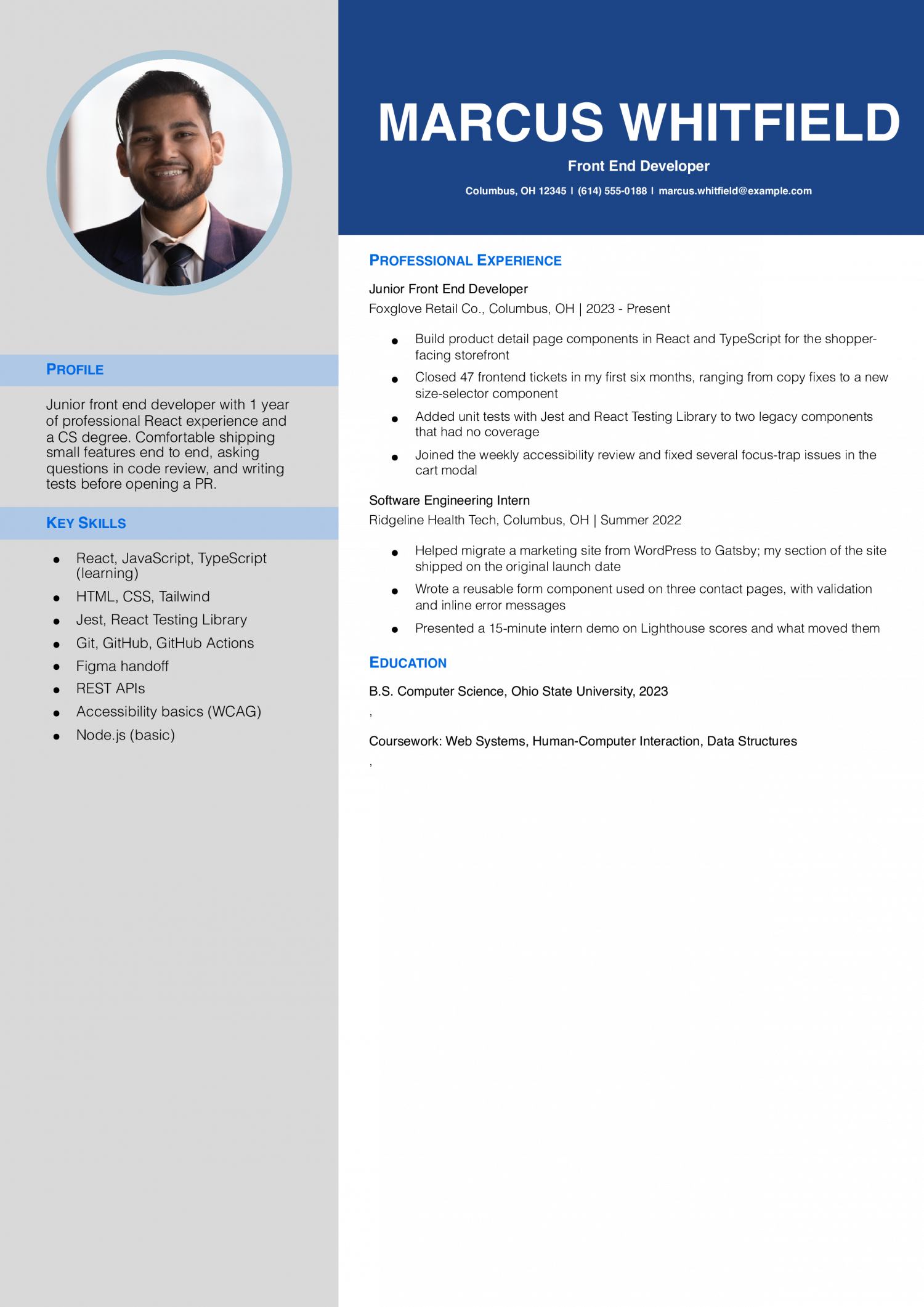
The junior front end developer has one to three years shipping production features, often inside a senior-led team. This resume needs to prove you can take a Figma file to a merged pull request with tests.
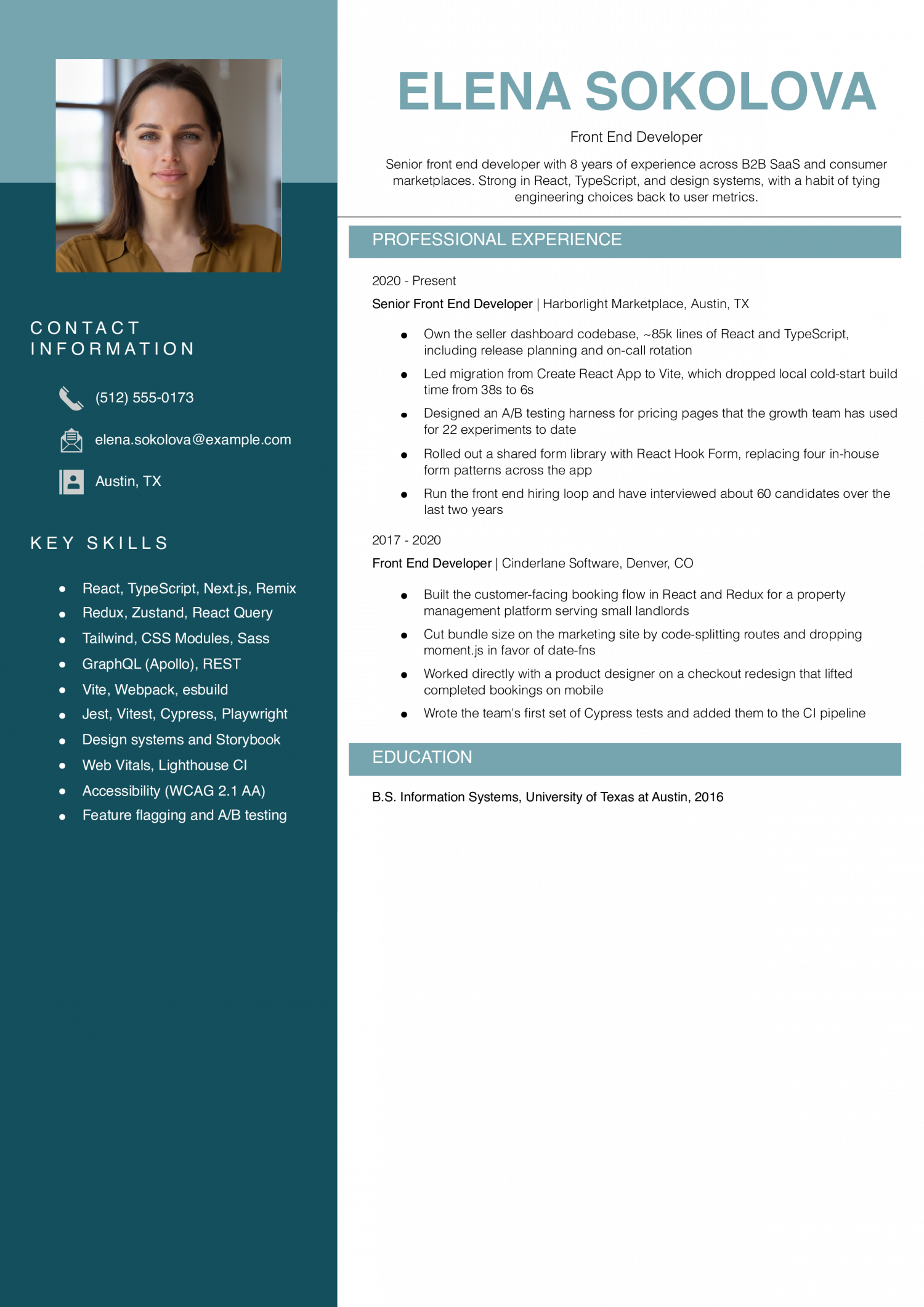
The senior front end developer owns features end-to-end and mentors juniors on review. This resume needs to prove framework depth, component architecture decisions, and measurable Core Web Vitals or accessibility wins.
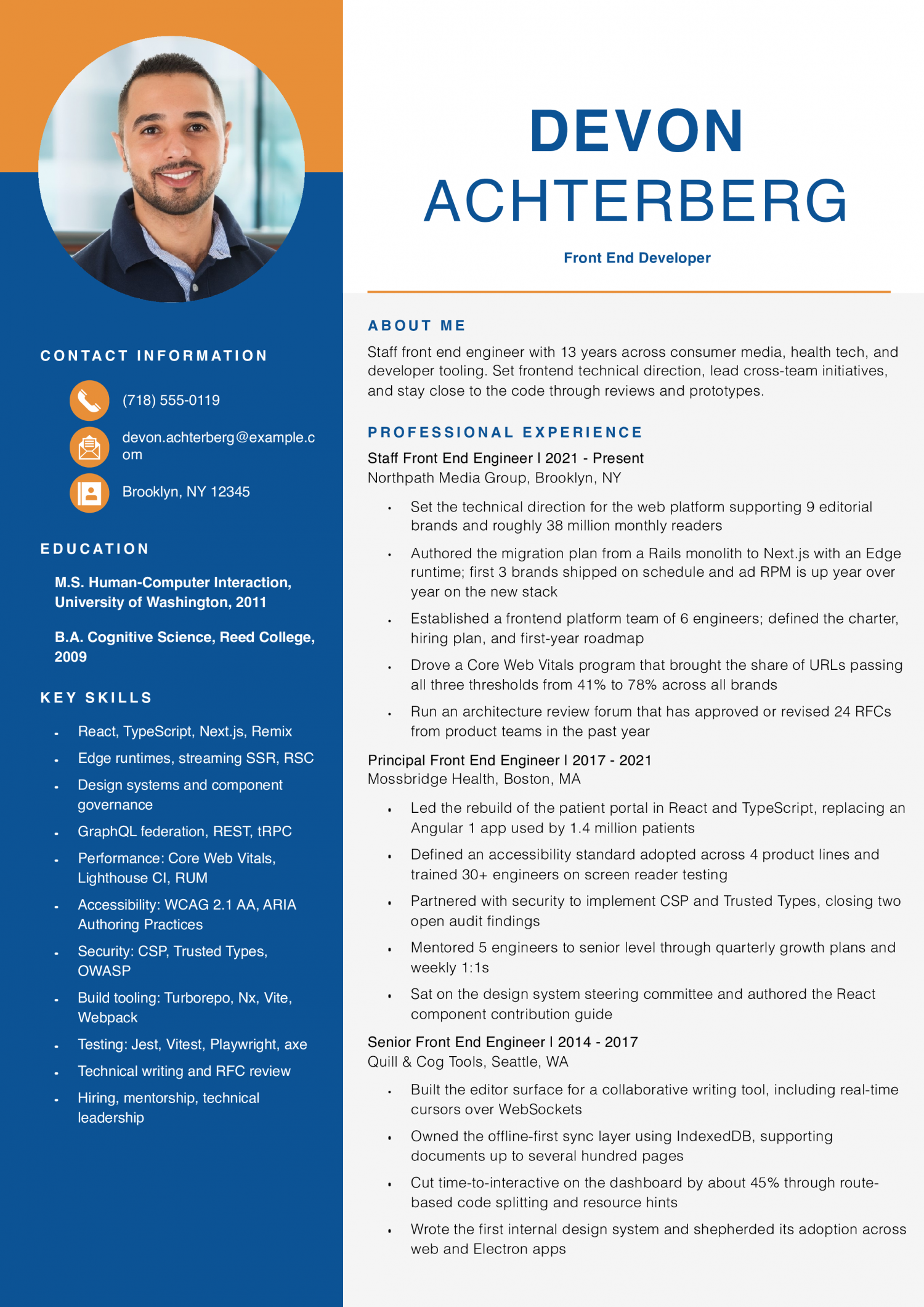
The staff front end developer sets direction for the design system, the build pipeline, or the frontend platform. This resume needs to prove cross-team influence, architecture documents you authored, and the performance budgets your work unlocked.
Hannah Ostlund
Minneapolis, MN | (612) 555-0164 | [email protected] | linkedin.com/in/hannahostlund
Front end developer with 7 years building React and TypeScript applications for logistics, edtech, and nonprofit clients. Comfortable owning a feature from Figma through production, with a strong record on accessibility, performance, and clear documentation for the next engineer who picks up the code.
Senior Front End Developer
Kestrel Freight Systems | Minneapolis, MN | 2022-Present
Front End Developer
Bluebell Learning Platforms | Madison, WI | 2019-2022
Front End Developer
Greycoat Civic Tech | Saint Paul, MN | 2017-2019
Junior Web Developer
Aspen Trail Web Studio | Saint Paul, MN | 2016-2017
Your profile should state your years building production UIs, the primary framework stack you own (React, Vue, Angular, Svelte), and the product surface you ship against (consumer web, B2B SaaS, design system, internal tools).
Name the rendering model too: SPA, server-rendered Next.js, or static site. Engineering managers and frontend tech leads use these three signals to decide in under a minute whether to keep reading. A profile that says “five years on React and TypeScript shipping a B2B SaaS dashboard backed by a shared design system” reads as specific.
A profile that says “passionate front end developer” gets cut.
Bullets without a number tend to read as duties. Strong front end developer bullets name two or three metrics drawn from real product work.
Lead with Core Web Vitals movement (LCP from 4.2s to 1.8s), bundle-size reduction (cut main chunk by 38%), and user-facing scale (served 2.1M monthly active users). Accessibility wins count too: name the WCAG level you reached and the audit tool that confirmed it. Recruiters scan for a number in the first line of each bullet, so put it there.
A bullet that opens “Reduced LCP by 56% across the checkout flow” advances further than “Optimized site performance.”
Cluster your bullets into three or four categories so a tech lead can scan by interest. Component architecture covers design system contributions, reusable component libraries, and state management patterns (Redux Toolkit, Zustand, React Query).
Performance and quality covers Core Web Vitals work, bundle splitting, and test coverage with Jest, Vitest, or Playwright. Product delivery covers features shipped, A/B tests run, and conversion outcomes. Tooling covers build setup (Vite, Webpack, Turbopack), CI pipelines, and deployment targets (Vercel, Cloudflare Pages, AWS Amplify).
Group, do not list.
Put a technical skills block at the top of page one, immediately after the profile. Engineering managers and frontend tech leads want the framework, language, testing, and tooling decision in one glance.
Split the block into Languages (TypeScript, JavaScript, HTML, CSS), Frameworks (React, Next.js, Vue), Styling (Tailwind, CSS Modules, Styled Components), Testing (Jest, Playwright, Cypress), and Tooling (Vite, Storybook, Figma). Add a Links row with your GitHub, portfolio, and one or two live production URLs. Certifications like Meta Front-End Developer or AWS Certified Developer go in a separate four-line block below skills, not buried in education.
Cut tutorial-grade projects (todo apps, weather widgets, clone landing pages) once you have shipped production work. Cut every framework you touched once and cannot defend in an interview.
Cut soft-skill paragraphs that do not back a bullet. Drop pre-2018 jQuery, Backbone, or AngularJS unless the job posting names them. Keep education brief: degree, school, year, and one line on relevant coursework only if you graduated in the last three years.
Trim the resume to one page through senior, two pages at staff and above. Every line on the page should answer “what did you ship and what did it move?”
Frontend hiring is tight in 2026. Engineering teams are running leaner and the bar to clear a recruiter screen is higher. The skills below come from our user-built front end developer resumes.
Engineering managers and frontend tech leads weigh hard skills like React and TypeScript first, then read soft skills as evidence backing your bullets. Match this list against the target job posting and treat any soft skill you claim as something a bullet has to prove.
| Soft Skills | % of resumes with this skill |
|---|---|
| Problem solving | 78% |
| Attention to detail | 65% |
| Communication | 40% |
| Collaboration | 39% |
| Design sense | 34% |
And here are the top hard skills showing up most often.
| Hard Skills | % of resumes with this skill |
|---|---|
| HTML and CSS | 68% |
| JavaScript | 60% |
| Responsive web design | 47% |
| Front-end frameworks | 40% |
| Version control with Git | 25% |
Based on data from thousands of front-end developers’ resumes built on ResumeTemplates.com, May 2026.
The items below are what separate a front end developer resume from one that gets put back in the pile.
Engineering managers and frontend tech leads scan for sub-niche signals that tell them which kind of frontend work you have actually done. Use the cluster that matches the posting, not all five.
| Niche | Keywords ATS scans for |
|---|---|
| React product engineer | react, typescript, next.js, react query |
| Design system builder | design system, storybook, component library, tokens |
| Performance and Core Web Vitals | core web vitals, lcp, bundle size, lighthouse |
| Accessibility specialist | wcag 2.2, aria, axe, screen reader testing |
| Frontend platform and tooling | vite, turbopack, monorepo, ci/cd |
Engineering teams are split between leads who expect Copilot fluency on day one and leads who audit pull requests for over-generated code. Name the tools you use, describe the workflow honestly, and avoid claiming you “build with AI” if your practice is reviewing and refactoring suggestions.
Copilot and Cursor generate first-pass components in seconds, so the review and refactoring skill is what differentiates senior from junior.
AI writes Jest and Playwright tests against your component code, shifting your time from boilerplate to edge-case coverage.
AI linters flag WCAG issues at PR time, so you should own the remediation pattern, not just the detection.
AI reviewers comment first on every PR, raising the bar on what a human reviewer must catch in architecture and product fit.
Your portfolio is the proof your resume points at. A frontend tech lead clicks the live URL before reading bullet three, so the work you link to has to load fast, look intentional, and show source.
Pin four to six repos with real READMEs, screenshots, and a live demo link.
Deploy your portfolio site and side projects with custom domains and instant previews.
Host a public component library so reviewers can interact with your design system work.
Publish two or three engineering posts on a real production trade-off you owned.
Pin shipped work, not tutorials. Four polished repos beat twenty half-finished ones. Each pinned repo should have a one-paragraph README, a screenshot or GIF, the stack list, and a deployed URL.
Make your portfolio site itself the proof. If your site scores 95+ on Lighthouse, passes WCAG AA, and loads in under a second, you have already demonstrated three core skills before a reviewer reads a word.
Engineering managers and frontend tech leads scan the skills block for stack fit in under 20 seconds. Group your tools so they can find the framework, the language, the testing layer, and the build tooling without hunting.
Beyond a CS degree or bootcamp credential, the certifications below tell engineering managers and frontend tech leads which platforms you can ship to and which depth of framework you can defend. List the issuing body and the year earned for each item.
For front end developers, the 10th-percentile floor reflects junior and bootcamp-grad pay at small shops, and the top-decile ceiling reflects staff and principal pay at large product companies. That spread tells you framework depth, design system ownership, and big-tech or high-scale product experience move you from floor to ceiling more than tenure does.
Lead the resume with the production URLs, the frameworks you defend in interviews, and the scale you have shipped against.
| # | State | Avg. Annual |
|---|---|---|
| 1 | District of Columbia | $121,000 |
| 2 | California | $117,380 |
| 3 | Washington | $112,010 |
| 4 | Maryland | $111,750 |
| 5 | Virginia | $110,830 |
| 6 | Massachusetts | $107,570 |
| 7 | Illinois | $103,300 |
| 8 | Alaska | $102,530 |
| 9 | Colorado | $101,760 |
| 10 | Missouri | $100,950 |
| # | State | Workers | Median |
|---|---|---|---|
| 1 | California | 10,820 | $117,380 |
| 2 | New York | 6,340 | $67,400 |
| 3 | Texas | 5,280 | $93,120 |
| 4 | Florida | 4,530 | $81,410 |
| 5 | Virginia | 4,450 | $110,830 |
Resume Templates offers HR approved resume templates to help you create a professional resume in minutes. Choose from several template options and even pre-populate a resume from your profile.
Use a single-column reverse-chronological format. Header on top with name, location, email, GitHub, portfolio, and one live production URL.
Skip two-column templates with sidebars. ATS parsers split them inconsistently and lose your stack keywords. Save the design flex for your portfolio site, not the resume PDF.
Write three or four lines. Name years of experience, your primary framework stack, the product surface you ship to, and one measurable win.
Cut every adjective that is not load-bearing. "Senior React developer with six years on B2B SaaS, led a design system migration that cut bundle size 41%" reads stronger than "passionate developer with a love for clean code."
Include side projects when you have under three years of experience or are pivoting from backend, design, or another stack. Pick one or two with a live URL and a real user count.
Cut todo apps, weather widgets, and landing-page clones once you have shipped production work for an employer. Tutorial projects signal junior even when your job history does not.
Name the tool, the workflow, and the outcome. "Used GitHub Copilot to scaffold Jest tests for the checkout flow, cut PR turnaround by 30%" is honest and verifiable.
Avoid vague claims like "AI-powered development" or "leveraged AI to ship faster." Engineering managers and frontend tech leads read those as filler and may probe in the interview.
For a front-end developer, a tech template is the safest pick, because it keeps your stack, tools, and impact easy to scan. An ATS-friendly template is a solid alternative. Whichever you choose, keep the formatting clean and easy to parse: clear section headings, a standard font, and no graphics a parser can choke on.
Executive Resume Writer and Career Coach
Andrew Stoner is an executive career coach and resume writer with 17 years of experience as a hiring manager and operations leader at two Fortune 500 Financial Services companies, and as the career services director at two major university business schools.
Customize this template in our builder in under 10 minutes.